
“Add Files Is Unavailable” in ChatGPT: What It Means + Fixes (Step-by-Step) and No‑Upload Video→Text Workarounds
 Video To Text AI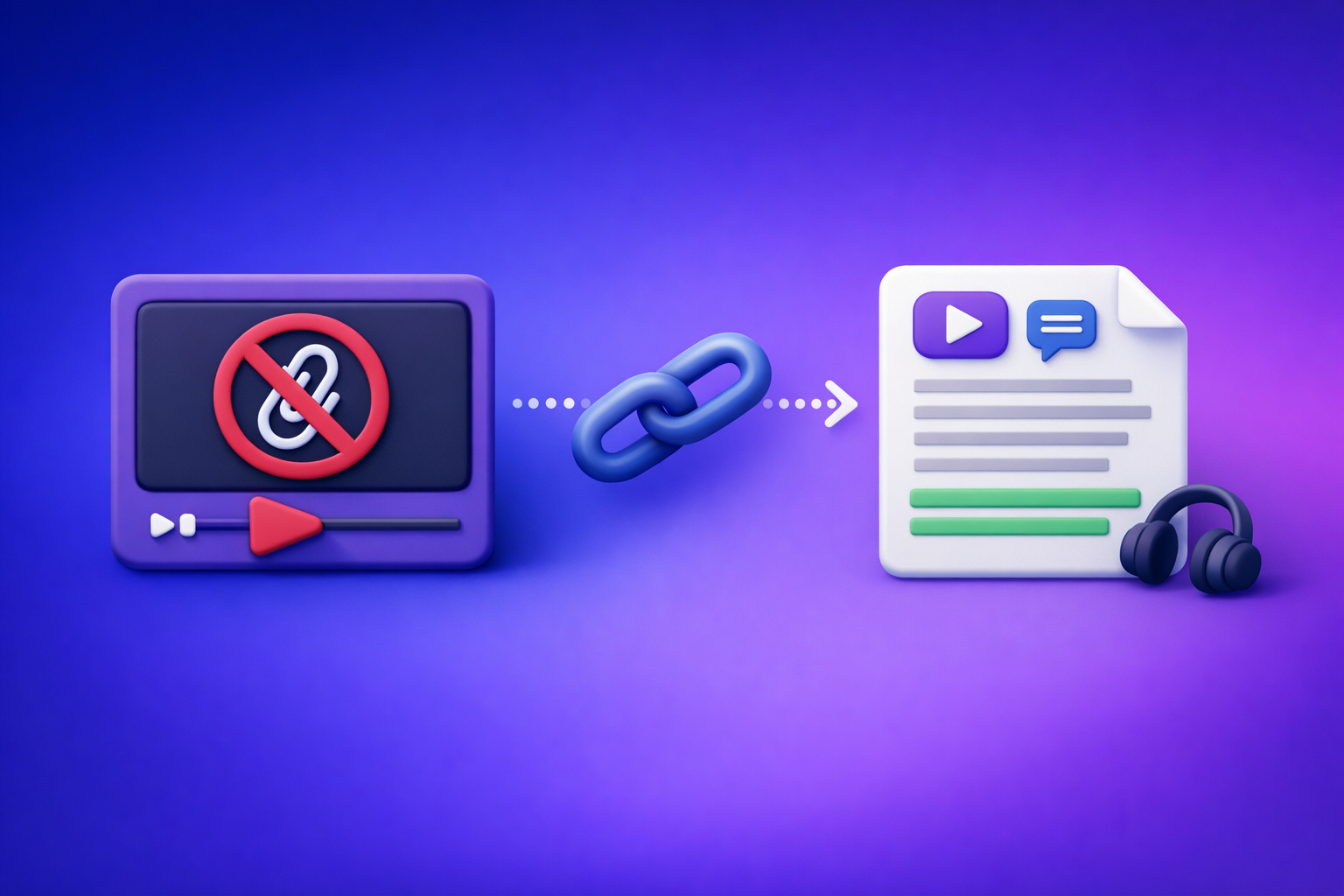
If ChatGPT says “add files is unavailable,” stop trying different file types—start a new chat, switch to an attachment-capable model, and test another surface (web/app) to confirm it’s a context/policy issue. If uploads are blocked by workspace policy or network security, skip uploads entirely and use a link-based video→text workflow (URL → transcript → SRT/VTT → repurposed content).
Why you’re seeing “add files is unavailable” in ChatGPT
What the message actually indicates (feature disabled in the current context)
“Add files is unavailable” typically means the attachment feature is disabled where you are right now, such as:
- The selected model doesn’t support attachments on your plan.
- The current chat thread is in a state where attachments aren’t offered.
- You’re using a surface where attachments aren’t available (or temporarily broken).
- Your workspace admin disabled attachments (Team/Enterprise).
- Your browser/network is blocking upload endpoints.
What it does not mean (your file is “bad”)
This message is not the same as:
- “File type not supported”
- “File too large”
- “Upload failed”
If the UI says unavailable, the feature is off—it’s not rejecting your file.
The fastest way to confirm it’s a context/policy issue (new chat + different surface)
Do this quick confirmation:
- New chat (don’t reuse the thread).
- Switch model (pick one that supports attachments on your plan).
- Switch surface (web ↔ desktop app ↔ iOS/Android).
If the button appears elsewhere, your file is fine—your context is the problem.
60‑second triage (do this before deeper troubleshooting)
Step 1: Start a brand-new chat (don’t reuse the same thread)
Old threads can get “stuck” with missing UI features. A new chat is the fastest reset.
Step 2: Switch model (pick a model that supports attachments on your plan)
Attachments are model- and plan-dependent. If “Add files” disappears when you change models, you’ve found the cause.
Step 3: Check surface (Web vs Desktop vs iOS/Android)
Test the same account on:
- Web app (browser)
- Desktop app
- Mobile app
If it works on mobile but not desktop, it’s usually browser/network.
Step 4: Try an incognito/private window (no extensions, clean cookies)
This isolates:
- Extension interference (ad blockers, script blockers)
- Corrupted cookies/local storage
Step 5: Test a different network (mobile hotspot vs corporate Wi‑Fi)
If hotspot works and corporate Wi‑Fi fails, it’s almost always:
- Proxy/DLP rules
- SSL inspection
- Firewall allowlist gaps
Root causes (mapped to symptoms you can verify)
Chat context / thread state issues
Symptom: Upload worked earlier, now missing in the same thread
You may see the attachment UI vanish mid-thread, especially after switching models or tools.
Fix: New chat + reselect model + refresh session
- Create a new chat
- Re-select an attachment-capable model
- Hard refresh the page (details below)
Model capability mismatch
Symptom: “Add files” missing only on certain models
If the button appears on one model but not another, it’s a capability mismatch.
Fix: Switch to an attachment-capable model; verify plan entitlements
- Switch models and re-check the UI
- If you’re on a managed plan, confirm your plan includes attachments for that model
Workspace/admin policy restrictions (ChatGPT Team/Enterprise)
Symptom: Upload missing for everyone in the workspace
If multiple users report the same issue, it’s likely a workspace policy.
Fix: Admin toggles for attachments/data controls; request policy exception
Ask your admin to verify:
- Attachments are enabled
- Data controls aren’t blocking uploads
- Users have access to models that support attachments
Browser environment problems
Symptom: Button appears but does nothing / spinner / silent failure
This points to:
- Extension interference
- Blocked scripts/cookies
- Outdated browser features
Fixes: disable extensions, clear site data, allow third-party cookies (if required), update browser
Implementation steps are in the decision tree below.
Network/security controls (DLP, proxy, SSL inspection)
Symptom: Works on home network but not at work/school
Classic corporate environment behavior:
- Upload endpoints blocked
- SSL inspection breaks secure uploads
- DLP policies prevent file transfer
Fixes: whitelist domains, bypass SSL inspection for upload endpoints, test DNS and firewall rules
You’ll find an IT-ready checklist later in this post.
Temporary service degradation
Symptom: Intermittent availability across devices
If it fails everywhere and then returns, it may be a transient outage.
Fix: wait + status check + retry with a clean session
- Wait 10–30 minutes
- Retry in a clean session (incognito + new chat)
Step-by-step fix flow (minimal-waste decision tree)
Step 1 — Confirm the feature is unavailable (not a file-specific error)
Do a controlled test:
- Try attaching a tiny file (e.g., 1 KB
.txt). - If it still says unavailable, it’s not your file—continue to Step 2.
Step 2 — Reset chat context
- Open a new chat
- Select an attachment-capable model
- Hard refresh:
- Windows/Linux: Ctrl+Shift+R
- macOS: Cmd+Shift+R
- If the UI still doesn’t update: sign out/in
Why this works: it forces the UI to reload the correct feature flags for your session.
Step 3 — Isolate browser vs account
- Open an incognito/private window
- Test a different browser (Chrome ↔ Firefox ↔ Safari/Edge)
- Disable extensions (common culprits):
- Ad blockers
- Privacy tools
- Script blockers
- Corporate security extensions
- Clear ChatGPT site data and re-login:
- Cookies
- Local storage
- Cached files
Interpretation:
- Works in incognito → extension/cookie issue.
- Works in another browser → browser profile/config issue.
Step 4 — Isolate device/surface
- Test web app vs desktop app
- Test iOS/Android app
- If mobile works but desktop doesn’t → browser/network issue, not your account.
Step 5 — Isolate network/security
- Switch to a mobile hotspot
- If hotspot works → corporate network restriction
- Give IT this short checklist:
- Allow required domains for ChatGPT
- Bypass SSL inspection for upload endpoints (SSL MITM often breaks uploads)
- Review DLP rules blocking file transfer
- Verify firewall/proxy isn’t stripping auth headers
- Confirm DNS isn’t rewriting/blocked
Step 6 — Workspace/admin remediation (if applicable)
Ask your admin to confirm:
- Attachments enabled for the workspace
- Data controls not blocking file uploads
- Model access includes attachment-capable models
If the admin can’t enable uploads (policy), treat uploads as a dead end and move to no-upload workflows below.
No-upload workarounds (keep shipping when attachments are blocked)
Uploading video files is an outdated workflow for creator productivity: it’s slow, fragile (policies, size limits, network blocks), and hard to repeat at scale. Link-based extraction is the future because it’s faster, more operationally reliable, and easier to standardize across teams.
Option A: Use link-based video→text instead of uploading files (fastest for video workflows)
When this is the best option
Use link-based processing when:
- You have a YouTube/Instagram/TikTok link
- You need transcript/subtitles/captions now
- You’re on a restricted network/workspace where uploads are blocked
Workflow: Link → transcript → captions → repurposed content (production-ready)
- Paste the video link into VideoToTextAI
- Export transcript (TXT) for editing
- Export subtitles (SRT/VTT) for publishing
- Generate repurposed assets (blog post, LinkedIn post, hooks)
Recommended VideoToTextAI tools (canonical URLs)
- Video transcript extraction: video transcript generator
- General video→text: video to text converter
- YouTube subtitles: free youtube subtitles
- YouTube→blog repurposing: youtube to blog
- TikTok transcript: tiktok transcript generator
- Instagram transcript from link: instagram transcript from link
Operational note: this workflow avoids the entire “attachments unavailable” failure mode because you’re not uploading files into ChatGPT at all.
Option B: Copy/paste text (when you already have a transcript)
How to chunk long text safely
For long transcripts, paste in chunks:
- 1–2k words per message
- Keep speaker labels intact
- Preserve timestamps in a separate block if needed (so formatting doesn’t break)
Prompt template for structured outputs (captions, chapters, summaries)
Paste this after your transcript chunk:
- Goal: “Turn this transcript into {captions/chapters/summary}”
- Target platform: “YouTube / TikTok / LinkedIn”
- Constraints: “Max length, tone, reading level, include timestamps yes/no”
- Output format: “SRT blocks / bullet chapters / JSON fields”
Example (edit the braces):
- “Create YouTube chapters with timestamps every 2–4 minutes. Output as a bullet list:
timestamp — title.” - “Rewrite into TikTok captions: short lines, max 42 characters per line, keep key terms.”
Option C: Use platform-native transcripts (when available)
YouTube transcript → clean → summarize
If YouTube provides a transcript:
- Copy it
- Clean filler words
- Then summarize/structure in ChatGPT
Podcast RSS/host transcript → refine
Many podcast hosts provide transcripts. Use them as the base, then:
- Create show notes
- Pull quotes
- Generate chapter markers
Implementation checklist (printable)
- New chat created (not same thread)
- Model switched to an attachment-capable option
- Tested incognito/private window
- Extensions disabled (ad blocker/privacy/script)
- Cleared site data + re-authenticated
- Tested another browser
- Tested another device/surface (mobile app)
- Tested another network (hotspot)
- If workspace: admin verified attachment policy + model access
- If still blocked: switched to link-based workflow in VideoToTextAI
VideoToTextAI vs Competitors
Comparison criteria (what you should evaluate)
Evaluate tools based on what actually breaks in real environments:
- No-upload reliability: link-based processing vs attachment dependency
- Output formats: TXT, SRT, VTT and export speed
- Repurposing workflows: blog, social posts, hooks
- Fit for restricted environments: corporate networks, disabled attachments
- Time-to-first-output: from link paste to usable transcript
Comparison table
Competitor research was not provided in the request (competitorProfiles missing), so the table below compares workflow approach without pricing/limits claims.
| Tool | Best for | Input method | Exports (TXT/SRT/VTT) | Repurposing workflow | Fit when ChatGPT uploads are blocked |
|---|---|---|---|---|---|
| VideoToTextAI | Link-based transcript/subtitles + repurposing | Video link (URL-first) | Yes (transcript + subtitles formats) | Yes (e.g., YouTube→blog) | Strong (no file upload dependency) |
| ChatGPT | Editing/rewriting/summarizing once text exists | Attachments (when available) + copy/paste | Not a dedicated export tool | Strong for rewriting/formatting | Mixed (attachments can be unavailable; copy/paste still works) |
| YouTube built-in transcript | Quick access for YouTube-only videos | YouTube UI | Transcript text (limited) | No | Medium (works if you can access transcript; not universal) |
Where VideoToTextAI wins for “uploads blocked” scenarios
VideoToTextAI wins when your goal is repeatable production output:
- Link-first workflow avoids ChatGPT attachment availability entirely.
- Dedicated tools for transcript + subtitles (SRT/VTT) and repurposing from the same source link.
- More operationally repeatable than “download a file → upload a file → hope the button exists.”
If you want to standardize creator workflows, downloading video files is the old path; link-based extraction is the scalable path. Use VideoToTextAI for the extraction/exports, then use ChatGPT for polishing.
Where ChatGPT still fits
ChatGPT is still excellent for:
- Cleaning transcripts (remove filler, fix grammar)
- Summaries, outlines, and chapter titles
- Turning transcripts into posts, scripts, and FAQs
Once you have text (via link-based extraction), ChatGPT becomes the editor—not the ingestion bottleneck.
Competitor Gap
What most “add files unavailable” articles miss (and this post will cover)
Most posts say “try another browser” and stop. The missing pieces are:
- A strict 60-second triage that isolates context vs browser vs network vs policy
- A decision-tree fix flow that prevents random “try everything” troubleshooting
- A production-safe no-upload alternative specifically for video→text deliverables (transcripts + SRT/VTT + repurposing)
- An IT-ready network/security checklist for corporate environments
- A ship-now workflow: link → transcript → subtitles → repurposed content
FAQ (People Also Ask-aligned)
Why does ChatGPT say “add files is unavailable”?
Because attachments are disabled in your current context—most commonly due to model capability, chat thread state, workspace policy, browser/session issues, or network security controls.
How do I enable file upload in ChatGPT?
Try, in order:
- New chat → select an attachment-capable model
- Hard refresh → sign out/in
- Incognito window → different browser
- Different surface (mobile app)
- If Team/Enterprise: ask admin to enable attachments and confirm model access
Why is the “Add files” button missing on one device but not another?
That usually indicates a surface/browser/network difference:
- Desktop browser blocked by extensions or cookies
- Corporate network blocking upload endpoints
- Mobile app on cellular bypasses corporate proxy/DLP
Can I still generate a transcript or subtitles if ChatGPT uploads are blocked?
Yes. Use a link-based tool to generate transcript + SRT/VTT, then paste the text into ChatGPT for editing and repurposing. For a ship-now workflow, use VideoToTextAI’s link tools, then do final formatting in ChatGPT.
Is “add files is unavailable” caused by my file type or size?
Usually no. “Unavailable” indicates the feature is not enabled. File type/size issues typically show as upload errors, not a disabled button.
Internal Link Plan
- “Add File Is Unavailable” in ChatGPT: What It Means, Fixes That Work (2026), and a No‑Upload Video→Text Workflow
- “Add Files Unavailable” in ChatGPT: Meaning, Root Causes, Fixes (Step-by-Step) + a No‑Upload Video→Text Workflow
- “Add Files” Button Unavailable in ChatGPT: Causes, Fixes (Step-by-Step) + No‑Upload Workarounds
- “Add Files Is Unavailable” in ChatGPT: What It Means, Fixes That Work (2026), and a No‑Upload Video→Text Workflow
- Attachments Disabled for ChatGPT Image Upload: Fixes That Work (2026) + No‑Upload Video→Text
- ChatGPT “Upload Video” Feature (2026): How to Use It, What It Can Do, Limits, Fixes, and a No‑Upload Video→Text Workflow
If you’re repeatedly blocked by “add files is unavailable” in ChatGPT, treat uploads as non-deterministic and move to a link-first workflow: extract from the URL, export TXT/SRT/VTT, then edit in ChatGPT. Use VideoToTextAI to standardize that process across YouTube/TikTok/Instagram and keep production moving: VideoToTextAI
Related posts
Reel Analyser (Instagram Reels): Transcript‑First Competitor Research, Hook/CTA Extraction, and Repurposing Workflow (VideoToTextAI)
Video To Text AI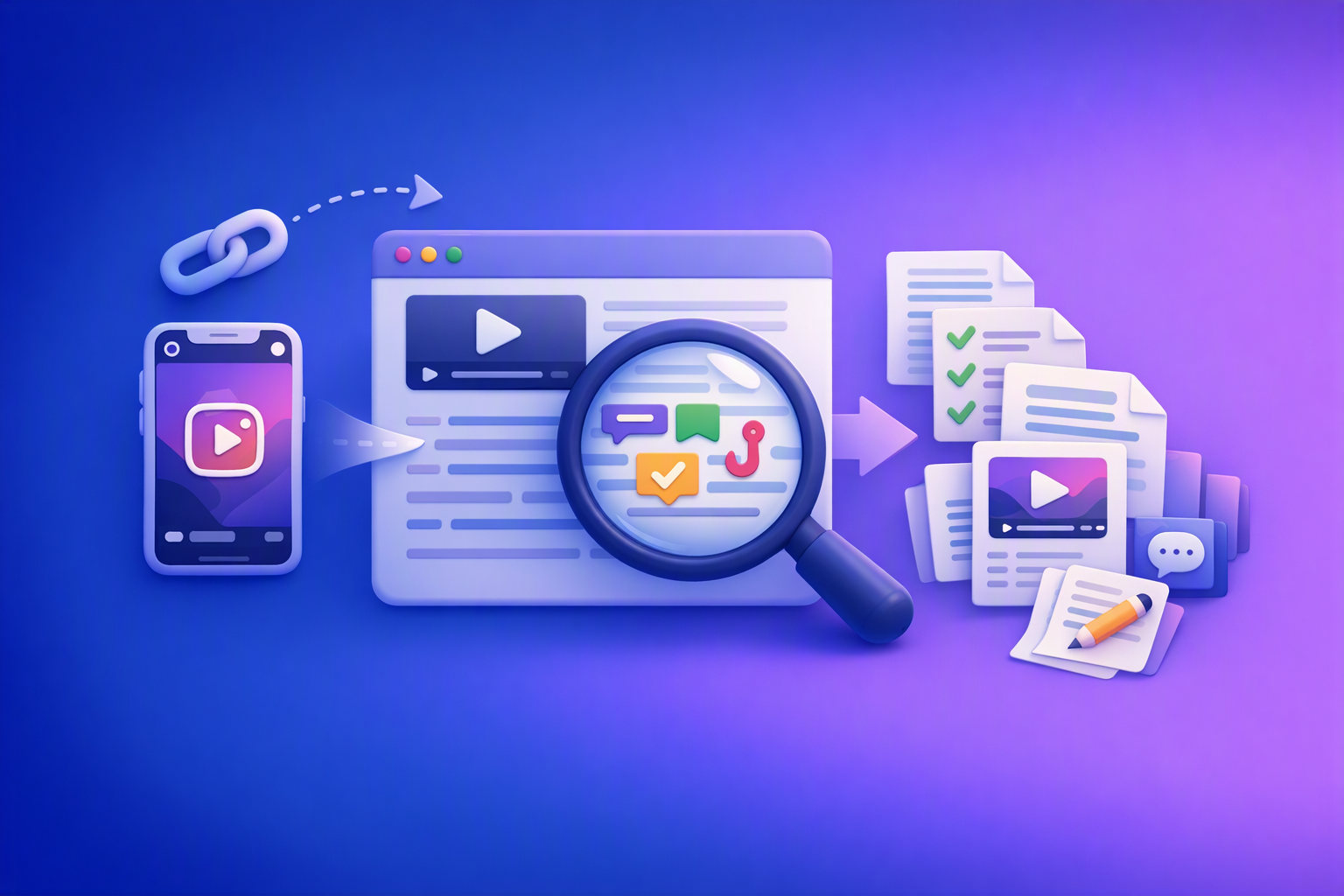
A 2026 reel analyser should turn Instagram Reel links into a searchable transcript library you can tag for hooks, CTAs, objections, and topic clusters—then export into repurposing-ready drafts without a download/upload loop.
Traducir video de Instagram (Reels) en 2026: workflow transcript-first para traducir, sacar hooks/CTAs y repurpose (con VideoToTextAI)
Video To Text AI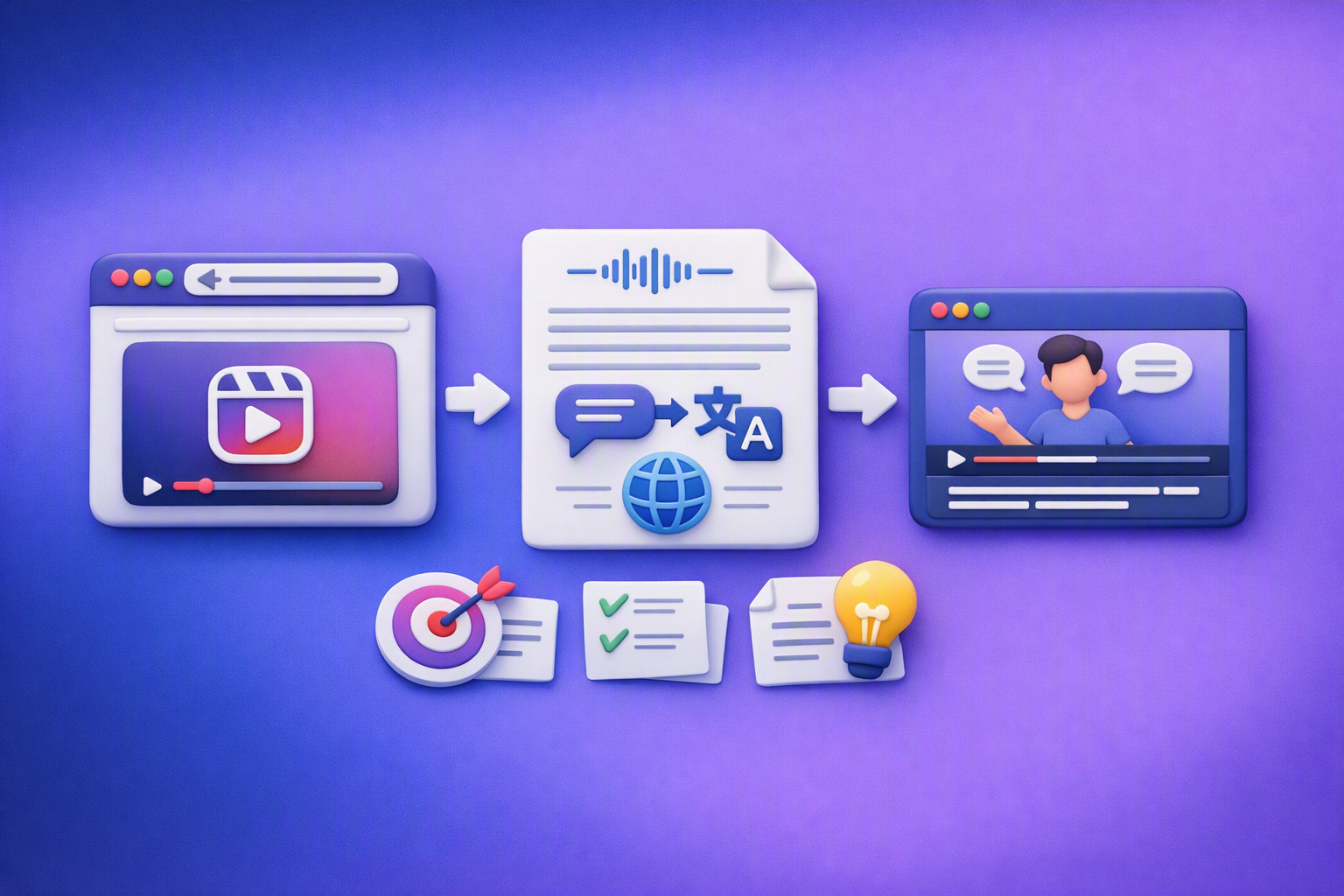
Aprende a traducir un Reel de Instagram con un flujo URL→transcripción→traducción→subtítulos, y a convertir esa traducción en un activo de investigación para hooks, CTAs, objeciones y clusters de contenido.
Reel Analyzer: Transcript‑First Instagram Reels Research (Hooks, CTAs, Objections) + Workflow Guide (VideoToTextAI)
Video To Text AI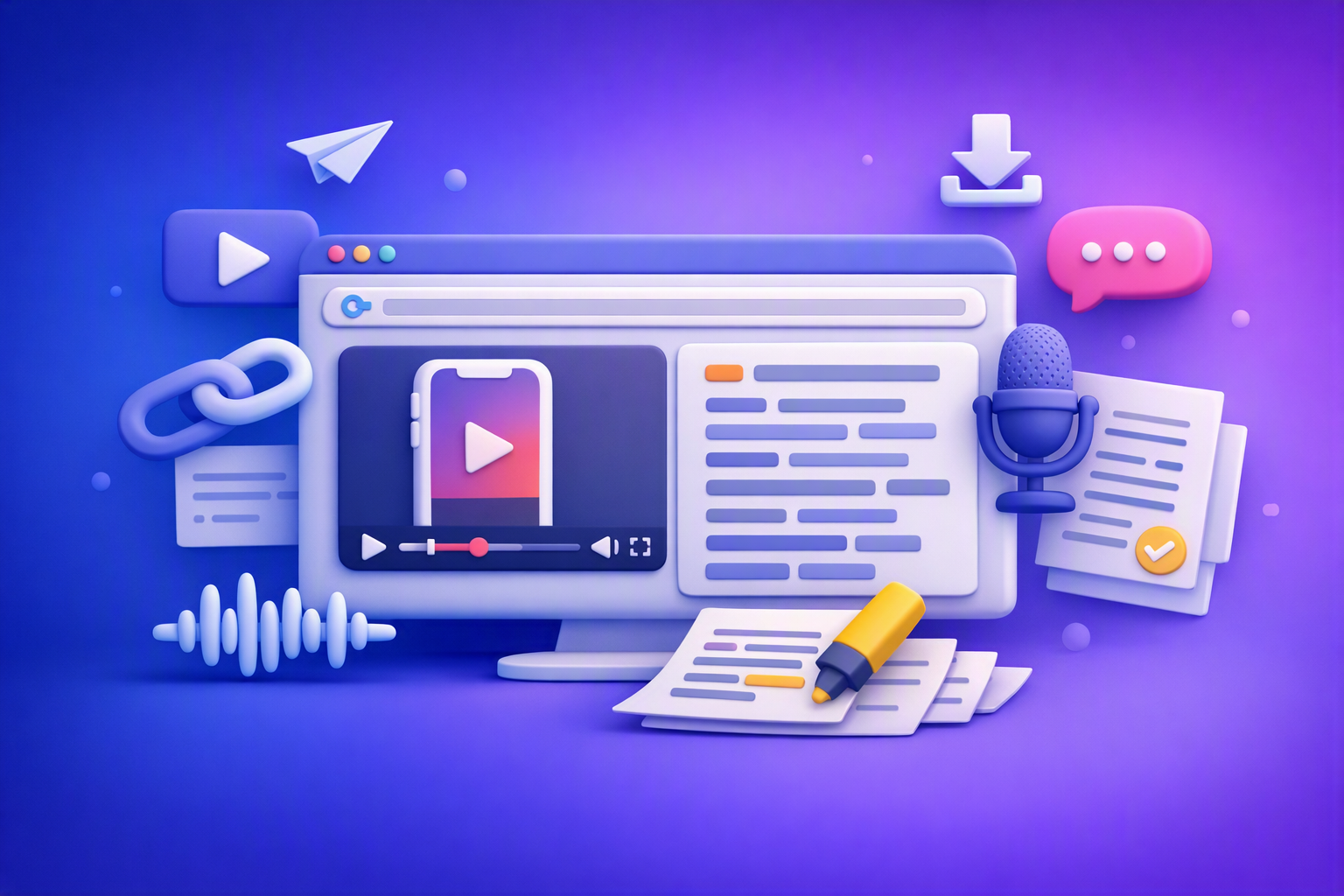
A reel analyzer should turn any public Instagram Reel link into a searchable transcript library you can mine for hooks, CTAs, objections, and topic clusters—then repurpose into original drafts with a repeatable SOP.