
“Attachments Disabled for” ChatGPT: What It Means, Why It Happens, and the Fastest Fix (Plus a No-Upload Video→Text Workflow)
 Video To Text AI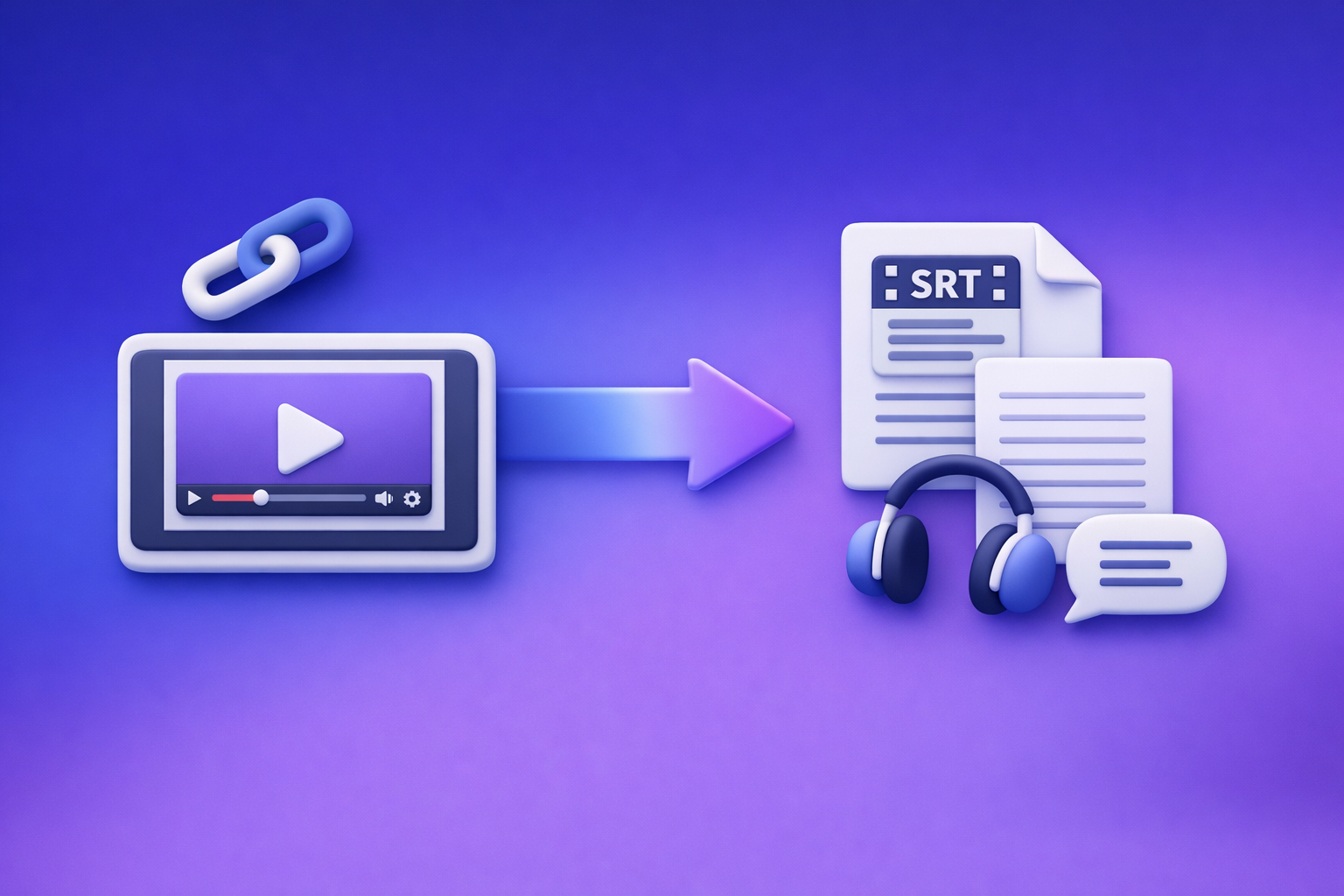
“Attachments Disabled for” ChatGPT: What It Means, Why It Happens, and the Fastest Fix (Plus a No-Upload Video→Text Workflow)
Fix “attachments disabled for” by starting a brand-new chat and switching to an upload-capable model/surface (then re-check the paperclip/Add files control). If you still can’t upload, isolate policy vs browser vs network in 2 minutes—or skip uploads entirely with a link/MP4 → TXT + SRT/VTT → ChatGPT-on-text workflow.
Quick answer: what the message actually means
What “attachments disabled for …” is telling you (and what it isn’t)
That tooltip is usually saying: this current chat context cannot accept file uploads right now.
It is not a reliable signal that:
- Your account is permanently blocked
- Your file type is “bad”
- You did something wrong in the conversation
The 3 most common root causes (surface/model, policy, local environment)
In practice, this error clusters into three buckets:
- Surface/model mismatch
- The specific chat type, model, or context you’re in doesn’t support attachments at the moment.
- Policy restriction (Workspace)
- Team/Enterprise/Edu admins can disable uploads or restrict data controls.
- Local environment interference
- Browser extensions, privacy settings, content blockers, VPN/proxy/DNS filtering, or corporate security tooling breaks upload controls.
When to stop troubleshooting and switch workflows (time-box rule)
Use a strict time box:
- 2 minutes to isolate the category (new chat + incognito + hotspot).
- 10 minutes max to attempt fixes.
- If you still can’t upload, switch workflows and keep shipping (see “Ship-now workaround” below).
Where you’ll see it (and what it looks like)
ChatGPT web app: paperclip / “Add files” greyed out + tooltip
Common symptoms:
- Paperclip icon is disabled
- “Add files” is greyed out
- Hover tooltip shows “attachments disabled for …”
Mobile apps: upload icon missing/disabled
On iOS/Android you may see:
- Upload icon missing entirely
- Upload icon present but unresponsive
- Different behavior across accounts/models
Workspace accounts (Team/Enterprise/Edu): admin-controlled uploads
If you’re on a managed workspace, uploads can be disabled by policy. A key tell: the issue persists across devices and networks.
Safari-specific symptoms vs Chrome/Edge symptoms
Safari tends to show upload issues when:
- Cross-site tracking prevention is strict
- Content blockers are enabled
- Private Relay/VPN-like routing interferes
Chrome/Edge issues more often involve:
- Extension interference
- Corrupted profile/site data
- Strict privacy settings in a specific profile
2-minute diagnosis (do this before any fixes)
Step 1 — Confirm it’s thread-specific vs account-wide
Test in a brand-new chat (don’t debug inside a “broken” thread)
Do this first:
- Open ChatGPT
- Start a new chat
- Look for the paperclip / Add files control again
If uploads work in a new chat, your “broken” thread is the problem—stop debugging inside it.
Test a different model (if model picker is available)
If you can switch models:
- Pick another model
- Start a new chat with that model
- Re-check attachments
This quickly confirms a surface/model capability issue.
Step 2 — Confirm it’s device/app-specific
Web vs mobile app cross-check
- If web is broken, test mobile
- If mobile is broken, test web
If only one surface fails, you’re likely dealing with local environment (browser/app) rather than account policy.
Another browser profile (Guest/Incognito) test
On desktop:
- Open Incognito/Private or Guest profile
- Log in
- Start a new chat and check attachments
If it works in incognito, your main profile has a blocker (extensions/site data/settings).
Step 3 — Confirm it’s network/security-tooling related
Hotspot test (cellular) vs corporate Wi‑Fi
- Switch to a phone hotspot (or cellular)
- Reload ChatGPT and test attachments
If hotspot works but corporate Wi‑Fi fails, it’s likely network security filtering.
VPN/proxy/DNS filtering quick isolation
Temporarily disable:
- VPN
- Proxy
- “Secure DNS” / filtered DNS profiles
- Corporate security browser agents (if you control them)
Then retest in a new chat.
Fixes by root cause (ordered: lowest effort → highest certainty)
Fix 1 — Switch to an upload-capable surface/model
Start a new chat and re-check the attachment control
This is the highest-leverage fix:
- New chat
- Different model (if available)
- Confirm the paperclip is active
If you’re in a restricted mode/context, move to a standard chat
If you’re in a special context (restricted workspace mode, or a chat type that doesn’t support uploads), move to a standard chat surface and re-test.
Related reading (internal):
- “Add Files Is Unavailable” in ChatGPT: Fix It Fast (and Use a No-Upload Video→Text Workflow)
- “Add Files” Button Unavailable in ChatGPT (2026): Root Causes, Exact Fixes, and a No-Upload Transcript Workflow
Fix 2 — Remove browser-level blockers
Disable extensions that commonly break uploads (ad blockers, privacy, script blockers)
Temporarily disable:
- Ad blockers
- Privacy/script blockers
- “Anti-tracking” extensions
- Download/upload managers
Then hard refresh and retest.
Clear site data for ChatGPT + hard refresh
In your browser settings:
- Clear site data for ChatGPT (cookies + cache)
- Hard refresh
- Log in again
- Test in a new chat
Verify browser permissions (files, pop-ups, cross-site tracking)
Check:
- File access prompts
- Pop-up blocking
- Cross-site tracking settings (especially Safari)
Fix 3 — Browser-specific fixes (including Safari)
Safari: cross-site tracking, content blockers, private relay considerations
On Safari, try:
- Disable Prevent cross-site tracking (temporarily)
- Disable Content Blockers for the site
- Turn off Private Relay (temporarily) if enabled
- Retest in a new chat
Chrome/Edge: profile corruption signals and clean-profile test
If incognito works but normal doesn’t:
- Create a fresh browser profile
- Install no extensions
- Log in and retest
This is the fastest way to bypass profile corruption.
Fix 4 — Workspace policy path (Team/Enterprise/Edu)
What to ask your admin to check (uploads/attachments policy, data controls)
Ask your admin to verify:
- Whether file uploads/attachments are disabled
- Whether data controls restrict uploads for certain models/surfaces
- Whether security tooling is blocking upload endpoints
How to confirm it’s policy (symptoms that persist across devices/networks)
Strong policy signal:
- Attachments disabled on multiple devices
- Attachments disabled on multiple networks (home + hotspot)
- Attachments disabled for multiple users in the same workspace
Fix 5 — If it’s intermittent: stabilize your workflow
Why upload-dependent workflows fail in production
Uploads are a fragile dependency:
- UI changes
- Model/surface capability shifts
- Workspace policy toggles
- Browser/network interference
If your deliverable is a transcript/captions, relying on “paperclip works today” is not operationally safe.
Standardize on “text-first” handoff assets (TXT + SRT/VTT)
A production-safe standard is:
- TXT = editable source of truth
- SRT/VTT = publishable captions assets
- ChatGPT = transformation on text (summaries, chapters, repurposing)
For more context (internal):
- ChatGPT “Upload Video” Feature (2026): What Works, What Breaks, and the Reliable Link → Transcript Workflow
- ChatGPT “Upload Video” Feature (2026): What Works, What Breaks, and the Production-Safe Link → Transcript Workflow
Ship-now workaround: stop depending on ChatGPT uploads
Why “paste verified text” beats uploading for transcripts/captions
If your goal is transcripts, subtitles, captions, or repurposed content, uploads are the wrong dependency.
A better pattern:
- Generate verified text outputs (TXT + SRT/VTT)
- Paste text into ChatGPT for editing/repurposing
- Publish captions from SRT/VTT directly
This is also why downloading video files and re-uploading them is an outdated workflow. Link-based extraction is the future of creator productivity: fewer moving parts, fewer UI failures, faster time-to-asset.
Production-safe workflow: Link/MP4 → TXT + SRT/VTT → ChatGPT-on-text
Step 1 — Generate transcript + captions from a link (or MP4)
Use a link-first workflow whenever possible (YouTube, Loom, Drive-hosted video, etc.). If you only have a file, use MP4 input.
One place to run the workflow end-to-end is VideoToTextAI: VideoToTextAI
Step 2 — Export deliverables (TXT + SRT + VTT) for downstream tools
Export:
- TXT for editing, QA, and archiving
- SRT for YouTube and many editors
- VTT for web players and LMS platforms
Recommended tools (internal):
Step 3 — Paste transcript into ChatGPT for summarization/repurposing
Now ChatGPT is operating on stable inputs:
- No upload UI dependency
- Easy to version and review
- Repeatable across team members
Step 4 — Use SRT/VTT for publishing (YouTube, LMS, editors) without rework
Publish captions directly from SRT/VTT:
- YouTube caption upload
- LMS caption tracks
- Video editors that accept SRT/VTT
Implementation: copy/paste prompts for ChatGPT-on-text
Prompt: clean transcript (remove filler, keep meaning, preserve timestamps if provided)
You are editing a transcript for publication.
Rules:
- Remove filler words (um, uh, like) and false starts.
- Keep meaning and technical terms intact.
- Preserve speaker labels if present.
- If timestamps exist, keep them and do not invent new ones.
Output: cleaned transcript only.
Here is the transcript:
[PASTE TXT]
Prompt: create chapter markers + titles
Create chapter markers for this transcript.
Rules:
- 6–12 chapters depending on length.
- Each chapter: timestamp (use existing timestamps if present) + short title (max 8 words) + 1-sentence summary.
Output as a markdown list.
Transcript:
[PASTE TXT]
Prompt: generate captions-safe line breaks (short lines, readable pacing)
Format this transcript into caption-friendly lines.
Rules:
- Keep lines short (aim ~32–42 characters per line).
- Prefer 1–2 lines per caption block.
- Do not change meaning; lightly edit for readability.
- If timestamps are present, keep them; otherwise output text with line breaks only.
Transcript:
[PASTE TXT]
Prompt: repurpose into blog + social variants from the transcript
Repurpose this transcript into:
1) A blog post outline with H2/H3s and key takeaways
2) A 200-word summary
3) 5 LinkedIn post drafts (each 600–900 characters)
4) 10 tweet-length hooks (max 240 characters)
Keep claims grounded in the transcript; do not add new facts.
Transcript:
[PASTE TXT]
Repurposing tools (internal):
Step-by-step checklist (restore uploads OR ship without them)
A) Restore attachments checklist (2–10 minutes)
- New chat + different model test
- Incognito/Guest profile test
- Disable extensions + clear site data
- Switch network (hotspot)
- Try alternate browser/device
- Confirm workspace policy with admin (if applicable)
B) Ship-now transcript-first checklist (10–20 minutes)
- Paste video link (or use MP4 in a transcript tool)
- Export TXT (editing), SRT (captions), VTT (web captions)
- Paste transcript into ChatGPT for summaries/repurposing
- Publish captions from SRT/VTT; archive TXT as source of truth
VideoToTextAI vs Competitors
Comparison criteria (what we will evaluate)
We’ll compare based on signals from the research block:
- URL-first speed (link → transcript) vs upload-heavy loops
- Export readiness: clean TXT, SRT, VTT (publishable formats)
- Repeatability for teams: deterministic steps, fewer UI dependencies
- Repurposing support: transcript → blog/social workflows without re-uploading
Competitors explicitly compared (researched)
- Reduct Video
- Videotranscriber AI
- Zapier’s recommended transcription stack (tool-roundups)
Comparison table (capability signals from research)
| Tool | URL-first (paste link) | Upload-heavy loop | Transcript export | Subtitles/captions outputs | Team/collab signals | Repurposing signals | Best fit |
|---|---|---|---|---|---|---|---|
| VideoToTextAI | Yes (brand positioning: link-based workflows) | No (designed to avoid download/re-upload) | Yes (TXT) | Yes (SRT/VTT via tools) | Yes (repeatable workflow) | Yes (YouTube→blog, MP4→blog) | Fast link→assets→publish pipeline |
| Reduct Video | No strong public signal | Not clearly positioned as link-first | Yes | Weak evidence in research | Yes | Limited | Collaborative transcript/video review |
| Videotranscriber AI | Yes | Not emphasized | Yes | Yes | Limited | Limited | Quick link-based transcription + subtitles |
| Zapier roundups/stack | No strong public signal | Not clearly positioned | Yes | Weak evidence in research | Yes | Not clear | Teams assembling multi-tool workflows |
Why VideoToTextAI wins for this specific problem (attachments disabled)
When ChatGPT attachments are disabled, the winning workflow is the one that doesn’t depend on uploads:
- Workflow speed: link/MP4 → transcript/captions assets → paste text into ChatGPT (no UI roulette).
- Link-based input: avoids the outdated “download video → upload video” loop.
- Export readiness: TXT + SRT + VTT are portable deliverables you can publish anywhere.
- Operational repeatability: deterministic steps your team can follow even when ChatGPT surfaces/models change.
- Repurposing: transcript-first makes blog/social generation a text operation, not a file-transfer operation.
Fair note:
- If you need collaborative review inside a transcript/video platform, Reduct Video may be better suited for that narrower job.
- If you want a simple link-based transcription tool with subtitles, Videotranscriber AI is a reasonable option—especially for quick, lightweight use.
Competitor Gap
What top-ranking results miss about “attachments disabled for”
Most posts treat “attachments disabled for” as a single bug. In reality, it’s usually one of:
- Surface/model mismatch
- Workspace policy restriction
- Local environment interference
They also tend to:
- Skip a time-boxed diagnosis (new chat, incognito, hotspot) and jump into random fixes
- Ignore the production fallback that avoids uploads entirely
What this post adds (differentiators)
- An ordered decision tree with isolation tests: new chat → incognito → hotspot
- A deterministic ship-now workflow: link/MP4 → TXT + SRT/VTT → ChatGPT-on-text
- Copy/paste prompts plus two checklists (restore vs ship)
Related internal reading:
- Attachments Disabled in ChatGPT Image Upload: Causes, Fixes, and a No-Upload Video-to-Text Workflow (2026)
- “Attachments Disabled for” ChatGPT: What It Means, Why It Happens, and the Fastest Fix (Plus a No-Upload Video-to-Text Workflow)
FAQ
Why are my ChatGPT uploads disabled?
Because the current chat surface/model may not support attachments, your workspace admin may have disabled uploads, or your browser/network is blocking the upload control.
Why are my ChatGPT attachments greyed out?
Most commonly: you’re in a thread/context that doesn’t allow uploads right now, or a local blocker (extension/privacy setting) is interfering. Confirm in a new chat and incognito.
Why am I unable to upload images to ChatGPT?
Image uploads can be disabled by the same three categories: surface/model, workspace policy, or local environment. Safari content blockers and cross-site tracking settings are frequent culprits.
Why are “Add files” unavailable in ChatGPT Plus?
Plus doesn’t guarantee attachments in every surface/model/context. If “Add files” is unavailable, treat it as a capability/policy/environment issue and run the isolation tests.
Can ChatGPT do video transcription (reliably) in 2026?
For production deliverables (publishable captions, reusable transcripts), a transcript-first workflow is more reliable: generate TXT + SRT/VTT externally, then use ChatGPT on the text. Upload-dependent transcription is too fragile for repeatable operations.
Internal Link Plan
- “Attachments Disabled for” ChatGPT: What It Means, Why It Happens, and the Fastest Fix (Plus a No-Upload Video-to-Text Workflow)
- “Add Files Is Unavailable” in ChatGPT: Fix It Fast (and Use a No-Upload Video→Text Workflow)
- “Add Files” Button Unavailable in ChatGPT (2026): Root Causes, Exact Fixes, and a No-Upload Transcript Workflow
- ChatGPT “Upload Video” Feature (2026): What Works, What Breaks, and the Reliable Link → Transcript Workflow
- Attachments Disabled in ChatGPT Image Upload: Causes, Fixes, and a No-Upload Video-to-Text Workflow (2026)
- ChatGPT “Upload Video” Feature (2026): What Works, What Breaks, and the Production-Safe Link → Transcript Workflow
Related posts
Reel Analyser (Instagram Reels): Transcript‑First Competitor Research, Hook/CTA Extraction, and Repurposing Workflow (VideoToTextAI)
Video To Text AI
A 2026 reel analyser should turn Instagram Reel links into a searchable transcript library you can tag for hooks, CTAs, objections, and topic clusters—then export into repurposing-ready drafts without a download/upload loop.
Traducir video de Instagram (Reels) en 2026: workflow transcript-first para traducir, sacar hooks/CTAs y repurpose (con VideoToTextAI)
Video To Text AI
Aprende a traducir un Reel de Instagram con un flujo URL→transcripción→traducción→subtítulos, y a convertir esa traducción en un activo de investigación para hooks, CTAs, objeciones y clusters de contenido.
Reel Analyzer: Transcript‑First Instagram Reels Research (Hooks, CTAs, Objections) + Workflow Guide (VideoToTextAI)
Video To Text AI
A reel analyzer should turn any public Instagram Reel link into a searchable transcript library you can mine for hooks, CTAs, objections, and topic clusters—then repurpose into original drafts with a repeatable SOP.