
Attachments Disabled in ChatGPT Image Upload: Causes, Fixes, and a No-Upload Video-to-Text Workflow (2026)
 Video To Text AI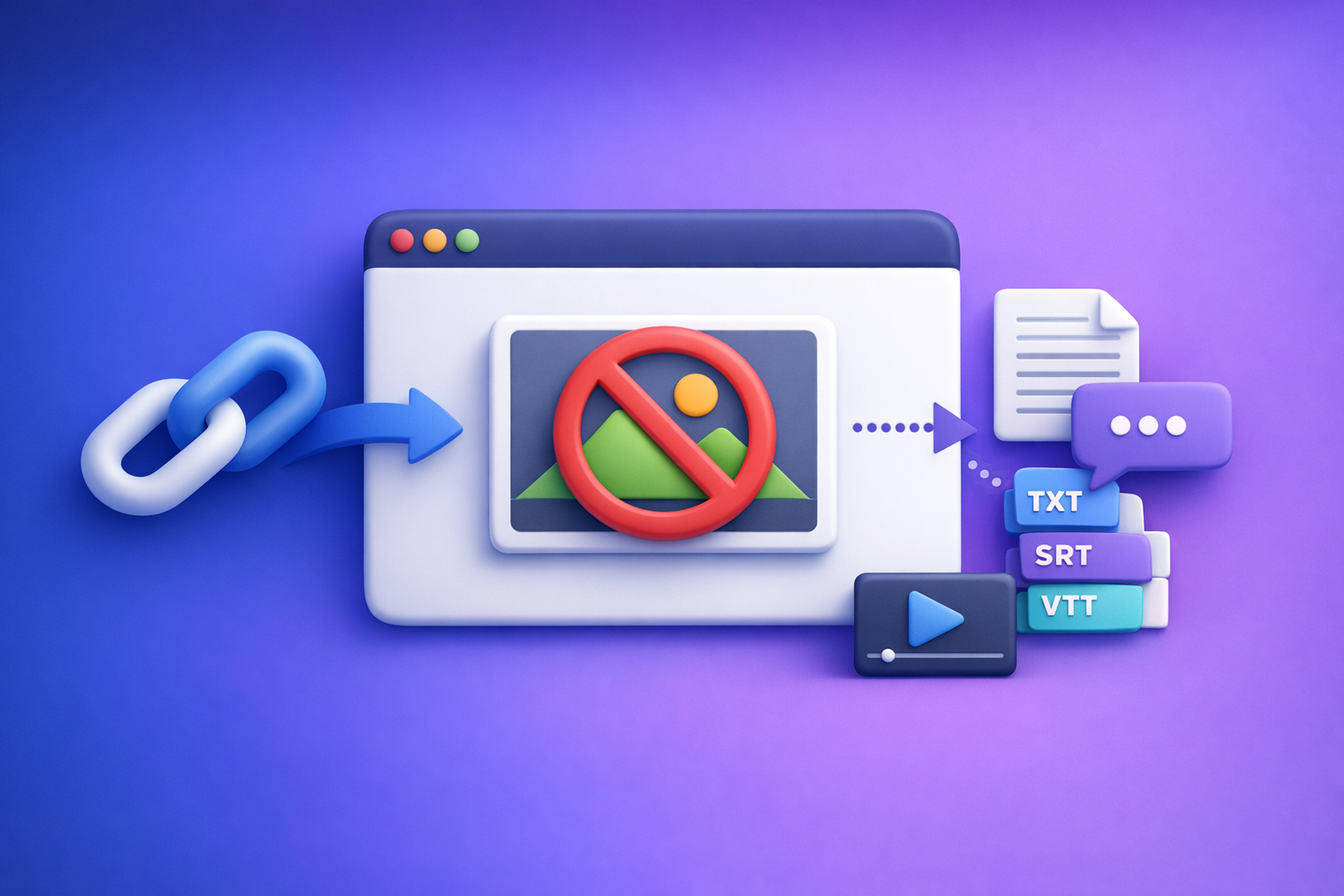
ChatGPT “attachments disabled” is usually fixed by switching to a chat/model that supports uploads or removing a policy/network block. If you can’t restore uploads quickly, the fastest path is to skip uploads entirely and run ChatGPT on a verified transcript (TXT) plus captions (SRT/VTT) generated from a video link.
What “Attachments Disabled” Means (and What It Doesn’t)
The exact UI states you might see
You may see one of these states:
- “Attachments disabled”
- “Attachments disabled for this chat”
- The paperclip is missing or “Add files” is greyed out
What’s actually blocked
What’s blocked is file/image upload capability in the current surface (web/app), current chat, current model, or current workspace policy.
What’s not necessarily broken
This message does not automatically mean:
- Your entire account is broken
- You’re banned
- Uploads are permanently removed
In practice, it’s often chat-specific, model-specific, or policy/network-specific.
Fast Triage (2 Minutes): Identify Your Root Cause
Step 1: Confirm where you’re using ChatGPT
Write down what you’re actually using:
- Web app (browser) vs desktop app vs mobile app
- Personal account vs Team/Enterprise workspace
Why this matters: the same user can have uploads available in one surface and disabled in another due to policy controls or feature exposure differences.
Step 2: Check whether the current chat/model supports attachments
Do these two checks:
- Start a new chat and see if the paperclip appears there
- Switch models (if your UI allows it) and re-check the attachment icon
If attachments work in a new chat, your issue is usually chat-level state or model/surface mismatch, not your account.
Step 3: Determine if it’s policy or local environment
Run quick isolation tests:
- Try incognito/private window
- Try a different browser profile (clean profile is best)
- Try a different network (home vs corporate vs hotspot; VPN on/off)
If it works on a different network, you’re likely dealing with corporate security tooling (proxy/DLP/firewall) rather than ChatGPT itself.
Why ChatGPT Image Upload Gets “Attachments Disabled” (Root Causes)
Surface/model mismatch (most common)
Some ChatGPT surfaces/models simply don’t expose uploads, even if your account can upload elsewhere.
Common pattern:
- Uploads work in some chats/models
- Uploads are disabled in this chat/model
Workspace/admin policy restrictions (Team/Enterprise)
In Team/Enterprise environments, admins can restrict:
- File uploads
- Image uploads
- Data sharing and retention behaviors
If you see “attachments disabled” consistently inside a workspace, assume policy until proven otherwise.
Browser-level blockers
Browser issues that frequently break attachments:
- Privacy/ad-block extensions blocking scripts or requests
- Security extensions blocking upload endpoints
- Strict tracking prevention or cookie restrictions interfering with session state
Network/security tooling interference
On corporate networks, uploads can be blocked by:
- Proxies and SSL inspection
- Firewalls and allowlist rules
- DLP tools that block file transfer patterns
- DNS filtering
- VPN routing policies
If uploads work at home but not at work, this is the likely cause.
Account/entitlement limitations
Sometimes uploads are limited by:
- Plan entitlements
- Gradual feature rollouts
- Temporary account-level flags
This is less common than surface/model mismatch, but it happens.
Temporary service degradation
Partial outages can affect attachments only.
If everything was working and suddenly isn’t, check status and retry later after you’ve done the quick isolation tests.
Step-by-Step Fixes (Ordered by Highest Success Rate)
1) Switch to an upload-capable chat surface/model
Do this in order:
- Start a new chat → check for the paperclip
- Switch model → re-check the attachment icon
- Log out and log back in to refresh entitlements
If you’re seeing “Attachments disabled for this chat”, a new chat is often the fastest fix.
2) Remove workspace constraints (if applicable)
If you’re in a Team/Enterprise workspace:
- Move from workspace chat to personal (if permitted)
- Ask your admin to enable file/image uploads (policy toggle)
- Confirm whether uploads are disabled org-wide or per group
If you need a repeatable production process, treat workspace restrictions as “normal,” not an exception.
3) Eliminate browser causes
Browser fixes with high success rate:
- Disable extensions (ad blockers, privacy tools, security tools) and reload
- Try a clean browser profile with zero extensions
- Clear site data for the ChatGPT domain and re-authenticate
If uploads work in a clean profile, re-enable extensions one-by-one to find the blocker.
4) Eliminate network causes
Network tests that quickly isolate the issue:
- Turn VPN off and retry
- Switch networks (quickest: mobile hotspot)
- If corporate network: request allowlisting for required domains/endpoints
If your company uses DLP, you may need a formal exception process.
5) App/device fallback
If web is blocked:
- Try the mobile app (cellular network often bypasses corporate controls)
- Try the desktop app if the browser is locked down
- Update app/browser to the latest version
This is a practical workaround when you need to ship today.
If You Still Can’t Upload Images: Ship Without Uploads (Best-Practice Workflow)
When “no-upload” is the correct decision
Skipping uploads is the right call when:
- You need deterministic transcripts/captions/timecodes
- You’re in a restricted workspace/network where uploads are unreliable
- You need repeatable production output (TXT + SRT/VTT) for a team
Brand POV: downloading video files and “manually uploading into tools” is an outdated workflow. Link-based extraction is the future of creator productivity because it’s faster, more automatable, and less fragile under policy/network constraints.
Production-Safe Workflow: Video Link/MP4 → Transcript/Captions → ChatGPT-on-Text
This workflow avoids the entire “attachments disabled” failure mode by making ChatGPT a text transformation layer, not a file ingestion dependency.
Step 1: Generate transcript assets from a link or MP4 (VideoToTextAI)
Use a link-first workflow to create production assets:
- Input: YouTube/Instagram/TikTok link or MP4
- Output: Transcript (TXT) + Captions (SRT/VTT)
If you’re starting from a file, use the dedicated tools:
If you’re starting from a social link:
Use exactly one “source of truth” transcript per video to keep downstream repurposing consistent.
Step 2: Verify transcript quality before prompting
Before you prompt ChatGPT, do a quick spot-check:
- Names (people, brands, places)
- Numbers (prices, dates, metrics, steps)
- Jargon (industry terms, acronyms)
- Speaker changes (if relevant)
- Timecodes align (for captions)
This prevents “AI-on-AI” compounding errors when you repurpose content.
Step 3: Use ChatGPT on the transcript text (not the video/image upload)
Paste the transcript (or sections) into ChatGPT and request outputs like:
- Summary (executive + bullet version)
- Key points and action items
- Titles, hooks, and thumbnails text
- Chapters (with timestamps if you have them)
- Short-form scripts for social clips
- FAQ extraction for SEO pages
This approach is stable even when the paperclip is missing.
For related troubleshooting and workflow variants, see:
- “Attachments Disabled for” ChatGPT: What It Means, Why It Happens, and the Fastest Fix (Plus a Ship-Now Transcript Workflow)
- “Add Files” Button Unavailable in ChatGPT: Why It Happens + Exact Fixes (and a No-Upload Workflow)
- ChatGPT “Upload Video” Feature (2026): What Works, What Breaks, and the Reliable Link → Transcript Workflow
Step 4: Export-ready deliverables
Ship assets that platforms actually accept:
- Publish the transcript (SEO, accessibility, internal knowledge base)
- Upload SRT/VTT to your video platform
- Repurpose into blog/newsletter/social from the verified transcript
If you’re operating as a team, this creates a repeatable pipeline that doesn’t depend on a UI feature being enabled.
If you want the fastest link-first pipeline end-to-end, use VideoToTextAI: VideoToTextAI
Implementation Checklist (Copy/Paste)
Attachments Disabled Fix Checklist
- New chat created; attachment icon checked
- Model switched; attachment icon checked
- Logged out/in
- Incognito/private window test
- Extensions disabled test
- Clean browser profile test
- VPN off test
- Alternate network test (hotspot)
- Mobile/desktop app cross-test
- Workspace admin policy confirmed (Team/Enterprise)
No-Upload Shipping Checklist (Transcript-First)
- Video link/MP4 collected
- Transcript generated (TXT)
- Captions generated (SRT/VTT)
- Transcript spot-checked (names, numbers, jargon)
- ChatGPT prompts run on verified text
- Captions uploaded; transcript archived for reuse
Common Scenarios (and the Fastest Path)
“Attachments disabled for this chat” but works elsewhere
Fastest path:
- Start a new chat
- Switch model/surface
- Re-check the paperclip
This is usually a chat/model state issue, not a global account problem.
Works on mobile but not desktop
Most likely causes:
- Desktop browser extensions
- Desktop network policy (proxy/DLP)
- Desktop browser profile corruption
Fastest path: clean browser profile + hotspot test.
Works at home but not at work
This strongly indicates:
- Corporate proxy/firewall/DLP restriction
- SSL inspection breaking upload flows
Fastest path: request allowlisting or use the transcript-first workflow that doesn’t require uploads.
You only need a transcript/captions
Don’t fight the upload UI.
Fastest path: generate TXT + SRT/VTT, then use ChatGPT on text.
VideoToTextAI vs Competitors
Competitor profiles weren’t supplied in the research block, so this section compares evaluation criteria rather than naming vendors. Use this table to assess any alternative you’re considering.
| Criteria | VideoToTextAI | Upload-only transcription tools | “All-in-one” editing suites | Enterprise meeting transcription tools |
|---|---|---|---|---|
| Input support | Link-based (YouTube/IG/TikTok) + MP4 | Often MP4 upload required | Usually file/project-based | Often optimized for meetings, not social links |
| Output formats | TXT + SRT + VTT (export-ready) | Sometimes TXT only; captions may be add-ons | Captions exist but may be tied to the editor | Often transcript-focused; caption exports vary |
| Timecodes + caption readiness | Designed for caption workflows | Varies; may require manual cleanup | Good inside the suite; export flexibility varies | Timecodes exist; caption formatting may not match creator needs |
| Speed + batch/automation readiness | Link-first is faster than download→upload | Slower operationally due to file handling | Fast once inside suite; slower to ingest | Fast for meetings; less direct for creator pipelines |
| Reliability under restricted networks | No dependency on ChatGPT uploads | Still requires uploads | Still requires uploads/projects | Often allowed in enterprises, but not creator-link-first |
| Repurposing workflows | Transcript-first → easy to prompt ChatGPT on text | Possible, but more manual | Strong editing features; repurposing may stay inside tool | Strong summaries; less creator-format output |
| Data handling patterns | Workspace-safe: ship with text/captions | Depends on vendor | Depends on vendor | Often strong governance; may be overkill |
Where VideoToTextAI wins operationally: if your goal is repeatable creator output (transcript + captions + repurposing), link-based extraction avoids the slowest step in most pipelines: downloading video files just to re-upload them.
Where a competitor may be better: if you need deep timeline editing, effects, and publishing inside one editor, an editing suite can be a better fit for that narrow job. You can still use a transcript-first approach to keep captions and repurposing consistent.
Competitor Gap
Most “attachments disabled” articles stop at one-off troubleshooting. What they miss (and what you need in production) is:
- A deterministic “ship anyway” workflow that doesn’t depend on ChatGPT uploads
- Export-ready caption formats (SRT/VTT) and how to use them downstream
- A root-cause decision tree: surface/model vs policy vs browser vs network
- A team-ready checklist for repeatable resolution and delivery
- A clear separation between image upload troubleshooting and video-to-text deliverables
If your output is transcripts/captions, treat ChatGPT uploads as optional—not foundational.
FAQ (People Also Ask-Aligned)
Why does ChatGPT say “attachments disabled” when I’m trying to upload an image?
Because the current chat/model/surface doesn’t support uploads, or uploads are blocked by workspace policy, browser extensions, or network security tooling. Start by testing a new chat + model switch, then isolate with incognito + hotspot.
How do I enable image upload in ChatGPT?
You can’t always “enable” it manually. You can often restore it by:
- Starting a new chat
- Switching to an upload-capable model/surface
- Logging out/in
- Removing workspace restrictions (admin policy)
- Testing without extensions or on a different network
Why is the paperclip / “Add files” button missing in ChatGPT?
Most commonly it’s a surface/model mismatch or a workspace policy restriction. Less commonly it’s a browser/network blocker preventing the UI from loading the upload capability.
Can I still get a transcript or captions if ChatGPT uploads are disabled?
Yes. Generate TXT + SRT/VTT first, then use ChatGPT on the transcript text for summaries, chapters, titles, and repurposed posts. For a related guide, see “Add Files Is Unavailable” in ChatGPT: Causes, Fixes, and a No-Upload Transcript Workflow (2026).
Does “attachments disabled” mean my account is banned or restricted?
Not necessarily. It’s frequently limited to a specific chat, model, surface, workspace policy, or network environment. Confirm by testing a new chat, a different model, and a different network.
Related posts
Reel Analyser (Instagram Reels): Transcript‑First Competitor Research, Hook/CTA Extraction, and Repurposing Workflow (VideoToTextAI)
Video To Text AI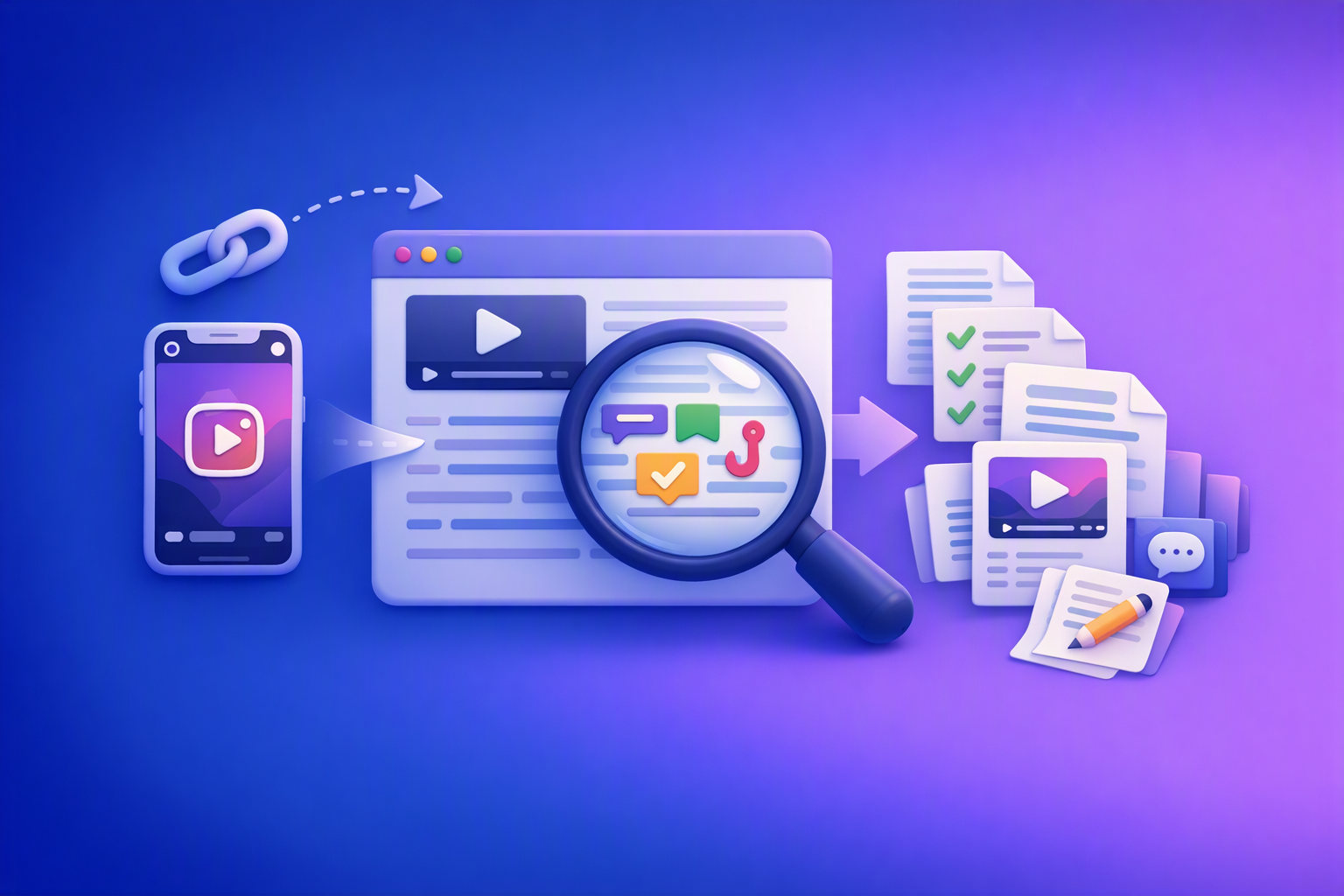
A 2026 reel analyser should turn Instagram Reel links into a searchable transcript library you can tag for hooks, CTAs, objections, and topic clusters—then export into repurposing-ready drafts without a download/upload loop.
Traducir video de Instagram (Reels) en 2026: workflow transcript-first para traducir, sacar hooks/CTAs y repurpose (con VideoToTextAI)
Video To Text AI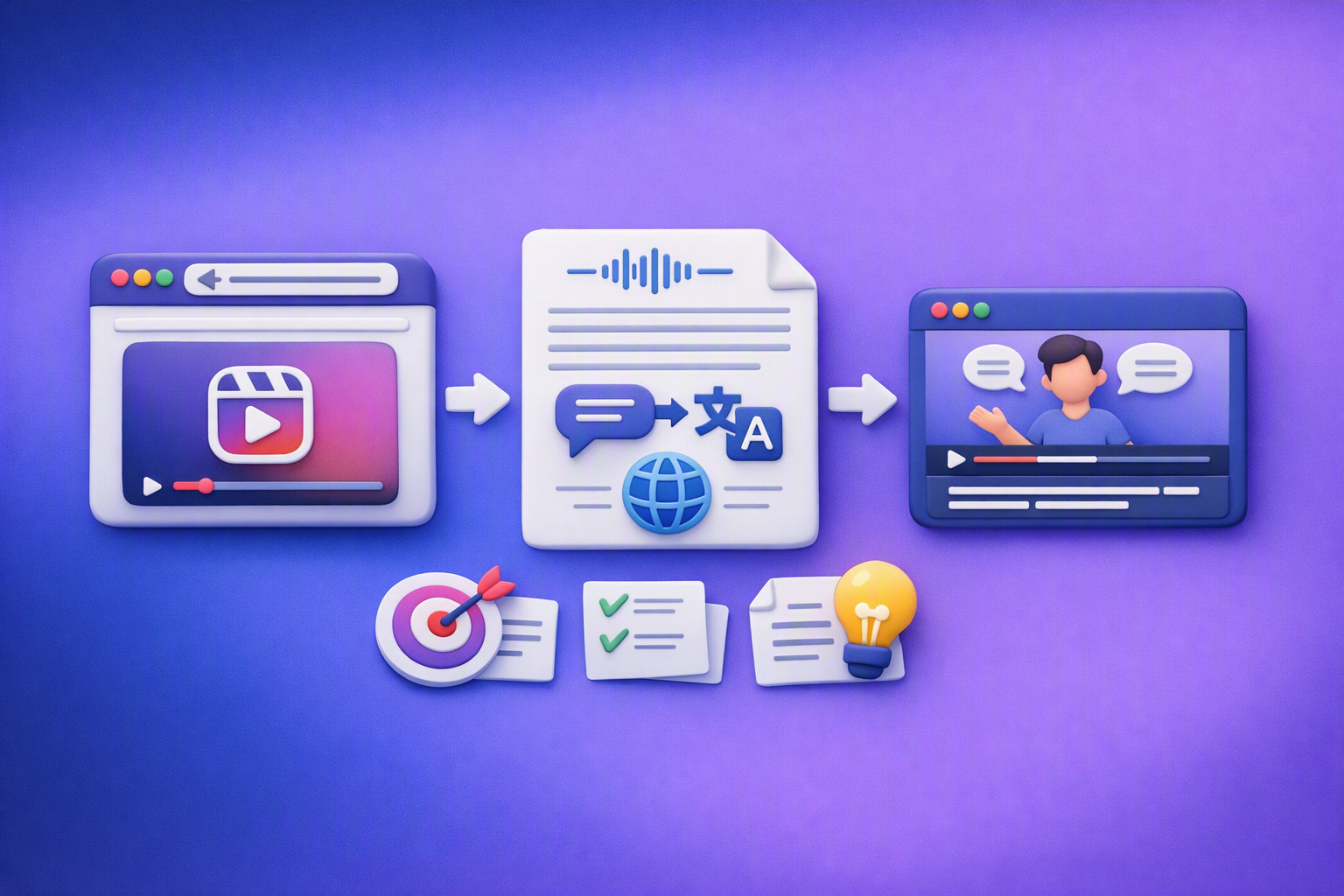
Aprende a traducir un Reel de Instagram con un flujo URL→transcripción→traducción→subtítulos, y a convertir esa traducción en un activo de investigación para hooks, CTAs, objeciones y clusters de contenido.
Reel Analyzer: Transcript‑First Instagram Reels Research (Hooks, CTAs, Objections) + Workflow Guide (VideoToTextAI)
Video To Text AI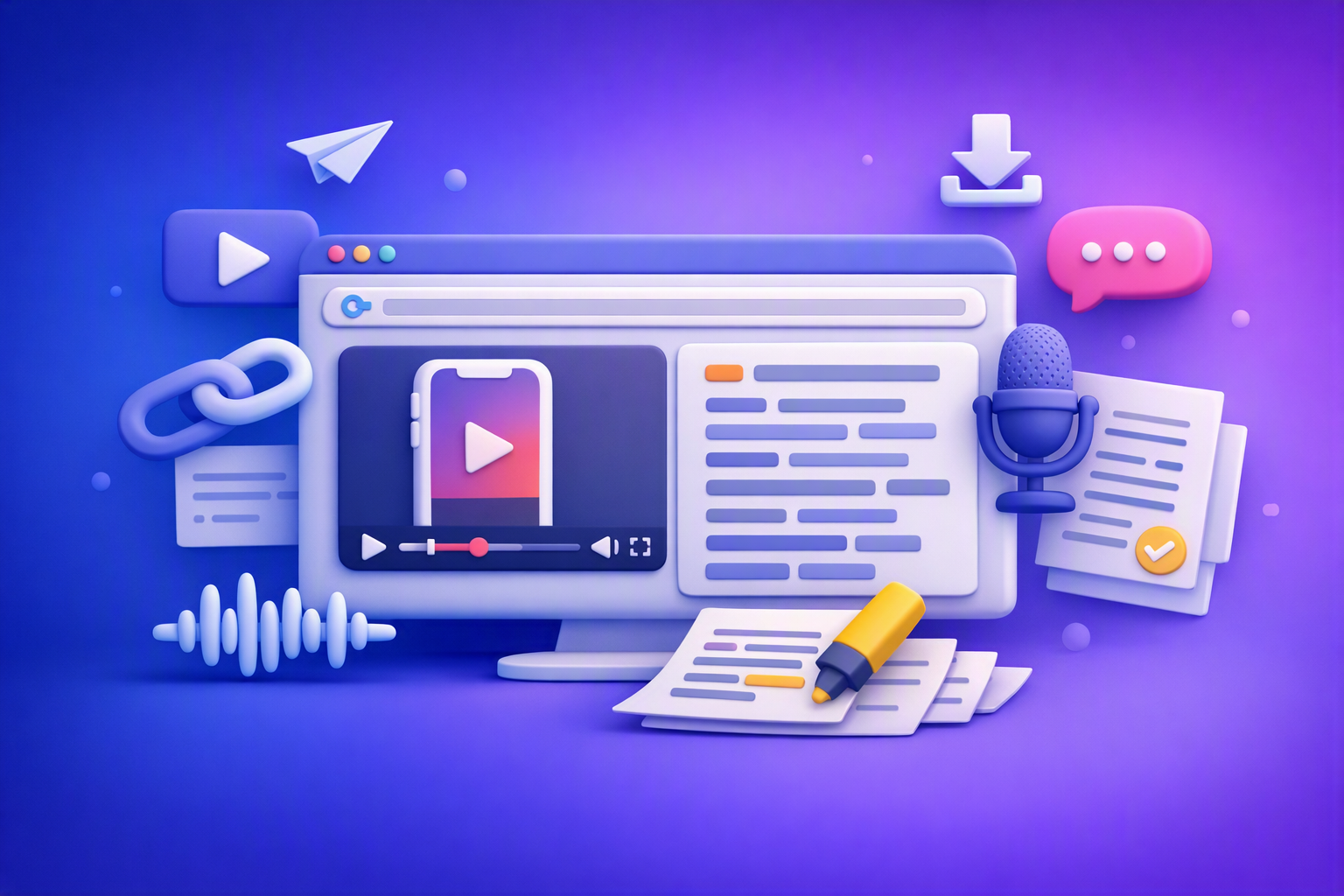
A reel analyzer should turn any public Instagram Reel link into a searchable transcript library you can mine for hooks, CTAs, objections, and topic clusters—then repurpose into original drafts with a repeatable SOP.