
“Add Files” Button Unavailable in ChatGPT (2026): Root Causes, Exact Fixes, and a No-Upload Transcript Workflow
 Video To Text AI
If the “add files” button is unavailable in ChatGPT, stop guessing: isolate whether it’s a surface/model mismatch, account entitlement, workspace policy, or browser/network interference. If you need transcripts or captions today, skip uploads entirely and run a link → transcript/captions → ChatGPT-on-text workflow that doesn’t depend on the paperclip.
What “Add files is unavailable” Actually Means (and What It Doesn’t)
“Add files is unavailable” is a UI symptom, not a single bug. The same message can be triggered by different layers—so the fastest fix is identifying the layer first.
The 4 root-cause buckets (map the symptom to the layer)
-
Surface/model capability mismatch
- The UI you’re in doesn’t expose attachments.
- The model/chat context you selected doesn’t support tools there.
-
Account entitlement/plan state
- Your account/org doesn’t have the feature enabled.
- Your subscription is active, but you’re signed into the wrong org.
-
Workspace/admin policy (Team/Enterprise)
- Your admin disabled file uploads or tool access.
- DLP/allowed-domain rules block attachments.
-
Client/network interference
- Extensions break the upload UI.
- Cookies/local storage are corrupted.
- VPN/proxy/corporate network blocks upload endpoints.
Quick symptom mapping (what you see → likely cause)
- Paperclip/“Add files” missing entirely → surface/model/tooling mismatch
- Button present but greyed out → policy/entitlement or blocked client permissions
- “Unknown error occurred” on upload → browser/network or file-type/size limits
- Works in one org but not another → org/workspace policy or entitlement mismatch
2-Minute Triage (Do This Before You “Fix” Anything)
Your goal is a single-pass isolation test: identify the failing layer in minutes, not hours.
Step 1: Confirm you’re on the right ChatGPT surface
Check where it fails:
- Web app vs desktop app vs mobile app
- Standard chat vs custom GPT
- Personal account vs Team/Enterprise workspace (org selector)
If you have multiple orgs, the org selector is the #1 “it worked yesterday” trap.
Step 2: Start a fresh chat to reset tool state
Tool availability can “stick” to an old thread.
- Start New chat
- Re-check whether Add files appears
- If you’re using a custom GPT, test in a standard chat (custom GPTs can restrict tools)
Step 3: One-pass isolation test (fastest way to find the layer)
Run these in order (each test answers a different question):
- Incognito/private window (no extensions) → same account
- Different browser profile (clean cookies/storage) → same network
- Mobile hotspot (bypass corporate network) → same device
- Different device (phone vs laptop) → same account
Interpretation:
- Works in incognito → extension/storage issue
- Works on hotspot → network/proxy/DLP issue
- Works on personal org but not workspace → admin policy
- Never appears anywhere → surface/model mismatch or entitlement
Step 4: Decide your path
- Path A: Restore uploads (if you must attach PDFs/images)
- Path B: Ship without uploads (best for video → transcript/captions workflows)
If your end goal is video transcription/captions, Path B is usually faster and more reliable.
Fix Sequence (Ordered, Fastest-to-Highest-Leverage)
Don’t start with cache-clearing. Start with the fixes that most often restore the paperclip immediately.
1) Fix surface/model mismatch (most common)
What to do:
- Switch to a standard chat (not a restricted context).
- Switch to a surface/model that supports attachments in your environment.
What to verify:
- Does the paperclip return?
- Is Add files clickable (not greyed out)?
If the button is missing entirely, this step is the highest ROI.
2) Fix plan/entitlement issues (Plus/Team/Enterprise)
Entitlements fail most often when you have multiple logins or orgs.
Do this:
- Confirm you’re signed into the correct account (email/profile).
- Confirm the subscription is active and applied to the current org.
- Log out → log in → re-check (forces a fresh capability fetch).
If uploads work in one org but not another, assume entitlement/policy before browser issues.
3) Fix workspace/admin policy blocks (Team/Enterprise)
If you’re in a managed workspace, assume policy until proven otherwise.
Ask your admin to confirm settings for:
- File uploads/attachments
- Tool access / data controls
- Allowed domains / DLP rules that block uploads
Validation test:
- Switch to your personal org (if available) and re-check.
- If it works personally but not in workspace, it’s almost certainly policy.
Related reading: “Attachments Disabled for” ChatGPT: What It Means, Why It Happens, and the Fastest Fix (Plus a No-Upload Video-to-Text Workflow)
4) Fix browser/profile breakage (UI present but non-functional)
If the button exists but doesn’t work, treat it like a client-side UI failure.
Try:
- Disable extensions that commonly interfere (test one-by-one):
- Ad blockers
- Script blockers
- Privacy tools
- Password managers
- Clear site data for ChatGPT:
- Cookies
- Local storage
- Try a clean browser profile (not just incognito) to eliminate corrupted storage
This is the most common fix for “button greyed out” when policy is not involved.
5) Fix network/security interference (403/blocked uploads)
If you see blocked/403 errors or uploads fail only on corporate networks:
- Disable VPN temporarily and retry
- Test on a different network (mobile hotspot is fastest)
- In corporate environments, proxies/DLP often block upload endpoints
If hotspot works and office Wi‑Fi fails, you need a network exception—cache-clearing won’t help.
6) App-specific fixes (desktop/mobile)
If web works but the app fails (or vice versa):
- Update the app to the latest version
- Force quit and relaunch
- On mobile: verify OS permissions (files/photos access)
Common Edge Cases (Where People Get Stuck)
“It worked yesterday” (regression vs policy change)
Most “regressions” are actually context changes:
- You switched orgs (personal → workspace)
- Workspace policy changed
- Cached tool state is stuck in an old chat
Do this first:
- Confirm org selector
- Start a new chat
- Test a clean browser profile
“Only certain file types fail” (PDFs/images/videos)
If small text files work but PDFs/images/videos fail:
- Validate file size and format; try a small known-good file
- Rename the file (remove special characters)
- If video uploads fail: stop using uploads for transcription (see workflow below)
For video, downloading and re-uploading is an outdated workflow. Link-based extraction is the future of creator productivity because it avoids size limits, flaky upload UIs, and corporate network blocks.
“Uploads work, but analysis fails”
Separate the steps:
- Upload/convert → export text
- Analyze → paste TXT/SRT/VTT into ChatGPT
For production work, TXT + SRT/VTT is the stable interface for downstream editing, captions, and repurposing.
Ship-Now No-Upload Workflow (Best for Video → Transcript/Captions)
Why ChatGPT uploads are fragile for video workflows
Video workflows break uploads more than any other use case:
- Upload UI availability varies by surface/model/org policy
- Video files are large, slow, and more likely to hit network/security limits
- Even when upload works, outputs aren’t consistently export-ready (captions need SRT/VTT)
If your job is shipping content, treat ChatGPT as the repurposing layer, not the ingestion layer.
The deterministic workflow (link/MP4 → TXT + SRT/VTT → ChatGPT-on-text)
This is the repeatable pipeline creators and marketing teams can operationalize.
Step-by-step implementation
-
Start with a link or MP4
- Prefer a public video URL when possible.
- Avoid download → upload loops (slow, fragile, and increasingly blocked).
-
Generate export-ready assets in VideoToTextAI
- Export TXT for editing/analysis
- Export SRT/VTT for captions/subtitles
-
QA the transcript quickly
- Spot-check:
- Names and acronyms
- Jargon
- Timestamps
- Speaker turns (if applicable)
- Spot-check:
-
Paste transcript into ChatGPT (no attachments required)
- Ask for:
- Summary + key takeaways
- Chapters/timestamps
- Blog draft
- Social posts
- SEO metadata
- Ask for:
-
Publish with captions + repurposed content
- Upload SRT/VTT to YouTube/LinkedIn or your editor
- Use transcript for blog + newsletter + clips
Helpful tools and guides:
- MP4 to Transcript
- MP4 to SRT
- MP4 to VTT
- YouTube to Blog
- Podcast Transcription
- ChatGPT “Upload Video” Feature (2026): What Works, What Breaks, and the Production-Safe Link → Transcript Workflow
If you want the fastest path from video to publishable assets without relying on ChatGPT uploads, use VideoToTextAI: VideoToTextAI
Minimal prompt pack (copy/paste) for ChatGPT-on-text
Use these prompts after you paste the transcript text.
-
Clean transcript
- “Create a clean, publish-ready transcript from this text. Preserve speaker labels and fix obvious punctuation.”
-
Repurpose pack
- “Turn this transcript into: (1) 8-section blog outline, (2) 5 LinkedIn posts, (3) 10 short hooks.”
-
Caption formatting guidance
- “Generate SRT-style line breaks guidance (max 42 chars/line) based on this transcript.”
Checklists (Fix Uploads + Keep Shipping)
Restore uploads checklist (10 items)
- Confirm correct org/account
- Start a new chat (tool state reset)
- Switch to an upload-capable surface/model
- Test standard chat vs custom GPT
- Incognito test (no extensions)
- Clean browser profile test
- Clear site data for ChatGPT
- Disable VPN / test different network
- Update desktop/mobile app
- Confirm workspace policy with admin (Team/Enterprise)
Ship-now checklist (transcript-first)
- Video link or MP4 ready
- Generate TXT + SRT/VTT
- Spot-check transcript accuracy (names, jargon, timestamps)
- Paste transcript into ChatGPT for repurposing
- Publish captions using SRT/VTT (not copy/pasted text)
- Store exports for reuse (blog, shorts, email, SEO pages)
VideoToTextAI vs Competitors
Below is a fair, workflow-focused comparison using only signals present in the research set. The key difference is operational: download/upload loops are outdated, while link-based extraction + export-ready deliverables is the future of creator productivity.
| Criteria | VideoToTextAI | Reduct Video | PCMag-recommended stacks (Otter/Rev/Trint categories) | Morningscore free-tool roundups |
|---|---|---|---|---|
| Link-based input (paste a URL) | Yes (positioned as link-based extraction) | No strong public signal for link-based workflow | Typically upload-heavy workflows | No strong public signal for link-based workflow |
| Export-ready caption formats (SRT/VTT) | Yes (explicit TXT + SRT/VTT workflow) | Weak evidence for subtitle/caption exports | Varies by tool; often separate steps for captions | Often optimized for “quick transcript,” not caption deliverables |
| Reliability when ChatGPT uploads are blocked | High (no-attachment pipeline) | Depends on platform workflow; not positioned as a no-upload fallback | Upload-dependent; more likely to be blocked by network/policy | Free tools vary; reliability and repeatability inconsistent |
| Best fit | Creators/marketers shipping transcripts + captions + repurposed content | Teams doing collaborative transcript-based editing, review, highlights | Broad transcription needs; tool choice depends on human vs automated | Quick experiments and lightweight needs |
Where competitors can be better:
- Reduct Video is a strong fit when you need collaboration, review, highlighting, and transcript-based editing in a shared workspace.
- PCMag-style stacks are useful for comparing many vendors and choosing between human vs automated transcription approaches.
- Free-tool roundups can be fine for one-off tests, but they often under-serve export-ready captions and repeatable publishing pipelines.
Competitor Gap
Top-ranking threads and forum answers usually miss four practical pieces that matter when the add files button unavailable ChatGPT issue blocks real work:
- No single-pass isolation test to identify whether the failure is surface/model vs entitlement vs policy vs browser/network.
- No ordered fix sequence (most advice starts with cache-clearing, which is often wasted time).
- No production-safe fallback when uploads stay blocked—especially for video transcription and captions.
- No explicit deliverables (TXT + SRT/VTT) and no repeatable ChatGPT-on-text repurposing pipeline.
This post closes that gap by giving you a fast diagnostic path and a ship-now workflow that doesn’t depend on the paperclip.
FAQ (People Also Ask)
Why can’t I add files in ChatGPT Plus?
Most often: you’re in the wrong org, the wrong chat context/model/surface, or your workspace policy blocks uploads. Run the isolation tests (incognito + hotspot) to quickly separate client vs network vs policy.
Can you no longer upload files to ChatGPT?
File uploads can be available or unavailable depending on surface/model support, account entitlements, and workspace admin settings. If you can’t restore uploads quickly, use a transcript-first workflow and paste text instead.
How do I add a file in ChatGPT?
When attachments are enabled, you’ll see a paperclip or Add files control in the composer. If it’s missing or greyed out, follow the ordered fix sequence above (surface/model → entitlement → policy → browser → network).
Why am I unable to upload a PDF to ChatGPT?
Common causes include:
- Workspace restrictions (Team/Enterprise)
- Extensions blocking scripts
- Corrupted cookies/local storage
- Network/proxy/DLP blocking upload endpoints
Test incognito and a mobile hotspot to isolate the cause fast.
Can ChatGPT do video transcription?
ChatGPT can help with understanding and repurposing text, but video uploads are fragile for production. For reliable transcripts/captions, use a deterministic pipeline: link/MP4 → TXT + SRT/VTT → ChatGPT-on-text.
Internal Link Plan
- “Add Files” Button Unavailable in ChatGPT: Causes, Exact Fixes, and a Ship-Now No-Upload Workflow
- “Attachments Disabled for” ChatGPT: What It Means, Why It Happens, and the Fastest Fix (Plus a No-Upload Video-to-Text Workflow)
- ChatGPT “Upload Video” Feature (2026): What Works, What Breaks, and the Production-Safe Link → Transcript Workflow
- MP4 to Transcript
- MP4 to SRT
- MP4 to VTT
- YouTube to Blog
- Podcast Transcription
Related posts
Reel Analyser (Instagram Reels): Transcript‑First Competitor Research, Hook/CTA Extraction, and Repurposing Workflow (VideoToTextAI)
Video To Text AI
A 2026 reel analyser should turn Instagram Reel links into a searchable transcript library you can tag for hooks, CTAs, objections, and topic clusters—then export into repurposing-ready drafts without a download/upload loop.
Traducir video de Instagram (Reels) en 2026: workflow transcript-first para traducir, sacar hooks/CTAs y repurpose (con VideoToTextAI)
Video To Text AI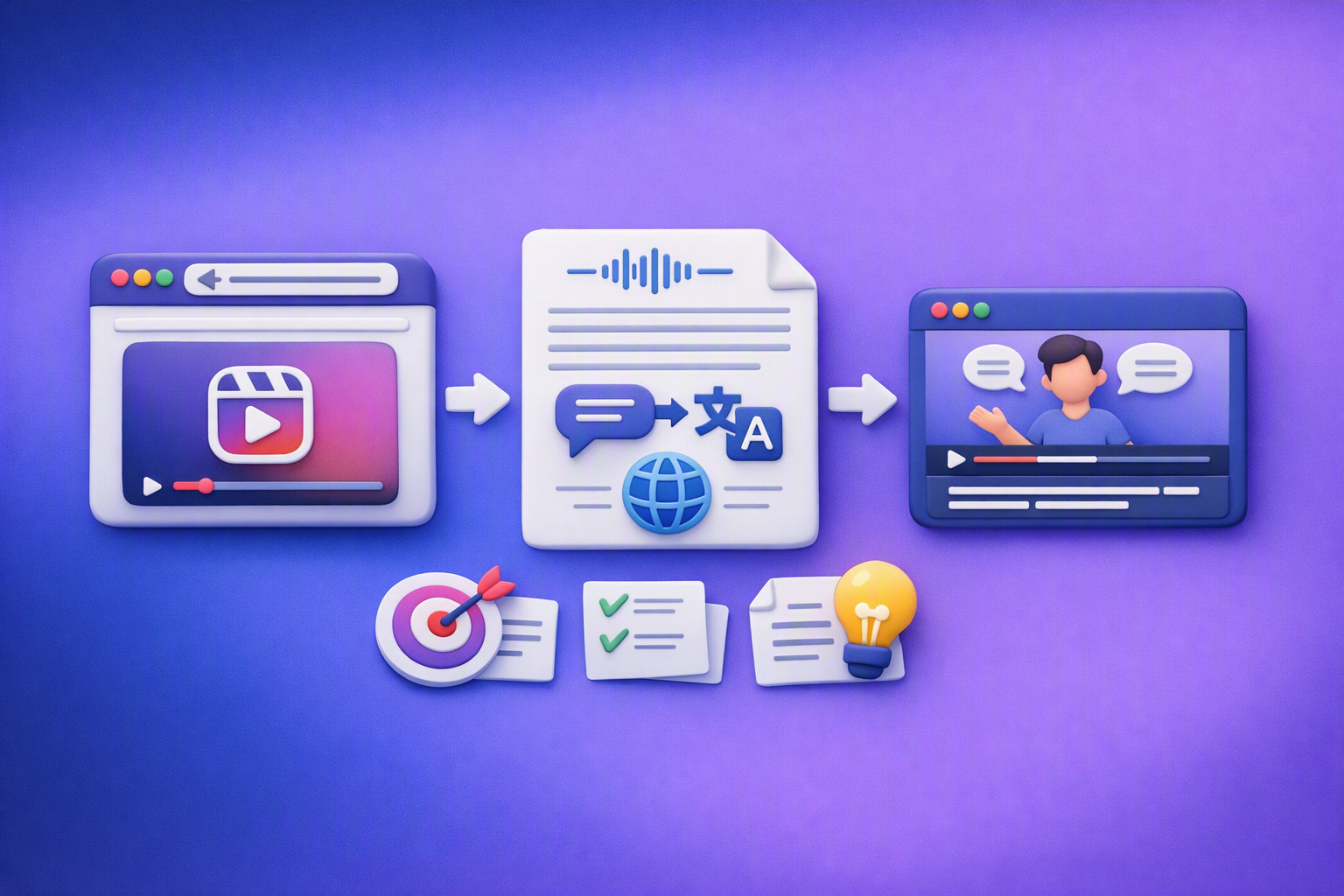
Aprende a traducir un Reel de Instagram con un flujo URL→transcripción→traducción→subtítulos, y a convertir esa traducción en un activo de investigación para hooks, CTAs, objeciones y clusters de contenido.
Reel Analyzer: Transcript‑First Instagram Reels Research (Hooks, CTAs, Objections) + Workflow Guide (VideoToTextAI)
Video To Text AI
A reel analyzer should turn any public Instagram Reel link into a searchable transcript library you can mine for hooks, CTAs, objections, and topic clusters—then repurpose into original drafts with a repeatable SOP.