
ChatGPT “Upload Video” Feature (2026): What Works, What Breaks, and the Reliable Link → Transcript Workflow
 Video To Text AI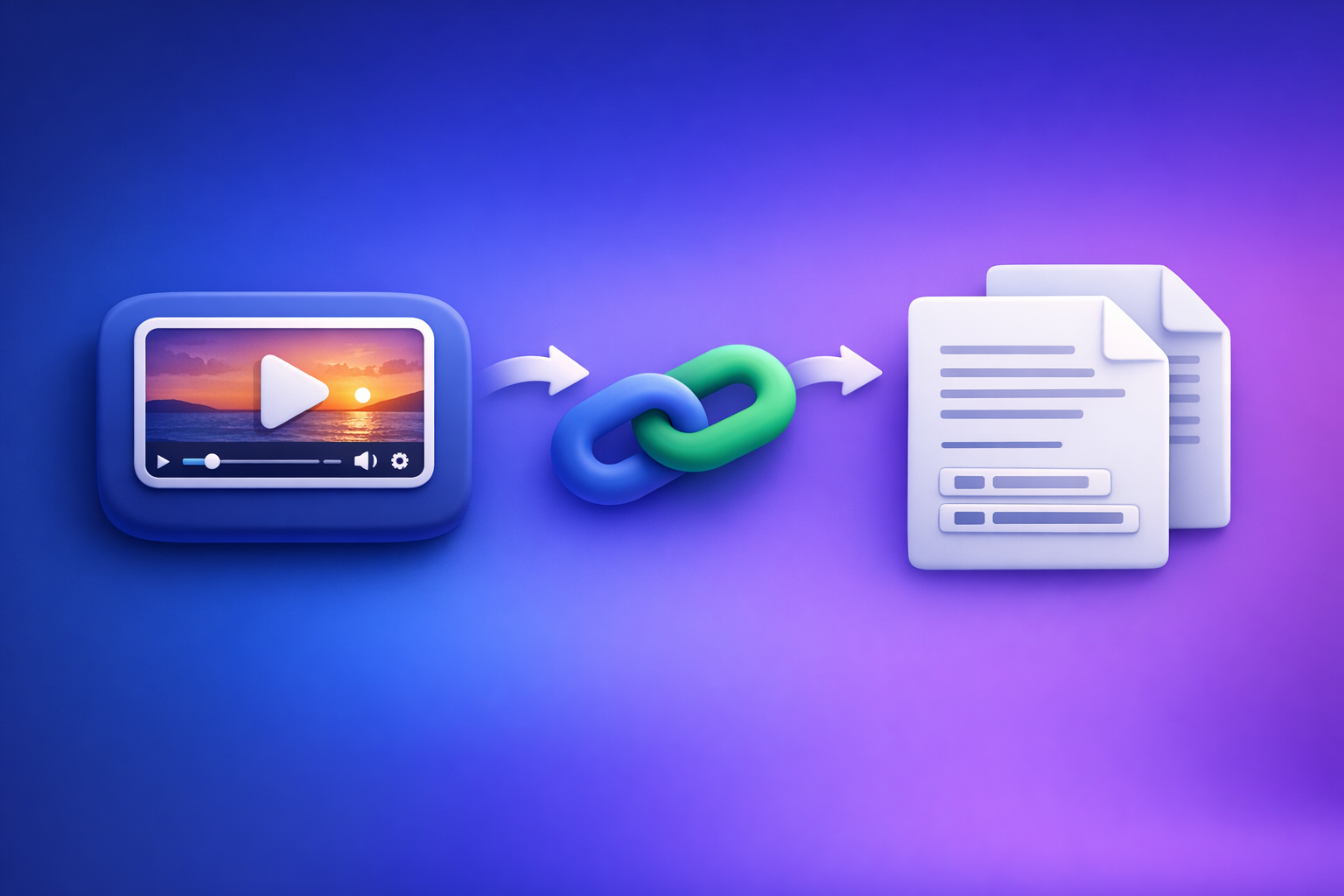
ChatGPT “Upload Video” Feature (2026): What Works, What Breaks, and the Reliable Link → Transcript Workflow
If you need export-ready TXT + SRT/VTT, stop trying to make ChatGPT “upload video” behave like a production pipeline—use a link/MP4 → transcript/captions → ChatGPT-on-text workflow instead. ChatGPT video upload is best treated as a convenience layer for quick understanding, not a deliverables layer you can QA and ship.
Why people search “ChatGPT upload video feature” (and what they actually need)
Most searches aren’t about novelty. They’re about getting from video → usable text assets with minimal friction.
The 3 jobs-to-be-done behind the keyword
People typically want one of these:
- Understand a clip fast (summary, key points, what happened).
- Extract words (a transcript they can edit, quote, or publish).
- Ship captions/subtitles (SRT/VTT with timing that works in editors and platforms).
“Upload video” vs “get export-ready text assets” (TXT/SRT/VTT)
“Upload video” sounds like a complete workflow. In practice, production work needs:
- Deterministic exports: TXT, SRT, VTT
- Repeatable timing: stable timecodes you can spot-check
- QA hooks: the ability to verify and correct before publishing
When ChatGPT is the right tool—and when it’s the wrong pipeline
Use ChatGPT when you need:
- Quick comprehension of a short clip
- High-level Q&A about what’s visible/said (when supported)
Don’t use ChatGPT as the pipeline when you need:
- Accurate, complete transcription
- Subtitle deliverables (SRT/VTT) for publishing
- Repeatable team workflows across many videos
Does ChatGPT allow video uploads? (Reality check: availability + limitations)
Where the feature may appear (web vs mobile; account/workspace differences)
Video upload availability can vary by:
- Client surface: web app vs iOS vs Android
- Account type: individual vs workspace/enterprise
- Policy controls: org settings can disable attachments
- Rollout variance: features can appear gradually
If your UI doesn’t show an attachment control, it’s often not “you”—it’s the surface, policy, or rollout.
What “upload video” can mean in practice (file upload vs link access)
In real usage, “upload video” usually means:
- File attachment (you upload an MP4/MOV)
- Link access (you paste a URL and hope it’s accessible)
For production, link access is the future—but only if the tool is designed for link-based extraction rather than “best effort” browsing.
Hard limits that matter for production work
File size/length constraints
Uploads can fail due to:
- oversized files
- long durations
- unsupported containers/codecs
Even when it works, large files increase the chance of partial results.
Processing timeouts and partial analysis
Longer videos can trigger:
- timeouts
- incomplete analysis
- truncated outputs
That’s fine for “tell me what this is about,” but risky for deliverables.
No deterministic export formats (SRT/VTT) and timecode reliability
Even if ChatGPT returns “captions,” you may see:
- inconsistent timecodes
- formatting that doesn’t validate in tools
- drift that requires manual repair
If you need SRT/VTT you can drop into an editor today, you want a transcript/captions tool built for exports.
What ChatGPT can do with an uploaded video (and what it can’t)
Works well for
Quick understanding of a short clip
- “What’s the main point?”
- “What are the key moments?”
- “What’s the tone and intent?”
High-level summary and Q&A
- “List the claims made.”
- “What objections are addressed?”
- “What’s the call to action?”
Identifying visible objects/scenes (when supported)
- “What’s on screen?”
- “What changes between scenes?”
Not reliable for
Accurate, complete transcription
Transcription requires consistent decoding, diarization, and long-form stability. Chat-based video analysis isn’t optimized for that.
Subtitle/caption deliverables (SRT/VTT) with correct timing
Captions are a format + timing problem, not just a text problem.
Batch processing and repeatable team workflows
If you’re doing this weekly (or daily), you need:
- consistent outputs
- predictable QA steps
- shareable artifacts for editors/clients
How to upload a video to ChatGPT (step-by-step)
UI labels change, but the flow is consistent: open an attachment-capable chat, attach video, send, then ask for the output you want.
Desktop (web) steps
- Open ChatGPT in a modern browser.
- Start a new chat.
- Look for an attachment / add files control near the message box.
- Select your video file and upload.
- Ask for a specific task (summary, questions, scene list).
iPhone/iOS steps
- Open the ChatGPT app.
- Start a new chat.
- Tap the + / attachment control (if present).
- Choose a video from Photos/Files.
- Send, then ask for the analysis.
Android steps
- Open the ChatGPT app.
- Start a new chat.
- Tap the attachment control (if present).
- Select a video from device storage.
- Send, then ask for the analysis.
Control test: validate your setup with a known-good 60–120s clip
Before troubleshooting your “real” video, test with:
- MP4
- H.264 video + AAC audio
- 60–120 seconds
- clear speech
If the control clip fails, your issue is surface/policy/network—not your content.
Why ChatGPT won’t let you upload videos (fast diagnosis)
1) Surface/model mismatch (you’re in a context that doesn’t support attachments)
Some chat contexts don’t expose attachments. If you don’t see the control, assume mismatch first.
2) Plan/entitlement or workspace policy restrictions
Workspaces can disable attachments. Individual plans can differ in what’s enabled.
3) Browser profile issues (extensions, cookies, cached state)
Ad blockers, privacy extensions, and stale cookies can break upload UI.
4) Network/security blocks (VPN, corporate proxy, content filters)
Corporate networks often block file upload endpoints or large payloads.
5) File issues (codec/container, corruption, oversized files)
Common culprits:
- HEVC/H.265 in a container the client struggles with
- variable frame rate oddities
- corrupted exports
- very large files
6) Rollout variance (feature not enabled for your account yet)
If others “have it” and you don’t, it may simply not be enabled for your account.
Fixes: ordered troubleshooting that actually isolates the root cause
Step 1: Confirm you’re in an upload-capable chat surface
- Try web and mobile.
- Start a fresh chat.
- Look specifically for the attachment control.
If you’re seeing “attachments disabled” style behavior, also review: “Attachments Disabled for” ChatGPT: What It Means, Why It Happens, and the Fastest Fix (Plus a No-Upload Video-to-Text Workflow)
Step 2: Switch model/surface and re-check attachment controls
- New chat
- Different model (if selectable)
- Different client (web ↔ mobile)
Step 3: Try a clean browser profile (no extensions) + hard refresh
- Incognito/private window
- Disable extensions
- Clear site data for the domain
If the “add files” UI is missing, see: “Add Files” Button Unavailable in ChatGPT: Causes, Exact Fixes, and a Ship-Now No-Upload Workflow
Step 4: Change network (hotspot) to rule out policy blocks
- Switch off VPN
- Try mobile hotspot
- Try a non-corporate network
Step 5: Re-encode video to a standard MP4 (H.264 + AAC) and retry
This isolates codec/container issues. Export a smaller test file first.
Step 6: Stop after 10 minutes if you need deliverables (switch workflows)
If your goal is TXT/SRT/VTT you can ship, continued upload debugging is usually sunk cost.
10-minute triage: decide whether to keep trying ChatGPT or switch workflows
If you need any of these, switch now
Export-ready TXT + SRT/VTT
If the output must be imported into YouTube, Premiere, CapCut, or a client workflow, you need deterministic exports.
Repeatable results across many videos
Creators and teams need consistency more than “it worked once.”
Shareable artifacts for editors/clients
You want files/links you can hand off and QA.
If your use case is low-stakes, keep trying ChatGPT upload
ChatGPT upload is fine for:
- a quick summary
- brainstorming titles
- extracting a few quotes from a short clip
The production-safe workflow: Link/MP4 → TXT + SRT/VTT → ChatGPT-on-text
Downloading video files is an outdated workflow. The future of creator productivity is link-based extraction: paste a URL, generate artifacts, and move straight into editing and repurposing.
Why transcript-first beats “ChatGPT watches the video”
Deterministic outputs you can QA
You can spot-check timestamps, fix names, and validate formatting before publishing.
Faster iteration (edit text, not media)
Text edits are faster than re-uploading media or re-running fragile analysis.
Easier collaboration (share files/links to artifacts)
Editors, clients, and stakeholders can review the same artifacts.
Step-by-step implementation with VideoToTextAI
Step 1: Choose input type (video URL or MP4)
Use the input that matches your source:
- YouTube
- TikTok
- Instagram/Reels
- Direct MP4 links
- or upload an MP4 when you must
If you’re repurposing YouTube content, start here: YouTube to blog
Step 2: Generate transcript (TXT) for editing + reuse
Create a clean transcript you can edit and reuse across formats: MP4 to transcript
Step 3: Generate captions/subtitles (SRT + VTT) for publishing
Export the formats platforms and editors expect:
Step 4: QA pass (what to check before shipping)
Do a fast, repeatable QA:
- Speaker names/labels (if applicable)
- Punctuation + proper nouns (brands, people, products)
- Timing drift and line length for captions (readability)
Step 5: Use ChatGPT on verified text (not raw video)
Once you have verified text, ChatGPT becomes extremely reliable for:
- summaries and stakeholder briefs
- blog drafts and outlines
- clip lists and hooks
- titles, thumbnails text, and CTAs
For a related workflow on short-form sources, see: Reel Summary: How to Summarize an Instagram Reel (Accurately) + Turn It Into Captions, Posts, and a Blog
If you want the full reference version of this guide, keep this bookmarked: ChatGPT “Upload Video” Feature (2026): What Works, What Breaks, and the Production-Safe Link → Transcript Workflow
Implementation checklist (copy/paste)
Inputs
- Source link OR MP4 file ready
- Target deliverables defined: TXT, SRT, VTT
- Language(s) and formatting requirements confirmed
Processing
- Generate transcript (TXT)
- Generate captions (SRT)
- Generate web captions (VTT)
QA
- Spot-check 3 timestamps across the video
- Verify names/brands/terms
- Confirm caption line length + readability
Repurposing
- Summary + key points
- Chapters/timestamps (if needed)
- Blog/social drafts from transcript
Practical prompt pack: what to ask ChatGPT after you have the transcript
Use these prompts after you have a verified transcript (TXT) and, if needed, captions (SRT/VTT).
Transcript → executive summary (stakeholders)
“Summarize this transcript for executives in 8 bullets. Include: goal, key claims, proof points, risks, and recommended next steps.”
Transcript → SEO blog outline + draft
“Create an SEO outline targeting: [keyword]. Use the transcript as the only source. Then draft the article with H2/H3s, short paragraphs, and a conclusion.”
Transcript → YouTube chapters + titles
“Generate YouTube chapters with timestamps based on this transcript. Then propose 10 titles and 5 hook options for the first 15 seconds.”
Transcript → short-form clip list (time ranges + hooks)
“Identify 8 short-form clips. For each: start/end time, hook line, why it works, and suggested on-screen caption.”
Transcript → captions cleanup rules (style guide enforcement)
“Rewrite these captions to match this style guide: [rules]. Keep meaning identical. Preserve timing blocks and line length constraints.”
VideoToTextAI vs Competitors
Below is a fair, workflow-focused comparison using only publicly signaled capabilities from the researched pages.
| Criteria | VideoToTextAI | Canva (canva.com) | Reduct Video (reduct.video) | PCMag recommended tools list (pcmag.com) |
|---|---|---|---|---|
| Link-based input (paste a URL) | Yes (core workflow) | Not a strong public signal | No strong public signal | Not applicable (editorial list) |
| Export-ready deliverables | TXT + SRT + VTT | Transcript/captions mentioned; export specifics not strongly evidenced in research | Transcript export mentioned; subtitle export not strongly evidenced | Varies by tool; list discusses transcription services broadly |
| Workflow speed (URL → assets) | Fast: avoids download/upload loops | Upload-centric flow is typical | Platform-centric workflow; link-first not emphasized | Depends on the chosen tool; not a workflow product |
| Repeatability for creators/teams | Designed for consistent artifact generation + QA | Strong design/team environment; less positioned around deterministic export pipeline | Strong collaboration/search in a transcript-based platform | Not a workflow; guidance-oriented |
| Best fit | Production-safe transcript/captions pipeline + repurposing | Design-first caption styling and creative workflows | Collaborative transcript editing/search for teams | Choosing between human/AI transcription services |
Where VideoToTextAI wins (when you care about shipping):
- Workflow speed: link-first execution removes the outdated “download → re-upload” loop.
- Operational repeatability: you generate the same artifacts (TXT/SRT/VTT), run the same QA, then repurpose.
- Repurposing reliability: ChatGPT works best on verified text, not fragile media uploads.
When a competitor may be the better fit (edge cases):
- If you need design-first caption styling inside a creative suite, Canva can be a better home for that step.
- If you need a collaborative transcript editing/archive platform, Reduct’s collaboration/search positioning may fit better.
- If you’re deciding between human vs automated transcription vendors, PCMag’s list is useful for vendor discovery (but it won’t give you a link-first production workflow by itself).
To run the link-first workflow end-to-end, use VideoToTextAI here: https://videototextai.com
Competitor Gap
What top-ranking pages miss (and how this post fixes it)
Most pages discussing the “chatgpt upload video feature” miss the operational reality:
- Missing: a hard “stop troubleshooting” threshold tied to deliverables
- Missing: ordered isolation steps (surface/model vs policy vs browser vs network)
- Missing: deterministic export workflow (TXT + SRT/VTT) before using ChatGPT
- Missing: mobile-specific upload friction (iOS/Android) + control test method
Unique angle to win the SERP
Treat “upload video” as a convenience layer. Handle deliverables with a transcript-first pipeline that produces QA-able exports, then use ChatGPT on the verified text for repurposing.
FAQ (People Also Ask)
Does ChatGPT allow video uploads?
Sometimes. Availability varies by client surface, account/workspace policies, and rollout status, and it’s not designed as a deterministic export pipeline.
Can I upload a video to ChatGPT to analyze?
If the attachment control is available, yes—for short, low-stakes analysis like summaries and Q&A. For production transcripts/captions, use a transcript-first workflow.
Why won’t ChatGPT let me upload videos?
Most failures come from surface mismatch, policy restrictions, browser/profile issues, network blocks, file/codec problems, or feature rollout variance.
Can ChatGPT watch videos you upload to it?
In some contexts it can analyze aspects of a video, but behavior varies and isn’t consistent enough to rely on for deliverables.
Can ChatGPT do video transcription?
It may produce text from a video in some cases, but it’s not reliably complete or export-ready with stable SRT/VTT timing.
What is the best software to convert video to text?
The best option is the one that matches your deliverables. If you need TXT + SRT/VTT you can QA and ship, use a tool built for exports, then use ChatGPT to repurpose the verified transcript into blogs, chapters, and clip lists.
Related posts
Reel Analyser (Instagram Reels): Transcript‑First Competitor Research, Hook/CTA Extraction, and Repurposing Workflow (VideoToTextAI)
Video To Text AI
A 2026 reel analyser should turn Instagram Reel links into a searchable transcript library you can tag for hooks, CTAs, objections, and topic clusters—then export into repurposing-ready drafts without a download/upload loop.
Traducir video de Instagram (Reels) en 2026: workflow transcript-first para traducir, sacar hooks/CTAs y repurpose (con VideoToTextAI)
Video To Text AI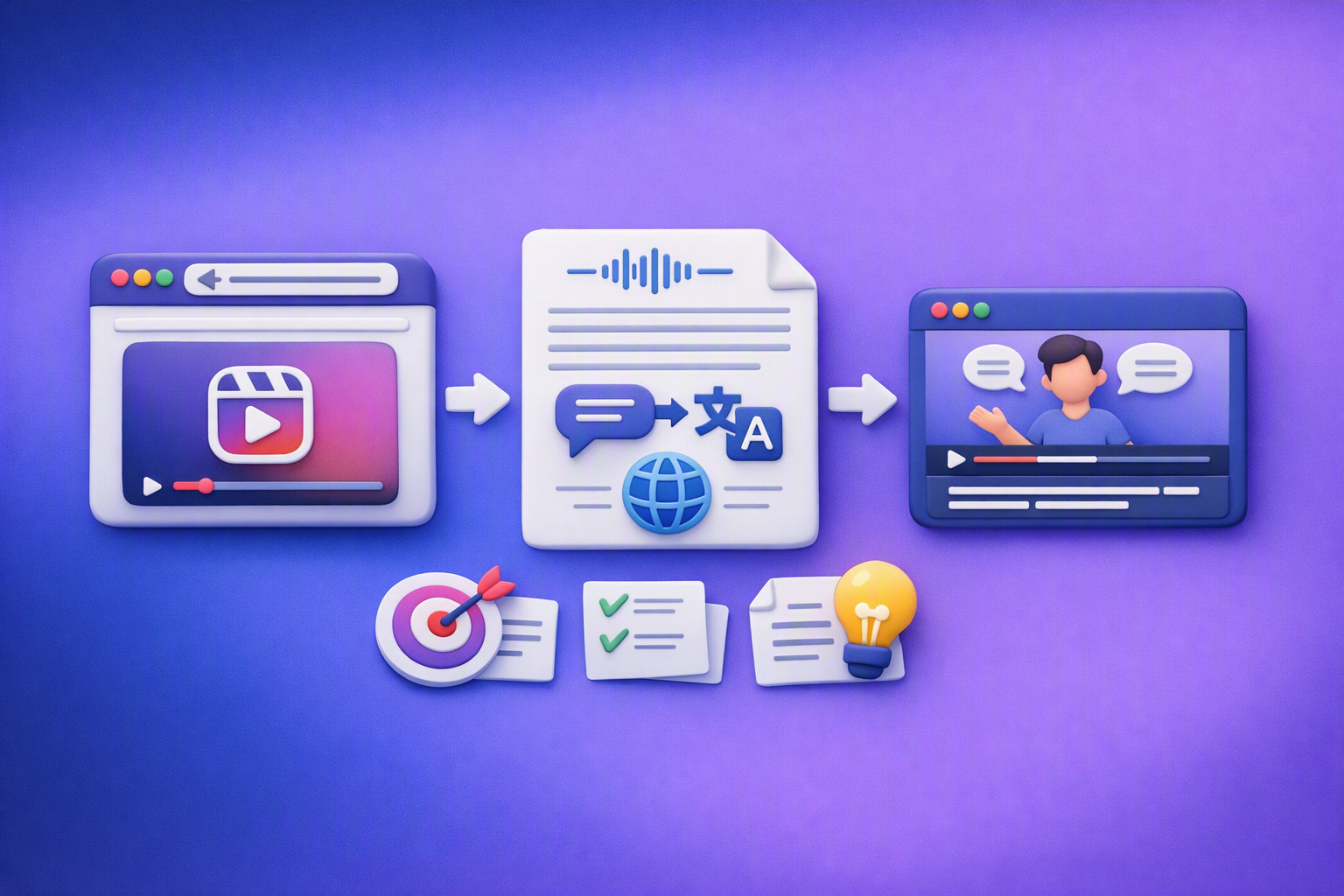
Aprende a traducir un Reel de Instagram con un flujo URL→transcripción→traducción→subtítulos, y a convertir esa traducción en un activo de investigación para hooks, CTAs, objeciones y clusters de contenido.
Reel Analyzer: Transcript‑First Instagram Reels Research (Hooks, CTAs, Objections) + Workflow Guide (VideoToTextAI)
Video To Text AI
A reel analyzer should turn any public Instagram Reel link into a searchable transcript library you can mine for hooks, CTAs, objections, and topic clusters—then repurpose into original drafts with a repeatable SOP.