
“Add Files Is Unavailable” in ChatGPT: Meaning, Fixes (Step-by-Step), and No‑Upload Video→Text Workarounds
 Video To Text AI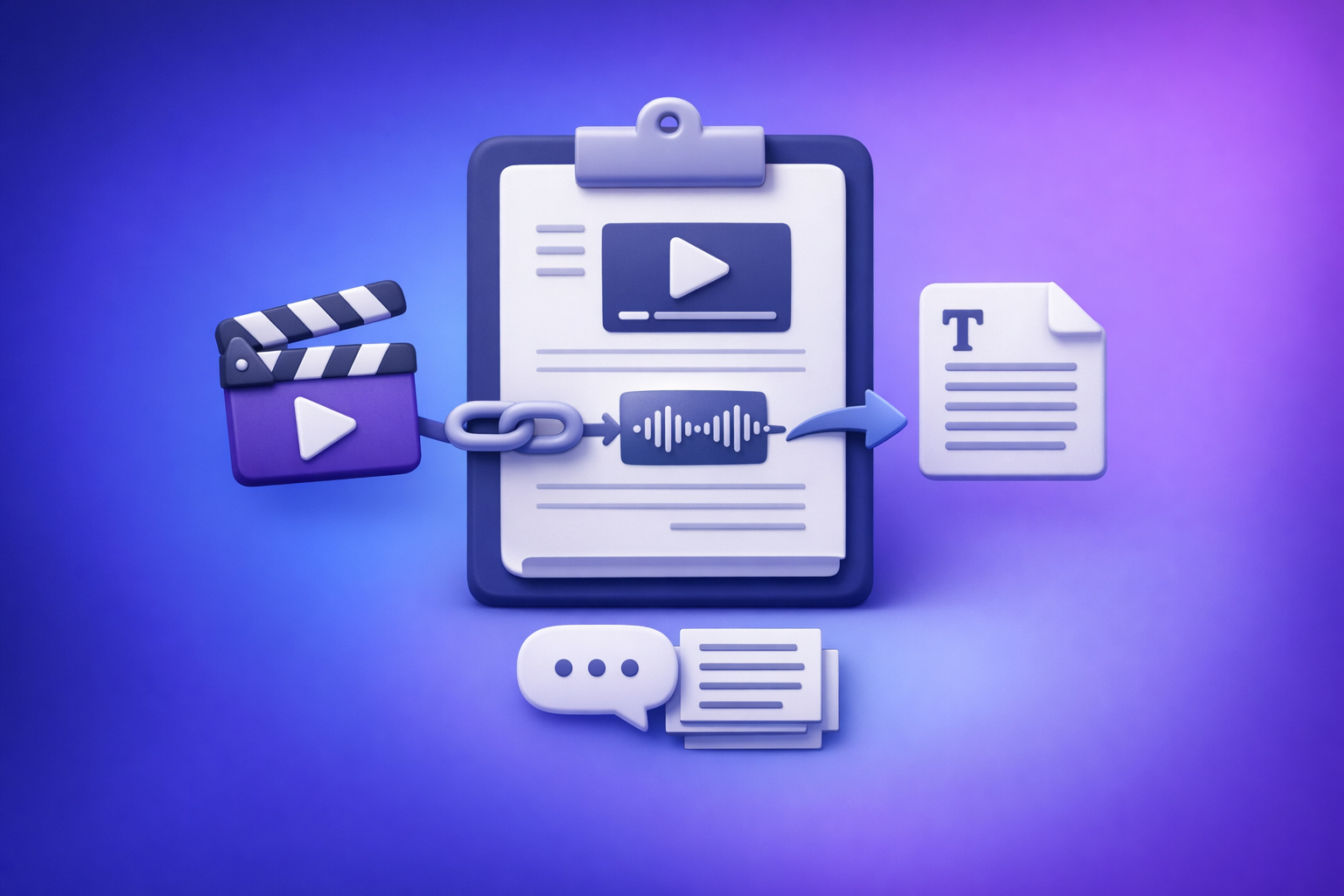
If ChatGPT says “Add files is unavailable,” the fastest fix is to start a new chat and switch to an attachment-capable model, then test another surface (web/app) to confirm it’s not a thread-only limitation. If uploads are blocked by policy or network controls, skip file attachments entirely and use a link-based video→text workflow to generate transcripts/subtitles you can paste into ChatGPT.
Quick Answer (60-second fix)
1) Confirm you’re on an attachment-capable surface
Check whether the paperclip / “Add files” control exists on another surface:
- Web app (different browser if possible)
- Desktop app
- iOS/Android app
If it’s missing only on one surface, it’s likely a local UI/environment issue—not account-wide.
2) Start a brand-new chat + switch model
Do this in order:
- Create a new thread (don’t reuse the same conversation).
- Select a model that supports attachments (availability depends on plan/workspace).
- Refresh once after selecting the model.
Some threads retain restrictions even after you switch models, so new chat first is the key move.
3) Eliminate browser causes in 2 minutes
In this order:
- Open an incognito/private window.
- Disable extensions (especially ad blockers, script blockers, privacy tools).
- Clear site data for ChatGPT and re-login.
If the button returns in incognito, an extension or corrupted site data is the culprit.
4) Rule out network/admin policy blocks
- Try a different network (mobile hotspot is the fastest test).
- If you’re on a work/school device, assume an admin policy until proven otherwise.
5) If uploads remain blocked: use a no-upload workflow
If you can share a video link (YouTube/TikTok/Instagram/podcast URL), you can still get transcripts/subtitles without attaching files.
What “Add Files Is Unavailable” Means (and what it does not mean)
What it usually indicates
Most of the time, this message means attachments are disabled due to one of these constraints:
- The current chat context (thread) doesn’t allow attachments.
- The selected model doesn’t support attachments in your plan/workspace.
- The current surface (web/app version) isn’t showing the upload UI.
- A workspace policy (Team/Enterprise/managed device) disables uploads.
- A network security control blocks upload endpoints.
What it usually does not indicate
This message is rarely about the file itself:
- Not “your file is corrupt” (file corruption usually triggers a different upload error).
- Not a permanent account ban from uploads (possible, but uncommon).
- Not proof of an outage (outages happen, but most cases are local/policy).
Root Causes (ranked by likelihood)
Model/thread mismatch (most common)
- The current model or conversation doesn’t support attachments.
- Some threads keep restrictions even after switching models.
- Fix: new chat + choose an attachment-capable model before typing.
Surface limitations (web vs app differences)
- Upload UI may be absent on one platform while present on another.
- Mobile app versions can lag behind web features.
- Fix: test web vs mobile vs desktop.
Workspace/admin restrictions (ChatGPT Team/Enterprise/managed devices)
- Admins can disable file uploads for compliance.
- DLP/MDM policies can remove attachment controls.
- Fix: confirm with admin; use an approved no-upload workflow.
Browser environment blocks
- Extensions can block scripts or upload endpoints.
- Corrupted cookies/local storage can break UI rendering.
- Fix: incognito test, disable extensions, clear site data.
Network/security filtering
- Corporate proxies, SSL inspection, or firewall rules can block upload requests.
- Captive portals/hotel Wi‑Fi can break upload flows.
- Fix: hotspot test; adjust VPN/proxy as allowed.
Temporary service degradation
- Upload subsystem incidents can occur while chat still works.
- Fix: test across devices/networks; check status if it fails everywhere.
Step-by-Step Fix Flow (minimal-waste decision tree)
Step 1 — Identify scope: thread-only vs account-wide
Test “Add files” in this exact order:
- New chat (same device/browser)
- Different browser (or incognito)
- Different device (phone app)
Outcome mapping
- Works elsewhere → local/thread/surface issue
- Fails everywhere → policy/plan/network/service issue
This prevents wasting time on cache-clearing when the real blocker is admin policy.
Step 2 — Reset the chat context correctly
Do the reset the way that actually changes capability:
- Start a new chat.
- Select an attachment-capable model before typing anything.
- Refresh once after model selection.
If you type first and switch later, you can end up stuck in a thread context that still won’t allow uploads.
Step 3 — Browser hard reset (ordered)
Work top-down; stop when it’s fixed:
- Disable extensions (privacy/ad/script blockers first)
- Clear site data for ChatGPT (cookies + local storage)
- Incognito/private window test
- Update browser to latest stable
- Try a different browser profile (fresh profile)
Why this works: the upload UI is script-driven; anything that blocks scripts, storage, or requests can remove the button or break the upload flow.
Step 4 — App-specific fixes (iOS/Android/Desktop)
If you’re using an app:
- Update the app to the latest version
- Force quit + relaunch
- Log out/in
- If on a managed device, check for MDM restrictions (uploads may be disabled at the device level)
Step 5 — Network isolation test
This is the fastest way to prove a network block:
- Switch to a mobile hotspot
- Disable VPN (or try a different VPN exit region if your org requires VPN)
If hotspot fixes it, your primary network is blocking upload endpoints or interfering with authentication.
Step 6 — Workspace/admin policy confirmation
If you’re on a work/school account:
- Ask whether file uploads are disabled for your workspace
- Request an exception or an approved alternative workflow
In many organizations, the answer is simply “uploads are intentionally disabled,” and the best response is to standardize a no-upload process.
Implementation: No‑Upload Video→Text Workflow (when ChatGPT uploads are blocked)
Downloading video files to upload them is an outdated workflow. Link-based extraction is the future of creator productivity because it’s faster, easier to standardize, and less fragile under admin/network restrictions.
Use case fit
This workflow is ideal when:
- You need transcripts, subtitles (SRT/VTT), captions, summaries, or repurposed content.
- You can share a link (YouTube/TikTok/Instagram Reels/podcast URL) instead of uploading a file.
- Your environment blocks attachments, or you want a repeatable team process.
Step-by-step workflow (VideoToTextAI)
- Copy the video link (YouTube/TikTok/Instagram Reel/podcast page).
- Generate a transcript via VideoToTextAI:
- General workflow: video to text converter
- Transcript-first: video transcript generator
- Export what you need:
- Transcript text for docs/notes
- Subtitle formats (SRT/VTT) when applicable
- Repurpose immediately (optional):
- YouTube → blog draft: youtube to blog
- YouTube → summary: youtube to summary
- TikTok → blog: tiktok video to blog post
- Instagram Reel → blog: instagram reel to blog post
- Paste outputs into ChatGPT (no attachments required) for:
- Rewriting and tone changes
- Structuring into outlines
- Formatting into markdown, email, or social threads
Operational advantage: this turns “uploads are blocked” from a hard stop into a simple copy/paste step.
When you must work from a local file (MP4/MP3)
If you only have a local file, you can still avoid ChatGPT attachments:
- MP4 → text: mp4 to text
- MP4 → SRT: mp4 to srt
Then paste the resulting transcript/subtitles into ChatGPT for editing and repurposing.
Primary CTA (use once)
If you want the fastest no-upload path from video link to transcript/subtitles, use VideoToTextAI: VideoToTextAI
Checklist: Fix “Add Files Is Unavailable” Fast
Use this as a team-standard runbook.
- New chat created (not same thread)
- Attachment-capable model selected
- Tested alternate surface (web/app)
- Incognito/private window test
- Extensions disabled
- Site data cleared + re-login
- Alternate network (hotspot) test
- VPN/proxy toggled (as allowed)
- Workspace admin policy confirmed
- No-upload fallback workflow ready (link → transcript/subtitles)
VideoToTextAI vs Competitors
You should evaluate tools based on what actually breaks in real environments: upload restrictions, policy controls, and repeatability. If “add files is unavailable” is blocking you, the winning approach is usually link-based extraction plus clean exports you can paste anywhere.
Note: No competitor research block was provided in the prompt, so the table below compares categories at a workflow level without asserting unsupported pricing/limits.
| Criteria | VideoToTextAI | ChatGPT file uploads | YouTube built-in transcript | Local transcription apps (desktop) |
|---|---|---|---|---|
| Link-based input (no upload required) | Yes (video/podcast/social links) | No (requires attachment when using files) | Yes (YouTube only) | No (requires local file) |
| Works when “Add files is unavailable” | Yes (paste link → export text) | No (blocked) | Sometimes (only if transcript exists and is accessible) | Yes (but requires file access + install) |
| Exports for captions/subtitles | Yes (transcript + subtitle formats when applicable) | Not the core export path | Limited (copy transcript; subtitle export varies) | Varies by app |
| Repurposing workflows from same source | Yes (e.g., YouTube/TikTok/IG → blog/summary) | Possible after you have text, but upload-dependent | No | No/limited |
| Operational repeatability for teams | High (standard link → transcript → paste) | Medium (depends on model/surface/policy) | Low (platform-specific) | Medium (device-specific installs) |
Where VideoToTextAI wins (practically):
- Workflow speed: link in → transcript/subtitles out, without waiting on upload UI to work.
- Link-based input: avoids the most common failure mode (attachments disabled by thread/model/policy).
- Exports + repurposing: you can generate transcript/subtitles and then immediately create blog/summary drafts from the same source URLs.
- Operational repeatability: teams can standardize “link → export → paste into ChatGPT” across managed devices.
Where others can be better (narrow cases):
- If you only need a quick read of a public YouTube transcript and it’s already available, YouTube’s built-in transcript can be sufficient.
- If you must process sensitive offline media with strict air-gapped requirements, a local desktop transcription app may be more appropriate.
Competitor Gap
Most “add files is unavailable” articles fail because they treat every case like a cache problem. What’s usually missing is a fast isolation method and a production-ready fallback.
This post covers the gaps that matter:
- A minimal-waste decision tree that isolates thread vs surface vs policy vs network in minutes.
- A production-ready fallback that doesn’t depend on uploads: link → transcript/subtitles → paste into ChatGPT.
- Clear mapping from symptom → test → conclusion → next action (instead of generic lists).
- A repeatable checklist teams can standardize, especially in managed workspaces.
If you want related troubleshooting and workflow guidance, see:
- “Add Files Is Unavailable” in ChatGPT: What It Means + Fixes (Step-by-Step) and No‑Upload Video→Text Workarounds
- “Add Files Unavailable” in ChatGPT: Meaning, Root Causes, Fixes (Step-by-Step) + a No‑Upload Video→Text Workflow
- “Add Files” Button Unavailable in ChatGPT: Causes, Fixes (Step-by-Step) + No‑Upload Workarounds
- “Attachments Disabled for” ChatGPT: What It Means + Fixes That Work (2026) + No‑Upload Video→Text Workflow
- ChatGPT “Upload Video” Feature (2026): How to Use It, What It Can Do, Limits, Fixes, and a No‑Upload Video→Text Workflow
- 90 Characters of Copyrighted Text in ChatGPT: Policy, Safe Alternatives, and a No‑Upload Video→Text Workflow
FAQ (People Also Ask aligned)
Why does ChatGPT say “Add files is unavailable”?
Because attachments are disabled for your current model/thread/surface or blocked by workspace/network policy. It’s usually not about your file being “bad.”
How do I enable “Add files” in ChatGPT?
You typically can’t toggle it on manually. The practical approach is:
- Start a new chat
- Select an attachment-capable model before typing
- Test another surface/browser/network to isolate the blocker
Is “Add files is unavailable” a ChatGPT outage?
Sometimes, but not usually. If it fails across devices and networks, it could be service degradation. If it works on another network/device, it’s almost always local, admin, or network restriction.
What can I do if my work/school blocks ChatGPT uploads?
Adopt a no-upload workflow:
- Use a link-based tool to generate transcript/subtitles (for example:
video to text converter) - Paste the text into ChatGPT for summarizing, rewriting, structuring, and formatting
This is also the more future-proof approach: link-based extraction beats downloading and re-uploading files for speed, compliance, and repeatability.
Related posts
Reel Analyser (Instagram Reels): Transcript‑First Competitor Research, Hook/CTA Extraction, and Repurposing Workflow (VideoToTextAI)
Video To Text AI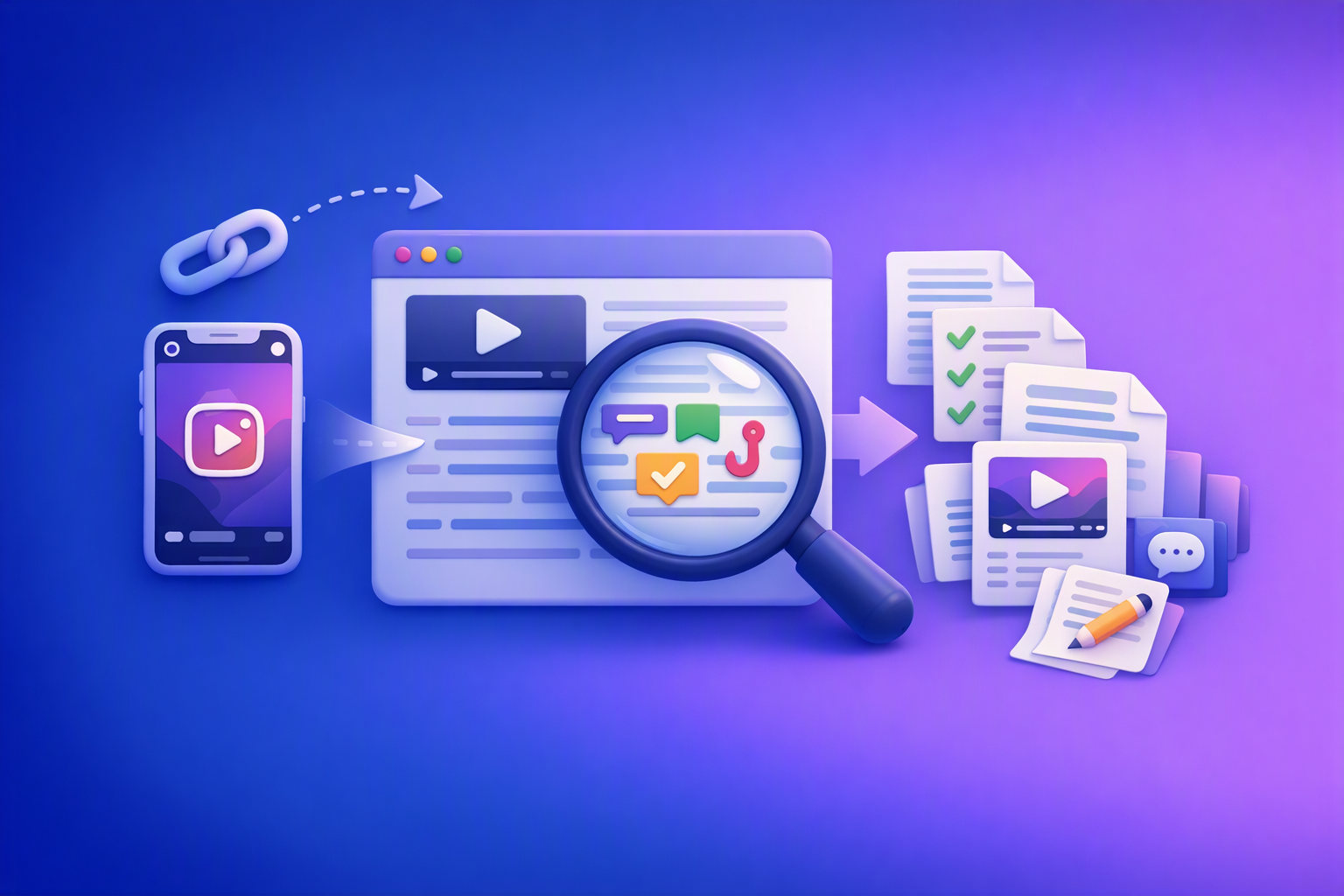
A 2026 reel analyser should turn Instagram Reel links into a searchable transcript library you can tag for hooks, CTAs, objections, and topic clusters—then export into repurposing-ready drafts without a download/upload loop.
Traducir video de Instagram (Reels) en 2026: workflow transcript-first para traducir, sacar hooks/CTAs y repurpose (con VideoToTextAI)
Video To Text AI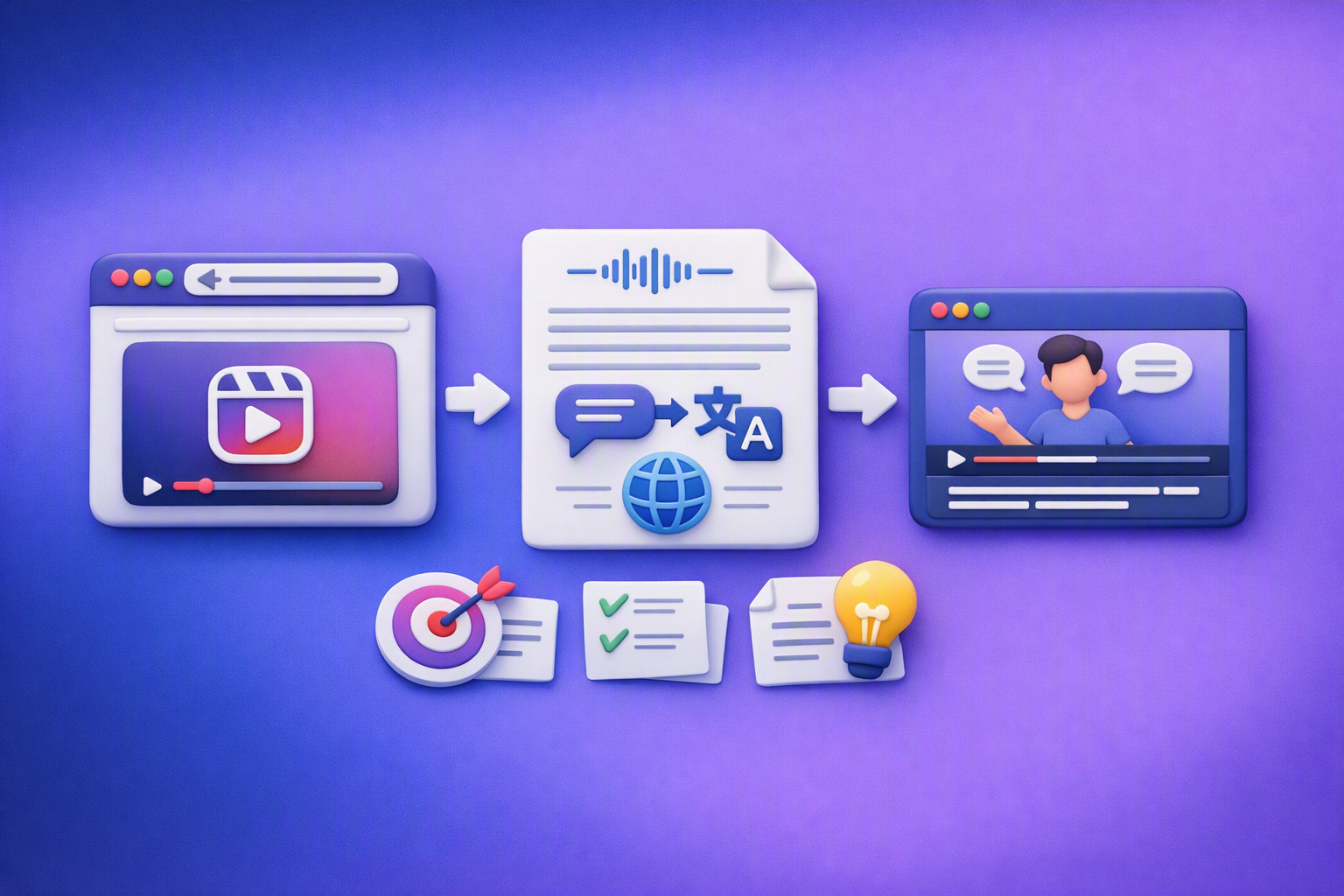
Aprende a traducir un Reel de Instagram con un flujo URL→transcripción→traducción→subtítulos, y a convertir esa traducción en un activo de investigación para hooks, CTAs, objeciones y clusters de contenido.
Reel Analyzer: Transcript‑First Instagram Reels Research (Hooks, CTAs, Objections) + Workflow Guide (VideoToTextAI)
Video To Text AI
A reel analyzer should turn any public Instagram Reel link into a searchable transcript library you can mine for hooks, CTAs, objections, and topic clusters—then repurpose into original drafts with a repeatable SOP.