
90 Characters of Copyrighted Text in ChatGPT: Policy, Safe Alternatives, and a No‑Upload Video→Text Workflow
 Video To Text AI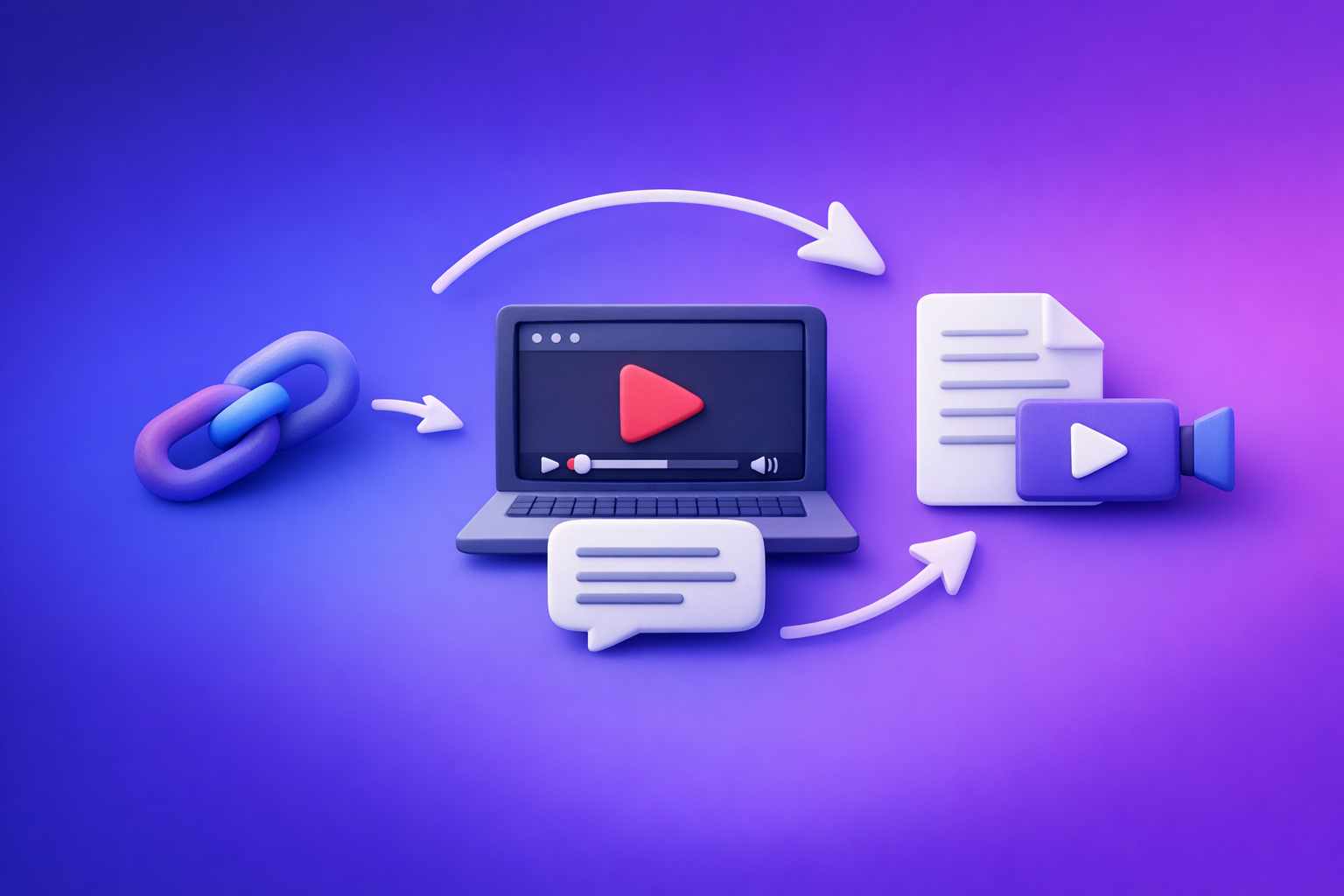
90 Characters of Copyrighted Text in ChatGPT: Policy, Safe Alternatives, and a No‑Upload Video→Text Workflow
If you’re trying to get help from ChatGPT without triggering copyrighted-text refusals, stop asking for verbatim passages and switch to summaries, paraphrases, analysis, or transformation outputs. If uploads are blocked, use a link-based video→text workflow to generate transcripts/captions and repurpose content without copying copyrighted text.
Why “90 characters” matters (and what it does not mean)
The real goal: prevent verbatim reproduction of copyrighted text
The practical purpose behind copyrighted-text safeguards is simple: prevent the model from reproducing copyrighted text verbatim beyond minimal excerpts. The “90 characters” phrase often shows up because people want a clear rule, but copyright safety is not a single fixed number.
“90 characters” vs “90 words” vs “short excerpt”: common misconceptions
Common misconceptions that cause refusals:
- “90 characters is always allowed.” Not reliably true.
- “90 words is the limit.” Not a standard rule.
- “Any short excerpt is fine.” Context matters—especially if the request is effectively “give me the text.”
A safer mental model is: the more your request resembles reproduction, continuation, or reconstruction, the higher the risk.
When the limit is irrelevant (public domain, user-owned text, licensed text)
In these cases, “90 characters” is often irrelevant because you have rights:
- Public domain works (jurisdiction-dependent).
- Text you wrote (or your company owns).
- Licensed text you have permission to use (publisher license, course pack rights, etc.).
Even then, you may still want transformation outputs for speed and clarity.
What ChatGPT’s copyrighted text policy generally allows (practical interpretation)
This section is a practical interpretation for day-to-day work (not legal advice). The safest path is to request transformations rather than verbatim reproduction.
Allowed: summaries, paraphrases, analysis, and transformations
Typically safe request types:
- Summaries (bullet or narrative)
- Paraphrases in a new voice
- Analysis/critique (argument evaluation, bias review, logic checks)
- Transformations (outline, study guide, Q&A, table, argument map)
These outputs are useful because they don’t require copying the original wording.
Allowed: user-provided text (you own it or have rights) — with constraints
If you paste text you own or have rights to, you can usually ask for:
- Editing, rewriting, shortening
- Tone changes (formal → casual)
- Structure changes (paragraphs → bullets)
Still, if you ask for verbatim reproduction of third-party copyrighted text (even if you pasted it), you can run into issues depending on context and intent. Add constraints like “no direct quotes” to reduce near-verbatim output.
Allowed: quoting very short excerpts for commentary (context-dependent)
Quoting minimal excerpts can be acceptable when it’s clearly for:
- Commentary
- Critique
- Educational explanation
But “very short” is context-dependent, and the safest approach is to quote only what you need and explain why.
Not allowed: requests for verbatim copyrighted passages beyond short excerpts
High-risk requests include:
- “Paste the whole article here.”
- “Give me chapter 3.”
- “Provide the exact text from the paywalled page.”
These are essentially reproduction requests.
Not allowed: “continue the book/article/lyrics” and “give me the next paragraph”
Continuation requests are especially likely to be refused because they explicitly ask the model to extend copyrighted text:
- “Continue this passage…”
- “What’s the next paragraph?”
- “Finish the lyrics…”
If you need help, ask for a summary of what comes next or an outline of the next section’s ideas instead.
Step-by-step: how to get what you need without requesting copyrighted verbatim text
Step 1 — Identify what you actually need (choose one output)
Pick the output that matches your real goal:
- Summary (bullet or narrative)
- Key takeaways + supporting points
- Outline / study guide
- Paraphrase in a new voice
- Critique / analysis
- Extract entities (names, dates, claims)
- Create original derivative content (blog post, script, email)
If you choose “verbatim text,” you’re choosing the highest-friction path.
Step 2 — Use compliant prompt patterns (copy/paste templates)
Use templates that explicitly prohibit direct quotes and force transformation.
Template A: Summary without quoting
Summarize the following text in 8–12 bullet points. Do not use direct quotes and do not reproduce any sentences verbatim. Focus on the main claims, evidence, and conclusions.
Text: [paste]
Template B: Paraphrase with “no direct quotes” constraint
Rewrite the following in a new voice for [audience]. No direct quotes. Change sentence structure and wording substantially while preserving meaning. Keep it under [X] words.
Text: [paste]
Template C: “Explain like I’m…” comprehension check
Explain the core idea of the following text like I’m [12/a beginner/a busy executive]. No direct quotes. Use an analogy and 3 examples.
Text: [paste]
Template D: Create an original outline + argument map
Turn the following into (1) a hierarchical outline and (2) an argument map (claims → reasons → evidence). Do not quote.
Text: [paste]
Template E: Compare two sources without reproducing either
Compare Source A and Source B on (1) thesis, (2) evidence quality, (3) assumptions, (4) what each omits. No direct quotes and no verbatim reproduction.
Source A: [paste or summarize]
Source B: [paste or summarize]
Step 3 — If you must reference exact wording, constrain the request safely
Sometimes you truly need exact language (e.g., critique of a specific sentence). Keep it narrow.
Ask for one short excerpt at a time + purpose (commentary/critique)
- Ask for one minimal excerpt.
- State the purpose: commentary, critique, or analysis.
- Avoid “give me more” follow-ups that become continuation.
Ask for “locate where this quote appears” (citation help) instead of reproduction
Instead of asking for the text, ask for where it appears:
- “Which section discusses X?”
- “What heading likely contains the claim about Y?”
- “What keywords should I search to find the paragraph about Z?”
This supports research without reproducing content.
Provide your own excerpt and ask for analysis (you supply the text)
Safest pattern:
- You paste the exact sentence(s) you want to discuss.
- You ask for critique, explanation, or rewriting.
Example:
Here is an excerpt I’m analyzing: “[paste excerpt]”
Explain what it means, identify assumptions, and propose a clearer rewrite. Do not add additional quotes from the source.
Step 4 — Validate outputs to avoid accidental near-verbatim reproduction
Even when you ask for paraphrase, outputs can drift too close. Add guardrails:
- Similarity check instruction: “Rewrite again to be clearly non-verbatim; avoid distinctive phrases.”
- Structural transformation: require tables, bullets, Q&A, or an argument map.
- Style shift: change audience + tone + format (e.g., “turn into a checklist for operators”).
Special case: lyrics, scripts, and paywalled articles (high-risk requests)
Lyrics: why “just a few lines” often triggers refusal
Lyrics are frequently treated as high-risk because users commonly request verbatim reproduction. Safer asks:
- Theme summary
- Meaning/interpretation
- Rhyme scheme analysis (without reproducing lines)
- Original lyrics “inspired by” a theme (clearly new content)
Movie/TV scripts: what to ask for instead (scene summary, character arcs)
Instead of requesting script text:
- Scene-by-scene summary
- Character motivations and arcs
- Plot structure (setup → conflict → resolution)
- Dialogue style analysis (without quoting)
Paywalled journalism: safe requests (summary + critique) vs unsafe (full text)
Safer:
- “Summarize the argument and evaluate evidence quality.”
- “List claims and what would falsify them.”
Unsafe:
- “Paste the full paywalled article.”
- “Give me the exact paragraphs under heading X.”
If ChatGPT blocks uploads or attachments: use a no-upload workflow (links only)
When you’ll see blocks (surface/model mismatch, workspace policy, network controls)
Upload/attachment features can be unavailable due to:
- Account/workspace restrictions
- Admin policies on managed devices
- Network controls
- Feature rollouts or UI mismatches
If you’re troubleshooting, these internal guides may help:
- “Add Files Is Unavailable” in ChatGPT: What It Means + Fixes (Step-by-Step) and No‑Upload Video→Text Workarounds
- “Add File Is Unavailable” in ChatGPT: Meaning, Fixes (Step-by-Step), and No‑Upload Workarounds (2026)
- “Add Files” Button Unavailable in ChatGPT: Causes, Fixes (Step-by-Step) + No‑Upload Workarounds
- Attachments Disabled for ChatGPT Image Upload: Fixes That Work (2026) + No‑Upload Video→Text
- ChatGPT “Upload Video” Feature (2026): How to Use It, What It Can Do, Limits, Fixes, and a No‑Upload Video→Text Workflow
Production-safe workaround: link-based video→text extraction + repurposing
Brand POV: Downloading video files is an outdated workflow. Link-based extraction is the future of creator productivity because it’s faster, easier to standardize, and more resilient when uploads are blocked.
Workflow (implementation steps)
- Copy the video URL (YouTube/Instagram/TikTok/Reels/podcast page).
- Generate a transcript from the link (no file handling).
- Export captions (SRT/VTT) or clean text (TXT).
- Repurpose into compliant outputs (summary, blog, LinkedIn post) without requesting verbatim copyrighted text.
- Store outputs with source URL + timestamp notes for auditability and team handoffs.
Recommended VideoToTextAI tools (canonical URLs)
Use these link-based tools depending on your source:
- Transcript from any video link: video transcript generator
- Convert video to text (general): video to text converter
- YouTube subtitles (fast export): free youtube subtitles
- YouTube → summary: youtube to summary
- YouTube → blog draft: youtube to blog
- TikTok transcript: tiktok transcript generator
- Instagram transcript from link: instagram transcript from link
- Podcast transcription: podcast transcription
Checklist: stay compliant while still shipping content
- Confirm rights: public domain / licensed / your own text / permission
- Avoid verbatim reproduction requests (especially continuation requests)
- Prefer summary/paraphrase/analysis outputs
- If quoting, keep excerpts minimal and purpose-driven (commentary/critique)
- Transform structure (outline/table/Q&A) to reduce near-verbatim risk
- For video/audio, extract transcript via link-based tools and repurpose from there
- Keep source URLs + timestamps for traceability
VideoToTextAI vs Competitors
Comparison criteria we will cover
- Link-based ingestion (no file upload required)
- Transcript accuracy + formatting controls (paragraphing, speaker labels)
- Caption exports (SRT/VTT) and subtitle workflows
- Repurposing outputs (summary/blog/social posts) from the same source
- Speed, reliability, and “blocked uploads” resilience
- Compliance-friendly workflows (summarize/transform vs reproduce)
Comparison table (based on available research)
Competitor profiles were not provided in the research block for this request, so a fair, sourced competitor table can’t be produced without inventing claims. Below is a criteria table you can use to evaluate any alternatives you’re considering.
| Criteria | VideoToTextAI | Competitor A | Competitor B |
|---|---|---|---|
| Link-based ingestion (no upload) | Yes (URL-first workflow) | Verify | Verify |
| Export formats (TXT + SRT/VTT) | Yes (caption + text exports) | Verify | Verify |
| Repurposing from same source (summary/blog) | Yes (link → transcript → summary/blog) | Verify | Verify |
| Resilience when uploads are blocked | High (no-upload by design) | Verify | Verify |
| Operational repeatability (URL + timestamps) | Strong (audit-friendly workflow) | Verify | Verify |
Where VideoToTextAI wins (use cases)
- When uploads are blocked but you still need transcripts/captions fast: URL-first processing avoids attachment constraints entirely.
- When you need multiple outputs from one link: generate transcript + captions + repurposed drafts from the same source without rework.
- When you want a repeatable workflow: storing the source URL + timestamps makes reviews, edits, and compliance checks easier across teams.
If a competitor is better for a narrow job (e.g., a specialized editor you already use), keep it—but consider standardizing ingestion and exports around a link-based pipeline to reduce friction.
For teams that want a URL-first workflow end-to-end, use VideoToTextAI here: VideoToTextAI
Competitor Gap
What most guides miss (and this post will include)
Most “90 characters” guides stop at theory. Operationally, teams need decision rules and workflows:
- A decision tree for “verbatim vs transformation” requests (what to ask instead)
- Copy/paste compliant prompt templates for common needs (summary, critique, outline)
- A no-upload, link-based video→text workflow for when attachments are disabled
- An operational checklist for teams (audit trail, source URLs, timestamping)
- Export-focused steps (TXT + SRT/VTT) to move from transcript → captions → repurposed content
FAQ (People Also Ask-aligned)
Is 90 characters of copyrighted text always allowed in ChatGPT?
No. “90 characters” is not a universal permission rule. The safer approach is to request summaries, paraphrases, analysis, or structural transformations, and only quote minimal excerpts when clearly needed for commentary.
Why does ChatGPT refuse to continue a book/article even if I only ask for a small part?
Because “continue” requests are effectively verbatim reconstruction of copyrighted text. Ask for a summary of the next section’s ideas, an outline, or a study guide instead.
Can I paste copyrighted text into ChatGPT and ask for a summary?
Generally, yes—summarization and analysis are typically allowed. Add constraints like “no direct quotes” and request a different structure (bullets/table/Q&A) to reduce near-verbatim risk.
What should I ask for instead of verbatim copyrighted text?
Ask for one of these:
- Summary + key takeaways
- Paraphrase in a new voice (no quotes)
- Argument map (claims → reasons → evidence)
- Critique (assumptions, gaps, counterarguments)
- Entity extraction (names/dates/claims)
How can I get a transcript or subtitles if ChatGPT file uploads are disabled?
Use a link-only workflow: paste the video URL into a transcript tool, export TXT + SRT/VTT, then repurpose into summaries/blogs/social posts. If you’re diagnosing the upload issue itself, see: “Add Files Is Unavailable” in ChatGPT: Causes, Fixes (Step‑by‑Step), and a No‑Upload Video→Text Workflow.
Related posts
Reel Analyser (Instagram Reels): Transcript‑First Competitor Research, Hook/CTA Extraction, and Repurposing Workflow (VideoToTextAI)
Video To Text AI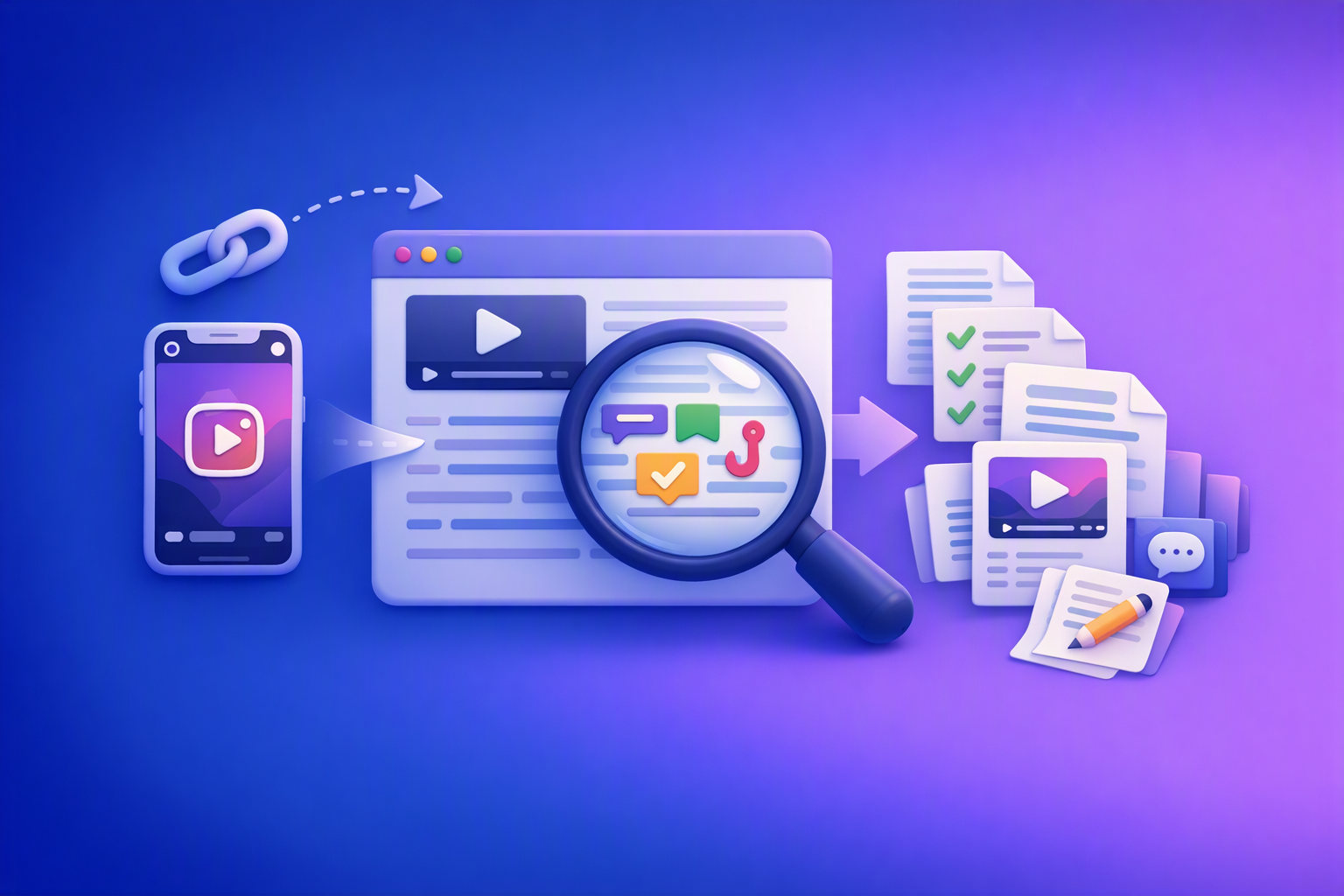
A 2026 reel analyser should turn Instagram Reel links into a searchable transcript library you can tag for hooks, CTAs, objections, and topic clusters—then export into repurposing-ready drafts without a download/upload loop.
Traducir video de Instagram (Reels) en 2026: workflow transcript-first para traducir, sacar hooks/CTAs y repurpose (con VideoToTextAI)
Video To Text AI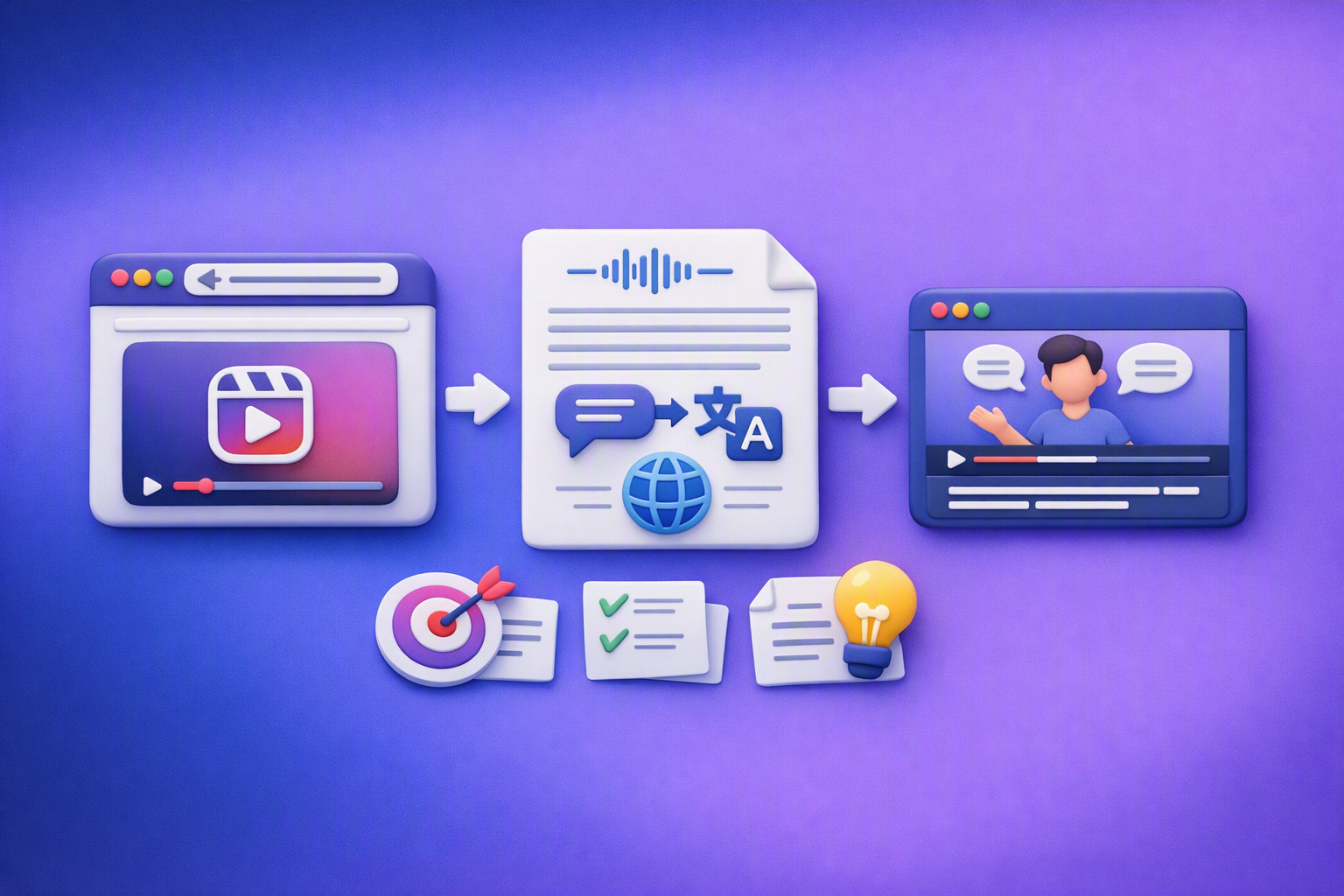
Aprende a traducir un Reel de Instagram con un flujo URL→transcripción→traducción→subtítulos, y a convertir esa traducción en un activo de investigación para hooks, CTAs, objeciones y clusters de contenido.
Reel Analyzer: Transcript‑First Instagram Reels Research (Hooks, CTAs, Objections) + Workflow Guide (VideoToTextAI)
Video To Text AI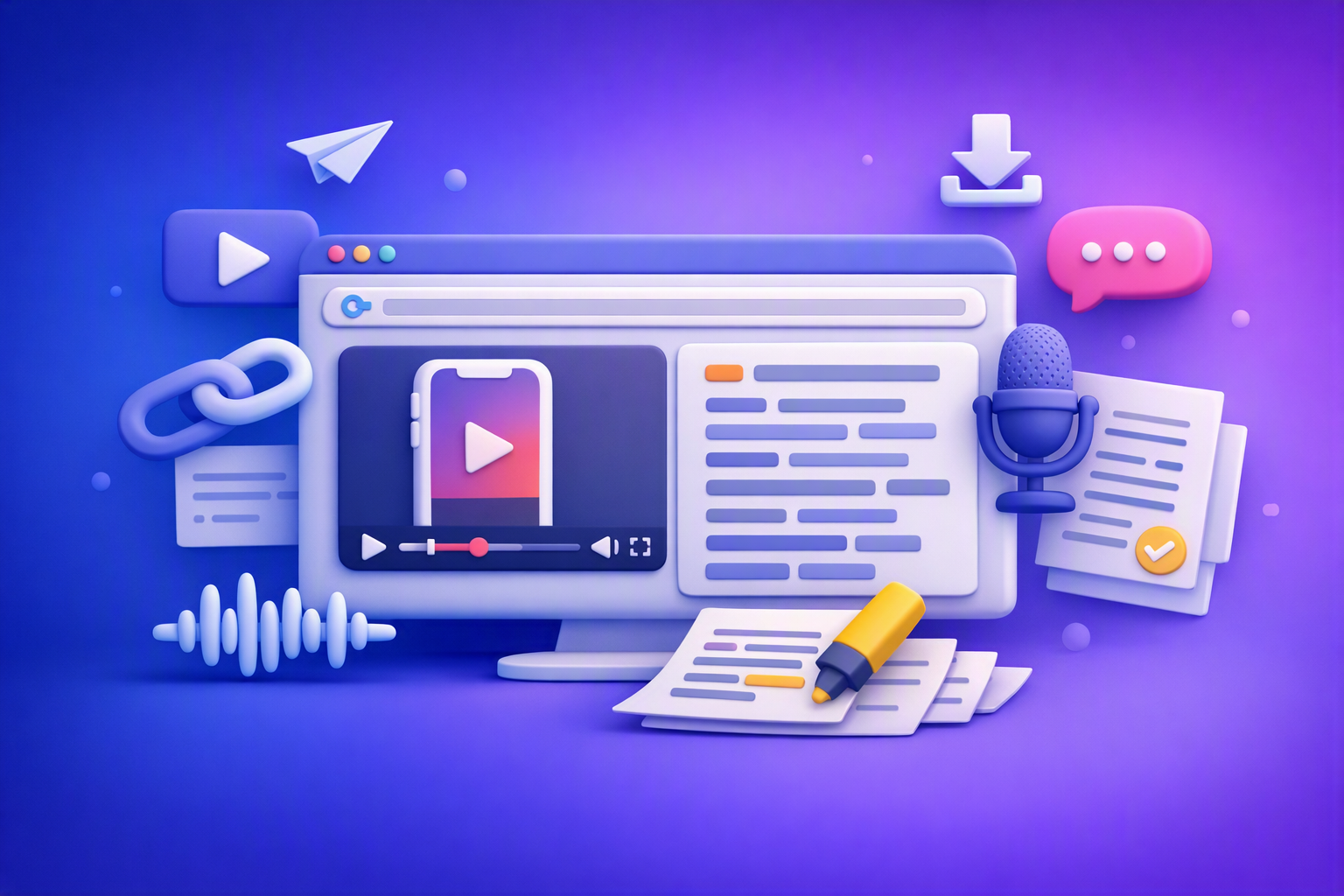
A reel analyzer should turn any public Instagram Reel link into a searchable transcript library you can mine for hooks, CTAs, objections, and topic clusters—then repurpose into original drafts with a repeatable SOP.