
90 Characters of Copyrighted Text in ChatGPT: What It Means + Safe, Practical Workflows (VideoToTextAI)
 Video To Text AI
Seeing the “90 characters” + “copyrighted” message in ChatGPT usually means your prompt looks like a request for verbatim text (or a continuation of it). The fix is to switch to summary/paraphrase/structure prompts and use a link-based video→text workflow so you’re not copy/pasting protected text into chat in the first place.
90 Characters of Copyrighted Text in ChatGPT: What It Means + Safe, Practical Workflows (VideoToTextAI)
TL;DR (for busy teams)
- What the message signals (and what it doesn’t): It’s a policy refusal pattern that often appears when ChatGPT thinks you want word-for-word copyrighted text.
- Fast “safe rewrite” prompt patterns: Ask for summaries, paraphrases, outlines, commentary, and original content inspired by themes—not “continue” or “quote the next part.”
- No-copy/paste workflow: Use link-based extraction to generate transcripts/captions, then use ChatGPT for transformations (blog drafts, social packs, email sequences) instead of reproduction.
Mid-article note: if your team keeps hitting refusals because you’re pasting text, stop treating copy/paste as the default. Downloading files and shuttling text between tools is an outdated workflow; link-based extraction is the future of creator productivity.
What “90 Characters” + “Copyrighted” in ChatGPT Actually Means
The message you’re seeing (common variants)
You’ll typically see one of these:
- “I can’t provide more than 90 characters of copyrighted text…”
- “I can’t help with that request…”
- “I can’t provide that content…”
What it’s not
This message is commonly misunderstood. It is not:
- A legal fair use determination
- A guaranteed “safe limit” you can game by requesting 89 characters repeatedly
- Proof the content is copyrighted (it’s a policy-based refusal pattern, not a courtroom verdict)
What it usually indicates
In practice, it usually means:
- Your prompt is requesting verbatim reproduction (or near-verbatim) of protected text
- The model detects a request that resembles quoting/continuing a known passage (books, articles, lyrics, scripts)
- You’re asking for a full transcript or “the next paragraph,” which looks like continuation
Why ChatGPT Refuses: The Practical Policy Logic (No Legal Jargon)
ChatGPT is designed to avoid helping users reproduce large chunks of protected text. The refusal is less about your intent and more about the shape of the request.
Requests that commonly trigger the refusal
These patterns often trip the “verbatim reproduction” wire:
- “Continue this paragraph…”
- “Give me the exact transcript/lyrics”
- “Quote the next section”
- “Provide the full text of…”
Requests that are usually allowed (and why)
These are typically fine because they ask for ideas and transformations, not copying:
- Summaries (non-verbatim)
- Paraphrases (transformative wording)
- Extracting structure (outline, key points, themes)
- Commentary/analysis (meaning, critique, implications)
Quick Self-Check: Are You Asking for Verbatim Text?
Red-flag wording checklist (copy/paste into your team SOP)
If your prompt includes any of these, you’re more likely to trigger a refusal:
- “exact,” “verbatim,” “word-for-word,” “full text,” “complete transcript,” “continue,” “the next paragraph,” “quote”
- “match the original tone and wording”
- “keep the same sentences but rephrase slightly”
Safer wording swaps (before → after)
Use these swaps to keep the task productive while reducing refusal risk:
- “Quote the section about X” → “Summarize the section about X in 5 bullets”
- “Continue this passage” → “Write an original explanation of the same concept for beginners”
- “Give me the transcript” → “Create a timestamped outline of the video’s topics”
What To Ask Instead: Safe Prompt Patterns That Still Get the Job Done
Below are prompt patterns that teams can standardize. They’re designed to produce usable outputs without asking for reproduction.
Pattern 1: Summary with constraints (fastest)
Use when: You need quick comprehension, meeting notes, or a brief for stakeholders.
Prompt template:
- “Summarize the content about [topic] for [audience] in [length]. Output as [bullets/executive summary]. Include key takeaways + action items.”
Pattern 2: Paraphrase for clarity (transformative rewrite)
Use when: You have your own notes, or you’re working from authorized material and want clearer language.
Prompt template:
- “Using my notes below, write a clear explanation for [audience]. Keep wording original. Add examples and define jargon.”
Important: Provide your notes, not copied paragraphs from a paid article/book.
Pattern 3: Extract structure, not sentences
Use when: You want an outline, headings, or a content plan.
Prompt template:
- “Create an outline with H2/H3s for a post about [topic]. Include an argument map, key points, and FAQs. Do not reproduce sentences verbatim.”
Pattern 4: Create original content inspired by a theme
Use when: You want net-new content that’s aligned with a topic but not derivative.
Prompt template:
- “Write an original [blog post/script/email] on [theme] with the angle [angle]. Use these examples I provide. Avoid direct quotes.”
Step-by-Step: A Safer Workflow for Video → Text Without Risky Copy/Paste
If your workflow involves copying text from a site into ChatGPT, you’re increasing refusal risk and operational friction. A better approach is to start from authorized video sources and generate your own working text assets.
Step 1 — Use a link-based transcript workflow (avoid pasting copyrighted text)
Use a link-based converter so your team can work from a source URL instead of copy/pasting text blocks.
- Tool: video to text converter
- Goal: Generate a working transcript/captions from a video link (especially for content you own, have rights to, or are authorized to repurpose).
Why this matters operationally:
- Links are easier to standardize in SOPs than “paste the text”
- It reduces accidental “continue this passage” prompting
- It’s faster than downloading, uploading, and reformatting files
Step 2 — Generate captions/subtitles in production formats
If you’re publishing, you’ll want subtitle formats that drop into editors and platforms cleanly.
- MP4 → SRT: mp4 to srt
- YouTube subtitles: free youtube subtitles
Tip: Keep a consistent naming convention: Project_Channel_Date_Language.srt.
Step 3 — Repurpose into compliant outputs (summary, blog, posts)
Once you have a transcript you’re authorized to use, repurpose it into new assets.
- YouTube video → blog draft: youtube to blog
- YouTube video → summary: youtube to summary
- TikTok video → blog post: tiktok video to blog post
- Instagram Reel → blog post: instagram reel to blog post
Brand POV: This is where link-based extraction wins. Downloading video files to “do content” is an outdated workflow; link-based pipelines are the future because they’re repeatable, auditable, and faster for teams.
Step 4 — Use ChatGPT for transformation, not reproduction (prompt templates)
Use ChatGPT after you have a legitimate working transcript, and focus on original wording.
Template A: “Transcript → blog post” (original, non-verbatim)
- “Using the transcript below, write an original blog post for [audience]. Do not quote long passages; rewrite in your own words. Include: H2s, examples, and a checklist.”
Template B: “Transcript → short-form content pack”
- “Turn this transcript into: 10 hooks, 5 LinkedIn posts, and 1 email. Keep wording original; avoid direct quotes.”
Template C: “Transcript → outline + talking points”
- “Create a detailed outline and talking points. Do not reproduce sentences verbatim; focus on ideas and structure.”
Implementation Checklist (Use This Before You Hit Send)
Use this as a pre-flight check for prompts and workflows:
- I’m not asking for “full text,” “verbatim,” or “continue the passage”
- I’m requesting a summary, paraphrase, outline, or commentary
- If using source material, I’m providing my own notes or a transcript I’m authorized to use
- Outputs are original wording (no long quotes)
- Captions/subtitles are generated from the video source via a workflow (not copied from protected text)
- If quoting is necessary, I’m limiting to short excerpts and adding commentary/context
Common Scenarios + The Safest Way to Handle Each
Scenario: “I need a transcript for captions”
Use link-based extraction + subtitle formats:
- Transcript generator: video transcript generator
- MP4 → SRT: mp4 to srt
Then: Edit for speaker labels, brand terms, and on-screen timing.
Scenario: “I want to turn a YouTube video into a blog post”
- Use: youtube to blog
Then ask ChatGPT:
- “Rewrite this into an original SEO blog post with H2s, FAQs, and a checklist. Avoid direct quotes; keep wording original.”
Scenario: “I’m summarizing a podcast episode”
Then generate:
- Executive summary (5–7 bullets)
- Key takeaways
- “Who this is for / who should skip”
- Action items
Scenario: “I’m repurposing short-form (Reels/TikTok)”
- Reels: reel to post converter
- TikTok transcript: tiktok transcript generator
Then ask ChatGPT:
- “Create 3 caption options, 10 hooks, and 5 comment replies. Keep it original; no direct quotes.”
VideoToTextAI vs Competitors
Competitor profiles were not provided in the input dataset, so this section compares category-level alternatives teams commonly use. The goal is to choose the workflow that’s fastest, repeatable, and least likely to push people into risky copy/paste prompting.
| Option | Input method | Outputs you typically get | Workflow speed (link → usable assets) | Compliance posture (reduces verbatim-copy prompting risk) | Best for |
|---|---|---|---|---|---|
| VideoToTextAI | Link-based video → text | Transcripts + captions/subtitles (SRT) + repurposed drafts via dedicated tools | Fast because you start from a URL and move directly into transcript/caption/repurpose steps | Stronger because the workflow starts from authorized media sources and avoids “paste copyrighted text” habits | Teams repurposing video content at scale (transcripts, subtitles, blogs, summaries) |
| Upload-to-transcribe tools (file-based transcription apps) | File upload required | Transcripts (sometimes subtitle exports) | Slower when downloading/uploading is required or blocked by admin/network | Mixed; still often leads to copy/paste into chat for repurposing | When you already have local files and uploads are easy |
| In-editor caption generators (platform-native captioning) | Inside a platform editor | Captions inside that platform | Fast for that platform only; limited portability | Neutral; doesn’t solve repurposing or prompt safety | Quick captions for a single platform workflow |
| General-purpose AI chat tools (prompt-only workflows) | Text prompts | Drafts, summaries, rewrites | Fast for writing, but blocked if you rely on pasted protected text | Riskier if users paste articles/books and ask for continuation | Ideation and transformation after you have authorized source text |
Where VideoToTextAI wins (based on the workflow design):
- Link-based input reduces operational friction and eliminates the “download → upload → copy/paste” loop.
- Exports + repurposing depth are built into the tool set (transcripts, SRT, blog drafts, summaries).
- Operational repeatability: teams can standardize on URLs, tool steps, and prompt templates.
Where alternatives can be better (narrower jobs):
- Platform-native captioning can be fine if you only need captions inside one platform and don’t need reusable exports or repurposed assets.
Competitor Gap
Most competing workflows miss the parts that actually prevent “90 characters copyrighted” failures in real teams:
- A concrete “do this instead” prompt library that avoids verbatim reproduction triggers
- A no-upload, link-based workflow for when attachments are blocked or impractical
- A production checklist teams can adopt as an internal policy
- Clear separation between quoting vs summarizing vs paraphrasing vs repurposing from authorized sources
If you want a workflow that scales across creators, editors, and marketers, you need both:
- a link-based source-to-text pipeline, and 2) transformation-first prompts.
FAQ (People Also Ask-Aligned)
Why does ChatGPT mention “90 characters of copyrighted text”?
Because your request resembles verbatim reproduction or continuation of protected text. The model is following a policy pattern, not making a legal judgment.
Is “90 characters” a rule that makes quoting safe?
No. It’s not a dependable threshold. If quoting is necessary, keep excerpts short and add commentary/context, but don’t treat “90 characters” as a loophole.
How can I summarize copyrighted content in ChatGPT without getting blocked?
Ask for summaries, key points, themes, and implications. Avoid prompts like “continue,” “quote,” “full text,” or “exact wording,” and provide your own notes rather than pasted passages.
Can I generate transcripts and captions without copying text into ChatGPT?
Yes. Use link-based tools to generate transcripts and subtitle files from the video source, then use ChatGPT for original rewrites and packaging.
What should I do if ChatGPT refuses even when I’m asking for a summary?
Tighten the prompt:
- Remove any “quote,” “verbatim,” “exact,” or “continue” language
- Ask for bullets, an outline, or commentary
- Provide high-level notes instead of pasted text
- If you need source-based work, use an authorized transcript generated from the video source
Internal Link Plan
Use these related guides to build a complete “no-upload + safe prompting” SOP:
- 90 Characters of Copyrighted Text in ChatGPT: What It Means, What’s Allowed, and Safer Workflows (VideoToTextAI)
- 90 Characters of Copyrighted Text in ChatGPT: Policy, Safe Alternatives, and a No‑Upload Video→Text Workflow
- “Add Files Is Unavailable” in ChatGPT: Meaning, Fixes (Step-by-Step), and No‑Upload Video→Text Workarounds
- “Add Files” Button Unavailable in ChatGPT: Causes, Fixes That Work (2026) + a No‑Upload Video→Text Workflow
- ChatGPT “Upload Video” Feature (2026): How to Use It, What It Can Do, Limits, Fixes, and a No‑Upload Video→Text Workflow
- “Attachments Disabled for” ChatGPT: What It Means + Fixes That Work (2026) + No‑Upload Video→Text Workflow
Suggested CTA Blocks
CTA 1: Stop copy/paste prompts—use link-based video → text
If your team keeps tripping “90 characters copyrighted” refusals, move upstream: start from the video link and generate your working transcript/captions first. Use VideoToTextAI’s link-based converter: video to text converter
CTA 2: Need subtitles fast?
- MP4 → SRT: mp4 to srt
- YouTube subtitles: free youtube subtitles
A practical SOP you can adopt today
To stop the “90 characters” problem from recurring, standardize these rules:
- Never ask ChatGPT to “continue” or provide “full text” of third-party content.
- Generate transcripts/captions via link-based extraction (not copy/paste).
- Use ChatGPT for transformation: summaries, outlines, original rewrites, and repurposed packs.
- Keep a pre-flight checklist in your content brief template so editors and marketers don’t accidentally trigger refusals.
If you implement the workflow above, you’ll spend less time fighting refusals and more time shipping transcripts, subtitles, and repurposed content—without relying on outdated download/upload loops.
Related posts
Reel Analyser (Instagram Reels): Transcript‑First Competitor Research, Hook/CTA Extraction, and Repurposing Workflow (VideoToTextAI)
Video To Text AI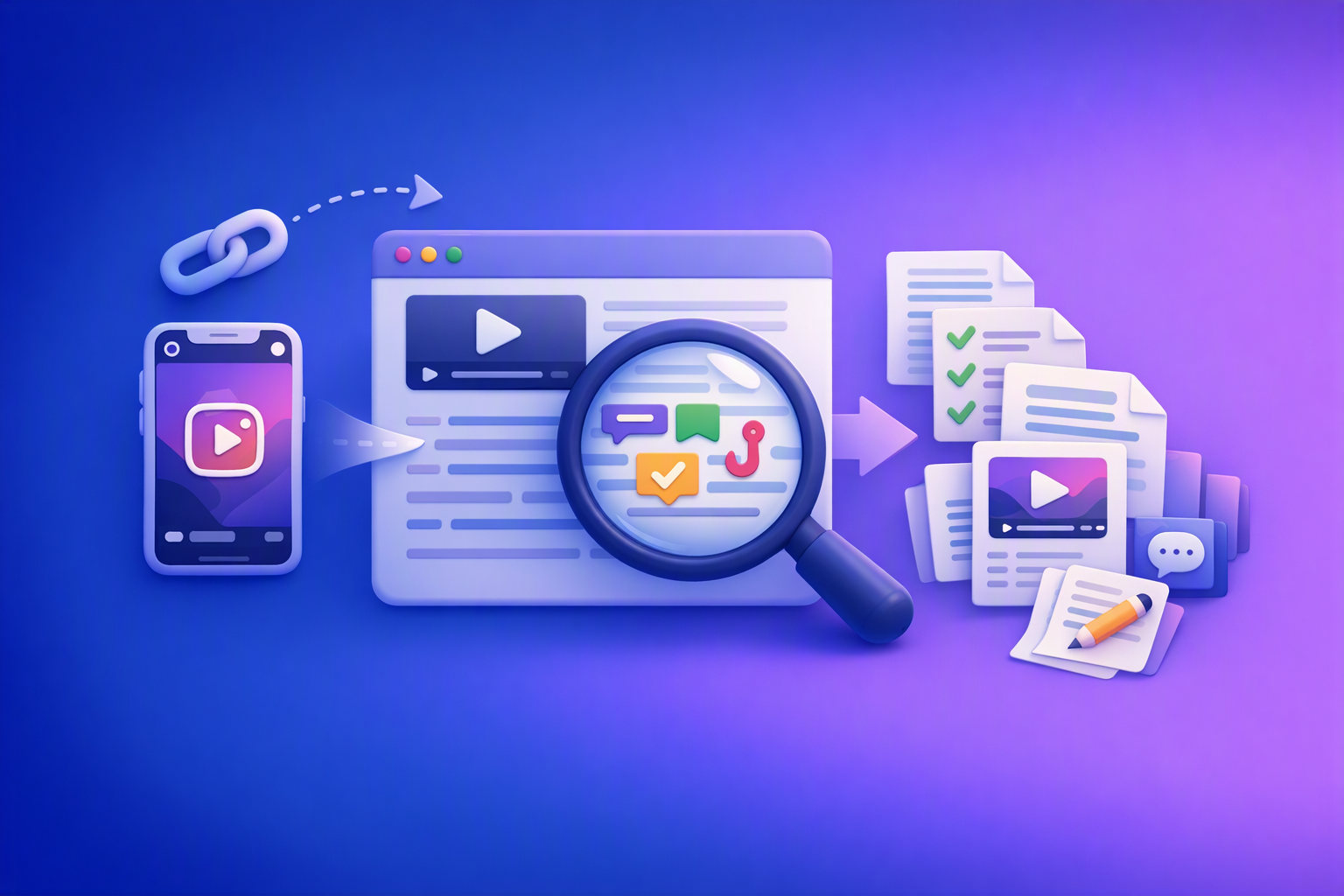
A 2026 reel analyser should turn Instagram Reel links into a searchable transcript library you can tag for hooks, CTAs, objections, and topic clusters—then export into repurposing-ready drafts without a download/upload loop.
Traducir video de Instagram (Reels) en 2026: workflow transcript-first para traducir, sacar hooks/CTAs y repurpose (con VideoToTextAI)
Video To Text AI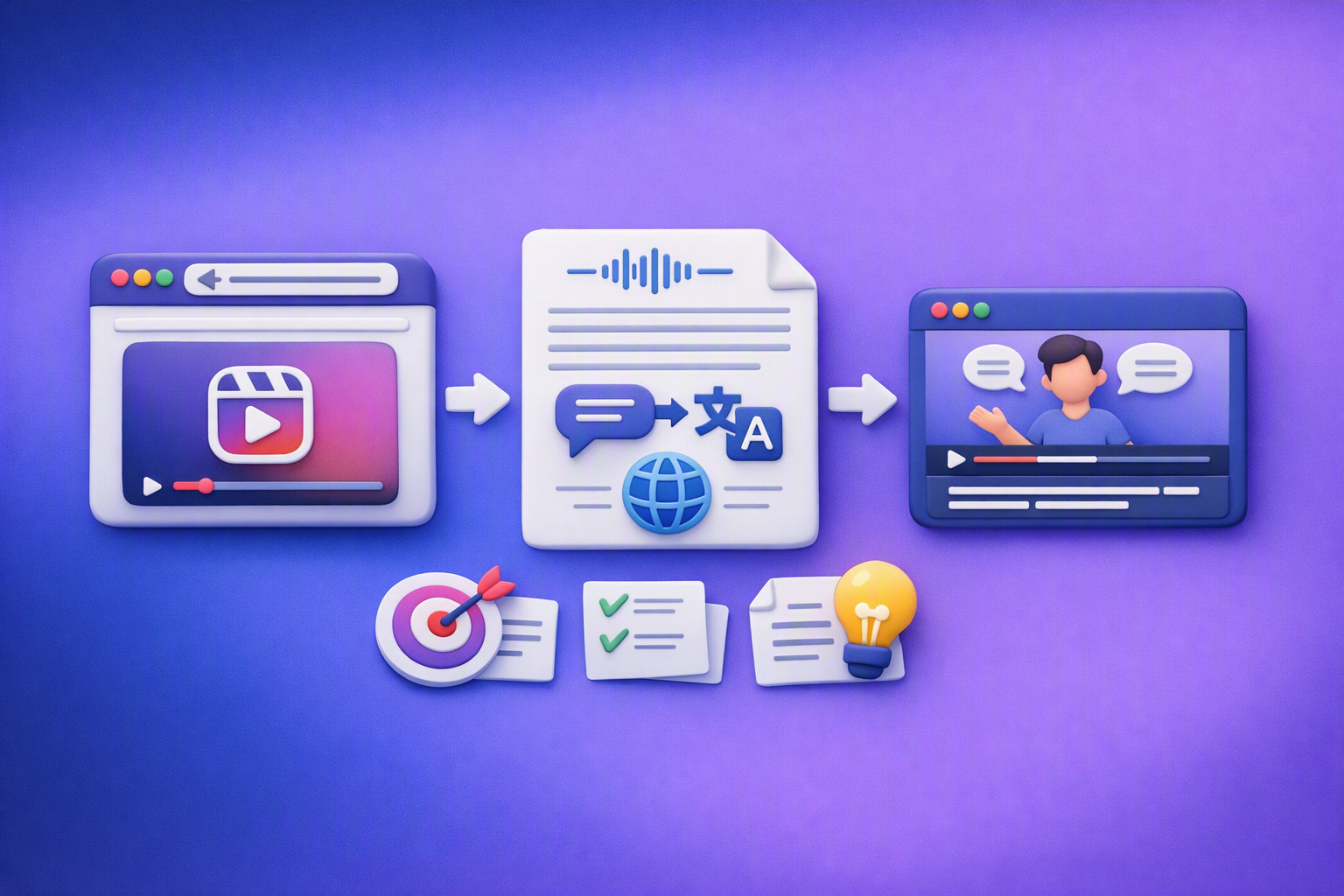
Aprende a traducir un Reel de Instagram con un flujo URL→transcripción→traducción→subtítulos, y a convertir esa traducción en un activo de investigación para hooks, CTAs, objeciones y clusters de contenido.
Reel Analyzer: Transcript‑First Instagram Reels Research (Hooks, CTAs, Objections) + Workflow Guide (VideoToTextAI)
Video To Text AI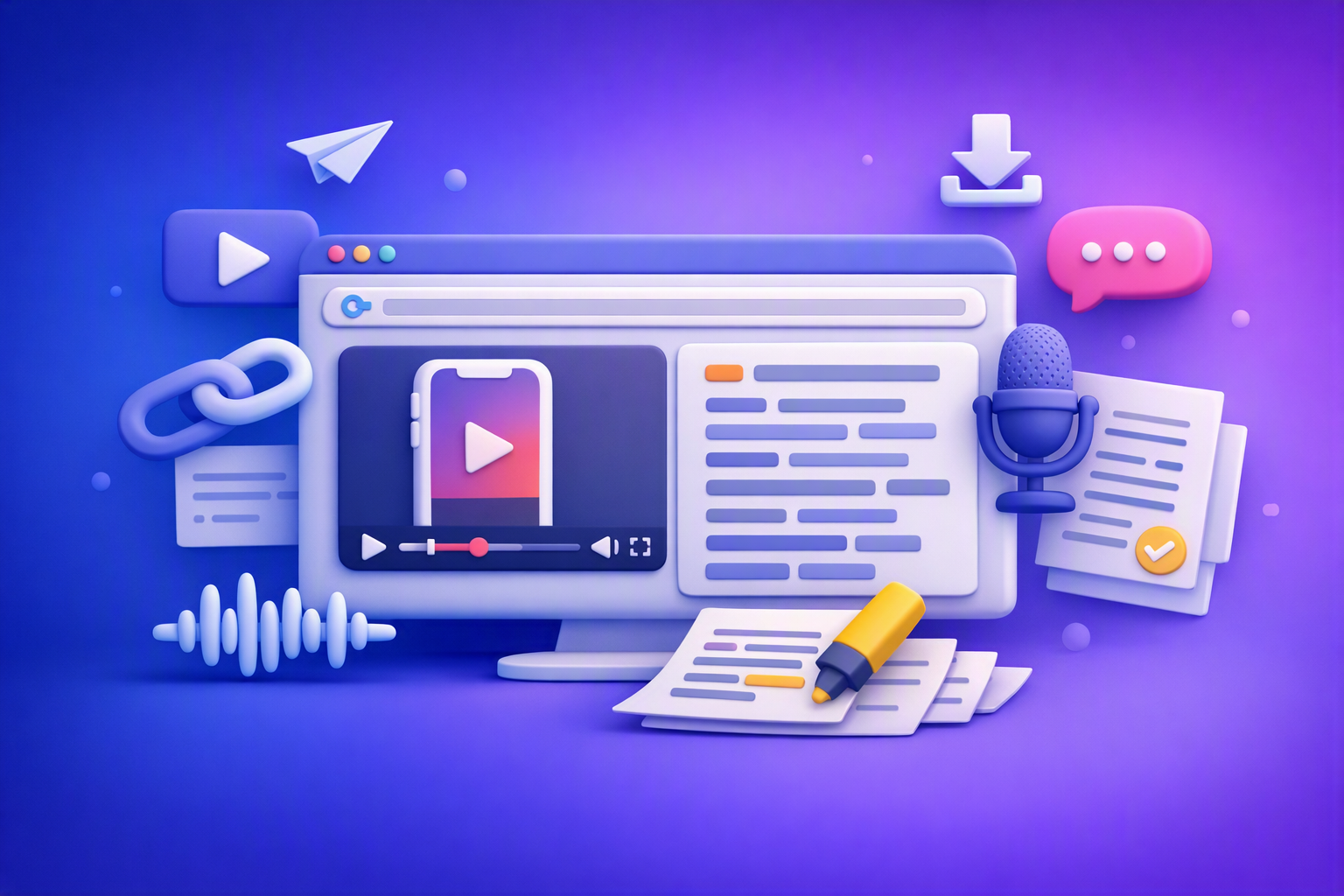
A reel analyzer should turn any public Instagram Reel link into a searchable transcript library you can mine for hooks, CTAs, objections, and topic clusters—then repurpose into original drafts with a repeatable SOP.