
“Add Files” Button Unavailable in ChatGPT: Causes, Fixes That Work (2026) + a No‑Upload Video→Text Workflow
 Video To Text AI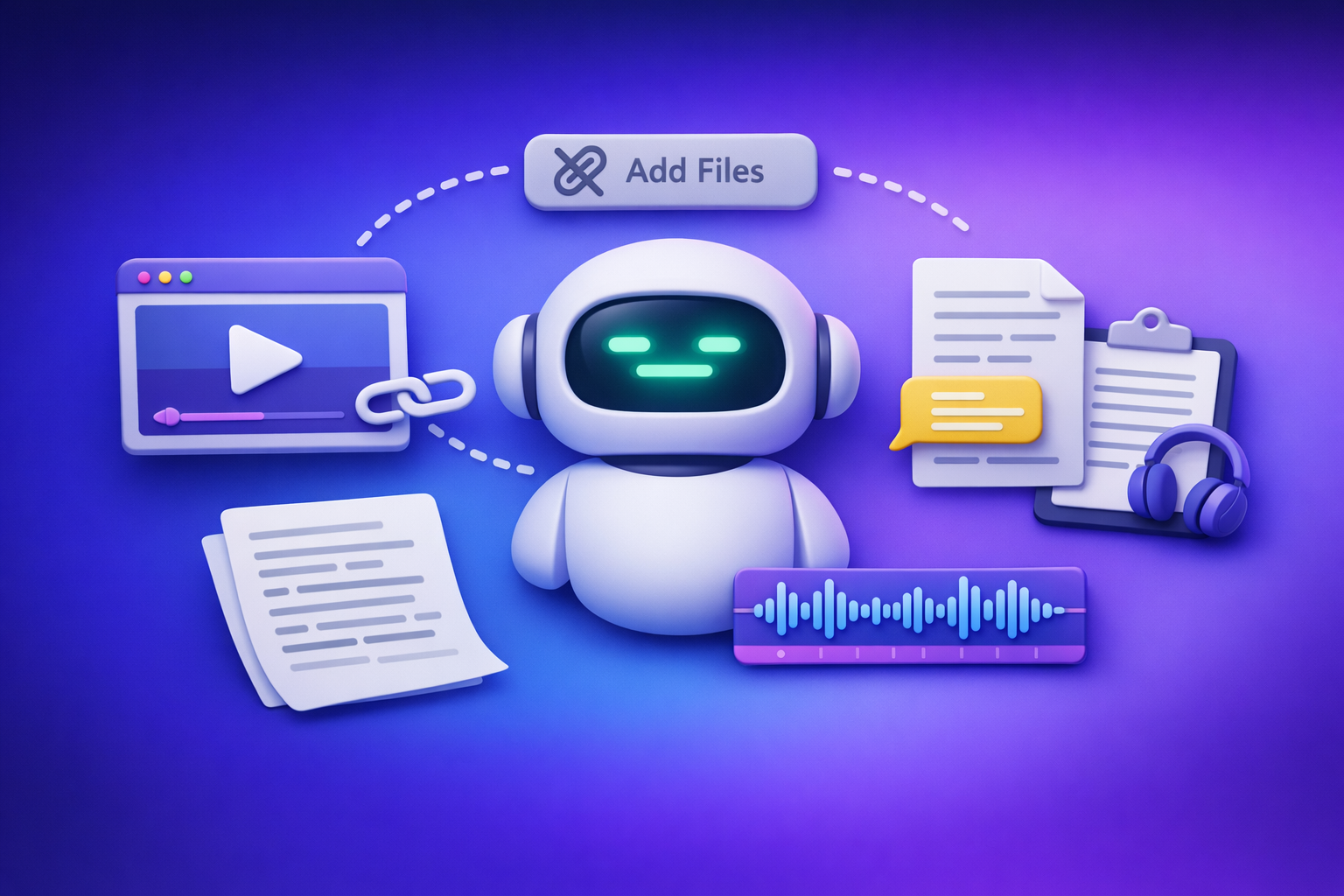
If the “Add files” button is unavailable in ChatGPT, fix it fastest by starting a new chat and switching models, then testing in incognito and on a hotspot to isolate browser vs network vs policy. If uploads still won’t return, you can still ship transcripts/captions using a no‑upload, link-based video→text workflow (outlined below).
What “Add files” button unavailable actually means (and what it doesn’t)
What’s happening under the hood
The upload UI (paperclip / “Add files”) is gated by multiple controls, and any one of them can remove the button:
- Surface: web vs desktop app vs mobile app can differ.
- Model: some models/chats support attachments; others don’t.
- Workspace policy: Team/Enterprise/Edu admins can disable attachments.
- Account state: feature rollouts, temporary restrictions, or plan changes can affect availability.
- Network/browser controls: script blockers, DLP tools, proxies, VPNs, and strict privacy settings can break the UI.
What it does not mean
Missing uploads is frustrating, but it’s usually not catastrophic:
- Not automatically a ban.
- Not proof your file is corrupt.
- Not always a size/format issue (those typically show an error after you try uploading, not a missing button).
2‑Minute Diagnosis (decision tree)
Use this order because it eliminates the most common causes first.
Step 1 — Confirm you’re in a chat context that supports uploads
- Start a New chat (don’t troubleshoot inside an older thread).
- Switch models (if your UI allows model selection).
- Re-check whether the paperclip / “Add files” returns.
If it returns only in the new thread/model, you’ve confirmed a surface/model mismatch.
Step 2 — Is it account/workspace policy?
If you’re on ChatGPT Team/Enterprise/Edu, assume policy first.
Quick test:
- Try the same account on a personal network (hotspot) and a personal browser profile.
- If uploads work on personal but not work network, it’s likely policy/DLP/network.
Step 3 — Is it browser/UI state?
- Hard refresh the page.
- Sign out/in.
- Try a Private/Incognito window.
Then check:
- Does the button appear in incognito but not your main profile? That points to extensions/cookies.
Step 4 — Is it network/security tooling?
- Try a mobile hotspot.
- If you’re on corporate Wi‑Fi/VPN: test off VPN, or switch VPN endpoint.
If the button returns on hotspot, your network path is interfering (proxy/DLP/VPN/DNS filtering).
Step 5 — Is it a temporary platform limitation?
Symptoms that suggest temporary limitations:
- Button disappears and reappears across refreshes.
- Adjacent issues like “max 0 uploads at a time” behavior.
Fix:
- Wait 10–30 minutes, then retry in a fresh thread.
Related troubleshooting: “Max 0 Uploads at a Time” Rate Limit in ChatGPT: What It Means, Why It Happens, and Fixes (Plus a No-Upload Video→Text Workflow)
Root causes (mapped to fixes)
Surface/model mismatch (most common)
Symptom
- “Add files” is missing only in certain chats/models, but appears elsewhere.
Fix
- Start a new chat → select a model known to support attachments → re-check the UI.
Workspace/admin restrictions
Symptom
- Button missing for multiple people in the org.
- Works on a personal account or outside the org network.
Fix
- Ask your admin to enable attachments.
- Provide: timestamp, screenshot, device, browser version, and whether you’re on VPN.
Browser extensions and blocked scripts
Symptom
- Button appears briefly, then disappears.
- Only fails in one browser profile.
- UI elements glitch or don’t respond.
Fix
- Disable extensions → whitelist ChatGPT domain in blockers → test in a clean profile.
Cache/cookies/session corruption
Symptom
- Upload UI broke after an update.
- Other UI elements behave inconsistently.
Fix
- Clear site data for ChatGPT (cookies + cache) → re-login → test.
VPN/proxy/DLP filtering
Symptom
- Button missing on work network; returns on hotspot.
- Works off VPN or on a different VPN endpoint.
Fix
- Bypass proxy/VPN where allowed.
- Ask IT to allowlist required domains and remove upload-blocking rules for approved users.
Rate limits / feature rollouts
Symptom
- Intermittent availability.
- Upload-related limits show up in adjacent errors.
Fix
- Wait and retry.
- Reduce concurrent tabs/sessions.
- Use the no-upload workflow below to keep shipping.
Step-by-step fixes (in the fastest order)
Fix 1 — New thread + model switch (60 seconds)
- Open ChatGPT in a new tab.
- Click New chat.
- Switch to a different model (if available).
- Look for the paperclip / “Add files”.
- If it returns, upload in that thread (don’t go back to the broken one).
Fix 2 — Clean browser profile test (2 minutes)
- Open an Incognito/Private window.
- Log in.
- Check if “Add files” is available.
- If yes: the issue is extensions/cookies in your main profile.
Fix 3 — Extension isolation (3–5 minutes)
- Disable all extensions.
- Reload ChatGPT.
- Re-enable extensions one-by-one until the button disappears.
- Keep the culprit disabled for ChatGPT or add an allowlist rule.
Common culprits:
- Script blockers
- Privacy/ad blockers
- Download managers
- Corporate security extensions
Fix 4 — Network isolation (3 minutes)
- Switch to a mobile hotspot.
- Reload ChatGPT.
- If it works: your network/VPN/proxy/DLP is blocking upload capability.
Fix 5 — Workspace policy confirmation (5 minutes)
- Ask a teammate to check the same feature.
- If missing for multiple users: escalate to admin with:
- affected users
- device/browser versions
- timestamp
- screenshot showing missing UI
If your org confirms uploads are intentionally disabled, stop burning time on browser tweaks and move to a no-upload workflow.
Implementation checklist (copy/paste)
- New chat created and tested
- Model switched and re-tested
- Incognito/private window test completed
- Extensions disabled and isolated
- Site data cleared (ChatGPT cookies/cache)
- Hotspot test completed (VPN off)
- Workspace/admin policy confirmed
- Alternative no-upload workflow ready (below)
When you can’t restore uploads: a production-safe no‑upload workflow (VideoToTextAI)
Downloading video files is an outdated workflow. It’s slow, it breaks on device limits, and it’s often blocked by workplace policies. Link-based extraction is the future of creator productivity because it’s faster to run, easier to repeat, and less dependent on fragile upload UI.
Why a no-upload workflow is faster than fighting the UI
- You can still deliver transcripts, captions, and repurposed drafts even when ChatGPT attachments are disabled.
- Link-based ingestion avoids local upload failures and many policy blocks.
- You get clean text outputs you can paste into ChatGPT for editing, summarizing, and formatting.
If you want a single home base for link-based video→text workflows, use VideoToTextAI: VideoToTextAI
Workflow A — Get a transcript from a video link (TXT)
- Copy the video URL (YouTube/TikTok/Instagram Reel, etc.).
- Generate a transcript using VideoToTextAI:
- Export as TXT (or copy to clipboard).
- Paste the transcript into ChatGPT for:
- summaries
- rewriting
- topic extraction
- outlines and scripts
Workflow B — Generate subtitles/captions (SRT/VTT) without ChatGPT uploads
If you have an MP4 and need subtitles:
If you need YouTube subtitles fast:
Then:
- Paste SRT/VTT into Premiere/CapCut/Descript, or into ChatGPT for cleanup (typos, speaker labels, line length).
Workflow C — Repurpose into publish-ready content (blog/social)
Use the same source link and generate drafts you can refine in ChatGPT:
- YouTube → blog draft: youtube to blog
- YouTube → summary: youtube to summary
- TikTok → blog: tiktok video to blog post
- Instagram Reel → blog: instagram reel to blog post
- Reel → LinkedIn post: instagram reel to linkedin post
Operationally, this is more repeatable than “download → upload → hope the button exists,” especially for teams.
VideoToTextAI vs Competitors
Competitor profiles were not supplied in this brief, so the comparison below is criteria-based and does not claim pricing, limits, or features for named vendors.
| Criteria | VideoToTextAI | Typical file-upload-only transcript tools | Typical “all-in-one editor” tools |
|---|---|---|---|
| Input method reliability | Link-based ingestion (designed for URL-first workflows) | Dependent on local uploads; fails when upload UI/policies break | Often supports uploads; link support varies by tool and source |
| Export formats | Built for transcript + caption workflows (e.g., TXT/SRT/VTT use cases) | Exports vary; may require extra steps for captions | Often strong exports, but may be tied to the editor workflow |
| Workflow speed | Fast path: URL → transcript/captions → paste into ChatGPT | Slower: download file → upload → wait → export | Can be fast once imported, but import/upload is still a dependency |
| Repurposing outputs | Purpose-built tools for blog/social conversions from the same source link | Usually transcript-only; repurposing is manual | Repurposing may exist, but often inside the editor ecosystem |
| Operational resilience | Works when ChatGPT attachments are disabled because you paste text outputs | Breaks when uploads are blocked by policy/network | Still impacted by upload restrictions if the editor requires file import |
| Compliance controls (process-level) | Link-first reduces handling of local files and repeated uploads | Requires moving files around (harder in restricted environments) | Can be compliant, but depends on org policy and deployment model |
Why VideoToTextAI wins in practice (when uploads are flaky):
- Link-based input avoids the single point of failure: the ChatGPT “Add files” UI.
- Operational repeatability is higher: the workflow is “URL in → text out,” which is easier to standardize across a team.
- Repurposing is built-in: you can generate drafts (blog/social) from the same link, then use ChatGPT for final polish.
Where a competitor may be better (narrow use case):
- If you need a full timeline editor with heavy post-production features, an all-in-one editor tool can be better for that specific job. The tradeoff is you’re still dependent on import/upload steps.
Competitor Gap
What most “fix the button” articles miss (and this post includes)
- A 2-minute decision tree that isolates surface/model vs policy vs browser vs network (in that order).
- A copy/paste checklist so you don’t repeat the same troubleshooting loop.
- A no-upload fallback that still produces deliverables (transcripts + SRT/VTT) when ChatGPT can’t accept files.
- Clear mapping from symptom → root cause → fastest fix, so you can stop guessing.
For related attachment issues, see:
- “Add Files Unavailable” in ChatGPT: What It Means, Fixes That Work, and a No-Upload Video→Text Workflow (2026)
- “Add Files Is Unavailable” in ChatGPT: What It Means, Fixes That Work (2026), and a No‑Upload Video→Text Workflow
- “Add Files” Button Unavailable in ChatGPT: Causes, Fixes That Work (2026) + a No‑Upload Video→Text Workflow
FAQ (People Also Ask-aligned)
Why is the “Add files” button missing in ChatGPT?
Most often it’s one of these:
- You’re in a model/chat context that doesn’t support attachments.
- Your workspace admin disabled uploads.
- A browser extension or blocked script removed the UI.
- Your network/VPN/DLP blocks upload capability.
Start with New chat + model switch, then test incognito and hotspot.
How do I enable file upload in ChatGPT?
You may not be able to enable it yourself.
Do this in order:
- New chat → switch model → re-check.
- Test in incognito (rules out extensions/cookies).
- Test on hotspot (rules out network controls).
- If you’re on Team/Enterprise/Edu, ask your admin to confirm attachments policy.
Is “Add files unavailable” a ban or account restriction?
Not by default. A missing button is more commonly:
- a surface/model mismatch
- a workspace policy
- a browser/network issue
- a temporary rollout/rate limit
If it’s account-specific, you’ll usually see other account-level symptoms too (plan/feature changes, repeated access issues across devices).
Why does it work on mobile but not on desktop (or vice versa)?
That usually indicates:
- Different surface/app behavior (mobile app vs web).
- Desktop browser extensions interfering.
- Desktop network path (VPN/proxy/DLP) blocking scripts or endpoints.
Use the incognito + hotspot tests to pinpoint which.
What can I do if my workplace blocks ChatGPT uploads?
Treat it as a policy decision first:
- Confirm with a teammate.
- Escalate to admin with a timestamp + screenshot + environment details.
If uploads remain blocked, switch to a no-upload workflow:
- Generate transcript/subtitles from a video link (TXT/SRT/VTT).
- Paste text into ChatGPT for editing and repurposing.
- This avoids the outdated “download video → upload file” loop and keeps production moving.
Related posts
Reel Analyser (Instagram Reels): Transcript‑First Competitor Research, Hook/CTA Extraction, and Repurposing Workflow (VideoToTextAI)
Video To Text AI
A 2026 reel analyser should turn Instagram Reel links into a searchable transcript library you can tag for hooks, CTAs, objections, and topic clusters—then export into repurposing-ready drafts without a download/upload loop.
Traducir video de Instagram (Reels) en 2026: workflow transcript-first para traducir, sacar hooks/CTAs y repurpose (con VideoToTextAI)
Video To Text AI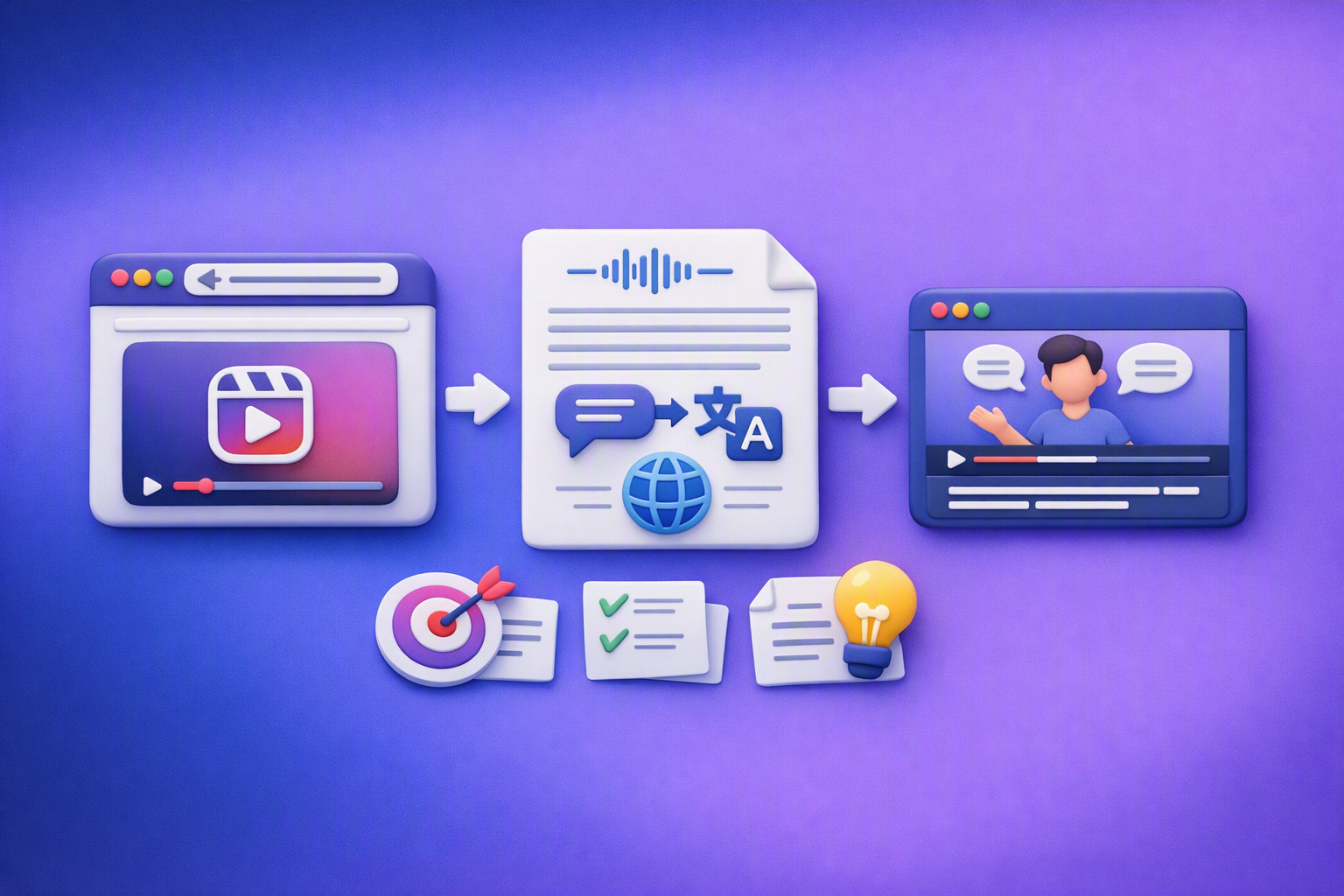
Aprende a traducir un Reel de Instagram con un flujo URL→transcripción→traducción→subtítulos, y a convertir esa traducción en un activo de investigación para hooks, CTAs, objeciones y clusters de contenido.
Reel Analyzer: Transcript‑First Instagram Reels Research (Hooks, CTAs, Objections) + Workflow Guide (VideoToTextAI)
Video To Text AI
A reel analyzer should turn any public Instagram Reel link into a searchable transcript library you can mine for hooks, CTAs, objections, and topic clusters—then repurpose into original drafts with a repeatable SOP.