
Legal Marketing Agency Instagram Reel Competitor Research: Transcript‑First Workflow (Hooks, CTAs, Objections) with VideoToTextAI
 Video To Text AI
Legal marketing agencies should stop “watching” competitor Reels and start indexing them as transcripts you can search, tag, and reuse across clients. This SOP shows how to turn Reel links into a research library that reliably produces hooks, CTAs, objection answers, and topic clusters—without copying competitor wording.
Why legal marketing agencies should treat Reels as competitor research assets (not “content to watch”)
Reels are a live feed of what competitors believe converts right now: what they lead with, what they avoid, and what they ask viewers to do next.
A transcript-first approach makes that measurable and repeatable across multiple clients and practice areas.
What you can reliably extract from competitor Reels (without copying scripts)
From transcripts, your team can extract patterns that are safe to learn from:
- Hook structures that stop the scroll (problem-first, myth-busting, deadline framing).
- CTA mechanics (DM keyword, consult form, “save/share,” call/text).
- Objection handling (fees, eligibility, timing, fear, process anxiety).
- Positioning (who they serve, what they don’t do, what they emphasize).
- Compliance posture (disclaimers, results language, testimonial usage).
The key: you’re extracting categories and angles, not reusing their sentences.
What you should not do in regulated niches (copy-paste wording, implied guarantees, unverifiable outcomes)
In legal marketing, transcript-driven research can create risk if you treat competitor language as “templates.”
Avoid:
- Copying competitor phrasing verbatim (even “common” lines).
- Repeating outcome claims without context and disclaimers.
- Using “specialist/expert” language where restricted by jurisdiction/bar rules.
- Publishing jurisdiction-specific guidance without jurisdiction framing and review.
Use competitor transcripts to identify what topics and objections matter, then write original education content with an attorney review gate.
What “competitor research” means on Instagram Reels for law firms and agencies
Competitor research on Reels is not “who has the most views.” It’s message-market fit analysis: what claims, questions, and next steps are being tested in public.
Define your competitor set (direct firms, adjacent firms, legal educators, agencies)
Build a mixed set so you don’t overfit to one style:
- Direct competitors: same practice area + same geography.
- Adjacent firms: different practice area but same audience (e.g., PI + workers’ comp).
- Legal educators: attorneys who teach broadly (often strong hook patterns).
- Agencies/marketers: useful for format trends and CTA mechanics.
Define your research questions (positioning, offers, objections, CTAs, proof, disclaimers)
Use questions that produce assets you can ship:
- What promise is implied in the first 3 seconds?
- What next step do they push (DM, consult, link-in-bio)?
- What objection is answered, and how early?
- What proof is used (credentials, process, testimonials, case outcomes)?
- What disclaimers appear (or are missing)?
Choose a time window and sample size (e.g., last 30–90 days; 25–50 Reels per competitor)
For agencies, consistency beats perfection:
- Time window: 30–90 days (captures current creative).
- Sample size: 25–50 Reels per competitor (enough to see patterns).
- Focus: prioritize pinned Reels and repeated formats (signals internal winners).
Setup: Build a Reel research library your team can reuse
Your goal is a library that supports search + tagging + briefing, not a folder of random notes.
Create a tracking sheet (minimum fields)
Use a spreadsheet or database with these fields:
- Reel URL
- Account/competitor name
- Practice area + jurisdiction target
- Date posted + format (talking head, b‑roll, carousel-to-reel, interview)
- Hook (first 1–2 lines)
- CTA type (DM, link-in-bio, consult, download)
- Primary objection addressed
- Compliance flags (results claims, “specialist” language, testimonials, case outcomes)
- Notes + next content idea
Tip: make Hook, CTA type, Objection, and Compliance flags dropdowns so tagging stays consistent across team members.
Collect Reel URLs efficiently (sources)
Build your URL list from sources that reflect what Instagram is actively distributing:
- Competitor profile grids (start with pinned Reels).
- Instagram search + hashtags by practice area (e.g., “car accident lawyer,” “custody lawyer”).
- “Suggested for you” (log why it’s suggested: topic/format similarity).
Step-by-step: Transcript-first competitor research workflow (legal marketing agency SOP)
This is where “watching” becomes an operational system. Brand POV: downloading video files is an outdated workflow—link-based extraction is the future of creator productivity because it reduces friction and makes research repeatable.
Step 1 — Turn Reel links into transcripts (fast, repeatable)
Use link-based tools so your team can work from a shared URL list.
- For single Reel URLs: use Instagram to Transcript.
- For teams working from a shared list: use Instagram Transcript From Link.
Operational standard:
- Store one transcript per Reel in a shared folder/knowledge base.
- Save metadata alongside it (competitor, date, practice area, jurisdiction target).
Step 2 — Normalize transcripts for analysis (so patterns show up)
Normalize just enough to compare apples-to-apples:
- Remove filler words only if they distort meaning (don’t rewrite claims).
- Keep timestamps if you plan to map hooks to visuals.
- Tag speaker/context: attorney, narrator, client story, office b‑roll.
This keeps your analysis defensible, especially when compliance review asks, “Where did this claim come from?”
Step 3 — Hook extraction (first 3 seconds) from transcripts
Hooks are easier to compare in text than in video.
Use Instagram Reel Hook Extractor and store outputs in a “Hook Bank.”
Hook categories to tag:
- Problem-first: “If you were injured and…”
- Myth-busting: “No, you don’t have to…”
- Deadline/urgency: “You have X days to…”
- Authority: “As a [practice area] attorney…”
- Story: “Last week a client asked…”
Agency use: once you have 100+ hooks tagged, you can brief new Reels in minutes by pulling proven structures (not competitor wording).
Step 4 — CTA + offer mapping (what they ask viewers to do)
Most legal Reels fail because the CTA is vague (“call us”) or mismatched to the viewer’s stage.
CTA taxonomy for legal marketing (tag each Reel)
Tag each Reel’s CTA as one primary type:
- DM keyword / comment keyword
- Link in bio to consult form
- Call now / text now
- Download checklist/guide
- “Save/share” engagement CTA
Offer clarity scoring (1–5)
Score each Reel’s next step:
- Is the next step explicit?
- Is the audience qualified (jurisdiction/practice area)?
- Is there a compliance-safe disclaimer?
This creates a simple benchmark: “Competitor A uses DM keyword CTAs with high clarity; Competitor B relies on generic ‘call now’ CTAs.”
Step 5 — Objection mining (what prospects are worried about)
Objections are the fastest path to original content ideas because they map directly to client questions and intake friction.
Common legal objections to tag in transcripts
Tag one primary objection per Reel:
- Cost/fees (“How much does it cost?”)
- Eligibility (“Do I have a case?”)
- Timing (“Is it too late?”)
- Risk (“Will this hurt my job/immigration/status?”)
- Process anxiety (“What happens after I call?”)
Output: “Objection → Answer Angle” table (original wording required)
Create a table your writers can use without copying:
| Objection | What competitor addresses (summary) | Your original “answer angle” (brief) | Disclaimer note |
|---|---|---|---|
| “Do I have a case?” | Mentions common qualifying facts | “3 factors we look at in an intake call” | “Not legal advice; depends on jurisdiction/facts” |
| “How much will it cost?” | Mentions contingency/fee structure | “How fees typically work + what to ask before signing” | “Fee arrangements vary; confirm in consult” |
Your writer uses the angle, not the competitor phrasing.
Step 6 — Topic clustering for SEO + Reels series planning
Transcript patterns reveal what the market repeatedly asks. That’s your clustering input for both Reels and SEO.
Build clusters from transcript patterns (not from one-off ideas)
Cluster by:
- Question type: eligibility, timelines, steps, mistakes.
- Scenario: rear-end, slip-and-fall, custody modification, DUI stop.
- Misconception themes: “I waited too long,” “I was partly at fault,” “I didn’t go to the ER.”
Deliverables
For each client, produce:
- 5–10 cluster names
- 3–7 Reel angles per cluster
- 1 pillar page + 3–5 supporting posts per cluster
If you want a deeper walkthrough on transcript-driven ideation, link your team to Instagram Reel Competitor Research: How to Find Hooks, Angles, and Content Ideas From Transcripts.
Step 7 — Repurposing outputs (without copying competitor language)
Repurposing should happen from your own content and notes, not competitor scripts.
Use these tools as drafting accelerators:
- Draft an original post structure from your notes + angle using Reel to Post Converter.
- After publishing your Reel, convert your own transcript into a blog draft using Instagram Reel to Blog Post.
- Reframe for professional education using Instagram Reel to LinkedIn Post.
For more repurposing workflows, see Repurpose Instagram Reels Into Blog Post Ideas: Transcript-First Workflow (Hooks, CTAs, Objections) with VideoToTextAI.
Role-specific operating model: Legal marketing agency workflow (team + client review)
A transcript-first system only works if responsibilities are clear and review is built in.
Who does what (RACI)
- Strategist: competitor set, research questions, cluster plan
- Content lead: hook bank + objection bank + briefs
- Writer: original scripts/blog drafts + citations/disclaimers
- Attorney/client reviewer: compliance + jurisdiction accuracy
- Editor: final QA + CTA alignment
If you manage multiple law firm clients, also standardize how you store research. A shared library prevents “starting over” every month.
Client education deliverables you can ship monthly
These deliverables justify retainers because they show strategic insight, not just posting volume:
- Competitor Messaging Snapshot: hooks, CTAs, objections, formats
- Angle Bank: original angles mapped to practice areas
- Compliance Risk Log: what competitors do that you will avoid
For a legal-specific overview, reference How Law Firms and Legal Marketing Agencies Can Transcribe Instagram Reels for Content Research and Client Education.
Compliance and risk caveats (must-have for regulated niches)
Transcript-first research increases speed. It also increases the risk of accidentally reusing restricted language if you don’t add gates.
Avoid these transcript-driven mistakes
- Copying competitor phrasing verbatim (even short “hooky” lines).
- Repeating outcome claims without context and disclaimers.
- Using “specialist/expert” language where restricted.
- Publishing jurisdiction-specific advice without jurisdiction framing.
Add a review gate before publishing
Use a simple approval checklist:
- Claims: no implied guarantees; no unverifiable outcomes.
- Disclaimers: educational intent; “not legal advice”; results vary where relevant.
- Jurisdiction: clearly stated (or content generalized appropriately).
- Testimonials/case outcomes: compliant usage and permissions.
- Platform policy: avoid misleading claims and sensitive-event exploitation.
VideoToTextAI vs Competitors
Most “best transcription software” pages are built for general transcription. This use case is different: legal marketing agency Instagram Reel competitor research needs a URL-first pipeline, export-ready outputs, and repeatable tagging/briefing.
Comparison criteria (workflow-based, verifiable, and relevant to Reel research)
- URL-first workflow vs upload-first workflow (speed from Reel link → transcript)
- Export readiness (clean transcript + subtitle formats when needed: TXT/SRT/VTT)
- Repeatability for teams (batchable SOP, consistent outputs, handoff-friendly)
- Repurposing support (hooks/CTA/objection extraction → drafts)
Workflow comparison table (evidence-bound)
| Tool / Site | What it’s strong for (based on public positioning) | Fit for Reel link → transcript SOP | Where it doesn’t fit this SOP |
|---|---|---|---|
| VideoToTextAI | Link-based Instagram workflows + transcript-first research and repurposing tools | High: built around Reel URL → transcript, hook extraction, and repurposing outputs | If you need human transcription for extremely poor audio, a human-first provider may be better |
| Pcmag Com | Broad transcription service roundups and testing narratives | Low: it’s a roundup, not a tool or Reel-specific SOP | Doesn’t provide an implementation system for hook/CTA/objection mining from Reels |
| Zapier Com | Automation lens and app ecosystem thinking | Medium (strategy): useful for systems thinking around workflows | Guidance is general; not focused on Reel-specific transcript analysis and tagging |
| Nytimes Com (Wirecutter) | Buying guidance and high-level recommendations | Low: not designed for agency execution | Not built around legal marketing compliance or competitor messaging extraction |
Why VideoToTextAI wins for this specific job
For agencies, the bottleneck is not “can we transcribe audio?” It’s “can we turn competitor Reels into searchable, taggable research assets without wasting hours?”
VideoToTextAI is positioned around:
- Workflow speed: link-based extraction removes the download/upload loop (outdated and slow).
- Link-based input: built for working from a shared Reel URL list.
- Operational repeatability: consistent steps your team can run weekly across clients.
- Repurposing support: tools that turn transcript insights into briefs and drafts (while keeping wording original).
Where competitors can be better (narrow jobs):
- If your priority is human-verified transcripts for highly technical audio, a human-first transcription provider may be preferable.
- If your primary need is meeting transcription, meeting-focused tools are often a better fit than public-Reel research.
If you’re evaluating alternatives for Reel transcription workflows specifically, you may also want: Happy Scribe Alternative for Instagram Reel Transcripts: Transcript-First Research Workflow (Hooks, CTAs, Objections) with VideoToTextAI and VOMO AI Alternative for Instagram Reels: Transcript-First Research Workflow with VideoToTextAI.
Competitor Gap
Top-ranking pages and generic advice usually stop at “use Reels” or “transcribe videos.” They miss the operational layer agencies need.
What top-ranking pages miss (and what this post will implement)
- No transcript-first competitor research SOP (most stop at “watch competitors”).
- No hook/CTA/objection tagging system that produces reusable assets.
- No legal compliance review gate (jurisdiction, claims, disclaimers).
- No checklists/templates for agencies managing multiple clients.
- Over-reliance on watching videos manually instead of building a searchable transcript library.
Implementation checklist (copy into your agency SOP)
Use this as your minimum viable operating cadence.
Weekly (per client)
- Add 10–25 competitor Reel URLs to the library
- Generate transcripts from links
- Extract and tag hooks (first 1–2 lines)
- Tag CTA type + offer clarity score
- Tag objections + “answer angle”
- Add 5 original angles to the Angle Bank
- Flag compliance risks seen in competitor content
Monthly (per client)
- Build/refresh 3 topic clusters from transcript patterns
- Produce 12–20 Reel briefs (hook + objection + CTA + disclaimer notes)
- Repurpose your best-performing Reel transcripts into 2–4 blog posts
- Run attorney review gate before publishing
To keep your cluster consistent across the Instagram/SEO pipeline, pair this with Instagram Reels Content Ideas From Competitor Transcripts (Transcript-First Workflow with VideoToTextAI) and Law Firms Transcribing Instagram Reels for Content Ideas: Transcript-First Research Workflow (VideoToTextAI).
FAQ
What is the best tool to transcribe a video?
For this use case, “best” means fast from link to usable research. Prioritize a tool that supports Reel URL → transcript, exports you can store, and a workflow your team can run weekly without downloading files.
Can ChatGPT do video transcription?
ChatGPT can help analyze and rewrite after you have a transcript. For competitor research, you typically need a dedicated transcription step first, then use AI to extract hooks, CTAs, objections, and cluster themes.
What is the most accurate transcription software?
Accuracy depends on audio quality, speakers, and jargon. If you need near-perfect accuracy for poor audio, consider human transcription; for competitor Reel research, speed and repeatability often matter more because you’re extracting patterns, not producing court-ready transcripts.
Can Microsoft Word transcribe a video?
Word can transcribe in some Microsoft 365 contexts, but it’s not designed for Instagram Reel link-based competitor research or building a reusable transcript library with hook/CTA/objection tagging.
Internal Link Plan
- Instagram Reel Competitor Research: How to Find Hooks, Angles, and Content Ideas From Transcripts
- How Law Firms and Legal Marketing Agencies Can Transcribe Instagram Reels for Content Research and Client Education
- Instagram Reels Content Ideas From Competitor Transcripts (Transcript-First Workflow with VideoToTextAI)
- Law Firms Transcribing Instagram Reels for Content Ideas: Transcript-First Research Workflow (VideoToTextAI)
- Repurpose Instagram Reels Into Blog Post Ideas: Transcript-First Workflow (Hooks, CTAs, Objections) with VideoToTextAI
- Happy Scribe Alternative for Instagram Reel Transcripts: Transcript-First Research Workflow (Hooks, CTAs, Objections) with VideoToTextAI
If you want to operationalize this SOP across multiple law firm clients, run the workflow with a link-based pipeline in VideoToTextAI.
Related posts
Reel Analyser (Instagram Reels): Transcript‑First Competitor Research, Hook/CTA Extraction, and Repurposing Workflow (VideoToTextAI)
Video To Text AI
A 2026 reel analyser should turn Instagram Reel links into a searchable transcript library you can tag for hooks, CTAs, objections, and topic clusters—then export into repurposing-ready drafts without a download/upload loop.
Traducir video de Instagram (Reels) en 2026: workflow transcript-first para traducir, sacar hooks/CTAs y repurpose (con VideoToTextAI)
Video To Text AI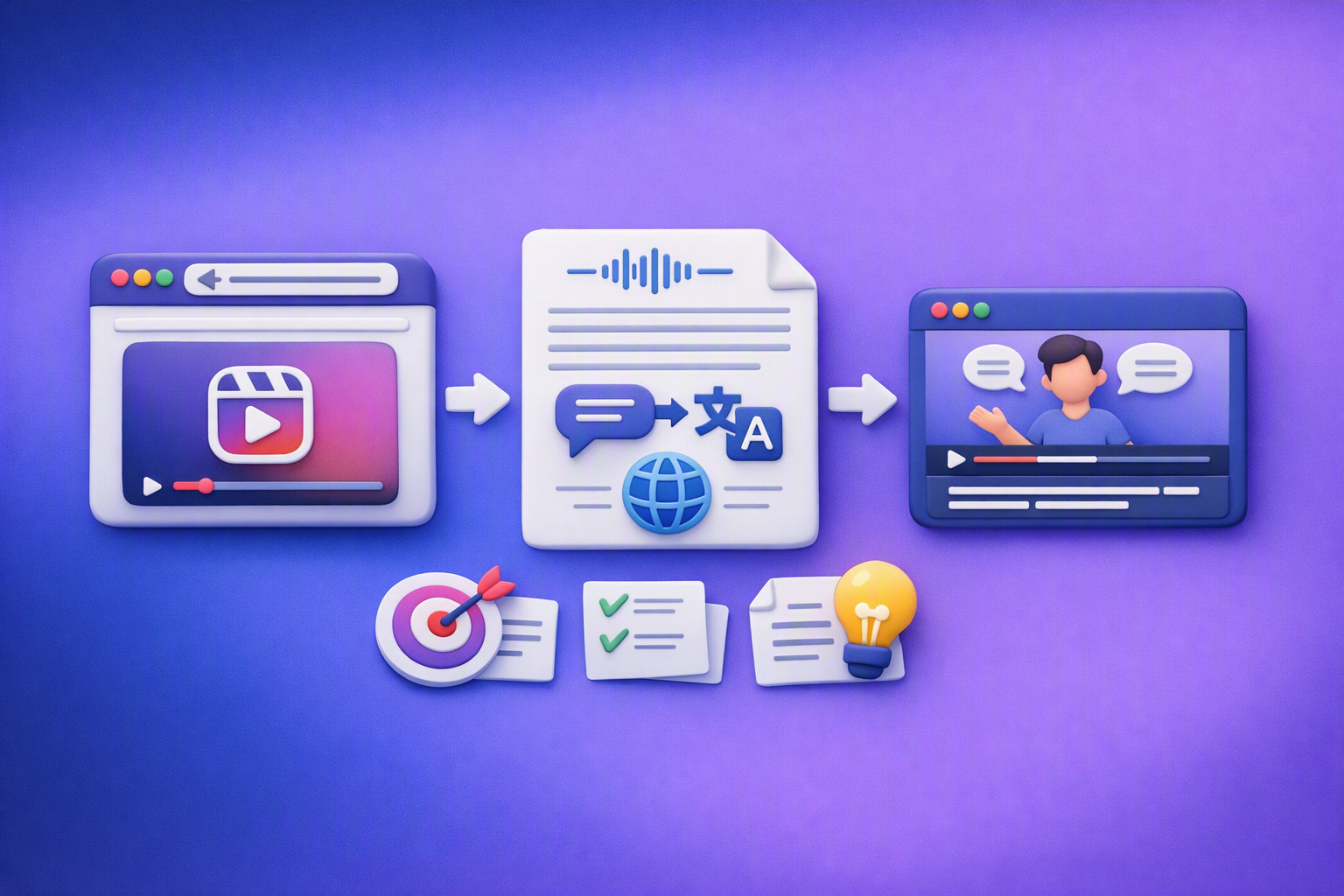
Aprende a traducir un Reel de Instagram con un flujo URL→transcripción→traducción→subtítulos, y a convertir esa traducción en un activo de investigación para hooks, CTAs, objeciones y clusters de contenido.
Reel Analyzer: Transcript‑First Instagram Reels Research (Hooks, CTAs, Objections) + Workflow Guide (VideoToTextAI)
Video To Text AI
A reel analyzer should turn any public Instagram Reel link into a searchable transcript library you can mine for hooks, CTAs, objections, and topic clusters—then repurpose into original drafts with a repeatable SOP.