
“Add Files Is Unavailable” in ChatGPT: Causes, Fixes (Step‑by‑Step), and a No‑Upload Video→Text Workflow
 Video To Text AI
“Add Files Is Unavailable” in ChatGPT: Causes, Fixes (Step‑by‑Step), and a No‑Upload Video→Text Workflow
If ChatGPT says “add files is unavailable,” fix it fastest by confirming uploads are supported in this chat (new chat + supported mode), then isolating browser/network/workspace restrictions. If uploads are blocked by policy or corporate controls, bypass uploads entirely with a link → transcript/subtitles → paste into ChatGPT workflow.
What “add files is unavailable” means (and what it does not mean)
The message is about your current upload context, not your file
This error usually indicates the current chat session can’t accept attachments right now. It does not automatically mean your PDF/MP4/TXT is too large, corrupted, or unsupported.
Common contexts that disable uploads
Uploads can be disabled by any of the following:
- Model/tooling mismatch in the current chat
- Some chat modes support attachments; others don’t.
- Surface mismatch (web vs mobile vs desktop app)
- Features can differ by platform and version.
- Workspace/admin policy restrictions (Team/Enterprise)
- Admin data controls can disable attachments across the org.
- Browser profile/extension interference
- Script/privacy/security extensions can break upload UI.
- Network/security controls (VPN, proxy, DLP, SSL inspection)
- Corporate networks can block file transfer endpoints.
Quick triage: confirm it’s not a file-size/type issue
You can see “add files is unavailable” even when:
- You try uploading a tiny TXT file.
- You try a different file type.
- You try a file that uploaded successfully yesterday.
A key signal: the attachment UI is missing/disabled before you even choose a file. That points to context, not the file.
Also common: the same file uploads in a different thread/device, because the restriction is tied to the chat mode, app surface, or network.
2‑minute diagnosis decision tree (fastest path to a fix)
Step 1 — Confirm uploads are supported in this chat
Do this first because it resolves a large share of cases.
- Start a new chat and check whether the attachment control appears.
- If your UI allows it, switch to a model/tool mode that supports attachments.
- If the button appears in a new chat, the issue is thread/context-specific.
If you’re also seeing related states like “attachments disabled” or “max 0 uploads,” cross-check these guides for adjacent root causes:
- “Max 0 Uploads at a Time” Rate Limit in ChatGPT: What It Means, Why It Happens, and Fixes (Plus a No‑Upload Video→Text Workflow)
- “Attachments Disabled for” ChatGPT: Meaning, Root Causes, Fixes That Work (2026) + a No‑Upload Video→Text Workflow
Step 2 — Isolate surface/app issues (Web vs iOS vs Android)
Test the same account in a different surface:
- Another browser (Chrome ↔ Firefox)
- Incognito/private window
- Mobile app (or mobile web) vs desktop web
Interpretation:
- Works on mobile but not web → likely browser/profile/extensions or desktop network issue.
- Works on web but not mobile → likely app permissions/version issue.
If you’re specifically dealing with the upload UI itself, this related post can help you validate UI states:
Step 3 — Check workspace policy restrictions (Team/Enterprise)
Signs it’s policy-based:
- Upload UI is missing across devices.
- Other users in the same workspace report the same issue.
- The issue started after a security/policy change.
Ask your admin to verify:
- Attachment/file upload permissions
- Data controls that disable uploads
- Allowed domains/content controls that may block attachment endpoints
If your environment is managed, you may not be able to self-fix. In that case, jump to the no‑upload workflow section below to keep shipping.
Step 4 — Check browser blockers (most common “it worked yesterday” cause)
Extensions frequently break upload controls.
Do this in order:
- Disable extensions one-by-one (start with):
- Ad blockers
- Privacy/script blockers
- Download managers
- Security/DLP extensions
- Clear site data for the ChatGPT domain and re-login
- Test in a clean browser profile (not just incognito)
Why a clean profile matters: incognito often still inherits some settings/policies, while a new profile removes hidden conflicts (storage, permissions, extension state).
Step 5 — Check network controls (most common corporate cause)
Prove it quickly:
- Test on a different network (use a mobile hotspot).
- Temporarily disable VPN/proxy and retest.
- If corporate network is required, ask IT about:
- SSL inspection
- DLP
- Upload filtering that blocks attachment traffic
If you need a broader “what it means + fixes” reference for this exact error phrasing, see:
- “Add Files Is Unavailable” in ChatGPT: What It Means, Fixes That Work (2026), and a No‑Upload Video→Text Workflow
- “Add Files Unavailable” in ChatGPT: What It Means, Fixes That Work, and a No‑Upload Video→Text Workflow (2026)
Fixes that work (ordered by highest success rate)
Fix 1 — New chat + supported model/tool selection
Exact sequence:
- Open a new chat
- Select a model/tool mode that supports attachments (if selectable)
- Confirm the attachment UI appears before composing the prompt
- Upload the file
If it works in a new chat, your prior thread likely had a mode/context where uploads were disabled.
Fix 2 — Clean browser run (no extensions, fresh storage)
Exact sequence:
- Create a new browser profile
- Install zero extensions
- Sign in and test upload
Why this beats “clear cache” alone:
- Cache clearing doesn’t remove extension interference.
- A new profile resets permissions, storage, and policy artifacts that can persist.
Fix 3 — App update + permissions reset (mobile)
Do this when web works but mobile doesn’t:
- Update the app to the latest version
- Re-enable file/photo permissions
- Force close → reopen → start a new chat → try upload again
Fix 4 — Workspace/admin enablement (when you can’t self-fix)
Send your admin this copy/paste checklist:
- Screenshot of the error state (“add files is unavailable”)
- Workspace name
- Whether it fails on multiple devices and multiple networks
- Time it started + any recent policy changes
- Whether the attachment UI is missing in new chats too
If your org uses strict controls, uploads may be intentionally disabled. Don’t burn hours debugging what policy forbids.
Fix 5 — Network isolation (prove it’s the network in <5 minutes)
Use this test matrix:
- Home Wi‑Fi vs corporate Wi‑Fi
- VPN on vs off
- Browser A vs Browser B
Interpretation:
- Works on hotspot but not corporate Wi‑Fi → network security control is blocking uploads.
- Works with VPN off but not on → VPN/proxy path is interfering.
- Works in Browser B only → browser profile/extensions issue.
Escalate with evidence: “Uploads work on hotspot + clean profile, fail on corporate Wi‑Fi.” That’s actionable for IT.
Implementation: ship work without uploads (no‑upload workflow)
When to bypass uploads instead of debugging
Bypass uploads when:
- You have deadlines (transcripts/captions needed today).
- Corporate policies won’t change quickly.
- You repeatedly hit “unavailable/disabled/max 0 uploads” states.
Brand POV: downloading video files and re-uploading them is an outdated workflow. Link-based extraction is the future of creator productivity because it’s faster, repeatable, and less fragile in restricted environments.
No‑upload workflow: link → transcript/subtitles → paste into ChatGPT
Step-by-step (VideoToTextAI)
- Copy the video link (YouTube/Instagram/TikTok or a hosted MP4).
- Generate text assets using VideoToTextAI (link-based).
- Export the format you need:
- Transcript (TXT)
- Subtitles (SRT/VTT)
- Paste the transcript/subtitles into ChatGPT for summarizing, repurposing, or SEO drafts.
This workflow keeps you moving even when attachments are blocked, and it avoids the “download → upload → fail” loop entirely.
Best-fit VideoToTextAI tools (pick by source)
- YouTube transcript/subtitles: free youtube subtitles
- General video transcript: video transcript generator
- Video to text conversion: video to text converter
- MP4 to subtitles: mp4 to srt
- TikTok transcript: tiktok to transcript
- Instagram transcript from link: instagram transcript from link
If you want the broader “upload video” context and why link-based often wins operationally, see:
Paste-ready prompt templates (so ChatGPT works without attachments)
1) Transcript → summary + key takeaways
- Prompt:
- “Summarize the transcript below in 8 bullets. Then list 5 key takeaways and 3 actionable recommendations. Transcript:”
- Paste transcript.
2) Transcript → blog outline + SEO sections
- Prompt:
- “Create an SEO blog outline targeting [keyword]. Include H2/H3s, suggested FAQs, and a meta title + meta description. Use only the transcript content as source. Transcript:”
- Paste transcript.
3) SRT/VTT → chapter timestamps + hooks
- Prompt:
- “Using the subtitles below, create 6–10 chapter timestamps with short titles and a 1-sentence hook for each chapter. Subtitles:”
- Paste SRT/VTT.
4) Transcript → repurposing pack (LinkedIn + X + email)
- Prompt:
- “Turn this transcript into: (1) a LinkedIn post, (2) a 6-tweet X thread, and (3) a short email newsletter. Keep claims faithful to the transcript. Transcript:”
- Paste transcript.
Exactly one CTA if you need the no-upload path now: VideoToTextAI.
Checklist: resolve “add files is unavailable” in under 10 minutes
- New chat created; attachment UI checked
- Alternate surface tested (web ↔ mobile)
- Incognito/private window tested
- Extensions disabled / clean profile tested
- Site data cleared and re-login completed
- Alternate network tested (hotspot)
- Workspace/admin policy verified (if applicable)
- If still blocked: switched to link-based VideoToTextAI workflow
VideoToTextAI vs Competitors
Competitors to compare (and why they matter)
- ChatGPT native uploads (baseline): convenient when enabled, but can be blocked by context/policy/network.
- Manual transcription tools (time cost baseline): reliable but slow and labor-heavy.
- Platform-native captions (YouTube/Instagram/TikTok) (quality/format baseline): quick access, but formatting/export and cleanliness vary by platform.
Comparison criteria this section will cover
- Upload dependency (can you work when uploads are disabled?)
- Input method (file upload vs link-based)
- Output formats (TXT, SRT, VTT) and downstream usability
- Speed to first draft (minutes to usable transcript/captions)
- Repurposing readiness (clean transcript vs noisy captions)
- Reliability in restricted environments (workspace/network constraints)
Comparison table
| Option | Upload dependency | Input method | Output formats for downstream work | Repurposing readiness | Reliability in restricted environments |
|---|---|---|---|---|---|
| VideoToTextAI | No (designed for link-based workflows) | Video link (YouTube/IG/TikTok/hosted MP4) | Transcript + subtitles exports (TXT, SRT/VTT) | High (paste-ready text assets) | High (works even when ChatGPT uploads are blocked) |
| ChatGPT native uploads | Yes (attachments must be enabled) | File upload inside chat | Depends on what you upload and what the chat supports | Medium–High (good once text is in-chat) | Low–Medium (often blocked by policy/network/context) |
| Manual transcription | No (but requires human time) | Listen + type | Whatever you create manually | High (if done carefully) | High (not dependent on upload features) |
| Platform-native captions | No (within platform) | Platform video | Varies by platform; often not cleanly exportable | Medium (often needs cleanup) | Medium (platform access required; export/format friction) |
Where VideoToTextAI fits
VideoToTextAI is best when you need a production-safe, no-upload path to transcripts/subtitles and then want to use ChatGPT for writing and repurposing.
It wins specifically on:
- Workflow speed: link in → transcript/subtitles out → paste into ChatGPT.
- Link-based input: avoids downloading large videos and avoids attachment restrictions.
- Exports: TXT + SRT/VTT are immediately usable for SEO drafts, captions, and editing timelines.
- Operational repeatability: the workflow stays consistent across devices and restricted workspaces.
Fair note: if your only task is quick, casual summarization and uploads are enabled, ChatGPT native uploads can be the simplest path. If you need maximum accuracy for specialized audio and have time, manual transcription can still be the gold standard.
Competitor Gap
Most “fix” articles stop at “clear cache” or “try another browser.” This post also includes:
- A decision-tree that isolates thread/model/surface/policy/network in a fixed order
- A proof-based network isolation matrix (hotspot/VPN/browser) to escalate to IT/admin
- A no-upload fallback workflow that still produces TXT + SRT/VTT assets
- Paste-ready prompts that replace attachment-based workflows
FAQ (People Also Ask aligned)
Why does ChatGPT say “add files is unavailable”?
Because uploads are disabled in your current context—most often the chat mode/model, app surface, workspace policy, browser environment, or network controls. It’s frequently unrelated to the file itself.
How do I enable the “Add files” button in ChatGPT?
- Start a new chat
- Switch to a mode that supports attachments (if your UI offers it)
- Test in a clean browser profile and/or another device/network
If you’re in a managed workspace, an admin may need to enable attachments.
Is “add files is unavailable” caused by my account or by my workplace policy?
If the upload UI is missing everywhere (multiple devices, networks, new chats) and coworkers see the same issue, it’s likely workspace policy. If it works on hotspot or a personal device, it’s likely network controls.
Why does it work on mobile but not on desktop (or vice versa)?
- Mobile works, desktop fails: usually browser extensions/profile or desktop network.
- Desktop works, mobile fails: usually app version or permissions (files/photos).
What can I do if uploads are blocked and I still need a transcript or subtitles today?
Use a no-upload workflow: generate transcript/subtitles from a video link, export TXT/SRT/VTT, then paste into ChatGPT for summaries, outlines, repurposing, and SEO drafts. This avoids the outdated “download video → upload video” loop and keeps production moving under real-world restrictions.
Related posts
Reel Analyser (Instagram Reels): Transcript‑First Competitor Research, Hook/CTA Extraction, and Repurposing Workflow (VideoToTextAI)
Video To Text AI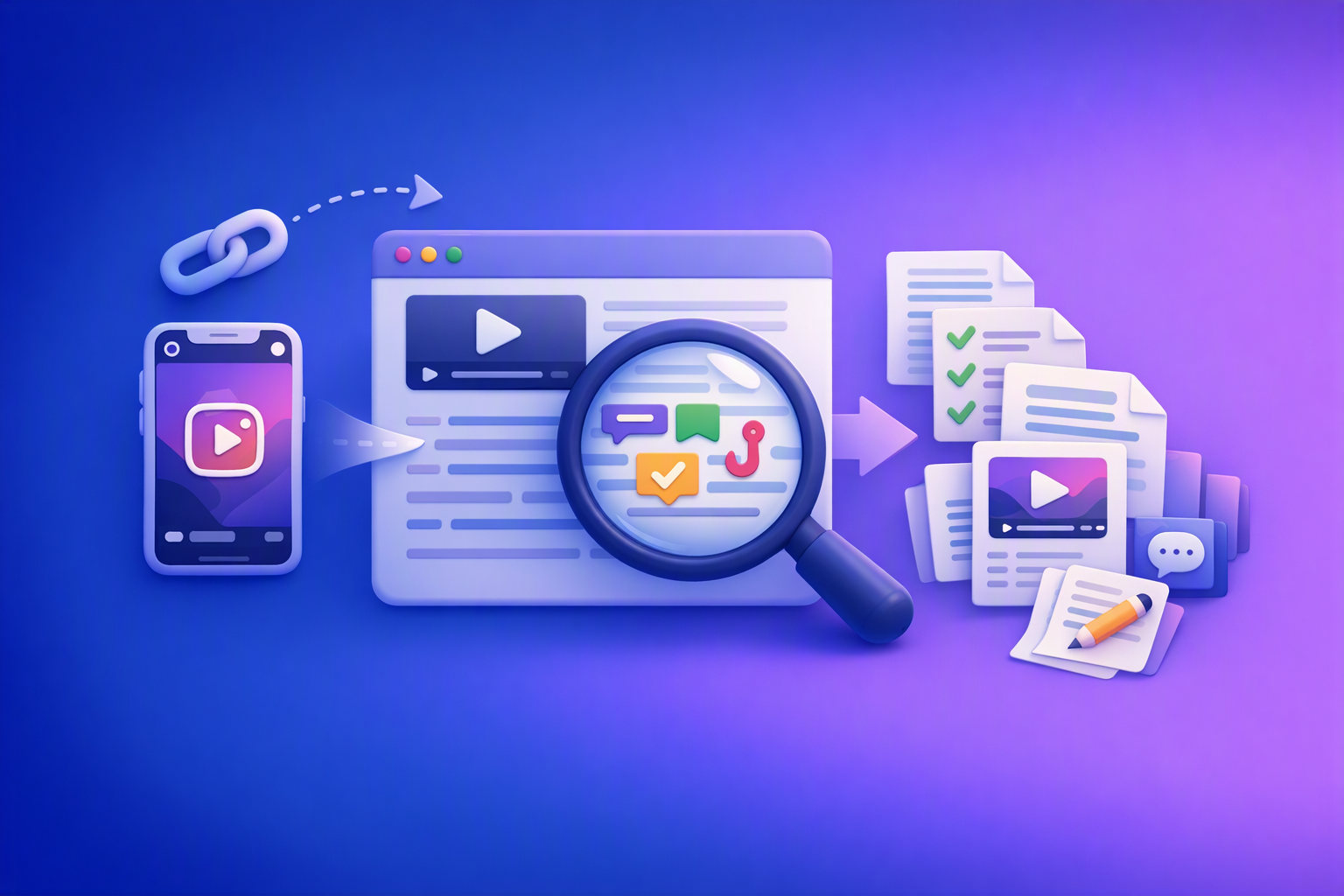
A 2026 reel analyser should turn Instagram Reel links into a searchable transcript library you can tag for hooks, CTAs, objections, and topic clusters—then export into repurposing-ready drafts without a download/upload loop.
Traducir video de Instagram (Reels) en 2026: workflow transcript-first para traducir, sacar hooks/CTAs y repurpose (con VideoToTextAI)
Video To Text AI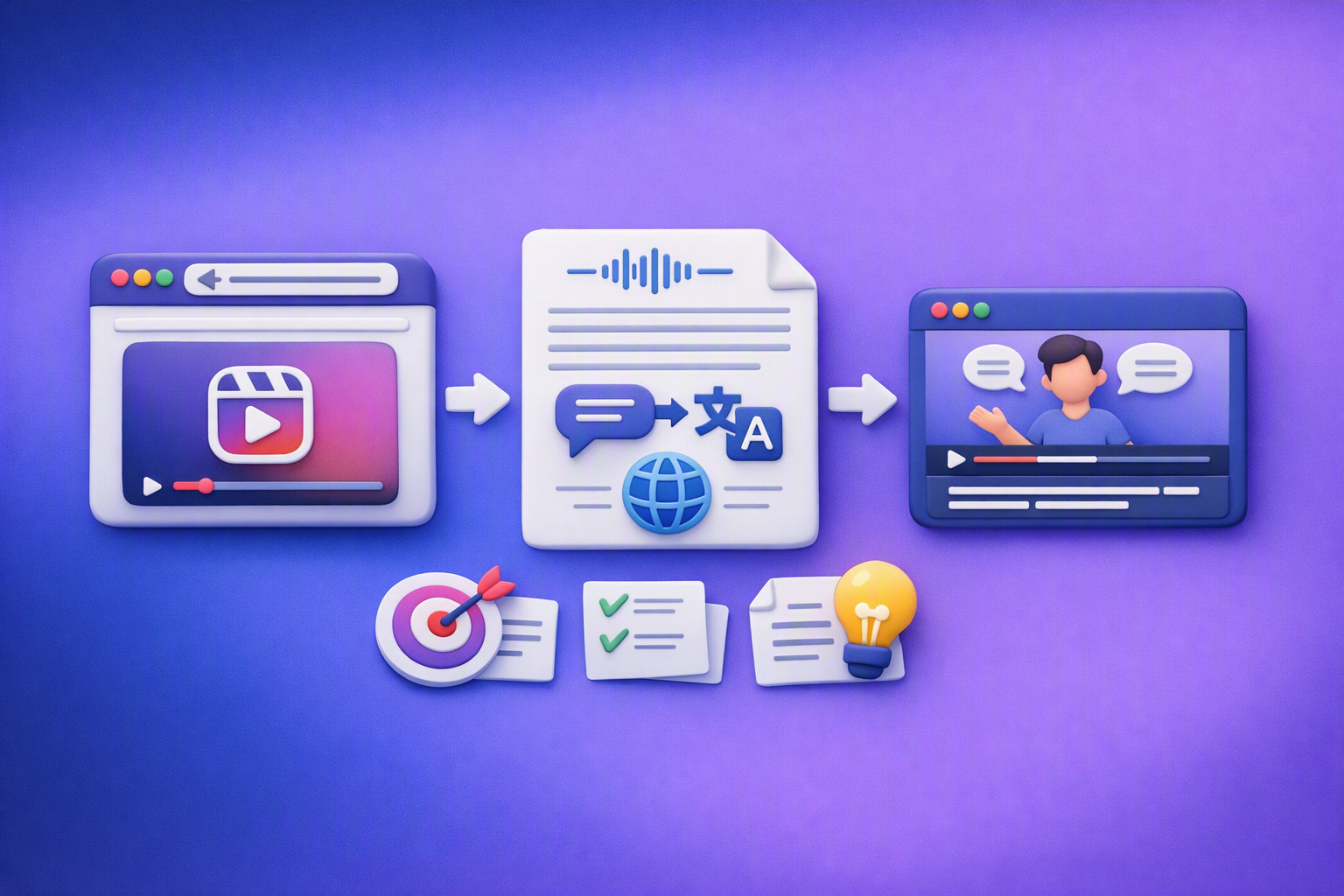
Aprende a traducir un Reel de Instagram con un flujo URL→transcripción→traducción→subtítulos, y a convertir esa traducción en un activo de investigación para hooks, CTAs, objeciones y clusters de contenido.
Reel Analyzer: Transcript‑First Instagram Reels Research (Hooks, CTAs, Objections) + Workflow Guide (VideoToTextAI)
Video To Text AI
A reel analyzer should turn any public Instagram Reel link into a searchable transcript library you can mine for hooks, CTAs, objections, and topic clusters—then repurpose into original drafts with a repeatable SOP.