
ChatGPT “Upload Video” Feature (2026): What Works, What Fails, and the Production-Grade Link → Transcript Workflow
 Video To Text AI
ChatGPT’s “upload video” feature can work for short clips, but it’s not a dependable way to generate accurate transcripts, captions, or reusable content at scale. The production-grade approach is video link/MP4 → transcript/subtitles → ChatGPT, so you get deterministic exports (TXT/SRT/VTT) and then use ChatGPT for summarizing and repurposing.
ChatGPT “Upload Video” Feature (2026): What Works, What Fails, and the Production-Grade Link → Transcript Workflow
Why this guide exists (and who it’s for)
If you’re searching for the “chatgpt upload video feature,” you usually want one of three outcomes: understanding, transcription, or content repurposing. The problem is that “upload” implies reliability—yet video ingestion still fails often due to platform differences, limits, and access issues.
This guide is for creators, marketers, and ops teams who need repeatable outputs (transcripts + captions + publishable derivatives), not a one-off demo.
The 3 common goals behind “upload video to ChatGPT”
- Understand a clip: “What happens in this video?” “What are the key moments?”
- Turn video into text: transcript, notes, action items, searchable documentation.
- Ship content faster: captions, chapters, blog posts, LinkedIn posts, X threads.
When you should not use ChatGPT for video ingestion
Avoid relying on ChatGPT video ingestion when you need:
- Accurate transcription (names, acronyms, technical terms).
- Export formats like SRT/VTT with timing you can publish.
- Long-form processing (podcasts, webinars, meetings).
- Guaranteed access to private links or permissioned storage.
If your deliverable is text, treat video as an input to a transcript/subtitle generator first, then use ChatGPT on the text.
Quick Answer: Can you upload a video to ChatGPT?
Yes—sometimes—but “upload” is not a single capability. In practice, it’s either attaching a local file or sharing a link, and both have failure modes that make it unreliable for production workflows.
What “upload” means in practice (file upload vs. link sharing)
- File upload: You attach an MP4/MOV in the chat UI (availability varies by client/plan).
- Link sharing: You paste a YouTube/Drive/Dropbox URL and ask ChatGPT to analyze it (often blocked by permissions or fetch restrictions).
What ChatGPT can do reliably with video content (and what it can’t)
More reliable:
- High-level summaries when you provide context.
- Structured outputs (bullets, chapters) from a transcript.
- Repurposing (blog/social/email) from text.
Less reliable:
- Perfect transcription from raw video.
- Long video processing without timeouts.
- Accessing private/permissioned links consistently.
- Producing publish-ready SRT/VTT with correct timing.
The deterministic approach: transcript/subtitles first, ChatGPT second
If you want predictable results, separate the jobs:
- Extract text deterministically (transcript + captions/subtitles).
- Use ChatGPT on the text for summarization, structure, and repurposing.
This is the workflow teams use because it’s repeatable, auditable, and shippable.
What people mean by “ChatGPT upload video feature”
Different requests require different workflows. Most frustration comes from asking ChatGPT to do all of these at once.
“Watch my video and tell me what happens”
This is analysis, not transcription. It can work for short clips, but it’s inconsistent for long videos and can miss details without a transcript.
“Transcribe my MP4 into accurate text”
This is where uploads fail most. Transcription accuracy depends on audio quality, duration, and system constraints—and you still won’t get deterministic exports.
“Generate captions/subtitles (SRT/VTT)”
Captions require timestamps and formatting. Even when ChatGPT produces something, timing alignment is often off unless you start from a timestamped transcript/subtitle file.
“Summarize and repurpose for blog/social”
This is where ChatGPT shines—after you have clean text. Repurposing from a transcript is faster and more controllable than repurposing from raw video.
“Analyze a private Drive/Dropbox link”
This fails frequently due to permissions, blocked fetches, expiring tokens, or organization policies. A link-based workflow only works when the tool can actually access the content.
What works vs. what fails in 2026 (real constraints)
Works best for
Short clips with clear audio
- Short duration reduces timeouts.
- Clear speech reduces transcription drift.
- Minimal background noise improves results.
Lightweight analysis when you provide context
- “Here’s what the video is about; extract 5 key points.”
- “List the steps shown in the demo; ignore filler.”
Fails most often because of
Client/plan differences (web vs. iOS vs. Android rollouts)
- Some users see an upload button; others don’t.
- Capabilities can differ across web, iPhone, and Android.
File size, duration, and processing timeouts
- Long videos are more likely to fail mid-processing.
- Even successful uploads can return partial outputs.
Unsupported containers/codecs and missing audio tracks
- “MP4” is a container; the codec inside can still break ingestion.
- Some screen recordings have odd audio tracks or none at all.
Private/permissioned links and blocked fetches
- “Anyone with the link” is not the same as “fetchable by a tool.”
- Enterprise settings can block external access.
DRM/restricted content and policy constraints
- DRM streams and restricted content are commonly blocked.
- Policy constraints can prevent analysis or extraction.
How to upload a video to ChatGPT (when you still want to try)
Use this when your goal is quick analysis of a short clip—not when you need production-ready transcripts/captions.
Uploading a local MP4/MOV (web + mobile)
Pre-flight: compress, trim, and confirm audio track
Before uploading:
- Trim to the smallest segment that contains what you need.
- Compress to reduce upload/processing failures.
- Confirm the file has an audio track and it’s not muted.
Prompt pattern: ask for structure (chapters, bullets) not “perfect transcription”
Better prompt:
- “Create a structured outline with headings and bullet points. If you’re unsure, mark it as uncertain.”
Avoid:
- “Transcribe this perfectly word-for-word with timestamps.”
Sharing a video link (YouTube/Drive/Dropbox)
Public vs. private links: what breaks access
- Public YouTube links are most likely to work.
- Drive/Dropbox links often fail due to permissions, expiring tokens, or blocked fetches.
If link access fails: the fallback that keeps your workflow moving
Don’t fight the link permissions inside ChatGPT. Move to a deterministic extraction step (transcript/subtitles), then bring the text back to ChatGPT.
The production-grade workflow: Video link/MP4 → transcript/subtitles → ChatGPT
This is the workflow that scales because it’s tool-appropriate: extraction tools extract, language models write.
Why this workflow is repeatable for teams
- Deterministic deliverables: TXT + SRT/VTT are stable artifacts.
- Easier QA: you can spot-check text quickly.
- Reusable across channels: the same transcript powers captions, blogs, and posts.
- No “download-first” bottleneck: downloading huge files is an outdated workflow; link-based extraction is the future of creator productivity.
Outputs you can ship (and reuse)
Clean transcript (TXT)
- Documentation, SEO pages, knowledge base, meeting notes.
Captions/subtitles (SRT/VTT)
- Upload directly to platforms.
- Keep timing for editing and cut lists.
Chapters, summaries, cut lists, hooks, and posts (from ChatGPT on text)
- Faster ideation with fewer hallucinations because the source text is explicit.
Step-by-step implementation (VideoToTextAI → ChatGPT)
This is the practical workflow for turning any video into publishable text assets, then using ChatGPT for the creative layer.
Step 1 — Choose your input type
Option A: Paste a public video URL
Best when the video already lives on a platform and is accessible.
Option B: Upload an MP4 file
Best when you have a local recording (podcast, webinar export, screen recording).
If you’re building a modern creator workflow, prioritize link-first ingestion whenever possible. Downloading, re-uploading, and re-encoding is friction you don’t need.
To run the workflow end-to-end, use VideoToTextAI: VideoToTextAI
Step 2 — Generate export-ready text in VideoToTextAI
Select output: transcript vs. SRT vs. VTT (when to choose each)
- Transcript (TXT): editing, repurposing, SEO, documentation.
- SRT: captions for many video platforms and editors.
- VTT: web/video players that prefer WebVTT formatting.
Quality controls: punctuation, timestamps, speaker labels (if needed)
Turn on what your use case requires:
- Punctuation for readability and repurposing.
- Timestamps for chapters and cut lists.
- Speaker labels for interviews, meetings, podcasts.
Step 3 — Do a fast accuracy pass (2–5 minutes)
Fix names, acronyms, and domain terms
- Correct product names, people names, and acronyms.
- Standardize terminology once so every derivative asset is consistent.
Confirm timing alignment for captions
- Spot-check the first minute and a mid-section.
- If timing is off, fix the subtitle export before publishing.
Step 4 — Run ChatGPT on the transcript (copy/paste prompts)
Use ChatGPT where it’s strongest: structure, clarity, and repurposing—grounded in your transcript.
Prompt: summary + key points + action items
You are an editor. Using the transcript below, produce:
1) a 5-sentence summary,
2) 10 key takeaways (bullets),
3) action items (if any) with owners as “TBD”.
Only use information present in the transcript.

TRANSCRIPT:
[paste transcript]
Prompt: chapters with timestamps (use transcript timestamps)
Create 6–10 chapters for this video.
Rules:
- Each chapter must include a timestamp from the transcript.
- Use short, descriptive titles (max 6 words).
- Add 1 sentence describing what the viewer learns.

TRANSCRIPT (with timestamps):
[paste timestamped transcript]
Prompt: caption variants (short, medium, platform-specific)
From the transcript, write:
- 10 short captions (<= 80 characters)
- 10 medium captions (<= 150 characters)
- 5 YouTube description hooks (1–2 sentences)
Keep claims faithful to the transcript. No new facts.

TRANSCRIPT:
[paste transcript]
Prompt: repurpose into blog + LinkedIn + X threads
Repurpose the transcript into:
1) A blog post outline with H2/H3s and suggested internal links (placeholders).
2) A LinkedIn post (150–250 words) with a strong opening line.
3) A 10-tweet X thread with clear progression.
Use the transcript as the only source.

TRANSCRIPT:
[paste transcript]
Step 5 — Publish and distribute
Upload SRT/VTT to YouTube/LinkedIn
- Upload captions and verify sync in the player.
- Fix any timing issues at the subtitle level, not in ChatGPT.
Use transcript for SEO blog content and internal linking
- Publish a post based on the transcript.
- Add internal links to related posts to build topical authority.
For related reading, link these naturally within your site:
- ChatGPT “Upload Video” Feature (2026): What Works, What Fails, and the Reliable Link → Transcript Workflow
- ChatGPT “Upload Video” Feature: What Works in 2026 (and the Reliable Link → Transcript Workflow)
- Chat GPT Transcribe: What Actually Works in 2026 (Audio, Video Links, and the Reliable Workflow)
- Can ChatGPT Transcribe Videos? What Works in 2026 + The Reliable Link → Transcript Workflow (VideoToTextAI)
- Can ChatGPT Upload Video in 2026? What Works, What Fails, and the Reliable Link → Transcript Workflow (VideoToTextAI)
- Can ChatGPT Transcribe Video in 2026? What Works, What Fails, and the Reliable Link → Transcript Workflow
Copy/paste implementation checklist (no skipped steps)
Inputs checklist (before you start)
- Video URL is public (or MP4 is available locally)
- Audio is present and clear (no muted track)
- Target outputs chosen: TXT + SRT/VTT + repurposed assets
VideoToTextAI run checklist
- Generate transcript (TXT) for editing/repurposing
- Export SRT/VTT for captions/subtitles
- Spot-check first 2 minutes + a mid-section for accuracy
ChatGPT prompts checklist (run on transcript)
- Summary + takeaways
- Chapters + titles (use timestamps)
- Hook ideas + short-form captions
- Blog outline + SEO sections
Publishing checklist
- Captions uploaded and verified in player
- Blog post includes transcript excerpts + internal links
- Repurposed posts scheduled and tracked
Troubleshooting: “Video upload failed” and other common blockers
If ChatGPT won’t accept the file
Reduce duration, compress, or split into segments
- Trim to the smallest clip that answers the question.
- Split long videos into 5–10 minute segments if you must upload.
Convert container/codec (MP4/H.264 + AAC audio)
- Re-encode to MP4 (H.264 video + AAC audio).
- Confirm the audio track exists and plays in a standard player.
If ChatGPT can’t access your link
Make link public or generate a share link with proper permissions
- Ensure “anyone with the link can view” (and that it’s not expiring).
- Test in an incognito window.
Use VideoToTextAI with a supported public URL (or upload MP4)
If link access is inconsistent, don’t burn time debugging ChatGPT fetch behavior. Extract transcript/subtitles first, then use ChatGPT on the text.
If the output is inaccurate
Fix transcript first, then re-run ChatGPT prompts
- Correct the source transcript once.
- Re-run summaries/chapters/posts from the corrected text.
Provide glossary (names, products, acronyms) to improve rewrite quality
Add a short glossary above the transcript:
- Names, brand terms, acronyms, and preferred capitalization.
Security & privacy: is it safe to upload videos to ChatGPT?
What to avoid uploading (sensitive, regulated, confidential)
Avoid uploading:
- Customer PII, medical/financial data, internal HR content.
- Confidential product roadmaps or unreleased IP.
- Anything governed by strict retention/compliance requirements.
Safer workflow: extract text first, then share only what’s needed
A safer pattern is:
- Extract transcript/subtitles.
- Share only the relevant excerpt needed for the task (summary, blog, captions).
Team practice: redact transcript segments before repurposing
- Remove names, IDs, or sensitive sections.
- Keep a “public transcript” version for marketing reuse.
Competitor Gap
Most guides stop at “try the upload button,” then blame the user when it fails. What’s missing is the workflow that actually ships deliverables.
- Most guides ignore failure modes: platform rollouts, timeouts, codecs, and link permissions.
- Most guides skip deterministic exports: TXT + SRT/VTT should be the core deliverables, not an afterthought.
- Most guides don’t provide a repeatable workflow: teams need steps, QA, and checklists.
- Most guides don’t connect repurposing to the same source: one transcript should power blog/LinkedIn/X without rework.
Recommended VideoToTextAI tools (pick your workflow)
MP4 workflows
- MP4 → Transcript: mp4 to transcript
- MP4 → SRT captions: mp4 to srt
- MP4 → VTT subtitles: mp4 to vtt
- MP4 → Blog post: mp4 to blog post
Social/video platform workflows
- YouTube → Blog: youtube to blog
- TikTok → Transcript: tiktok to transcript
- Instagram → Text: instagram to text
FAQ
Can I upload a video on ChatGPT?
Sometimes. Availability depends on your client (web/iOS/Android), plan, and current rollout. Even when available, long videos and certain formats can fail.
Can ChatGPT watch videos that I upload?
For short clips, it may provide limited analysis, but it’s not a consistent “watch and understand everything” solution. For reliable outcomes, extract a transcript/subtitles first and use ChatGPT on the text.
Is it safe to upload videos on ChatGPT?
Don’t upload sensitive, regulated, or confidential content. A safer practice is to extract text first, redact what you don’t want shared, and only send the minimum necessary excerpt.
How big of a video can you upload to ChatGPT?
Limits vary and can change. If you hit failures, assume the file is too large/long or encoded in a problematic format, and switch to a transcript/subtitle-first workflow for predictable results.
Related posts
Reel Analyser (Instagram Reels): Transcript‑First Competitor Research, Hook/CTA Extraction, and Repurposing Workflow (VideoToTextAI)
Video To Text AI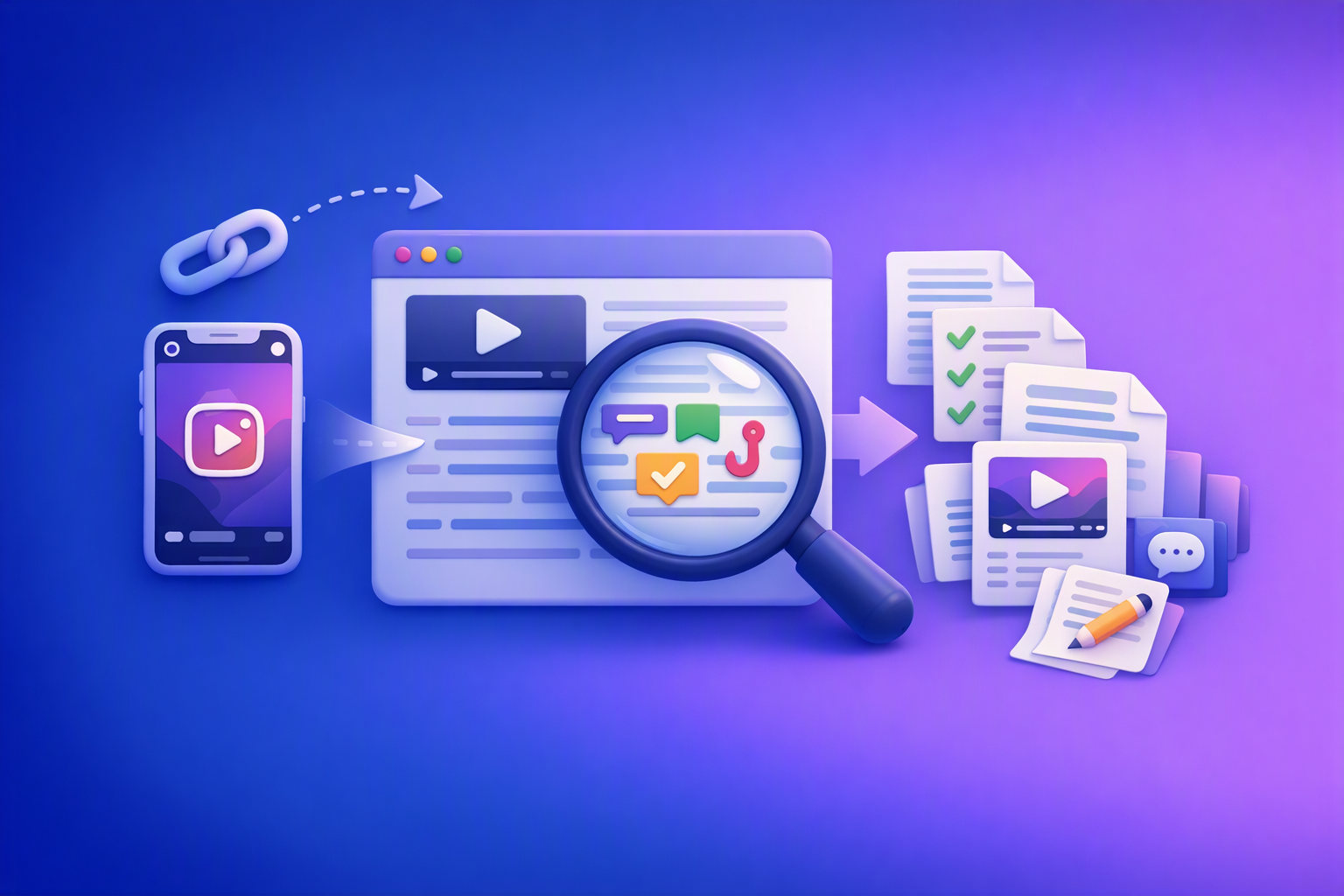
A 2026 reel analyser should turn Instagram Reel links into a searchable transcript library you can tag for hooks, CTAs, objections, and topic clusters—then export into repurposing-ready drafts without a download/upload loop.
Traducir video de Instagram (Reels) en 2026: workflow transcript-first para traducir, sacar hooks/CTAs y repurpose (con VideoToTextAI)
Video To Text AI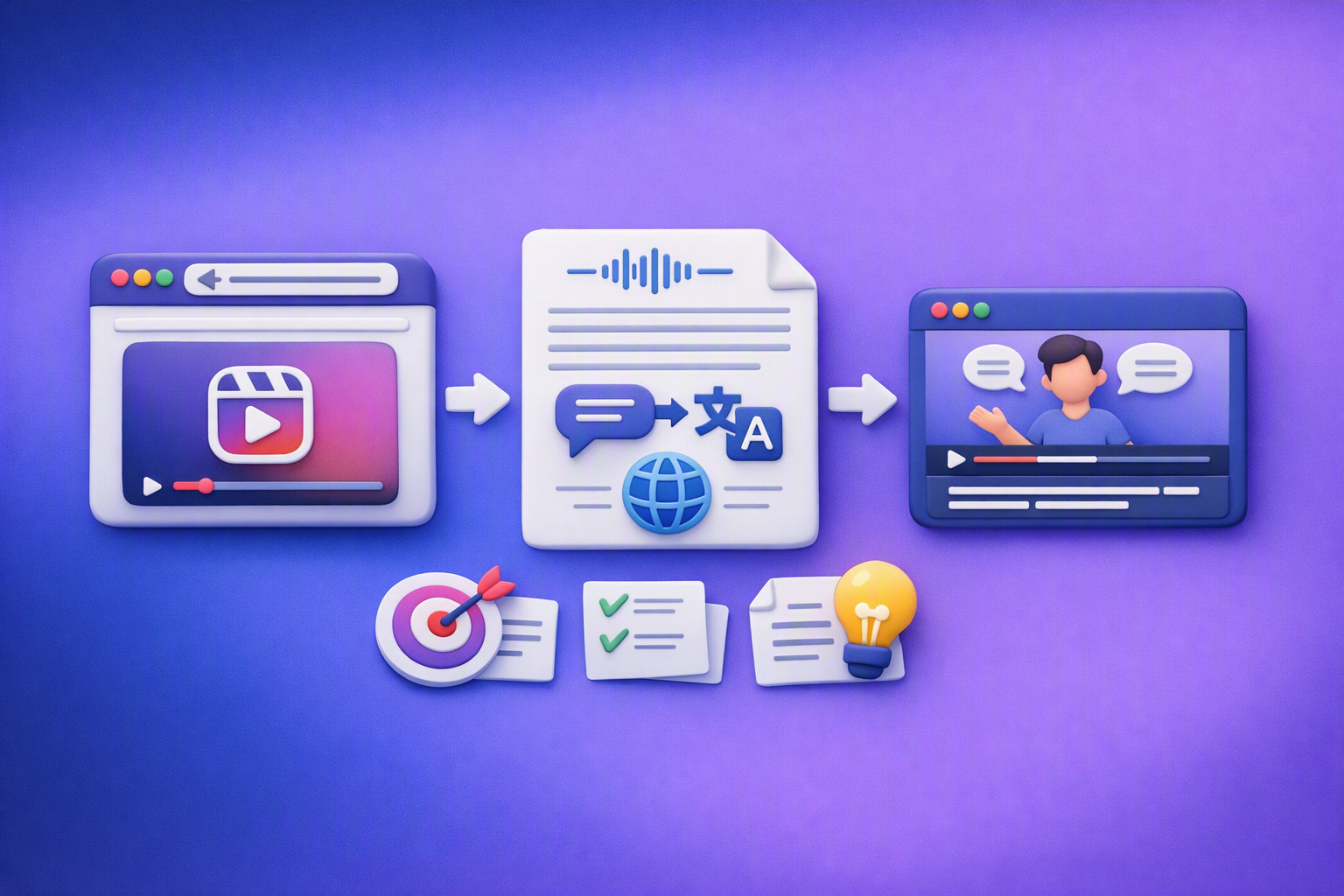
Aprende a traducir un Reel de Instagram con un flujo URL→transcripción→traducción→subtítulos, y a convertir esa traducción en un activo de investigación para hooks, CTAs, objeciones y clusters de contenido.
Reel Analyzer: Transcript‑First Instagram Reels Research (Hooks, CTAs, Objections) + Workflow Guide (VideoToTextAI)
Video To Text AI
A reel analyzer should turn any public Instagram Reel link into a searchable transcript library you can mine for hooks, CTAs, objections, and topic clusters—then repurpose into original drafts with a repeatable SOP.