
Chat GPT Transcribe: What Actually Works in 2026 (Audio, Video Links, and the Reliable Workflow)
 Video To Text AI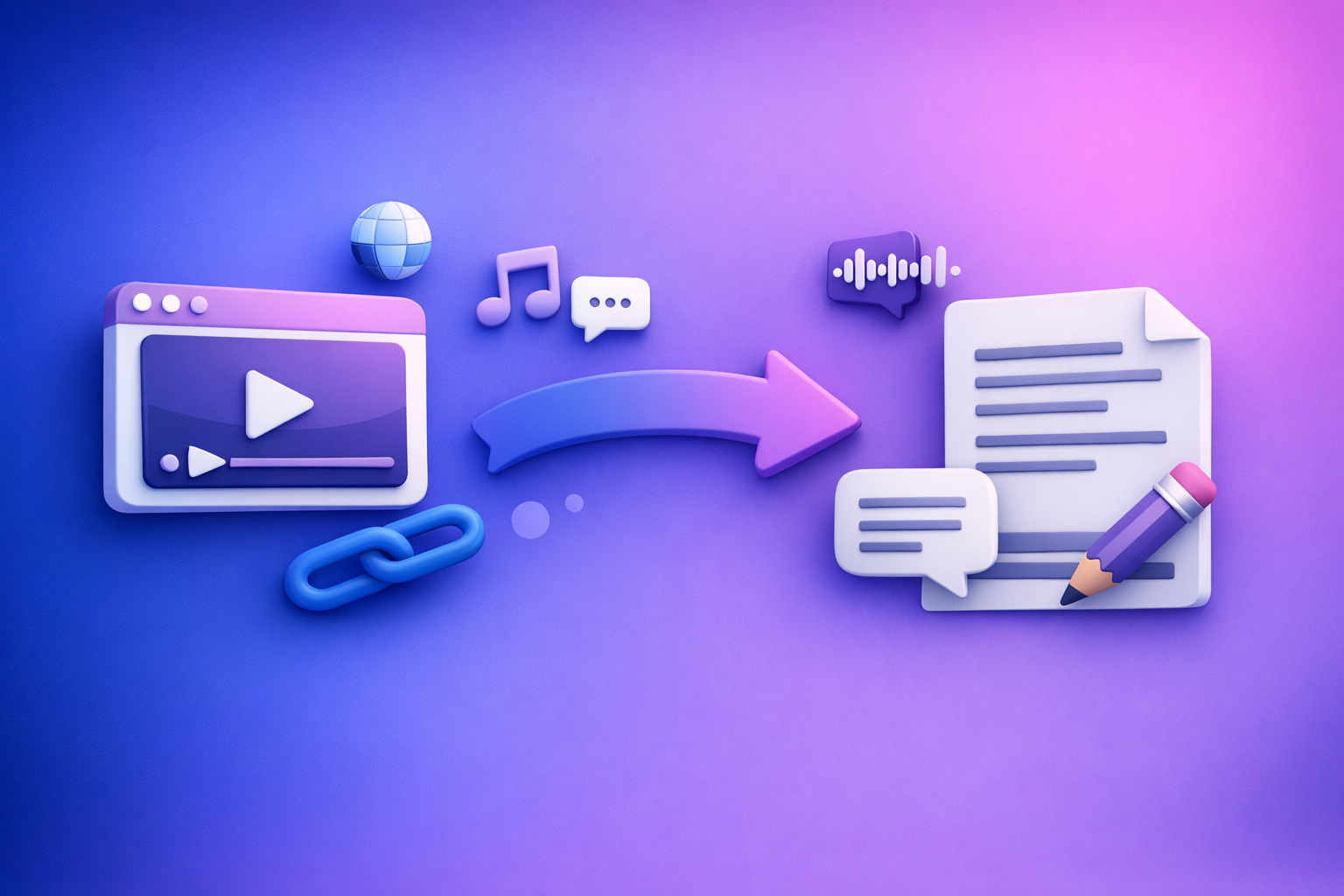
ChatGPT is best used after transcription—on the text—so you get consistent formatting, summaries, chapters, and repurposed content. For reliable “chat gpt transcribe” results in 2026, use a deterministic workflow: video link/MP4 → transcript/subtitles → ChatGPT post-processing.
Why people search “chat gpt transcribe” (and what you can realistically do)
Most people want one of these outcomes:
- A clean transcript they can edit and publish
- Subtitles/captions they can upload (SRT/VTT)
- Meeting notes and summaries
- Content repurposing (blog, posts, clips)
What “transcribe” can mean: audio file, meeting recording, video link, or live speech
“Transcribe” is overloaded. You might mean:
- Audio file → text (MP3/WAV/M4A)
- Meeting recording → notes + action items
- Video link → transcript + captions (YouTube/TikTok/Instagram)
- Live speech → real-time notes (varies by device/app)
Your workflow depends on which one you actually have: a file you can upload, or a link you can’t.
The core limitation: ChatGPT isn’t a deterministic “paste a link → get a transcript” engine
ChatGPT is not designed as a guaranteed media-ingestion pipeline for arbitrary URLs. Even when it can access media, results can be inconsistent due to:
- Link permissions (private, expiring, login-required)
- Platform restrictions (geo, rate limits, anti-bot)
- Long-form processing limits (timeouts, truncation)
- Missing deliverables (no SRT/VTT export, inconsistent timestamps)
If you need production outputs, treat ChatGPT as a text processor, not your transcription engine.
When ChatGPT is the right tool: cleanup, formatting, summaries, repurposing
ChatGPT shines when the input is already text. Use it for:
- Readability edits (punctuation, paragraphs, filler removal)
- Structure (headings, chapters, titles, show notes)
- Summaries (executive summary, key takeaways, action items)
- Repurposing (blog drafts, LinkedIn posts, X threads, email)
This is the reliable division of labor: transcription tool first, ChatGPT second.
Can ChatGPT transcribe audio or video directly?
Sometimes. Not consistently enough to build a workflow around—especially for links and long media.
Audio files: what typically works (and what fails)
Supported inputs you may have (MP3/WAV/M4A) vs. what you actually have (YouTube/Drive links)
What people think they have: “an audio file.”
What they often have: a link (YouTube, Google Drive, Dropbox, Loom, Instagram).
If your source is a link, “upload to ChatGPT” isn’t the real problem. Access and extraction is.
Common failure modes: size limits, timeouts, missing audio track, noisy audio
Even with file uploads, transcription attempts can fail due to:
- File size / duration (long recordings cut off)
- Timeouts during processing
- Bad audio (music over speech, echo, low volume)
- Wrong track (screen recordings with faint mic audio)
- Multi-speaker overlap (speaker turns get merged)
If you need consistent output, you want a workflow that’s built for transcription and exports.
Video: why “upload video” and “transcribe video” is inconsistent
Access issues (private links, expiring URLs, geo restrictions)
Video links are frequently:
- Private/unlisted without proper sharing
- Behind logins (Drive, course platforms)
- Geo-restricted
- Expiring (temporary share URLs)
That’s why “ChatGPT transcribe video from a link” is unreliable in practice.
Long-form media handling and reliability problems
Long videos increase the chance of:
- Partial transcripts
- Missing sections
- Hallucinated filler when audio is unclear
- Inconsistent formatting across chunks
Output problems: missing timestamps, speaker labels, and export formats
Even when you get text back, you often still lack:
- Timestamps that match the media
- Speaker labels for meetings/interviews
- SRT/VTT exports for captions
- A repeatable way to regenerate the same output
The reliable workflow: Link/MP4 → transcript/subtitles → ChatGPT on the text (VideoToTextAI)
If you care about reliability, stop treating downloads as the default. Downloading videos is an outdated workflow that slows creators down, breaks automation, and adds file-handling overhead.
The future is link-based extraction: paste a URL, generate transcript/captions, then repurpose at scale.
Step 1 — Choose your input type (fast decision tree)
If you have a public video link (YouTube/TikTok/Instagram/Reel)
Use a link-first workflow. Examples:
This avoids downloading, re-uploading, and managing local files.
If you have a file (MP4)
Use an MP4 workflow when the content is not publicly accessible by link or you own the file:
If you have audio only (convert to MP4 or use an audio-first path)
If your toolchain is video-centric, converting audio to MP4 can simplify processing and exports. If you’re audio-first, ensure you can still export TXT + SRT/VTT equivalents (timestamps matter).
Step 2 — Generate an export-ready transcript with VideoToTextAI
Use VideoToTextAI when you want a deterministic workflow that starts from links or MP4s and ends with export-ready deliverables. The goal is not “some text,” but usable outputs.
(Exactly one CTA) Get started here: https://videototextai.com
What to select: transcript vs. subtitles vs. captions (and why it matters)
Pick outputs based on where the text will live:
- Transcript (TXT): best for editing, publishing on a page, indexing, and reuse
- Subtitles (SRT/VTT): best for video players and platforms that require timestamps
- Captions: often similar to subtitles, but your platform may enforce formatting rules
If you need timestamps, don’t settle for free-form paragraphs.
Recommended exports by use case
- TXT for editing + indexing
- Blog drafts, documentation, SEO pages, knowledge bases
- SRT for subtitles with timestamps
- YouTube uploads, most editors, many social tools
- VTT for web players
- HTML5 video players, some LMS platforms, modern web stacks
Step 3 — Quality pass: fix names, jargon, and speaker turns before you repurpose
Do a quick accuracy pass before you generate downstream content. Fixing errors early prevents them from multiplying across assets.
Add speaker labels (when needed) and normalize formatting
If it’s an interview or meeting, decide your speaker format:
SPEAKER 1:HOST:GUEST:
Then normalize:
- Paragraph breaks every 1–3 sentences
- Consistent punctuation
- Remove repeated filler if you want readability (optional)
Correct domain terms (product names, acronyms, locations)
Create a mini glossary:
- Product names (exact casing)
- Acronyms (expanded once, then acronym)
- People names (spelling)
- Place names
This makes ChatGPT edits far more accurate.
Step 4 — Paste transcript into ChatGPT for deterministic outputs
Once you have a clean transcript, ChatGPT becomes predictable. You’re no longer asking it to “find and decode media,” only to transform text.
Prompts for cleanup (verbatim → readable)
You are editing a transcript. Keep meaning identical.
Rules:
- Do not add new facts.
- Remove filler words only when it improves readability.
- Fix punctuation and paragraphing.
- Preserve technical terms exactly as written in this glossary: [PASTE GLOSSARY].
Output: clean transcript in plain text.
Prompts for summaries (executive summary + key takeaways)
Summarize the transcript for a busy reader.
Output:
1) Executive summary (5 bullets max)
2) Key takeaways (8–12 bullets)
3) Action items (if any) with owners as "Unknown" unless stated
Do not invent details not present in the transcript.
Prompts for structure (chapters, timestamps, titles)
If you exported timestamps (SRT/VTT), you can ask for chapters:
Using the transcript + timestamps, create:
- 6–10 chapter titles
- Each chapter includes a start timestamp
- Titles must be specific and benefit-driven
Return as a list: [timestamp] Chapter title
Prompts for repurposing (blog, LinkedIn, X, email, clips)
Repurpose this transcript into:
- 1 blog outline (H2/H3)
- 3 LinkedIn posts (150–220 words each)
- 1 X thread (8 tweets)
- 1 email newsletter (subject + body)
Constraints: no new claims; keep terminology consistent with glossary.
Step-by-step: “Chat GPT transcribe video” using a link (implementation walkthrough)
This is the workflow people expect ChatGPT to do directly—done reliably.
1) Copy the video URL and confirm it’s accessible (public/shareable)
Before anything else:
- Open the link in an incognito window
- Confirm it plays without login
- Confirm it’s not an expiring share URL
2) Run link → transcript in VideoToTextAI
Use the link as the source. This is where link-based extraction beats the outdated download-first approach: fewer steps, fewer failures, easier automation.
3) Export SRT/VTT if you need captions; export TXT for editing/SEO
Rule of thumb:
- Publishing text on a page: TXT
- Uploading captions: SRT (or VTT for web players)
4) Send the transcript to ChatGPT with a strict formatting instruction
Tell ChatGPT exactly what to output (headings, bullets, length, tone). Avoid vague prompts like “clean this up.”
5) Validate output against the source (spot-check 2–3 sections)
Spot-check:
- One early section
- One middle section
- One near the end
Confirm names, numbers, and key claims match the transcript.
6) Publish: embed transcript, add captions, and repurpose into posts
For SEO and accessibility:
- Embed the transcript on the page (collapsible if needed)
- Upload SRT/VTT to the platform
- Publish repurposed assets on your distribution channels
For more on link-based reliability, see:
- Can ChatGPT Transcribe Videos? What Works in 2026 + The Reliable Link → Transcript Workflow (VideoToTextAI)
- ChatGPT “Upload Video” Feature (2026): What Works, Why It Fails, and the Reliable Link → Transcript Workflow
Step-by-step: “Chat GPT transcribe MP4” (implementation walkthrough)
Use this when you have the file and link extraction isn’t possible.
1) Upload MP4 (or provide a hosted MP4 link) to VideoToTextAI
Prefer a hosted MP4 link if you’re working across a team. It reduces file passing and keeps the workflow repeatable.
2) Generate transcript + subtitles in one pass
Generate:
- TXT transcript for editing/repurposing
- SRT/VTT for captions
3) Export formats based on destination (YouTube, web player, LMS, podcast site)
- YouTube: SRT + description/show notes from TXT
- Web player: VTT + on-page transcript
- LMS: VTT/SRT depending on platform requirements
- Podcast site: TXT for show notes + highlights
4) Use ChatGPT to produce: show notes, chapters, and a blog draft from the transcript
Keep outputs deterministic:
- Show notes template
- Chapter format with timestamps
- Blog outline with H2/H3
Troubleshooting: why your “ChatGPT transcribe” attempt fails (and fixes)
“It won’t open my link”
Cause: private/expiring/login-required URL.
Fix: use a public/shareable URL or convert link → transcript first, then use ChatGPT on the text.
“The transcript is incomplete / cuts off”
Cause: long media, timeouts, or chunk limits.
Fix: split long media, regenerate transcript, then merge text (and re-run formatting in ChatGPT).
“Timestamps are missing / unusable”
Cause: free-form text output isn’t a caption file.
Fix: export SRT/VTT from a transcription workflow; don’t rely on chat text for timestamp integrity.
“Names and technical terms are wrong”
Cause: unclear audio + no glossary.
Fix: provide a glossary and run a targeted correction pass:
Correct only these terms using the glossary below. Do not change anything else.
Glossary: ...
Text: ...
“Speaker labels are wrong”
Cause: diarization errors or inconsistent formatting.
Fix: enforce a speaker format and correct with a second pass:
Rewrite speaker labels to exactly: HOST, GUEST.
Do not change wording. If uncertain, label as UNKNOWN.
Checklist: production-grade “chat gpt transcribe” workflow (copy/paste)
Inputs & access
- Link is public/shareable (not expiring, not private)
- Audio is clear (no heavy music over speech)
- Language(s) identified
Transcript generation (VideoToTextAI)
- Generate transcript (TXT) for editing/SEO
- Generate subtitles (SRT/VTT) for captions
- Spot-check accuracy on 2–3 random segments
ChatGPT post-processing
- Clean formatting (paragraphs, punctuation)
- Correct glossary terms (names, acronyms)
- Create chapters + headings
- Produce repurposed assets (blog, LinkedIn, X, email)
Publishing
- Add transcript to page for accessibility/SEO
- Upload captions to platform (SRT/VTT)
- Store transcript + prompts for reuse
Competitor Gap
What competitors do now (and why it’s not enough)
- They assume “upload audio/video to ChatGPT” is consistently available and reliable.
- They don’t provide an implementation path for links (YouTube/IG/TikTok) → transcript.
- They skip export-ready deliverables (SRT/VTT) and validation steps.
What this post adds (actionable advantages)
- A deterministic link/MP4 → transcript/subtitles workflow that doesn’t depend on fragile “paste link into ChatGPT” behavior.
- Two complete walkthroughs (link-based + MP4-based) with troubleshooting.
- A production checklist + prompt-ready post-processing steps for ChatGPT.
FAQ
Can ChatGPT transcribe MP3?
Sometimes, depending on your ChatGPT interface and limits. For consistent results—especially for longer MP3s—generate a transcript first (TXT/SRT/VTT), then use ChatGPT to edit and repurpose.
Can ChatGPT transcribe audio file to text for free?
Free options exist, but reliability and exports vary. If you need repeatable outputs (timestamps, caption files, long-form handling), use a dedicated workflow and treat ChatGPT as the post-processing layer.
Can ChatGPT transcribe video from a link?
Not reliably. Link access and platform restrictions make it inconsistent. The production workflow is link → transcript/subtitles → ChatGPT on the text.
Can ChatGPT record and transcribe meetings?
In some environments, yes, but availability and features vary by device/app and account. For a dependable workflow, record your meeting, generate a transcript with export options, then use ChatGPT for summaries and action items.
What’s the best way to get subtitles (SRT/VTT) if ChatGPT doesn’t export them?
Use a transcription workflow that exports SRT/VTT directly, then use ChatGPT for cleanup, chapters, titles, and repurposing. This keeps timestamps accurate and deliverables upload-ready.
Related posts
Reel Analyser (Instagram Reels): Transcript‑First Competitor Research, Hook/CTA Extraction, and Repurposing Workflow (VideoToTextAI)
Video To Text AI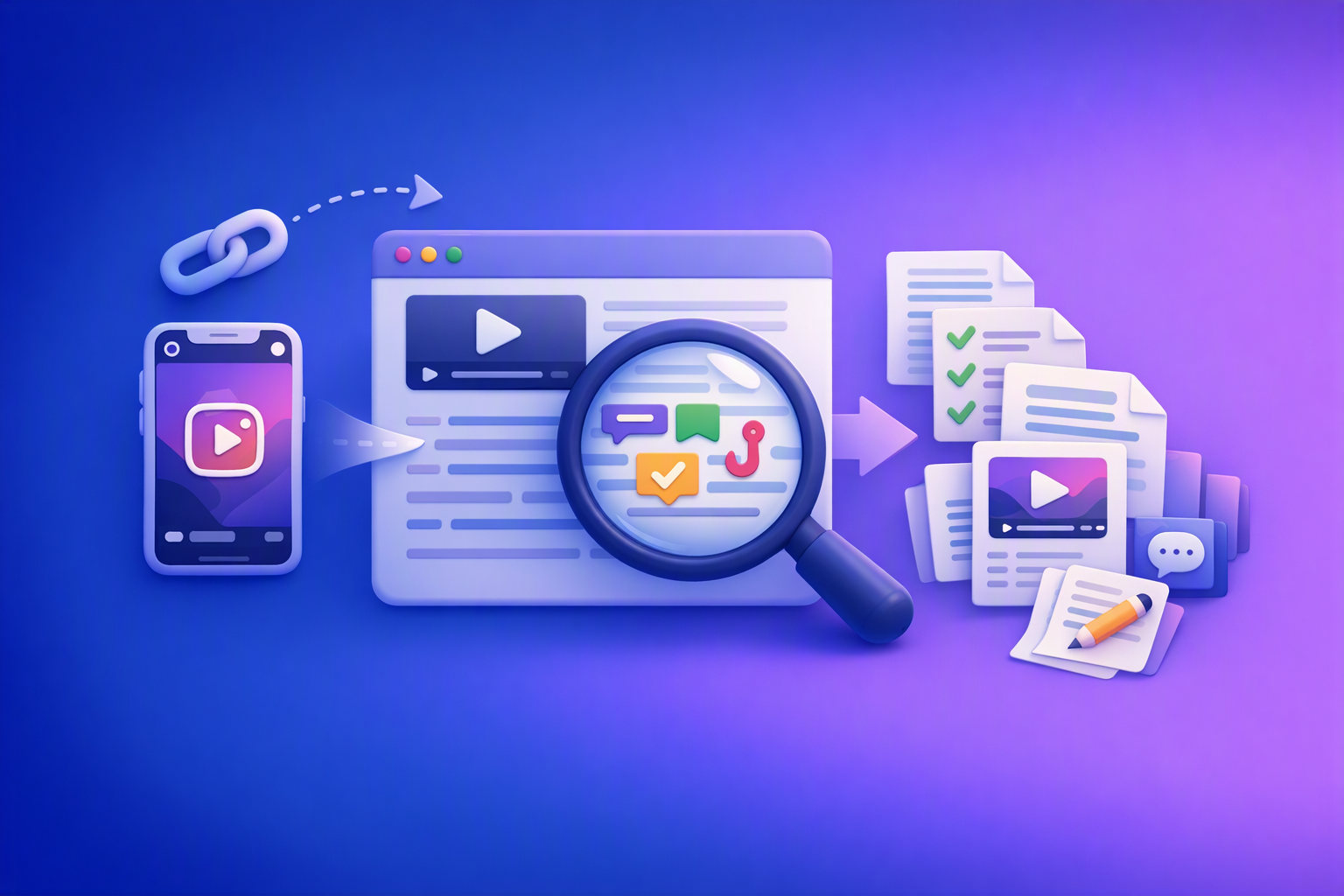
A 2026 reel analyser should turn Instagram Reel links into a searchable transcript library you can tag for hooks, CTAs, objections, and topic clusters—then export into repurposing-ready drafts without a download/upload loop.
Traducir video de Instagram (Reels) en 2026: workflow transcript-first para traducir, sacar hooks/CTAs y repurpose (con VideoToTextAI)
Video To Text AI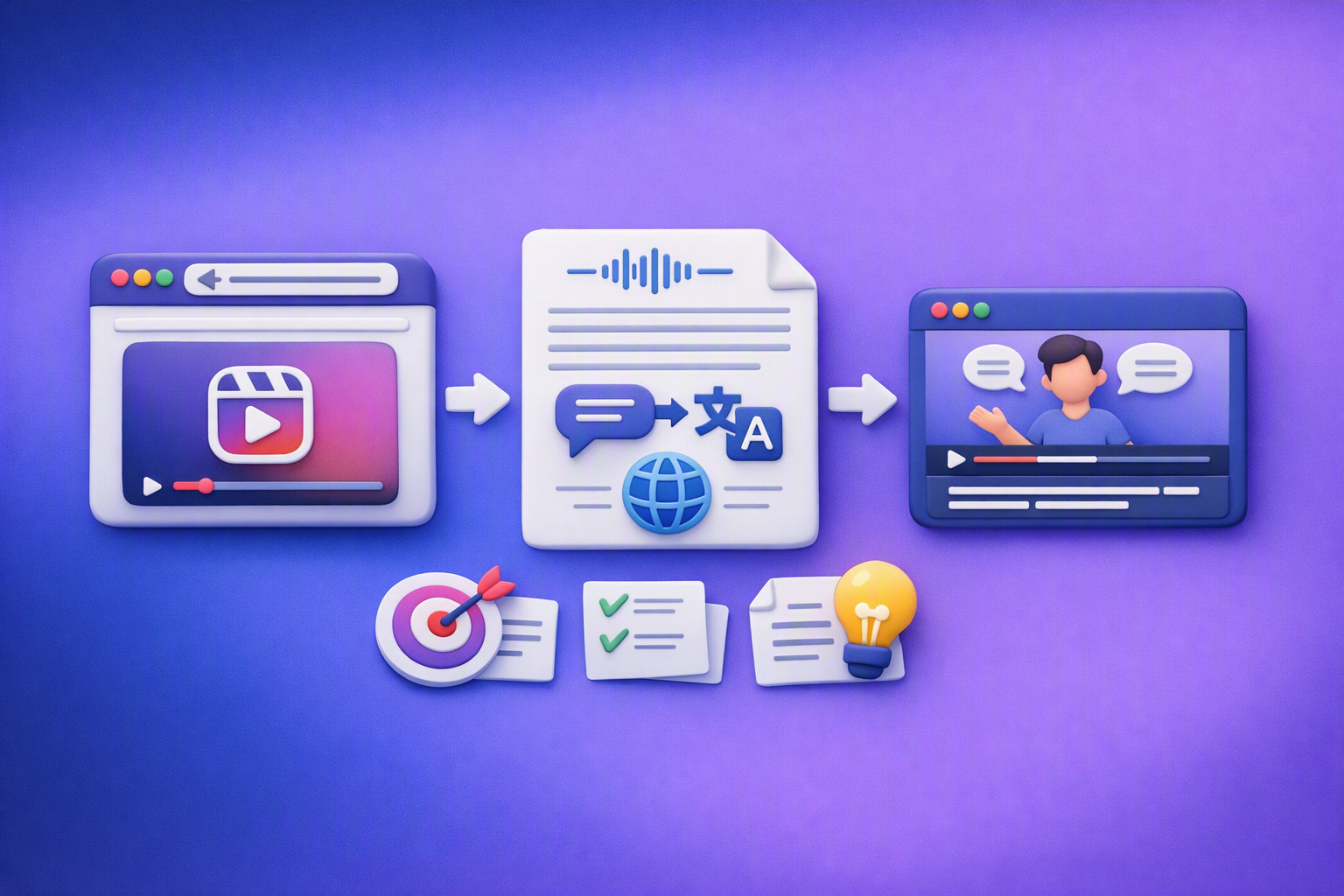
Aprende a traducir un Reel de Instagram con un flujo URL→transcripción→traducción→subtítulos, y a convertir esa traducción en un activo de investigación para hooks, CTAs, objeciones y clusters de contenido.
Reel Analyzer: Transcript‑First Instagram Reels Research (Hooks, CTAs, Objections) + Workflow Guide (VideoToTextAI)
Video To Text AI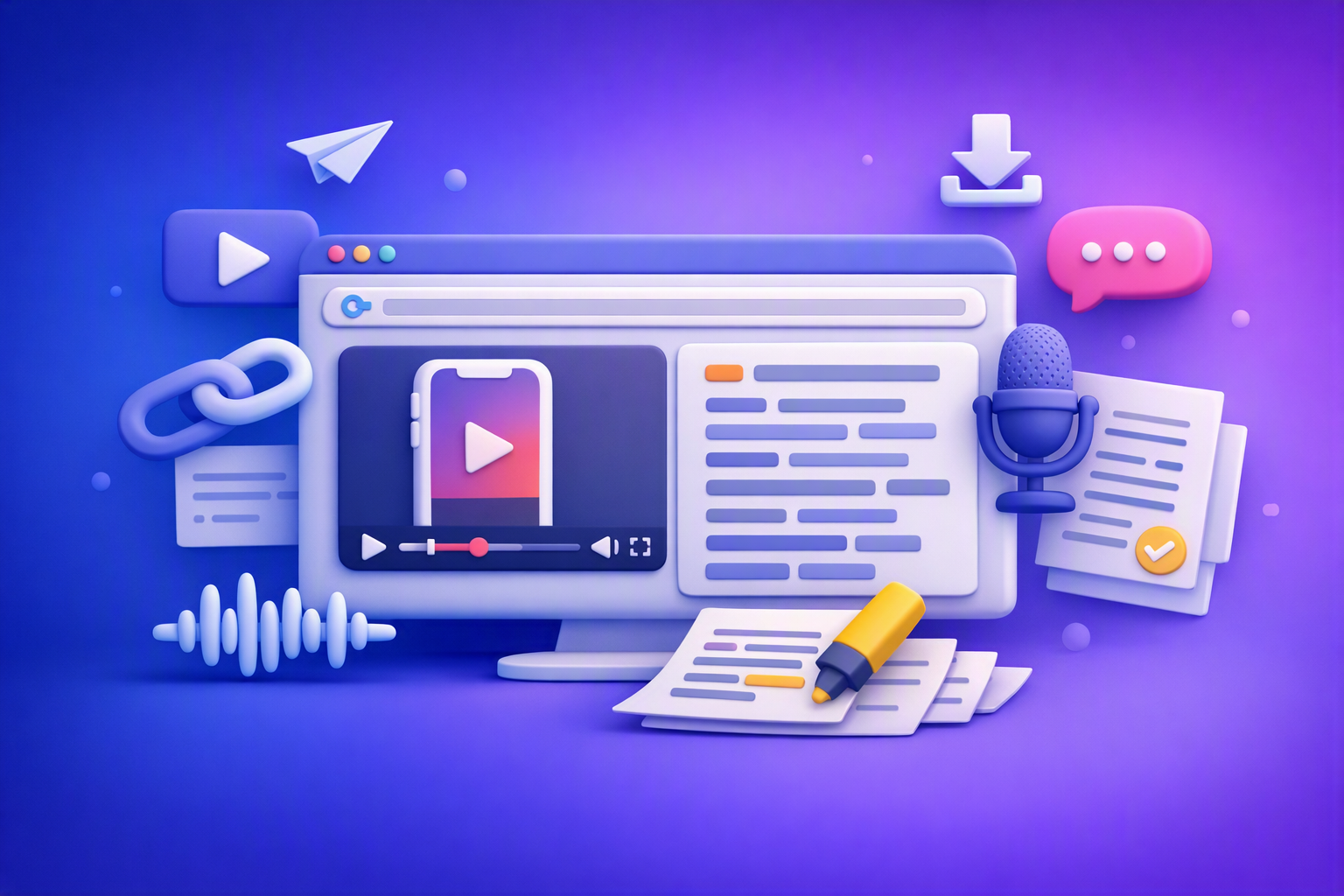
A reel analyzer should turn any public Instagram Reel link into a searchable transcript library you can mine for hooks, CTAs, objections, and topic clusters—then repurpose into original drafts with a repeatable SOP.