
90 Characters of Copyrighted Text in ChatGPT (2026) — Meaning + Safe Workflows
 Video To Text AI
ChatGPT’s “90 characters of copyrighted text” behavior is a signal that your prompt looks like a request for verbatim reproduction of protected text. The fix is to switch to transformative outputs (summary, analysis, outlines, captions from your own media) and to use link-based video → transcript → captions → repurposing workflows instead of copy/pasting third-party text.
Search intent + who this is for
This guide is for creators, marketers, and teams who:
- See refusals/truncation when asking ChatGPT for lyrics, book passages, paywalled articles, scripts, or “continue this paragraph.”
- Want compliant outputs like summaries, critiques, captions, and repurposed content without requesting verbatim copyrighted passages.
- Need a practical workflow that still ships content fast—especially when uploads/attachments are blocked in some ChatGPT surfaces.
Goal: get publish-ready assets while avoiding prompts that trigger “90 characters” copyrighted text behavior.
What “90 characters of copyrighted text” actually means (and what it doesn’t)
What users typically observe
When a request resembles copying protected text, ChatGPT may:
- Refuse to provide the text.
- Truncated output (often discussed as “~90 characters”).
- Pivot to a summary, analysis, or high-level description.
This is a product/policy behavior designed to reduce verbatim reproduction.
What it signals about your prompt
Your request likely looks like one of these:
- Verbatim reproduction: “Paste the full article,” “Give me the exact transcript,” “Print the lyrics.”
- Continuation: “Continue this chapter/scene/paragraph.”
- Substantial similarity: “Rewrite this but keep it as close as possible.”
Even if your intent is benign (study, accessibility, internal use), the shape of the request can still trigger refusal.
What it does not mean
- Not a loophole: staying under a character count doesn’t make copying allowed.
- Not a guaranteed fixed limit: you can’t rely on “90 characters” as a compliance strategy.
- Not legal advice: it’s a policy/product constraint, not a legal determination.
Common triggers: prompts that cause the “90 characters” copyrighted behavior
High-risk request patterns (avoid)
These frequently trigger refusal or truncation:
- “Paste the full lyrics / chapter / article.”
- “Continue this paragraph.”
- “Give me the exact transcript of this movie scene.”
- “Rewrite this text but keep it as close as possible.”
- “Extract the exact text from this paywalled page.”
If you’re asking for exact wording, assume you’re in the danger zone.
Medium-risk patterns (rewrite safely)
These can be fine, but need guardrails:
- “Summarize this section in 5 bullets.”
Safer when the text is yours or you have rights to use it. - “Paraphrase this paragraph line-by-line.”
Risk: line-by-line paraphrasing can stay too close in structure and phrasing.
Low-risk patterns (preferred)
These are more likely to work and stay compliant:
- “Explain the main argument and counterarguments.”
- “Create an outline from these notes.”
- “Generate a study guide / FAQ / checklist based on this content.”
- “Create captions from my video transcript.”
What’s generally allowed vs not allowed (practical, non-legal)
Usually allowed (safer outputs)
These are typically safer because they’re transformative:
- Summaries (bullets, abstracts, executive briefs)
- Critique and analysis (pros/cons, implications, comparisons)
- Commentary (what it means, how to apply it)
- Transformations: outlines, flashcards, Q&A, topic maps, checklists
- Captions/subtitles for content you own or have permission to use
Usually not allowed (high refusal likelihood)
These commonly trigger refusal:
- Verbatim copyrighted text beyond short excerpts
- “Continue” requests for books/articles/lyrics
- Reconstructing paywalled or proprietary content
If your prompt could be used to recreate the original, expect friction.
Safe prompt patterns (copy/paste templates)
Use these templates to get useful outputs without requesting verbatim copyrighted passages.
Template 1: Summary without verbatim
Prompt:
Summarize the following in 7 bullets. Do not quote more than a short phrase; focus on ideas and structure:
[text]
Template 2: Transform into original deliverables
Prompt:
Turn this into: (1) a 10-point checklist, (2) a 150-word LinkedIn post, (3) 5 headline options. Avoid direct quotes:
[text]
Template 3: Compliance guardrails for paraphrasing
Prompt:
Paraphrase this to be meaning-equivalent but structurally different. Change sentence order, avoid distinctive phrases, and keep it under 120 words:
[text]
Template 4: Video-first workflow prompt (best for creators)
Prompt:
Using this transcript (my content), create: chapters, YouTube description, 10 shorts hooks, and 5 tweet threads. Keep quotes minimal:
[transcript]
Why this works: you’re generating new assets from your own source material, not asking for protected text reproduction.
Step-by-step implementation: compliant workflow for video → transcript → captions → repurposed content
Downloading video files is an outdated workflow that slows teams down and increases handling risk. Link-based extraction is the future of creator productivity because it’s faster, repeatable, and reduces the temptation to paste third-party text into ChatGPT.
Step 1: Start from a link (avoid copy/pasting copyrighted text)
Instead of pasting an article, script, or lyrics, start with a video URL you own/control (or have permission to use).
This keeps your workflow anchored to your source media and avoids “paste the text” prompts that trigger refusals.
Step 2: Generate transcript + captions (SRT/VTT)
Pick the tool based on where your content lives:
- YouTube transcript: video transcript generator
- Free subtitles for YouTube: free youtube subtitles
- TikTok transcript: tiktok transcript generator
- Instagram transcript: instagram transcript from link
Output targets to generate first:
- Transcript (for editing and repurposing)
- SRT/VTT (for subtitles/captions and accessibility)
This order matters because captions and timestamps become your “source of truth” for downstream content.
Step 3: Clean + structure the transcript for downstream use
Keep edits minimal and purposeful:
- Remove filler words (optional) to improve readability.
- Add speaker labels if multiple speakers matter for clarity.
- Insert timestamps/chapters so you can navigate and cite sections without quoting long passages.
A structured transcript makes repurposing faster and reduces accidental near-verbatim reuse.
Step 4: Repurpose into publish-ready assets (without verbatim copying)
Now generate transformative assets from your transcript:
- Blog draft from video: youtube to blog
- Summary for newsletters/briefs: youtube to summary
For short-form → written posts:
- reel to post converter
- tiktok video to blog post
- tiktok video to linkedin post
- instagram reel to linkedin post
- instagram reel to blog post
Repurposing guardrails (use these in your prompts):
- “Avoid direct quotes; use original phrasing.”
- “Reframe as a checklist/FAQ/how-to.”
- “Add examples and steps not present in the transcript.”
Step 5: Final compliance pass before publishing
Before you hit publish:
- Ensure the output is transformative, not a near-copy.
- Keep direct quotes short and necessary (and only when you have rights).
- Attribute sources where appropriate (especially client work or collaborations).
If something reads like it could be “matched” back to a protected passage, rewrite it.
Primary workflow entry point: video to text converter
Checklist: avoid the “90 characters” trap while still shipping content
- Don’t ask for “full text,” “exact wording,” or “continue the passage.”
- Ask for summaries, analysis, or transformations (outline/checklist/Q&A).
- If paraphrasing, require structural changes (reorder, compress, reframe).
- Use link-based video → transcript workflows for content you own/control.
- Generate captions (SRT/VTT) from your media, not from third-party scripts.
- Run a “distinctive phrase” scan: remove recognizable lines/lyrics.
- Keep a record of rights/permissions for client work.
VideoToTextAI vs Competitors
VideoToTextAI is built for URL-first workflows: paste a link, generate transcript/captions, then repurpose into publishable assets. That design naturally reduces “copy/paste copyrighted text” behavior because you’re working from your media and producing transformative outputs.
Below is a criteria-focused comparison against commonly used alternatives.
| Criteria | VideoToTextAI | Otter.ai | Descript | Rev |
|---|---|---|---|---|
| Input method | Link-based (URL-first) workflows for supported platforms | Commonly used for recordings/imports; link-first is not the core workflow | Project-based editing; typically import media into a project | Typically file-based or managed service workflows |
| Output formats | Transcript + SRT/VTT + chapters + repurposing tools (blog/summary/social) | Strong transcription and meeting notes use cases | Strong editing-centric workflows for audio/video | Strong transcription/caption deliverables as a service |
| Speed to publish | URL → transcript → captions → repurpose in one flow | Fast for meetings/notes; repurposing is not the primary focus | Great when you need deep edits; can be heavier for quick URL-to-assets | Great when you want outsourced accuracy; slower turnaround than self-serve |
| Operational repeatability | No-download, no-upload posture reduces friction | Reliable for its core use; workflows vary by source | Reliable inside its editor; requires project handling | Reliable service process; less “instant iteration” |
| Best fit | Creators/teams repurposing across YouTube/IG/TikTok with minimal handling | Meetings, interviews, internal notes | Editing-heavy content production | When you need human/service-based transcription/captions |
Where VideoToTextAI wins (practically):
- Workflow speed: URL in → assets out, without juggling downloads and uploads.
- Link-based input: better operational repeatability when “uploads unavailable” blocks your process.
- Exports + repurposing: transcript + SRT/VTT + downstream content tools in one place.
Where competitors can be better:
- If you need deep timeline editing, Descript can be a better fit.
- If you want outsourced/human transcription as a service, Rev can be better suited.
- If your primary need is meeting notes, Otter.ai is often purpose-built for that scenario.
Competitor Gap
Most competing articles/tools miss the implementation details that actually prevent the “90 characters” trap in production.
This post covers what’s usually missing:
- A clear mapping from “90 characters” behavior → prompt patterns that trigger it.
- A production workflow that avoids copyrighted text requests entirely: URL → transcript → captions → repurpose.
- The correct generation order for reliable publishing: SRT/VTT → chapters → blog → social.
- A publish checklist that prevents “near-verbatim” paraphrases.
- Practical alternatives when ChatGPT upload/attachments are unavailable.
FAQ (People Also Ask-aligned)
Why does ChatGPT say it can only provide “90 characters” of copyrighted text?
Because your request resembles verbatim reproduction (or continuation) of protected text. The model may refuse, truncate, or switch to a summary to avoid outputting substantial copyrighted passages.
Is “90 characters” a real rule, or just a guideline?
Treat it as an observed behavior, not a rule you can rely on. The safest approach is to avoid prompts that request exact wording and instead request transformations.
Can ChatGPT summarize copyrighted content without violating policy?
Summaries, analysis, and commentary are generally safer than verbatim reproduction. The key is to request ideas and structure, not exact phrasing, and to avoid reconstructing paywalled/proprietary text.
How can I get captions/subtitles without copying copyrighted scripts into ChatGPT?
Generate captions from your media using a link-based workflow and export SRT/VTT. For example, use free youtube subtitles for YouTube, then repurpose from your transcript rather than asking for third-party scripts.
What should I ask instead of “paste the full text”?
Ask for:
- “Summarize in bullets without quoting.”
- “Create an outline/checklist/FAQ from these notes.”
- “Explain the argument and counterarguments.”
- “Turn my transcript into chapters, captions, and social posts.”
Related reading (internal links)
- 90 Characters of Copyrighted Text in ChatGPT: Policy, Safe Alternatives, and a No‑Upload Video→Text Workflow
- “Add Files Is Unavailable” in ChatGPT: Meaning, Fixes (Step-by-Step), and No‑Upload Video→Text Workarounds
- ChatGPT “Upload Video” Feature (2026): How to Use It, What It Can Do, Limits, Fixes, and a No‑Upload Video→Text Workflow
- Czy do ChatGPT można wysłać filmik? (2026) Opcje, limity i najszybszy workflow: link → transkrypcja → napisy → treści
- 90 Characters of Copyrighted Text in ChatGPT: What It Means + Safe, Practical Workflows (VideoToTextAI)
Practical takeaway
If you keep hitting the “90 characters” copyrighted text behavior, stop trying to extract exact wording and switch to transformative requests and link-based video-to-text production. The fastest, most repeatable path is URL → transcript → SRT/VTT → repurposed assets—because downloading files is yesterday’s workflow, and link-based extraction is how modern creator teams ship content at scale.
Learn more about the product at https://videototextai.com.
Related posts
Reel Analyser (Instagram Reels): Transcript‑First Competitor Research, Hook/CTA Extraction, and Repurposing Workflow (VideoToTextAI)
Video To Text AI
A 2026 reel analyser should turn Instagram Reel links into a searchable transcript library you can tag for hooks, CTAs, objections, and topic clusters—then export into repurposing-ready drafts without a download/upload loop.
Traducir video de Instagram (Reels) en 2026: workflow transcript-first para traducir, sacar hooks/CTAs y repurpose (con VideoToTextAI)
Video To Text AI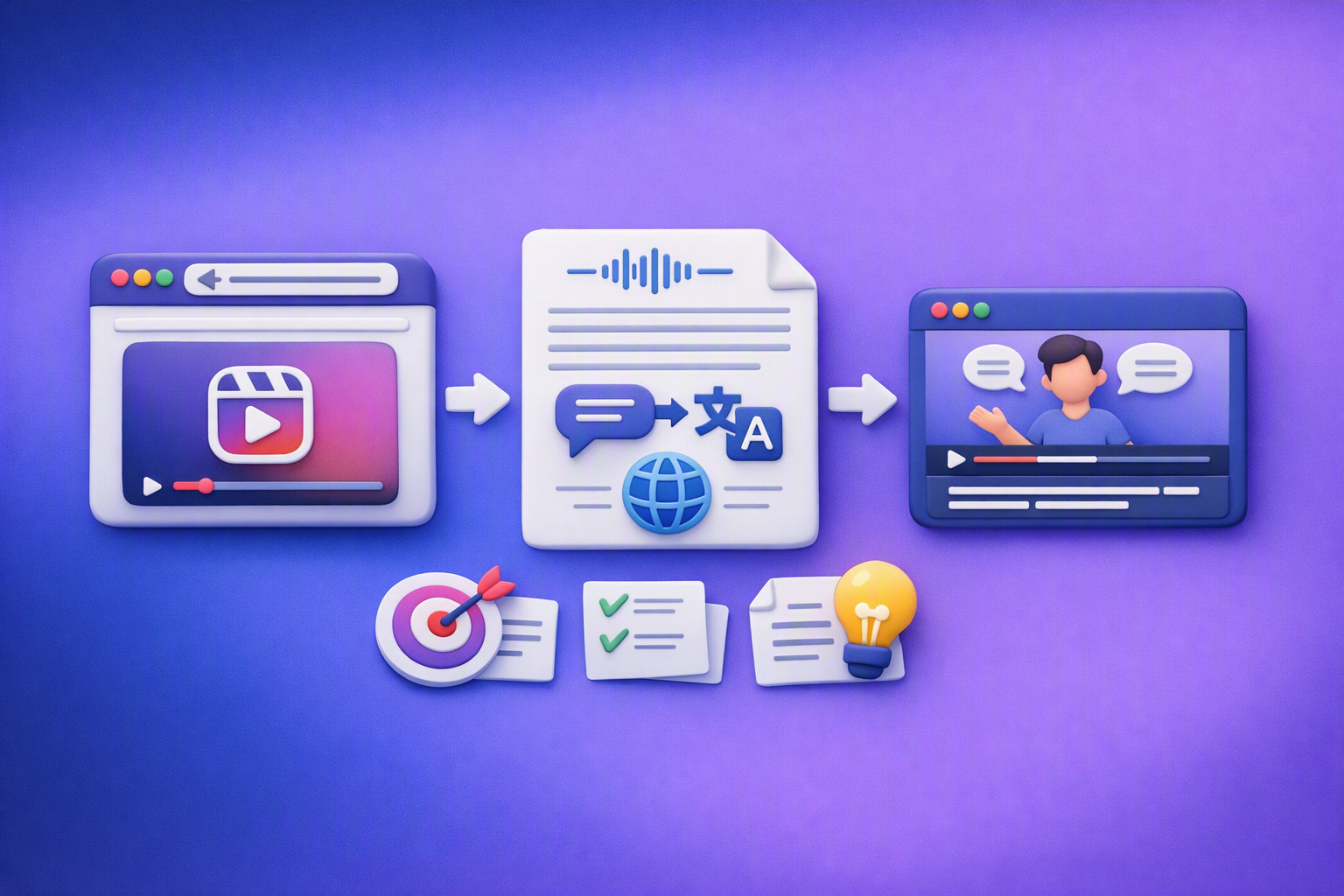
Aprende a traducir un Reel de Instagram con un flujo URL→transcripción→traducción→subtítulos, y a convertir esa traducción en un activo de investigación para hooks, CTAs, objeciones y clusters de contenido.
Reel Analyzer: Transcript‑First Instagram Reels Research (Hooks, CTAs, Objections) + Workflow Guide (VideoToTextAI)
Video To Text AI
A reel analyzer should turn any public Instagram Reel link into a searchable transcript library you can mine for hooks, CTAs, objections, and topic clusters—then repurpose into original drafts with a repeatable SOP.