
Can ChatGPT Transcribe Video? What Actually Works in 2026 (Plus the Reliable Link → Transcript Workflow)
 Video To Text AI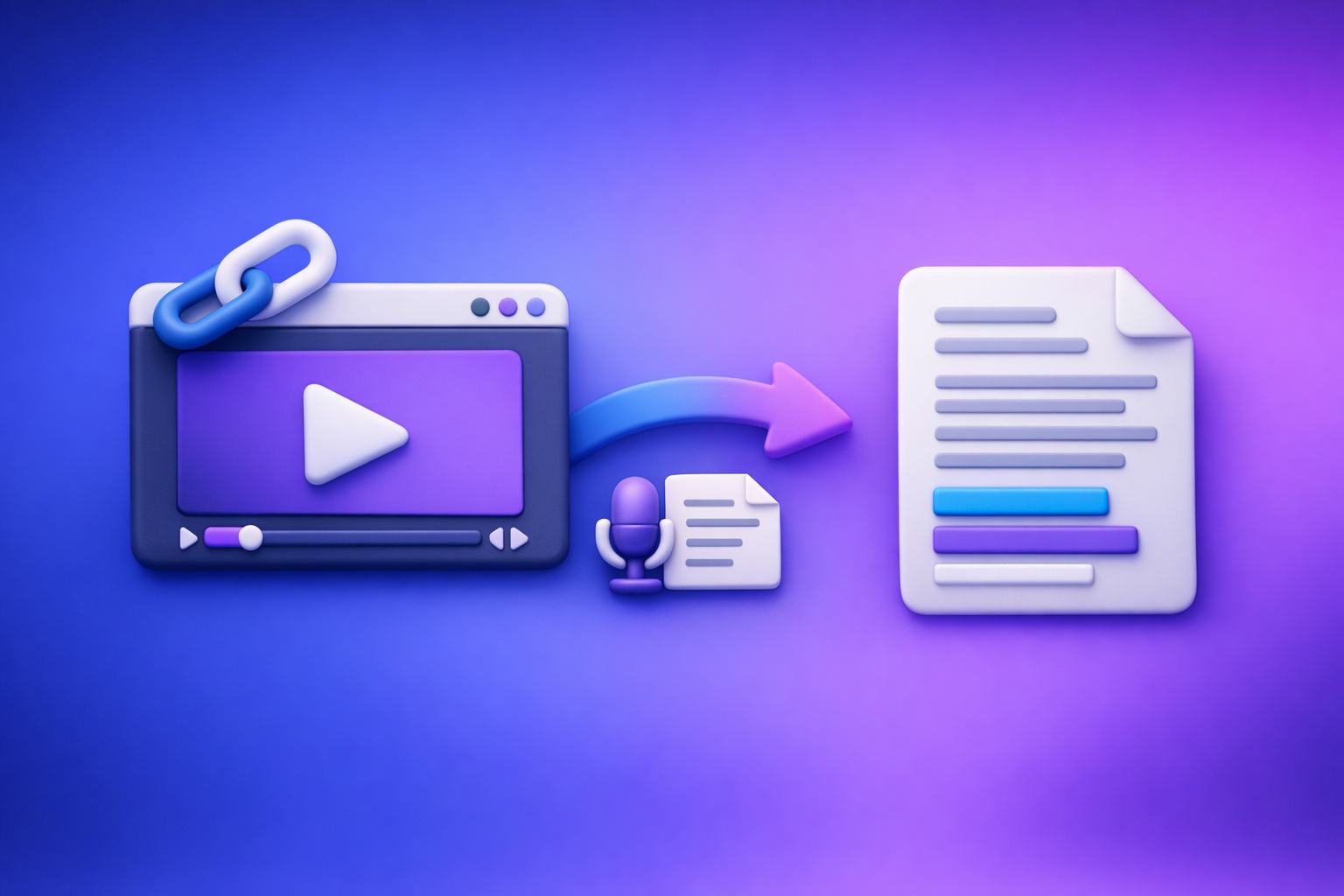
Can ChatGPT Transcribe Video? What Actually Works in 2026 (Plus the Reliable Link → Transcript Workflow)
If your goal is an accurate, export-ready transcript (TXT/SRT/VTT), ChatGPT isn’t a reliable “video → transcript” tool. The dependable 2026 approach is transcript-first (from a link or MP4), then use ChatGPT for cleanup, chapters, and repurposing.
Quick Answer: ChatGPT Isn’t a Reliable “Video → Transcript” Tool
What ChatGPT can do well (once you already have text)
ChatGPT is excellent at working with text you provide, including:
- Cleaning transcripts (remove filler, fix punctuation, normalize casing)
- Structuring content (chapters, headings, summaries, key takeaways)
- Repurposing (blog drafts, social posts, email sequences, scripts)
- Formatting (turn raw text into SRT-like blocks, tables, outlines)
What ChatGPT can’t reliably do (watch a full link/video end-to-end)
In real production workflows, “transcribe this video” usually requires:
- Full coverage (intro → outro) with no missing sections
- Accurate quotes (no invented lines)
- Timestamps that align with playback
- Export formats that upload cleanly: SRT/VTT
ChatGPT may fail any of the above depending on interface, permissions, video length, and whether it can access the media at all.
The dependable workaround: transcript-first, then ChatGPT for cleanup + repurposing
The modern workflow is:
- Generate transcript/subtitles from the video link (preferred) or MP4
- Do a 2-minute QA pass to confirm coverage and key terms
- Paste the transcript into ChatGPT to polish + repurpose
This is also why downloading video files is an outdated workflow for creators and teams. Link-based extraction is faster, easier to standardize, and scales across channels without file chaos.
What People Mean by “ChatGPT Transcribe Video” (3 Different Scenarios)
1) YouTube/Instagram/TikTok link → transcript
You paste a URL and expect a transcript back.
- This is the most common request.
- It’s also where people most often confuse “the model can read the link” with “the model can watch the video.”
2) MP4 file upload → transcript
You upload a file and expect a full transcript with timestamps.
- Sometimes possible.
- Often inconsistent for long videos, multi-speaker audio, or subtitle exports.
3) “Take notes” / summarize a video without a transcript
You want a summary, bullet notes, or key takeaways.
- Without a transcript, you’re asking the model to infer content it may not have actually processed.
- That’s where hallucinations and missing sections show up.
Can ChatGPT Transcribe a Video Link (YouTube/IG/Reels)?
Why pasting a link usually doesn’t equal “the model can watch it”
A URL is not the content.
Even in 2026, link access depends on:
- Whether the interface can fetch and process the media
- Platform restrictions (login, age gates, region locks)
- Rate limits, timeouts, or partial retrieval
- Whether audio extraction is supported for that source
Common failure modes (and how to recognize them fast)
Partial coverage (only first minutes)
Red flags:
- Transcript ends abruptly mid-thought
- No mention of the video’s closing CTA or final topic
- Output length is suspiciously short for the video duration
Hallucinated quotes / missing sections
Red flags:
- Quotes that don’t match the speaker’s style
- “As you said earlier…” references that never happened
- Confident claims without timestamps or verifiable anchors
No timestamps / unusable subtitle formats
Red flags:
- One big paragraph for a 20-minute video
- No time alignment
- No SRT/VTT structure (or malformed blocks)
When it might work (and why it’s still not export-ready)
It might work for:
- Short clips with clear audio
- Public videos with accessible audio streams
- Cases where you only need a rough summary (not a publishable transcript)
But for subtitles, captions, compliance, editing, or SEO content, “might work” isn’t a workflow.
Can ChatGPT Transcribe an MP4 Video You Upload?
What varies by plan/interface (and why results are inconsistent)
Results vary because:
- Upload limits differ by product surface (web/app/enterprise)
- Processing timeouts happen on longer media
- Some interfaces summarize instead of transcribing verbatim
- Export controls (SRT/VTT, timestamps, speaker labels) are limited
Practical limitations that break real workflows
Long videos and timeouts
Common issues:
- The model returns partial output
- It stops at a token limit
- It produces a summary instead of a transcript
Multi-speaker audio and diarization gaps
If you need “Speaker 1 / Speaker 2” accuracy:
- ChatGPT may merge speakers
- It may miss interruptions and overlaps
- It may label speakers inconsistently across the file
No SRT/VTT formatting control
Even if you get text, you still need:
- Correct timestamp formatting
- Reasonable line lengths
- Monotonic timecodes (no overlaps/backwards jumps)
Bottom line: use ChatGPT after transcription, not as the transcriber
Use ChatGPT for what it’s best at:
- Editing, structuring, repurposing, and drafting
- Not raw audio/video transcription and subtitle export
The Reliable 2026 Workflow (VideoToTextAI): Link/MP4 → Transcript/SRT/VTT → ChatGPT
This is the workflow that holds up across creators, marketing teams, and ops: link/MP4 in → transcript/subtitles out → ChatGPT value-add. It also aligns with the future: link-based extraction beats downloading files for speed, organization, and repeatability.
Step 1: Choose your input type (link vs MP4)
- Use a link when the video is hosted (YouTube, socials, LMS, public pages).
- Use MP4 when you own the file (webinars, interviews, recordings).
If you can use a link, do it. File downloading and re-uploading is friction you don’t need.
Step 2: Generate the transcript in VideoToTextAI
Use VideoToTextAI to generate export-ready outputs from a link or MP4: transcripts plus subtitle files. Start here: VideoToTextAI
Output options: TXT for editing, SRT/VTT for subtitles/captions
- TXT: best for editing, SEO pages, blog drafts, knowledge bases
- SRT/VTT: best for YouTube uploads, players, editors, social captioning
When to include timestamps (and when not to)
- Include timestamps when you need captions, chapters, QA, or editing alignment
- Skip timestamps when you only need clean reading text for an article
Step 3: Run a fast QA pass (2-minute accuracy check)
This prevents publishing errors and catches coverage gaps quickly.
Check #1: first 30 seconds (names, brand terms, accents)
- Proper nouns spelled correctly
- Brand/product names correct
- Accent-heavy words not mangled
Check #2: mid-video section (topic shift + speaker changes)
- Topic transitions are captured
- Speaker turns make sense (if multi-speaker)
- No “missing chunk” feeling
Check #3: last 60 seconds (end coverage + CTA accuracy)
- Transcript reaches the actual ending
- CTA, offer, URL, or next step is correct
- No abrupt cutoff
Step 4: Use ChatGPT for value-add (not raw transcription)
Clean up filler words without changing meaning
- Remove “um,” “you know,” repeated phrases
- Keep intent and technical meaning intact
- Preserve key terms for SEO and accuracy
Create chapters + titles from timestamps
- Convert timestamps into YouTube-style chapters
- Generate descriptive, searchable headings
Generate repurposed assets (blog, LinkedIn, X, email)
- Blog draft + SEO headings
- Social hooks + short posts
- Email newsletter summary + CTA
Step-by-Step: Get a Transcript From a Video Link (No Download)
Link-based transcription is the future because it eliminates the slowest steps: downloading, renaming, storing, re-uploading, and version confusion.
Inputs that typically work best (public links, stable hosting)
Best-case inputs:
- Public YouTube links
- Public Instagram/TikTok posts (where accessible)
- Stable hosting with consistent playback
Implementation steps
1) Paste the video link into VideoToTextAI
Keep a simple intake template:
- Source platform (YouTube/IG/TikTok/etc.)
- Video title
- Publish date
- Target output (TXT + SRT/VTT)
2) Select output: Transcript (TXT) + Subtitles (SRT/VTT)
Choose:
- TXT for editing and repurposing
- SRT for broad compatibility
- VTT for web players and some platforms
3) Export and store with a naming convention (project/date/source)
Use a naming convention that scales:
project_YYYY-MM-DD_source_title.txtproject_YYYY-MM-DD_source_title.srtproject_YYYY-MM-DD_source_title.vtt
Troubleshooting link issues
Private/age-restricted content
- If login is required, link-based extraction may fail.
- Use an authorized source or export a file you have rights to process.
Region-locked videos
- Region locks can block retrieval.
- Use an accessible mirror or a file you control.
Short-form clips with music-heavy audio
- Loud music reduces word accuracy.
- Expect more QA edits, especially for hooks and on-screen text references.
Step-by-Step: Convert an MP4 to Transcript + Subtitles (Export-Ready)
MP4 workflows still matter for owned recordings, but they’re slower than link-based pipelines and easier to break with file handling mistakes.
Implementation steps
1) Upload MP4 to VideoToTextAI
Before upload:
- Confirm the audio track is present and not muted
- Prefer clear voice levels over background music
2) Generate TXT transcript + SRT/VTT
Export both:
- TXT for editing/repurposing
- SRT/VTT for captions and publishing
For related workflows, see:
3) Validate timestamps and line length for captions
Open the SRT/VTT in your editor/player and confirm:
- Captions appear at the right moments
- No giant blocks of text
- No overlapping or out-of-order timestamps
Caption formatting rules (so SRT/VTT works everywhere)
Max characters per line
Practical rule:
- Aim for ~32–42 characters per line
- Prefer two lines max per caption block
Reading speed sanity check
If viewers can’t read it, it’s not usable.
- Keep captions on screen long enough to read
- Avoid cramming full sentences into 1 second
Speaker labels (when to keep/remove)
- Keep speaker labels for interviews, podcasts, panels
- Remove speaker labels for single-speaker marketing videos unless required
Checklist: “Is This Transcript Good Enough to Publish?”
Accuracy checklist (content)
- Proper nouns (people, brands, locations) verified
- Numbers/dates/URLs corrected
- No missing sections (intro/middle/outro)
- Speaker turns make sense (if multi-speaker)
Subtitle checklist (format)
- SRT/VTT exports open correctly in your editor/player
- Timestamps are monotonic and aligned
- Lines are readable (no walls of text)
- No repeated or skipped caption blocks
Repurposing checklist (conversion)
- Clear hook extracted (first 10–20 seconds)
- 3–5 key takeaways identified
- CTA preserved and placed near the end
- One “publish-ready” asset produced (blog/email/post)
Competitor Gap
Most pages ranking for “can chat gpt transcribe video” either overpromise (“just upload it”) or skip the operational details that make transcripts publishable.
What competitors miss (and what this post adds):
- A transcript QA system that catches hallucinations and coverage gaps in ~2 minutes
- Export-ready subtitle requirements (SRT/VTT rules that prevent upload failures)
- A repeatable SOP: link/MP4 → transcript/subtitles → ChatGPT repurposing
- Troubleshooting for private/blocked links and music-heavy audio
- Copy/paste prompt pack for cleanup, chapters, and repurposing
Copy/Paste Prompt Pack: Use ChatGPT After You Generate the Transcript
Use these prompts after you have a transcript (TXT) or timestamped transcript.
Prompt 1: Clean transcript without changing meaning
You are an editor. Clean this transcript for readability without changing meaning.
Requirements: keep technical terms, keep intent, remove filler words, fix punctuation, keep paragraph breaks short (1–3 sentences).
Transcript:
[PASTE]
Prompt 2: Create chapters with timestamps (YouTube-style)
Create YouTube-style chapters from this timestamped transcript.
Requirements: 6–12 chapters, each with a timestamp and a clear title, reflect topic shifts, keep titles under 60 characters.
Transcript:
[PASTE]
Prompt 3: Turn transcript into a blog post outline + draft
Turn this transcript into an SEO blog post.
Requirements: H2/H3 outline first, then a draft. Keep paragraphs short, add bullet lists, preserve key terms, include a concise conclusion and next steps.
Transcript:
[PASTE]
Prompt 4: Create short captions + hooks for Reels/TikTok
Extract 10 short hooks and 10 caption options from this transcript.
Requirements: hooks under 12 words, captions under 150 characters, keep the tone direct, avoid clickbait, include 3 CTA variations.
Transcript:
[PASTE]
Prompt 5: Extract quotes, stats, and “soundbites” for social
Extract: (1) 10 quotable soundbites, (2) any stats/numbers mentioned, (3) 5 contrarian takes.
Requirements: keep wording faithful to the transcript; if a quote is unclear, mark it as [VERIFY].
Transcript:
[PASTE]
Best Tools If Your Goal Is Video Transcription (Not Chat)
When you need transcript-first tools
Use transcript-first tools when you need:
- Accuracy and full coverage
- Timestamps for QA, editing, and chapters
- SRT/VTT exports that upload cleanly
- A workflow that scales across many videos
Where VideoToTextAI fits (link-based workflows + exports + repurposing)
VideoToTextAI is built for link-based video-to-text workflows (plus MP4), producing transcripts and subtitle exports you can immediately publish and repurpose. This matches where creator productivity is going: stop downloading files; extract from links and ship content faster.
Related reading:
- Video to Text: Convert Any Video Link into a Transcript, Subtitles (SRT/VTT), and Repurposed Content
- Free Instagram Transcript Generator (From a Link): Get Reel Transcripts Fast with VideoToTextAI
- videototext.io vs VideoToTextAI: Link-Based Video-to-Text Workflows for Transcripts, Subtitles, Captions, and Repurposing (2026)
- Can ChatGPT Upload Video? What Actually Works in 2026 (and the Reliable Link → Transcript Workflow)
- Video2Text AI: Convert Any Video Link into Transcripts, SRT/VTT Subtitles, and Repurposed Content (VideoToTextAI)
FAQ
Which AI can transcribe video?
A dedicated transcription tool that supports video links and MP4, and exports TXT + SRT/VTT reliably. Then use ChatGPT for editing and repurposing.
Can you put a video into ChatGPT?
Sometimes you can upload a video file depending on the interface and plan, but it’s not consistent for long videos or export-ready subtitles. For dependable results, transcribe first, then use ChatGPT on the transcript.
Can ChatGPT take notes from a video?
ChatGPT can take strong notes from a transcript (or timestamped transcript). Without a transcript, it may miss sections or invent details because it can’t reliably process a full video link end-to-end.
Is there a way to transcribe text from a video?
Yes: generate a transcript from the video (preferably from a link to avoid file downloads), export TXT/SRT/VTT, run a quick QA pass, then repurpose the transcript into publishable assets.
Related posts
Reel Analyser (Instagram Reels): Transcript‑First Competitor Research, Hook/CTA Extraction, and Repurposing Workflow (VideoToTextAI)
Video To Text AI
A 2026 reel analyser should turn Instagram Reel links into a searchable transcript library you can tag for hooks, CTAs, objections, and topic clusters—then export into repurposing-ready drafts without a download/upload loop.
Traducir video de Instagram (Reels) en 2026: workflow transcript-first para traducir, sacar hooks/CTAs y repurpose (con VideoToTextAI)
Video To Text AI
Aprende a traducir un Reel de Instagram con un flujo URL→transcripción→traducción→subtítulos, y a convertir esa traducción en un activo de investigación para hooks, CTAs, objeciones y clusters de contenido.
Reel Analyzer: Transcript‑First Instagram Reels Research (Hooks, CTAs, Objections) + Workflow Guide (VideoToTextAI)
Video To Text AI
A reel analyzer should turn any public Instagram Reel link into a searchable transcript library you can mine for hooks, CTAs, objections, and topic clusters—then repurpose into original drafts with a repeatable SOP.