
Instagram Reels Content Ideas From Competitor Transcripts (Transcript-First Workflow with VideoToTextAI)
 Video To Text AI
Turn competitor Reels into original Instagram content ideas by extracting transcripts from public links, then mining hooks, CTAs, objections, and topic clusters. With VideoToTextAI, you can go Reel URL → transcript → hook library → 30-day idea backlog without the outdated download/upload loop.
Brand POV: Downloading video files is an outdated workflow. Link-based extraction is the future of creator productivity—faster inputs, fewer file-handling errors, and easier team handoffs.
Instagram Reels Content Ideas From Competitor Transcripts (Transcript-First Workflow with VideoToTextAI)
Why competitor Reel transcripts are a research asset (not a script to copy)
Competitor transcripts aren’t “content to rewrite.” They’re structured market research that shows what your audience is responding to—especially when you analyze them at scale.
If you want the deeper framework behind this approach, see: Instagram Reel Competitor Research: How to Find Hooks, Angles, and Content Ideas From Transcripts.
What transcripts reveal that “watching Reels” doesn’t
Watching helps you feel what works. Transcripts help you measure and systematize what works.
Use transcripts to identify:
- Exact hook wording patterns (first 1–3 seconds)
You’re not copying lines—you’re learning the mechanisms competitors use to earn attention. - Repeated objections + reassurance lines
These often map directly to buying friction (“Is it expensive?”, “Will this take long?”, “Is it risky?”). - CTA structures
Patterns like comment keywords, DM prompts, “save this,” “follow for part 2,” and link-in-bio. - Topic clusters and sequencing across a series
Competitors rarely post randomly. Transcripts reveal series logic (Part 1 → Part 2 → Part 3) and content ladders.
Compliance + originality rules (especially for regulated niches)
Transcript-first research is powerful, but you need guardrails—especially in legal, medical, and financial niches.
Follow these rules:
- Do not copy-paste competitor phrasing; extract structures, not sentences.
- Keep a source log for research; publish only original language.
- For legal/medical/financial: add review gates (attorney/compliance approval) before publishing.
For a legal-specific workflow, see: How Law Firms and Legal Marketing Agencies Can Transcribe Instagram Reels for Content Research and Client Education.
Step-by-step: competitor transcript → hooks → angles → original Reel ideas
This workflow is designed for teams and agencies who need repeatability, not random inspiration.
Step 1: Build a competitor Reel watchlist (fast, repeatable inputs)
Start with a small, consistent panel. You’re building a dataset.
- Choose 5–10 competitor/adjacent accounts
- Include direct competitors and “adjacent educators” (same audience, different offer).
- Pick 20–50 Reels to start
- Mix top-performing (views/likes/comments) and recent (current messaging).
- Track these fields in a spreadsheet:
- Reel URL
- Date posted
- Topic guess
- Format (talking head, b-roll, green screen)
- CTA type (comment/DM/save/follow/link)
Tip: If you’re a legal marketing agency, include local competitors and national educators. Local accounts reveal jurisdiction-specific concerns; national accounts reveal scalable hook patterns.
Step 2: Generate transcripts from public Reel links (link-based workflow)
This is where most workflows waste time. Downloading, converting, uploading, and renaming files is friction you don’t need.
Use Instagram link → transcript tools:
- Primary: instagram to transcript
- Backup: instagram transcript from link
- If you need a clean “script-like” extraction: instagram script extractor
Why link-based matters operationally:
- Faster ingestion for 20–50 Reels at a time
- Fewer file errors (wrong version, wrong Reel, missing audio)
- Easier delegation (VA/assistant can paste URLs into a queue)
Step 3: Normalize transcripts for analysis (so patterns are comparable)
Raw transcripts are messy. Normalize them into the same schema so you can compare across creators.
Standardize fields per Reel:
- Hook (0–3s)
- Promise/Outcome
- Steps/Framework
- Proof (credibility markers: experience, results, case type, process)
- Objections handled
- CTA + CTA placement (mid vs end)
Optional (but useful for high-performing accounts):
- Add timestamps around retention moments (e.g., where they introduce the “big reveal” or switch visuals).
This schema becomes your internal “Reel research template.” It’s also what most top-ranking pages don’t provide (we’ll cover that in the Competitor Gap section).
Step 4: Extract hooks that match your audience (without reusing wording)
Once transcripts are normalized, hook extraction becomes a repeatable step—not a creative guessing game.
Tool-assisted hook pull:
Categorize hooks by mechanism (not by exact sentence):
- Contrarian: “Stop doing X…”
- Specific outcome: “In 7 days, you can…”
- Mistake-based: “If you’re doing X, you’re losing…”
- Checklist: “3 things to do before…”
For legal marketing, hook mechanisms often map to:
- Risk avoidance (what not to do)
- Timeline clarity (what happens next)
- Eligibility (is it worth calling)
- Cost anxiety (fees, settlement myths, hidden costs)
Step 5: Mine CTAs and conversion triggers
Competitor CTAs tell you how they convert attention into leads.
Identify CTA types used repeatedly:
- Comment keyword → DM automation
- “Save this” retention CTA
- “Follow for part 2” series CTA
- “Link in bio” traffic CTA
Map CTA to funnel stage:
- Awareness: save/share/follow
- Consideration: comment/DM (“send me the checklist”)
- Conversion: book call / consult / trial
Then ask: Which CTA types show up most often in Reels about X topic cluster?
That’s how you align content with outcomes, not just views.
Step 6: Turn competitor transcripts into original content ideas (idea mining system)
Your goal is not “more ideas.” Your goal is better angles that you can defend, repeat, and scale.
Create an “Angle Bank” from transcript patterns
Use this angle formula:
Audience + Pain + Mechanism + Proof + Next step
Example (legal-safe, structure-only):
- Audience: “Drivers after a rear-end collision”
- Pain: “They accidentally damage their claim”
- Mechanism: “3 documentation steps in the first 48 hours”
- Proof: “What insurers look for / what your intake team sees”
- Next step: “Save this + call for a case evaluation (jurisdiction disclaimer)”
Pull recurring themes from competitor transcripts:
- “Common mistake” themes
- “Myth vs fact” themes
- “Step-by-step” themes
- “Checklist before you…” themes
Build topic clusters from transcript tags
Cluster by:
- Problem type: pricing, process, risk, timeline
- Persona: founder, marketer, client, patient
- Stage: newbie, intermediate, advanced
Output:
- 10–20 cluster titles
- 3–5 Reel ideas per cluster
If you want to connect this to a broader content system, pair it with your blog strategy and internal linking. Example: build a cluster around “timeline” and link Reels to a longer explainer post.
Step 7: Repurpose transcripts into multi-channel drafts (still original)
A transcript-first workflow should produce multi-channel assets, not just Reel ideas.
Convert a Reel insight into:
- LinkedIn post draft: instagram reel to linkedin post
- Blog post draft: instagram reel to blog post
- Text post version: reel to post converter
Important: repurposing should carry over the angle and structure, not competitor phrasing.
For deeper tool-alternative comparisons in this cluster, see:
- Best Reduct Video Alternative for Instagram Reel Research, Content Ideas, and Repurposing
- Best VOMO AI Alternative for Instagram Reel Transcripts, Content Ideas, and Repurposing
Operating workflow for teams & agencies (with a legal marketing track)
Transcript-first workflows win when they’re scheduled and auditable.
Weekly cadence (agency-friendly)
Use a weekly sprint that produces a backlog, not one-off posts:
- Monday: ingest 10–20 competitor Reels → transcripts
- Tuesday: hook/CTA extraction + tagging
- Wednesday: ideation sprint (original angles only)
- Thursday: draft + internal review
- Friday: compliance review + scheduling
This cadence is especially useful when you manage multiple clients and need consistent throughput.
Law firms / legal marketing agencies: role-specific steps + risk controls
Legal marketing is a perfect fit for transcript-first research because prospects ask the same questions repeatedly—just with different facts.
What to extract from competitor transcripts (legal-safe)
Focus on client education signals, not competitor language:
- Client questions (eligibility, timelines, costs, “what happens if…”)
- Objection patterns (fear, skepticism, “is it worth it?”)
- Misconceptions to correct (without referencing competitor claims)
Review gates (recommended)
Add explicit gates to reduce risk:
- Gate 1: marketer drafts using angle templates (no verbatim reuse)
- Gate 2: attorney review for jurisdictional claims, disclaimers, outcomes language
- Gate 3: final approval + archive transcript sources for audit trail
If your team uses AI tools in drafting, also align with your internal policy on copyrighted text and quoting. Reference: 90 Characters of Copyrighted Text in ChatGPT: What It Means, What’s Allowed, and Safer Workflows (VideoToTextAI)
Example Reel idea transformations (structure-only, not wording)
- Competitor pattern: “3 mistakes after an accident”
→ Your original: “3 things that can hurt your claim (and what to do instead)” - Competitor pattern: “Do you qualify?”
→ Your original: “Eligibility checklist: when it’s worth calling a lawyer”
Checklist: transcript-first competitor research system (copy into your SOP)
Inputs
- List of competitor/adjacent accounts
- 20–50 public Reel URLs
- Spreadsheet with fields (URL, date, topic, hook type, CTA type, objections, proof)
Processing
- Transcribe each Reel via link workflow
- Extract hook (0–3s) + CTA + objections
- Tag transcript to a topic cluster
- Add 1–3 original angles per Reel (no reused phrasing)
Outputs
- 30-day Reel idea backlog (clustered)
- Hook library (categorized by mechanism)
- CTA library (mapped to funnel stage)
- Repurposed drafts (LinkedIn + blog + text post)
Common mistakes + troubleshooting (what breaks transcript-first workflows)
Mistake: treating transcripts as scripts to rewrite
If your output sounds like the competitor, you’re doing it wrong.
Fix:
- Extract frameworks (sequence, proof, objection handling)
- Rewrite from your POV: your process, your client stories, your constraints, your jurisdiction
Mistake: no tagging → no reusable system
If you can’t filter your spreadsheet by “hook type” or “objection,” you can’t scale.
Fix:
- Enforce a minimum tag set:
- hook type
- topic cluster
- CTA type
- objection
- proof type
Mistake: optimizing for “more ideas” instead of “better angles”
A backlog of weak ideas is still a weak strategy.
Fix:
- Require each idea to include:
- audience
- promise
- proof
- CTA
- one differentiator (your method, your stance, your checklist, your boundary)
VideoToTextAI vs Competitors
If you’re building instagram reels content ideas from competitor transcripts, the differentiator isn’t “can it transcribe.” It’s how fast you can go from a Reel URL to structured research outputs your team can reuse.
Comparison criteria (workflow-based, not feature guessing)
Evaluate tools on:
- URL-first speed: paste link → transcript → hooks/repurposing outputs
- Export readiness: transcript + captions/subtitles formats when needed (TXT/SRT/VTT where applicable)
- Repeatability for teams: consistent fields, templates, and batch-style processing habits
- Repurposing depth: hooks, CTAs, objections, and cluster outputs—not just summaries
Workflow comparison table
| Criteria | VideoToTextAI | Pcmag Com | Zapier Com | Nytimes Com |
|---|---|---|---|---|
| Best fit for Instagram Reel competitor research | Yes (purpose-built tools for Reel transcripts, hooks, repurposing) | No (editorial directory of services) | No (editorial roundup + automation ecosystem) | No (editorial testing context) |
| Link-based input (paste Reel URL) | Yes (Instagram link → transcript tools) | Not positioned as link-first workflow | Not positioned as link-first workflow | Not positioned as link-first workflow |
| Transcript-first ideation outputs (hooks/repurposing drafts) | Yes (hook extractor + post/blog converters) | Not a workflow tool; reviews mention repurposing generally | Not a workflow tool; focuses on app selection/automation | Not a workflow tool; focuses on testing recommendations |
| Operational repeatability (schemas, templates, cadence) | Strong fit (URL-first ingestion supports team SOPs) | Not applicable | Helpful if your main need is connecting many apps | Not applicable |
| When it may be better | If you want URL-first research + repurposing | If you’re building a broad shortlist of transcription services | If your priority is automating across many apps | If you want human-vs-AI transcription framing and testing context |
Where VideoToTextAI fits best
VideoToTextAI fits best when you want link-based Instagram Reel research and a transcript-first workflow that produces publishable drafts.
Dedicated tools that support this workflow:
Fair notes on when a competitor may fit better for narrower jobs
- Pcmag Com: useful as a broad directory for evaluating many transcription services (good for initial shortlist building).
- Zapier Com: useful if your primary need is connecting transcription into wider automation stacks across many apps.
- Nytimes Com: useful if you want editorial testing context and human-vs-AI transcription framing.
- Morningscore IO: useful if you’re researching “free tool” experiences and want a personal-test style roundup.
If your goal is speed + repeatability from Reel URL to research assets, link-based extraction wins—and that’s the workflow VideoToTextAI is built around. To implement the URL-first workflow end-to-end, use VideoToTextAI exactly once as your starting point.
Competitor Gap
Top-ranking pages and forum threads often talk about “transcribing Reels” or “getting content ideas,” but they skip the operational details that make it scalable.
What top-ranking pages/forums typically miss (and what this post will include)
- Missing: a concrete transcript schema (hook/CTA/objection/proof fields)
- Included: a standardized analysis template + tagging system
- Missing: step-by-step implementation from Reel URL to idea backlog
- Included: end-to-end workflow + weekly cadence for teams/agencies
- Missing: compliance caveats for regulated niches
- Included: legal marketing review gates + “structure-only” examples
- Missing: PAA-aligned FAQ that answers tool/workflow questions directly
- Included: FAQ focused on rules, tools, and practical constraints
FAQ
What is the 3 second rule on Instagram?
It’s the practical rule that your Reel must communicate a clear reason to keep watching in the first 1–3 seconds. Transcript-first workflows help you analyze competitor hook structures (question, contrarian claim, specific outcome) so you can write original hooks that match your audience’s intent.
How to get content ideas for Instagram reels?
Build a transcript-first system:
- Collect competitor Reel URLs
- Transcribe from links
- Normalize into hook/promise/steps/proof/objections/CTA
- Tag patterns into clusters
- Generate original angles per cluster
This produces a backlog you can schedule for 30 days (or more) without relying on trends.
What type of content is best for Instagram reels?
Content that earns attention fast and delivers a clear payoff:
- Problem → solution education
- Mistake → fix frameworks
- Checklist and “before you…” guidance
- Myth vs fact corrections
- Series that build a topic cluster over multiple Reels
Transcripts help you see which of these formats competitors repeat—and where you can differentiate.
Can ChatGPT do video transcription?
ChatGPT can sometimes transcribe if you provide audio/text input, but it’s not inherently a link-based Instagram transcription workflow. For competitor research, you typically want a tool that turns public Reel links into transcripts and then supports hook extraction and repurposing outputs.
What is the best tool to transcribe a video?
Choose based on workflow:
- If you need URL-first Instagram research (paste link → transcript → hooks/repurposing drafts), VideoToTextAI is designed for that operational path.
- If you need broad comparisons of transcription vendors, editorial roundups like Pcmag Com or Nytimes Com can help you evaluate categories and tradeoffs before selecting a workflow tool.
Related posts
Reel Analyser (Instagram Reels): Transcript‑First Competitor Research, Hook/CTA Extraction, and Repurposing Workflow (VideoToTextAI)
Video To Text AI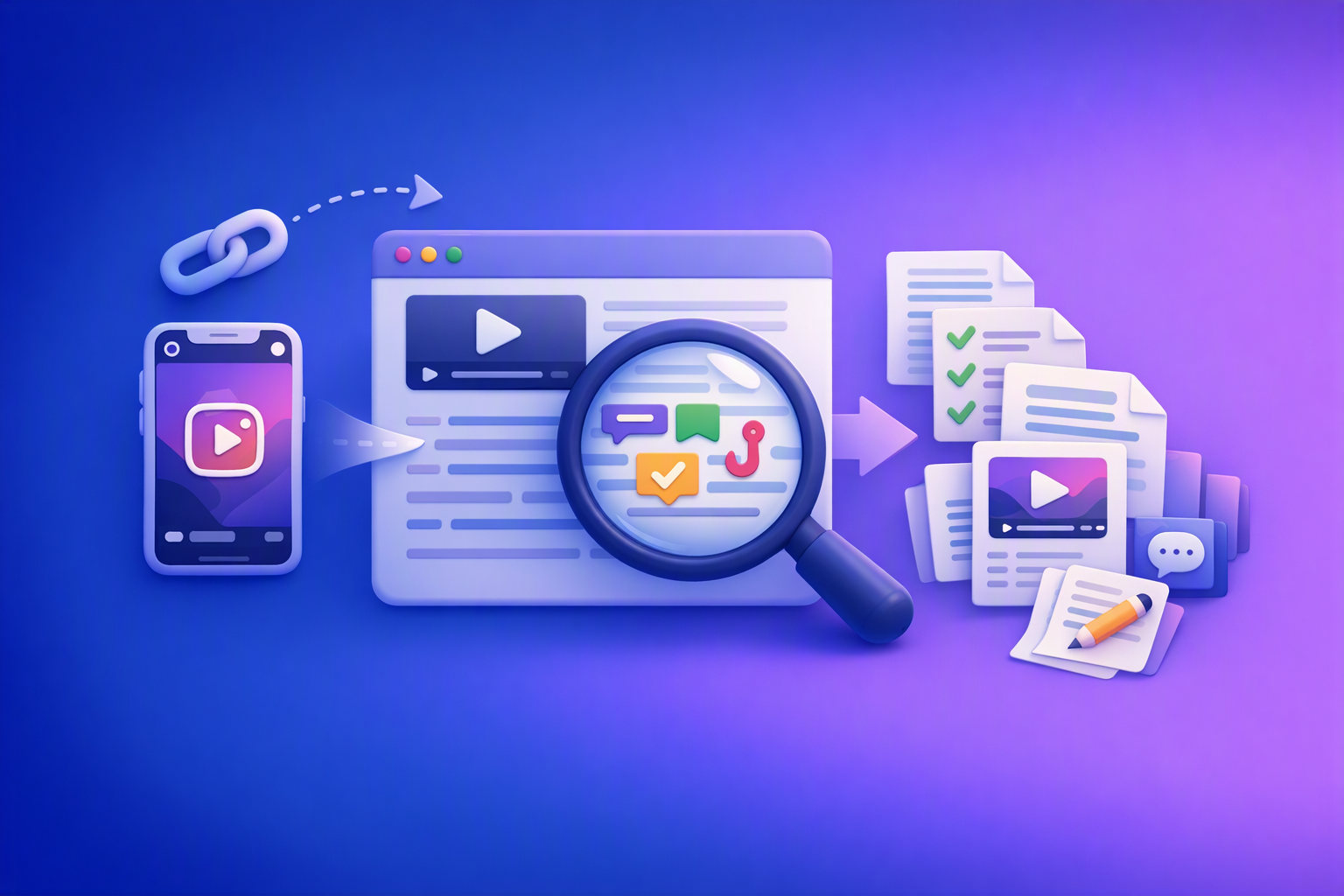
A 2026 reel analyser should turn Instagram Reel links into a searchable transcript library you can tag for hooks, CTAs, objections, and topic clusters—then export into repurposing-ready drafts without a download/upload loop.
Traducir video de Instagram (Reels) en 2026: workflow transcript-first para traducir, sacar hooks/CTAs y repurpose (con VideoToTextAI)
Video To Text AI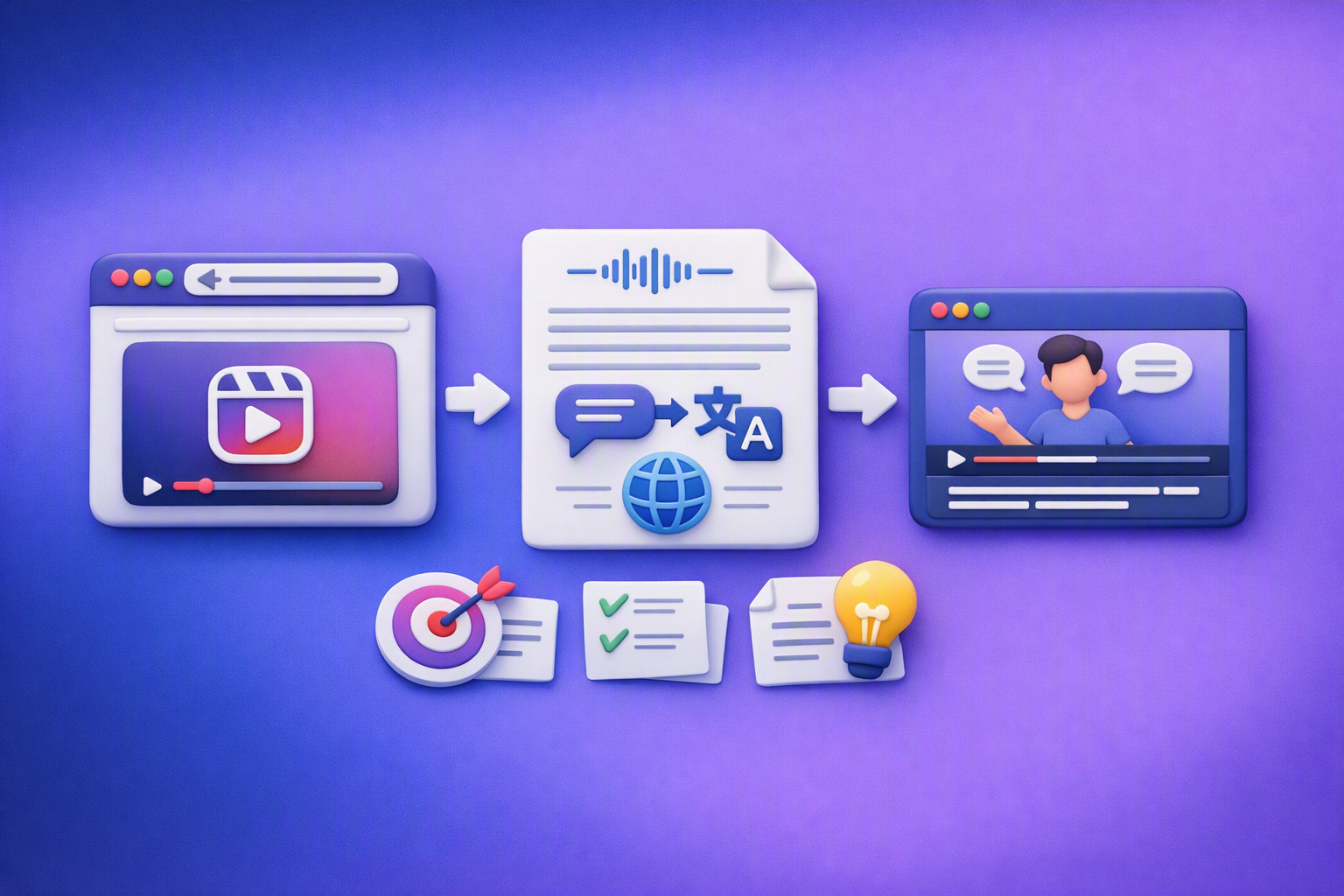
Aprende a traducir un Reel de Instagram con un flujo URL→transcripción→traducción→subtítulos, y a convertir esa traducción en un activo de investigación para hooks, CTAs, objeciones y clusters de contenido.
Reel Analyzer: Transcript‑First Instagram Reels Research (Hooks, CTAs, Objections) + Workflow Guide (VideoToTextAI)
Video To Text AI
A reel analyzer should turn any public Instagram Reel link into a searchable transcript library you can mine for hooks, CTAs, objections, and topic clusters—then repurpose into original drafts with a repeatable SOP.