
Repurpose Instagram Reels Into Blog Post Ideas: Transcript-First Workflow (Hooks, CTAs, Objections) with VideoToTextAI
 Video To Text AI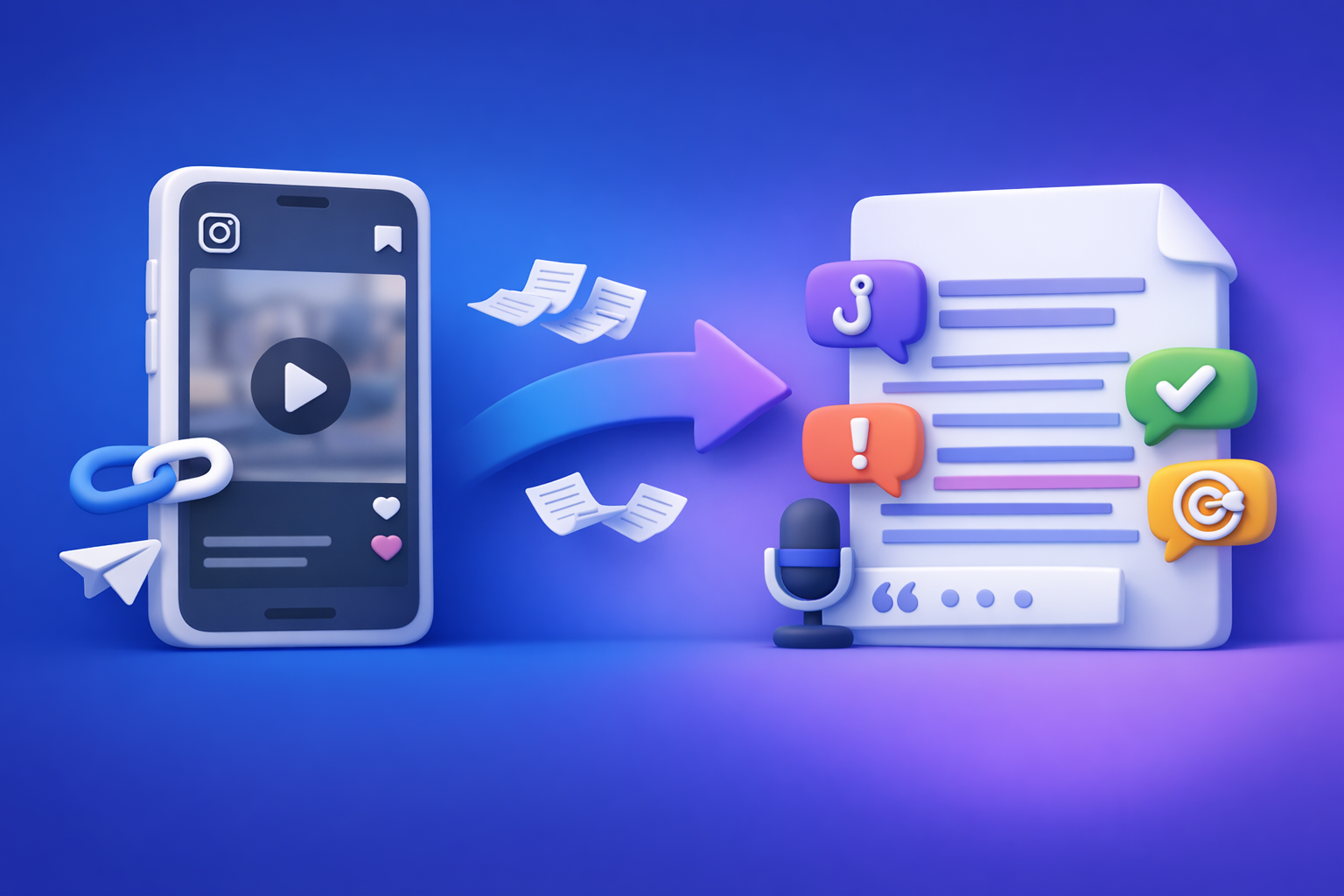
Repurpose Instagram Reels Into Blog Post Ideas: Transcript-First Workflow (Hooks, CTAs, Objections) with VideoToTextAI
Paste 10–30 public Instagram Reel links into a transcript tool, then mine the transcripts for hooks, CTAs, objections, and repeated topics to generate blog post ideas that can rank. This transcript-first workflow turns Reels into a search and conversion research asset, not a “content summary” exercise.
Downloading video files is an outdated workflow. Link-based extraction is the future of creator productivity because it’s faster, easier to systemize, and easier to audit for teams.
Why “transcript-first” beats “watch-and-guess” for blog ideation
Reels are dense research assets (not just short videos)
A good Reel compresses a full argument into 15–60 seconds: a hook, a promise, a few steps, proof, and a CTA. That’s exactly the structure you need for a blog post that ranks and converts.
When you rely on “watch-and-guess,” you lose:
- Exact phrasing that signals intent (“here’s what to do if…”, “don’t make this mistake…”)
- The order of persuasion (hook → proof → steps → CTA)
- Repeatable patterns across multiple creators (cluster signals)
What you can reliably extract from transcripts
Treat transcripts like qualitative research data. You’re not summarizing; you’re coding.
From Reel transcripts, you can extract:
-
Hooks and pattern language (what earns attention)
The first 1–2 lines often reveal the “angle” that wins: contrarian, fear-based, checklist, myth-bust, story. -
CTAs and conversion paths (what they ask viewers to do)
“Comment X,” “DM me,” “book a call,” “download,” “follow for part 2.” These map directly to blog conversion elements. -
Objections and clarifications (what audiences resist)
The best Reels pre-handle resistance: cost, time, risk, “does this apply to me,” compliance concerns. -
Repeated topics (cluster signals for SEO)
If 3+ creators repeat the same subtopic, you likely have a supporting post opportunity (and maybe a pillar).
What you need before you start (inputs + guardrails)
Inputs checklist
Keep it simple and operational:
- 10–30 public Reel URLs (your account + peers + competitors)
- Target audience + offer (what the blog should convert to)
- A simple tagging scheme: hooks / CTAs / objections / proof / steps
If you want a deeper competitor workflow, pair this post with:
- Instagram Reel Competitor Research: How to Find Hooks, Angles, and Content Ideas From Transcripts
- Instagram Reels Content Ideas From Competitor Transcripts (Transcript-First Workflow with VideoToTextAI)
Guardrails (especially for regulated niches)
Transcript-first research is powerful, but you need clean boundaries:
-
Don’t copy competitor wording; extract patterns and angles
Example: reuse a “myth vs reality” structure, not their sentences. -
Verify claims, statistics, and legal/medical advice with a reviewer
Reels often oversimplify. Your blog must be accurate and defensible. -
Keep a review log (who approved what, when, and what changed)
This matters for agencies and regulated teams.
For legal-specific workflows, also see:
- Law Firms Transcribing Instagram Reels for Content Ideas: Transcript-First Research Workflow (VideoToTextAI)
- How Law Firms and Legal Marketing Agencies Can Transcribe Instagram Reels for Content Research and Client Education
Step-by-step: URL → transcript → idea bank → blog outlines (VideoToTextAI workflow)
Step 1: Turn Reel links into transcripts (fast, repeatable)
Use link-based transcription so you’re not downloading files, renaming them, uploading them, and losing source context.
Recommended tools:
Output to store (in a sheet or database):
- Transcript text
- Timestamps (if available)
- Source URL
- Publish date (or capture date)
This creates an audit trail for competitor research and regulated publishing.
Step 2: Clean and normalize transcripts for analysis (2–5 minutes per Reel)
You’re cleaning for meaning, not grammar.
What to fix (only what affects meaning):
- Speaker names/roles (Creator vs Interviewee)
- Acronyms and niche terms
- Missing words in the first 3 seconds (hook zone)
What not to over-edit:
- Filler words unless they change meaning
- Minor grammar issues (analysis > perfection)
Step 3: Tag the transcript like a researcher (not a summarizer)
Minimal tagging taxonomy (recommended)
Use a small set of tags so the workflow stays repeatable:
- Hook (first 1–2 lines)
- Promise/Outcome
- Steps/Framework
- Proof (case result, demo, authority)
- Objection (“but what if…”, “people think…”, “here’s the catch…”)
- CTA (comment, DM, link, consult, download)
How to tag quickly
- Highlight the exact lines
- Attach a short label + intent note
Examples:- “Hook: contrarian (calls out common mistake)”
- “Objection: cost fear”
- “CTA: comment keyword for template”
This is how you turn transcripts into an idea bank instead of a pile of text.
Step 4: Extract hooks you can ethically reuse as structures
Use a hook extraction workflow to identify what’s working across creators.
Tool:
Hook pattern library (what to record per hook)
For each hook, record:
- Hook type: myth-bust, contrarian, checklist, warning, story
- Audience trigger: cost, risk, time, confusion, compliance
- Open loop mechanism: what question it creates
- Proof cue: what makes it believable (credential, example, “here’s why”)
Your blog titles and intros get easier when you have 30–100 hooks categorized by type.
Step 5: Mine CTAs and objections to build blog sections that convert
Most “repurpose Reels” advice stops at ideas. Conversion happens when you map CTA + objection into the outline.
CTA mapping (Reel → blog)
- “Comment X” → “Download the checklist” / “Request template”
- “DM me” → “Book a consult” / “Get a demo”
- “Follow for part 2” → “Related posts” + internal links + email capture
Objection-to-section mapping (fast outline builder)
- Objection line → FAQ section header
- Clarification line → Common mistakes section
- Proof line → Examples / case notes section
If you want to go deeper on safe reuse boundaries, reference:
Step 6: Turn transcript clusters into SEO topic clusters (not one-off posts)
How to cluster (simple method)
Create a spreadsheet with:
- Reel URL
- Hook
- Topic
- Subtopic
- Objection
- CTA
- Notes
Then group by repeated subtopics (≥3 mentions across different creators).
Cluster outputs
From one transcript set, you should produce:
- 1 pillar post idea (broad, evergreen)
- 5–12 supporting posts (specific questions, objections, scenarios)
- 1 lead magnet angle (checklist, template, script bank)
This is how you build an engine instead of publishing random posts.
Blog post idea formulas pulled from Reel transcripts (with examples you can generate)
Use these formulas to convert tagged transcript lines into outlines.
1) “Myth vs reality” posts (best when Reels use contrarian hooks)
Outline:
- Myth
- Why it persists
- What’s true
- Steps
- Proof
- CTA
Transcript signals to look for:
- “Everyone thinks…”
- “Stop doing…”
- “The truth is…”
2) “Checklist / SOP” posts (best when Reels list steps fast)
Outline:
- Who it’s for
- Prereqs
- Step-by-step
- Checklist
- Mistakes
- CTA
Transcript signals:
- “Do these 3 things…”
- “Save this…”
- “Here’s the process…”
3) “Objection-handling” posts (best when Reels address fear/risk)
Outline:
- Objection
- What’s at stake
- What to do
- Examples
- FAQ
- CTA
Transcript signals:
- “But what if…”
- “Here’s the catch…”
- “Don’t panic if…”
4) “Case-style explainer” posts (best when Reels cite outcomes)
Outline:
- Scenario
- Constraints
- Decision points
- Result
- Lessons
- CTA
Transcript signals:
- “Here’s what happened when…”
- “In this case…”
- “What I’d do differently…”
Repurposing outputs (beyond the blog) from the same transcript set
Once you’ve built the idea bank, you can generate drafts and distribution assets from the same source transcripts.
Blog draft generation (starting point, then edit)
Tool:
Use drafts as a starting point, then:
- Add original examples
- Verify claims
- Improve structure for search intent
- Add internal links and a clear CTA
Cross-posting to distribution channels (optional, after blog is approved)
Role-specific workflow: legal marketing agencies + law firms (compliance-first)
Legal teams can use Reel transcripts for research and client education, but must avoid “copy-paste marketing” and must maintain review discipline.
What to extract from competitor/peer Reels (without copying)
Focus on audience questions and friction, not competitor phrasing:
- Intake-friction questions (“Do I have a case if…?”)
- Misconceptions that create bad leads
- Jurisdiction-specific qualifiers (what must be reviewed)
- CTA style that fits ethics rules (consult vs guarantee)
Operating steps for a weekly “Reel transcript research sprint” (60–90 minutes)
- Collect 10 Reel URLs (competitors + bar association + local firms)
- Transcribe all links
- Tag hooks/objections/CTAs
- Build 3 blog outlines:
- 1 educational evergreen (“What to do after…”)
- 1 objection post (“Is it worth hiring a lawyer for…?”)
- 1 process post (“How consultations work + what to bring”)
- Compliance review checklist (before publishing)
Risk/compliance caveats to include in the post itself
- “This is general information, not legal advice”
- Avoid outcome guarantees; avoid “specialist” claims unless verified
- Review jurisdictional advertising rules and firm policy
- Keep a source log; do not reproduce competitor phrasing
Common mistakes when repurposing Instagram Reels into blog post ideas
Mistake: turning a Reel into a blog “summary” instead of a search-targeted article
A summary rarely matches a query. A search-targeted post answers a specific question with structure, examples, and internal links.
Mistake: ignoring CTAs and objections (losing conversion intent)
If you don’t map CTAs and objections, you’ll publish “informational” posts that never convert.
Mistake: building one post per Reel (instead of clusters)
One Reel is one data point. Clusters are how you build topical authority and internal linking.
Mistake: copy-pasting competitor lines (copyright + brand risk)
Use transcripts to extract patterns, then write original content and verify claims.
Mistake: skipping fact-checking when Reels cite stats or legal/medical claims
Reels optimize for attention. Your blog must optimize for accuracy and trust.
Implementation checklist (copy/paste into your SOP)
Weekly Reel-to-blog ideation checklist
- Pick a theme (one audience problem, one offer)
- Collect 10–30 Reel URLs
- Transcribe via Instagram link → transcript
- Tag Hook / CTA / Objection / Proof / Steps
- Extract hook patterns via Instagram Reel hook extractor
- Build a cluster map (pillar + supporting posts)
- Draft 1–3 outlines (objection-led + CTA-led)
- Add compliance notes + reviewer (if regulated)
- Publish + link internally to supporting posts
If you want to operationalize this across a team, stop downloading files and standardize on link-based inputs. For the workflow hub, use VideoToTextAI.
VideoToTextAI vs Competitors
Comparison criteria (workflow-based, not feature speculation)
For “repurpose instagram reels into blog post ideas,” the criteria that matter are:
- URL-based speed: paste a public Reel link → transcript → repurposing assets
- Export readiness: transcript usability for editing, outlining, and reuse
- Repurposing workflow fit: hook/CTA/objection extraction → blog ideation → drafts
- Repeatability for teams: consistent SOP for weekly research sprints
Workflow comparison table
| Criteria | VideoToTextAI | Zapier Com | Pcmag Com | Nytimes Com |
|---|---|---|---|---|
| Paste a public Instagram Reel link (link-based input) | Yes (core workflow) | Not positioned as a Reel-link transcription workflow (automation platform) | Not a tool (editorial reviews/roundups) | Not a tool (editorial reviews) |
| Transcript-first ideation (hooks/CTAs/objections → outlines) | Yes (purpose-built repurposing tools) | Not positioned for transcript analysis/ideation (more about connecting apps) | Not applicable (guidance, not workflows) | Not applicable (guidance, not workflows) |
| Operational repeatability for teams (weekly research sprint) | Strong fit: link → transcript → assets | Strong for automation thinking, but not specific to Reel-link research | Useful for choosing services, not running a sprint | Useful for choosing services, not running a sprint |
| Best use case | Instagram Reel research + repurposing engine | Connecting many apps and building automations | Broad market overview of transcription services | General buying guidance for transcription services |
Where VideoToTextAI fits best
VideoToTextAI is strongest when your workflow starts with public Instagram links and ends with publishable writing assets:
- Instagram link → transcript
- Instagram transcript from link
- Instagram Reel → blog post
- Instagram Reel hook extractor
This is the “future” workflow: link-based extraction instead of download/upload loops.
Fair “when they may fit better” notes (narrower jobs)
- Pcmag Com: useful if you want a broad overview of transcription services and buying considerations; it’s not a Reel-link research workflow tool.
- Zapier Com: strong if your primary need is connecting many apps and orchestrating automations; less relevant if your core need is Reel-link → transcript analysis.
- Nytimes Com (Wirecutter): helpful for general transcription service selection; not designed around Instagram ideation or repurposing workflows.
Competitor Gap
What top-ranking content typically misses (and what this post should include)
Most content ranking around repurposing Reels focuses on generic ideas (“turn it into a blog”) and skips the operational method. The gaps you can exploit:
- Transcript-first analysis steps (hooks/CTAs/objections) instead of generic “repurpose ideas”
- A repeatable tagging taxonomy + cluster method (turn Reels into an idea engine)
- Troubleshooting + common mistakes (accuracy, compliance, sourcing)
- A concrete checklist + weekly sprint SOP for teams/agencies
- Regulated-niche caveats (explicitly avoiding copy-paste reuse of competitor wording)
If you build your content process around these gaps, you’ll publish fewer posts—but each one will be more targeted, more internally linked, and more conversion-aware.
FAQ
How to repurpose an Instagram reel?
Turn the Reel into a transcript, tag Hook / Steps / Proof / Objection / CTA, then convert those tags into a search-targeted outline. Build clusters by grouping repeated subtopics across multiple creators, and write original content (don’t reuse competitor wording).
What is the best tool to transcribe a video?
Choose based on workflow. For Instagram research, the fastest path is paste a public Reel link → transcript → repurposing assets, because it avoids download/upload friction and preserves source URLs for auditing.
Can ChatGPT do video transcription?
ChatGPT can help analyze text you provide, but it’s not typically a dedicated Instagram Reel link transcription workflow. A transcript-first system usually starts with a transcription tool, then uses AI for tagging, clustering, and drafting.
What is the most accurate transcription software?
Accuracy depends on audio quality, speakers, and jargon. For high-stakes regulated use (legal/medical), consider workflows that include careful review and, when needed, human transcription—then use transcripts for research and outlining rather than copying claims.
Can Microsoft Word transcribe a video?
Microsoft Word has dictation/transcription capabilities in some Microsoft 365 setups, but it’s not designed as an Instagram Reel link research workflow. For competitor research and repeatable ideation, link-based transcription plus tagging and clustering is usually more operationally efficient.
Internal Link Plan
- Instagram Reels Content Ideas From Competitor Transcripts (Transcript-First Workflow with VideoToTextAI)
- Instagram Reel Competitor Research: How to Find Hooks, Angles, and Content Ideas From Transcripts
- Law Firms Transcribing Instagram Reels for Content Ideas: Transcript-First Research Workflow (VideoToTextAI)
- How Law Firms and Legal Marketing Agencies Can Transcribe Instagram Reels for Content Research and Client Education
- Best VOMO AI Alternative for Instagram Reel Transcripts, Content Ideas, and Repurposing
- Best Reduct Video Alternative for Instagram Reel Research, Content Ideas, and Repurposing
- “90 Characters of Copyrighted Text” in ChatGPT/OpenAI: Meaning + Safe Workflows (2026)
Related posts
Reel Analyser (Instagram Reels): Transcript‑First Competitor Research, Hook/CTA Extraction, and Repurposing Workflow (VideoToTextAI)
Video To Text AI
A 2026 reel analyser should turn Instagram Reel links into a searchable transcript library you can tag for hooks, CTAs, objections, and topic clusters—then export into repurposing-ready drafts without a download/upload loop.
Traducir video de Instagram (Reels) en 2026: workflow transcript-first para traducir, sacar hooks/CTAs y repurpose (con VideoToTextAI)
Video To Text AI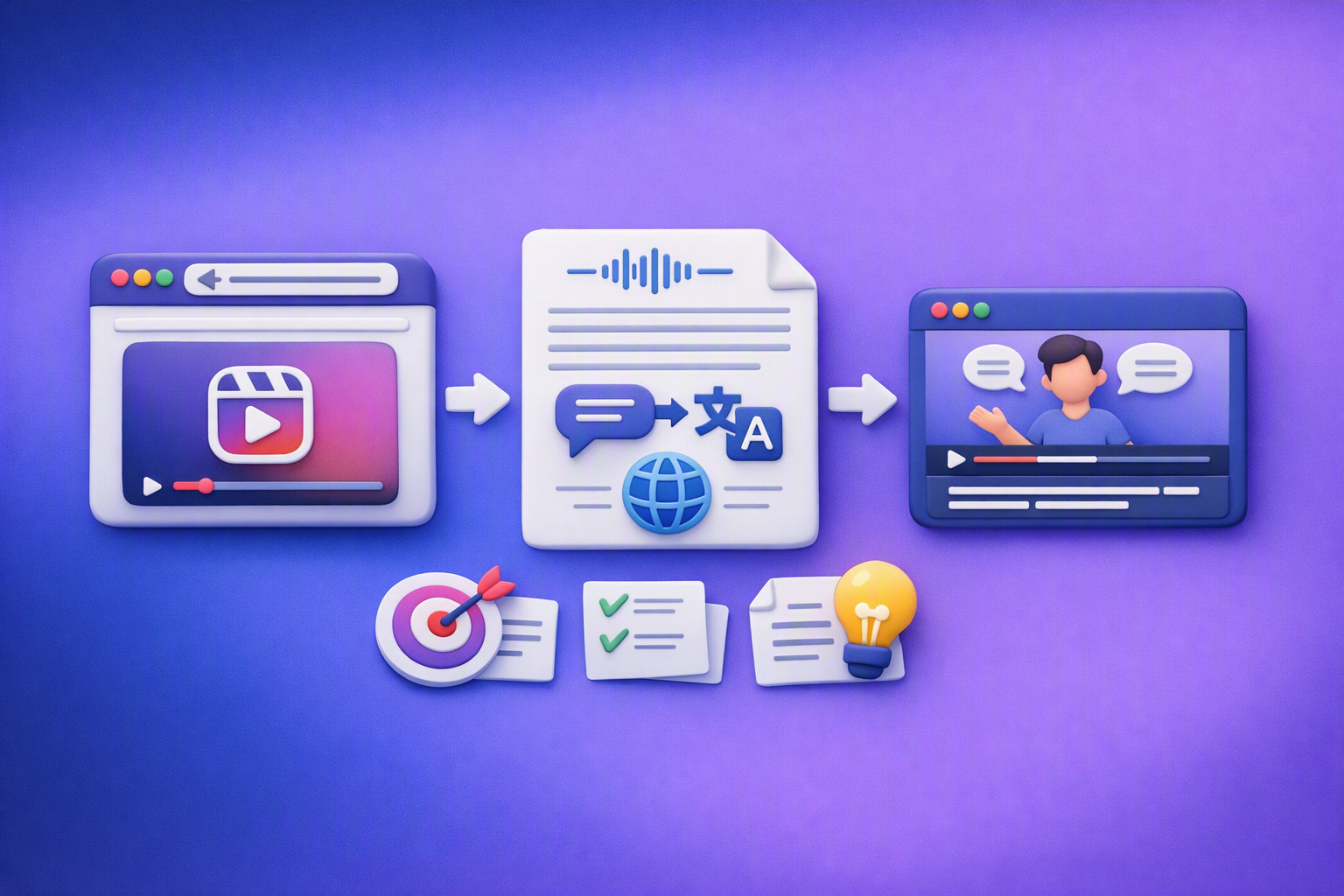
Aprende a traducir un Reel de Instagram con un flujo URL→transcripción→traducción→subtítulos, y a convertir esa traducción en un activo de investigación para hooks, CTAs, objeciones y clusters de contenido.
Reel Analyzer: Transcript‑First Instagram Reels Research (Hooks, CTAs, Objections) + Workflow Guide (VideoToTextAI)
Video To Text AI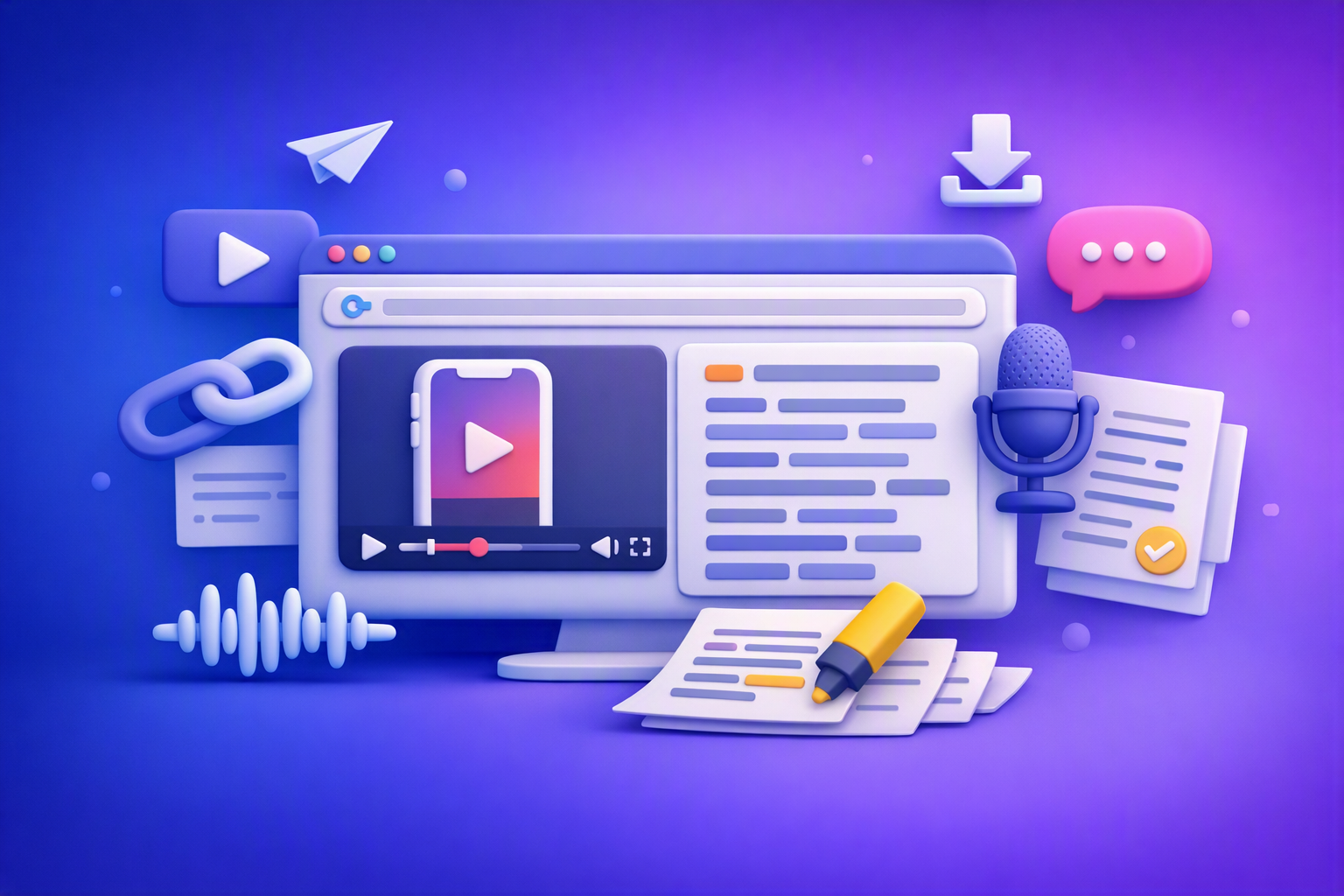
A reel analyzer should turn any public Instagram Reel link into a searchable transcript library you can mine for hooks, CTAs, objections, and topic clusters—then repurpose into original drafts with a repeatable SOP.