
How Law Firms and Legal Marketing Agencies Can Transcribe Instagram Reels for Content Research and Client Education
 Video To Text AI
Most law firms already know they should be posting more video.
What they often miss is that competitor Reels are not just content to watch. They are market research inputs.
When legal teams transcribe Instagram Reels, they can see exactly:
- how competitors frame practice-area pain points
- which client questions show up repeatedly
- which hooks and CTAs are overused
- where the market is shallow, vague, or non-compliant
That matters because short-form legal content is usually compressed. A 30 to 60 second Reel may contain the exact phrasing a competitor uses to attract consultations, explain a process, or simplify a complex issue.
Once that Reel is converted into text, your team can analyze it properly.
Why this matters for legal marketing
Legal buyers do not usually search Instagram for "fun." They search for clarity, reassurance, and speed.
That means legal Reels often revolve around:
- "What happens if..."
- "Do I need a lawyer for..."
- "3 things to know before..."
- "Do not sign this until..."
- "What to do after..."
Those patterns are useful. They show you what the market believes is worth explaining.
For law firms and legal marketing agencies, Reel transcripts help with three jobs:
1. Competitor research
You can compare how competing firms talk about:
- personal injury
- immigration timelines
- criminal defense myths
- family law mistakes
- estate planning basics
- employment law rights
Instead of relying on memory, you get the actual words and structure.
2. Content ideation
If five firms keep posting short videos about the same misconception, that is a signal. Either the topic converts, or clients keep asking about it, or both.
Transcript research lets you decide:
- where to match market demand
- where to differentiate
- where to go deeper with better educational content
3. Client education
The same transcript can be turned into:
- FAQ answers
- blog outlines
- consultation follow-up emails
- LinkedIn posts
- local landing page content
Short-form video becomes the starting point for longer-form trust-building assets.
The practical workflow for legal teams
The best workflow is simple:
- Save relevant Reel links
- Transcribe them
- Tag them by practice area and message type
- Extract ideas
- Rewrite for compliance and local relevance
Step 1: Build a clean watchlist
Start with:
- direct local competitors
- regional firms with strong social distribution
- national legal creators in the same practice area
- legal marketing agency client accounts you manage
Focus the research by practice area. Mixing immigration, DUI defense, and estate planning in one analysis pass just creates noise.
Step 2: Generate transcripts from the links
Use a link-first workflow like instagram to text so your team can go from public Reel URL to usable text quickly.
If a partner or strategist only needs the high-level takeaway first, use:
But keep the transcript as the source of truth.
Step 3: Tag each Reel using legal-specific fields
A generic content sheet is not enough. Legal teams should track:
- Practice area
- Target audience
- Jurisdiction signal
- Hook
- Main legal question
- Risk or mistake highlighted
- Credibility device used
- CTA
- Compliance notes
- Your content opportunity
That last field is the one that turns research into pipeline.
Step 4: Turn transcripts into content opportunities
Good opportunities usually fall into one of these buckets:
- Clarify: competitor mentioned a topic but explained it poorly
- Localize: competitor gave generic advice that needs jurisdiction context
- Expand: competitor compressed a complex issue into one sentence
- Differentiate: competitor used fear-heavy framing that your brand should replace
- Sequence: competitor made a topic into one Reel that should really become a series
This is how a legal team moves from passive inspiration to a real editorial strategy.
Step 5: Run a compliance review before publishing
This is the non-negotiable step.
Even if the idea came from a transcript, your final content should still be reviewed for:
- jurisdiction accuracy
- advertising rules
- disclaimer needs
- testimonial and case-result sensitivity
- oversimplified or absolute wording
The transcript is a research tool. It is not your publish button.
Examples by practice area
Personal injury
Transcribe competitor Reels to see how firms frame:
- what to do after an accident
- dealing with insurers
- medical treatment timing
- common claim mistakes
Then convert those themes into deeper client education pieces like accident checklists, claim timelines, or FAQ pages.
Immigration
Reels often compress timelines and process explanations. Transcript review helps your team identify:
- recurring visa questions
- confusing government-process explanations
- fear-driven framing that may need nuance
That can become blog posts, multilingual FAQs, or office intake education content.
Family law
Competitors often rely on emotionally charged hooks. Transcript analysis helps you separate:
- actual questions clients ask
- emotional trigger phrasing
- oversimplifications that may create risk
This is especially useful for turning short Reels into calm, trust-oriented website content.
Estate planning
Estate planning content works well in short-form because the questions repeat:
- Do I need a will?
- What happens if I die without one?
- Does a trust avoid probate?
If competitor Reels keep hitting those points, your team can build a much stronger educational cluster from the same client concerns.
What legal teams should not do
Do not copy scripts
Use competitor transcripts to study structure and demand, not to clone wording.
Do not publish generic legal claims without review
A national creator may use framing that does not fit your state, country, or bar rules.
Do not mistake engagement hooks for full legal explanations
A short Reel is a conversation starter. Your firm still needs the article, FAQ, disclaimer, or consultation page that finishes the job.
A repeatable weekly process for law firms and agencies
This can be lightweight.
Every week:
- Save 10 relevant Reels in one practice area
- Transcribe all 10
- Tag the transcripts in a shared sheet
- Pull out the top 5 repeated questions
- Turn those into next week's content briefs
That workflow gives you:
- faster ideation
- better competitor awareness
- more structured client education planning
- less random brainstorming
Final takeaway
For law firms and legal marketing agencies, Instagram Reels are not just distribution channels. They are a live feed of client questions, market framing, and competitor messaging.
Transcribing those Reels makes the signal usable.
If your team wants to move faster on legal content research, start with the Reel transcript, extract the recurring questions and angles, then rewrite the content with proper jurisdiction review and compliance control.
Use instagram to text to generate the transcript, then build your practice-area idea bank from there.
Related guides
- Instagram Reel Competitor Research: How to Find Hooks, Angles, and Content Ideas From Transcripts
- How to Extract the Script from a Viral Instagram Reel to Recreate It
- Instagram Content Repurposing: How to Turn Reels into SEO Blog Posts
- Instagram Reels to Text Hub: 14 Workflows to Transcribe, Summarize, Translate, Research, and Repurpose (2026)
Related posts
Reel Analyser (Instagram Reels): Transcript‑First Competitor Research, Hook/CTA Extraction, and Repurposing Workflow (VideoToTextAI)
Video To Text AI
A 2026 reel analyser should turn Instagram Reel links into a searchable transcript library you can tag for hooks, CTAs, objections, and topic clusters—then export into repurposing-ready drafts without a download/upload loop.
Traducir video de Instagram (Reels) en 2026: workflow transcript-first para traducir, sacar hooks/CTAs y repurpose (con VideoToTextAI)
Video To Text AI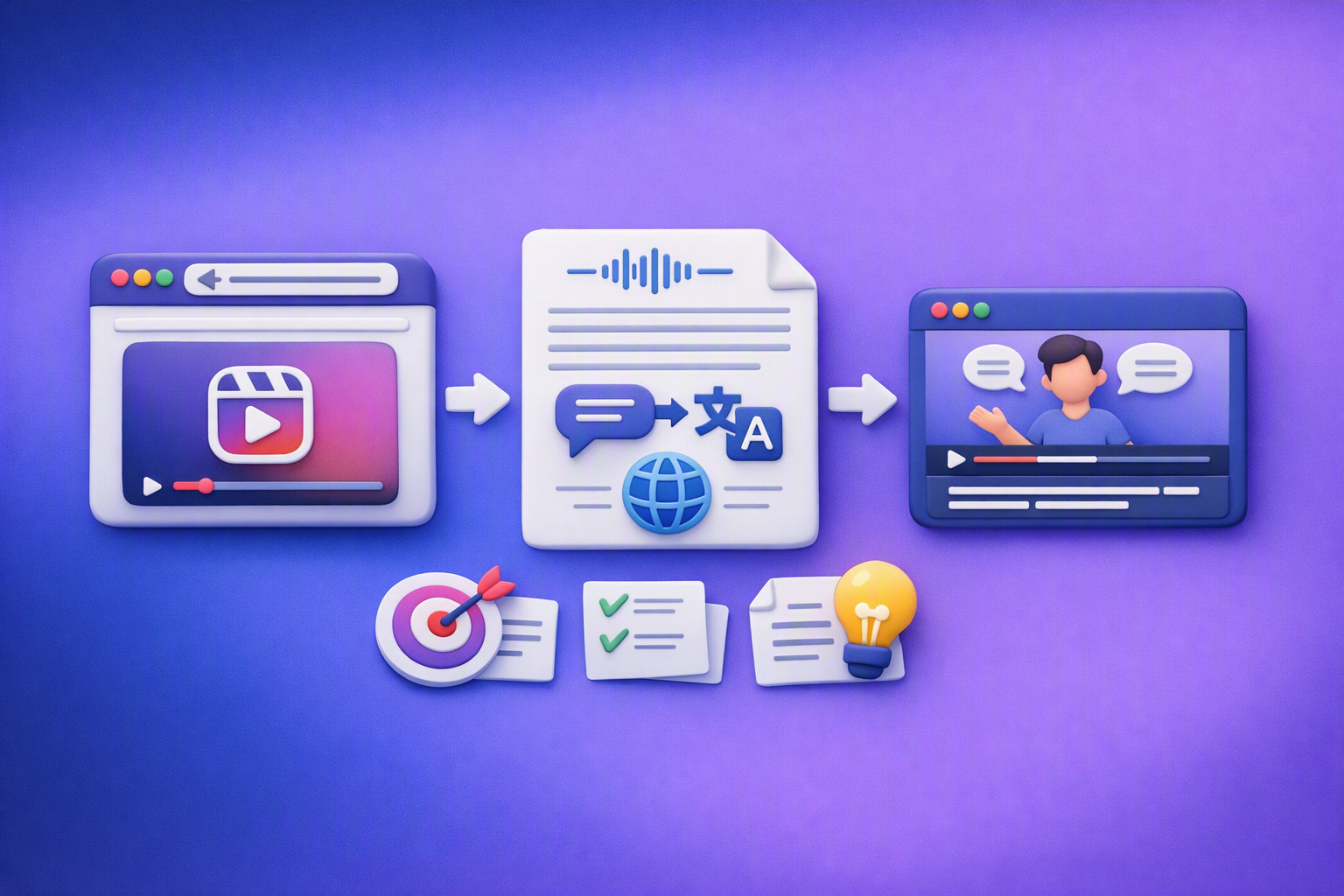
Aprende a traducir un Reel de Instagram con un flujo URL→transcripción→traducción→subtítulos, y a convertir esa traducción en un activo de investigación para hooks, CTAs, objeciones y clusters de contenido.
Reel Analyzer: Transcript‑First Instagram Reels Research (Hooks, CTAs, Objections) + Workflow Guide (VideoToTextAI)
Video To Text AI
A reel analyzer should turn any public Instagram Reel link into a searchable transcript library you can mine for hooks, CTAs, objections, and topic clusters—then repurpose into original drafts with a repeatable SOP.