
“Attachments Disabled for” ChatGPT: What It Means, Why It Happens, and How to Fix It (Plus a Ship-Now Transcript Workflow)
 Video To Text AI
Seeing “attachments disabled for” ChatGPT means uploads are blocked in your current context—switch to an upload-capable surface/model or remove the policy/browser/network blocker. If you can’t restore uploads quickly, ship anyway by generating a transcript (TXT + SRT/VTT) from a link/MP4 and using ChatGPT on the text.
Downloading and re-uploading video files is an outdated workflow; link-based extraction is the future of creator productivity because it reduces permissions friction, UI breakage, and “upload button missing” failures.
“Attachments Disabled for” ChatGPT: What It Means, Why It Happens, and How to Fix It (Plus a Ship-Now Transcript Workflow)
Quick Answer (What the Message Means)
What “attachments disabled for …” actually indicates
It’s a UI-level restriction on uploads in the current chat context (surface + model + policy + session state). ChatGPT can still respond to text, but the upload action is blocked.
What it does not mean (not an account ban; not proof ChatGPT is “down”)
It usually does not mean:
- Your account is banned
- ChatGPT is fully down
- Your device is “infected”
- Your file is “too large” (that’s a different error)
Which attachment types may be blocked (files vs images vs video)
Depending on where you’re using ChatGPT, the block may apply to:
- Files (PDF/DOCX/CSV)
- Images (PNG/JPG)
- Video (MP4) or video-like inputs
- All uploads (paperclip missing/disabled)
Before You Troubleshoot: 2-Minute Diagnosis (Fastest Signal First)
Step 1 — Identify the surface you’re using (Web vs Desktop vs Mobile vs Workspace)
Write down exactly where you see the issue:
- Web app in a browser (Chrome/Safari/Firefox/Edge)
- Desktop app
- Mobile app
- Team/Enterprise workspace (managed org)
Surface matters because upload capability and policy controls differ.
Step 2 — Confirm the exact UI state
Banner message vs tooltip vs missing paperclip / “Add files” button
Look for:
- A banner that says “attachments disabled for …”
- A tooltip when hovering the paperclip
- The paperclip/Add files button missing entirely
Each points to a different class of cause (policy vs entitlement vs UI state).
“You need GPT‑4o to continue this chat because there’s an attachment” scenario
If you see a message like “You need GPT‑4o to continue this chat because there’s an attachment”, it usually means:
- The chat contains an attachment reference, and
- The current model/surface can’t continue that thread with attachments
Fix: start a new chat and select an upload-capable model before attaching anything.
Step 3 — Determine scope: one chat, all chats, or one device/network
New chat test (same account)
- Create a new chat
- Select the intended model
- Check whether the paperclip returns
If it works in a new chat, the old chat is likely stuck in a non-upload state.
Different browser profile / incognito test
Open an incognito/private window and sign in. If uploads work there, the issue is likely:
- Extension interference
- Corrupted cookies/storage
- Browser privacy settings
Different network test (hotspot)
Switch to a phone hotspot for 5 minutes. If uploads work on hotspot, the issue is likely:
- Corporate firewall/proxy
- VPN
- Content filter / DLP agent
Root Causes (Ranked) + How to Confirm Each
1) Model/surface mismatch (uploads not supported in this context)
How to verify you’re on an upload-capable model/surface
Confirm:
- You’re in a surface that supports uploads (often web/mobile, depending on org settings)
- The UI shows paperclip/Add files in a new chat
If the paperclip never appears across new chats, move to entitlement/policy checks.
Why switching models inside the same broken chat can fail
Some chats retain a session state where attachments are disabled. Switching models inside that same thread can keep the UI disabled.
Rule: if you’re troubleshooting uploads, always test in a new chat.
2) Plan/entitlement limitations (feature not enabled on your plan)
Signs it’s entitlement vs a local issue
Likely entitlement if:
- Upload UI is missing across devices and networks
- Incognito and mobile app behave the same
- Other accounts on the same device can upload, but yours cannot
What to check in account/workspace settings
Check:
- Whether you’re in a managed workspace vs personal account
- Workspace feature toggles (if visible)
- Whether your org has restricted uploads for compliance
3) Workspace/admin policy (Team/Enterprise restrictions)
Common admin controls that disable uploads
In managed environments, admins may disable:
- File uploads entirely
- Specific file types
- External data sharing features
What evidence to capture for your admin (screenshots + timestamps + URL)
Capture:
- Screenshot of the banner/tooltip
- Timestamp and timezone
- ChatGPT URL (or workspace name)
- Device + OS + browser version
- Whether hotspot test changed behavior
4) Browser profile issues (extensions, cookies, storage corruption)
Extensions that commonly break attachments (privacy blockers, script blockers, DLP agents)
Common culprits:
- Ad blockers and privacy blockers
- Script blockers
- Antivirus “web shield” tools
- Corporate DLP/browser agents
Cookie/storage symptoms that map to upload UI failures
Symptoms include:
- Paperclip missing only in one browser profile
- Upload dialog opens but never completes
- UI elements don’t render consistently
5) Network/security blocks (VPN, proxy, corporate firewall, content filters)
How to confirm with a hotspot test
If uploads fail on corporate Wi‑Fi but succeed on hotspot, you’ve confirmed a network-layer block.
Why uploads fail while text chat still works
Text chat can route through allowed endpoints, while uploads require additional endpoints that are often blocked by:
- Proxies
- SSL inspection
- Content filters
- DLP rules
6) Temporary service degradation
How to distinguish outage vs local configuration
If:
- Multiple users report the same issue at the same time, and
- It fails across devices/networks, and
- It started suddenly without changes
…then it may be service degradation. Still, do the 2-minute diagnosis first to avoid waiting on a local issue.
Step-by-Step Fix Sequence (Ordered, Implementation-Focused)
Fix 1 — Start clean: hard refresh + new chat + reselect model
- Hard refresh the page (or fully quit/reopen the app)
- Create a new chat
- Select the model/surface you intend to use
- Check for the paperclip, then try a small test upload
Fix 2 — Try the official mobile app (isolates browser-only problems)
If mobile works but web doesn’t, you’ve narrowed it to:
- Browser extensions
- Cookies/storage
- Browser privacy settings
Fix 3 — Incognito/private window test (no extensions, clean storage)
- Open incognito/private
- Sign in
- Test upload
If it works, proceed to extension isolation.
Fix 4 — Disable extensions (one-by-one) and retest uploads
Priority disable list (ad blockers, privacy tools, antivirus web shields, corporate agents)
Disable in this order:
- Ad blockers / privacy blockers
- Script blockers
- Antivirus web protection
- Corporate browser agents / DLP tools (if you can)
Retest after each change so you identify the exact cause.
Fix 5 — Clear site data for ChatGPT and re-authenticate
What to clear (cookies + local storage) and what not to clear (password manager)
Clear for the ChatGPT site:
- Cookies
- Local storage / site data
Do not delete your password manager vault; just re-authenticate after clearing site data.
Fix 6 — Switch networks + remove VPN/proxy
Hotspot test procedure (5 minutes)
- Turn off VPN/proxy
- Connect to hotspot
- Open a new chat
- Test upload
If hotspot works, ask IT/admin to allow required upload endpoints.
Fix 7 — Workspace path: copy/paste request to admin
Exact message to send (what to ask, what to include, what to avoid)
Copy/paste:
Hi team — I’m seeing “attachments disabled for …” in ChatGPT and cannot upload files/images.
Time observed: [timestamp + timezone]
Where: [web/desktop/mobile], [browser + version], [OS]
Workspace: [name]
Scope: [all chats vs one chat], [incognito test result], [hotspot test result]
Evidence: [screenshots], [URL]
Can you confirm whether file uploads are disabled by workspace policy (or restricted by DLP/proxy), and if so, whether uploads can be enabled for my role or an exception can be granted?
Avoid arguing about “bugs.” Ask for policy confirmation and exception path.
Fix 8 — Stop troubleshooting and ship anyway (fallback workflow)
Decision rule: when to stop debugging (timebox + deliverable priority)
Timebox troubleshooting to 15–20 minutes. If you still can’t upload, switch to a workflow that doesn’t depend on ChatGPT attachments.
Ship-Now Workflow (No ChatGPT Uploads Needed): Link/MP4 → Transcript/Captions → ChatGPT-on-Text
Why transcript-first works when attachments are disabled
When attachments are blocked, you can still use ChatGPT for:
- Summaries and outlines
- SEO structuring
- Repurposing into posts/emails/scripts
- Extracting action items and FAQs
You just need clean text input. This is why downloading and re-uploading video files is an outdated workflow—and why link-based extraction is the future of creator productivity.
Step-by-step: production-safe workflow using VideoToTextAI
Step 1 — Provide a video link or MP4 to VideoToTextAI
Use a link-based workflow whenever possible (fewer moving parts than downloading/uploading). If you only have a file, MP4 works too.
If you need a direct path, use VideoToTextAI here: https://videototextai.com
Step 2 — Export deliverables (TXT + SRT/VTT) for downstream use
Export:
- TXT for analysis, summaries, blog drafts
- SRT/VTT for captions, shorts, timestamped quote extraction
Related tools you can reference internally:
Step 3 — QA the transcript quickly (names, numbers, jargon, timestamps)
Do a fast pass for:
- Proper nouns (people, brands, places)
- Numbers (prices, dates, metrics)
- Acronyms/jargon
- Speaker changes (if relevant)
- Timestamp alignment (for SRT/VTT)
Step 4 — Paste verified text into ChatGPT for analysis/repurposing
Paste the transcript (or sections) directly into ChatGPT and run structured prompts. This avoids attachment dependency entirely.
If your goal is turning a YouTube video into an article, see: youtube to blog
Copy/paste prompt templates (use with transcript text)
Template: summarize + key takeaways + action items
You are given a verified transcript. Create:
1) A 120-word summary
2) 7 key takeaways (bullets)
3) 5 action items (imperative verbs)
Transcript:
[PASTE TRANSCRIPT]
Template: generate chapters + titles + SEO description
From this transcript, generate:
- 8–12 chapters with timestamps (if timestamps exist; otherwise infer sections)
- 5 title options (SEO-friendly, not clickbait)
- A meta description (155–160 chars)
Transcript:
[PASTE TRANSCRIPT OR CHAPTERED TEXT]
Template: create shorts hooks + captions + post variants
Create 10 short-form hooks (max 12 words each) and 10 matching captions (max 120 chars).
Then write 3 LinkedIn post variants and 3 X post variants based on the transcript.
Transcript:
[PASTE TRANSCRIPT]
Template: extract quotes + timestamps from SRT/VTT
You are given SRT/VTT captions. Extract:
- 12 quotable lines (<= 18 words)
- The exact timestamp range for each quote
- A suggested on-screen caption rewrite (<= 60 chars) that keeps meaning
Captions:
[PASTE SRT OR VTT]
Checklist: Fix or Fallback (Printable)
Upload restoration checklist (7 checks)
- Surface/model supports uploads
- New chat created (not same session)
- Mobile app test completed
- Incognito test completed
- Extensions disabled test completed
- Site data cleared + re-auth completed
- Network/VPN/proxy isolated (hotspot test)
Transcript-first shipping checklist (deliverables)
- Transcript exported (TXT)
- Captions exported (SRT and/or VTT)
- Quick QA completed (proper nouns, numbers, speaker changes)
- ChatGPT prompts run on verified text
- Final assets saved (blog draft, captions, social posts)
Common Mistakes That Keep Attachments Disabled
Testing only one chat/session (state persists)
If the chat was created in a restricted context, the UI can remain disabled. Always test in a new chat.
Assuming “Plus” guarantees uploads in every surface/model
Entitlements can vary by:
- Surface (web vs mobile vs desktop)
- Workspace policy
- Model context and chat state
Confusing workspace policy with personal account settings
If you’re in a managed workspace, your personal expectations don’t apply. Treat it as a policy/security issue first.
Debugging for an hour when a transcript-first workflow ships in minutes
If the deliverable is due today, stop chasing the paperclip. Generate TXT + SRT/VTT, then use ChatGPT on text.
For a related deep dive, see:
- “Add Files” Button Unavailable in ChatGPT: Causes, Fixes, and a Ship-Now Workflow (No Uploads Needed)
- ChatGPT “Upload Video” Feature (2026): What Works, Limits, Fixes, and a Production-Safe Video-to-Text Workflow
VideoToTextAI vs Competitors
Comparison criteria (what we will evaluate)
We’ll compare based on what’s consistently operational when ChatGPT attachments are disabled:
- Workflow speed from URL/MP4 → publishable assets
- Export readiness (TXT, SRT, VTT) and downstream compatibility
- Repeatability for creators/teams (fewer UI dependencies)
- Repurposing support from verified transcript text
Comparison table (research-backed, no invented claims)
| Tool | Link-based input signal | Export-ready captions (SRT/VTT) signal | Repurposing workflow signal | Best fit (fair take) |
|---|---|---|---|---|
| VideoToTextAI | Yes (product positioning: link-based workflows) | Yes (TXT + SRT/VTT deliverables in workflow/tooling) | Yes (transcript → blog/social prompts + pipeline) | Best when you need a ship-now workflow that doesn’t depend on ChatGPT uploads and produces deterministic exports. |
| Reduct Video | No strong public signal for link-first workflow | Weak evidence for export-ready subtitle workflow | Limited public positioning on blog/social repurposing | Strong for collaborative transcript-based review and team synthesis; less focused on link-first + export-ready caption pipeline. |
| Otter AI | Primarily upload-based in researched page | No strong public signal for SRT/VTT export on researched page | Some summaries; less on creator repurposing | Good for meeting-style transcription and summaries; less optimized for caption-export + repurposing pipeline. |
| Zapier (list reference) | Not a single tool; list-style overview | Varies by tool; not deterministic | Not positioned as a transcript-to-assets pipeline | Useful for researching options, but lists don’t give a deterministic “when uploads break, do this” workflow. |
Why VideoToTextAI wins specifically in “attachments disabled” scenarios
When ChatGPT blocks uploads, you need a workflow that:
- Doesn’t require the paperclip
- Produces exportable artifacts (TXT + SRT/VTT) you can paste/use anywhere
- Is repeatable (same steps every time, fewer UI dependencies)
That’s why the transcript-first approach is operationally safer than downloading/re-uploading video files, and why link-based extraction is the future of creator productivity.
Competitor Gap
What competitors cover (transcription) vs what they miss (ship-now workflow when uploads break)
Most competitors focus on “we transcribe.” Fewer explain what to do when your primary analysis tool (ChatGPT) can’t accept uploads.
Missing in most competitor content
- A clear 2-minute diagnosis (surface/model vs entitlement vs policy vs local)
- An ordered fix sequence (fastest signal first)
- A decision rule to stop troubleshooting
- Deterministic exports (TXT/SRT/VTT) as the primary deliverable
- A transcript → repurposing pipeline (blog/social/captions) that doesn’t rely on ChatGPT attachments
If you want the full troubleshooting + fallback playbook in one place, also see:
- “Attachments Disabled for” ChatGPT: What It Means, Why It Happens, and How to Fix It (Plus a Ship-Now Workflow)
- ChatGPT “Upload Video” Feature (2026): What Works, What Breaks, and the Reliable Link → Transcript Workflow
FAQ
Why can’t I attach files in ChatGPT?
Because uploads are disabled in your current context: model/surface mismatch, plan entitlement, workspace policy, browser extension/storage issue, or network security block.
Why is my ChatGPT upload disabled?
Most often it’s either:
- You’re in a chat/session that’s not upload-capable, or
- Your workspace/network is enforcing a restriction (policy, proxy, DLP)
Why am I unable to upload images to ChatGPT?
Image uploads can be blocked even when text works, especially under:
- Workspace policy restrictions
- Network content filtering
- Browser privacy/extension interference
Why are “Add files” unavailable in ChatGPT Plus?
Plus doesn’t guarantee uploads everywhere. Start a new chat, confirm you’re in an upload-capable surface/model, then test in incognito/hotspot to isolate local vs policy causes.
What should I do if my workspace blocks attachments and I can’t change policy?
Send your admin a concise request with evidence (screenshots, timestamps, URL, device/browser) and ask whether uploads are disabled by policy. If you’re time-boxed, ship via transcript-first: generate TXT + SRT/VTT externally, then paste verified text into ChatGPT.
Related posts
Reel Analyser (Instagram Reels): Transcript‑First Competitor Research, Hook/CTA Extraction, and Repurposing Workflow (VideoToTextAI)
Video To Text AI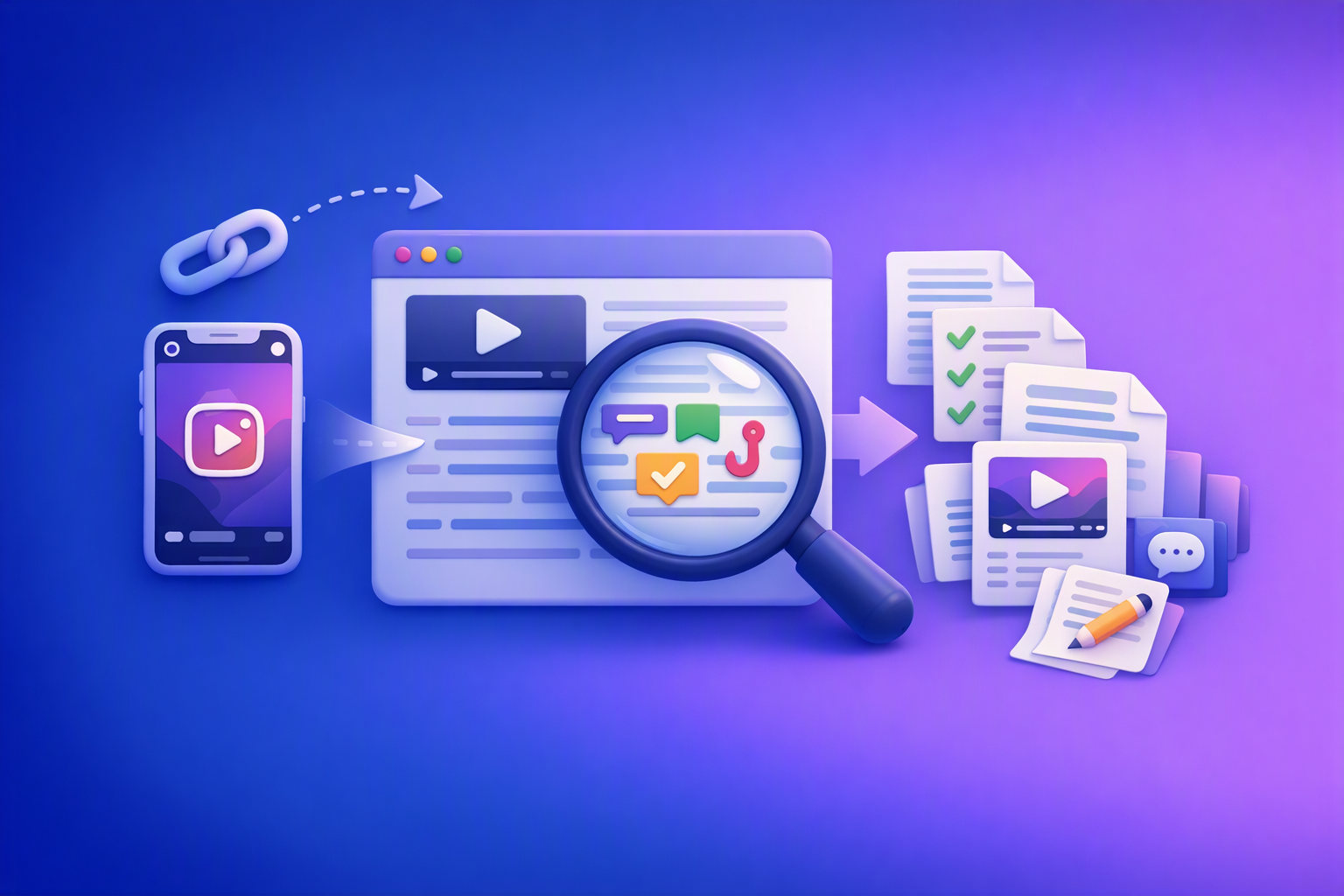
A 2026 reel analyser should turn Instagram Reel links into a searchable transcript library you can tag for hooks, CTAs, objections, and topic clusters—then export into repurposing-ready drafts without a download/upload loop.
Traducir video de Instagram (Reels) en 2026: workflow transcript-first para traducir, sacar hooks/CTAs y repurpose (con VideoToTextAI)
Video To Text AI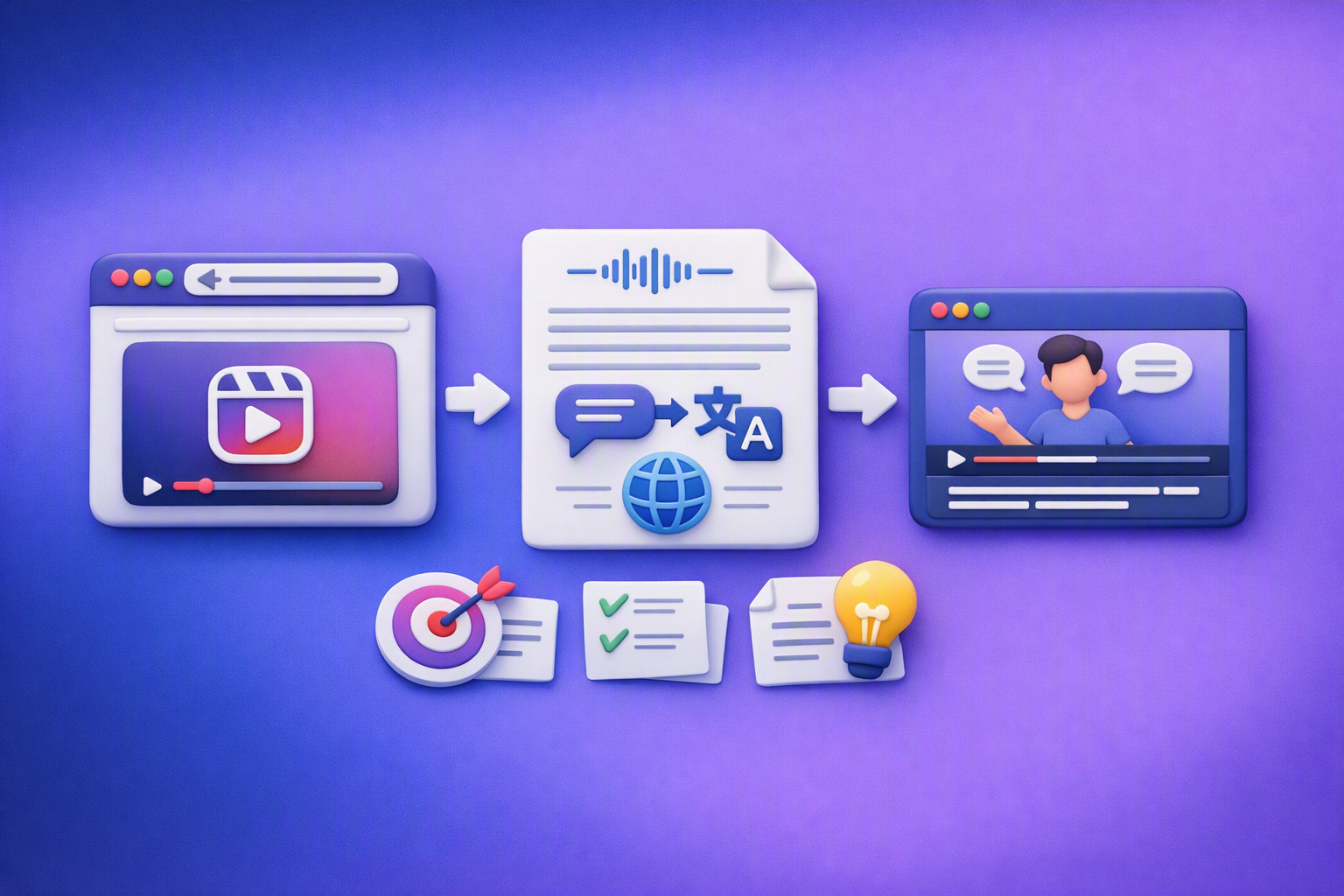
Aprende a traducir un Reel de Instagram con un flujo URL→transcripción→traducción→subtítulos, y a convertir esa traducción en un activo de investigación para hooks, CTAs, objeciones y clusters de contenido.
Reel Analyzer: Transcript‑First Instagram Reels Research (Hooks, CTAs, Objections) + Workflow Guide (VideoToTextAI)
Video To Text AI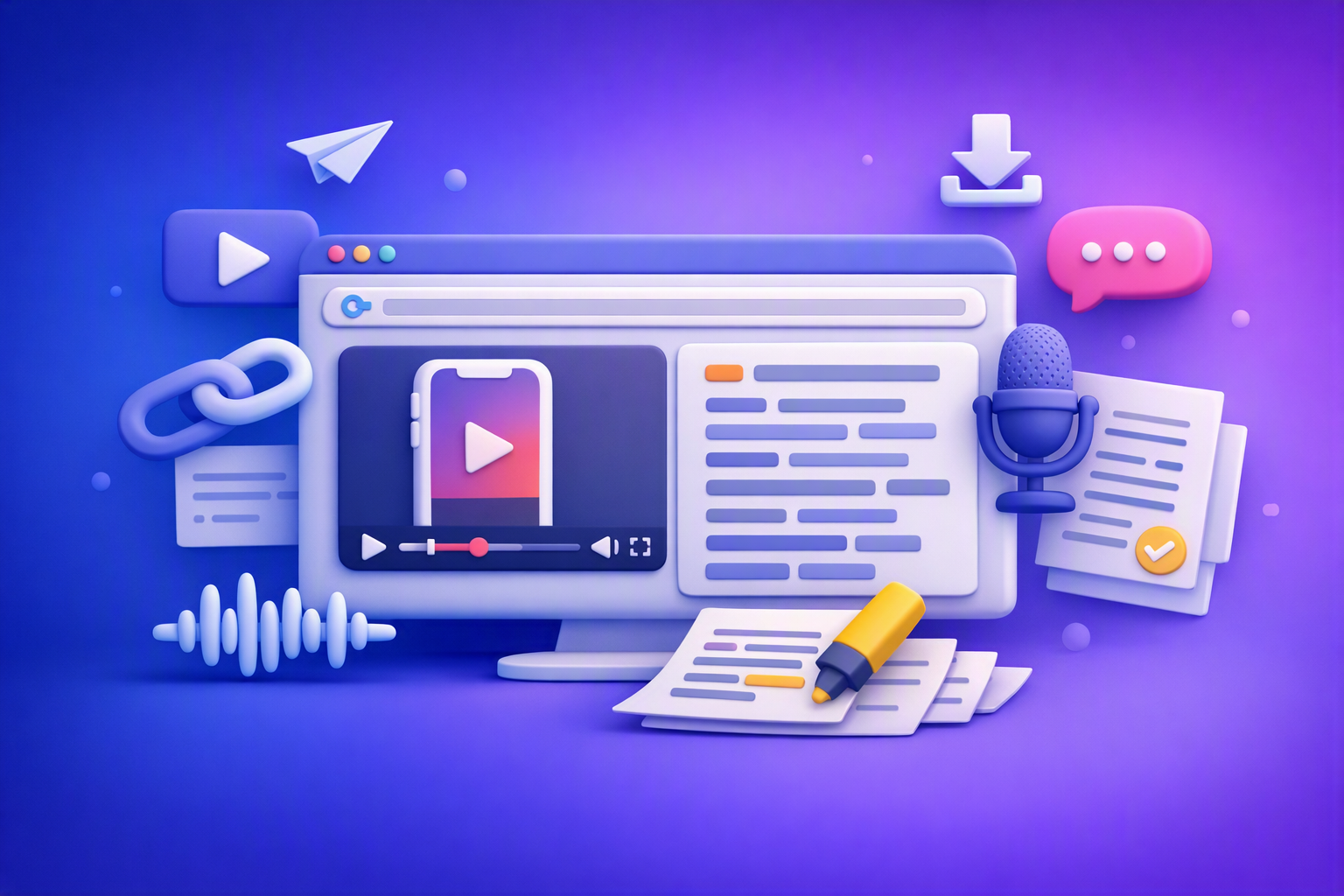
A reel analyzer should turn any public Instagram Reel link into a searchable transcript library you can mine for hooks, CTAs, objections, and topic clusters—then repurpose into original drafts with a repeatable SOP.