
“Add Files” Button Unavailable in ChatGPT: Causes, Fixes, and a Ship-Now Workflow (No Uploads Needed)
 Video To Text AI
“Add Files” Button Unavailable in ChatGPT: Causes, Fixes, and a Ship-Now Workflow (No Uploads Needed)
Fix this fastest by starting a new chat in an upload-capable model/surface and testing in incognito with extensions off. If uploads are still blocked, stop burning time and switch to a text-in workflow: generate transcript/captions from a video link, then paste the text into ChatGPT.
Quick answer (what “Add files unavailable” usually means)
When ChatGPT shows “Add files is unavailable” (or the + icon is greyed out/missing), it usually means uploads are disabled in your current context—not that your file is “bad.”
The 5 most common root causes
- Model/surface limitation: the current model or chat surface doesn’t support uploads.
- Plan/entitlement mismatch: your account doesn’t have the feature enabled (or it’s temporarily gated).
- Workspace/admin policy: Team/Enterprise settings disable attachments.
- Browser profile issues: corrupted cookies/storage or blocked scripts.
- Extensions/network security: ad/privacy/DLP tools, corporate proxy/firewall, or DNS filtering blocks upload endpoints.
What to do first (2-minute triage order)
- Start a new chat and switch models, then re-check the + button.
- Incognito/private window (no extensions) and re-check.
- Hotspot test (phone tether) to rule out corporate network blocks.
- If you’re in a managed workspace, assume policy and confirm with an admin.
Symptoms checklist (confirm you’re seeing the same issue)
Use this to match the failure mode before you change settings.
“Add files is unavailable” tooltip vs greyed-out + icon vs missing button
- Tooltip says “Add files is unavailable” when hovering the + icon.
- + icon is greyed out (can’t click).
- Button is missing entirely (often surface/UI variant or model mismatch).
Upload fails after selection (unknown error / 403 / max 0 uploads)
- File picker opens, but upload fails with:
- “Unknown error occurred”
- HTTP 403
- “Max 0 uploads at a time”
- These often point to entitlement checks, security blocks, or service-side gating.
Works in one chat but not another (surface/model mismatch)
- Upload works in one conversation but not another.
- This strongly suggests different model, different surface, or different tool permissions in that chat.
2-minute diagnosis: isolate the cause before you change anything
Don’t randomly clear everything. Run these quick tests in order.
Step 1 — Confirm the chat surface (web vs desktop vs mobile)
- Test the same account on:
- Web app (browser)
- Desktop app (if installed)
- Mobile app
- If it works on one surface but not another, it’s likely surface-specific UI/permissions or local device/browser.
Step 2 — Confirm the model supports uploads (switch models and re-check UI)
- In a new chat, switch to another model option available to you.
- Re-check whether the + / attachment control becomes active.
- If the button appears after switching, you’ve confirmed a model/context limitation.
Step 3 — Check account/workspace context (personal vs team/enterprise)
- If you’re logged into a Team/Enterprise workspace, attachments may be disabled by policy.
- If you have both, test:
- Personal account chat
- Workspace chat
- If it fails consistently only in the workspace, it’s likely admin policy.
Step 4 — Test a clean browser state (incognito + no extensions)
- Open an incognito/private window.
- Log in and test uploads in a new chat.
- If incognito works, your issue is almost always:
- extensions
- cookies/storage corruption
- tracking/script blocking
Step 5 — Test a different network (VPN off/on, hotspot) to detect security blocks
- Try:
- Office Wi‑Fi → phone hotspot
- VPN off → VPN on (or vice versa)
- If hotspot works and office fails, it’s likely proxy/firewall/DNS filtering.
Why the “Add files” button becomes unavailable (root causes + how to verify)
Model/surface limitation (uploads not enabled in this context)
Uploads can be enabled in one model/surface and disabled in another.
How to verify (UI indicators + model switch test)
- The + icon is greyed out or missing in one chat.
- Starting a new chat and switching models changes the UI state.
Fix (start a new chat in an upload-capable surface/model)
- Start a new conversation.
- Switch to a model that shows upload support in your UI.
- Re-check the + icon before troubleshooting anything else.
Plan/entitlement mismatch (feature not available on your plan or temporarily gated)
Even with the same UI, features can be gated by account entitlements or temporarily limited.
How to verify (account plan + feature availability across devices)
- Check whether uploads fail across:
- multiple browsers/devices
- multiple networks
- If it fails everywhere, suspect account/entitlement or service-side.
Fix (re-auth, update app, confirm plan, retry later if service-side)
- Sign out/in to force an entitlement refresh.
- Update the desktop/mobile app.
- Retry later if it appears to be service-side.
Workspace/admin policy (Team/Enterprise disables attachments)
Many orgs disable attachments for compliance.
How to verify (workspace banner/policy behavior, consistent across devices)
- Upload is disabled everywhere while in the workspace.
- Other teammates report the same behavior.
Fix (admin allowlist, policy exception, approved surfaces)
- Ask your admin to review:
- attachment/file upload policy for ChatGPT
- allowlists for required domains/endpoints
- whether uploads are allowed only on certain surfaces
Browser profile issues (cookies/storage corruption, blocked third-party scripts)
Broken local state can disable UI controls or break upload handshakes.
How to verify (incognito works, primary profile fails)
- Incognito works.
- Your main profile fails.
Fix (clear site data for ChatGPT, disable strict tracking, new profile)
- Clear site data for ChatGPT (cookies + local storage).
- Temporarily relax strict tracking prevention for that site.
- Test in a fresh browser profile.
Extensions/security tooling blocking uploads (ad blockers, privacy tools, DLP)
Upload flows often rely on scripts/requests that privacy tools block.
How to verify (disable extensions, test in a clean profile)
- Disable extensions and retry.
- If it works, re-enable one-by-one to find the blocker.
Fix (allowlist domains, disable “file upload” blocking rules)
- Allowlist ChatGPT-related domains in your blocker.
- For DLP tools, request a policy exception for uploads (or use the no-upload workflow below).
Network restrictions (corporate proxy, firewall, DNS filtering)
Corporate networks may block upload endpoints or signed URLs.
How to verify (works on hotspot, fails on office Wi‑Fi)
- Hotspot works.
- Office Wi‑Fi fails.
Fix (IT allowlist, bypass proxy for required endpoints)
- Ask IT to allowlist required endpoints.
- If possible, bypass SSL inspection/proxy for the upload flow.
File-level constraints (size/type/codec) that look like “unavailable”
Sometimes the UI is available, but uploads fail due to constraints.
How to verify (try a small TXT/PDF vs large MP4)
- Try uploading a tiny TXT file.
- If TXT works but MP4 fails, it’s likely size/type/codec.
Fix (compress, convert, split, or use link-based workflow)
- Compress or split large files.
- Convert to a supported format.
- Prefer link-based extraction to avoid file handling entirely.
Fixes: ordered playbook (fastest wins first)
1) Start a new chat + switch to an upload-capable model
- New chat → switch model → re-check + icon.
- This resolves a large share of “works in one chat but not another” cases.
2) Hard refresh + sign out/in (forces entitlement re-check)
- Hard refresh the page.
- Sign out/in.
- Re-test in a new chat.
3) Clear site data for ChatGPT (cookies + local storage) and retry
- Clear site data for the ChatGPT domain.
- Restart browser.
- Re-test.
4) Disable extensions (especially ad/privacy/DLP) and retry
- Disable all extensions.
- If it works, re-enable until you find the culprit.
- Keep an allowlist rule for ongoing reliability.
5) Try another browser/device (separates local vs account issues)
- If it works elsewhere, your issue is local (browser profile, OS security, extensions).
6) Switch networks (hotspot test) to confirm firewall/proxy blocking
- If hotspot works, escalate to IT with a clear reproduction.
7) If in a workspace: request admin policy change (what to ask for)
Ask for:
- Confirmation whether attachments/uploads are disabled by policy.
- A temporary exception for your user/group.
- Any required allowlists for upload endpoints.
- Approved surfaces (web vs desktop) if policy differs.
Ship-now workaround: stop depending on ChatGPT uploads
If uploads are unreliable, treat them as a “nice-to-have,” not a dependency.
Brand POV: downloading video files, moving them between tools, and re-uploading is an outdated workflow. Link-based extraction is the future of creator productivity because it removes file handling, reduces failure points, and standardizes outputs for teams.
When uploads are unreliable, use “verified text in → AI out”
Instead of “video file into ChatGPT,” use:
- Video → transcript/captions in a dedicated workflow
- Transcript text → ChatGPT for summarizing, rewriting, repurposing, and formatting
What you’ll produce (deliverables that don’t require ChatGPT file upload)
- TXT transcript for editing and prompting
- SRT/VTT captions for publishing
- Repurposed drafts (blog, LinkedIn, X) generated from the transcript text
Step-by-step: Video link/MP4 → transcript/captions → paste into ChatGPT (production-safe)
This is the workflow you can ship today even if ChatGPT uploads are broken.
Step 1 — Generate transcript from a link or MP4 in VideoToTextAI
Use VideoToTextAI to create export-ready text assets, then paste them into ChatGPT.
-
Option A: Use a public video URL (YouTube/Instagram/TikTok)
Paste the link and generate a transcript without downloading the video first. This is the fastest path when you’re repurposing published content. -
Option B: Upload MP4 directly (if you have the file)
If you must work from a local file, upload the MP4 and generate transcript/captions.
Use exactly one CTA when you’re ready to run it end-to-end: VideoToTextAI.
Related internal tools/pages you can use next:
Step 2 — Export in the right format for the job (TXT vs SRT vs VTT)
Pick exports based on where the output will be used.
Use TXT when you want summaries, outlines, rewrites, repurposing
- Best for: briefs, blogs, email drafts, social threads
- Easy to paste into ChatGPT without file upload
Use SRT/VTT when you need timecoded captions/subtitles
- Best for: YouTube captions, course platforms, editors
- Keeps timestamps and line breaks structured
Step 3 — QA the transcript quickly (accuracy + speaker/terms)
Before prompting ChatGPT, fix the errors that cause downstream garbage.
- Correct proper nouns (names, brands, product terms)
- Fix repeated mishears (technical vocabulary)
- If you need speaker labels, standardize them (e.g.,
HOST:/GUEST:)
Step 4 — Paste transcript into ChatGPT with a deterministic prompt
Keep prompts structured so outputs are repeatable across videos and teammates.
Prompt template: summary + key points + action items
You are an editor. Using the transcript below:
1) Write a 120-word summary.
2) List 7 key points (bullets).
3) Extract action items (bullets) with clear owners if implied.
4) Add a 1-sentence title.

Transcript:
[PASTE TRANSCRIPT]
Prompt template: blog post draft + SEO sections
Act as a technical content writer. Create a blog post draft from this transcript:
- H1 + meta description (155 chars max)
- H2 sections with short paragraphs (max 3 sentences each)
- Add a "Key takeaways" bullet list
- Include a short FAQ (4 questions)
- Keep claims factual and avoid inventing data

Transcript:
[PASTE TRANSCRIPT]
If your goal is specifically blog repurposing from a YouTube link, see: YouTube to blog.
Prompt template: caption cleanup + line length rules
Clean up these captions for readability:
- Keep each caption <= 42 characters per line
- Max 2 lines per caption
- Preserve timestamps exactly
- Fix punctuation and casing
- Do not paraphrase meaning

SRT/VTT:
[PASTE CAPTIONS]
Step 5 — Keep outputs consistent (reuse a saved prompt + formatting rules)
Operational repeatability comes from standardization:
- Save prompts in a shared doc.
- Use the same export format every time (TXT for repurposing, SRT/VTT for publishing).
- Keep a QA checklist for names/terms.
For deeper workflow guidance, reference:
- A Production-Safe Link-Based Video-to-Text Workflow (Transcripts, SRT/VTT Captions, and Repurposing)
- ChatGPT “Upload Video” Feature (2026): What Works, Limits, Fixes, and a Production-Safe Video-to-Text Workflow
Implementation checklist (copy/paste)
Troubleshooting checklist (restore “Add files”)
- Confirm surface/device and start a new chat
- Switch to an upload-capable model and re-check the + button
- Sign out/in and hard refresh
- Clear ChatGPT site data (cookies/storage)
- Disable extensions (ad/privacy/DLP)
- Test incognito/new browser profile
- Test hotspot vs corporate network
- If workspace-managed: request attachments policy review
If you’re seeing a related tooltip like “Attachments disabled for…”, also read:
Ship-now checklist (no uploads required)
- Generate transcript from link/MP4 in VideoToTextAI
- Export TXT + SRT/VTT as needed
- QA proper nouns + key timestamps
- Paste transcript into ChatGPT with a saved prompt
- Export final captions/blog/social drafts from text outputs
VideoToTextAI vs Competitors
If ChatGPT uploads are flaky, the winning pattern is deterministic transcript/captions first, then AI writing on plain text. VideoToTextAI is built around that operational reality: URL-first inputs and export-ready outputs reduce dependency on any single UI (including ChatGPT’s upload button).
Competitors compared (researched)
- Reduct Video
- Otter AI
- Zapier (transcription software roundup context)
Comparison criteria (what this section will evaluate)
- URL-first workflow speed (paste a link → assets)
- Export readiness (clean TXT + publishable SRT/VTT)
- Repeatability for teams (standardized outputs, fewer UI dependencies)
- Repurposing depth (transcript → blog/social drafts with consistent structure)
Comparison table
| Criteria | VideoToTextAI | Reduct Video | Otter AI | Zapier (roundup) |
|---|---|---|---|---|
| URL-first workflow (paste a link) | Yes (core workflow) | No strong public signal | No strong public signal (upload-focused page) | Not a tool; roundup content |
| Transcript export | Yes | Yes | Yes | N/A |
| Export-ready captions (SRT/VTT) | Yes (explicit workflow focus) | Weak public evidence | Weak public evidence | N/A |
| Team repeatability (standard outputs, fewer UI dependencies) | High (link → exports → paste text anywhere) | Strong collaboration positioning | Team/meeting workflow positioning | N/A |
| Repurposing depth (transcript → blog/social) | Built for content repurposing workflows | Limited public positioning | Limited public positioning | Mentions categories; not a workflow tool |
Where VideoToTextAI fits (when ChatGPT uploads fail)
- Use VideoToTextAI for deterministic transcript/captions (from a link or MP4).
- Then use ChatGPT on plain text for:
- summaries
- blog drafts
- social posts
- caption cleanup rules
Why this reduces failure points vs “upload into ChatGPT and hope”
- No attachment UI dependency: you can paste text in any chat surface.
- Fewer security/policy collisions: many orgs block file uploads but allow text.
- Cleaner handoffs: TXT/SRT/VTT exports are portable across editors, CMS, and teams.
Fair note:
- If your primary need is collaborative transcript-based video editing, Reduct’s positioning is strong for that narrower job.
- If your primary need is meeting-style transcription and summaries, Otter is commonly positioned around that use case.
Competitor Gap
Most competing content/tools miss what actually matters when the “Add files” button breaks: diagnosis order + a production-safe fallback.
Missing in most competing content/tools
- No ordered 2-minute diagnosis (surface/model vs policy vs browser vs network)
- No production-safe fallback that avoids uploads entirely
- Weak guidance on export-ready captions (SRT/VTT) vs plain transcript text
- No reusable checklists + prompt templates for repeatable shipping
FAQ
Why is “Add files” unavailable in ChatGPT?
Because uploads are disabled in your current context—most commonly a model/surface mismatch, workspace policy, or browser/network security block.
Why can’t I upload files to ChatGPT anymore?
Common causes include:
- entitlement/plan gating changes
- workspace admin disabling attachments
- extensions or DLP tools blocking upload requests
- corporate proxy/firewall restrictions
Why is the upload button greyed out in ChatGPT?
A greyed-out button typically indicates uploads are not enabled for that chat/model/surface, or they’re blocked by policy/security tooling.
How do I add a file in ChatGPT (when the button is missing)?
- Start a new chat
- Switch to a model that shows upload support in your UI
- Test in incognito (no extensions)
- If you’re in a workspace, confirm attachments policy
For a related deep dive, see:
What’s the fastest workaround if I need a transcript or captions today?
Use a link-based video-to-text workflow to generate TXT + SRT/VTT, then paste the text into ChatGPT for repurposing and formatting. This avoids the entire “Add files” failure mode and aligns with the modern reality: links in, assets out, no downloading required.
Internal Link Plan
- “Add Files” Button Unavailable in ChatGPT: Why It Happens + Fixes (and a Ship-Now Workflow)
- “Attachments Disabled for” ChatGPT: What It Means, Why It Happens, and How to Fix It (Plus a Ship-Now Workflow)
- ChatGPT “Upload Video” Feature (2026): What Works, Limits, Fixes, and a Production-Safe Video-to-Text Workflow
- A Production-Safe Link-Based Video-to-Text Workflow (Transcripts, SRT/VTT Captions, and Repurposing)
- MP4 to transcript
- MP4 to SRT
- MP4 to VTT
- YouTube to blog
Related posts
Reel Analyser (Instagram Reels): Transcript‑First Competitor Research, Hook/CTA Extraction, and Repurposing Workflow (VideoToTextAI)
Video To Text AI
A 2026 reel analyser should turn Instagram Reel links into a searchable transcript library you can tag for hooks, CTAs, objections, and topic clusters—then export into repurposing-ready drafts without a download/upload loop.
Traducir video de Instagram (Reels) en 2026: workflow transcript-first para traducir, sacar hooks/CTAs y repurpose (con VideoToTextAI)
Video To Text AI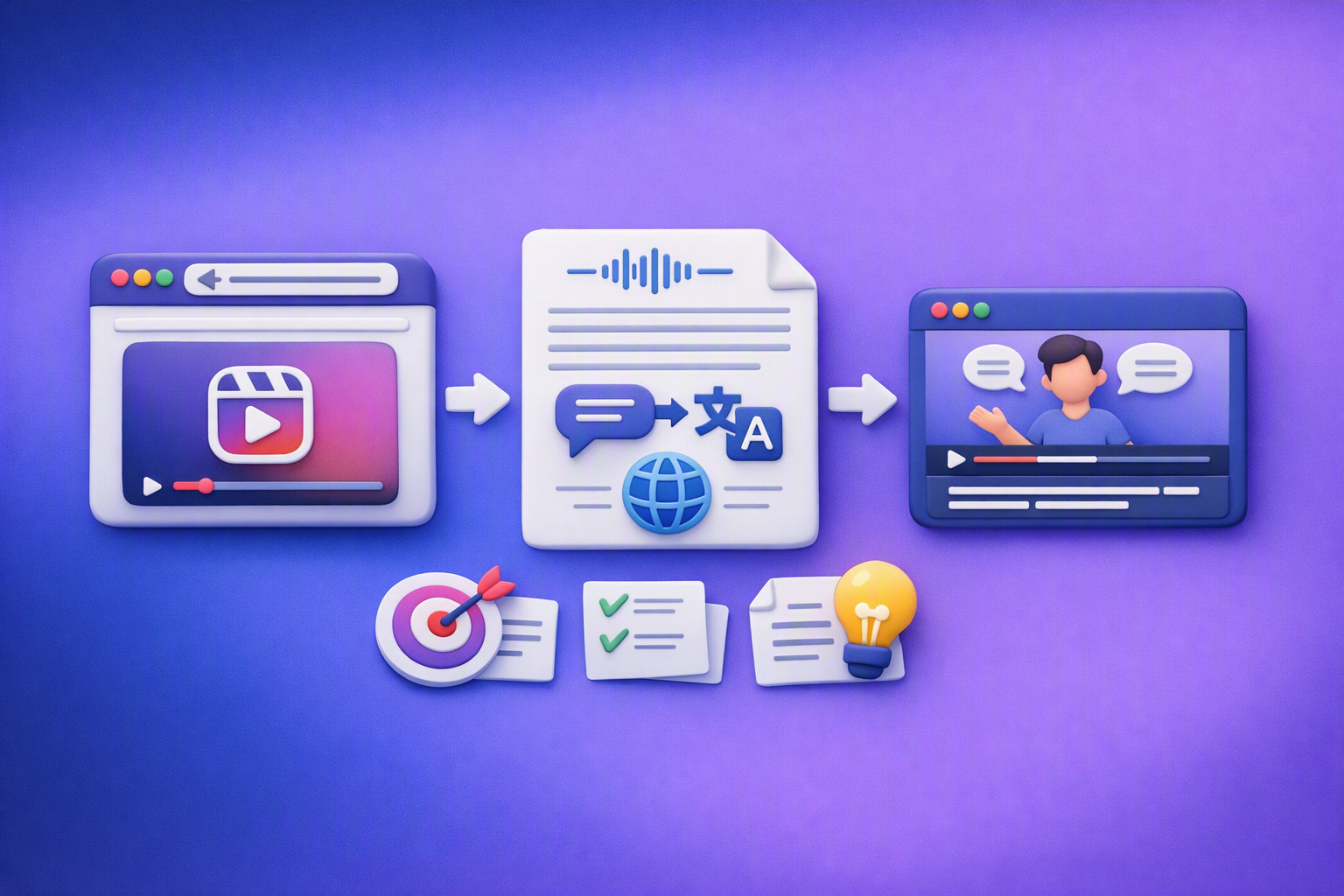
Aprende a traducir un Reel de Instagram con un flujo URL→transcripción→traducción→subtítulos, y a convertir esa traducción en un activo de investigación para hooks, CTAs, objeciones y clusters de contenido.
Reel Analyzer: Transcript‑First Instagram Reels Research (Hooks, CTAs, Objections) + Workflow Guide (VideoToTextAI)
Video To Text AI
A reel analyzer should turn any public Instagram Reel link into a searchable transcript library you can mine for hooks, CTAs, objections, and topic clusters—then repurpose into original drafts with a repeatable SOP.