
“Attachments Disabled for” ChatGPT: What It Means, Why It Happens, and How to Fix It (Plus a Ship-Now Workflow)
 Video To Text AI
Seeing “attachments disabled for” ChatGPT? Fix it by switching to an upload-capable model/surface, then rule out workspace policy and browser/network blockers with a quick incognito + hotspot test. If you need deliverables today, stop depending on uploads and use a transcript-first workflow: generate TXT + SRT/VTT from a link/MP4, then paste verified text into ChatGPT.
“Attachments Disabled for” ChatGPT: What It Means, Why It Happens, and How to Fix It (Plus a Ship-Now Workflow)
Quick answer (what the message means)
What “Attachments disabled for …” is actually telling you
That tooltip usually means this specific chat context cannot accept uploads right now.
Common underlying reasons:
- Model/surface limitation (the current chat type doesn’t support attachments)
- Workspace/admin policy (uploads disabled for your org)
- Local or network blocking (extensions, privacy tools, corporate proxy/DLP)
What it is not telling you (not a ban, not a permanent account lock)
In most cases, it’s not:
- A permanent account ban
- A “shadowban”
- A permanent lock on your account
It’s typically a context-level restriction (thread/model/surface) or an environment restriction (policy/browser/network).
The 3 fastest ways to confirm the root cause (model, policy, local block)
Use these three checks in order:
- Model/surface check: start a new chat and select a model/surface you know supports uploads; see if the paperclip returns.
- Policy check: if you’re in Team/Enterprise, ask whether uploads are disabled by admin data controls.
- Local block check: open incognito/private mode (no extensions) and test again.
When you’ll see it (common surfaces + symptoms)
ChatGPT web app: paperclip/“Add files” greyed out + tooltip
Symptoms:
- Paperclip icon is greyed out
- Hover shows “Attachments disabled for …”
- Drag-and-drop does nothing
Mobile apps: upload icon missing or disabled
Symptoms:
- No upload icon in the composer
- Upload option appears but is disabled
- Selecting a file fails immediately
Workspace/Team/Enterprise: uploads disabled by admin policy
Symptoms:
- Uploads disabled for everyone in the workspace
- Some users can upload in personal accounts but not in the org workspace
- Admin mentions “data controls,” “connectors,” or “security policy”
Model/surface mismatch: chat type that doesn’t support attachments
Symptoms:
- Uploads work in one chat, not another
- A thread behaves differently after switching models
- You see messages like: “You need GPT-4o to continue this chat because there’s an attachment” (a sign the thread is tied to a capability set)
2-minute diagnosis: identify the cause before you try fixes
Step 1 — Confirm you’re in an upload-capable chat surface/model
What to check in the model picker
- Open the model picker and verify you’re using a model/surface that supports attachments in your account.
- If you’re unsure, don’t troubleshoot settings yet—test with a new chat first.
How to test with a new chat vs an existing thread that contains attachments
- Create a new chat and check whether the upload UI appears.
- If uploads work in a new chat but not an old thread, the old thread is likely locked to a surface/model state that doesn’t allow attachments.
Practical rule: Don’t debug inside a “broken” thread. Validate capability in a fresh chat first.
Step 2 — Check plan/entitlement and workspace restrictions
Personal account vs Team/Enterprise workspace
- If you’re signed into a workspace, your org policies can override personal expectations.
- If possible, test the same browser while logged into a personal account to compare behavior.
Admin-controlled toggles that can disable uploads Ask your admin to confirm whether your workspace has disabled:
- File uploads (general)
- Image uploads (if separate)
- Data controls that restrict external content movement
Step 3 — Isolate browser/profile issues
Run these quick isolation tests:
- Incognito/private window test (extensions usually off)
- Different browser test (Chrome/Edge/Firefox/Safari)
- Temporarily disable extensions that can intercept uploads:
- Ad blockers
- Script blockers
- Privacy shields
- Download managers
- “Security” extensions that scan forms/files
If incognito fixes it, you’re dealing with a profile/extension issue, not a model or policy issue.
Step 4 — Isolate network/security tooling
Uploads can be blocked by:
- Corporate proxy
- DLP/CASB tooling
- Firewall rules
- VPN routing
- Aggressive DNS/ad blocking
Fast confirmation:
- Try a mobile hotspot (or a different network).
- If it works on hotspot, your primary network is the blocker.
Fixes by root cause (ordered, lowest effort first)
Fix 1 — Switch to an upload-capable model/surface
Do this first because it’s the most common and the fastest to validate.
- Start a new chat on an upload-capable model/surface.
- If a thread already contains an attachment, avoid forcing model switches that break capabilities.
- If you see “need X model to continue because there’s an attachment,” that thread is capability-bound—use the required model or move the work to a new thread with pasted text.
Validation: the paperclip returns and you can select a file without the tooltip.
Fix 2 — Remove local blockers (extensions + privacy settings)
If model switching didn’t help:
- Disable extensions that touch scripts/uploads:
- Ad blockers
- Privacy shields
- Script blockers
- Corporate “helper” extensions
- Clear site data for ChatGPT (cookies + local storage) and re-login.
Validation: incognito and normal mode behave the same after changes.
Fix 3 — Browser-specific fixes (including Safari)
Safari: cross-site tracking / content blockers checks
- Temporarily disable content blockers for the site.
- Check Prevent cross-site tracking settings.
- Retest uploads.
Chromium (Chrome/Edge): hardware acceleration toggle + cache reset
- Toggle hardware acceleration (on/off), restart browser.
- Clear cache/site data and re-authenticate.
Validation: upload UI is enabled and file selection completes.
Fix 4 — Workspace policy path (Team/Enterprise)
If you’re in a managed workspace, treat this as a policy problem until proven otherwise.
What to ask your admin to check:
- Whether uploads are disabled at the workspace level
- Whether specific file types are blocked
- Whether data controls/connectors restrictions affect attachments
How to validate the policy change worked:
- Log out/in (or hard refresh).
- Test in a new chat.
- Confirm the tooltip is gone and the upload completes.
Fix 5 — If it’s intermittent: stabilize your workflow
If uploads work “sometimes,” assume you’ll lose time again.
Stabilize by using:
- Deterministic inputs (verified text + timestamps) instead of best-effort uploads
- A repeatable export format:
- TXT for analysis and repurposing
- SRT/VTT for production captions/subtitles
Ship-now workaround: stop depending on ChatGPT uploads
Why “paste verified text” beats uploading for production deliverables
If you’re shipping content (not just experimenting), uploads are a fragile dependency.
Pasting verified text is better because:
- Fewer UI/entitlement failures (no attachment surface required)
- Easier QA (searchable transcript, consistent formatting)
- Cleaner handoff to editors, caption tools, and CMS workflows
Brand POV (operational reality): downloading video files just to re-upload them is an outdated workflow. Link-based extraction is the future of creator productivity because it removes file friction and makes outputs repeatable across teams.
Step-by-step: Link/MP4 → transcript/captions → ChatGPT-on-text (production-safe)
Step 1 — Generate a transcript from a video link (or MP4)
Use VideoToTextAI to generate:
- A clean TXT transcript for analysis, summarization, and repurposing
- SRT/VTT exports when you need timecodes for captions/subtitles
This avoids the “attachments disabled” bottleneck because your core asset becomes text, not a file upload.
For related workflows, see:
Step 2 — QA the transcript quickly (before you paste into ChatGPT)
Do a fast, repeatable QA pass:
- Spot-check names, numbers, and jargon
- Confirm speaker changes (if applicable)
- Verify timecode alignment (for SRT/VTT)
A simple method:
- Check the first 60 seconds, a middle section, and the last 60 seconds.
Step 3 — Paste transcript into ChatGPT with a structured prompt
Use a prompt that forces predictable output.
Prompt pattern: role + output format + constraints + sections
Example (copy/paste):
You are a senior content editor.
Using the transcript below, produce:
1) A 10-bullet executive summary
2) A blog outline with H2/H3s
3) A 900–1200 word draft in a direct, implementation-focused style
Constraints:
- Keep claims grounded in the transcript
- Use short paragraphs (max 3 sentences)
- Add a “Key takeaways” section
Transcript:
[PASTE TRANSCRIPT HERE]
Example tasks that work well on pasted text:
- Summary + key takeaways
- Blog draft + SEO headings
- Social post variations
- Chapter titles and timestamps (titles only, not timecodes)
- Email newsletter draft
If your goal is blog content specifically, also see: YouTube to blog
Step 4 — Use SRT/VTT for captions/subtitles (don’t ask ChatGPT to “make timecodes”)
Timecodes are production-critical and should be deterministic.
- Keep caption generation tied to SRT/VTT exports
- Use ChatGPT only for rewriting/condensing caption text (optional), then reinsert into the same timecode structure
If you need a deeper workflow, reference:
- A Production-Safe Link-Based Video-to-Text Workflow (Transcripts, SRT/VTT Captions, and Repurposing)
Implementation checklist (copy/paste)
A) Restore attachments checklist (2–10 minutes)
- Start a new chat and switch to an upload-capable model/surface
- Confirm plan/workspace entitlements allow uploads
- Incognito test (no extensions)
- Disable extensions that touch scripts/uploads (ad blockers, privacy, DLP helpers)
- Clear site data for ChatGPT and re-authenticate
- Try another browser + another network (hotspot)
- If workspace-managed: request admin review of upload/data controls
B) Ship-now transcript-first checklist (10–20 minutes)
- Generate TXT transcript from link/MP4 in VideoToTextAI
- Export SRT or VTT for timecoded captions
- QA: names/numbers + 60-second spot check across the file
- Paste transcript into ChatGPT with a structured prompt
- Export final captions from SRT/VTT (don’t rely on ChatGPT for timecodes)
Related internal references for teams:
- “Add Files” Button Unavailable in ChatGPT: Why It Happens + Fixes (and a Ship-Now Workflow)
- ChatGPT “Upload Video” Feature (2026): What Works, Limits, Fixes, and a Production-Safe Video-to-Text Workflow
VideoToTextAI vs Competitors
Below is a fair comparison focused on the specific failure mode you’re dealing with: when ChatGPT attachments are disabled and you still need transcripts/captions/repurposing inputs.
Competitors compared (researched)
- Reduct Video
- Otter AI
- Zapier (transcription software roundup perspective)
- NYTimes Wirecutter (transcription services perspective)
Comparison criteria (what this section will evaluate)
- Workflow reliability when ChatGPT attachments are disabled (link-based processing vs upload-dependent flows)
- Speed from URL/MP4 to usable assets (time to first transcript + time to export captions)
- Export readiness (TXT for analysis + SRT/VTT for production captions/subtitles)
- Repurposing throughput (transcript → blog/social drafts via repeatable templates)
- Team repeatability (consistent outputs + handoff formats)
Comparison table (capability signals from research)
| Tool | Link-based input (paste a URL) | Upload-dependent flow | Transcript output | Export-ready captions (SRT/VTT) | Repurposing positioning (blog/social) | Team workflow signal |
|---|---|---|---|---|---|---|
| VideoToTextAI | Yes (designed for link-based workflows) | No (not required) | Yes (TXT) | Yes (SRT/VTT) | Yes (repurposing inputs/workflows) | Yes (repeatable handoff formats) |
| Reduct Video | No strong public signal | Yes (implied by platform workflow) | Yes | Not a strong public signal | Limited public positioning | Yes |
| Otter AI | No strong public signal | Yes (explicitly mentions upload) | Yes | Not a strong public signal | Limited public positioning | Yes |
| Zapier (roundup) | N/A (directory/roundup) | N/A | Yes (covers tools that do) | Not a strong public signal | Not a tool; guidance only | Yes (enterprise automation context) |
Where VideoToTextAI fits (positioning for this problem)
When attachments disabled for ChatGPT blocks your normal process, VideoToTextAI is built for the workaround that actually scales:
- Link-based video-to-text means you don’t waste time downloading large files just to re-upload them.
- You get TXT for analysis (paste into ChatGPT reliably) plus SRT/VTT for production captions (deterministic, editor-ready).
- The workflow is operationally repeatable: consistent exports, consistent QA steps, consistent prompts.
Where competitors may be better for narrower jobs:
- If your primary need is a collaborative transcript-centric editing environment, Reduct may be a better fit for that specific collaboration/editing workflow.
- If your primary need is meeting-style transcription and summaries, Otter is often positioned around that use case.
If your bottleneck is “uploads keep failing,” the winning strategy is to stop depending on uploads and move to link → transcript → paste text.
To implement the link-based workflow now, use VideoToTextAI: VideoToTextAI
Competitor Gap
What top-ranking results miss (and this post will include)
Most results about “attachments disabled for ChatGPT” stop at generic advice (“clear cache,” “try another browser”). That’s not enough for teams shipping content.
This post adds:
- A 2-minute diagnostic sequence that separates:
- model/surface mismatch vs
- workspace policy vs
- local/network blocks
- Ordered fixes with validation steps (how to confirm each fix worked)
- A production-safe fallback workflow that avoids uploads entirely
- A copy/paste checklist to standardize troubleshooting + delivery
- A clear separation of responsibilities:
- ChatGPT = analysis/rewriting on text
- Transcript tool = export-ready captions (SRT/VTT) and source-of-truth text
FAQ
Why can’t I attach files in ChatGPT?
Because the current chat is running in a surface/model that doesn’t support uploads, your workspace policy disables uploads, or your browser/network is blocking the upload component. Start with a new chat on an upload-capable model, then test incognito.
Why is my ChatGPT upload disabled?
The most common causes are:
- You’re in a thread/model/surface where uploads are not enabled
- Your org (Team/Enterprise) disabled uploads via admin controls
- Extensions/privacy tools/proxies are interfering
Use the diagnosis steps above to isolate which one it is before changing settings.
Why am I unable to upload images to ChatGPT?
Image uploads can be blocked by the same three categories: surface/model, workspace policy, or local/network blockers. Test in incognito and on a different network to quickly confirm whether it’s local/network.
Why are add files unavailable in ChatGPT Plus?
Plus doesn’t guarantee uploads in every context. If the thread is capability-bound, the model/surface doesn’t support attachments, or your environment blocks uploads, the button can still be unavailable. The fastest fix is a new chat on an upload-capable model plus an incognito test.
Internal Link Plan (used in this post)
- “Add Files” Button Unavailable in ChatGPT: Why It Happens + Fixes (and a Ship-Now Workflow)
- ChatGPT “Upload Video” Feature (2026): What Works, Limits, Fixes, and a Production-Safe Video-to-Text Workflow
- A Production-Safe Link-Based Video-to-Text Workflow (Transcripts, SRT/VTT Captions, and Repurposing)
- MP4 to transcript
- MP4 to SRT
- MP4 to VTT
- YouTube to blog
Related posts
Reel Analyser (Instagram Reels): Transcript‑First Competitor Research, Hook/CTA Extraction, and Repurposing Workflow (VideoToTextAI)
Video To Text AI
A 2026 reel analyser should turn Instagram Reel links into a searchable transcript library you can tag for hooks, CTAs, objections, and topic clusters—then export into repurposing-ready drafts without a download/upload loop.
Traducir video de Instagram (Reels) en 2026: workflow transcript-first para traducir, sacar hooks/CTAs y repurpose (con VideoToTextAI)
Video To Text AI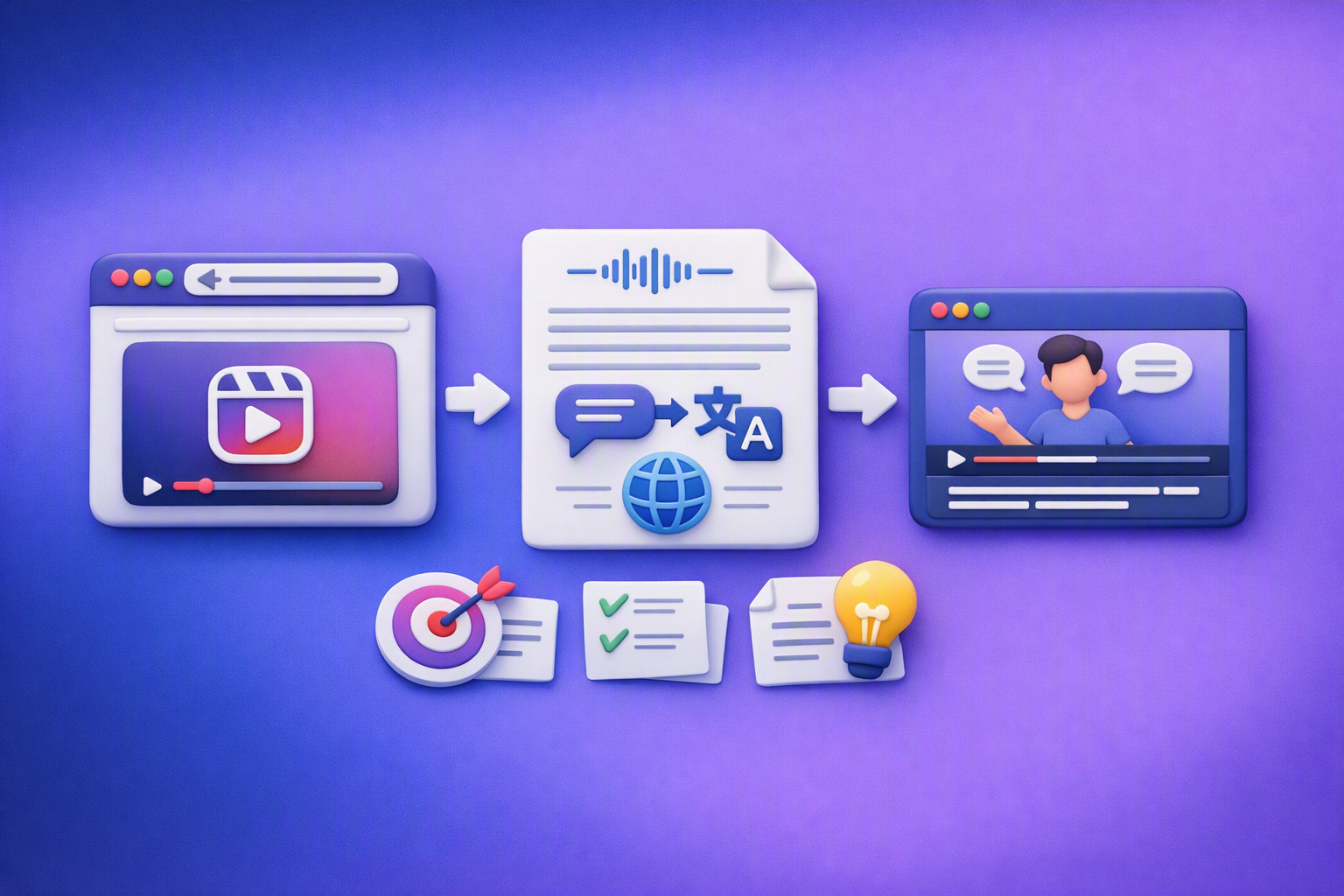
Aprende a traducir un Reel de Instagram con un flujo URL→transcripción→traducción→subtítulos, y a convertir esa traducción en un activo de investigación para hooks, CTAs, objeciones y clusters de contenido.
Reel Analyzer: Transcript‑First Instagram Reels Research (Hooks, CTAs, Objections) + Workflow Guide (VideoToTextAI)
Video To Text AI
A reel analyzer should turn any public Instagram Reel link into a searchable transcript library you can mine for hooks, CTAs, objections, and topic clusters—then repurpose into original drafts with a repeatable SOP.