
ChatGPT “Upload Video” Feature (2026): How to Upload, What It Can Analyze, Real Limits, and a Reliable No-Upload Workflow
 Video To Text AI
ChatGPT “Upload Video” Feature (2026): How to Upload, What It Can Analyze, Real Limits, and a Reliable No-Upload Workflow
If you have the ChatGPT “upload video” feature, you can attach a short video and ask for a transcript, summary, or highlights. If you don’t (or it fails), the fastest reliable workflow is video link → transcript/captions exports → ChatGPT-on-text.
What the “upload video” feature in ChatGPT actually is (and isn’t)
What “upload” means in ChatGPT (file attachment vs link)
In ChatGPT, “upload” usually means attaching a local file (paperclip/attachment UI). That’s different from pasting a video link.
- File attachment: You upload an MP4/MOV from your device into the chat.
- Link: You paste a URL (YouTube/social/hosted). Depending on your setup, ChatGPT may not reliably fetch or analyze it end-to-end.
Operational reality: file uploads are the most common “video upload” path, but they’re also the most fragile (limits, policies, stalls).
What ChatGPT can realistically do with video inputs
When uploads work, ChatGPT can often help with:
- High-level summaries (what happens, key points)
- Scene/segment notes (rough breakdown)
- Highlights (moments worth clipping)
- Rough transcript attempts (quality varies)
- Caption-style outputs (often needs cleanup)
When you should not use ChatGPT for video-first work (and why)
Avoid video-first work inside ChatGPT when you need:
- Ship-ready subtitles (SRT/VTT) with consistent timing
- Repeatable production workflows (teams, batches, reuse)
- Long-form stability (long videos fail more often)
- Compliance constraints (sensitive content, regulated data)
For production, downloading and re-uploading video files is an outdated workflow. Link-based extraction + export-first assets is the future of creator productivity because it’s faster, more repeatable, and doesn’t break when an upload button disappears.
Availability: why some users can upload video and others can’t
Plan, model, and surface differences (web vs iOS vs Android vs desktop)
Upload capability can differ by:
- Plan (features can be gated)
- Model selection (some models/surfaces support attachments better)
- Surface (web app vs iOS vs Android can behave differently)
Workspace/admin policy blocks (ChatGPT Team/Enterprise)
On Team/Enterprise, admins may disable attachments for security/compliance. If you see messages like “Attachments disabled for …”, it’s often policy, not a bug.
Related deep dives:
Region rollouts and feature flags (why the button appears/disappears)
Even with the same plan, features can be:
- Rolled out by region
- Controlled by feature flags
- Temporarily removed during experiments/incidents
That’s why the paperclip can appear one day and vanish the next.
Quick self-check: 30-second “do I have uploads?” test
- Open ChatGPT web app in a normal browser window.
- Start a new chat and switch models if available.
- Look for paperclip/attachment UI near the message box.
- If present, try attaching a small MP4 (10–30 seconds).
- If you see policy/limit errors, jump to troubleshooting below.
Step-by-step: how to upload a video to ChatGPT (web + iPhone + Android)
Web app (browser)
Step 1: Start a new chat in a supported model/surface
- Create a new chat (don’t reuse an old one).
- Select a model that supports attachments (if model picker exists).
Step 2: Use the attachment/paperclip flow
- Click the paperclip.
- Choose your video file (MP4/MOV).
Step 3: Confirm the file is attached before prompting
Before you type your request, confirm:
- The file shows as an attached item in the composer.
- The upload completes (no spinning indicator stuck).
Step 4: Use a structured prompt that forces grounded output
Use constraints so the model stays anchored to what it can actually support:
- Ask for transcript-first
- Require quotes + timestamps
- Require uncertainty flags for unclear audio
Example prompt:
Create a transcript first. If any words are unclear, mark them as [inaudible] and do not guess. Then provide: (1) a bullet summary, (2) 5 key quotes with timestamps, (3) a list of topics covered with approximate time ranges.
iPhone (camera roll / Files app)
Step 1: Choose the source (Photos vs Files) and share/export correctly
- If the video is in Photos, use Share → Save to Files if ChatGPT can’t pick it directly.
- Prefer uploading from Files to avoid permission quirks.
Step 2: Upload and request a transcript-first output
- Attach the file.
- Prompt for transcript-first, then summaries.
If you need caption deliverables later, plan ahead: ChatGPT outputs are rarely drop-in SRT/VTT without cleanup.
Android
Step 1: Pick the correct file provider and avoid “recent items” pitfalls
Android pickers can show “Recents” that point to inaccessible locations. If upload fails:
- Choose Files / your actual storage provider
- Avoid “Recent” shortcuts if they error
Step 2: Upload and request timecoded outputs
Ask for timecodes explicitly:
Produce a transcript with timestamps every 10–15 seconds. Then list 8 highlight moments with timestamps and why they matter.
What ChatGPT can analyze from an uploaded video (practical expectations)
Best-case outputs (summaries, scene notes, rough transcript, highlights)
Best-case happens when the video is:
- Short (a few minutes)
- Clear audio, minimal background noise
- One speaker, minimal overlap
- Standard encoding (common MP4 settings)
Then you can often get:
- A usable summary
- A decent outline
- A rough transcript you can refine
- Highlight candidates for clips
Common failure modes (missing segments, wrong speaker attribution, vague timestamps)
In practice, users commonly hit:
- Missing segments (skips or compresses parts)
- Wrong speaker attribution (especially with overlap)
- Vague timestamps (“around the middle”)
- Overconfident guesses when audio is unclear
“Transcript-first” prompting: how to reduce hallucinations
The single best control is: force transcript-first, then derive everything from the transcript.
Prompt template: transcript → outline → repurpose
Copy/paste:
Step 1) Create a transcript with timestamps every 15 seconds. Use [inaudible] for unclear words.
Step 2) Build a structured outline (H2/H3) strictly from the transcript.
Step 3) Repurpose into: TL;DR, 10 bullet takeaways, and 5 pull quotes (each quote must be verbatim from the transcript with timestamp).
Prompt template: captions/subtitles QA checklist
Copy/paste:
Review this transcript/caption draft for subtitle readiness. Output a QA checklist with: (1) names/brands to verify, (2) jargon/technical terms to verify, (3) timestamp consistency issues, (4) lines that are too long for captions, (5) suggested fixes.
Real limits you’ll hit (before you waste time)
File size, duration, and processing stability constraints (what users report in practice)
Even when uploads exist, stability is the bottleneck:
- Large files can stall
- Longer videos are more likely to timeout or partially process
- Some accounts hit upload caps or “max 0 uploads” style errors
If you’re repeatedly fighting limits, switch to an export-first workflow (see below) instead of retrying uploads.
Related:
- “Max 0 Uploads at a Time” ChatGPT Error: What It Means, Fixes That Work, and the No-Upload Video→Text Workflow (2026)
- “Max 0 Uploads at a Time” / “Upload Limit Reached” in ChatGPT (2026): Causes, Fixes, and the No-Upload Video→Text Workflow
Codec/container issues (MP4 vs MOV, variable frame rate, audio track problems)
Uploads can fail due to:
- Container mismatch (MP4 vs MOV)
- Variable frame rate (common from phones)
- Odd audio tracks (missing/unsupported, multi-track confusion)
If a file fails repeatedly, re-encoding often fixes it (see troubleshooting).
Long videos: why they fail more often and what to do instead
Long videos increase risk of:
- Upload timeouts
- Processing instability
- Incomplete outputs
Instead, use link-based extraction and work from TXT/SRT/VTT exports. This avoids re-uploading the same heavy asset every time you need a new deliverable.
Privacy/compliance considerations (what to avoid uploading)
Avoid uploading:
- Confidential client recordings
- Regulated data (health, finance) unless your org policy explicitly allows it
- Anything you can’t risk being stored/processed by third parties
A safer pattern is to generate text exports you can control and store, then analyze the text.
Troubleshooting: why you can’t upload video to ChatGPT (fast isolation flow)
Symptom → cause map (use this before changing settings)
No paperclip / no attachment UI
Likely causes:
- Wrong surface/model
- Feature not enabled for your account/region
- Workspace policy
“Attachments disabled for …”
Likely causes:
- Team/Enterprise admin policy
- Security controls
“Max 0 uploads at a time”
Likely causes:
- Temporary limit/flag
- Account-level restriction
- Session/model issue
Upload stalls, fails, or never finishes processing
Likely causes:
- Network/VPN/ad blocker interference
- File too large/long
- Codec issues (VFR, audio track)
Fixes in order (stop when it works)
1) Switch to a new chat + supported model
- New chat
- Change model (if possible)
- Retry with a small video first
2) Change surface (web ↔ mobile) and retry
- If web fails, try iOS/Android (or vice versa)
3) Disable extensions/VPN/ad blockers that intercept uploads
- Temporarily disable
- Retry upload
4) Try a clean browser profile / incognito
- Incognito window
- No extensions
- Retry
5) Check workspace policy (Team/Enterprise) and request enablement
- Ask admin to enable attachments (if allowed)
6) Re-encode video (constant frame rate + standard audio track) and retry
- Convert to MP4 (H.264) with constant frame rate
- Ensure a standard AAC audio track
- Retry upload
The production-safe alternative: no-upload workflow (video link → transcript/captions → ChatGPT)
Why link-based workflows beat download → convert → upload loops
Downloading video files just to re-upload them is slow, brittle, and hard to repeat. Link-based workflows are the future because they:
- Reduce manual steps
- Avoid attachment UI/policy failures
- Produce exportable assets you can reuse across tools and teams
Step-by-step: VideoToTextAI workflow (repeatable)
Step 1: Paste a video link (YouTube / social / hosted file) or use MP4
Use link-based input whenever possible. If you only have a file, you can still process MP4.
Step 2: Generate transcript + captions (TXT + SRT + VTT)
Export formats matter because they’re reusable:
- TXT for analysis, blogs, summaries
- SRT for subtitles
- VTT for web players
Helpful tools:
Step 3: QA the transcript quickly (names, jargon, timestamps)
Do a fast pass:
- Proper nouns (people, brands, products)
- Acronyms and technical terms
- Timestamp alignment (spot-check 3–5 points)
Step 4: Paste transcript into ChatGPT for analysis/repurposing
Now ChatGPT works on text, where it’s strongest and most stable.
Step 5: Export deliverables (subtitles, blog, posts) without reprocessing video
Because you already have TXT/SRT/VTT, you can iterate without touching the video again.
If you want the fastest path from YouTube to written content:
Exactly one CTA: Use the export-first workflow at VideoToTextAI.
Implementation prompts (copy/paste)
Prompt: “Turn this transcript into a blog post with H2s + TL;DR + key quotes”
Turn the transcript below into a blog post. Requirements: TL;DR at top, H2 sections, short paragraphs, and a “Key Quotes” section with 5 verbatim quotes (include timestamps). Only use information present in the transcript.
Prompt: “Create SRT QA notes: flag unclear words + propose fixes”
Review this transcript as if it will become SRT captions. Flag unclear words, long lines, missing punctuation, and any terms that look wrong. Propose corrected wording, but mark any uncertain fixes as “VERIFY”.
Prompt: “Repurpose into 10 short posts + 5 hooks + 3 titles”
Using only the transcript, create: 10 short social posts, 5 hooks, and 3 headline/title options. Include 1 supporting quote (verbatim) per post with timestamp.
Checklist: fastest path to results (upload vs no-upload)
If you insist on uploading to ChatGPT
- Confirm attachment UI exists in your current chat/model/surface
- Keep videos short and simple (single speaker, clear audio)
- Ask for transcript-first output before summaries
- Validate with timestamps/quotes before publishing
If you need reliable outputs today (recommended)
- Use VideoToTextAI to generate TXT + SRT + VTT
- QA transcript for names/terms
- Use ChatGPT on text for summaries, posts, and scripts
- Store exports for reuse (no re-uploading, no reprocessing)
VideoToTextAI vs Competitors
Below is a fair, workflow-focused comparison using only publicly signaled capabilities from the researched set (VOMO AI, Reduct Video, Choppity, PCMag as an evaluator/list—not a tool vendor).
| Criteria | VideoToTextAI | VOMO AI (vomo.ai) | Reduct Video (reduct.video) | Choppity (choppity.com) |
|---|---|---|---|---|
| Link-based input (paste a URL) | Yes (core workflow) | Yes (signals YouTube/link workflow) | No strong public signal | No strong public signal |
| Upload-heavy workflow required | No (link-first; file optional) | Mixed (supports uploads; also link) | Not clearly link-first | Yes (upload a video is central) |
| Export readiness (TXT/SRT/VTT) | Yes (export-first deliverables) | Transcript signals; subtitle export not clearly evidenced in provided research | Transcript export signals; subtitle export not strongly signaled | Transcript + subtitles/captions signals |
| Repurposing into written content | Yes (transcript-first assets for ChatGPT prompts) | Positions “insights/summaries” and workflows | Strong for collaborative transcript-based review/editing | Stronger for clip/editing workflows than blog-style repurposing |
| Operational repeatability when ChatGPT uploads are blocked | High (exports remain usable outside ChatGPT) | Medium (still a separate platform; may still involve uploads) | Medium (team archive/collab; not export-first subtitles) | Medium (great for editing/clips; still upload-centric) |
Where VideoToTextAI wins (when you care about speed + repeatability):
- Workflow speed: link-based input avoids the download → convert → upload loop.
- Export-first outputs: having TXT/SRT/VTT means you can repurpose, QA, and publish without reprocessing the video.
- Operational repeatability: if ChatGPT removes uploads, hits “max 0 uploads,” or policies block attachments, your workflow still runs because you’re working from exports.
Where competitors can be better (narrower jobs):
- Reduct Video can be a strong fit for collaborative, transcript-based review and building a searchable archive for teams.
- Choppity can be better if your primary need is AI-assisted video editing/clipping with captions as part of the edit workflow.
- VOMO AI is positioned around transcription/insights and may fit meeting-style capture, but your best “production safety” still comes from exportable assets you can reuse across tools.
Competitor Gap
What top-ranking pages miss (and this post will include)
Most pages ranking for the “chatgpt upload video feature” focus on “how to upload” and skip what breaks in production. This post includes:
- A) A deterministic troubleshooting flow for “no upload button / attachments disabled / max 0 uploads”
- B) Copy/paste prompt templates that force transcript-first, grounded outputs
- C) A production checklist that chooses upload vs no-upload based on constraints
- D) Export-first deliverables (TXT/SRT/VTT) that remain usable outside ChatGPT
Content additions to outperform competitors
“Decision tree” section: choose ChatGPT upload vs transcript-first workflow in under 60 seconds
Use this decision tree:
- If you don’t see the paperclip → go no-upload (link → exports → ChatGPT-on-text).
- If you see Attachments disabled → go no-upload (policy won’t be fixed quickly).
- If your video is >10–15 minutes or mission-critical → go no-upload.
- If your video is short + simple and you just need a quick summary → try upload.
For more context on the full feature set and limits:
“QA pass” section: 5-minute transcript/caption validation before repurposing
Do this before you publish anything:
- Search for names/brands and verify spelling.
- Spot-check 3 timestamps against the video.
- Verify numbers (prices, dates, metrics).
- Flag [inaudible] segments for manual review.
- Ensure captions aren’t too long per line (readability).
“Repeatable pipeline” section: link → exports → ChatGPT prompts → publish
- Link in → TXT/SRT/VTT out
- QA once
- Reuse exports for: blog, posts, scripts, multilingual variants
- Publish without re-uploading video assets
FAQ
Will ChatGPT let me upload a video?
Sometimes. It depends on plan/model/surface, workspace policy, and rollout flags. If you don’t have the attachment UI, use a no-upload workflow.
Can ChatGPT view videos you upload?
It can analyze video inputs with varying reliability. Expect best results on short, clear videos and use transcript-first prompting to reduce ungrounded output.
How do I upload a video to ChatGPT from my iPhone camera roll?
Attach from Photos if available; if not, Save to Files first, then attach from Files. Ask for transcript-first output and require timestamps/quotes.
Can ChatGPT do video transcription?
It can attempt transcription from a video upload, but accuracy and completeness vary. For ship-ready captions, generate TXT/SRT/VTT exports first, then use ChatGPT for repurposing.
How can I take a video and turn it into text?
Use a transcript-first pipeline: generate transcript + subtitle exports, QA names/terms/timestamps, then repurpose the text into blogs, posts, and scripts. This avoids fragile upload steps and is more repeatable for creators and teams.
Related posts
Reel Analyser (Instagram Reels): Transcript‑First Competitor Research, Hook/CTA Extraction, and Repurposing Workflow (VideoToTextAI)
Video To Text AI
A 2026 reel analyser should turn Instagram Reel links into a searchable transcript library you can tag for hooks, CTAs, objections, and topic clusters—then export into repurposing-ready drafts without a download/upload loop.
Traducir video de Instagram (Reels) en 2026: workflow transcript-first para traducir, sacar hooks/CTAs y repurpose (con VideoToTextAI)
Video To Text AI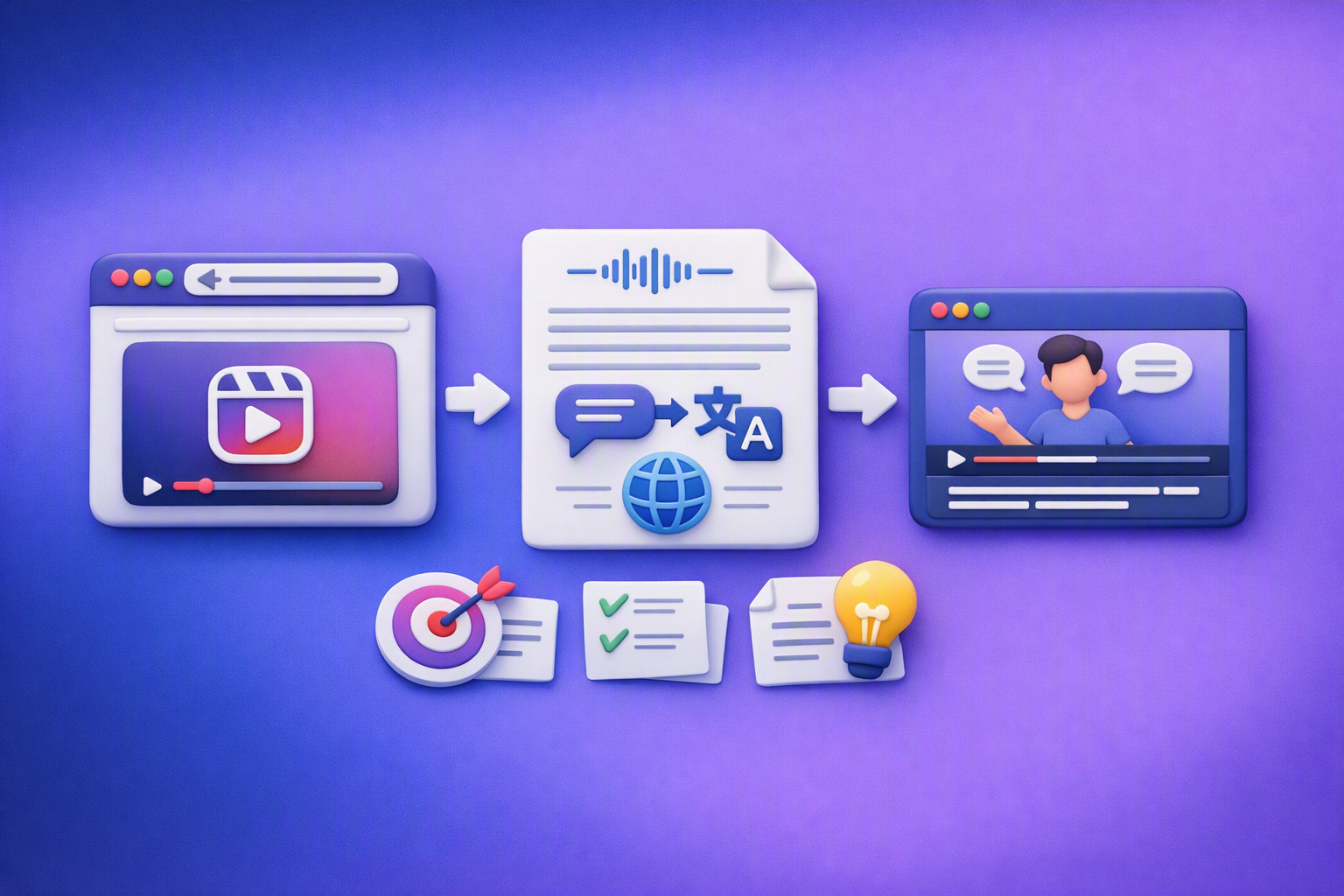
Aprende a traducir un Reel de Instagram con un flujo URL→transcripción→traducción→subtítulos, y a convertir esa traducción en un activo de investigación para hooks, CTAs, objeciones y clusters de contenido.
Reel Analyzer: Transcript‑First Instagram Reels Research (Hooks, CTAs, Objections) + Workflow Guide (VideoToTextAI)
Video To Text AI
A reel analyzer should turn any public Instagram Reel link into a searchable transcript library you can mine for hooks, CTAs, objections, and topic clusters—then repurpose into original drafts with a repeatable SOP.