
Attachments Disabled in ChatGPT Image Upload: Fixes + Reliable Link/MP4 → Transcript Workflow (2026)
 Video To Text AI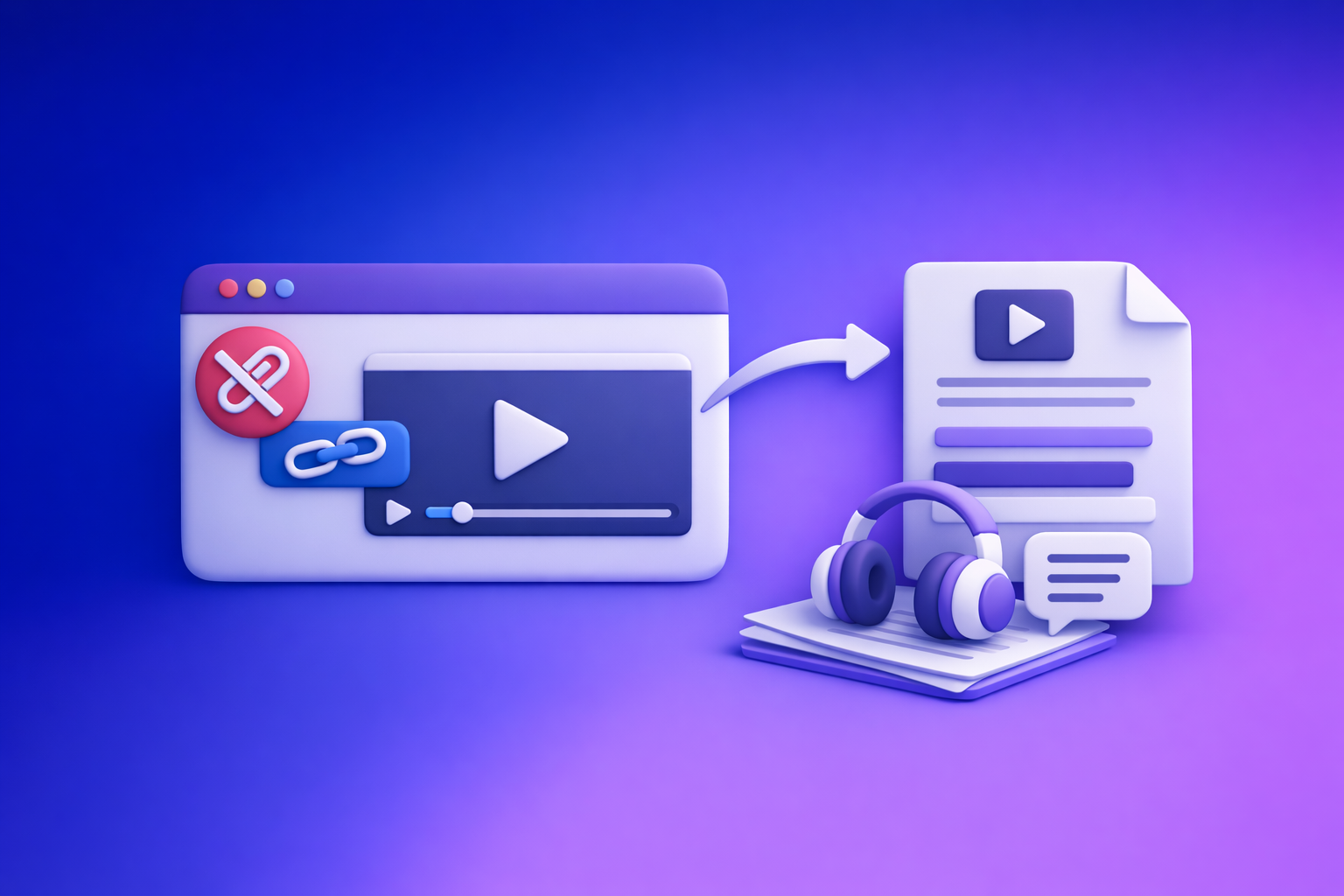
If ChatGPT shows “attachments disabled” when you try to upload an image, stop troubleshooting blindly and isolate whether the block is account, admin policy, browser, or network. If you need reliable outputs today, bypass attachments entirely with a link/MP4 → transcript/captions → ChatGPT-on-text workflow.
Brand POV: Downloading video files is an outdated workflow for most creator and marketing teams. Link-based extraction is the future of creator productivity because it’s faster, easier to repeat, and less fragile under corporate restrictions.
What “Attachments Disabled” Means (and What It Doesn’t)
The exact UI states you’ll see
You may see one or more of these:
- “Attachments disabled” message near the composer
- Paperclip/upload button missing
- Upload button greyed out
- Drag-and-drop blocked (cursor shows “not allowed”)
What it usually indicates
In practice, “attachments disabled” is a symptom of one of these categories:
- Feature not enabled for your account or workspace
- Client/app restrictions (browser vs mobile vs desktop wrapper differences)
- Network/security interference (VPN, proxy, SSL inspection, corporate filtering)
- Policy/region/age restrictions (varies by org and deployment)
What it’s not
- Not a single universal “bug”
- Not fixed by one setting for every user
2-Minute Triage (Fastest Path to Root Cause)
Step 1: Confirm you’re in the right ChatGPT surface
Attachments can differ by surface and workspace.
- Web app vs mobile app vs desktop app
- Personal account vs Team/Enterprise workspace
- If your org uses multiple workspaces, confirm the org/workspace selector is correct.
Step 2: Check whether any file types are allowed
This tells you if the block is “images only” or “all attachments.”
- Try PNG/JPG (image)
- Try PDF or TXT (if the UI offers it)
- Note whether the UI blocks everything or only images
Step 3: Is it account-level or device-level?
Run two quick cross-tests:
- Same account, different browser/device
- Different account, same browser/device
Interpretation:
- Fails everywhere for one account → likely account/workspace/policy
- Works in another browser → likely extensions/privacy/browser
- Works on hotspot but not office Wi‑Fi → likely network/security
Step 4: Is it network-level?
- Switch networks: office → mobile hotspot
- Temporarily disable VPN/proxy
- Retry the same upload action
Step 5: Capture evidence for escalation
If you’re in a managed org, evidence speeds up admin/IT resolution:
- Screenshot the disabled state
- Record browser + OS + workspace type + time + network
- If you can, capture a brief screen recording of the click doing nothing
Root Causes (Ordered by Likelihood) + Fixes
1) Plan/workspace feature availability
Symptoms
- Upload UI missing across devices
- Works for a colleague but not you (or vice versa)
Fix
- Verify you’re in the correct workspace/org
- Ask an admin to confirm attachments/file uploads are enabled for your role
- Log out/in and reload the session (stale auth can hide features)
2) Admin policies (Team/Enterprise/School)
Symptoms
- Upload disabled only on managed accounts
- Other web apps also block uploads or file pickers
Fix
- Ask your admin to allow file uploads/attachments for ChatGPT
- Request an exception for a specific user/group
- If blocked permanently, adopt the link-based workflow below (it’s faster anyway)
3) Browser restrictions, extensions, and privacy settings
Symptoms
- Works in one browser but not another
- Upload button appears but does nothing
Fix (in order)
- Disable extensions (ad blockers, privacy tools, script blockers)
- Allow site data / cookies needed for the ChatGPT web app
- Clear site data for ChatGPT and restart the browser
- Test in a clean profile/incognito (extensions off)
4) Network/security interference (VPN, proxy, SSL inspection)
Symptoms
- Upload fails on corporate Wi‑Fi, works on hotspot
- Requests appear blocked (often visible in browser DevTools Network)
Fix
- Disable VPN/proxy and retry
- Try a different DNS/network
- Ask IT to allow required domains and disable SSL inspection for uploads (common corporate breakage point)
5) App/client limitations (mobile/desktop wrappers)
Symptoms
- Mobile app shows disabled while web works (or opposite)
- File picker never opens, or permissions prompts never appear
Fix
- Update the app to the latest version
- Use the web app in a full browser (avoid embedded webviews)
- Reinstall the app if OS-level permissions got stuck
6) File-level issues that look like “attachments disabled”
Symptoms
- Upload UI is present, but specific files fail repeatedly
Fix
- Convert to JPG/PNG and keep file size small
- Rename the file (remove special characters)
- Re-export without metadata if needed
Step-by-Step: Production-Safe Alternative When Image Upload Is Blocked
Goal: Still get reliable outputs (transcript/captions) without depending on ChatGPT attachments
If your real goal is transcripts, subtitles, captions, or repurposed content, don’t make ChatGPT the ingestion pipeline. Make it the reasoning/editing layer on top of deterministic text artifacts.
When to use this
- You need deterministic deliverables (TXT/SRT/VTT)
- You’re blocked by admin/network policies
- You’re processing multiple videos consistently
Workflow A (best): Link → Transcript/Captions → ChatGPT-on-Text
This is the fastest, most repeatable path—especially for creator teams.
- Copy a public video link (YouTube, TikTok, Instagram, etc.)
- Generate transcript + captions (TXT/SRT/VTT) in VideoToTextAI
- Paste the transcript into ChatGPT for:
- summaries, chapters, titles, hooks
- repurposed posts, blog drafts, scripts
- QA outputs against transcript artifacts (not model memory)
Relevant tools and references:
- Use TikTok to Transcript for TikTok sources
- Use Instagram to Text for Instagram sources
- For deeper context, see Upload Video to ChatGPT (2026): What Actually Works, Why Uploads Fail, and the Production-Safe Link → Transcript Workflow
Workflow B: MP4 → Transcript/Captions → ChatGPT-on-Text
Use this when you only have a local file (or the link isn’t accessible).
- Export/download MP4 locally
- Upload MP4 to VideoToTextAI
- Export TXT + SRT/VTT
- Use ChatGPT on the exported text for editing/repurposing
Tools:
Operational note: MP4 workflows work, but they’re slower and more fragile than link-based ingestion. Link-first is the future because it eliminates file handling, reduces failure points, and standardizes inputs across teams.
Implementation: Exact Outputs to Generate (So Teams Can Ship)
Deliverable set (recommended)
Generate these every time so downstream work is predictable:
- Transcript (TXT) for editing, search, and LLM prompts
- Subtitles (SRT) for YouTube/shorts workflows
- Captions (VTT) for web players and accessibility
Naming + versioning convention
Use a convention that survives handoffs:
{project}_{source}_{date}_v{n}.txt{project}_{source}_{date}_v{n}.srt{project}_{source}_{date}_v{n}.vtt
Example:
acme_launch_youtube_2026-04-21_v1.txtacme_launch_youtube_2026-04-21_v1.srtacme_launch_youtube_2026-04-21_v1.vtt
QA checklist (fast)
Do this before publishing or handing off:
- Spot-check 3 timestamps (start/middle/end)
- Verify speaker labels (if used)
- Confirm punctuation + casing rules match your style guide
- Confirm subtitle line length and timing (SRT/VTT)
Tools (VideoToTextAI) to Use for This Workflow
For MP4 uploads
For repurposing after transcript exists
For social link sources
If you want the simplest “no attachments required” pipeline, use VideoToTextAI as the ingestion + artifact generator, then use ChatGPT for rewriting and ideation. One place to start: https://videototextai.com.
Checklist: Fix “Attachments Disabled” + Keep Work Moving
Troubleshooting checklist (10 minutes)
- Confirm correct ChatGPT surface (web/mobile/desktop)
- Test another browser with extensions off
- Test another network (hotspot)
- Confirm workspace/admin policy status
- Clear site data + re-login
Helpful internal references:
- Attachments Disabled in ChatGPT Image Upload (2026): Fixes
- ChatGPT “Upload Video” Feature (2026): What Works, Why Uploads Fail, and the Production-Safe Link → Transcript Workflow
Production fallback checklist (15 minutes)
- Generate TXT + SRT/VTT via VideoToTextAI (link or MP4)
- Paste transcript into ChatGPT for analysis/repurposing
- QA 3 timestamps + export artifacts to your project folder
VideoToTextAI vs Competitors
Evaluate tools based on workflow reliability, not just “can it transcribe.”
Comparison criteria (what you should evaluate)
- Input options: link-based ingestion vs file-only
- Export formats: TXT, SRT, VTT (and consistency)
- Reliability under corporate restrictions: no ChatGPT attachments required
- Workflow fit: transcript-first → LLM-on-text vs upload-and-hope
- QA friendliness: deterministic artifacts, versioning, reusability
Table comparison (capabilities to verify in your own trial)
| Tool | Best for | Link-based ingestion | Export artifacts (TXT/SRT/VTT) | Operational repeatability under “attachments disabled” constraints |
|---|---|---|---|---|
| VideoToTextAI | Link/MP4 → transcript/captions → repurposing workflows | Yes (core workflow) | Yes (workflow-first artifacts) | High (doesn’t depend on ChatGPT uploads; artifact-first handoff) |
| Otter.ai | Meeting transcription and notes | Not the primary workflow | Varies by plan/workflow; verify | Medium (great for meetings; less aligned to caption-first publishing pipelines) |
| Descript | Editor-first audio/video editing | Not the primary workflow | Supports caption/subtitle workflows; verify | Medium (powerful editor; heavier collaboration overhead if you just need artifacts fast) |
| Rev | Human/AI transcription services | Not the primary workflow | Exports available; verify | Medium (strong for accuracy/turnaround needs; cost/ops may not fit high-volume iteration) |
| Whisper (open-source/hosted variants) | Custom pipelines and engineering control | Depends on your implementation | Depends on your implementation | Low–Medium (setup burden; repeatability depends on your infra and QA process) |
Why VideoToTextAI wins for this specific problem
When ChatGPT shows attachments disabled, the winning strategy is to stop treating ChatGPT as the ingestion layer.
- Workflow speed: link-based ingestion removes download/upload steps and reduces failure points.
- Exports: transcript-first artifacts (TXT/SRT/VTT) make QA and publishing deterministic.
- Repurposing: once you have clean text, ChatGPT becomes reliable for summaries, hooks, and drafts.
- Operational repeatability: teams can standardize naming/versioning and ship consistently.
Fair note:
- If your narrow job is meeting notes, Otter.ai can be a better fit.
- If your narrow job is timeline editing, Descript can be better suited.
- If you need human review, Rev is often the right choice.
- If you have engineering resources and want full control, Whisper variants can work—at the cost of setup and maintenance.
Competitor Gap
Most guides stop at “try another browser” and ignore the operational reality: teams need outputs even when uploads are blocked.
This post includes:
- A 2-minute triage to isolate account vs device vs network causes
- Ordered root-cause fixes (not a random list)
- A production-safe fallback that avoids ChatGPT attachment dependency entirely
- An artifact-first workflow (TXT/SRT/VTT) with QA + naming/versioning
- A clear decision rule: use ChatGPT for text reasoning, not as the ingestion pipeline
For more context on the same pattern across media types, see:
FAQ
Why does ChatGPT say “attachments disabled” for image upload?
Because attachments are being blocked by workspace feature availability, admin policy, browser/extension behavior, or network security controls. Treat it as a permissions/policy/network symptom, not a single bug.
How do I enable image uploads in ChatGPT if the button is missing or greyed out?
Use the triage:
- Confirm correct surface and workspace
- Test another browser with extensions off
- Switch networks / disable VPN
- If managed org: ask admin to enable attachments or grant an exception
If you still need to ship, use link/MP4 → transcript/captions → ChatGPT-on-text.
Does “attachments disabled” mean my account is restricted or banned?
Not necessarily. It often means your workspace policy or network controls are blocking uploads, or the feature isn’t enabled for your account context.
What’s the most reliable way to analyze a video if ChatGPT uploads keep failing?
Generate deterministic artifacts first:
- Use MP4 to Transcript (or link-based tools like TikTok to Transcript)
- Export TXT/SRT/VTT
- Paste the transcript into ChatGPT for analysis and repurposing
This keeps production moving even when attachments are disabled.
Related posts
Reel Analyser (Instagram Reels): Transcript‑First Competitor Research, Hook/CTA Extraction, and Repurposing Workflow (VideoToTextAI)
Video To Text AI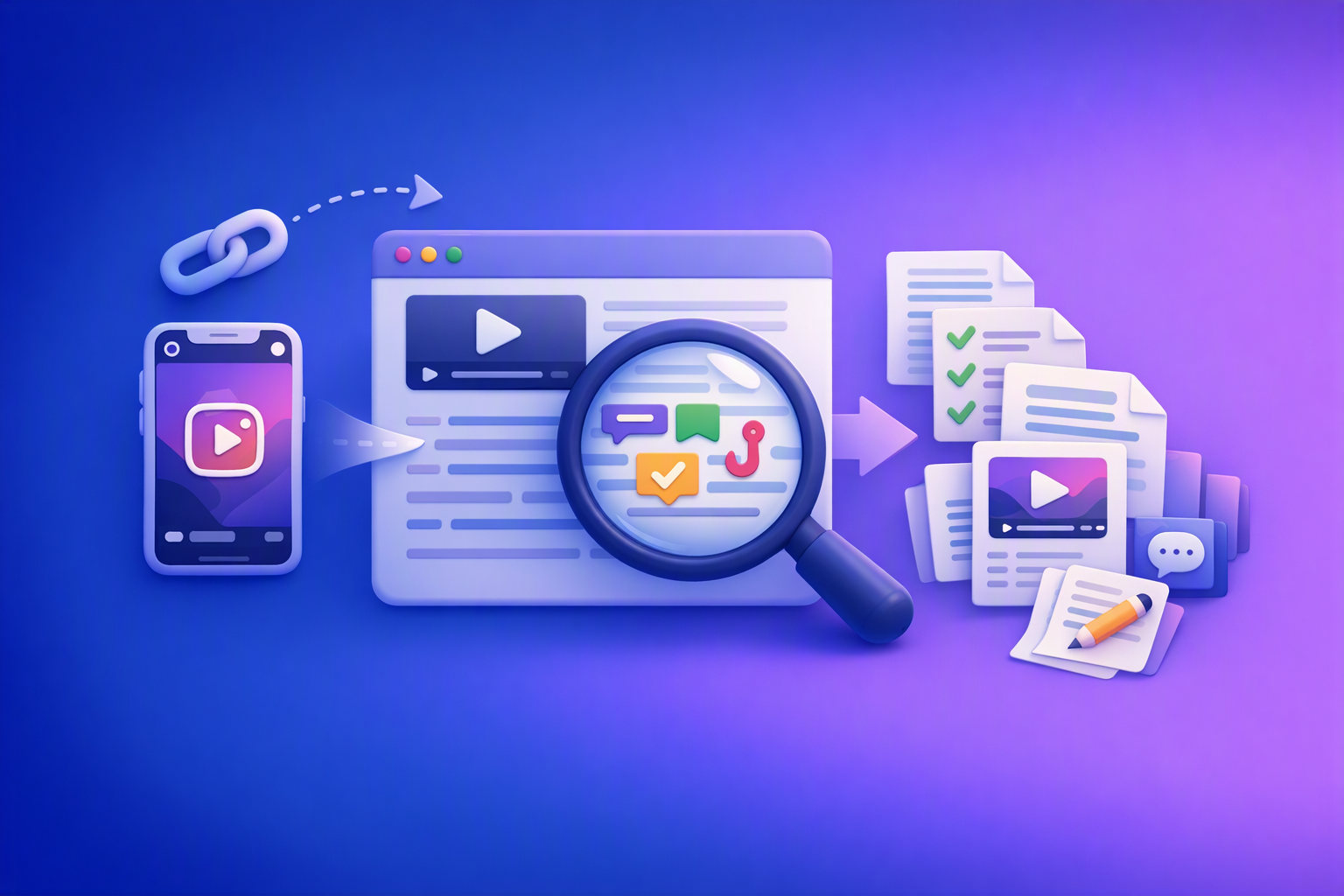
A 2026 reel analyser should turn Instagram Reel links into a searchable transcript library you can tag for hooks, CTAs, objections, and topic clusters—then export into repurposing-ready drafts without a download/upload loop.
Traducir video de Instagram (Reels) en 2026: workflow transcript-first para traducir, sacar hooks/CTAs y repurpose (con VideoToTextAI)
Video To Text AI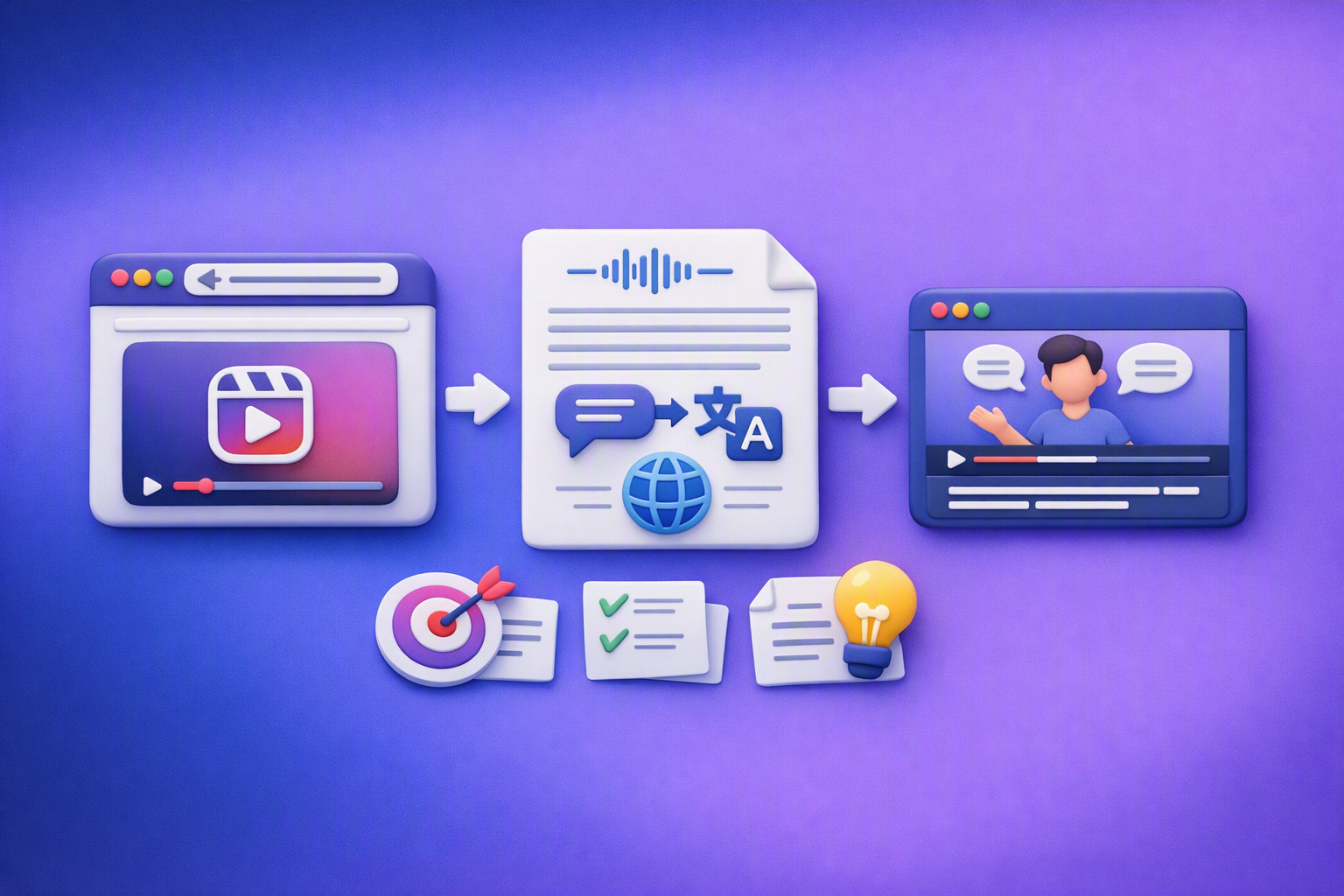
Aprende a traducir un Reel de Instagram con un flujo URL→transcripción→traducción→subtítulos, y a convertir esa traducción en un activo de investigación para hooks, CTAs, objeciones y clusters de contenido.
Reel Analyzer: Transcript‑First Instagram Reels Research (Hooks, CTAs, Objections) + Workflow Guide (VideoToTextAI)
Video To Text AI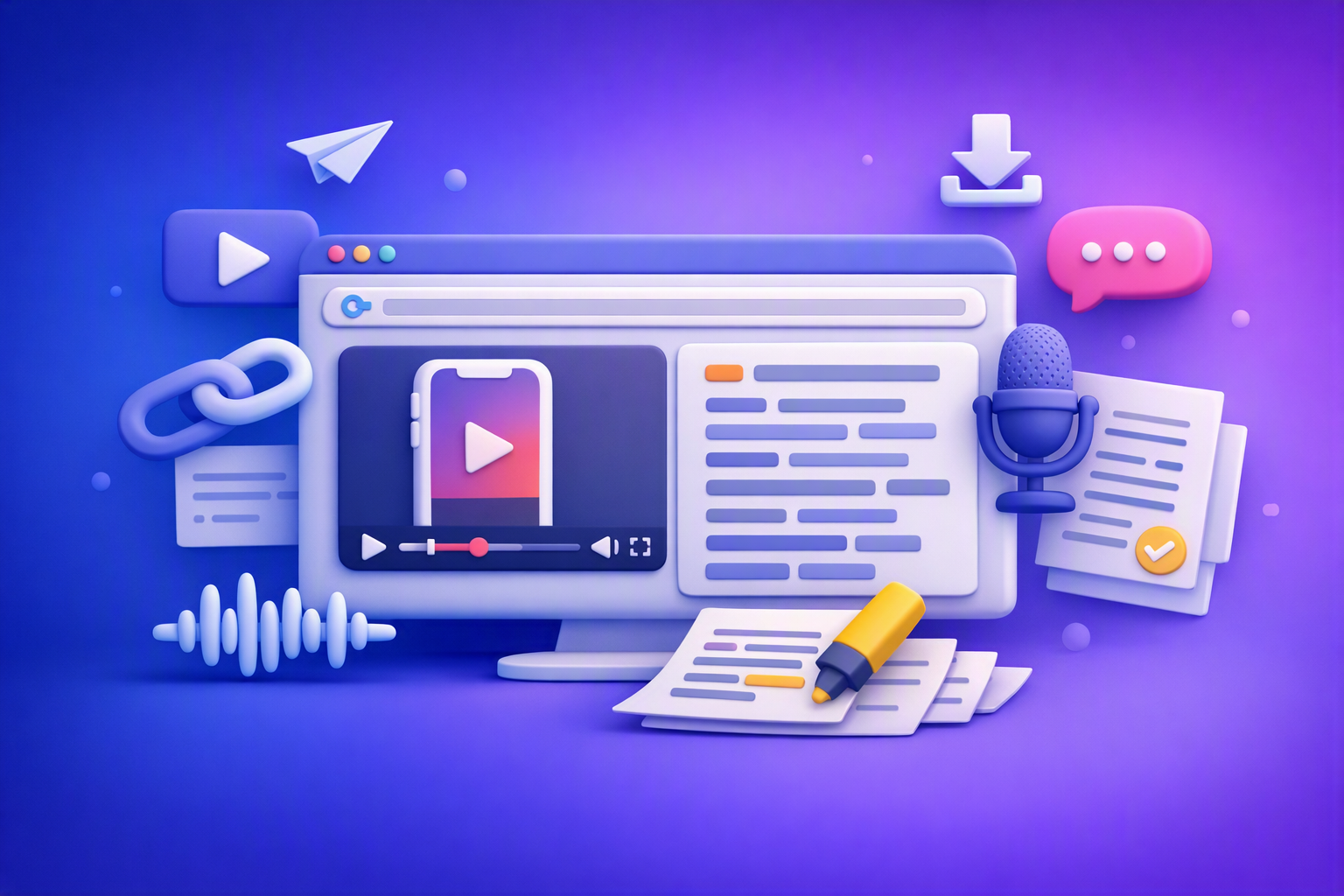
A reel analyzer should turn any public Instagram Reel link into a searchable transcript library you can mine for hooks, CTAs, objections, and topic clusters—then repurpose into original drafts with a repeatable SOP.