
“Attachments Disabled” in ChatGPT Image Upload (2026): Fixes, Root Causes, and a Production-Safe Link → Transcript Workflow
 Video To Text AI
If ChatGPT shows “attachments disabled” (or the upload button is missing/greyed out), stop guessing and identify whether the block is account policy, feature availability, client restrictions, or network security. If you need transcripts/captions, don’t block on image uploads—use a link/MP4 → transcript/captions → ChatGPT-on-text workflow that works even when uploads are permanently disabled.
What “Attachments Disabled” Means (and What It Doesn’t)
The exact UI states you’ll see
You’ll typically see one of these:
- Banner/text: “Attachments disabled”
- Missing UI: the paperclip / upload button isn’t visible
- Greyed out: upload button exists but is disabled (unclickable)
Each state can point to a different constraint (policy vs client vs transient outage).
What’s actually happening under the hood
“Attachments disabled” usually means the client is refusing to initiate an upload or the platform is not allowing uploads for your session.
Common underlying causes:
- Feature flag not enabled for your account/workspace (rollout/plan/region)
- Client-side restrictions (browser/app version, extensions, OS policy)
- Temporary service degradation or rate limiting affecting upload endpoints
When it’s not an “attachments” issue
Sometimes the UI looks like “attachments” are blocked, but the real issue is elsewhere:
- File type/size limits (unsupported format or too large)
- Network/proxy interference (uploads blocked or modified in transit)
- Account verification/billing constraints (capability gated by account state)
Fast Triage (2 Minutes): Identify the Cause Before You Try Fixes
Step 1 — Confirm the environment
Write down what you’re using:
- Web vs iOS vs Android vs desktop app
- Personal account vs Team/Enterprise workspace
Org workspaces are the #1 place where uploads get disabled by policy.
Step 2 — Check whether the model/chat supports image uploads
In some setups, only certain chats/models show attachment capability.
- Confirm you’re in a chat/model that supports images (if available to you)
- Look for UI indicators that attachments are supported (paperclip, image icon, etc.)
If the UI never shows upload controls in any chat, suspect account/workspace policy or feature availability.
Step 3 — Determine if it’s account-level or device-level
Run two quick tests:
- Try incognito or a new browser profile
- Try a different device (phone vs desktop)
If it fails everywhere on the same account, it’s likely account/workspace. If it works on another device, it’s likely client/network.
Step 4 — Rule out transient platform issues
Uploads can fail during brief incidents.
- Retry after 2–10 minutes
- Test again in a different time window
If it “magically” works later, document it as transient (useful for support).
Step 5 — Capture evidence for support/escalation
If you’re in a managed workspace, evidence speeds resolution.
Capture:
- Screenshot of the disabled state
- Timestamp (with timezone)
- Device + OS
- Browser/app version
- Workspace name (if applicable)
Root Causes (Most Common) and How to Confirm Each One
Account/workspace policy restrictions (most common in orgs)
In Teams/Enterprise environments, admins may disable uploads to reduce data leakage risk.
Typical controls:
- Admin setting disables file uploads/attachments
- DLP policies block uploads (or specific file types)
How to confirm:
- Test the same feature on a personal account (if allowed)
- Ask your admin whether uploads/attachments are disabled or governed by DLP
If policy is the cause, no amount of browser troubleshooting will fix it.
Feature availability / rollout mismatch
Some capabilities roll out unevenly.
How to confirm:
- Compare behavior across two accounts (same org, different user)
- Compare personal vs workspace access
If one account has uploads and another doesn’t, it’s likely feature availability rather than your device.
Browser/app constraints
Client issues can remove or disable the upload UI.
Common culprits:
- Outdated app version
- Privacy/ad-block extensions blocking scripts or endpoints
How to confirm:
- Disable extensions temporarily
- Update the app/browser and retest
Network/security interference
Corporate networks can break upload flows.
Common culprits:
- Proxy/SSL inspection interfering with upload endpoints
- Firewall rules blocking storage/CDN domains
How to confirm:
- Switch to a mobile hotspot
- Test on a different network (or VPN if allowed)
If it works off-network, escalate to IT with your evidence.
Session/authentication issues
Bad cookies or stale tokens can disable features.
How to confirm:
- Log out/in
- Clear site data and retry
Step-by-Step Fixes (Start Here, Stop When It Works)
Fix 1 — Switch to a supported surface
- Try ChatGPT web in a modern browser (latest Chrome/Edge/Safari)
- Try the mobile app if web is blocked (or vice versa)
- Try a different device to isolate device policy issues
Goal: determine whether the problem is tied to one client surface.
Fix 2 — Update + hard refresh
- Update the ChatGPT app (mobile/desktop)
- Hard refresh the web app
- Restart browser/app
If the UI is stuck in an old state, this often restores the upload control.
Fix 3 — Remove client blockers
- Disable ad blockers/privacy extensions for the site
- Turn off “strict” tracking prevention temporarily (test only)
- Retry upload
If uploads work after disabling blockers, re-enable extensions one-by-one to find the culprit.
Fix 4 — Clear site data (web)
- Clear cookies + cache for the ChatGPT domain
- Log back in
- Retry upload
This is especially effective when the upload button is present but greyed out.
Fix 5 — Network isolation test
- Switch to a different network (mobile hotspot)
- Retry upload
- If it works, document and escalate to IT/security
Be specific: “Uploads fail on corporate Wi‑Fi, succeed on hotspot.”
Fix 6 — Workspace/admin escalation path (Teams/Enterprise)
- Ask admin if attachments/uploads are disabled by policy
- Request a temporary exception or an approved workflow
- Provide your captured evidence (device/app/version/time)
If your org prohibits uploads, treat it as a permanent constraint and move to an artifact-first workflow.
If Your Real Goal Is Video/Audio Output: Don’t Block on Image Uploads
Why “upload to ChatGPT” is not production-safe for transcripts/captions
If you’re trying to generate transcripts, subtitles, or captions, relying on in-chat uploads is fragile.
Key issues:
- Non-deterministic availability: UI changes, feature flags, org policies
- Limited export artifacts: harder to standardize deliverables like SRT/VTT
- Weak QA control: harder to spot-check timestamps and formatting across a team
For production work, you want repeatable artifacts you can store, review, and reuse.
The production-safe alternative: artifact-first workflow
Use a workflow where media ingestion and LLM reasoning are separated:
- Input: link (preferred) or MP4
- Output: TXT transcript + SRT/VTT captions
- Then: use ChatGPT on text for summaries, chapters, repurposing
This is also why downloading video files is an outdated workflow. Link-based extraction is the future of creator productivity because it reduces manual handling, avoids upload bottlenecks, and standardizes outputs.
Production-Safe Workflow (Link/MP4 → Transcript/Captions → ChatGPT-on-Text)
Step 1 — Generate transcript/captions with VideoToTextAI
When attachments are disabled (or unreliable), generate your artifacts outside ChatGPT.
Use link-based ingestion whenever possible:
- YouTube → transcript/blog workflow (see: youtube to blog)
- TikTok → transcript (see: tiktok to transcript)
- Podcasts → transcription (see: podcast transcription)
If you only have a file, standardize exports:
When you’re ready to operationalize link-based transcription and captioning, use VideoToTextAI: VideoToTextAI
Step 2 — QA the artifacts (fast, repeatable)
Keep QA lightweight but consistent:
- Spot-check timestamps in SRT/VTT (start/end alignment on scene changes)
- Verify speaker names (if your workflow includes diarization)
- Confirm punctuation + casing rules (sentence case vs all caps)
Because you’re working with files (TXT/SRT/VTT), QA is repeatable across editors and teams.
Step 3 — Use ChatGPT on the transcript (not the media)
Once you have a clean transcript, ChatGPT becomes a reliable reasoning layer.
High-leverage uses:
- Summaries and takeaways
- Chapters and section headings
- Key quotes and pull-quote selection
- SEO outlines and content briefs
- Repurposing into blog/social formats
If you want a deeper guide on why uploads fail and what actually works, see: Upload Video to ChatGPT (2026): What Actually Works, Why Uploads Fail, and the Production-Safe Link → Transcript Workflow
Step 4 — Store outputs for reuse
Treat artifacts as your source of truth:
- Save TXT + SRT/VTT in your project folder
- Re-run repurposing later without re-uploading media
- Keep a changelog if you edit captions (so teams don’t fork versions)
This is operationally safer than “upload again and hope the UI works.”
Implementation Checklist (Copy/Paste)
- Confirm web vs app behavior (same account)
- Test incognito/new browser profile
- Update app/browser and hard refresh
- Disable extensions and retry
- Switch networks (hotspot test)
- If workspace: confirm admin upload policy/DLP
- If blocked: generate TXT/SRT/VTT via VideoToTextAI tools
- Run ChatGPT prompts on transcript text
- Archive artifacts (TXT/SRT/VTT) for future reuse
For a focused troubleshooting companion, see: “Attachments Disabled” in ChatGPT Image Upload: Causes, Fixes, and a Production-Safe Link → Transcript Workflow (VideoToTextAI)
VideoToTextAI vs Competitors
Comparison criteria (what you should evaluate)
When uploads are unreliable or blocked, evaluate tools on:
- Reliability under org policies (uploads disabled, DLP, proxies)
- Inputs supported (link-based vs file-only)
- Export artifacts (TXT/SRT/VTT) and timestamp quality
- Workflow repeatability (batching, reuse, QA)
- Repurposing outputs from transcript
Comparison table (limited by available research)
The provided research block does not include competitor profiles, so this table is intentionally constrained to criteria you can verify during evaluation.
| Criteria | VideoToTextAI | Other video transcription tools (evaluate) |
|---|---|---|
| Link-based input (avoid downloading files) | Yes (core workflow) | Varies by tool |
| Deterministic deliverables (TXT/SRT/VTT) | Yes | Varies by tool |
| Operational repeatability (artifact-first) | Strong fit | Varies by tool |
| Works when ChatGPT attachments are disabled | Yes (separate ingestion) | Varies by tool |
| Best for “LLM reasoning on text” | Pair with ChatGPT using transcript | Some tools include limited rewriting |
Where VideoToTextAI fits: link-based ingestion plus standardized transcript/caption artifacts designed for production deliverables (transcripts, subtitles, captions, repurposing). This aligns with the brand POV: downloading video files is an outdated workflow, and link-based extraction is the future of creator productivity.
If a competitor is better for a narrow job (for example, a specialized editor for caption styling), it can still complement this workflow—just keep artifact exports as the source of truth.
Competitor Gap
What most “fix attachments disabled” guides miss
Most guides stop at UI troubleshooting.
They usually don’t:
- Provide a production workflow when uploads are blocked by policy
- Standardize outputs (TXT/SRT/VTT) for QA and reuse
- Separate media ingestion from LLM reasoning (artifact-first approach)
How this post closes the gap
This guide gives you:
- A 2-minute triage to identify the true constraint
- Fixes ordered by likelihood and effort
- A fallback workflow that works even when attachments are permanently disabled
FAQ (People Also Ask)
Why does ChatGPT say “attachments disabled” when I try to upload an image?
Because uploads are being blocked at the account/workspace policy level, not enabled for your account (feature rollout), blocked by your client (extensions/app version), or interfered with by your network (proxy/SSL inspection). Use incognito + hotspot tests to isolate the layer.
How do I enable attachments in ChatGPT?
On a managed workspace, you typically can’t enable it yourself—an admin controls upload policies and DLP. On personal accounts, update the app/browser, disable extensions, clear site data, and retry on a different network.
Is “attachments disabled” caused by my browser or my account?
It can be either. If it fails across multiple devices and browsers on the same account, it’s likely account/workspace. If it works on another device or network, it’s likely client/network.
Why is the upload button missing in ChatGPT on my work account?
Workspaces often disable uploads for compliance. Ask your admin whether attachments are disabled or if DLP blocks uploads, and provide a screenshot + timestamp to speed resolution.
What’s the best workaround if my company blocks uploads?
Use an artifact-first workflow: generate TXT + SRT/VTT from a link or MP4, then paste the transcript into ChatGPT for summaries and repurposing. This avoids media uploads entirely and is more repeatable for teams.
Related posts
Reel Analyser (Instagram Reels): Transcript‑First Competitor Research, Hook/CTA Extraction, and Repurposing Workflow (VideoToTextAI)
Video To Text AI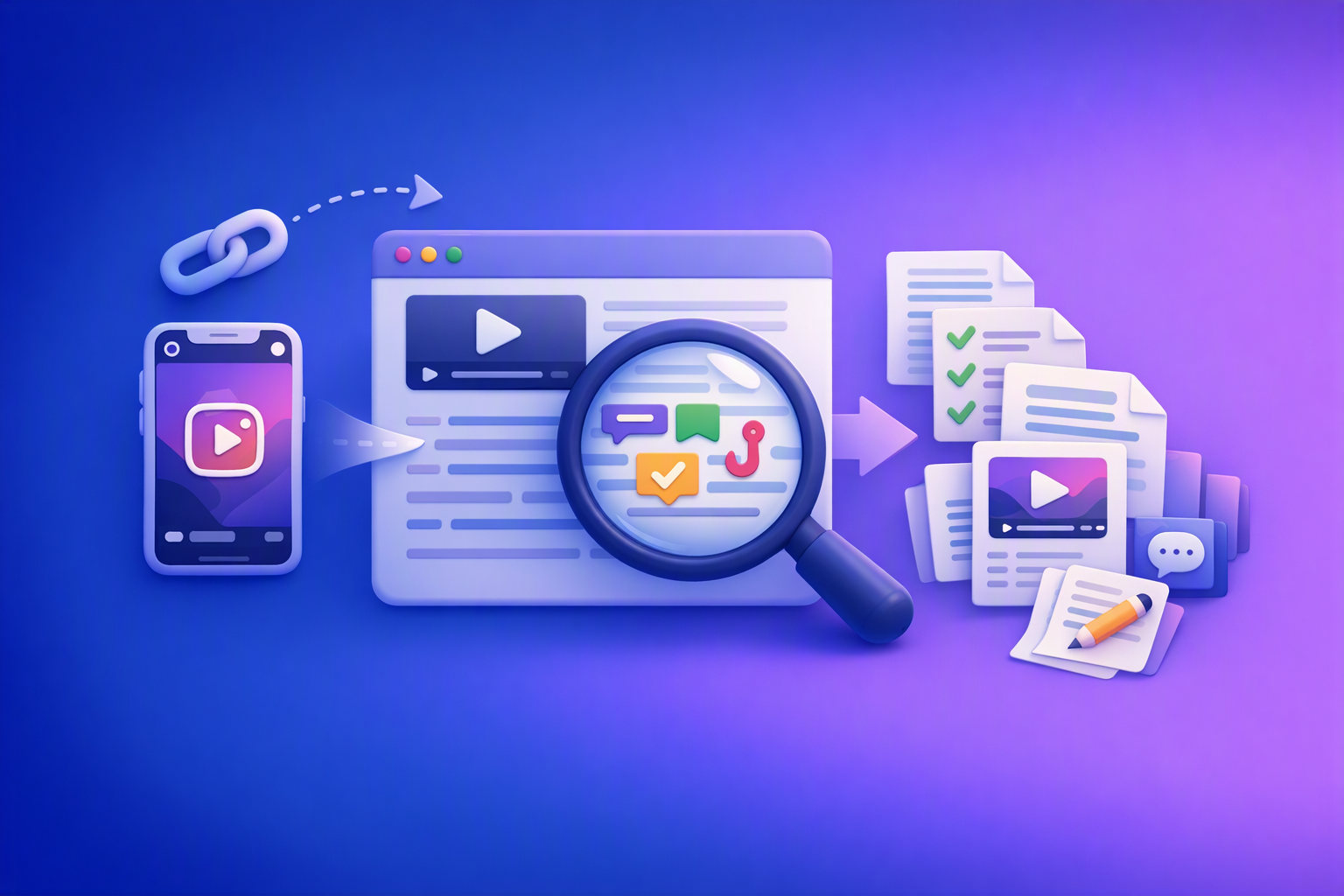
A 2026 reel analyser should turn Instagram Reel links into a searchable transcript library you can tag for hooks, CTAs, objections, and topic clusters—then export into repurposing-ready drafts without a download/upload loop.
Traducir video de Instagram (Reels) en 2026: workflow transcript-first para traducir, sacar hooks/CTAs y repurpose (con VideoToTextAI)
Video To Text AI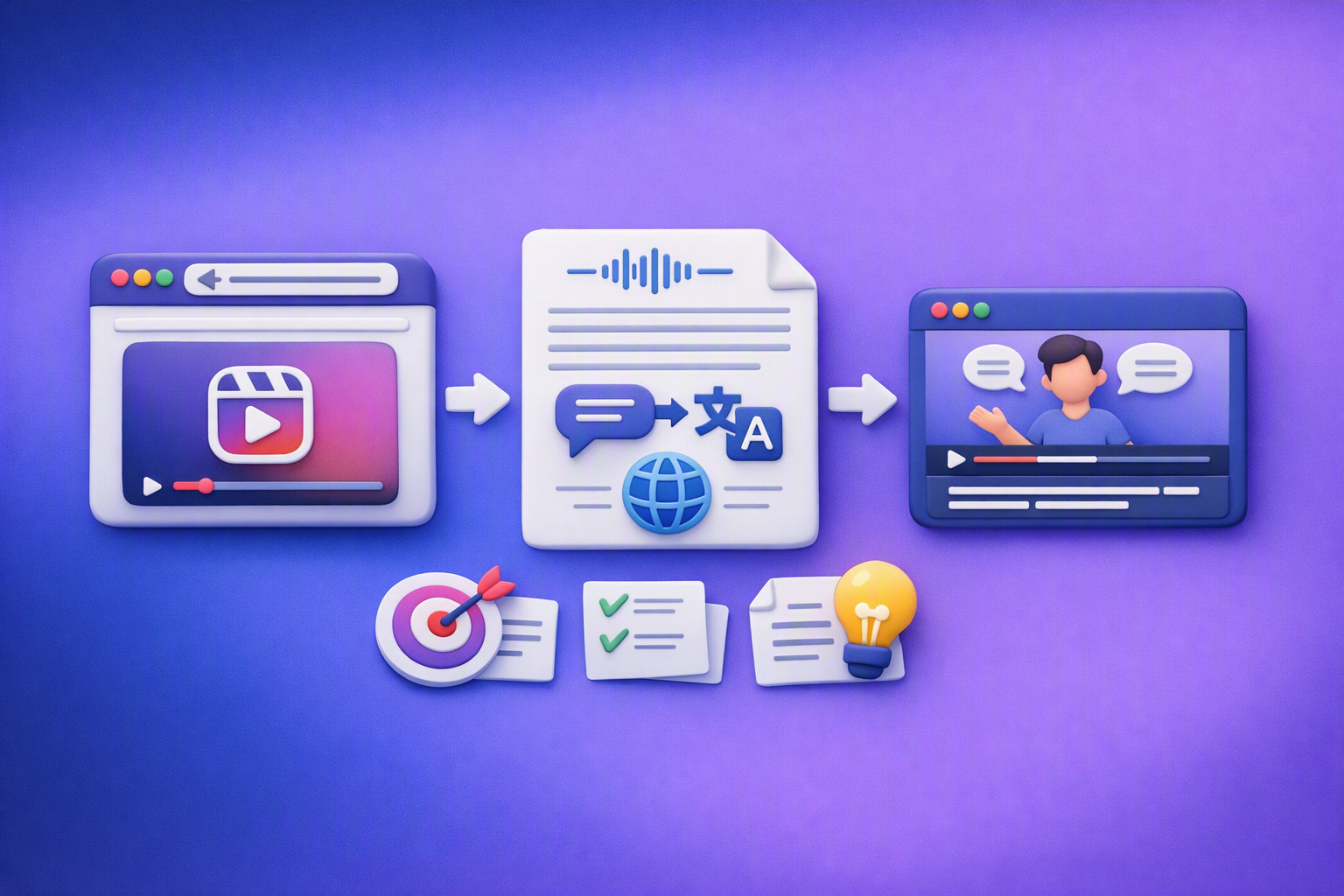
Aprende a traducir un Reel de Instagram con un flujo URL→transcripción→traducción→subtítulos, y a convertir esa traducción en un activo de investigación para hooks, CTAs, objeciones y clusters de contenido.
Reel Analyzer: Transcript‑First Instagram Reels Research (Hooks, CTAs, Objections) + Workflow Guide (VideoToTextAI)
Video To Text AI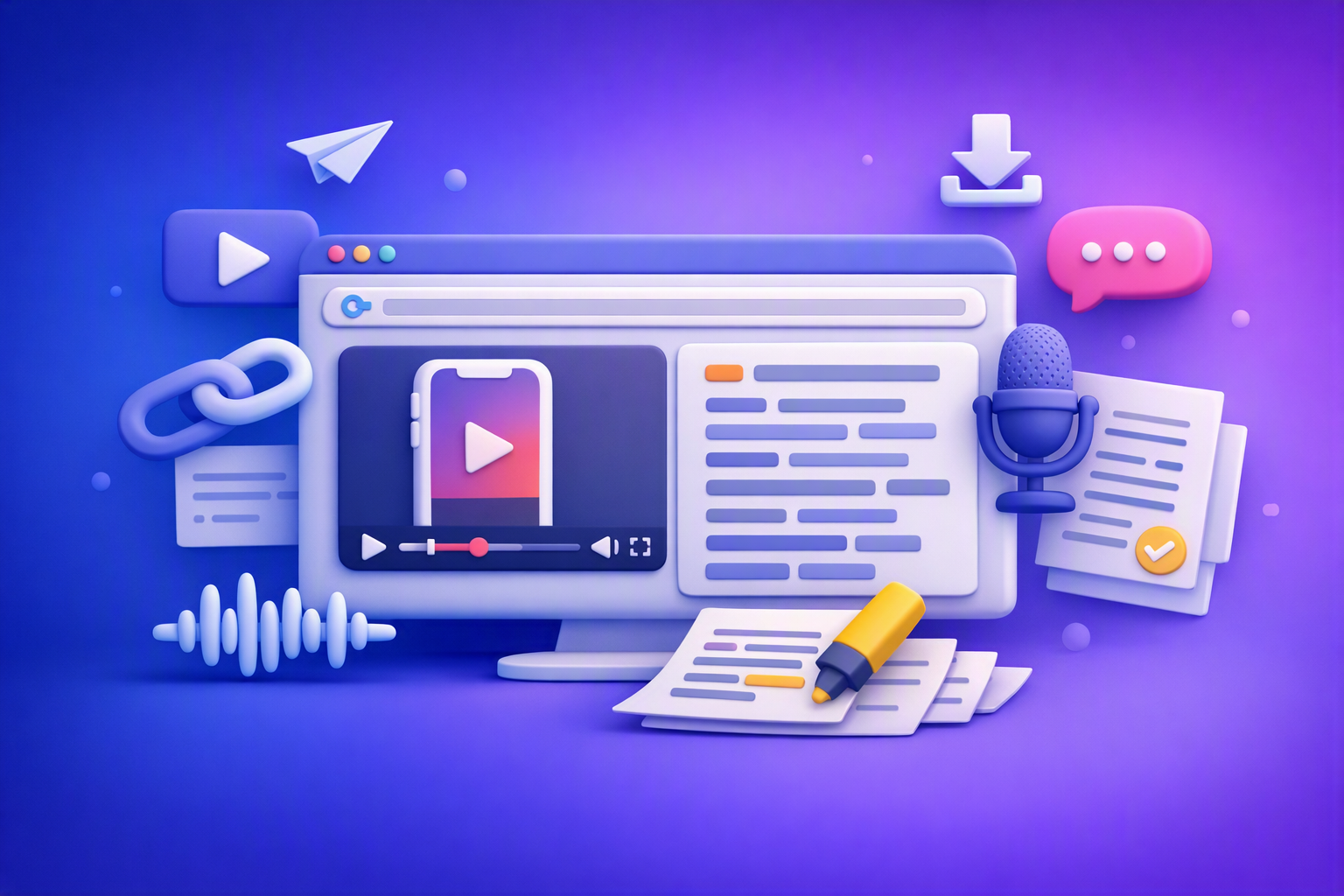
A reel analyzer should turn any public Instagram Reel link into a searchable transcript library you can mine for hooks, CTAs, objections, and topic clusters—then repurpose into original drafts with a repeatable SOP.