
Upload Video to ChatGPT (2026): What Actually Works, Why Uploads Fail, and the Production-Safe Link → Transcript Workflow
 Video To Text AI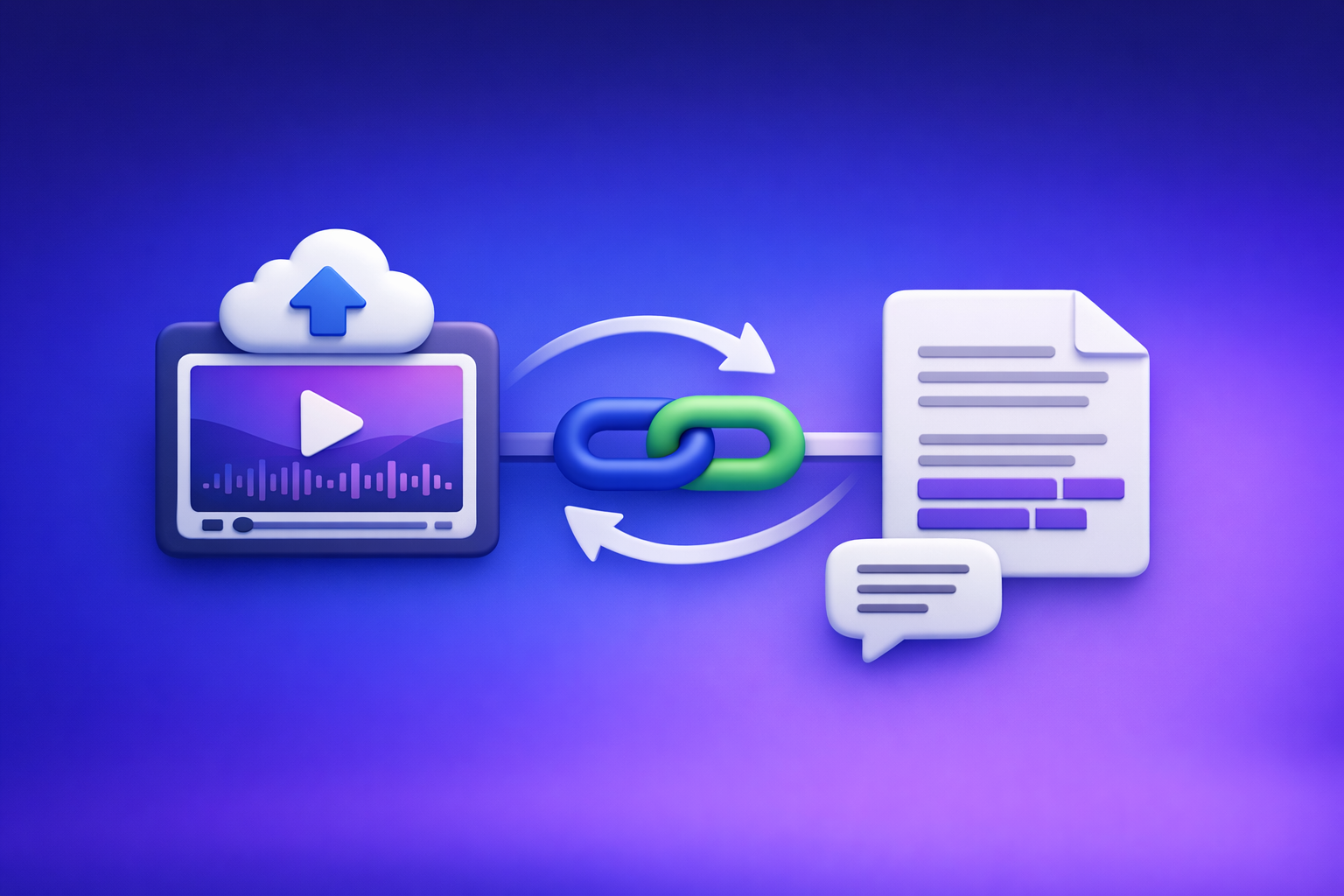
Uploading video to ChatGPT works best when you want a quick answer, not when you need export-ready transcripts/captions. If you need TXT/SRT/VTT you can QA and publish, skip video uploads and use a link → transcript → ChatGPT-on-text workflow.
Upload Video to ChatGPT (2026): What Actually Works, Why Uploads Fail, and the Production-Safe Link → Transcript Workflow
Why people search “upload video” + ChatGPT (and what they really want)
Most people don’t actually want “video upload.” They want usable text outputs they can ship.
The 3 real jobs-to-be-done
- Get a summary of a video fast (what happened, key points, takeaways)
- Extract an export-ready transcript/captions (TXT/SRT/VTT for editing and publishing)
- Repurpose video into posts, blogs, and scripts (content marketing pipeline)
If you’re trying to do any of the above repeatedly, downloading video files is an outdated workflow. Link-based extraction is the future of creator productivity because it removes the download → convert → upload loop.
The core mismatch: “video understanding” vs “deliverable artifacts”
ChatGPT can be helpful at “understanding” content, but production work requires artifacts:
- A transcript you can edit, search, and version
- Captions you can export (SRT/VTT) and sync
- A workflow that’s repeatable for teams
“It answered my question” ≠ “I can ship this transcript/captions.”
Can you upload a video to ChatGPT in 2026? (Reality check)
Yes, sometimes—but “upload video” can mean different things, and those differences explain most failures.
What “upload video” can mean inside ChatGPT
- File attachment upload (paperclip): you attach a local file (sometimes supported, sometimes blocked).
- Pasting a link (YouTube/social): often treated as a reference, not guaranteed full ingestion.
- Frame-based analysis vs full audio transcription expectations: analyzing frames is not the same as generating a clean transcript with consistent timecodes.
If your goal is captions (SRT/VTT), assume you’ll hit limitations unless you use an artifact-first transcription tool.
When it works well (low-stakes use cases)
- Short clips
- Quick Q&A (“What does this screen show?”)
- Rough summaries and topic extraction
- Basic action items from a short recording
When it fails (production use cases)
- Long videos and podcasts
- Multiple speakers, crosstalk, or noisy audio
- Requirements like SRT/VTT export, consistent timecodes, or speaker labels
- Repeatability (same input → same deliverables) for a team SOP
Step-by-step: How to upload a video to ChatGPT (and reduce failures)
If you still want to try native upload, do it like a technician—not like a gambler.
Step 1 — Confirm you actually have upload capability
Check the ChatGPT UI for:
- Attachment/paperclip icon
- Ability to select files from device storage
Common reasons uploads aren’t available:
- Workspace/admin policy disables attachments
- Account tier or feature rollout differences
- Browser/app version limitations
If you see “attachments disabled,” also review: “Attachments Disabled” in ChatGPT Image Upload: Causes, Fixes, and a Production-Safe Link → Transcript Workflow (VideoToTextAI).
Step 2 — Prepare the file to avoid preventable errors
Do quick sanity checks before you upload:
- Container: MP4 or MOV
- Video codec: H.264
- Audio codec: AAC
Then reduce failure risk:
- Trim to the smallest segment that answers your question
- Compress or split long videos into parts
- Rename the file (avoid special characters, emojis, and very long names)
Step 3 — Upload + prompt for the right output (what to ask for)
Ask for outputs ChatGPT can reliably produce from imperfect inputs.
Prompts for summaries and notes
- “Summarize this video in 10 bullets. Include key claims and supporting evidence.”
- “List action items with owner and due date fields (use ‘TBD’ if unknown).”
- “Extract key quotes (verbatim if possible) and label them as high/medium confidence.”
Prompts to force structure
- “Return a table with columns:
topic | what was said | why it matters | follow-up.” - “Return JSON:
{title, key_points[], risks[], next_steps[]}.”
Step 4 — Validate outputs (don’t trust first pass)
For anything you’ll publish:
- Spot-check 3–5 quotes against the audio
- Ask for uncertainty flags:
- “Mark any sections you’re not confident about and explain why.”
- Ask what might be missing:
- “What did you likely miss due to audio quality, speed, or overlap?”
Step 5 — Export limitations to expect
Even when upload “works,” expect these issues:
- No clean SRT/VTT (or inconsistent formatting)
- Speaker labels drift (Speaker 1/2 swaps)
- Timecodes are inconsistent (or missing)
- Hard to reproduce the same output across runs
If you need deliverables, move to an artifact-first workflow like: Give Me the Text: How to Extract Text From Any Video Link (Transcripts, Captions, and Repurposing) with VideoToTextAI.
Why ChatGPT video uploads fail (and how to troubleshoot fast)
Most “upload video” problems are not mysterious. They’re predictable failure modes.
Symptom → cause → fix (implementation-first)
| Symptom | Likely cause | Fast fix |
|---|---|---|
| Upload failed / stuck at 0% | Network issues, browser extensions, cache | Try incognito, disable extensions, switch browser/network |
| Unsupported format | Codec mismatch (not just “MP4”) | Re-encode to MP4 (H.264 video + AAC audio) |
| File too large | Size limits or memory constraints | Trim/compress/split; if recurring, use link-based workflow |
| “403 / access denied” on links | Permissions/geo/auth required | Use a public link, or download and convert via a transcript tool |
| Attachments disabled | Workspace policy | Stop debugging; use link → transcript workflow outside ChatGPT |
2-minute triage checklist
- Confirm the upload icon exists
- Test with a 10–30s MP4
- Switch browser + incognito
- Re-encode to MP4 (H.264/AAC)
- If still failing: stop debugging and move to an artifact-first workflow
For deeper context, see:
- ChatGPT “Upload Video” Feature (2026): What Works, Why Uploads Fail, and the Production-Safe Link → Transcript Workflow
- Upload Video in ChatGPT (2026): What Works, Why It Fails, and the Production-Safe Link → Transcript Workflow
The production-safe alternative: Link/MP4 → transcript/captions → ChatGPT-on-text
If you want publishable outputs, treat video as a source file and text as the product.
Why artifact-first beats “upload video” for real deliverables
Artifact-first means you generate:
- Deterministic exports (TXT/SRT/VTT) you can QA
- Assets reusable across tools, editors, and teams
- Faster iteration: edit text, not video
- A clean input for ChatGPT to summarize, structure, and repurpose
This is why downloading video files is an outdated workflow for most creators and marketers. The future is paste a link, extract artifacts, then automate repurposing.
Workflow overview (one screen, repeatable)
- Start with a video link (or MP4)
- Generate transcript (TXT) + captions (SRT/VTT)
- QA + light cleanup (names, jargon, punctuation)
- Send text to ChatGPT for summaries/chapters/repurposing
- Publish/export to your CMS/social pipeline
If you specifically need MP4 conversions, keep these handy:
Step-by-step: VideoToTextAI workflow (link-based, export-ready)
VideoToTextAI is built for AI link-based video-to-text workflows so you can produce transcripts, subtitles, captions, and repurposed content without the download/upload churn.
Step 1 — Choose input type (link vs MP4)
- Use a link when the source is YouTube/IG/TikTok and accessible
- Use MP4 when you own the file or link access is restricted
If your end goal is a blog post, you’ll also want: YouTube to Blog.
Step 2 — Generate the right artifacts (pick outputs intentionally)
Choose outputs based on what you’re shipping:
- Transcript (TXT): editing, search, internal docs, SEO drafts
- Captions (SRT/VTT): publishing, accessibility, social platforms, video players
Step 3 — QA checklist (what to verify before you ship)
Do a quick QA pass before you publish:
- Names and jargon: product names, acronyms, proper nouns
- Punctuation and paragraphing: readability for repurposing
- Caption constraints:
- Line length (avoid overly long lines)
- Reading speed (avoid dense blocks)
- Timecode alignment: spot-check 3–5 segments across the video
Step 4 — Paste transcript into ChatGPT (prompt pack)
Once you have clean text, ChatGPT becomes reliable because it’s operating on explicit artifacts.
Prompts for summaries and chapters
- “Create a 10-bullet executive summary from this transcript. Prioritize decisions, metrics, and outcomes.”
- “Generate chapters with timestamps using the transcript time markers. Use short, skimmable titles.”
Prompts for repurposing
- “Turn this transcript into a 1,200-word blog post with H2s, a short intro, and a conclusion with next steps.”
- “Extract 12 short clip ideas with
hook + quote + timestamp + why it will perform.”
Prompts for structured outputs
- “Return JSON:
{title, key_points[], quotes[], objections[], CTA}. Quotes must be exact strings from the transcript.”
Exactly one CTA: Use VideoToTextAI here: https://videototextai.com
Checklist: Standard operating procedure (SOP) for teams
This is the repeatable, production-safe SOP that prevents “random upload luck” from becoming your process.
Pre-flight (before processing)
- Confirm the link is accessible (public/permissioned)
- Confirm language(s) and expected deliverables: TXT/SRT/VTT
- Define speaker labeling requirement: yes/no
- Define where artifacts will live (shared drive/project folder)
Processing
- Generate TXT + SRT/VTT
- Store artifacts with a naming convention:
project_topic_YYYY-MM-DD_source_language.ext- Example:
acme_webinar_2026-04-20_youtube_en.srt
QA + publish
- Spot-check transcript accuracy + timecodes
- Run repurposing prompts in ChatGPT using the transcript
- Publish captions/subtitles + attach transcript to the project record
VideoToTextAI vs Competitors
Below is a fair, workflow-focused comparison using only competitors present in the research context (VOMO AI, Canva Video to Text, Reduct Video, and PCMag as a buyer-guide benchmark).
| Criteria | VideoToTextAI | VOMO AI (vomo.ai) | Canva Video to Text (canva.com) | Reduct Video (reduct.video) |
|---|---|---|---|---|
| URL-first workflow (paste link) | Yes (core workflow) | Mentions YouTube integration/link workflow in their guide | No strong public signal for paste-a-link workflow (upload-centric) | No strong public signal for paste-a-link workflow |
| Export readiness (TXT/SRT/VTT) | Designed for transcript + captions exports (artifact-first) | Strong on transcription; export readiness varies by workflow described | Strong on captions/transcripts inside Canva; export details vary by use | Strong on transcripts and collaboration; subtitle export not strongly signaled |
| Repurposing readiness for ChatGPT | Clean artifacts → easy to paste and prompt | Positions “video analysis” and structured outputs | More editing/design oriented; repurposing not a core positioning | Strong for research workflows; repurposing not a core positioning |
| Operational repeatability (team SOP) | Artifact-first outputs support SOPs and handoffs | Good for individual workflows; team repeatability depends on usage | Good for teams already in Canva | Strong collaboration and searchable archive positioning |
| Failure modes | Avoids upload loops by default (link-based) | Still subject to platform limits and long-video issues per guide | Upload-heavy workflows can slow teams | Not link-first; may require more ingest/setup steps |
Why VideoToTextAI wins (when you need deliverables):
- Workflow speed: link-first means fewer steps than download → convert → upload loops.
- Exports: artifact-first outputs (TXT/SRT/VTT) are easier to QA and publish than “best-effort” video uploads.
- Repeatability: teams can standardize naming, QA, and handoffs around stable text artifacts.
Where others may be better (narrower jobs):
- Canva can be a better fit if your primary job is design + video editing in the same tool.
- Reduct can be a better fit for collaborative research and building a searchable video archive.
- VOMO AI may be a good fit if you want an “analyze in one place” experience and your videos are within what their workflow handles reliably.
Competitor Gap
What top-ranking pages commonly miss—and what you should implement immediately:
- A 2-minute triage flow to stop wasting time on upload debugging
- A production workflow that outputs TXT + SRT + VTT (not just “summaries”)
- A QA checklist for captions (line length, reading speed, timecode spot-checks)
- Copy/paste prompt pack for turning transcripts into publishable assets
- A team SOP with naming conventions and handoff steps
FAQ
Can I upload a video on ChatGPT?
Sometimes. If your UI includes attachments and your workspace allows it, you can upload a video file, but results vary and exports are not production-safe.
Can I upload a video to ChatGPT to analyze?
Yes for quick analysis (summaries, Q&A, rough notes). For reliable transcripts/captions, use a transcript tool first and then analyze the text.
Why won’t ChatGPT let me upload videos?
Most often: attachments disabled by policy, file too large, unsupported codec, or browser/network issues. Use the triage checklist above, then switch to a link → transcript workflow if it persists.
Can ChatGPT transcribe video to text?
Not as a consistent, export-ready transcription pipeline. For deliverables like TXT/SRT/VTT, generate artifacts first, then use ChatGPT for summarization and repurposing.
What is the best tool to transcribe video to text?
The best tool is the one that produces export-ready artifacts (TXT/SRT/VTT) with a repeatable workflow. For creator productivity, link-based extraction beats download/upload loops because it’s faster to run, easier to QA, and easier to hand off across a team.
Related posts
Reel Analyser (Instagram Reels): Transcript‑First Competitor Research, Hook/CTA Extraction, and Repurposing Workflow (VideoToTextAI)
Video To Text AI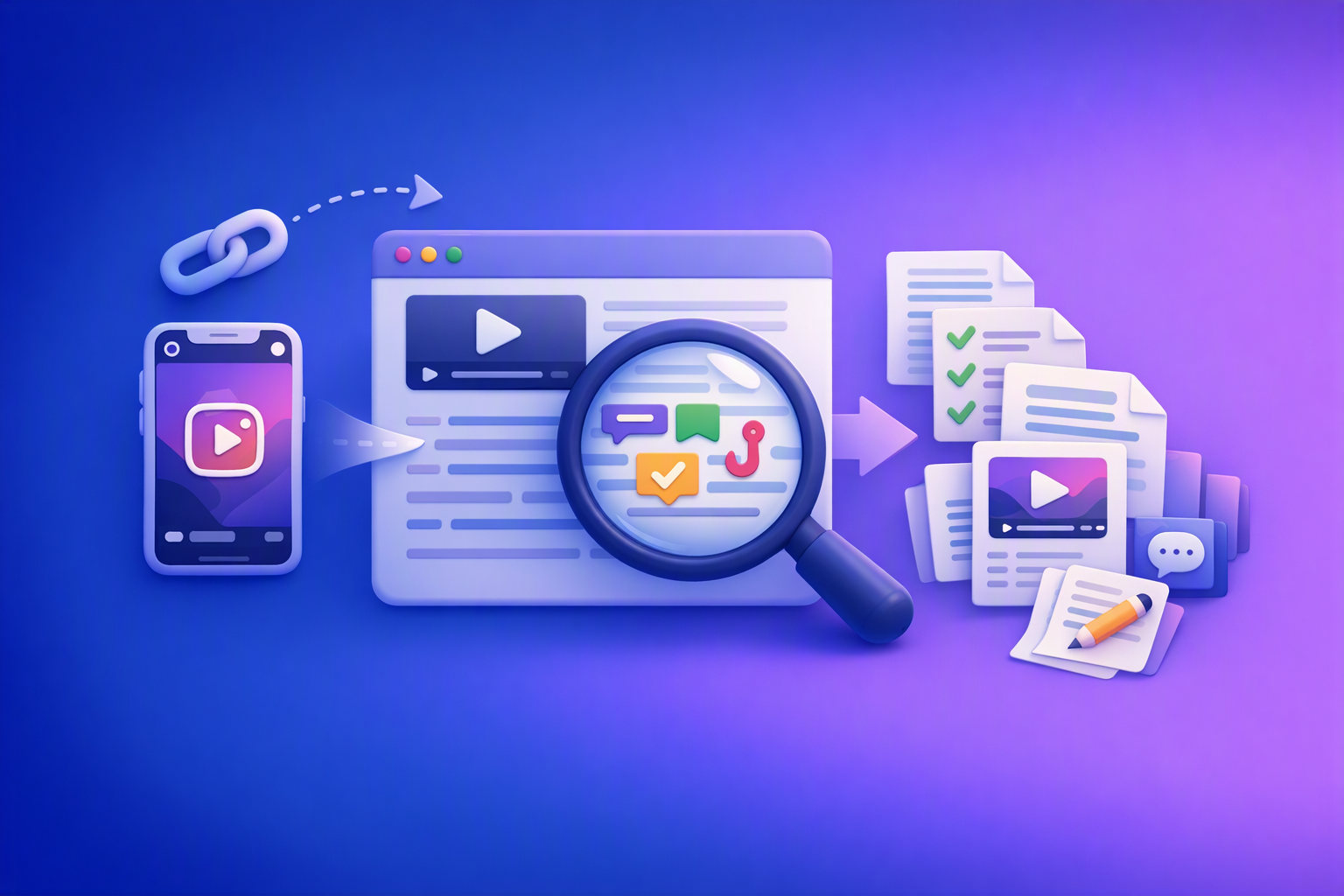
A 2026 reel analyser should turn Instagram Reel links into a searchable transcript library you can tag for hooks, CTAs, objections, and topic clusters—then export into repurposing-ready drafts without a download/upload loop.
Traducir video de Instagram (Reels) en 2026: workflow transcript-first para traducir, sacar hooks/CTAs y repurpose (con VideoToTextAI)
Video To Text AI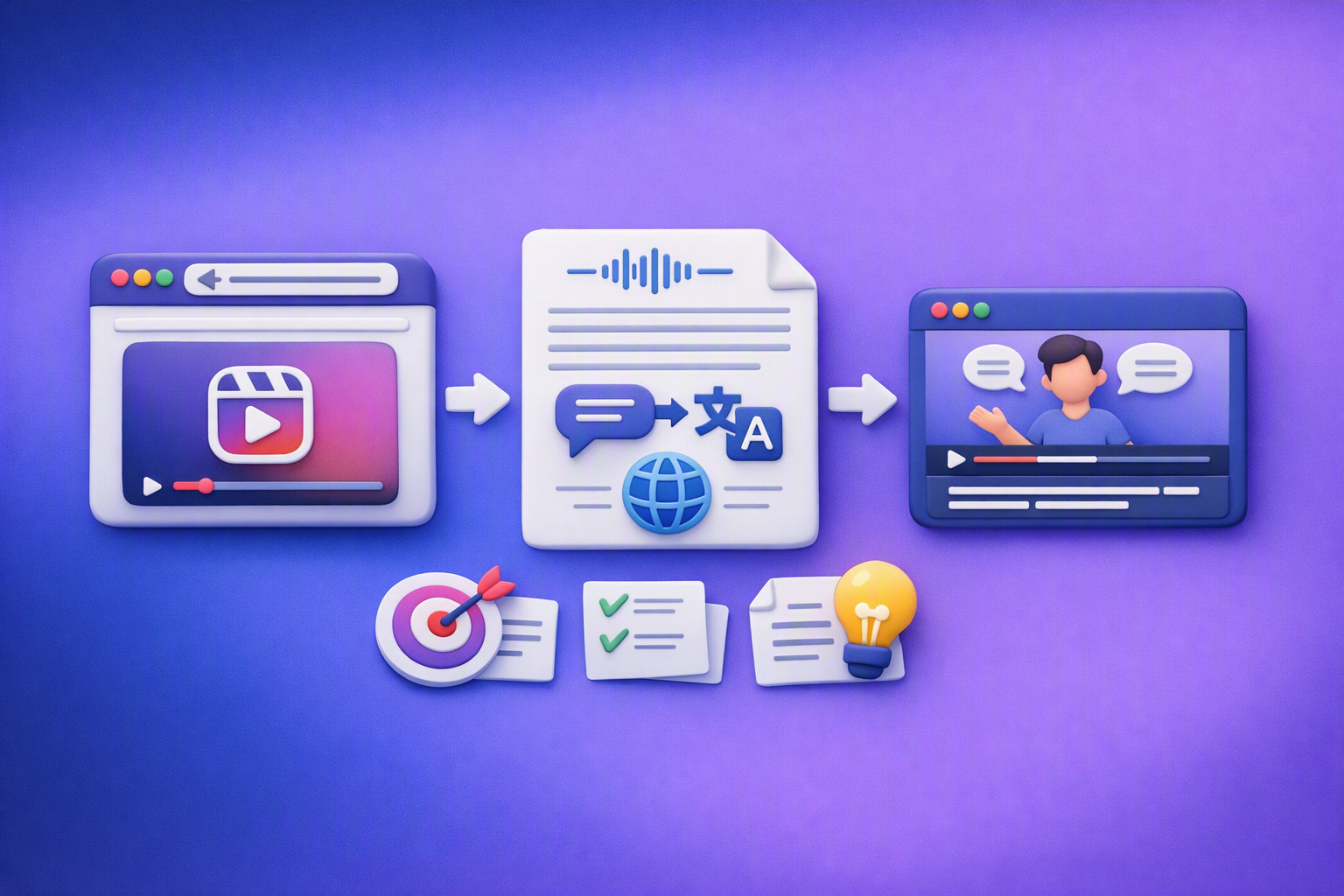
Aprende a traducir un Reel de Instagram con un flujo URL→transcripción→traducción→subtítulos, y a convertir esa traducción en un activo de investigación para hooks, CTAs, objeciones y clusters de contenido.
Reel Analyzer: Transcript‑First Instagram Reels Research (Hooks, CTAs, Objections) + Workflow Guide (VideoToTextAI)
Video To Text AI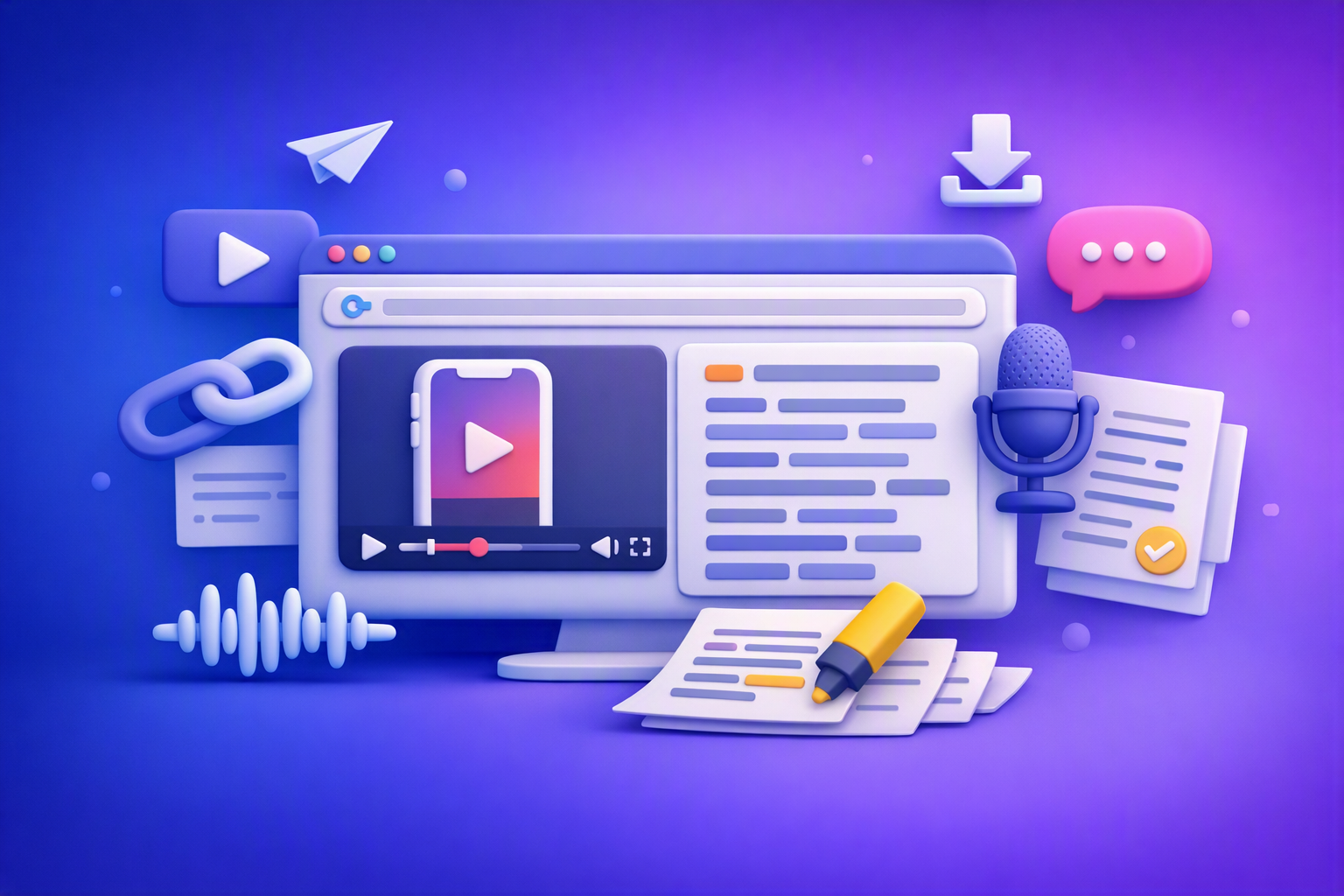
A reel analyzer should turn any public Instagram Reel link into a searchable transcript library you can mine for hooks, CTAs, objections, and topic clusters—then repurpose into original drafts with a repeatable SOP.