
ChatGPT “Upload Video” Feature (2026): What Works, Why Uploads Fail, and the Production-Safe Link → Transcript Workflow
 Video To Text AI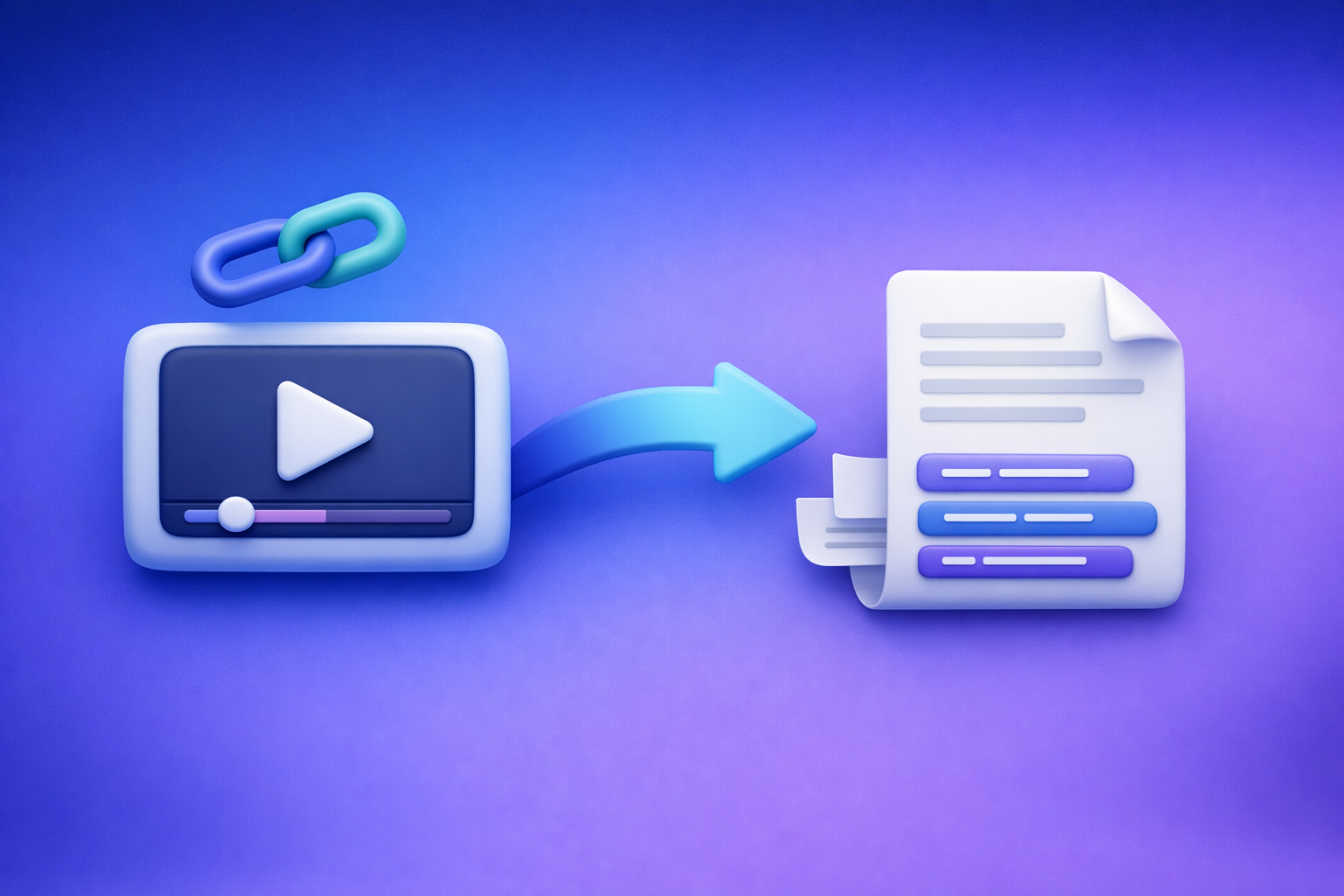
ChatGPT “Upload Video” Feature (2026): What Works, Why Uploads Fail, and the Production-Safe Link → Transcript Workflow
If you need export-ready transcripts (TXT) and captions (SRT/VTT), don’t rely on ChatGPT video uploads—generate artifacts first, then use ChatGPT on the text. If you only need quick understanding of a short clip, ChatGPT uploads can work, but expect limits and failures.
Why people search “ChatGPT upload video feature” (and what they actually need)
Most searches for the "chatgpt" "upload video" feature are really searches for reliable outputs. The “upload” part is less important than getting usable deliverables.
The 4 real jobs-to-be-done behind “upload video”
People usually want one of these:
- Understand what happens in a clip (quick summary, Q&A).
- Extract speech (a transcript they can copy into docs).
- Publish accessibly (captions/subtitles with timecodes).
- Repurpose (blog posts, social threads, emails, FAQs).
When ChatGPT is enough (analysis-only) vs. when you need export-ready artifacts
Use ChatGPT video upload only when:
- The clip is short.
- You can tolerate rough outputs.
- You don’t need strict timecodes or file exports.
You need an artifact-first workflow when:
- You’re publishing captions (YouTube/Shorts/Reels).
- You’re editing in Premiere/Final Cut/CapCut.
- You need repeatable QA for teams.
- You’re building SEO pages from video content.
The deliverables that matter: TXT transcript, SRT/VTT captions, chapters, summaries, repurposed posts
Production deliverables are files and structures, not chat messages:
- TXT transcript (clean, searchable, editable)
- SRT + VTT captions (timecoded, platform-ready)
- Chapters (timestamped sections)
- Summaries + takeaways (grounded in transcript)
- Repurposed content (blog, FAQ, LinkedIn/X threads)
Quick answer: Can ChatGPT upload and analyze videos in 2026?
Yes, sometimes—but it’s not a production-safe ingestion method. Treat it as a convenience feature, not a workflow foundation.
What “upload video” can mean (file upload vs. link vs. screen recording)
“Upload video” typically means one of:
- File upload: attach MP4/MOV directly in ChatGPT.
- Link: paste YouTube/Drive/Dropbox and ask it to analyze.
- Screen recording: upload a recording or share frames.
These behave differently, and availability varies by plan/client.
What ChatGPT can do reliably with video content
When the feature is available and the clip is short, ChatGPT can often:
- Provide rough summaries and key points
- Answer basic questions about visible content (when frames are accessible)
- Generate rough notes for internal use
What ChatGPT cannot guarantee (determinism, timecodes, exports, long-form stability)
ChatGPT cannot reliably guarantee:
- Deterministic transcription (same input → same output every time)
- Accurate timecodes suitable for captions
- Stable SRT/VTT exports
- Long-form processing without timeouts, truncation, or drift
- Consistent access to private links or expiring URLs
What works vs. what fails (real constraints you’ll hit)
Works best for
Short clips, quick understanding, rough notes
Best-case scenarios:
- Under a few minutes
- Clear audio
- One speaker
- Simple vocabulary
Outputs are usually “good enough” for understanding, not publishing.
Visual Q&A on a few key frames (when available)
If the system can access frames, it can help with:
- “What’s on screen?”
- “Which button is clicked?”
- “What does this chart show?”
But this is not the same as reliable full-video comprehension.
Fails most often because of
Missing upload button (plan/client/model differences)
Common causes:
- Your plan doesn’t include file tools.
- You’re on a client version without attachments enabled.
- The selected model/toolset doesn’t support video/file analysis.
File size/length limits and timeouts
Even when uploads are supported, you’ll hit:
- Size caps
- Duration caps
- Processing timeouts
- Background task failures
“Video upload failed” / processing stuck
Typical triggers:
- Unstable connection
- Large files
- Unsupported codec/container
- Server-side processing queue issues
Link access issues (Drive/Dropbox permissions, private videos, expiring URLs)
If the link requires login, is region-locked, or expires quickly, ChatGPT often can’t fetch it.
Non-deterministic transcription/caption outputs (no stable SRT/VTT)
Even when you get a transcript-like response, it may be:
- Missing sections
- Re-ordered
- Inconsistent punctuation
- Not aligned to timecodes
- Not exportable as valid SRT/VTT
How to upload a video to ChatGPT (when you still want to try)
Use this when your goal is analysis-only and the clip is short.
Web app steps (local MP4/MOV)
- Open ChatGPT in the browser.
- Start a new chat and look for the attachment/paperclip icon.
- Attach your MP4/MOV.
- Prompt for a narrow task: “Summarize the clip in 8 bullets. If unsure, say so.”
If the attachment icon isn’t present, skip to troubleshooting.
iPhone/iOS steps (camera roll → ChatGPT)
- Open the ChatGPT app.
- Tap the attachment icon.
- Choose Photos and select the video.
- Ask for a constrained output (summary, action items, questions).
Android steps (gallery → ChatGPT)
- Open the ChatGPT app.
- Tap attachment.
- Select video from Gallery/Files.
- Ask for a specific deliverable (not “transcribe perfectly”).
Link-based attempt (YouTube/Drive/Dropbox) and what to check first
If you paste a link, validate access first.
Permissions checklist (public, anyone-with-link, signed URLs)
Before you paste the link:
- Open it in an incognito/private window.
- Confirm it plays without login.
- If Drive/Dropbox: set to “Anyone with the link can view.”
- Avoid expiring signed URLs unless they last long enough to process.
Why “ChatGPT can’t access my link” happens
Most failures come from:
- Login-required pages
- Geo restrictions
- Bot protections
- Tokenized URLs that expire
- Links that load a page, not the actual media stream
The production-safe workflow: Link/MP4 → transcript/captions → ChatGPT-on-text (VideoToTextAI)
If you care about shipping outputs, the safe workflow is: extract text first, then use ChatGPT for writing and structuring.
This is also where the industry is going: downloading video files is an outdated workflow. Link-based extraction is the future of creator productivity because it removes friction, reduces file handling, and standardizes outputs.
Why artifact-first beats “upload video” for teams
Deterministic outputs you can QA and ship
Teams need:
- Repeatable runs
- Files that pass editorial QA
- Stable formatting for downstream tools
Artifacts (TXT/SRT/VTT) are testable and reviewable.
Reusable assets for SEO, accessibility, localization, and repurposing
Once you have a transcript and captions, you can:
- Publish accessible content
- Translate/localize
- Build SEO pages and FAQs
- Create clips and social posts faster
What you generate first (before ChatGPT)
Clean transcript (TXT)
Use TXT when you want:
- Summaries
- Blog drafts
- Knowledge base articles
- Sales enablement notes
Timecoded captions (SRT + VTT)
Use SRT/VTT when you want:
- Upload-ready captions for platforms
- Editor-friendly subtitle files
- Consistent timing alignment
Optional: speaker labels, chapters, highlights
These reduce repurposing time and improve accuracy for technical content.
Step-by-step implementation (VideoToTextAI → ChatGPT)
This workflow is designed to be repeatable for creators and teams: link in → artifacts out → ChatGPT on text. Use VideoToTextAI for the extraction step, then use ChatGPT for the writing step. (One CTA is included below.)
Step 1 — Choose your input type (fast decision tree)
- YouTube/public link: best for speed and zero file handling.
- Instagram/TikTok/Reels link: best for short-form repurposing.
- Local MP4 upload: use only when you truly don’t have a link.
Brand POV: If you can paste a link, do it. Downloading, converting, and re-uploading video files is legacy workflow overhead.
Step 2 — Generate the right artifact in VideoToTextAI
Use VideoToTextAI to generate export-ready artifacts (TXT/SRT/VTT) from a link or MP4. Start here: https://videototextai.com.
Transcript-first (TXT) for summaries, blogs, and knowledge base
Choose TXT when your downstream tasks are:
- Summaries and meeting notes
- Blog posts and SEO pages
- Documentation and FAQs
Captions-first (SRT/VTT) for publishing and editing workflows
Choose SRT/VTT when your downstream tasks are:
- Upload captions to YouTube/Shorts/Reels
- Hand off subtitles to editors
- Maintain timing accuracy across revisions
Step 3 — QA pass (2–5 minutes) to prevent downstream errors
Do a fast human pass before you ask ChatGPT to write.
Fix names, acronyms, product terms
- Correct brand/product names
- Fix acronyms (API, SSO, SOC 2, etc.)
- Standardize technical terms
Normalize punctuation and paragraphing
- Break long blocks into paragraphs
- Add punctuation where needed
- Remove obvious filler if desired (optional)
Confirm timecodes align (for SRT/VTT)
Spot-check:
- First 30 seconds
- A middle section
- The ending
If timing is off, fix captions before publishing.
Step 4 — Run ChatGPT on the transcript (copy/paste prompt set)
Paste the transcript (or chunks) and force grounding.
Prompt: accurate summary + key takeaways (no hallucinations)
You are summarizing a transcript. Use only the provided text.
Output: (1) 5-bullet summary, (2) 8 key takeaways, (3) 5 “quotes” copied verbatim from the transcript with timestamps if present.
If a detail is missing, write “Not stated in transcript.”
Prompt: chapter timestamps (using transcript time markers if present)
Create chapter titles and timestamps only from timestamps present in the transcript.
Output a table: Timestamp | Chapter title | 1-sentence description.
Do not invent timestamps.
Prompt: blog post outline + SEO sections (from transcript only)
Build an SEO outline from this transcript. Do not add facts not in the transcript.
Include: H1, 6–10 H2s, suggested FAQ questions, and a list of internal links to add.
Prompt: social repurposing pack (LinkedIn/X threads + hooks)
Create a repurposing pack from this transcript only:
- 3 LinkedIn posts (150–250 words)
- 2 X threads (6–8 tweets each)
- 10 hooks (1 sentence each)
Keep claims grounded in the transcript.
Step 5 — Publish outputs (what to export and where to use it)
Blog/SEO page from transcript-derived draft
- Publish the article
- Add the transcript below (or behind a toggle) for accessibility + SEO
- Extract FAQs and add schema if applicable
Captions to YouTube/Shorts/Reels (SRT/VTT)
- Upload SRT where supported
- Use VTT for platforms/workflows that prefer it
- Keep a versioned naming convention
Internal documentation / customer education
- Turn transcript into SOPs
- Create onboarding docs
- Build a searchable knowledge base
Copy/paste implementation checklist (no skipped steps)
Inputs checklist (before you start)
- Video link works in an incognito window (or MP4 plays locally)
- Audio is clear; note speakers and jargon terms
- Target outputs selected: TXT, SRT, VTT, repurposed content
VideoToTextAI run checklist
- Paste link or upload MP4
- Generate transcript (TXT)
- Generate captions (SRT + VTT) if publishing
- Download/store artifacts with consistent naming (date_project_version)
ChatGPT-on-text checklist
- Paste transcript (or sections) + instruction: “Use only provided text”
- Request structured outputs (headings, bullets, tables)
- Validate against transcript (spot-check 5–10 claims)
Publishing checklist
- Add captions to video platform (SRT/VTT)
- Add transcript to blog for accessibility + SEO
- Repurpose into 3–5 distribution formats (post, thread, email, FAQ)
Troubleshooting: “Video upload failed” and other common blockers
If ChatGPT won’t show the upload button
- Switch clients (web vs. mobile) and re-check attachments.
- Confirm you’re using a model/toolset that supports file uploads.
- If you’re on a restricted workspace, ask an admin about file tool permissions.
If the upload fails mid-processing
- Re-encode to a standard MP4 (H.264 + AAC) if possible.
- Trim the clip to a shorter segment and retry.
- Use a stable connection; avoid VPN/proxy if it causes interruptions.
If ChatGPT can’t access your video link
- Test in incognito (no login).
- Change Drive/Dropbox to anyone-with-link.
- Replace expiring URLs with stable share links.
- Prefer public platform links when possible.
If you need a transcript but ChatGPT output is inaccurate
Stop trying to “transcribe via chat.”
- Switch to transcript-first.
- Generate TXT, then re-run ChatGPT on text only with grounding prompts.
If you need timecoded captions (SRT/VTT) for editors
ChatGPT is the wrong tool for caption exports because it can’t guarantee:
- Valid SRT/VTT formatting
- Stable timecode alignment
- Repeatable results across runs
Use artifact generation first, then use ChatGPT for writing tasks.
Security & privacy: should you upload videos to ChatGPT?
What not to upload (confidential, regulated, client data)
Avoid uploading:
- Client recordings under NDA
- Regulated data (health, finance, legal)
- Internal product roadmaps
- Anything with sensitive PII
Safer pattern: extract text first, share only the minimum needed
A safer workflow is:
- Extract transcript/captions
- Redact sensitive lines
- Share only the relevant excerpt with ChatGPT
Team workflow tip: store artifacts (TXT/SRT/VTT) in your own system of record
Keep TXT/SRT/VTT in:
- Your DAM
- Your project folder structure
- Your documentation system
This makes the workflow auditable and repeatable.
Competitor Gap
Most competitor posts say “try uploading” and stop there. This post adds what teams actually need to operationalize video-to-text in 2026:
- A deterministic, export-ready workflow (TXT/SRT/VTT) instead of “try uploading and hope”
- A QA step that prevents repurposing errors and brand mistakes
- A complete troubleshooting matrix for upload + link access failures
- Copy/paste prompt set that forces transcript-grounded outputs
- A production checklist that teams can turn into an SOP
Recommended VideoToTextAI tools (pick your workflow)
For link-based extraction
- YouTube → content repurposing:
/tools/youtube-to-blog - Instagram → text:
/tools/instagram-to-text - TikTok → transcript:
/tools/tiktok-to-transcript
For file-based workflows (MP4)
- MP4 → transcript:
/tools/mp4-to-transcript - MP4 → SRT:
/tools/mp4-to-srt - MP4 → VTT:
/tools/mp4-to-vtt - MP4 → summary:
/tools/mp4-to-summary
FAQ
Does ChatGPT allow video uploads?
Sometimes. Availability depends on your plan, the client you’re using, and whether file tools are enabled for your account/workspace.
Can ChatGPT watch videos you upload to it?
It can analyze some content in limited ways, but it does not reliably “watch” long videos end-to-end with stable, verifiable outputs.
Why can’t I upload videos to ChatGPT anymore?
Common reasons: feature rollouts changed, your plan/tools changed, your workspace disabled attachments, or you’re using a model/client that doesn’t support video/file uploads.
Can I upload a video to ChatGPT to analyze?
Yes for short clips and narrow questions. For production work, extract transcript/captions first and analyze the text.
Can I upload a video to ChatGPT and get a transcript?
You might get a rough transcript, but it’s not deterministic and usually not export-ready. For accurate, shippable TXT/SRT/VTT, generate artifacts first, then use ChatGPT on the transcript.
Internal Link Plan
- Upload Video to ChatGPT in 2026: What Actually Works (and the Production-Safe Link → Transcript Workflow)
- ChatGPT “Upload Video” Feature: What Works in 2026, Why Uploads Fail, and the Production-Safe Link → Transcript Workflow (VideoToTextAI)
- Upload Video in ChatGPT (2026): What Works, Why It Fails, and the Production-Safe Link → Transcript Workflow
- ChatGPT “Upload Video” Feature: What Actually Works in 2026 (and the Production-Safe Link → Transcript Workflow)
- Give Me the Text: How to Extract Text From Any Video Link (Transcripts, Captions, and Repurposing) with VideoToTextAI
Related posts
Reel Analyser (Instagram Reels): Transcript‑First Competitor Research, Hook/CTA Extraction, and Repurposing Workflow (VideoToTextAI)
Video To Text AI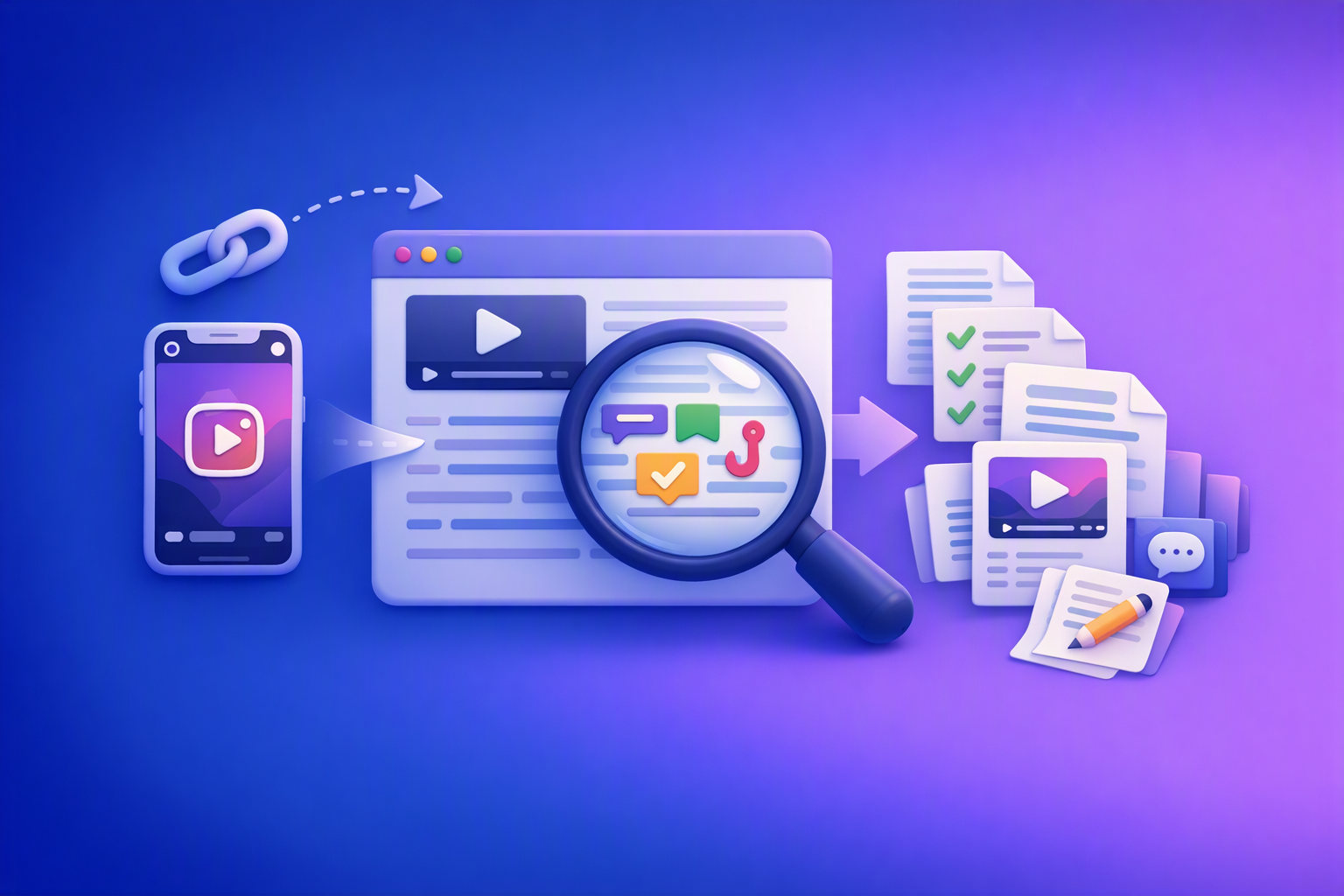
A 2026 reel analyser should turn Instagram Reel links into a searchable transcript library you can tag for hooks, CTAs, objections, and topic clusters—then export into repurposing-ready drafts without a download/upload loop.
Traducir video de Instagram (Reels) en 2026: workflow transcript-first para traducir, sacar hooks/CTAs y repurpose (con VideoToTextAI)
Video To Text AI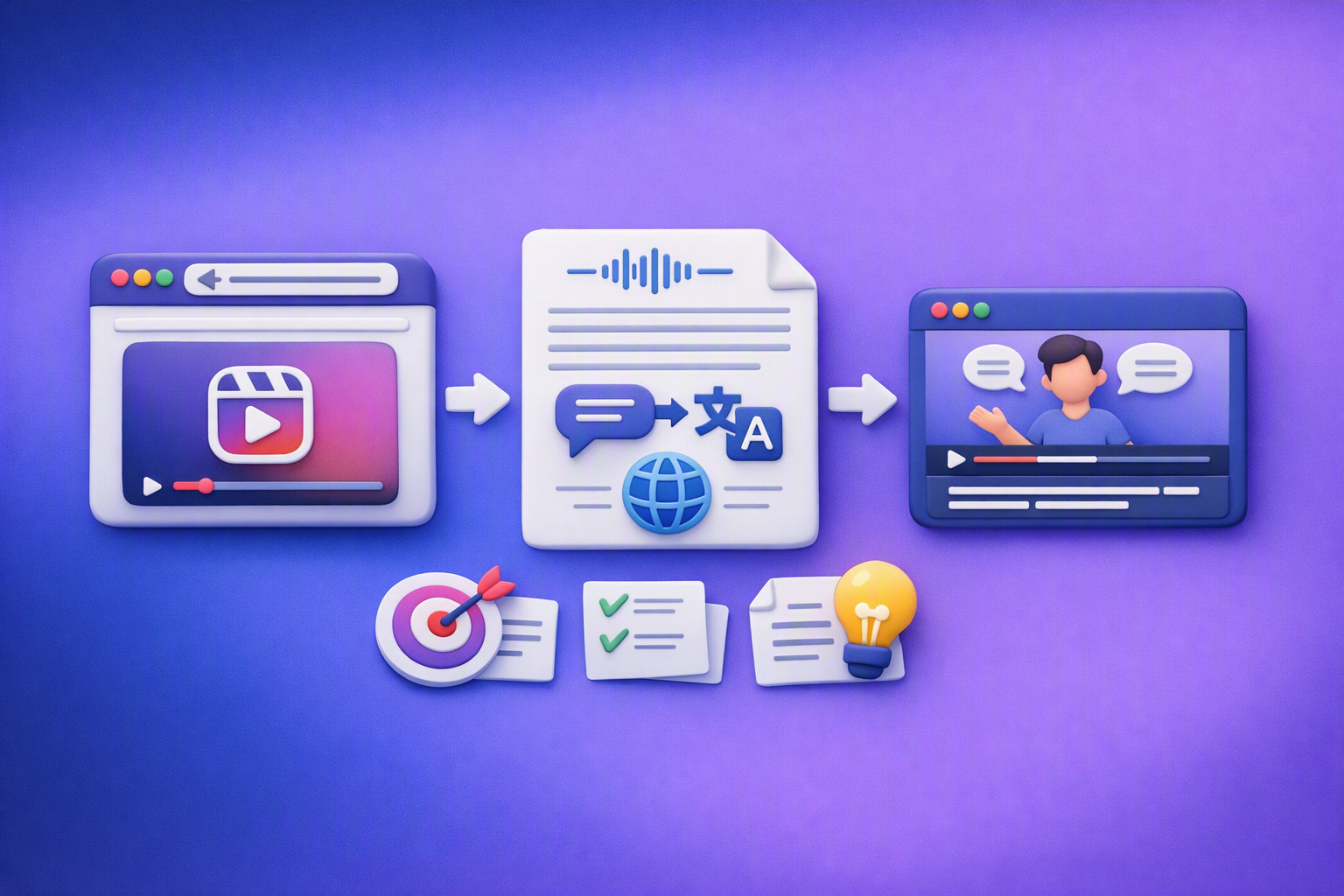
Aprende a traducir un Reel de Instagram con un flujo URL→transcripción→traducción→subtítulos, y a convertir esa traducción en un activo de investigación para hooks, CTAs, objeciones y clusters de contenido.
Reel Analyzer: Transcript‑First Instagram Reels Research (Hooks, CTAs, Objections) + Workflow Guide (VideoToTextAI)
Video To Text AI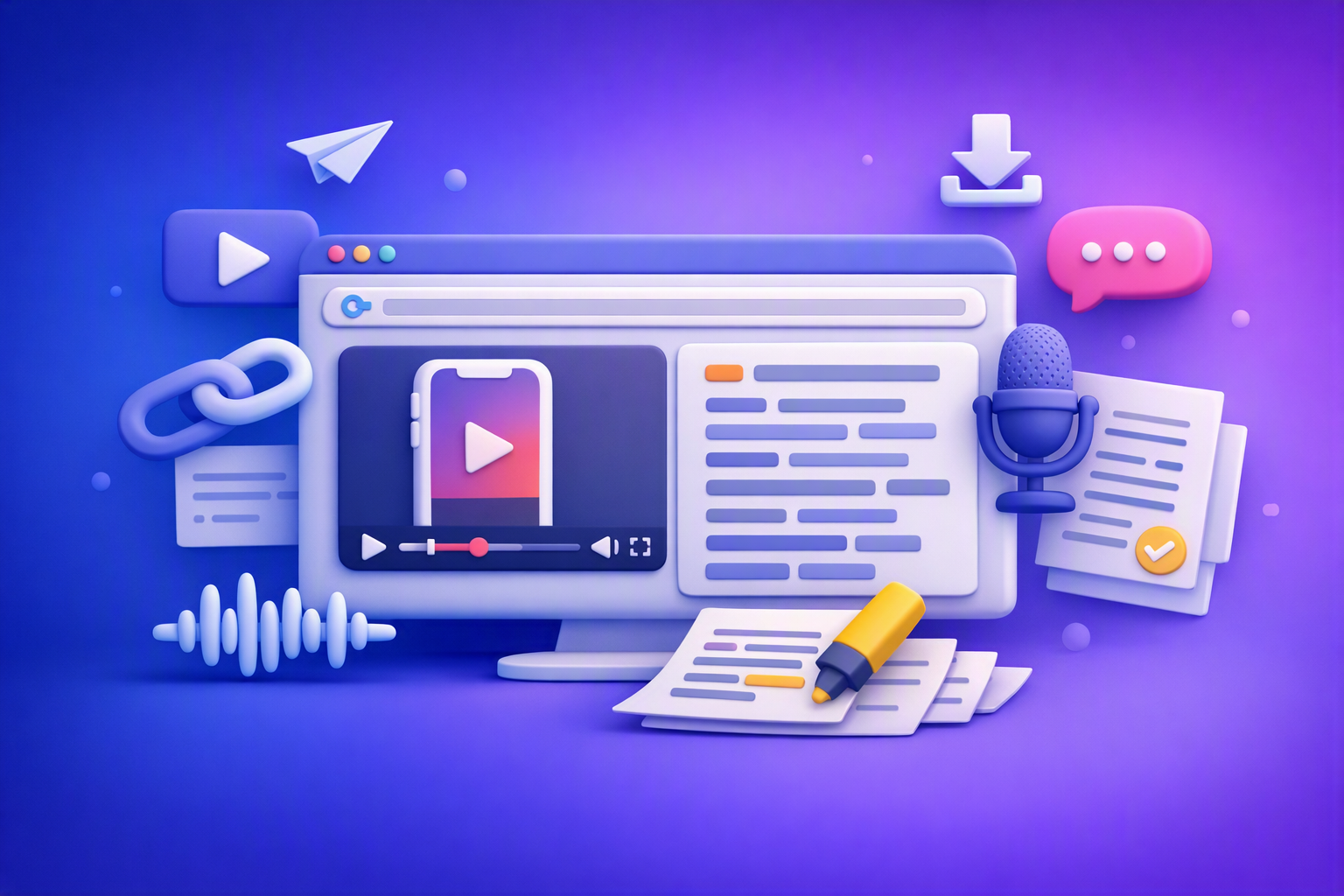
A reel analyzer should turn any public Instagram Reel link into a searchable transcript library you can mine for hooks, CTAs, objections, and topic clusters—then repurpose into original drafts with a repeatable SOP.