
ChatGPT “Upload Video” Feature in 2026: What Works, What Fails, and the Reliable Link → Transcript Workflow (VideoToTextAI)
 Video To Text AI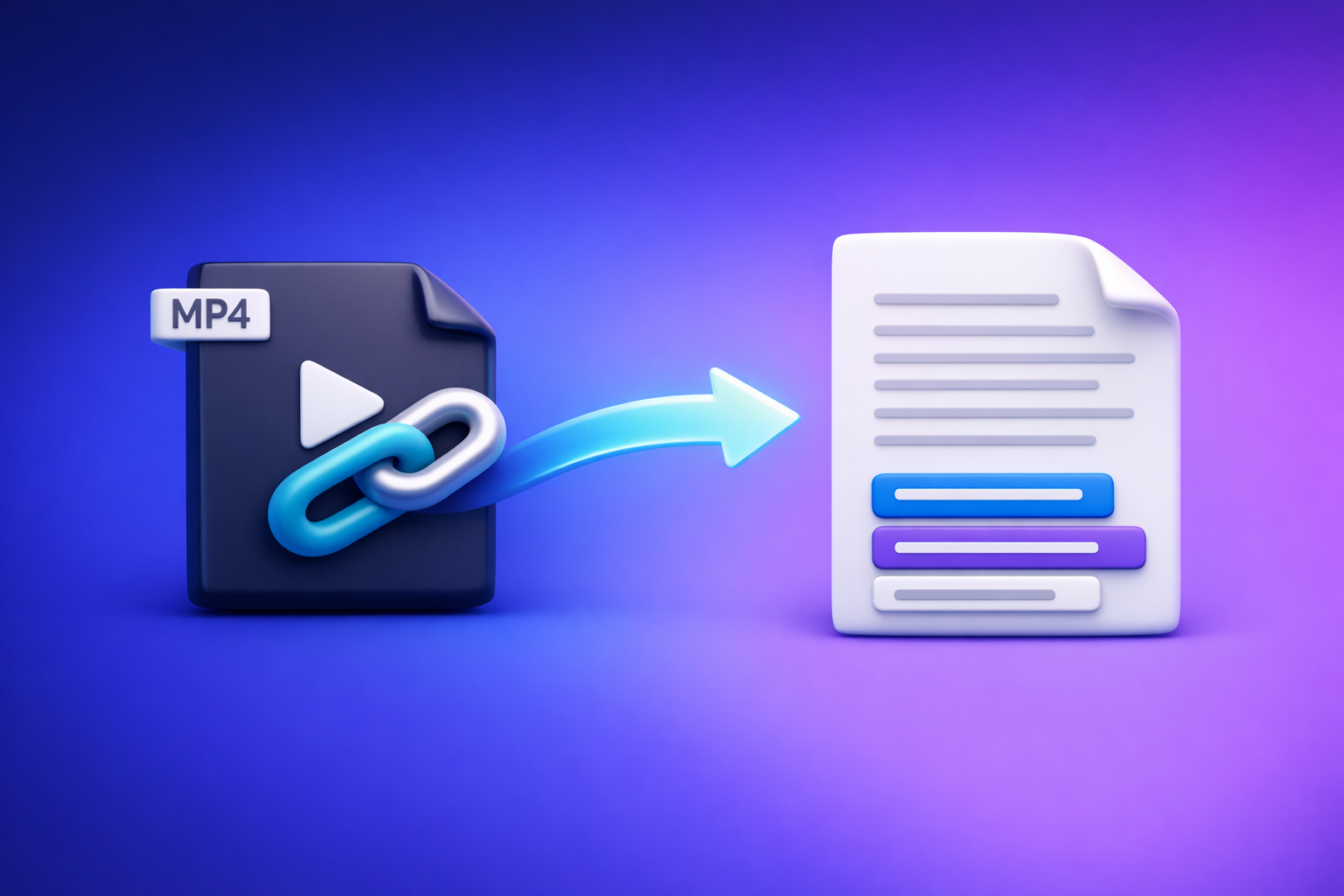
ChatGPT “Upload Video” Feature in 2026: What Works, What Fails, and the Reliable Link → Transcript Workflow (VideoToTextAI)
If your real goal is transcripts, captions, or repurposed content, don’t bet your workflow on ChatGPT video upload. The reliable path is video link/MP4 → transcript + SRT/VTT → ChatGPT on text.
Quick Answer: Can ChatGPT Upload Videos?
Yes, some ChatGPT clients and accounts can accept video files, but it’s not consistent—and it’s not designed as a deterministic transcription/caption pipeline.
What “upload video” means inside ChatGPT (file vs. link vs. screen recording)
People use “upload video” to mean three different things:
- File upload: You attach an MP4/MOV file directly in the chat UI.
- Link sharing: You paste a YouTube/TikTok/Drive link and expect ChatGPT to “watch it.”
- Screen recording: You record your screen (or a clip) and upload that recording.
In practice, file upload is the only scenario that resembles “uploading.” Links often fail due to permissions, paywalls, or the model not being able to fetch the media.
What ChatGPT can reliably do with video (analysis) vs. what it can’t (production transcription/captions)
Reliable (when upload works):
- Answer questions about a short clip
- Provide high-level summaries
- Identify obvious scenes/events (depending on quality)
Not reliable as a production pipeline:
- Verbatim transcription at scale
- Speaker labels you can trust
- SRT/VTT exports with stable timestamps
- Repeatable results across long videos and teams
The production-grade workaround: link/MP4 → transcript/subtitles first, then ChatGPT on text
For creator productivity in 2026, downloading video files is an outdated workflow. The future is link-based extraction: paste a link, generate transcript/captions, then use ChatGPT where it’s strongest—on text.
Use this order:
- Convert video → transcript + subtitles (TXT/SRT/VTT)
- Use ChatGPT to edit, summarize, structure, and repurpose the text
What People Mean by “ChatGPT Upload Video”
Most searches map to one of these jobs-to-be-done.
Goal A: “Analyze this video” (objects, scenes, key moments)
You want answers like:
- “What happens at 0:30–0:45?”
- “List key moments.”
- “What’s the main argument?”
This can work on short clips, but it’s fragile on long videos.
Goal B: “Transcribe this video” (verbatim text + speaker labels)
You want:
- Accurate words
- Speaker separation
- Minimal hallucination
- A transcript you can reuse as a source of truth
This is where “upload video to ChatGPT” usually disappoints.
Goal C: “Create captions/subtitles” (SRT/VTT with timestamps)
You want:
- SRT/VTT files
- Clean line breaks
- Readable caption pacing
- Timestamps that align with the audio
ChatGPT is not built to be your caption exporter.
Goal D: “Repurpose this video” (blog, LinkedIn, threads, chapters)
This is where ChatGPT shines—after you have a transcript with timestamps.
When ChatGPT Video Upload Works (and When It Doesn’t)
Works best for
Short clips with clear audio
If you’re testing an idea or reviewing a short segment, uploads can be “good enough.”
Simple questions (“what happens at 0:30–0:45?”) when the upload succeeds
When the clip is short and the question is narrow, you can get useful answers quickly.
Common failure modes
Upload not available on your account/client (feature rollout differences)
Video upload availability varies by:
- Plan/tier
- Region
- Client (web vs. iOS vs. Android)
- Workspace/admin settings
File size/duration/timeouts (long MP4s fail or stall)
Long videos often hit:
- Upload limits
- Processing timeouts
- Stalls that never complete
Unsupported containers/codecs or missing audio track
Even if the file “uploads,” processing can fail when:
- Container/codec is unsupported
- Audio track is missing or corrupted
- Variable frame rate causes parsing issues
Private/permissioned links (Drive, unlisted, paywalled, DRM)
A pasted link is not the same as accessible media. Common blockers:
- Drive links requiring login
- Unlisted/private social videos
- Paywalled courses
- DRM-protected content
Mobile vs. desktop differences (iOS/Android/web inconsistencies)
Many “it worked for them” tutorials ignore that:
- iOS may show different attachment options than web
- Android may behave differently with large files
- Web clients can change faster than mobile apps
Why ChatGPT Isn’t a Deterministic Transcription + Caption Pipeline
If you ship content weekly, you need repeatable outputs, not “sometimes it works.”
Transcription requires repeatable outputs (TXT + SRT/VTT) and stable timestamps
A production transcript workflow needs:
- Consistent formatting
- Stable timestamps
- Exportable files you can store and reuse
Captions need formatting rules (line length, reading speed, timing)
Good captions aren’t just “words with times.” They require:
- Line length constraints
- Reasonable reading speed
- Natural breakpoints
- Timing that matches speech
Teams need export-ready files for editors (Premiere/CapCut/Descript) and platforms (YouTube/TikTok)
Your pipeline should produce files that drop into:
- Editors (Premiere, CapCut, Descript)
- Platforms (YouTube caption upload, web players via VTT)
- Documentation (transcript as searchable asset)
The Reliable Workflow: Video Link/MP4 → Transcript/Subtitles → ChatGPT (VideoToTextAI)
Overview (what you’ll produce)
You want three deliverables from every video:
Transcript (TXT)
- Searchable
- Editable
- Reusable as the “source of truth”
Subtitles/captions (SRT + VTT)
- SRT for many editors/platforms
- VTT for web players and some publishing stacks
Repurposed assets (chapters, summaries, posts)
- Chapters with timestamps
- Cut lists for editors
- Blog/social/email drafts
Why this workflow is reliable
Deterministic conversion first (VideoToTextAI)
First, generate transcript/captions from a video link (preferred) or MP4. This is the step that must be stable and exportable.
Brand POV: Downloading video files is an outdated workflow that slows creators down with file transfers, versioning, and storage. Link-based extraction is the future because it’s faster, cleaner, and easier to standardize across teams.
Generative editing second (ChatGPT on text)
Then use ChatGPT for:
- Summaries
- Structure
- Rewrites
- Repurposing
- SEO formatting
This separation prevents “creative” behavior from corrupting your transcript/caption outputs.
Step-by-Step Implementation (Fastest Path)
Step 1 — Choose your input type
Option A: Public video link (YouTube, TikTok, Instagram, etc.)
Best for speed and collaboration:
- No file transfers
- Easy to share internally
- Repeatable runs when you update the source
Option B: Local file upload (MP4)
Use when you must:
- Client footage not published yet
- Internal recordings
- Exports from an editor
Step 2 — Generate transcript + captions in VideoToTextAI
Run the conversion and select outputs:
- TXT for editing and repurposing
- SRT/VTT for publishing and editors
If you want to implement this workflow end-to-end, start here (single link CTA): VideoToTextAI.
Practical settings to decide upfront (speaker labels, punctuation, timestamps)
Decide before you generate:
- Speaker labels: on/off, known names if available
- Punctuation: on for readability; off only for special use cases
- Timestamps: required if you need chapters or captions
Step 3 — Quality pass (2–5 minutes that prevents rework)
Do a quick QA pass before you repurpose.
Fix speaker names and obvious mishears
- Rename “Speaker 1” → actual names
- Fix brand/product terms
- Correct obvious homophones
Confirm timestamps align for captions (spot-check 3 segments)
Spot-check:
- Early (0–1 min)
- Middle
- Near the end
If those align, the rest usually does too.
Step 4 — Use ChatGPT on the transcript (not the raw video)
Now you’re using ChatGPT where it’s strongest: text transformation.
Summaries (short + long)
- 3–5 bullet executive summary
- 300–600 word narrative summary
Chapters with timestamps (based on transcript timecodes)
Use existing timecodes to generate:
- Chapter titles
- Chapter descriptions
- YouTube-ready chapter formatting
Cut list (what to remove/keep) for editors
Generate:
- Remove filler segments
- Keep high-signal moments
- Identify repeated points
Repurposing: blog outline, LinkedIn post, X thread, email
Create 1–3 assets per video, not 10. Shipping beats backlog.
Step 5 — Publish/export
Upload SRT/VTT to YouTube or your editor
- Upload SRT/VTT to YouTube captions
- Import SRT into your editor for burned-in captions or styling
Store transcript as the “source of truth” for future reuse
Save:
- The transcript
- The SRT/VTT
- The final published URL
- The repurposed assets
Copy/Paste Prompts (Run on the Transcript)
Use these prompts only after you have a transcript (TXT) and, ideally, timecodes.
Prompt: clean transcript without changing meaning
You are editing a transcript. Clean grammar, punctuation, and obvious mishears without changing meaning.
Rules:
- Do not add new facts.
- Preserve speaker labels.
- Preserve any timestamps exactly as written.
Output: cleaned transcript only.
Here is the transcript:
[PASTE]
Prompt: generate chapters + titles using existing timestamps
Create YouTube-style chapters using the timestamps already present in the transcript.
Rules:
- Use existing timestamps; do not invent new ones.
- Each chapter needs a short title (max 60 chars).
- Output 8–15 chapters depending on content density.
Format:
00:00 Title
mm:ss Title
Transcript:
[PASTE]
Prompt: create captions polish rules (keep timestamps, improve readability)
You are polishing captions for readability.
Input is SRT-like text with timestamps.
Rules:
- Keep all timestamps exactly unchanged.
- Improve line breaks for readability (max 42 chars/line).
- Keep meaning; do not paraphrase heavily.
- Remove filler words only if it improves readability and does not change meaning.
Output: same SRT structure.
Captions:
[PASTE]
Prompt: repurpose into a blog post with SEO headings (no hallucinated claims)
Write a blog post based only on the transcript content.
Rules:
- Do not add claims not supported by the transcript.
- Use H2/H3 headings, bullets, and short paragraphs.
- Include a concise intro and a clear conclusion.
- If something is missing, say “Not specified in the transcript.”
Transcript:
[PASTE]
Implementation Checklist (Production-Grade)
Inputs
- Video URL or MP4 confirmed accessible (no permissions/DRM)
- Target outputs selected: TXT + SRT + VTT
- Language(s) confirmed (original + any translations)
VideoToTextAI run
- Transcript exported (TXT)
- SRT exported
- VTT exported
- Spot-check: 3 timestamp segments + speaker labels
ChatGPT run (on text)
- Summary created (short + long)
- Chapters created (timestamp-based)
- Repurposed assets created (choose 1–3 formats)
Publishing
- Captions uploaded (SRT/VTT)
- Transcript stored + linked to the source video
- Repurposed content scheduled
Troubleshooting: If You Still Need to Use ChatGPT With Video
Sometimes you still want to attempt video upload for quick analysis. Here’s how to reduce wasted time.
If the upload button is missing
Check client (web vs. iOS) and input mode availability
- Try the web client if mobile is missing attachments
- Check whether you’re in a mode that supports file inputs
- Confirm your account/workspace allows attachments
If “upload failed” or processing stalls
Reduce duration (clip a segment) and retry
- Export a 30–120 second clip
- Ask a narrow question about that segment
Convert to MP4 with standard codec; ensure audio track exists
- Use H.264 + AAC in an MP4 container
- Confirm the file actually contains an audio stream
If you only have a private link
Make a shareable link or export the file, then use VideoToTextAI
If the link requires login, assume ChatGPT can’t access it. Prefer a workflow that accepts the source you can actually provide (shareable link or MP4).
If your real goal is transcription/captions
Stop retrying uploads; run link/MP4 → transcript/subtitles first
If you need SRT/VTT and repeatability, treat ChatGPT upload as optional—not foundational.
Competitor Gap
Most results focus on “how to upload” and ignore the real job-to-be-done: shipping transcripts, captions, and repurposed content reliably.
Most results show “how to upload” but don’t solve the real job-to-be-done
Common missing pieces:
- Missing: deterministic transcript + SRT/VTT exports
- Missing: repeatable workflow for long videos and restricted links
- Missing: a text-first prompt stack that ships chapters, cut lists, and repurposed content
This post closes the gap with
- A link/MP4 → transcript/subtitles pipeline (VideoToTextAI)
- A QA checklist to prevent caption/timestamp rework
- Copy/paste prompts that operate on the transcript (where ChatGPT is strongest)
FAQ
Does ChatGPT allow you to upload videos?
Sometimes. Availability depends on your plan and client, and it can change with rollouts. Even when available, it’s best treated as a light analysis feature, not a transcript/caption pipeline.
Can I upload a video to ChatGPT to analyze?
Yes for short clips, especially with clear audio and a narrow question. For long videos, you’ll get more reliable results by converting to text first and analyzing the transcript.
Why won’t ChatGPT let me upload videos?
Typical causes:
- Feature not enabled on your account/client
- File too large/too long (timeouts)
- Unsupported codec/container
- Missing audio track
- Private/permissioned/DRM links
Can you upload videos from Photos to ChatGPT?
On some mobile clients, yes—if attachments are enabled. If it fails, export a smaller MP4 clip or switch to a link-based workflow.
Can you upload videos to ChatGPT for free?
Free access varies by region and rollout. Even if free upload exists, it’s not a dependable way to generate export-ready transcripts and captions for production use.
Recommended VideoToTextAI Tools (Pick Your Workflow)
MP4-based workflows
/tools/mp4-to-transcript/tools/mp4-to-srt/tools/mp4-to-vtt
Repurposing workflows
/tools/mp4-to-blog-post/tools/youtube-to-blog
Social video workflows
/tools/tiktok-to-transcript/tools/instagram-to-text
Internal Link Plan
- ChatGPT “Upload Video” Feature: What Works in 2026 (and the Reliable Link → Transcript Workflow)
- ChatGPT “Upload Video” Feature (2026): What Works, What Fails, and the Reliable Link → Transcript Workflow
- Chat GPT Transcribe: What Actually Works in 2026 (Audio, Video Links, and the Reliable Workflow)
- Can ChatGPT Transcribe Videos? What Works in 2026 (and the Reliable Link → Transcript Workflow)
- Can ChatGPT Upload Video in 2026? What Actually Works (Plus a Reliable Link → Transcript Workflow)
- Can ChatGPT Transcribe Video? What Works in 2026 (and the Reliable Link → Transcript Workflow)
Related posts
Reel Analyser (Instagram Reels): Transcript‑First Competitor Research, Hook/CTA Extraction, and Repurposing Workflow (VideoToTextAI)
Video To Text AI
A 2026 reel analyser should turn Instagram Reel links into a searchable transcript library you can tag for hooks, CTAs, objections, and topic clusters—then export into repurposing-ready drafts without a download/upload loop.
Traducir video de Instagram (Reels) en 2026: workflow transcript-first para traducir, sacar hooks/CTAs y repurpose (con VideoToTextAI)
Video To Text AI
Aprende a traducir un Reel de Instagram con un flujo URL→transcripción→traducción→subtítulos, y a convertir esa traducción en un activo de investigación para hooks, CTAs, objeciones y clusters de contenido.
Reel Analyzer: Transcript‑First Instagram Reels Research (Hooks, CTAs, Objections) + Workflow Guide (VideoToTextAI)
Video To Text AI
A reel analyzer should turn any public Instagram Reel link into a searchable transcript library you can mine for hooks, CTAs, objections, and topic clusters—then repurpose into original drafts with a repeatable SOP.