
Can ChatGPT Transcribe Videos? What Works in 2026 (and the Reliable Link → Transcript Workflow)
 Video To Text AI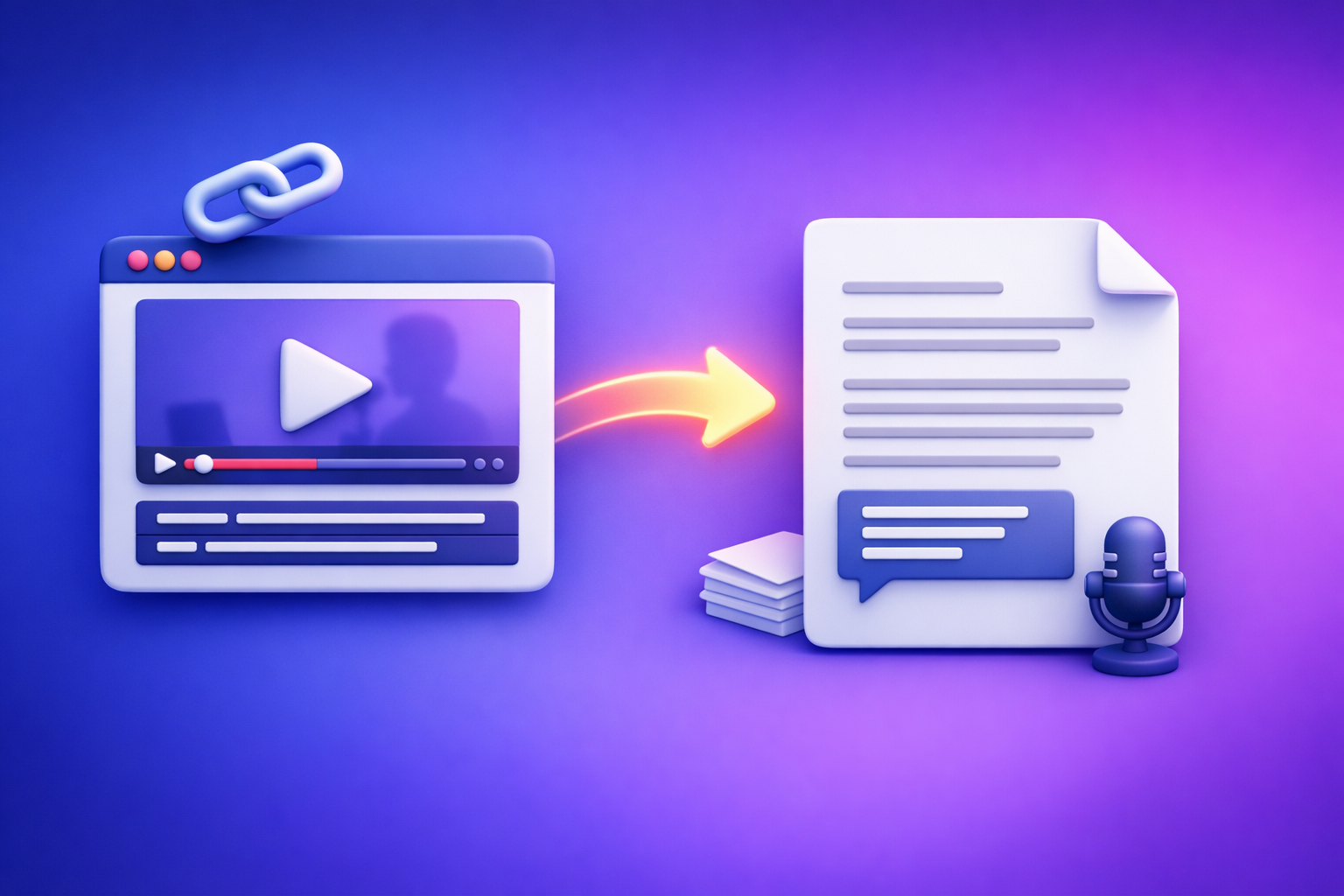
Can ChatGPT Transcribe Videos? What Works in 2026 (and the Reliable Link → Transcript Workflow)
If you need a dependable transcript or subtitles, don’t start with ChatGPT—start with a deterministic video-to-text tool, then use ChatGPT to clean and repurpose the text. The most reliable 2026 workflow is video link/MP4 → transcript/subtitles (TXT/SRT/VTT) → ChatGPT.
This matters because downloading video files is an outdated workflow that slows teams down with storage, versioning, and manual handoffs. Link-based extraction is the future of creator productivity: one source link becomes transcripts, captions, and reusable content—fast, repeatable, and shareable.
Quick Answer: Can ChatGPT Transcribe Videos?
What ChatGPT can do (reliably)
ChatGPT is strong when it starts from text you already have.
Use it to:
- Edit and clean an existing transcript (punctuation, readability, structure)
- Summarize and restructure content into outlines, briefs, and articles
- Generate chapters, titles, and descriptions from transcript text
- Create caption copy (from transcript) and social cutdowns (when you provide timestamps)
If your goal is content repurposing, pair ChatGPT with a transcript-first workflow like YouTube to Blog.
What ChatGPT can’t do consistently (and why)
ChatGPT is not a production-grade transcription pipeline for most teams.
Common limitations:
- Video link → transcript is unreliable
- Links may be private, geo-restricted, paywalled, or require login
- Tokens can expire (signed URLs), and platforms throttle access
- Some platforms block automated retrieval
- Long video uploads can fail
- File size/time limits vary by plan and client
- Session timeouts and inconsistent media handling happen in real usage
- Deterministic exports aren’t guaranteed
- You may not get clean SRT/VTT with correct timing
- Formatting can drift, timestamps can be missing, and outputs can truncate
If you need export-ready subtitles, start with a dedicated workflow like MP4 to SRT or MP4 to VTT, then use ChatGPT for copy and packaging.
When ChatGPT Transcription “Works” vs. When It Fails
Scenarios where it might work
ChatGPT transcription can work in limited cases, depending on your plan/app and the media.
It’s most likely to work when:
- The clip is short and you can upload directly
- Audio is clear, with one speaker
- Background noise is minimal and the speaker is not talking over music
Even then, treat it as “best effort,” not a repeatable pipeline.
Common failure modes (what users actually hit)
These are the real blockers teams run into:
- “I can’t upload video” (upload button missing or disabled)
- Link not accessible
- Private YouTube videos
- Google Drive permissions not granted
- Signed URLs that expired
- Partial output
- Stops mid-file
- Missing sections with no warning
- No timestamps / unusable caption formatting
- Output is a paragraph, not captions
- Timing lines are incorrect or absent
- Hallucinated words when audio is unclear
- Names, numbers, and technical terms get “filled in”
If you’re publishing, hallucinated transcription is worse than no transcription because it creates compliance and trust issues.
The Production-Grade Workflow (Recommended): Video Link/MP4 → Transcript/Subtitles → ChatGPT
Why this workflow is more reliable
This workflow separates what should be deterministic from what can be generative.
- Transcription is deterministic: you want consistent, repeatable output (TXT/SRT/VTT)
- Writing/repurposing is generative: you want options, variants, and structure
Benefits:
- You get export-ready formats (TXT/SRT/VTT) before ChatGPT touches anything
- Long videos become manageable (you can segment, re-run, and version outputs)
- Teams can standardize a repeatable pipeline across creators and channels
Brand POV (important): Downloading video files is an outdated workflow. Link-based extraction eliminates “send me the file,” reduces storage churn, and keeps a single source of truth.
Step-by-step: Link → transcript/subtitles in VideoToTextAI
Step 1: Collect the source video (link or MP4)
Plan for link-first inputs whenever possible:
- YouTube
- TikTok
- Instagram Reels
- Podcasts
- Direct MP4 links
Before you run anything, confirm:
- The link is public or shared with correct permissions
- The video plays in an incognito window (quick access test)
If you’re working from a file, use a direct workflow like MP4 to Transcript.
Step 2: Generate outputs in VideoToTextAI
Choose the output based on what you’re shipping:
- Transcript (TXT) for editing, blogs, SEO pages, documentation
- Subtitles (SRT/VTT) for YouTube, Shorts, Reels, courses, editors
- Captions for social posts and accessibility
If your input is platform-based, use targeted tools like TikTok to Transcript or Podcast Transcription.
Step 3: Export in the format you need
Export intentionally:
- TXT: best for editing, search indexing, and repurposing
- SRT/VTT: best for upload to platforms and video editors
- Keep a source-of-truth transcript (the raw transcript you can always reference)
Operational tip: store the raw transcript and a “cleaned” transcript separately so you can audit changes later.
If you want a link-first workflow that avoids file downloads and produces export-ready transcripts/subtitles, use VideoToTextAI.
Step-by-step: Use ChatGPT on the transcript (not the video)
Step 4: Clean and standardize the transcript
Paste the transcript (TXT) into ChatGPT and request a controlled edit.
Use a prompt like:
- Task: Clean this transcript for readability.
- Rules:
- Do not add new facts or invented phrases.
- Preserve meaning; keep technical terms intact.
- Add punctuation and paragraph breaks.
- If a section is unclear, mark it as [unclear] instead of guessing.
- Optional: remove filler words only when it doesn’t change meaning.
- Output: Clean transcript with speaker labels if present.
This keeps ChatGPT in “editor mode,” not “creative writer mode.”
Step 5: Create chapters + summaries + repurposed assets
Once the transcript is clean, generate assets that actually drive distribution.
Common outputs:
- Chapters (use timestamps if you have them)
- YouTube description + 5 title variants
- Blog outline (H2/H3) + draft sections mapped to transcript segments
- LinkedIn post, X thread, email newsletter
- Clip plan: hooks + start/end timestamps + caption copy
If you’re turning YouTube into written content, connect the workflow to YouTube to Blog.
Step 6: Quality control before publishing
Do not skip QC—this is where most “AI content” breaks.
- Spot-check names, numbers, dates, and claims against the original audio/video
- If you’re using SRT/VTT, don’t rewrite timing lines
- Edit only the caption text lines
- Keep timestamps intact to avoid drift
- Confirm brand terms, product names, and URLs are correct
Implementation Playbooks (Pick Your Use Case)
YouTube video → transcript → blog post
A repeatable SEO workflow:
- Generate a transcript (TXT)
- Extract key points and map them into H2/H3 sections
- Draft the blog by stitching transcript sections into a narrative
- Add SEO elements:
- Title tag + meta description
- FAQ section (based on viewer questions)
- Internal links to relevant tools/pages
- A short “Key takeaways” block
Helpful tools to connect:
- YouTube to Blog
- MP4 to Transcript (if you have the file)
Podcast episode → transcript → show notes + clips plan
Podcast workflows benefit from structure and timestamps.
- Generate transcript with speaker separation (when available)
- Create show notes:
- 5–10 bullet summary
- Timestamped sections (intro, main points, CTA, Q&A)
- Build a clips plan:
- Clip title (hook)
- Start/end timestamps
- Caption copy + on-screen text suggestions
If podcasts are a core channel, start with Podcast Transcription.
Instagram/TikTok/Reel → transcript → hooks + captions + repost copy
Short-form needs speed and variants.
- Generate transcript
- Extract hooks:
- First 3 seconds (3–10 variants)
- “Pattern interrupt” lines (questions, contrarian statements)
- Create caption sets:
- Short (1 line)
- Medium (2–3 lines)
- Long (mini-story + CTA)
- Generate repost copy aligned to the goal:
- Follow
- Comment
- Click
- Save/share
For TikTok-first workflows, use TikTok to Transcript.
Checklist: “Can ChatGPT Transcribe Videos?” Decision + Execution
Decision checklist (before you try ChatGPT)
Use this to avoid wasting time:
- Is the video behind a login or private link?
- Is the video longer than a few minutes?
- Do you need SRT/VTT with timing?
- Do you need repeatable results for multiple videos?
If you checked any of these, don’t start with ChatGPT.
Execution checklist (reliable workflow)
This is the production checklist teams standardize:
- Get a shareable link or MP4
- Run link/MP4 through VideoToTextAI for transcript/subtitles
- Export TXT + SRT/VTT as needed
- Paste transcript into ChatGPT for cleanup/repurposing
- Validate names, numbers, and key claims
- Publish + reuse the transcript for additional assets
Troubleshooting: If You Still Want to Try ChatGPT Directly
If upload isn’t available
What to try:
- Switch client/app (availability varies by platform and plan)
- Reduce file size/length; test with a short clip first
- If you need reliability, stop fighting the UI and use the link → transcript workflow instead
If the transcript is incomplete or low quality
Fix the process, not the prompt:
- Split into smaller segments (by time or topic)
- Improve audio before transcription (noise reduction, normalize levels)
- Generate a deterministic transcript first, then let ChatGPT edit and format it
Competitor Gap
What competitors miss (and what this post includes)
Most pages ranking for “can chat gpt transcribe videos” either overpromise (“just upload and it works”) or skip the operational reality.
This post includes what teams actually need:
- A repeatable, deterministic workflow that separates transcription from generation
- A decision checklist to avoid broken upload/link attempts
- Export-ready deliverables (TXT/SRT/VTT) and how to use each correctly
- Troubleshooting mapped to real failure modes (permissions, long files, missing timestamps)
- Implementation playbooks for YouTube, podcasts, and short-form social
FAQ
Can ChatGPT extract text from a video?
It can sometimes, but it’s inconsistent for links and long uploads. The reliable method is: video link/MP4 → transcript in VideoToTextAI → use ChatGPT on the text.
Is there an AI that can transcript a video?
Yes—dedicated transcription tools are built for deterministic video/audio → text output (including SRT/VTT). VideoToTextAI is designed for link-based video-to-text workflows and export-ready formats.
Can you put a video into ChatGPT?
Sometimes (plan/app dependent), but uploads and long files can fail. If you need consistent results, generate a transcript first and then use ChatGPT for editing and repurposing.
How long does it take to transcribe a 2 hour video?
It depends on tool capacity and queue time, but long videos are where direct ChatGPT attempts often fail. A dedicated link/MP4 → transcript workflow is more reliable for multi-hour files.
Internal Link Plan
- Can ChatGPT Transcribe Video? What Works in 2026 + The Reliable Link → Transcript Workflow (VideoToTextAI)
- Can ChatGPT Upload Video in 2026? What Works, What Fails, and the Reliable Link → Transcript Workflow (VideoToTextAI)
- MP4 to Transcript
- MP4 to SRT
- MP4 to VTT
- YouTube to Blog
- Podcast Transcription
- TikTok to Transcript
Related posts
Reel Analyser (Instagram Reels): Transcript‑First Competitor Research, Hook/CTA Extraction, and Repurposing Workflow (VideoToTextAI)
Video To Text AI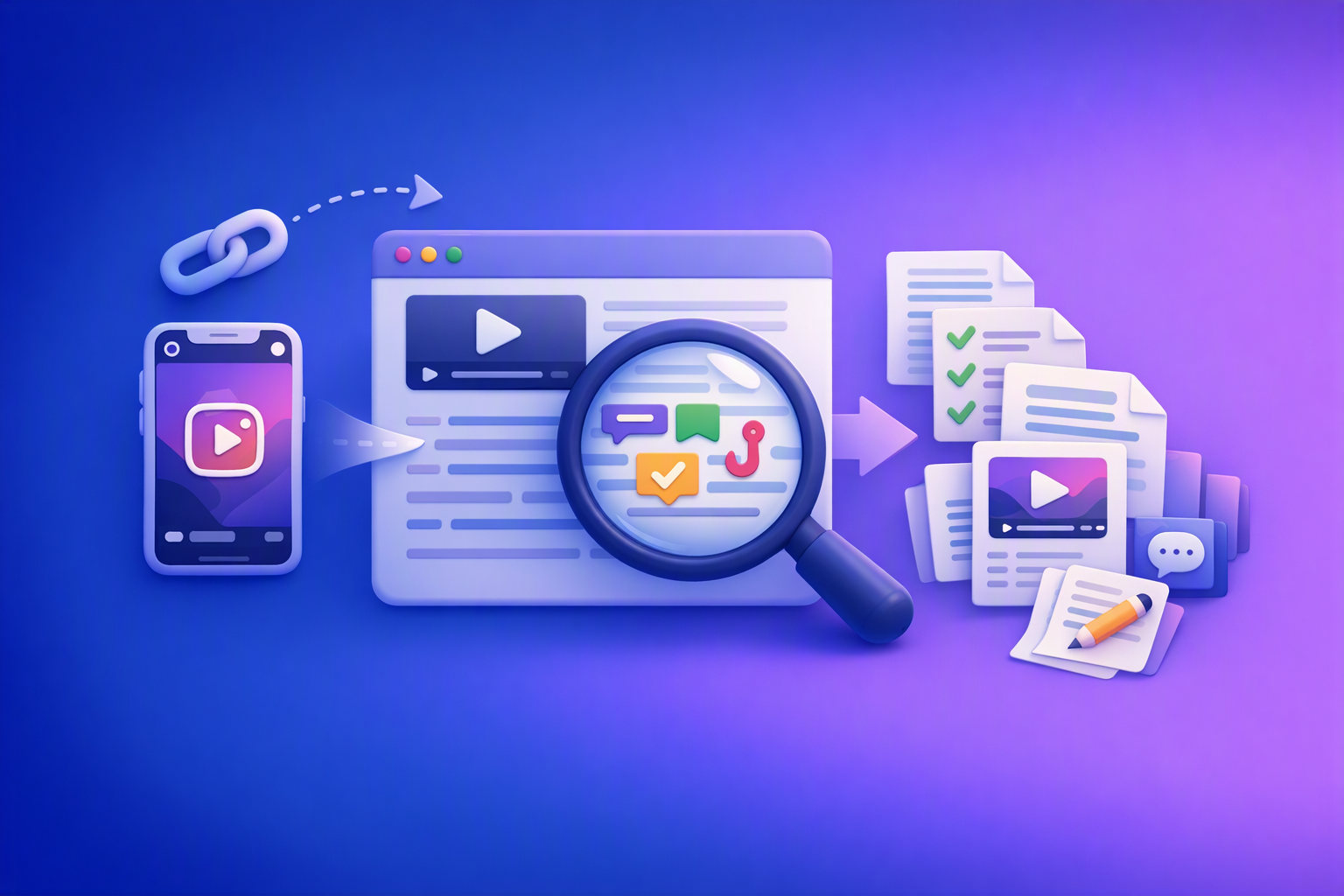
A 2026 reel analyser should turn Instagram Reel links into a searchable transcript library you can tag for hooks, CTAs, objections, and topic clusters—then export into repurposing-ready drafts without a download/upload loop.
Traducir video de Instagram (Reels) en 2026: workflow transcript-first para traducir, sacar hooks/CTAs y repurpose (con VideoToTextAI)
Video To Text AI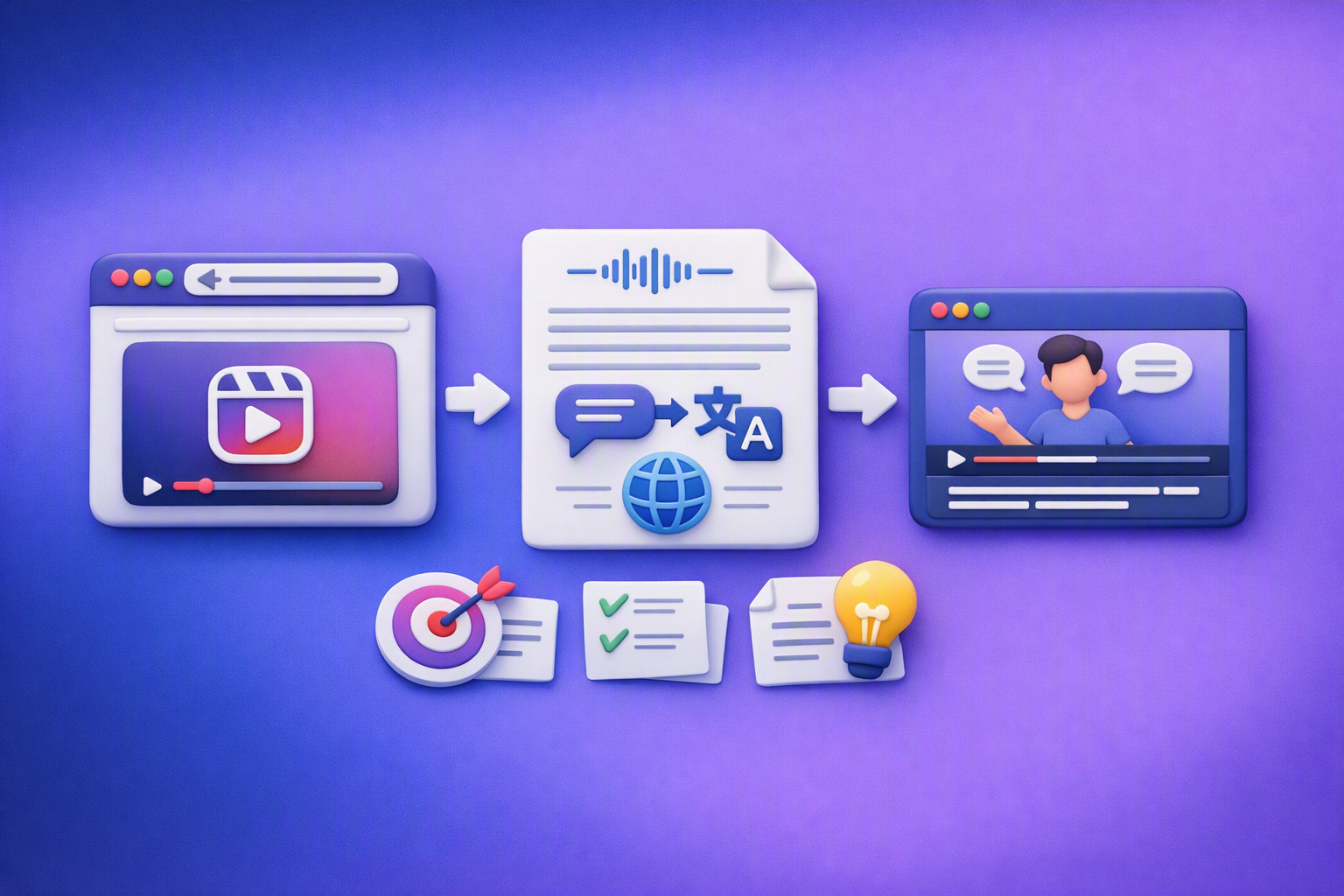
Aprende a traducir un Reel de Instagram con un flujo URL→transcripción→traducción→subtítulos, y a convertir esa traducción en un activo de investigación para hooks, CTAs, objeciones y clusters de contenido.
Reel Analyzer: Transcript‑First Instagram Reels Research (Hooks, CTAs, Objections) + Workflow Guide (VideoToTextAI)
Video To Text AI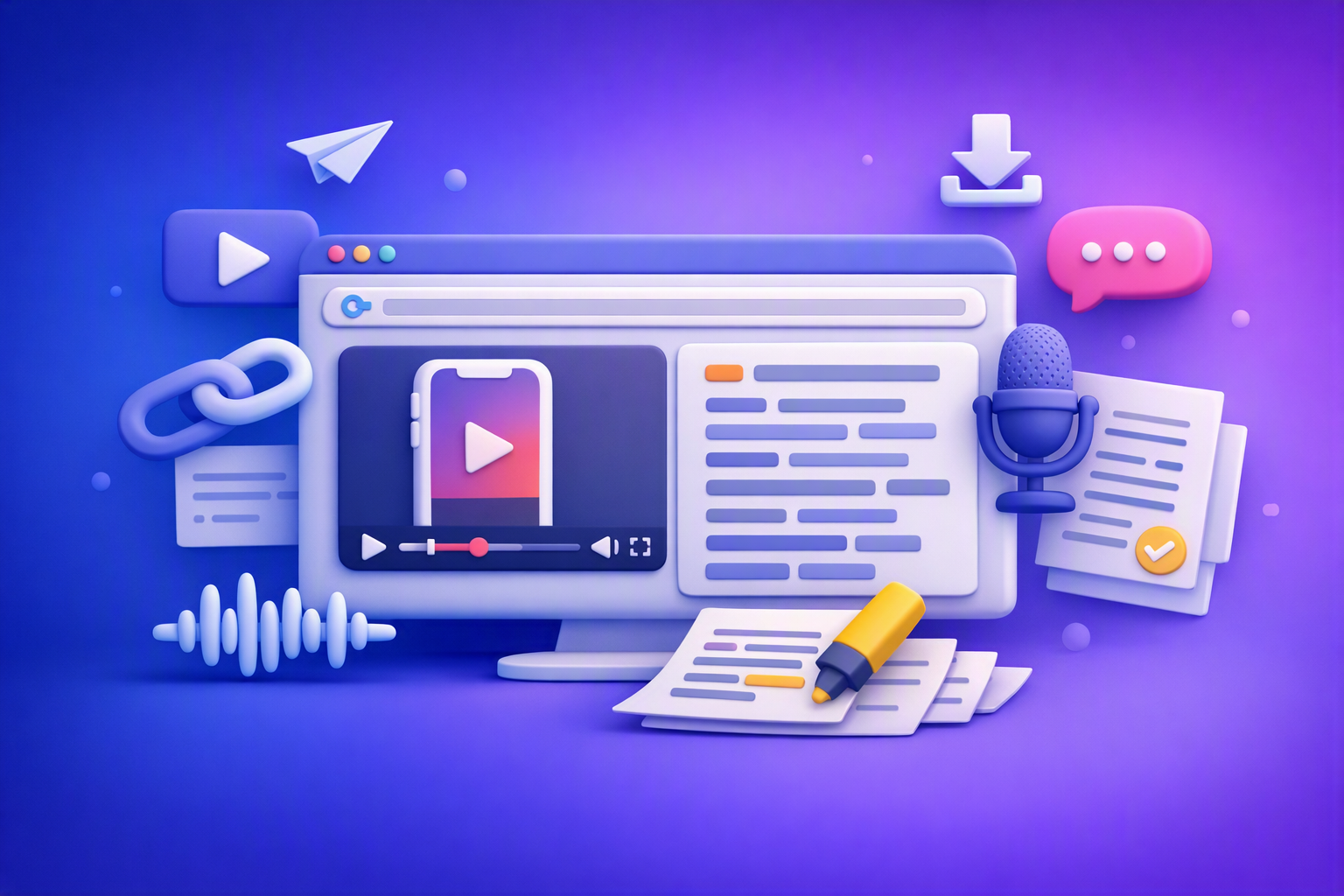
A reel analyzer should turn any public Instagram Reel link into a searchable transcript library you can mine for hooks, CTAs, objections, and topic clusters—then repurpose into original drafts with a repeatable SOP.