
Can ChatGPT Transcribe Video? What’s Actually Possible in 2026 (Plus a Reliable Link → Transcript Workflow)
 Video To Text AI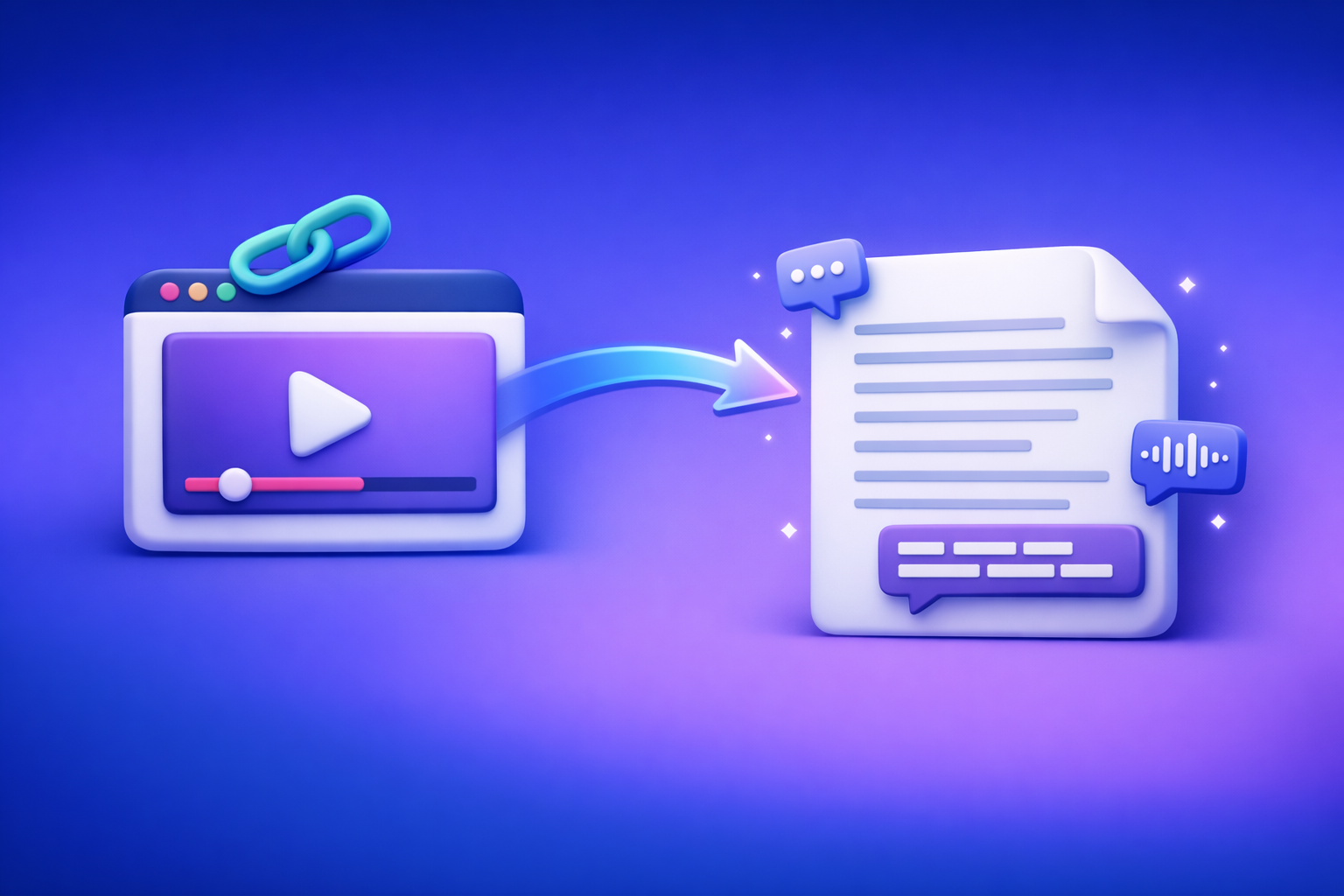
Can ChatGPT Transcribe Video? What’s Actually Possible in 2026 (Plus a Reliable Link → Transcript Workflow)
If you need an export-ready transcript, SRT, or VTT, don’t start by pasting a video link into ChatGPT. Start with a transcript-first workflow: generate the transcript/subtitles from the video link, then use ChatGPT for cleanup and repurposing.
Quick Answer (So You Don’t Waste Time)
Can ChatGPT transcribe a video file or YouTube link directly?
- YouTube link → transcript: Typically no (not in a reliable, production-ready way). ChatGPT usually can’t fetch and decode arbitrary public video URLs into accurate, timecoded transcripts on demand.
- MP4 upload → transcript: Sometimes, depending on your ChatGPT plan, file size, duration, and current feature availability.
- Best practical approach: Use a dedicated transcription workflow to produce TXT + SRT/VTT, then use ChatGPT to edit, structure, summarize, and repurpose.
When ChatGPT can help (and where it breaks)
ChatGPT is strong at:
- Cleaning messy transcripts (punctuation, paragraphs, readability)
- Structuring content (chapters, headings, outlines)
- Repurposing (blogs, posts, email drafts, scripts)
ChatGPT often breaks on:
- Long videos (timeouts, truncation, partial outputs)
- Export requirements (SRT/VTT formatting, timecode precision)
- Diarization (speaker labels can be inconsistent)
- Link-based extraction (it may not access the media behind the link)
The reliable approach: transcript-first, then ChatGPT for rewriting/repurposing
In 2026, downloading video files is an outdated workflow for most teams. The future of creator productivity is link-based extraction: paste a link, generate transcript/subtitles, then reuse that text everywhere.
What People Mean by “ChatGPT Transcribe Video” (3 Different Use Cases)
1) YouTube/Instagram/TikTok link → transcript
Goal: paste a link and get:
- A full transcript
- Timestamps
- Optional speaker labels
- Optional SRT/VTT for captions
Reality: ChatGPT is not designed as a dependable “any link → transcript” engine. Link access and media retrieval are the failure point.
2) MP4 upload → transcript/subtitles
Goal: upload a file and get:
- Accurate transcript
- Captions/subtitles in SRT/VTT
- Clean formatting for publishing
Reality: it can work for short clips, but length caps and format guarantees are common blockers.
3) Existing transcript → clean-up, chapters, summaries, posts
Goal: take raw text and turn it into:
- Chapters and headings
- Summaries and key takeaways
- Social posts, newsletters, blog drafts
- SEO metadata (titles, descriptions)
Reality: this is where ChatGPT is consistently valuable—after transcription.
What’s Actually Possible With ChatGPT in 2026
Scenario A: You paste a video link into ChatGPT
What typically happens
- ChatGPT may respond with a summary-style answer or ask you to provide the transcript.
- If it can’t access the media, it will hallucinate structure (chapters, timestamps) without real alignment.
- You may get something that looks like a transcript, but it’s often not verbatim and not complete.
Why it’s not export-ready (timestamps, speaker labels, formatting)
Export-ready transcription requires:
- Accurate timecodes (start/end per caption line)
- Consistent speaker labeling (if multi-speaker)
- Subtitle constraints (line length, reading speed, segmentation)
- No missing sections (especially intros/outros and Q&A)
ChatGPT responses from links rarely meet these requirements.
Scenario B: You upload an MP4 to ChatGPT
When it works
It can work when:
- The video is short
- Audio is clear
- There are few speakers
- You only need a rough transcript for internal use
Common limitations (length caps, inconsistent diarization, no SRT/VTT guarantees)
Common issues you’ll hit:
- Duration/file-size limits (varies by plan and environment)
- Truncated outputs (partial transcript)
- Inconsistent diarization (speaker switches wrong or missing)
- No guaranteed SRT/VTT (even if it outputs something “SRT-like,” formatting can be invalid)
Scenario C: You provide audio or a transcript to ChatGPT
Best-case use: editing, structuring, repurposing
This is the best-case scenario:
- You provide clean transcript text (or audio already extracted)
- ChatGPT improves readability and structure
- You generate chapters, summaries, posts, and drafts quickly
What to include for best results (timestamps, speaker names, glossary)
To get high-quality outputs, include:
- Timestamps (at least every 30–60 seconds, or per section)
- Speaker names (Speaker 1 = Host, Speaker 2 = Guest)
- A glossary of proper nouns (brands, acronyms, product names)
- The target output format (blog, YouTube description, LinkedIn posts, etc.)
The Fast, Reliable Workflow: Video Link → Transcript/SRT/VTT → ChatGPT
This workflow avoids the biggest time sink: trying to make ChatGPT behave like a dedicated transcription engine.
Step 1: Start with the right input (link vs file)
Public links that work best (YouTube, Reels, podcasts, hosted MP4 pages)
Link-based inputs are the modern standard because they:
- Remove file download/upload friction
- Reduce versioning mistakes (“final_final_v7.mp4”)
- Scale for teams (repeatable SOP)
Best sources:
- YouTube videos
- Public podcast pages
- Hosted MP4 landing pages
- Public social video URLs (where accessible)
If you’re building a repeatable content pipeline, link-first is the future.
If you only have a file: use MP4-based conversion
Sometimes you only have an MP4 (client delivery, internal recording). In that case, use an MP4 conversion workflow like mp4 to transcript or mp4 to srt.
Step 2: Generate the transcript in VideoToTextAI
Use a transcription tool that’s built for link-based extraction and exportable outputs. VideoToTextAI is designed for AI link-based video-to-text workflows for transcripts, subtitles, captions, and repurposing (one CTA link below).
Output options to choose:
- TXT transcript (best for editing, blogs, SEO)
- SRT (best for broad compatibility)
- VTT (best for web players)
Settings to decide upfront:
- Timestamps: on/off (turn on for chapters + subtitles)
- Speaker labels: enable for interviews/podcasts
- Language: set explicitly (and choose translation only if needed)
Step 3: Quality control the transcript (2-minute pass)
A short QC pass prevents most downstream issues.
Fix names/brands/terms (create a “proper nouns” list)
Before you repurpose, scan for:
- People names
- Company/product names
- Acronyms
- Technical terms
Create a quick “proper nouns” list and correct them once. This improves every derivative asset (captions, blogs, summaries).
Remove filler vs keep verbatim (choose based on use case)
Choose one:
- Verbatim (legal, research, compliance, court-style accuracy)
- Clean read (marketing, blogs, newsletters, tutorials)
Don’t mix styles mid-document.
Check timecode alignment for subtitles
Spot-check:
- Start (first 30 seconds)
- Middle (a random segment)
- End (last 30 seconds)
You’re looking for obvious drift, overlaps, or missing chunks.
Step 4: Use ChatGPT after transcription (repurposing prompts that work)
Below are prompt templates that consistently work when you provide a real transcript.
Prompt: clean transcript + add headings and chapters
You are an editor. Clean this transcript for readability without changing meaning.
Add H2 headings and chapter titles every 2–4 minutes based on topic shifts.
Keep speaker labels. Preserve timestamps in brackets.
Transcript:
[PASTE TRANSCRIPT]
Prompt: create YouTube description + timestamps + keywords
Create a YouTube description from this transcript.
Include: 1) a 2-sentence hook, 2) timestamped chapters, 3) 8–12 SEO keywords, 4) 5 relevant hashtags.
Transcript with timestamps:
[PASTE TRANSCRIPT]
Prompt: generate short-form captions from the transcript
From this transcript, generate 12 short-form caption ideas for TikTok/Reels/Shorts.
For each: include a hook line, the exact quote segment (verbatim), and a suggested on-screen caption (max 12 words).
Transcript:
[PASTE TRANSCRIPT]
Prompt: turn transcript into a blog outline + draft
Turn this transcript into a blog post.
Output: SEO title options (5), outline (H2/H3), then a 1,200–1,800 word draft.
Keep claims factual and remove filler.
Transcript:
[PASTE TRANSCRIPT]
If your starting point is YouTube content, a dedicated workflow like youtube to blog is often faster than manual prompting.
Step-by-Step: Turn a Video Into Export-Ready Subtitles (SRT/VTT)
Step 1: Create SRT (when you need broad compatibility)
Use SRT when you need compatibility with:
- YouTube uploads
- Many editors and caption tools
- Broad platform support
SRT basics:
- Sequential numbers
HH:MM:SS,mmm --> HH:MM:SS,mmm- 1–2 lines per caption block (typical)
Step 2: Create VTT (when you publish on web players)
Use VTT when you publish on:
- HTML5 players
- Web-based learning platforms
- Sites that prefer WebVTT styling/metadata
VTT basics:
- Starts with
WEBVTT - Uses
HH:MM:SS.mmmformatting - Can support additional cues and metadata
Step 3: Validate formatting (what to spot-check)
Subtitle length and reading speed
Spot-check:
- Captions aren’t too dense (avoid long sentences per cue)
- Reading speed feels natural (not “wall of text”)
Line breaks and punctuation
Look for:
- Broken phrases across lines
- Missing punctuation that changes meaning
- Over-aggressive filler removal that makes speech unnatural
Timecode drift and overlaps
Check for:
- Overlapping cues
- Gaps that skip spoken content
- Drift near the end (a common sign of bad segmentation)
Common Mistakes (And How to Fix Them Fast)
Mistake: expecting ChatGPT to “watch” a full video end-to-end
Fix:
- Use a transcript-first tool to generate TXT/SRT/VTT
- Then use ChatGPT for editing and repurposing
Mistake: using summaries as “transcripts”
Fix:
- If you need captions, compliance, or searchable archives, you need verbatim transcription, not a summary.
- Generate a real transcript first, then create summaries as a separate output.
Mistake: skipping a glossary for names/technical terms
Fix:
- Maintain a reusable glossary per channel/client.
- Apply it during QC so every downstream asset is consistent.
Mistake: exporting the wrong subtitle format (SRT vs VTT)
Fix:
- Use SRT for broad compatibility and most platform uploads.
- Use VTT for web players and web-first publishing.
Checklist: “Transcript-First” SOP You Can Reuse
Inputs
- Video link (or MP4) confirmed accessible
- Target language(s) decided
- Proper nouns list prepared (names, brands, acronyms)
Transcript Output
- Transcript exported as TXT (editable)
- Subtitles exported as SRT and/or VTT
- Speaker labels enabled if multi-speaker
QC Pass
- Names/terms corrected
- Obvious mishears fixed (numbers, URLs, product names)
- Timecodes spot-checked (start, middle, end)
Repurposing
- Chapters generated
- Summary + key takeaways generated
- 3–10 social posts drafted from transcript sections
For a deeper walkthrough on link-based conversion, see Video to Text: Convert Any Video Link into a Transcript, Subtitles (SRT/VTT), and Repurposed Content and How to Turn Any Video Link into a Transcript, Subtitles (SRT/VTT), and Repurposed Content (Step-by-Step).
Competitor Gap
What top results miss
Most top-ranking pages and lightweight tools miss the operational reality:
- No implementation walkthrough from link/file → transcript → SRT/VTT → repurposing
- No troubleshooting for common failure points (access, length, timecodes, names)
- No reusable checklist/SOP for teams
How this post is better (deliverables readers can copy)
This guide gives you:
- A repeatable transcript-first workflow that produces export-ready files
- A QC checklist that prevents the most common accuracy issues
- Prompt templates that use ChatGPT where it’s strongest (editing + repurposing)
If you want adjacent guidance, compare: Can I Upload Video to ChatGPT? What’s Actually Possible (and the Fastest Workaround) and Can ChatGPT Take Video as Input? What’s Actually Possible in 2026 + The Fast Transcript-First Workflow (VideoToTextAI).
FAQ
Can ChatGPT read videos?
ChatGPT can sometimes analyze uploaded clips or provided transcripts, but it’s not a dependable “read any video link and transcribe it” solution. For production work, generate the transcript/subtitles first, then use ChatGPT to refine and repurpose.
Can you put a video into ChatGPT?
In some environments, yes—you can upload an MP4. In practice, you may hit length limits, partial outputs, and no guaranteed SRT/VTT formatting, which is why transcript-first workflows are more reliable.
Can AI turn a video into a transcript?
Yes. Dedicated transcription tools can convert a video link or MP4 into TXT + SRT/VTT, with timestamps and optional speaker labels. Then ChatGPT can turn that transcript into chapters, summaries, and content drafts.
Is it free to use ChatGPT for audio transcription?
Sometimes you can transcribe short audio/video within ChatGPT depending on plan features, but “free” isn’t the real constraint—reliability and exportability are. If you need consistent outputs (especially SRT/VTT), use a transcript-first workflow.
Recommended VideoToTextAI Tools (Pick Your Starting Point)
If you have a YouTube link: use a link-based workflow
Link-based extraction is the modern workflow because it eliminates downloads, reduces errors, and scales across a content team. Start with VideoToTextAI here: https://videototextai.com
If you have an MP4 file: convert MP4 → transcript/SRT/VTT
Use:
If you want a blog post from a video: transcript → blog workflow
Use:
Related posts
Reel Analyser (Instagram Reels): Transcript‑First Competitor Research, Hook/CTA Extraction, and Repurposing Workflow (VideoToTextAI)
Video To Text AI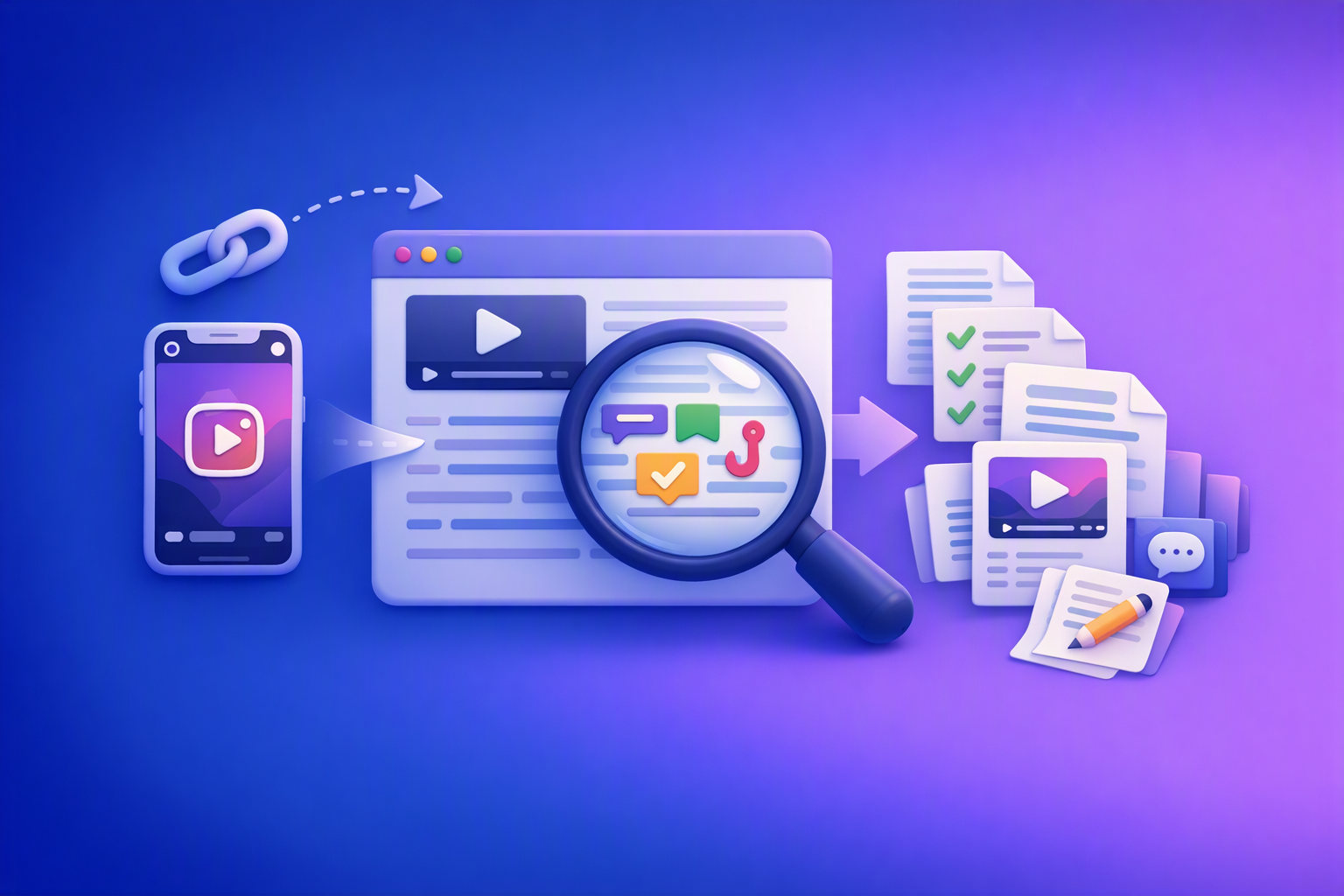
A 2026 reel analyser should turn Instagram Reel links into a searchable transcript library you can tag for hooks, CTAs, objections, and topic clusters—then export into repurposing-ready drafts without a download/upload loop.
Traducir video de Instagram (Reels) en 2026: workflow transcript-first para traducir, sacar hooks/CTAs y repurpose (con VideoToTextAI)
Video To Text AI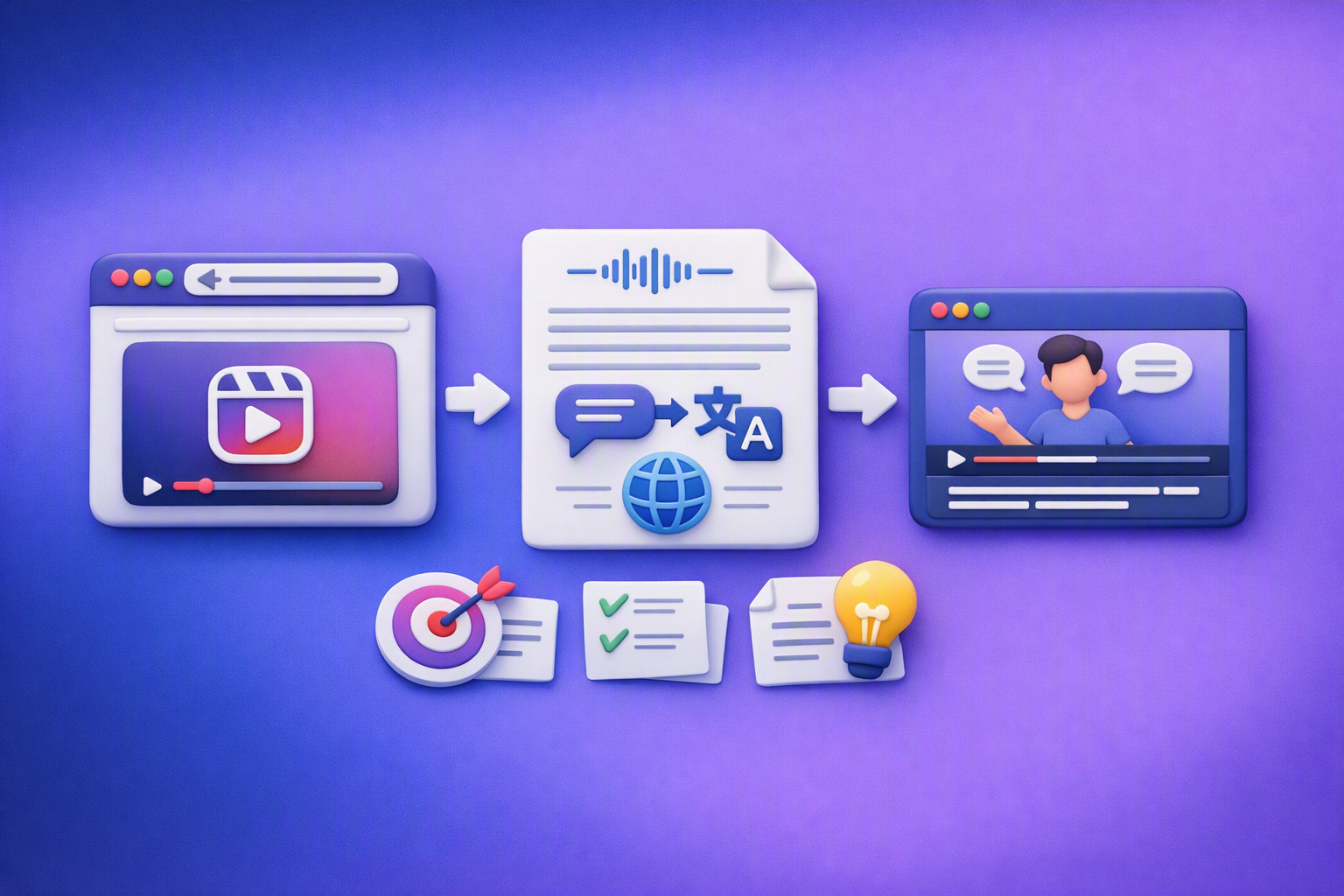
Aprende a traducir un Reel de Instagram con un flujo URL→transcripción→traducción→subtítulos, y a convertir esa traducción en un activo de investigación para hooks, CTAs, objeciones y clusters de contenido.
Reel Analyzer: Transcript‑First Instagram Reels Research (Hooks, CTAs, Objections) + Workflow Guide (VideoToTextAI)
Video To Text AI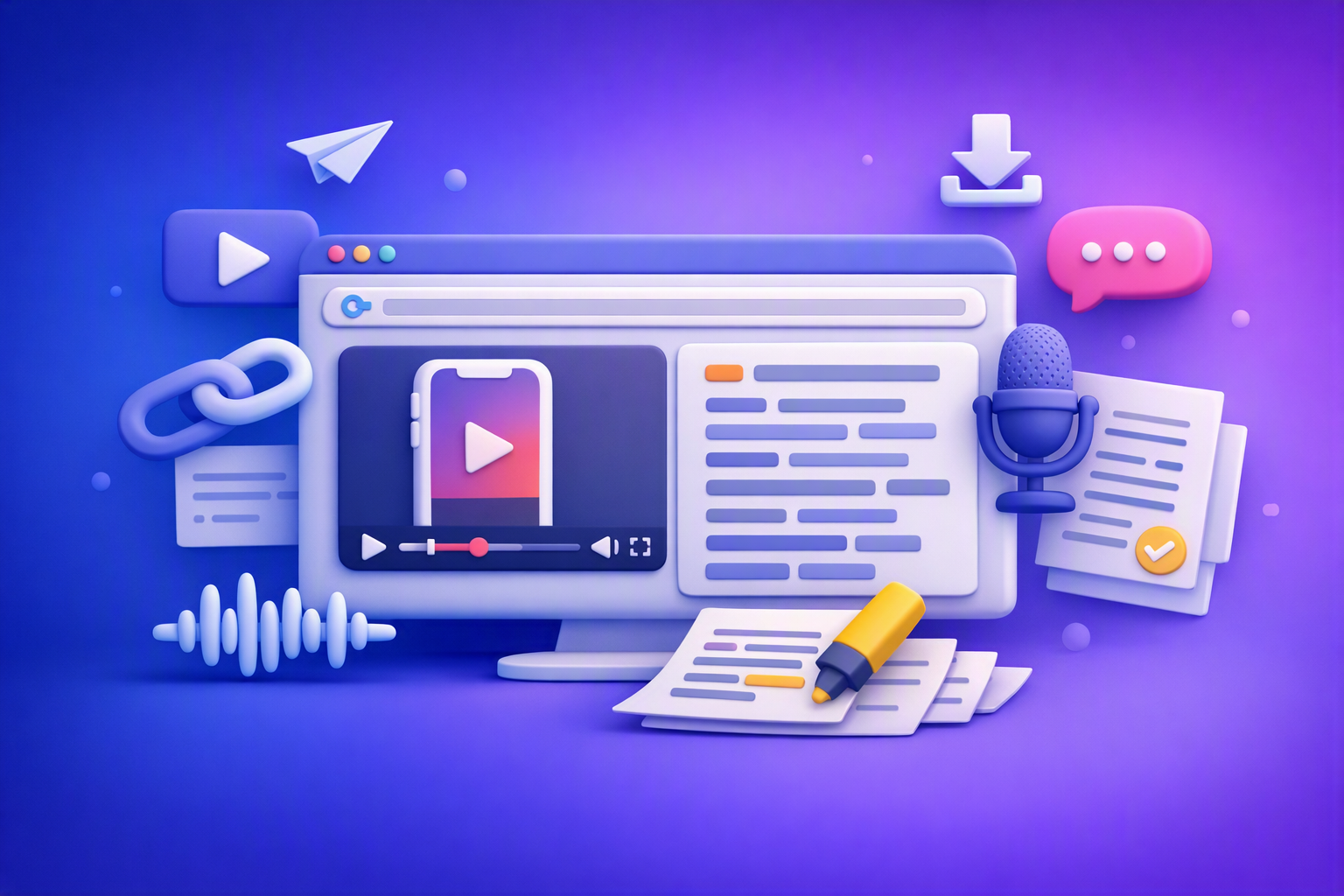
A reel analyzer should turn any public Instagram Reel link into a searchable transcript library you can mine for hooks, CTAs, objections, and topic clusters—then repurpose into original drafts with a repeatable SOP.