
Can I Upload Video to ChatGPT? What’s Actually Possible (and the Fastest Workaround)
 Video To Text AI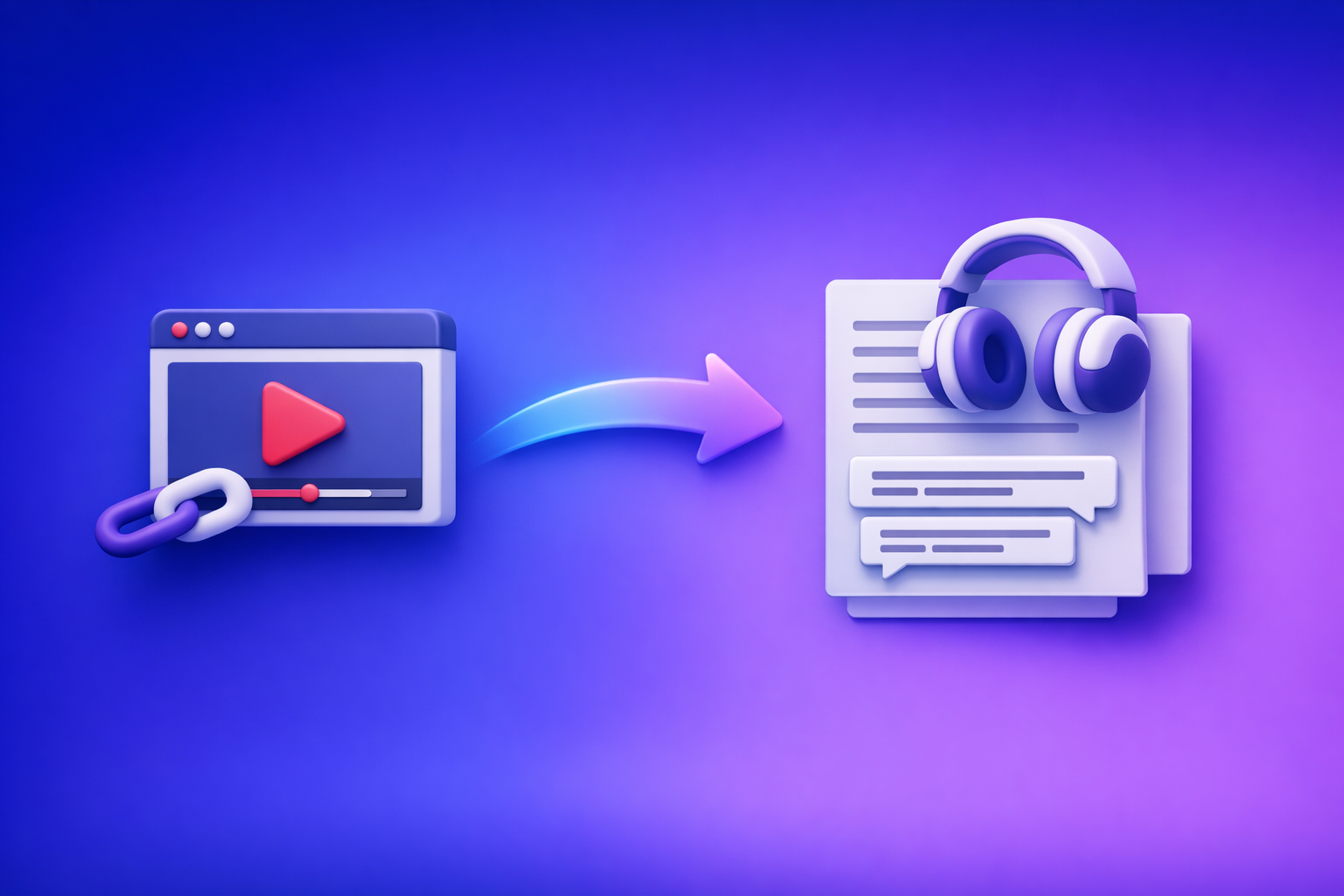
Can I Upload Video to ChatGPT? What’s Actually Possible (and the Fastest Workaround)
If you want ChatGPT to “watch” a video, the fastest dependable method is to convert the video into text first (transcript/subtitles) and then prompt ChatGPT with that text. This avoids upload failures, file-size limits, and inconsistent feature availability across devices and plans.
What people mean by “upload video to ChatGPT”
Most searches for can i upload video to chat gpt actually mean one of these workflows:
Video file upload vs video link vs screenshots/frames
- Video file upload (MP4/MOV): You attach a file and expect ChatGPT to analyze audio + visuals end-to-end.
- Video link (YouTube/Instagram/etc.): You paste a URL and expect ChatGPT to open it and summarize.
- Screenshots/frames: You upload a few key frames and ask ChatGPT to interpret what’s happening visually.
In practice, text is the most portable input across ChatGPT experiences. Video files and links are the least consistent.
“ChatGPT can see video” vs “ChatGPT can summarize what I paste”
Two different capabilities get mixed together:
- “See” = interpret visual content (often images; video is more complex).
- “Summarize” = transform text you provide (transcripts, notes, outlines).
If your goal is summaries, captions, blog drafts, or SOPs, you don’t need video upload. You need accurate text.
Can I upload a video in ChatGPT (current reality)
When ChatGPT can’t accept video files (common limitations)
Even when file uploads exist, video workflows commonly break due to:
- File size/duration limits
- Unsupported codecs/containers (e.g., certain MOV/HEVC variants)
- Mobile app constraints (iPhone/Android differences)
- Network timeouts on large uploads
- Feature availability changes by plan, region, or rollout
This is why “it worked yesterday” is a common complaint.
What does work: links, transcripts, still frames, and screen sharing (where available)
Reliable options (from most to least consistent):
- Paste a transcript (best for accuracy + speed).
- Upload still frames/screenshots (best for visual questions).
- Share your screen (where available) and ask questions in real time.
- Paste a public link (sometimes works, but access and permissions vary).
For creator workflows, transcript-first wins because it’s deterministic: you control the input.
Privacy + permissions: what not to share (client footage, private links, unlisted content)
Before you paste anything into an AI tool:
- Don’t share client footage unless you have written permission.
- Avoid private/unlisted links that expose internal content.
- Don’t paste personal data, credentials, or confidential financials.
- If you must process sensitive media, use approved internal tooling and policies.
Also note: a “public link” can still be geo-blocked or require login, which breaks link-based summarization.
The practical workaround: convert the video to text first, then use ChatGPT
Why transcript-first beats “video upload” for accuracy and speed
A transcript-first workflow is faster because:
- No large file uploads (less waiting, fewer failures).
- Searchable, editable input (you can correct names and terms).
- Chunkable (split long videos into sections for better outputs).
- Reusable across tools (captions, blogs, emails, docs).
From a productivity standpoint, downloading video files is an outdated workflow. Link-based extraction is the future of creator productivity because it removes friction: no local storage, no re-uploads, no format headaches.
What you can do once you have text: summarize, extract steps, create captions, repurpose content
Once you have a transcript (and optionally subtitles), ChatGPT becomes a high-leverage editor:
- Summaries with key takeaways and sections
- Action items and checklists (SOPs)
- Captions and hooks for short-form clips
- Blog drafts and SEO outlines
- Email sequences and landing page copy
- Quote extraction for social proof
If you publish, subtitles formats like SRT/VTT are also essential. See: How to Generate Subtitles (SRT & VTT Files) for Your Instagram Reels.
Step-by-step: turn a video link into a transcript with VideoToTextAI (no downloading)
This is the most repeatable workflow when you’re starting from a URL (YouTube, Instagram, and other supported sources). It also aligns with the brand POV: stop downloading files—use link-based extraction.
Step 1: Copy the public video URL (YouTube/Instagram/other supported sources)
Before you paste the link, confirm:
- The video is publicly accessible
- It’s not geo-blocked
- Audio is clear enough (heavy music reduces accuracy)
If you’re working from Instagram, you may also want: Free Instagram Transcript Generator (From a Link): Get Reel Transcripts Fast with VideoToTextAI.
Step 2: Paste the link into VideoToTextAI and choose an output
Use a link-based workflow to generate the asset you actually need.
Transcript (clean text)
Best for:
- Summaries
- Blog drafts
- SOPs and checklists
- Knowledge base articles
Subtitles (SRT/VTT)
Best for:
- YouTube captions
- Reels/TikTok subtitle overlays
- Accessibility compliance
- Faster editing workflows
If you’re new to link-based conversion, reference: Video to Text: Convert Any Video Link into a Transcript, Subtitles (SRT/VTT), and Repurposed Content.
Captions + repurposed assets (blog, LinkedIn, X)
Best for:
- Turning one video into multiple distribution formats
- Consistent publishing cadence
- SEO + social synergy
For a deeper repurposing workflow, see: Instagram Content Repurposing: How to Turn Reels into SEO Blog Posts.
Step 3: Export the format you need (TXT, SRT, VTT) and open in ChatGPT
Recommended exports:
- TXT for ChatGPT prompts (cleanest input)
- SRT/VTT if you’re publishing captions/subtitles
Implementation tip: if the transcript is long, export and paste it into ChatGPT in chunks (e.g., 5–10 minutes at a time) and ask for a structured output per chunk.
Step 4: Prompt ChatGPT with the transcript (prompt templates)
Paste the transcript, then use one of these deliverable-based prompts.
Template: “Summarize + key takeaways + timestamps”
You are an editor. Summarize the transcript below into:
1) A 5-sentence summary
2) 7–10 key takeaways (bullets)
3) A sectioned outline with timestamps (mm:ss) based on the transcript cues
4) 5 quotes worth highlighting

Transcript:
[PASTE TRANSCRIPT]
Template: “Turn this into a blog outline + SEO title ideas”
Act as a technical SEO strategist. Using the transcript below, produce:
- 10 SEO title ideas (include primary keyword variants)
- A blog outline with H2/H3s
- A meta description (155–160 chars)
- A list of internal link opportunities and anchor text suggestions
- A FAQ section (4 questions + concise answers)

Transcript:
[PASTE TRANSCRIPT]
Template: “Extract action items / SOP / checklist”
Turn this transcript into an SOP. Output:
- Goal statement
- Prerequisites
- Step-by-step procedure (numbered)
- Common mistakes + how to avoid them
- QA checklist

Transcript:
[PASTE TRANSCRIPT]
Template: “Create captions + hooks + CTAs”
You are a performance copywriter. From this transcript, generate:
- 15 short hooks (<= 12 words)
- 10 caption drafts (80–150 words)
- 10 CTA variations
- 10 hashtag sets (mix broad + niche)
Keep language specific and avoid generic claims.

Transcript:
[PASTE TRANSCRIPT]
If you only have a video file (MP4): best path to get it into ChatGPT workflows
If your starting point is an MP4, you can still avoid the “upload video to ChatGPT” trap by converting to text first.
Option A: Convert MP4 → transcript/subtitles in VideoToTextAI, then paste into ChatGPT
Best when:
- You need high control over prompts and outputs
- You want to reuse the transcript across multiple deliverables
- You need SRT/VTT for publishing
Workflow:
- Generate transcript/subtitles from the MP4
- Export TXT + SRT/VTT
- Paste TXT into ChatGPT using the templates above
Option B: Convert MP4 → blog/LinkedIn post directly (skip ChatGPT for first draft)
Best when:
- You want a fast first draft with minimal steps
- You’re repurposing at scale and need consistency
You can still use ChatGPT afterward for polishing, but the heavy lift is done.
File-size and duration considerations (how to split long videos)
For long recordings (webinars, podcasts, meetings):
- Split by time ranges (e.g., 0:00–10:00, 10:00–20:00)
- Keep each chunk focused on one topic cluster
- Merge outputs at the end and run a final “unify tone + remove duplicates” pass
This reduces errors and improves structure.
Troubleshooting: “ChatGPT video upload failed” and other common blockers
Why uploads fail (format, size, permissions, network, app limitations)
Common causes:
- Video is too large or too long
- Codec/container mismatch (e.g., HEVC issues)
- Weak connection or corporate firewall
- App/browser limitations
- The video is private, requires login, or is blocked
Why “it worked before” (feature availability changes, plan/device differences)
AI products change quickly. Differences can come from:
- Plan tier changes
- Gradual feature rollouts/rollbacks
- Mobile vs desktop parity gaps
- Regional availability
Don’t build a production workflow on a feature that’s not stable.
Fixes that work reliably
Use a public link instead of a file
If the platform supports it and the link is accessible, links reduce upload friction. But links can still fail due to permissions, so don’t rely on them alone.
Generate a transcript and paste text
This is the most stable path across tools and devices. It also gives you an audit trail you can edit.
Break long videos into segments (by time ranges) before transcription
Segmenting improves:
- Accuracy (less context drift)
- Output structure
- Prompt performance in ChatGPT
Checklist: fastest repeatable workflow (video → text → ChatGPT output)
Inputs checklist (before you start)
- Video URL is accessible (not private/geo-blocked)
- Audio is clear enough (minimal music overlap)
- Target output chosen (transcript vs SRT/VTT vs repurposed content)
Execution checklist (do this every time)
- Generate transcript from link in VideoToTextAI
- Skim for speaker labels, punctuation, and obvious mishears
- Export TXT + SRT/VTT if publishing
- Paste transcript into ChatGPT with a specific deliverable prompt
- Validate names, numbers, and claims against the source
Quality checklist (reduce hallucinations + caption errors)
- Confirm proper nouns and brand names
- Check timestamps align with key moments (if using subtitles)
- Spot-check 3–5 random sections against the video audio
Competitor Gap
What competitors miss (and what this post adds)
Most competing answers stop at “you can’t upload video” and leave you stuck. This post adds:
- A transcript-first implementation that works even when video upload isn’t available
- Copy/paste prompt templates tied to real deliverables (summary, blog, captions, SOP)
- A troubleshooting matrix for “upload failed / can’t upload anymore”
- A reusable checklist for consistent results across platforms and devices
It also reflects the reality of modern creator ops: downloading video files is legacy workflow debt. Link-based extraction is the scalable path.
FAQ
Can I upload a video in ChatGPT?
Usually not in the way people mean (attach an MP4 and have it analyzed end-to-end). The dependable method is to convert the video to text and paste the transcript, or provide still frames/screenshots for visual questions.
Can ChatGPT handle video?
ChatGPT can help with video-related tasks (summaries, scripts, captions) when you provide text (transcripts) and/or images (key frames). Full video handling is inconsistent across setups, so transcript-first is the stable approach.
Why can’t I upload videos to ChatGPT anymore?
Because features vary by plan, device, and rollout schedule, and can change over time. If uploads fail or disappear, switch to link-based transcription → paste transcript into ChatGPT.
Can ChatGPT see video files?
A video file is not the same as a single image. For reliable results, extract the audio into a transcript (and subtitles if needed), then use ChatGPT to transform that text into the deliverable you want.
Recommended VideoToTextAI tools (pick the one that matches your input)
- Instagram links → transcript:
/tools/instagram-to-text - YouTube links → blog draft:
/tools/youtube-to-blog - MP4 file → transcript/subtitles:
/tools/mp4-to-transcript,/tools/mp4-to-srt,/tools/mp4-to-vtt
If you want the fastest transcript-first workflow without downloading videos, use VideoToTextAI: VideoToTextAI
Further reading (internal)
- How to Turn Any Video Link into a Transcript, Subtitles (SRT/VTT), and Repurposed Content (Step-by-Step)
- Video to Text: Convert Any Video Link into a Transcript, Subtitles (SRT/VTT), and Repurposed Content
- Free Instagram Transcript Generator (From a Link): Get Reel Transcripts Fast with VideoToTextAI
- Instagram Content Repurposing: How to Turn Reels into SEO Blog Posts
- How to Generate Subtitles (SRT & VTT Files) for Your Instagram Reels
- videototext.io vs VideoToTextAI: Link-Based Video-to-Text Workflows for Transcripts, Subtitles, Captions, and Repurposing (2026)
Related posts
Reel Analyser (Instagram Reels): Transcript‑First Competitor Research, Hook/CTA Extraction, and Repurposing Workflow (VideoToTextAI)
Video To Text AI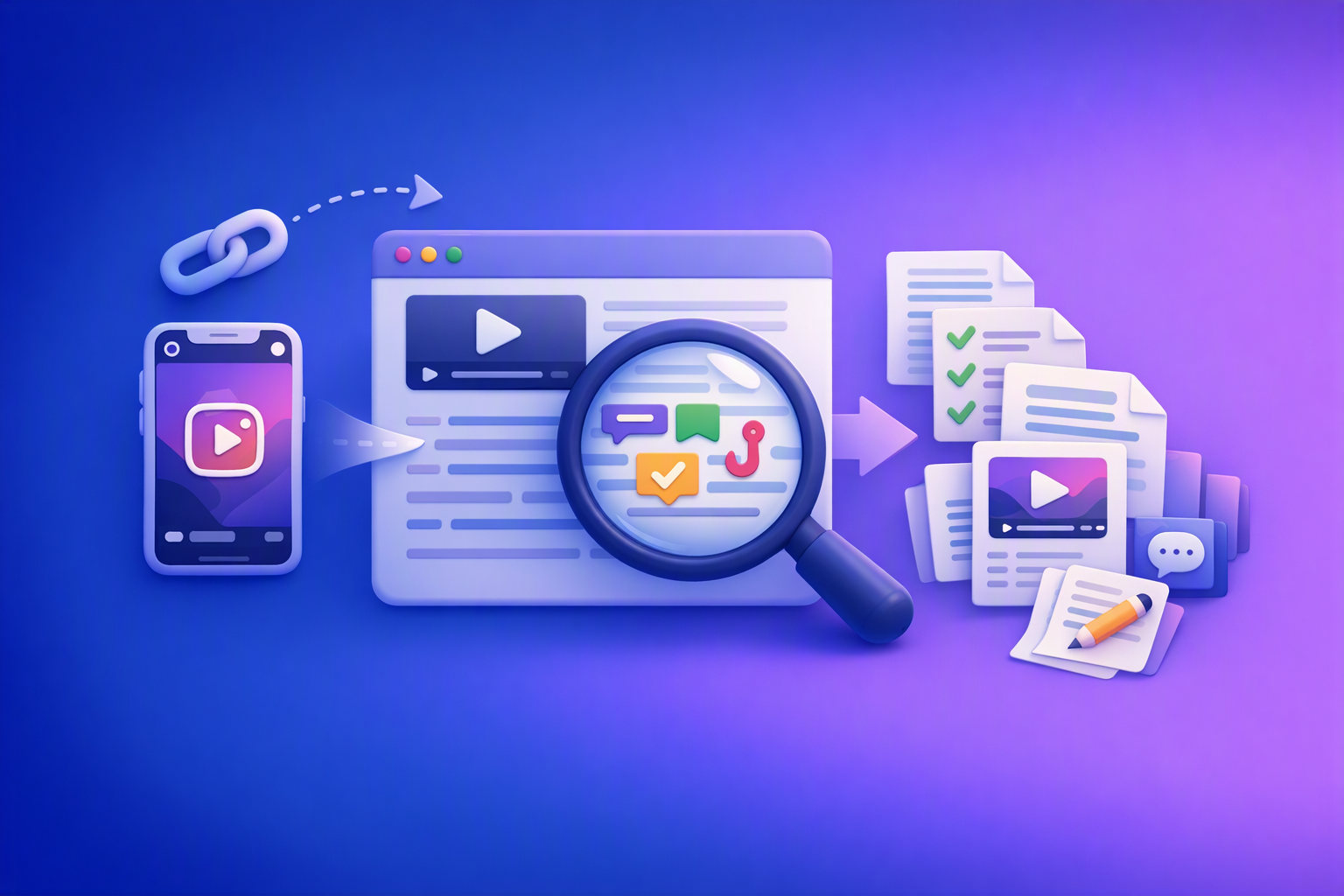
A 2026 reel analyser should turn Instagram Reel links into a searchable transcript library you can tag for hooks, CTAs, objections, and topic clusters—then export into repurposing-ready drafts without a download/upload loop.
Traducir video de Instagram (Reels) en 2026: workflow transcript-first para traducir, sacar hooks/CTAs y repurpose (con VideoToTextAI)
Video To Text AI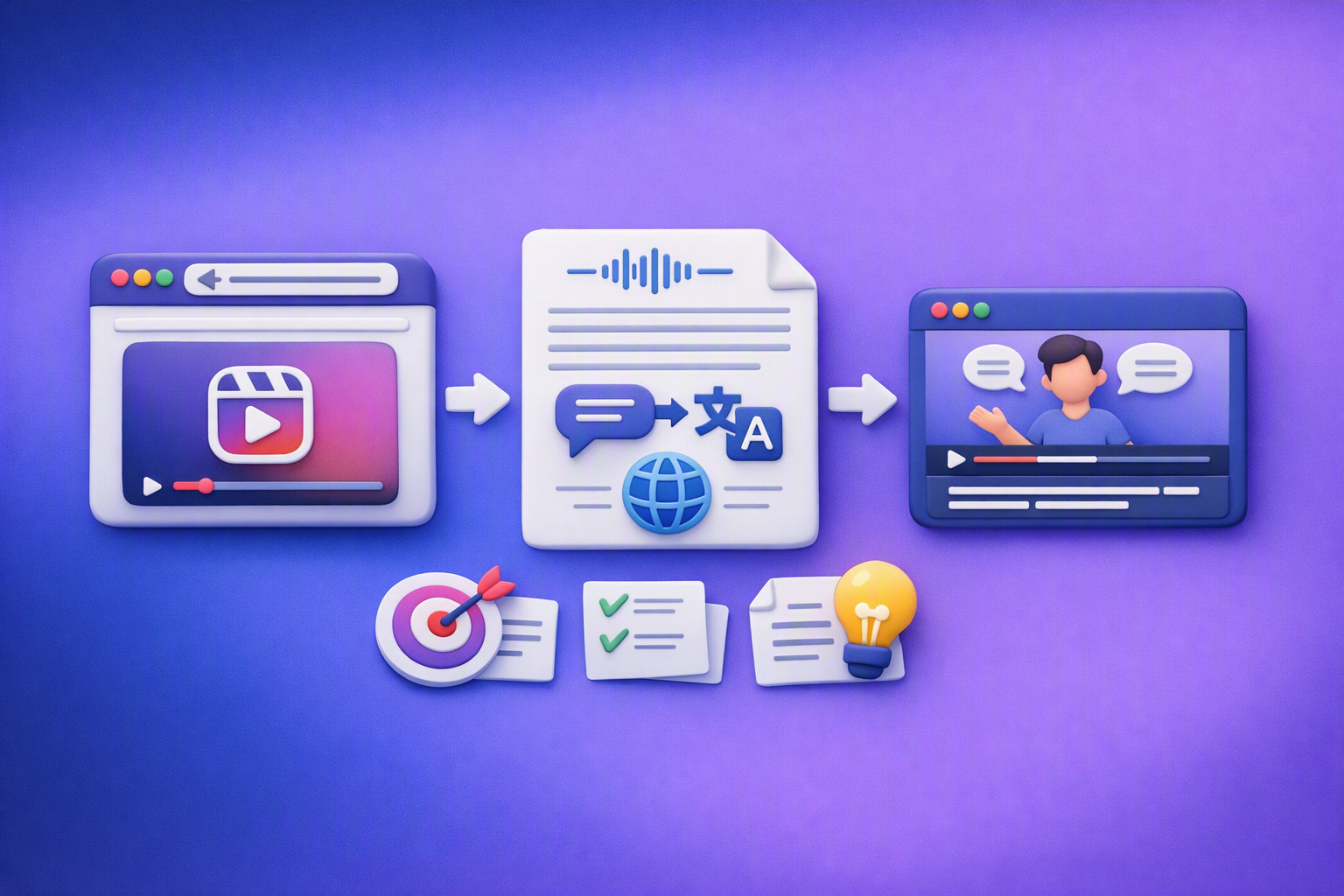
Aprende a traducir un Reel de Instagram con un flujo URL→transcripción→traducción→subtítulos, y a convertir esa traducción en un activo de investigación para hooks, CTAs, objeciones y clusters de contenido.
Reel Analyzer: Transcript‑First Instagram Reels Research (Hooks, CTAs, Objections) + Workflow Guide (VideoToTextAI)
Video To Text AI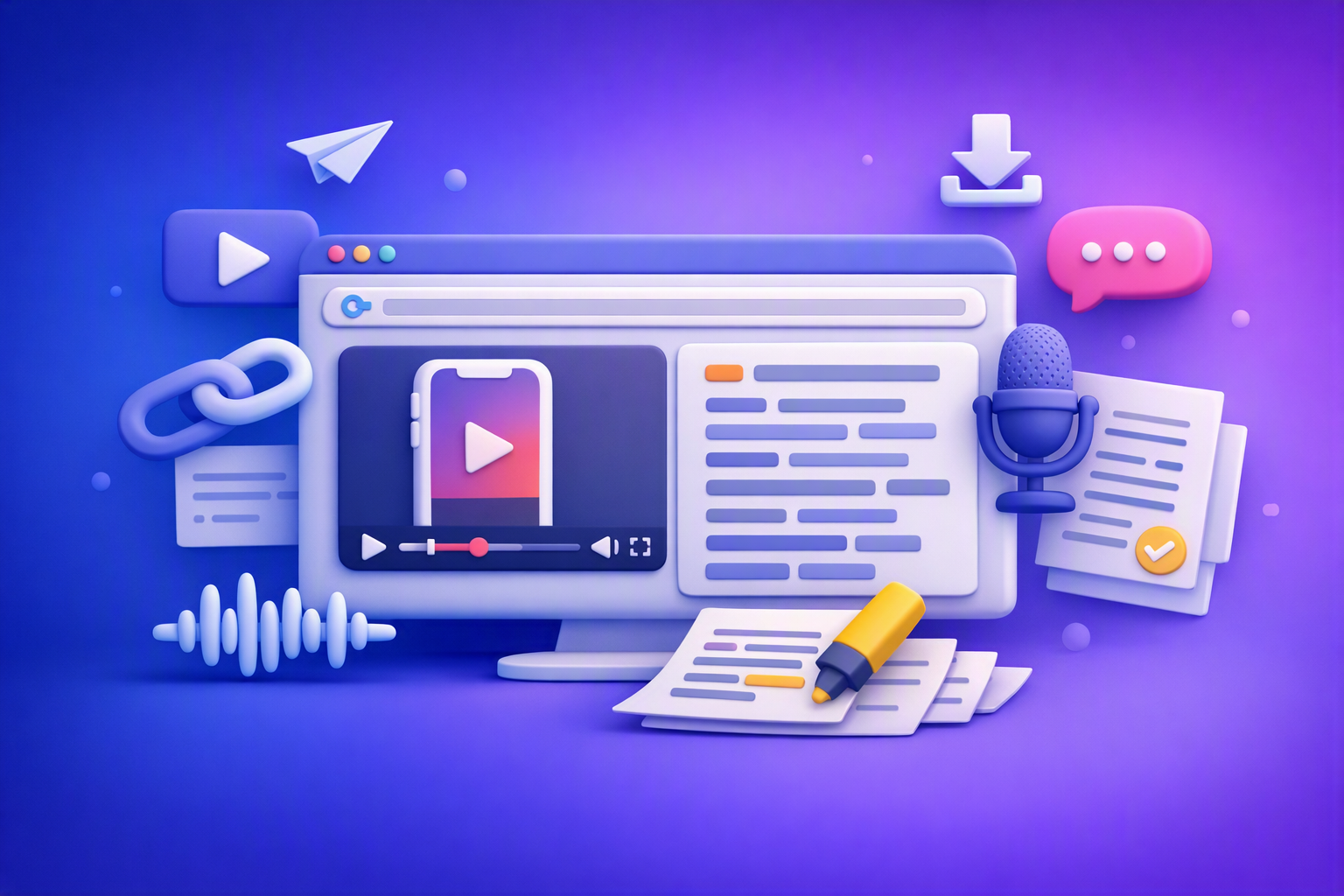
A reel analyzer should turn any public Instagram Reel link into a searchable transcript library you can mine for hooks, CTAs, objections, and topic clusters—then repurpose into original drafts with a repeatable SOP.