
Lyrics Extractor: How to Extract Lyrics from Any Song or Video Link (AI + Step-by-Step)
 Video To Text AI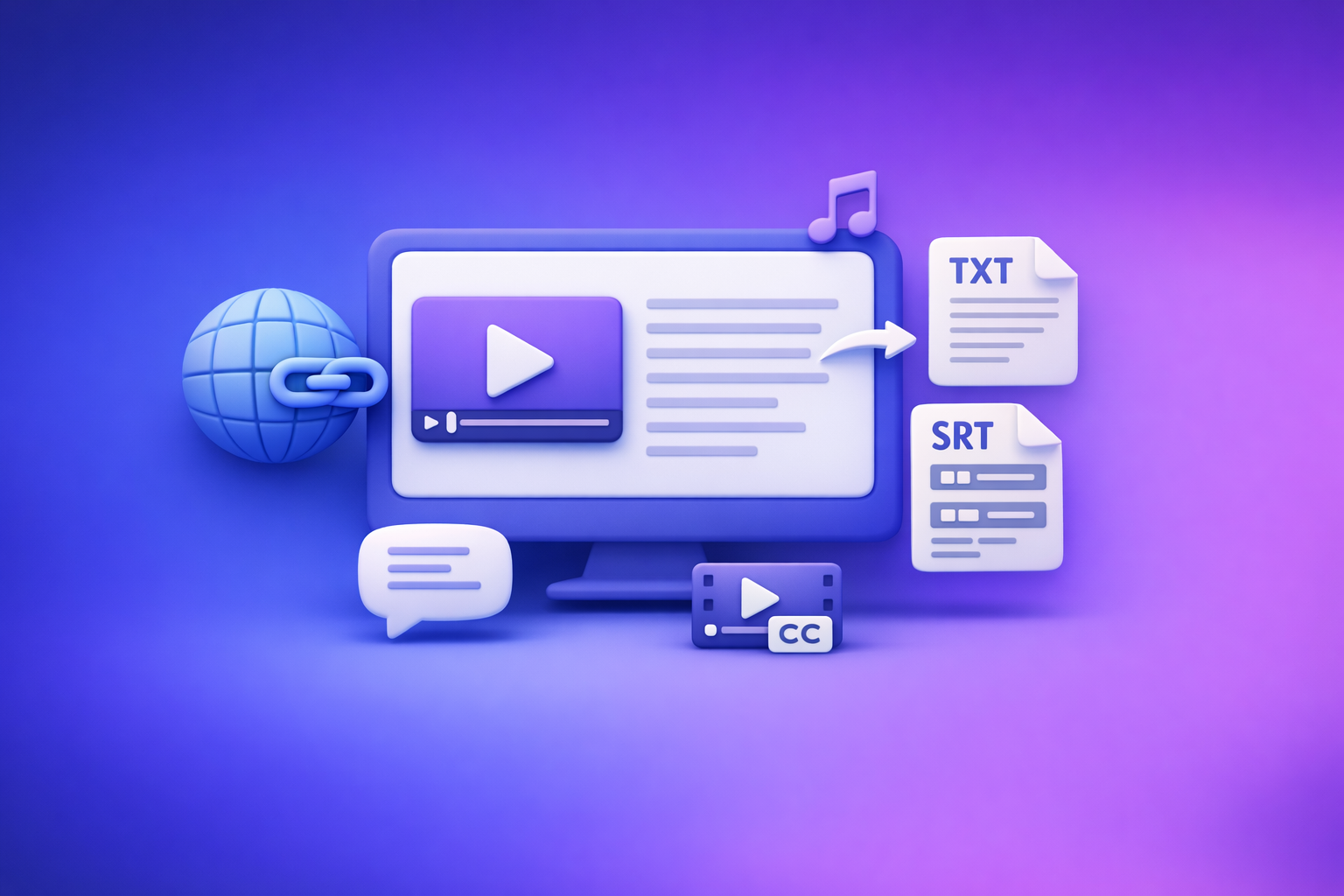
Extract lyrics by transcribing the audio (from a public video link or an audio file), then formatting the transcript into readable lyric lines or timed subtitles (SRT/VTT). The fastest workflow is link-based lyrics extraction—paste a URL, generate text, and export—because downloading and re-uploading files is an outdated, error-prone step.
What a “Lyrics Extractor” Actually Does (and What It Doesn’t)
A lyrics extractor is essentially speech-to-text tuned for music: it listens to vocals and converts what it hears into text. Some tools also add timestamps so you can verify lines against the audio.
Lyrics extraction vs “finding lyrics online”
These are different tasks:
- Finding lyrics online = retrieving an existing text version (often official or community-posted).
- Lyrics extraction = generating lyrics from the audio itself (AI transcription).
Extraction is useful when lyrics aren’t published, you’re working with a remix/live version, or you need timed output for subtitles.
When extraction works best (clear vocals, minimal crowd noise)
Expect the best results when:
- Vocals are front-and-center in the mix.
- The track is a studio recording (not a live crowd recording).
- There’s minimal overlap (few ad-libs stacked over lead vocals).
- The source is high quality (official upload > reupload > screen recording).
When you should use official lyrics instead (copyright + accuracy)
Use official lyrics when:
- You need word-for-word accuracy for publishing.
- The song has complex wordplay, names, or multilingual lines.
- You’re producing commercial assets where mistakes create risk.
Also note: lyrics are copyrighted in most cases. Extracting text for internal review, accessibility, or editing workflows is different from republishing full lyrics publicly. When in doubt, use licensed/official sources and follow platform rules.
Best Inputs for Lyrics Extraction (Audio, Video, and Links)
Your input choice determines speed, accuracy, and how much manual cleanup you’ll do.
Extract lyrics from audio files (MP3/WAV/M4A): pros/cons
Pros
- Often cleaner audio than a re-encoded video.
- Easy to trim and preprocess.
- Great for studio tracks you already have.
Cons
- Requires you to have the file (extra steps if your source is a link).
- File handling adds friction across devices/teams.
Extract lyrics from video files (MP4): pros/cons
Pros
- Useful if you already have the MP4 (music video, performance clip).
- Keeps audio + visual reference together for editing.
Cons
- Larger files, slower uploads.
- Many creators still waste time downloading videos first—this is exactly the bottleneck link-based workflows remove.
Extract lyrics from a link (YouTube/Instagram/public URLs): fastest workflow
Link-based extraction is the future of creator productivity. Instead of downloading a video, converting formats, and re-uploading, you:
- Copy a public URL
- Paste it into a workflow
- Export lyrics/subtitles immediately
This is the most repeatable approach for creators, editors, and marketers working across platforms.
Output formats you’ll want: TXT vs timestamped transcript vs SRT/VTT
Pick output based on what you’re making:
- TXT (clean lyrics): best for drafts, writing, review, and translation prep.
- Timestamped transcript: best for verifying hard-to-hear lines quickly.
- SRT/VTT: best for lyric videos, editors, and social captions with timing.
If you’re building a broader workflow, see: Video to Text: Convert Any Video Link into a Transcript, Subtitles (SRT/VTT), and Repurposed Content
Step-by-Step: Extract Lyrics from a Video Link with VideoToTextAI
This workflow is designed for speed: no downloads, no file conversions, no re-uploads—just link → transcript → export.
Step 1: Copy the public video URL (YouTube, Instagram Reel, etc.)
Use a public URL that the tool can access.
Prioritize sources in this order:
- Official artist/channel upload
- Official label/distributor upload
- High-quality repost
- Live recording (only if you must)
For Instagram-specific subtitle workflows, reference: How to Generate Subtitles (SRT & VTT Files) for Your Instagram Reels
Step 2: Paste the link into VideoToTextAI and choose the right workflow
Open VideoToTextAI and paste the URL into a link-based video-to-text workflow. (This is the modern alternative to downloading MP4s just to extract audio.)
Choose your output goal:
Option A: Clean lyrics text (no timestamps)
Use this when you want:
- A readable lyric draft
- Something to edit into verses/chorus
- A base for translation
Option B: Timestamped lyrics (for review and editing)
Use this when:
- The track has fast delivery or slang
- You expect mishears
- You need to verify lines quickly without scrubbing manually
Option C: SRT/VTT subtitles (for lyric videos and editors)
Use this when:
- You’re making a lyric video
- You’re delivering to an editor
- You need timed captions for Shorts/Reels/TikTok
If your main goal is link → transcript → repurposing, also see: How to Turn Any Video Link into a Transcript, Subtitles (SRT/VTT), and Repurposed Content (Step-by-Step)
Step 3: Generate the transcript and isolate the sung sections
Most music videos include non-lyric audio:
- Spoken intros/outros
- Skits/dialogue
- Producer tags
- Crowd noise (live clips)
Do a quick pass to:
- Remove spoken sections that aren’t lyrics
- Keep repeated hooks (you’ll format them cleanly later)
- Mark unclear lines for review (especially if you used timestamps)
Step 4: Edit for lyric formatting (line breaks, repeats, ad-libs)
Raw transcripts don’t read like lyrics until you format them.
Formatting rules that make lyrics readable
Use these rules consistently:
- One idea per line (don’t let lines run long)
- Break lines on natural pauses (breath points)
- Group into sections:
- [Verse 1]
- [Chorus]
- [Bridge]
- Keep the chorus identical each time unless the performance changes
- Use consistent capitalization and punctuation (minimal is fine)
How to handle “(yeah)”, “oh”, background vocals, and repeated hooks
Make ad-libs readable without clutter:
- Put ad-libs in parentheses:
(yeah),(uh),(oh) - If background vocals matter, label them:
- [Background]
(hold on)
- [Background]
- For repeated hooks, don’t rewrite from scratch—copy the chorus block and adjust only if words change.
Step 5: Export and use the result (TXT, SRT, VTT)
Export based on your downstream use.
Use case: lyric video subtitles (SRT/VTT)
- Export SRT for broad editor compatibility.
- Export VTT for web players and some social workflows.
- Keep subtitle lines short:
- Aim for 1–2 lines per caption
- Avoid long sentences; lyrics should “hit” on the beat
Use case: captions for Shorts/Reels/TikTok
For social captions:
- Prefer short, punchy lines (readable on mobile)
- Consider removing filler ad-libs unless they’re iconic
- Keep timing tight so captions don’t lag behind delivery
If your input is an Instagram link and you want a fast transcript first, see: Free Instagram Transcript Generator (From a Link): Get Reel Transcripts Fast with VideoToTextAI
Use case: translation/localization workflow
Best practice:
- Start with clean TXT lyrics
- Translate
- Then rebuild timed subtitles (SRT/VTT) for the translated version
- Add a review step for idioms, slang, and cultural references
Step-by-Step: Extract Lyrics from an MP3 (Upload-Based Workflow)
Upload-based workflows still work, but they add friction compared to link-based extraction. Use uploads when you truly don’t have a public URL or you’re working with private audio.
Step 1: Prepare the audio (trim silence, improve vocal clarity)
Before transcription:
- Trim long intros/outros and dead air
- Avoid clipping (distortion reduces accuracy)
- If you have tools available, lightly reduce noise (don’t over-process)
Step 2: Transcribe with a singing-optimized approach
Singing has stretched vowels and stylized pronunciation.
To improve results:
- Prefer a clean source (studio master > live recording)
- Use timestamps if available so you can verify quickly
- Expect to correct slang, names, and stylized phrasing
For a dedicated audio workflow, reference: MP3 to Lyrics: How to Convert Any MP3 into Accurate Lyrics (AI + Step-by-Step)
Step 3: Convert transcript to lyric formatting (verses/chorus/bridge)
Apply the same formatting rules:
- Add section labels
- Insert line breaks at natural pauses
- Normalize repeated choruses
Step 4: Quality check pass (names, slang, repeated phrases)
Do a targeted QA pass:
- Proper nouns (people, places, brands)
- Slang and contractions
- Repeated hooks (ensure consistency)
- Any line you’re unsure about (verify against timestamps/audio)
Accuracy Playbook: How to Get Cleaner Lyrics from Noisy Songs
You don’t need perfect audio—you need predictable steps to reduce errors.
Improve input quality (source selection, volume balance, clipping)
- Choose the cleanest source available (official upload wins)
- Avoid screen recordings (often compressed twice)
- If vocals are buried, try a different upload with better mixing
- Ensure audio isn’t clipping (peaking distortion causes mishears)
Segment long tracks (intro/verse/chorus) to reduce errors
Long tracks increase drift and compound mistakes.
Segmenting helps you:
- Focus on one section at a time
- Re-run only the problem segment
- Keep formatting clean (verse/chorus boundaries)
Use timestamps to verify hard-to-hear lines
Timestamps turn guessing into a quick check:
- Jump to the exact second
- Replay 2–3 times
- Decide the correct wording (or mark as unclear)
Common “AI lyric” failure modes (and fixes)
Misheard homophones (“your/you’re”, “there/their”)
Fix method:
- Use context (grammar + meaning)
- Check repeated lines (chorus often clarifies)
- Verify with timestamps on the clearest repetition
Vocal effects (autotune, distortion) and how to mitigate
- Find an alternate source (official audio upload vs music video)
- Use timestamped review and correct manually
- Expect errors on heavily processed consonants (“t”, “k”, “p”)
Overlapping vocals and crowd noise
- Prefer studio versions over live versions
- If live is required, accept that background chants may be merged into lead vocals
- Remove non-lyric crowd sections to keep output usable
Checklist: Lyrics Extractor Workflow (Copy/Paste SOP)
Before you start (input + goal)
- Confirm you have a public link or a clean audio/video file
- Decide output: TXT (lyrics), timestamped text, or SRT/VTT
- Pick the cleanest source (official upload > reupload > live recording)
Extraction run
- Paste link / upload file
- Generate transcript
- Identify sung sections and remove spoken intros/outros
- Apply lyric formatting rules (line breaks, repeats, labels)
Final QA + export
- Spot-check chorus + fastest verse
- Fix proper nouns and slang
- Export TXT and/or SRT/VTT
- Save a “final lyrics” version and a “timestamped review” version
Use Cases: What to Do After You Extract Lyrics
Create subtitles for a lyric video (SRT/VTT)
- Export SRT/VTT
- Keep lines short and beat-aligned
- Deliver to editors with consistent section formatting
Turn a music clip into social captions (short, readable lines)
- Use 1–2 short lines per caption
- Remove filler words if they hurt readability
- Keep the hook on-screen at the right moment
Translate lyrics for multilingual content (with review safeguards)
- Translate from clean TXT
- Add a human review for idioms and slang
- Re-time subtitles after translation (line length changes timing)
Repurpose behind-the-scenes music videos into blog content
Beyond lyrics:
- Pull quotes from spoken segments
- Turn the transcript into:
- a recap post
- a “making of” article
- short social snippets
Competitor Gap
Most “lyrics extractor” pages promise results but skip the implementation details that determine whether you get usable output.
What competitors typically miss (and what this post includes):
- A link-based workflow (no downloads) with clear output choices (TXT vs SRT/VTT)
- A repeatable SOP checklist for consistent results
- Troubleshooting for real-world audio (live versions, crowd noise, vocal effects)
- Formatting rules to turn raw transcripts into readable lyrics
- Export guidance for lyric videos and editors (SRT/VTT specifics)
If you’re comparing tools and workflows, see: videototext.io vs VideoToTextAI: Link-Based Video-to-Text Workflows for Transcripts, Subtitles, Captions, and Repurposing (2026)
FAQ
Can AI accurately extract lyrics from a song?
Yes, when the source is clean and vocals are clear. For difficult tracks, use timestamped output and do a focused QA pass on the chorus and fastest verse.
How do I extract lyrics from a YouTube video link?
Copy the public URL, paste it into a link-based transcription workflow, generate the transcript, isolate sung sections, then export as TXT (lyrics) or SRT/VTT (subtitles).
Is there a free lyrics extractor online?
Some tools offer free tiers, but “free” often comes with limits (length caps, lower accuracy, fewer exports). If you need repeatable creator workflows, prioritize link-based processing and the export formats you actually use.
Can I extract lyrics from a video (MP4) and export SRT/VTT?
Yes. Transcribe the MP4, then export SRT/VTT and adjust line breaks for lyric readability. Keep captions short and aligned to the beat.
Why are the extracted lyrics wrong for some songs?
Common causes:
- Heavy vocal effects (autotune/distortion)
- Overlapping vocals/ad-libs
- Crowd noise (live recordings)
- Low-quality reuploads or screen recordings
Fixes include choosing a cleaner source, segmenting sections, and using timestamps to verify unclear lines.
Try VideoToTextAI for link-based lyrics extraction + exports
Paste a video link → generate transcript → export TXT/SRT/VTT using a modern, link-first workflow that avoids downloads and keeps creator production moving: https://videototextai.com
Related posts
Reel Analyser (Instagram Reels): Transcript‑First Competitor Research, Hook/CTA Extraction, and Repurposing Workflow (VideoToTextAI)
Video To Text AI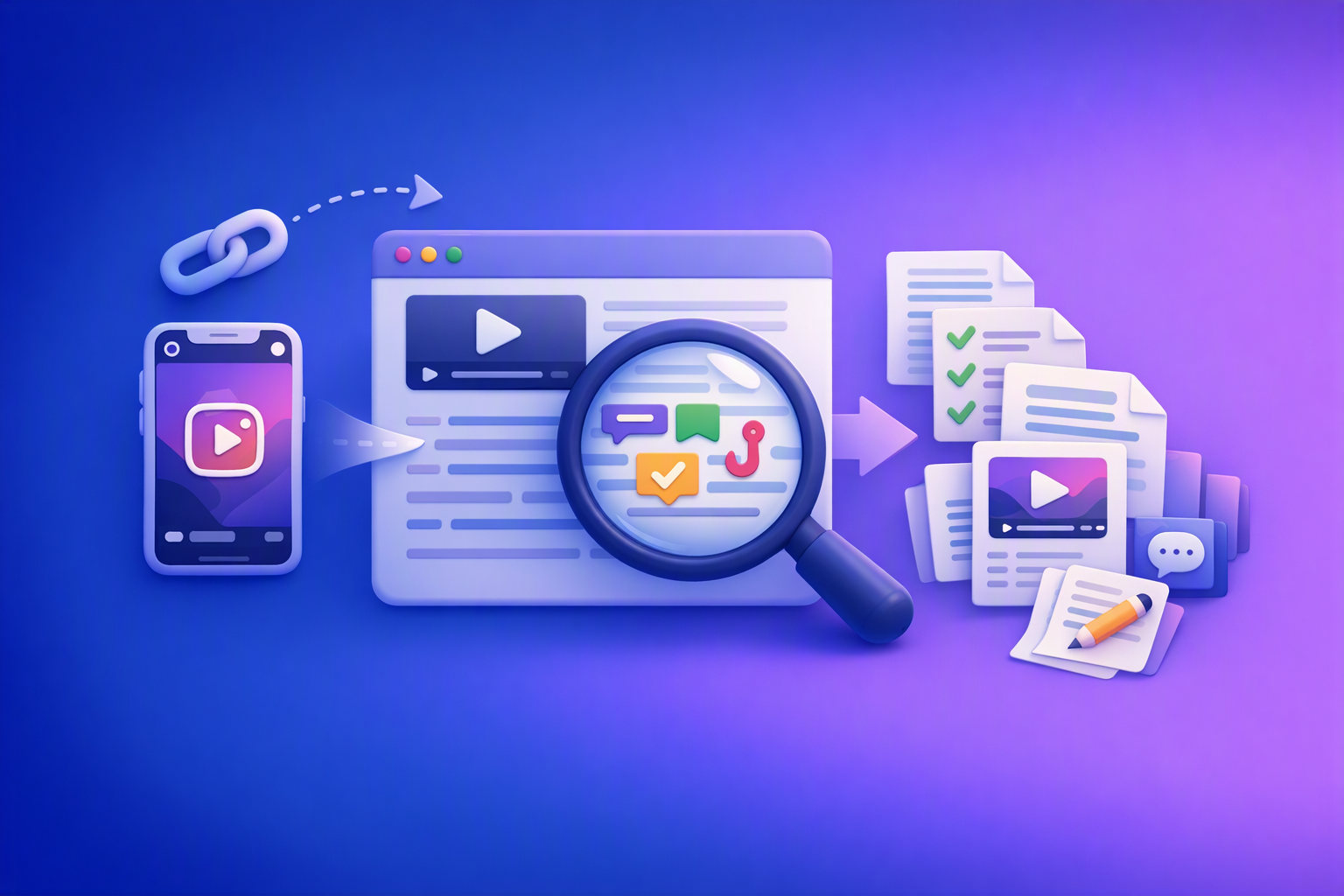
A 2026 reel analyser should turn Instagram Reel links into a searchable transcript library you can tag for hooks, CTAs, objections, and topic clusters—then export into repurposing-ready drafts without a download/upload loop.
Traducir video de Instagram (Reels) en 2026: workflow transcript-first para traducir, sacar hooks/CTAs y repurpose (con VideoToTextAI)
Video To Text AI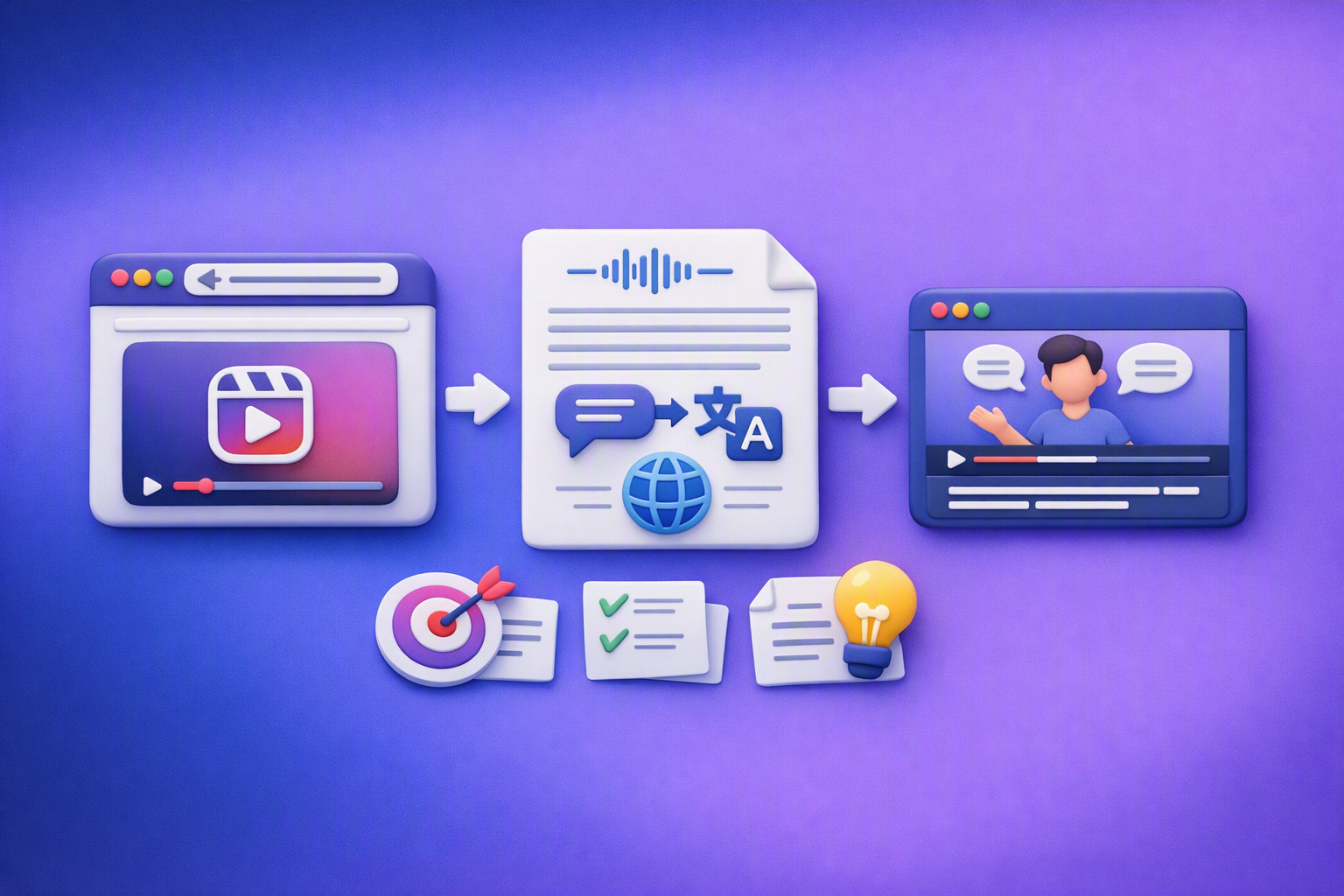
Aprende a traducir un Reel de Instagram con un flujo URL→transcripción→traducción→subtítulos, y a convertir esa traducción en un activo de investigación para hooks, CTAs, objeciones y clusters de contenido.
Reel Analyzer: Transcript‑First Instagram Reels Research (Hooks, CTAs, Objections) + Workflow Guide (VideoToTextAI)
Video To Text AI
A reel analyzer should turn any public Instagram Reel link into a searchable transcript library you can mine for hooks, CTAs, objections, and topic clusters—then repurpose into original drafts with a repeatable SOP.