
“Max 0 Uploads at a Time” Upload Limit Reached in ChatGPT: Meaning, Fixes, and the No-Upload Video→Text Workflow (2026)
 Video To Text AI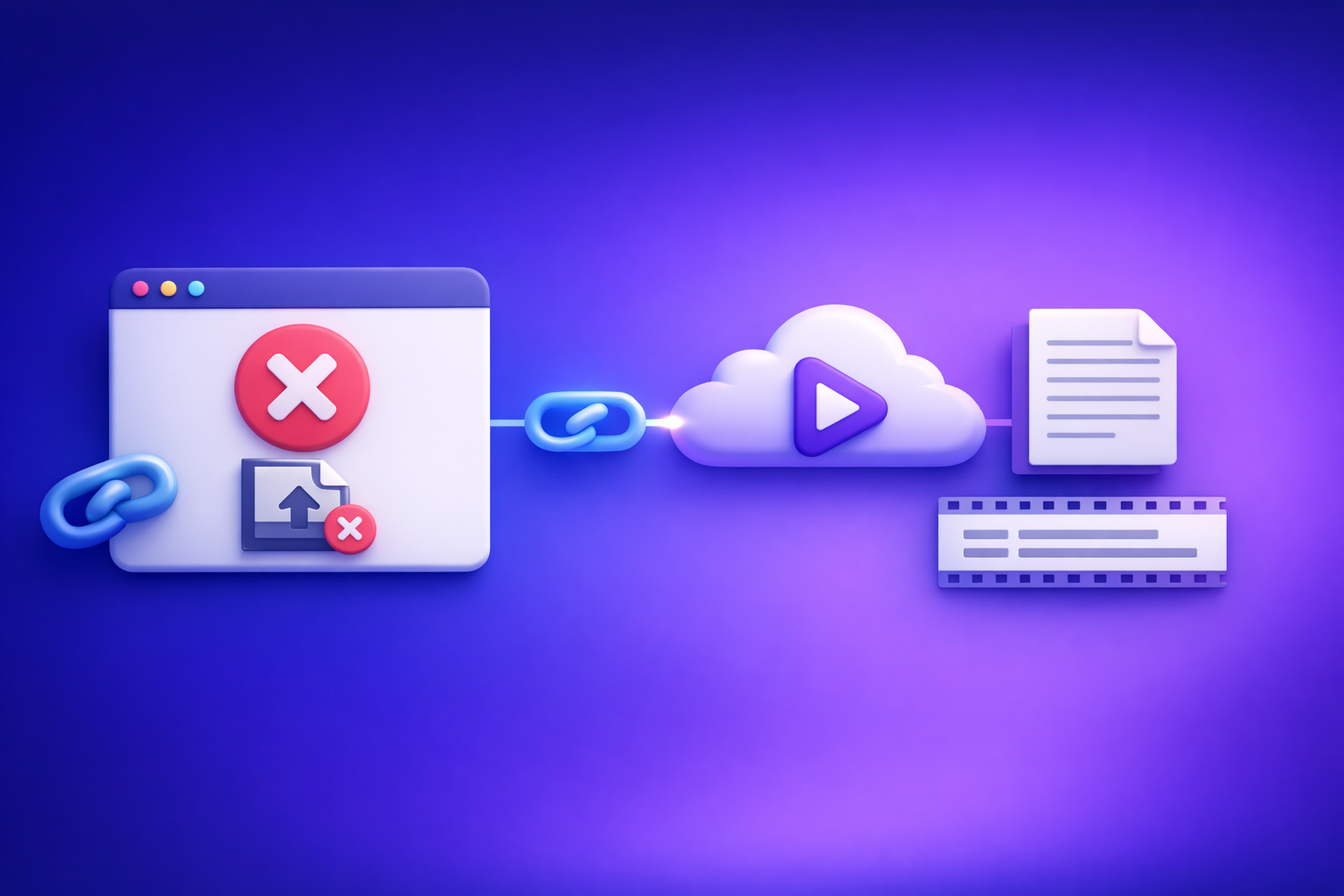
If ChatGPT says “max 0 uploads at a time” or “upload limit reached,” treat it as uploads being disabled (a capability toggle), not a problem with your file. Use the 10-minute isolation steps below, and if it persists, switch to a no-upload video→text workflow that still produces TXT/SRT/VTT deliverables on deadline.
Who this is for (and what you’ll fix in 10 minutes)
You’re in the right place if:
- You see “max 0 uploads at a time” or “upload limit reached” in ChatGPT.
- You need transcripts, subtitles, captions, or repurposed content today.
- You want a repeatable workflow that doesn’t break when ChatGPT uploads are unavailable.
If you’re trying to upload a video specifically, also see: ChatGPT “Upload Video” Feature (2026): How It Works, Limits, Fixes, and the Reliable No-Upload Workflow.
What “max 0 uploads at a time” actually means
The plain-English meaning
Your current ChatGPT context has file uploads set to zero.
This is not the same as:
- “Your file is corrupted”
- “Your file is too large”
- “You hit a usage quota”
It’s closer to: “Uploads are disabled here.”
Where the “0 uploads” setting can come from
Common sources:
- Surface/app limitation (web vs mobile vs desktop).
- Model capability mismatch (the selected model/thread doesn’t support uploads in your plan).
- Thread-level state (a specific chat has uploads disabled even if others don’t).
- Workspace/org policy (ChatGPT Team/Enterprise admin restrictions).
- Browser/network blocking (extensions, VPN, corporate proxy, DNS filtering).
- Temporary service-side degradation (feature rollouts, toggles, partial outages).
If your UI issue is specifically “Add files” missing, see: “Add Files” Button Unavailable in ChatGPT: Why It Happens + Fixes (and a No-Upload Workflow).
Fast diagnosis (2 minutes): isolate the block
Step 1 — Confirm it’s not just this thread
- Start a new chat.
- Check whether the paperclip / Add files control appears.
- If the new chat works, the issue is thread-level.
Thread-level weirdness is common. Don’t over-troubleshoot a single conversation.
Step 2 — Switch to an upload-capable model (if available)
- Open the model picker.
- Select a model that supports file uploads in your plan.
- Re-check the upload UI.
- Test with a tiny file (like a small
.txt) to remove file-size variables.
If you see “attachments disabled” messaging, this related guide may be faster: “Attachments Disabled for” ChatGPT: Meaning, Root Causes, Fixes, and the No-Upload Transcript Workflow (2026).
Step 3 — Cross-surface test
Try the same action on:
- Another browser profile (no extensions)
- Incognito/private window
- Mobile app (or desktop app)
If one surface works, the issue is local to the failing surface (browser data, extensions, local network rules).
Step 4 — Identify policy/network blocks
If you’re on a work/school account:
- Try a personal account on the same device/network.
- Try the same account on a different network (hotspot).
If hotspot works, it’s likely network filtering/proxy/VPN.
Fixes in priority order (do these exactly)
Fix 1 — New chat + correct model (most common)
- Create a new chat.
- Select an upload-capable model.
- Retry the upload.
If this works, you’re done. If it fails, keep going.
Fix 2 — Hard refresh + sign out/in
- Hard refresh the page.
- Sign out of ChatGPT.
- Sign back in and retry.
This clears stale UI state and auth/session edge cases.
Fix 3 — Remove local blockers (browser)
Do this in order:
- Disable extensions that intercept requests:
- ad blockers
- privacy tools
- script blockers
- Clear site data for
chat.openai.com(cookies + cache). - Retry in a clean browser profile.
If uploads suddenly appear, re-enable extensions one-by-one to find the blocker.
Fix 4 — Network/VPN/proxy isolation
- Turn off VPN temporarily.
- Switch networks (hotspot test).
- If corporate network blocks uploads, document it and escalate to IT.
Practical note: many corporate environments block file transfer endpoints or attachment features via proxy/DLP.
Fix 5 — Workspace policy check (Team/Enterprise)
Ask your admin to confirm:
- File uploads enabled for your workspace
- Any DLP/attachment restrictions that disable uploads
If policy is “uploads disabled,” stop troubleshooting. You need an operational workflow that doesn’t depend on ChatGPT attachments.
Fix 6 — Wait for service-side recovery (only after isolation)
If uploads are missing across devices/networks/accounts:
- Wait 10–30 minutes and retry.
- Use the no-upload workflow below immediately to avoid downtime.
The production-safe workaround: no-upload video→text workflow (ships today)
Brand POV (operational reality): downloading video files, re-uploading them, and hoping a UI toggle is enabled is an outdated workflow. Link-based extraction is the future of creator productivity because it’s faster, more portable, and less dependent on any single app’s attachment feature.
When to choose no-upload (decision rule)
Choose no-upload if “max 0 uploads” persists after:
- New chat + model switch + clean browser test (≈10 minutes)
Also choose no-upload if you need export-ready deliverables (TXT/SRT/VTT) with predictable output for publishing.
Workflow overview (link/MP4 → TXT/SRT/VTT → ChatGPT-on-text)
- Get the video source (YouTube/Instagram/TikTok link or MP4).
- Generate transcript + captions files (TXT/SRT/VTT) with VideoToTextAI.
- Paste transcript into ChatGPT (or chunk it) for:
- summaries
- outlines
- blog posts
- social posts
- translations
- Keep SRT/VTT for publishing (YouTube, TikTok, Reels, LMS, web players).
If you want tool-specific paths, these are useful references:
Step-by-step: Link-based transcription with VideoToTextAI
Step 1 — Choose input type
- Use a public link when possible (faster, no upload dependency).
- Use MP4 only when you must (local file, private footage, offline source).
Link-based input is the key operational advantage: you avoid attachment toggles, browser failures, and “max 0 uploads” entirely.
Step 2 — Generate the right outputs
Generate outputs based on what you’re shipping:
- TXT for editing, search, repurposing, and feeding into ChatGPT.
- SRT for subtitles on most platforms and editors.
- VTT for web players and some editing workflows.
If your goal is publishing captions, prioritize SRT/VTT first, then do repurposing second.
Step 3 — Quality pass (2-minute review)
Before you hand it off or publish:
- Scan for speaker names (if applicable).
- Fix acronyms/brand terms (product names, people, locations).
- Spot-check timestamp alignment (especially around cuts, music, or cross-talk).
This is usually faster than trying to “perfect” captions inside a locked UI.
Step-by-step: Use ChatGPT on transcript text (no attachments)
Once you have TXT/SRT/VTT, you can use ChatGPT without uploading anything.
Prompt template: clean summary + key points
Summarize this transcript in 10 bullets, then list 5 key quotes with timestamps:
[paste transcript]
If you have timestamps in the transcript, keep them. They make quotes and clips far more actionable.
Prompt template: captions cleanup rules
Rewrite captions for readability, keep meaning, max 42 chars/line, keep timestamps unchanged:
[paste SRT]
This is a practical way to improve readability without breaking sync.
Prompt template: repurpose into assets
Turn this transcript into: (1) blog outline, (2) LinkedIn post, (3) 5 tweet thread, (4) 10 short hooks:
[paste transcript]
If you want a repeatable pipeline, standardize these prompts in a doc and reuse them per video.
If the transcript is too long: chunking method that doesn’t break results
Use chunking so outputs stay coherent:
- Split by timestamps every 5–10 minutes.
- Ask ChatGPT to:
- summarize each chunk
- then synthesize a final combined output from the chunk summaries
Practical pattern:
- “Summarize chunk 1 into 8 bullets + 3 quotes.”
- Repeat for chunks 2–N.
- “Combine these chunk summaries into a single outline + final summary.”
This avoids context overflow and reduces hallucinated “missing sections.”
Implementation checklist (copy/paste)
- New chat created
- Upload-capable model selected
- Tested incognito / clean profile
- Extensions disabled (ad/privacy/script blockers)
- VPN off + hotspot test completed
- Workspace policy confirmed (if Team/Enterprise)
- If still blocked: VideoToTextAI used to generate TXT + SRT/VTT
- Transcript chunked (if needed) and processed in ChatGPT
- Final deliverables exported (TXT/SRT/VTT + repurposed content)
Common scenarios (and the fastest path)
Scenario A: “Max 0 uploads” only in one chat
Fastest fix:
- New chat + model switch → done
This is usually thread state, not your account.
Scenario B: “Max 0 uploads” on work account only
Fastest fix:
- Confirm workspace policy with admin
- Use the no-upload workflow immediately
If uploads are disabled by policy, troubleshooting is wasted time.
Scenario C: Upload UI missing everywhere on your device
Fastest fix:
- Clean browser profile
- Disable extensions
- Clear site data
If it works in a clean profile, you’ve found a local blocker.
Scenario D: Uploads fail only on corporate Wi‑Fi
Fastest fix:
- Hotspot test works → network filtering confirmed
- Use no-upload workflow + escalate to IT
Don’t wait on IT to ship captions.
VideoToTextAI vs Competitors
When “max 0 uploads at a time” blocks you, the deciding factor is whether the workflow depends on attachments. Link-based video→text is inherently more operationally repeatable than “download → upload → hope it works.”
| Criteria | VideoToTextAI | OpenAI ChatGPT (native uploads) | YouTube built-in transcripts | Descript | Otter.ai |
|---|---|---|---|---|---|
| Works when ChatGPT uploads are disabled | Yes (link-based workflow avoids ChatGPT attachments) | No (if uploads are disabled, you’re blocked) | Sometimes (only where transcripts exist/are accessible) | Yes (separate app), but not link-first for every source | Yes (separate app), meeting-first orientation |
| Link-based input (avoid downloading files) | Yes (core workflow) | Not the point; typically attachment-driven for files | Yes (YouTube-only) | Varies by source; often file/project-based | Not primary; often recording/import |
| Export formats for publishing | TXT/SRT/VTT outputs for portability | Not a transcript export tool by default | Limited; not always clean SRT/VTT export | Strong editing + export options | Strong for notes/transcripts; caption exports vary by workflow |
| Speed to first usable transcript | Fast: link → transcript/captions → paste text into ChatGPT | Fast only when uploads work | Fast if available; quality varies | Fast, but heavier editing suite overhead | Fast for meetings; less direct for creator caption pipelines |
| Best fit | Creators/marketers shipping captions + repurposed content on deadlines | Text reasoning, rewriting, ideation (when attachments work) | Quick reference for YouTube content | Deep edit + production workflows | Meetings, calls, and ongoing note capture |
Fair callouts:
- ChatGPT is excellent for analysis and repurposing once you have text, but it’s not reliable as the ingestion layer when uploads are disabled.
- YouTube transcripts can be the fastest option when available, but they’re platform-limited and not always export-ready.
- Descript is strong if you need a full editing suite; it can be heavier than necessary if your immediate need is “get TXT/SRT/VTT now.”
- Otter.ai is great for meeting capture; it’s not optimized as a link-first creator caption pipeline.
If you want the most repeatable “no-attachment” pipeline, use VideoToTextAI as the ingestion/export layer, then use ChatGPT on the resulting text. Use it here (single link CTA): https://videototextai.com
Competitor Gap
Most guides stop at “try another browser/model” and don’t provide a production workflow when uploads are permanently disabled by policy.
What’s usually missing:
- The explanation that “max 0 uploads” is a context-level setting (surface/model/thread/workspace), not a file-size issue.
- A focus on deliverables (TXT/SRT/VTT) instead of “getting the upload to work.”
- A repeatable no-upload pipeline (link/MP4 → TXT/SRT/VTT → ChatGPT-on-text) with:
- a checklist
- a chunking method that preserves output quality
For a deeper version of this same topic, see: “Max 0 Uploads at a Time” in ChatGPT: What It Means, Why It Happens, and the Fastest No-Upload Workflow (2026).
FAQ
Why does ChatGPT say “max 0 uploads at a time”?
Because uploads are disabled in your current context (model/surface/thread/workspace policy/network), so the allowed concurrent uploads is effectively set to zero.
How do I fix “upload limit reached” when I haven’t uploaded anything?
Do this sequence:
- New chat
- Switch to an upload-capable model
- Test in incognito/clean profile
If it only fails on a work account or corporate network, it’s likely policy or filtering, not usage.
Is “max 0 uploads at a time” a rate limit or a permissions issue?
Usually a permissions/context issue (uploads disabled). Treat it like a capability toggle, not a usage quota.
What’s the fastest workaround if uploads are blocked?
Use a no-upload workflow:
- Generate TXT/SRT/VTT from a video link (or MP4 when needed)
- Paste the transcript text into ChatGPT for summaries, rewrites, and repurposing
This ships deliverables even when attachments are unavailable.
Related posts
Reel Analyser (Instagram Reels): Transcript‑First Competitor Research, Hook/CTA Extraction, and Repurposing Workflow (VideoToTextAI)
Video To Text AI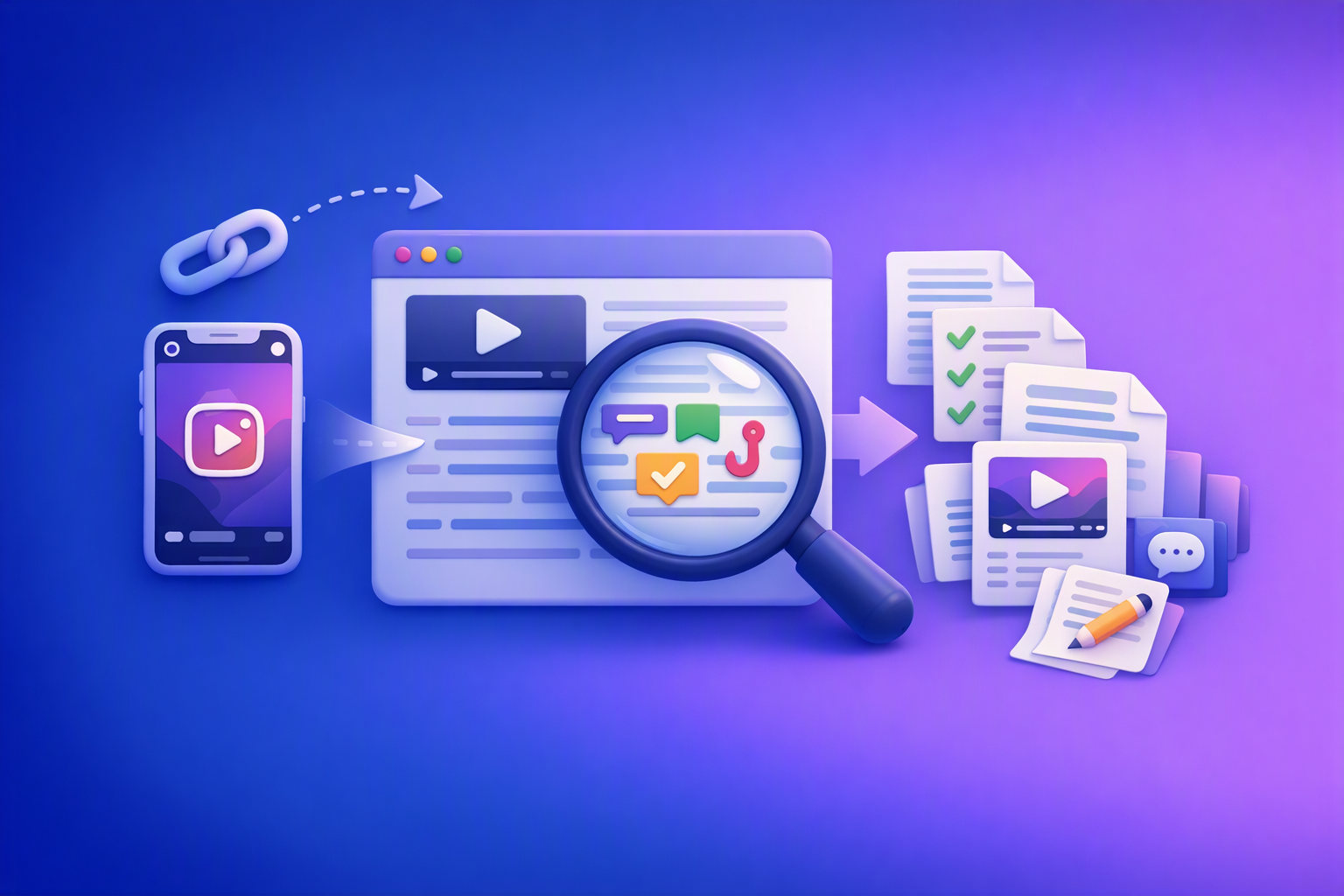
A 2026 reel analyser should turn Instagram Reel links into a searchable transcript library you can tag for hooks, CTAs, objections, and topic clusters—then export into repurposing-ready drafts without a download/upload loop.
Traducir video de Instagram (Reels) en 2026: workflow transcript-first para traducir, sacar hooks/CTAs y repurpose (con VideoToTextAI)
Video To Text AI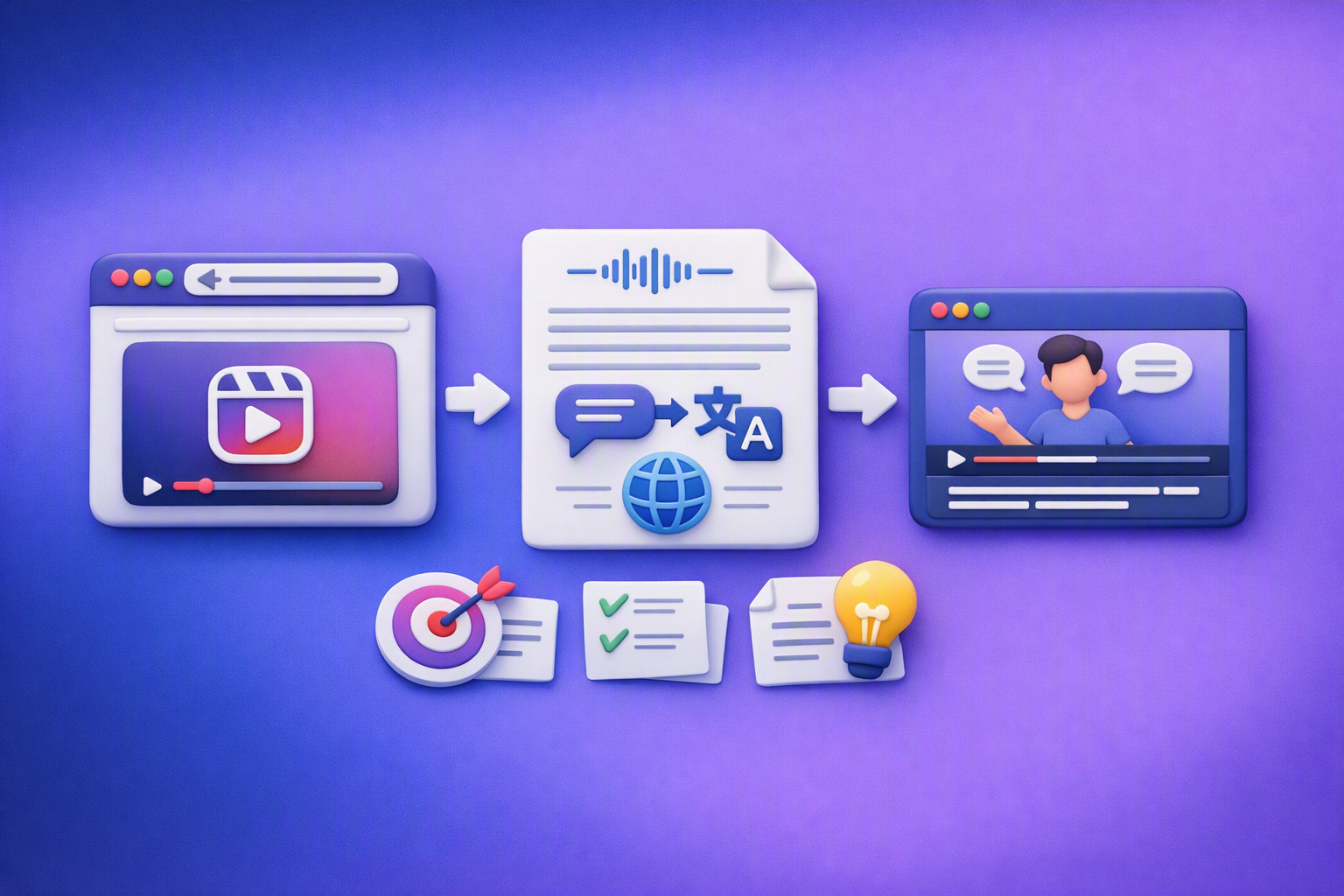
Aprende a traducir un Reel de Instagram con un flujo URL→transcripción→traducción→subtítulos, y a convertir esa traducción en un activo de investigación para hooks, CTAs, objeciones y clusters de contenido.
Reel Analyzer: Transcript‑First Instagram Reels Research (Hooks, CTAs, Objections) + Workflow Guide (VideoToTextAI)
Video To Text AI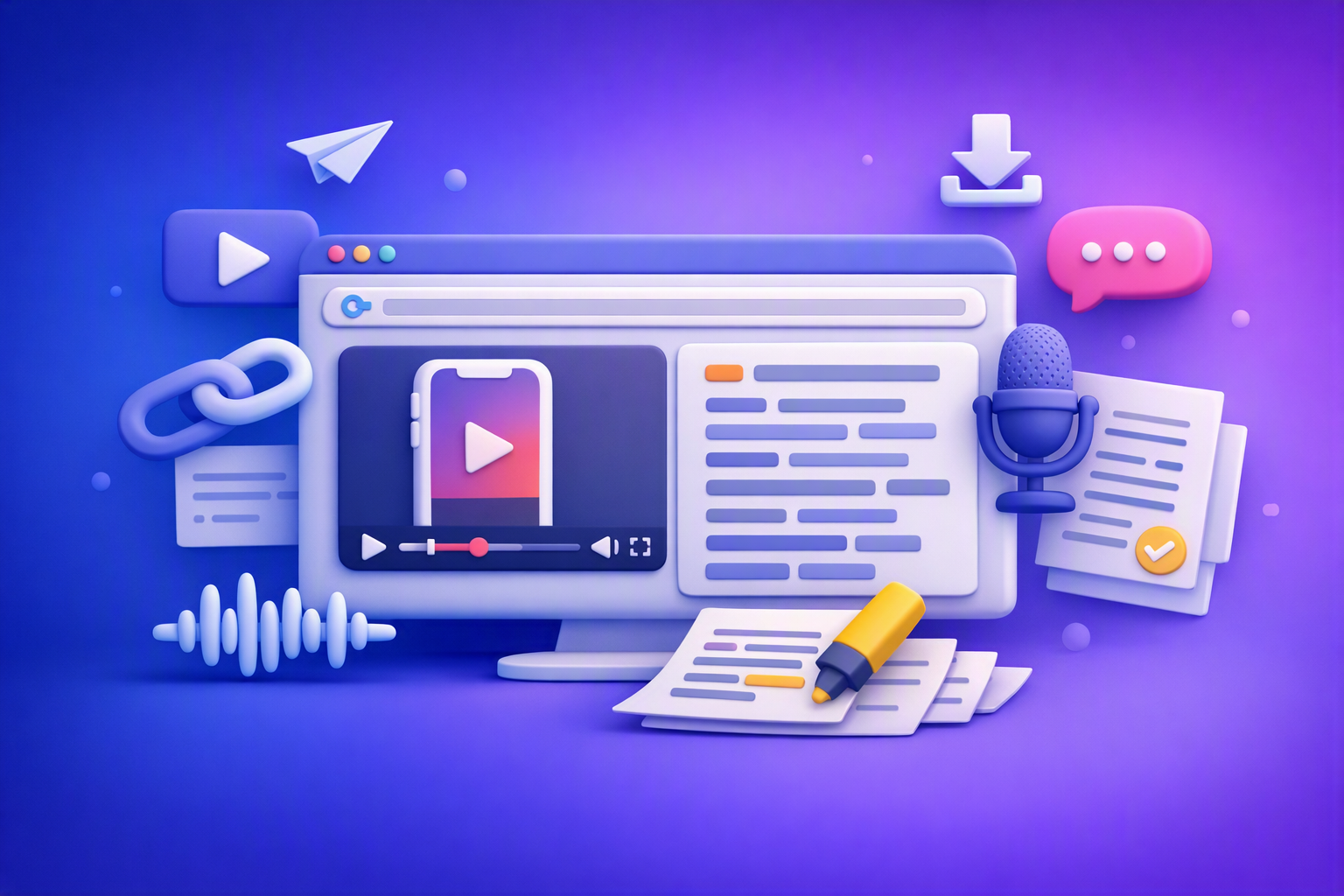
A reel analyzer should turn any public Instagram Reel link into a searchable transcript library you can mine for hooks, CTAs, objections, and topic clusters—then repurpose into original drafts with a repeatable SOP.