
ChatGPT “Upload Video” Feature (2026): How It Works, Limits, Fixes, and the Reliable No-Upload Workflow
 Video To Text AI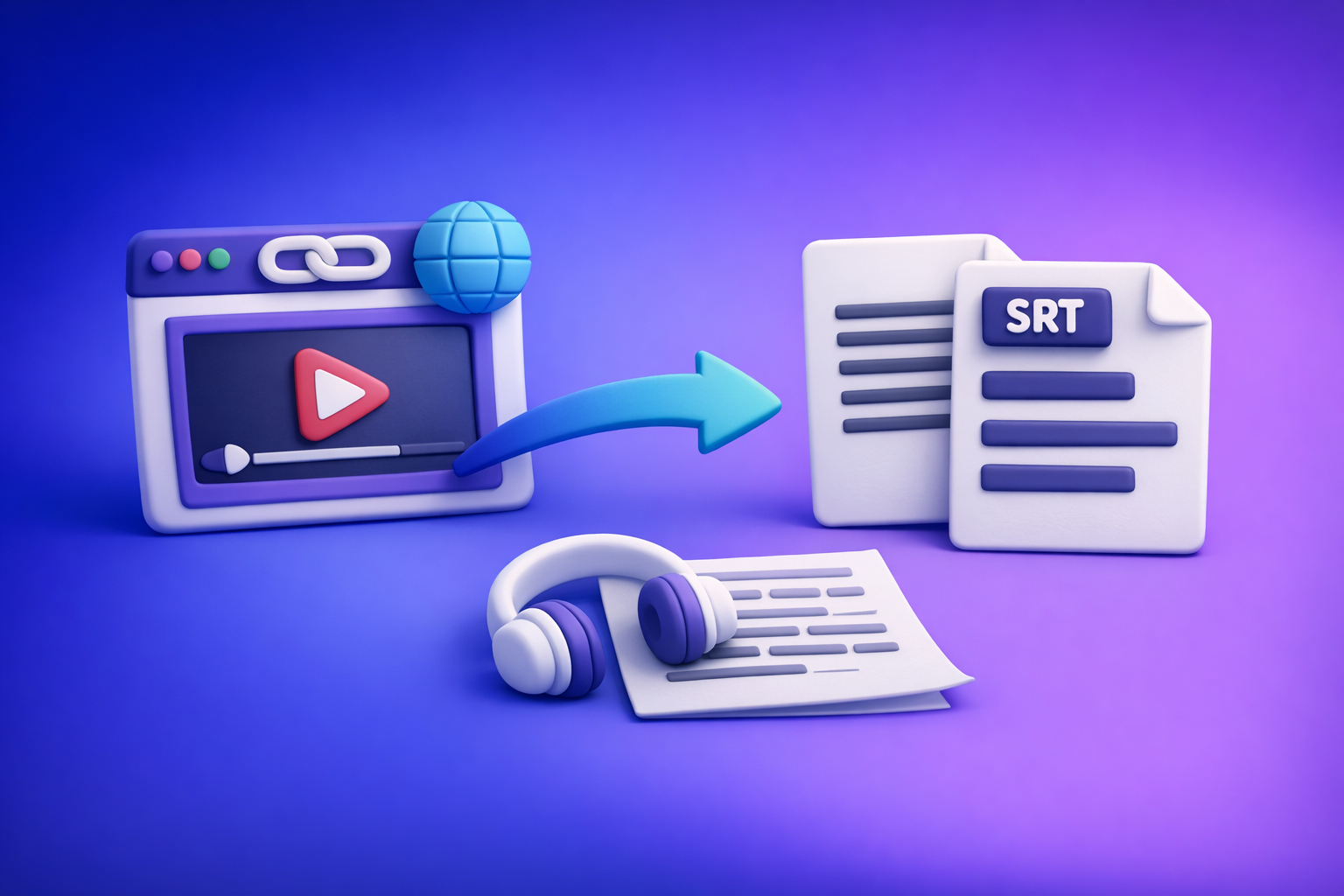
ChatGPT’s “upload video” feature is not a production-safe way to get transcripts, subtitles, or captions in 2026. The reliable workflow is no-upload: extract text deterministically (TXT/SRT/VTT), then use ChatGPT to summarize, rewrite, and repurpose.
This post explains what “upload video” actually means, why it breaks, how to fix it fast, and how to ship deliverables every time with a transcript-first pipeline.
What “Upload Video” Means in ChatGPT (and What It Doesn’t)
File upload vs link sharing vs “analyze frames”
People use “upload video” to mean three different things:
- File upload: attaching an MP4/MOV directly in ChatGPT.
- Link sharing: pasting a URL and expecting ChatGPT to “watch” it (often blocked by permissions/paywalls/geo).
- Analyze frames: the model extracts limited visual/audio signals from a short clip (not the same as full transcription exports).
Important: even when ChatGPT accepts a video file, that does not guarantee export-ready outputs (like SRT/VTT) or timestamp integrity.
What ChatGPT can realistically do with uploaded video
When it works, ChatGPT is best for:
- Short clip Q&A (“What happens at 0:12?” “What objects are on screen?”)
- High-level summaries of a short segment
- Idea generation (hooks, titles, angles) based on what it can infer
What ChatGPT is not reliable for (export-ready transcripts/captions)
ChatGPT is not consistently reliable for:
- Accurate, full-length transcription
- Timestamped captions you can publish (SRT/VTT with correct timing)
- Long videos without timeouts, processing stalls, or missing segments
If you need shippable files, treat ChatGPT as the editor, not the extractor.
Quick Answer: Can You Upload a Video to ChatGPT?
Yes—sometimes, depending on where you’re using ChatGPT and what’s enabled for your account.
When the upload button appears (client/surface + model + plan variability)
The attachment/upload UI can vary by:
- Surface: web app vs iOS vs Android
- Model selection: some models/threads support attachments; others don’t
- Plan and rollout state: features can change by region/time
When it won’t appear (workspace policy, thread context, network restrictions)
Common reasons it won’t show up:
- Workspace policy disables attachments
- Thread context (some chats/tools don’t allow files)
- Network restrictions (corporate proxies, VPN rules, content filters)
If you’re seeing errors like “max 0 uploads at a time”, jump to the fix sequence and the dedicated troubleshooting posts:
- “Max 0 Uploads at a Time” in ChatGPT: What It Means, Why It Happens, and the Fastest No-Upload Workflow (2026)
- “Attachments Disabled for” ChatGPT: What It Means, Why It Happens, and Fixes That Work (2026)
- “Add Files” Button Unavailable in ChatGPT: Why It Happens + Fixes (and a No-Upload Workflow)
What People Actually Want When They Search “ChatGPT Upload Video Feature”
Most searches map to one of these deliverables.
Goal A: Analyze a clip (scenes, objects, moments, Q&A)
You want:
- “What happened?”
- “What’s the key moment?”
- “What should I clip?”
ChatGPT can help here if the upload works and the clip is short.
Goal B: Transcribe a video (accurate text + timestamps)
You want:
- Transcript (TXT) for editing and SEO
- Captions/subtitles (SRT/VTT) for publishing
This is where ChatGPT upload is the least dependable, because you need export formats and timestamp integrity.
Goal C: Repurpose video into content (blog, LinkedIn, shorts scripts)
You want:
- Blog post draft
- LinkedIn post(s)
- Short-form scripts and hooks
This works best when you feed ChatGPT clean text first.
Choose your deliverable first: TXT vs SRT/VTT vs content assets
Decide upfront:
- TXT = analysis, summaries, repurposing, SEO drafting
- SRT/VTT = publishing captions/subtitles (YouTube, Shorts, Reels, web players)
- Content assets = hooks, scripts, threads, newsletters, outlines
How to Upload a Video to ChatGPT (When the Button Exists)
If your client supports video uploads, these steps usually work.
Web app steps (MP4/MOV upload → prompt → outputs)
- Start a new chat.
- Click the attachment/paperclip icon.
- Select an MP4/MOV file.
- Add a prompt that specifies the output format you want.
iPhone/iOS steps (camera roll → share sheet vs in-app attachment)
Two common paths:
- In-app attachment: attach from Files/Photos if available.
- Share sheet: share the video to ChatGPT (varies by app version and permissions).
If uploads stall, iOS backgrounding is often the culprit—keep the app open until processing completes.
Android steps (file picker + permissions + background processing)
- Tap attachment.
- Choose file picker.
- Grant storage permissions if prompted.
- Keep the app in the foreground for large files.
Prompts that reduce failure and improve results
Use prompts that limit scope and ask for structure.
Prompt for clip analysis (what happened + key moments)
Analyze this video clip.
Output: (1) 5-bullet summary, (2) key moments with timestamps (best-effort), (3) notable objects/people, (4) 3 suggested clip titles.
Prompt for extracting quotes + timestamps (best-effort)
Extract the most quotable lines.
Output a table: Quote | Speaker (if known) | Timestamp (best-effort) | Why it matters.
Prompt for repurposing (outline → draft → hooks)
Turn this into: (1) blog outline with H2/H3, (2) a 700–1,000 word draft, (3) 10 hooks for short-form clips, (4) 5 LinkedIn post angles.
Limits and Constraints You’ll Hit (Before You Waste Time)
File constraints (size, duration, codec/container, variable frame rate)
Uploads can fail due to:
- Large file size
- Long duration
- Unsupported codec/container combinations
- Variable frame rate (VFR) causing processing issues
Processing constraints (timeouts, long videos, mobile backgrounding)
Common failure modes:
- Processing stalls on long videos
- Timeouts on unstable connections
- Mobile OS suspends background tasks
Access constraints (private links, expiring URLs, geo restrictions)
If you paste links, ChatGPT may not access:
- Private drives
- Login-required pages
- Geo-blocked content
- Expiring URLs
Content constraints (DRM/copyrighted streams, restricted content)
DRM-protected streams and restricted content can block analysis or transcription.
Reliability constraint: feature rollouts differ by client/plan/region/time
Even if it worked yesterday, it can disappear after:
- App updates
- Workspace policy changes
- Model/tool changes
- Regional rollouts
Why ChatGPT Video Upload Fails (Symptoms → Likely Causes)
“Max 0 uploads at a time” (uploads disabled in your current context)
Usually means uploads are disabled for the current surface/model/thread/workspace.
Use the dedicated guide:
“Attachments disabled for …” (surface/model/thread/workspace/network block)
This is typically a policy/context block, not a file problem.
Use:
Upload failed / 403 / stuck processing (network, permissions, file encoding)
Likely causes:
- Corporate proxy/VPN interference
- Browser tracking protection/extensions
- Storage permission issues (mobile)
- File encoding/codec mismatch
Button missing entirely (model mismatch, workspace policy, client limitation)
Most often:
- You’re in a tool/thread that doesn’t support attachments
- Your workspace disabled uploads
- Your client version doesn’t have the feature
Fast Fix Sequence (10 Minutes, In Order)
1) Start a new chat + switch to an upload-capable model
- New thread removes thread-level restrictions.
- Re-check the attachment icon after switching models.
2) Try a different surface (web vs mobile) and re-check attachment permissions
- If web fails, try mobile (or vice versa).
- Confirm the app has file/photo permissions.
3) Remove blockers: extensions, strict tracking protection, corporate proxies/VPN
- Disable ad blockers/privacy extensions temporarily.
- Try a different network (hotspot) if you’re on a corporate connection.
4) Re-encode the file (MP4 H.264 + AAC) and retry with a shorter clip
- Convert to MP4 (H.264 video + AAC audio).
- Trim to a short segment to validate the pipeline.
5) If still blocked: stop troubleshooting and switch to the no-upload workflow
At ~10 minutes, the opportunity cost is too high.
Downloading video files to “make AI work” is an outdated workflow. Link-based extraction is the future because it’s faster, repeatable, and doesn’t depend on fragile UI rollouts.
The Production-Safe Alternative: No-Upload Video → Text → ChatGPT
Why this works: deterministic transcription first, generative editing second
A production workflow separates concerns:
- Extraction (speech-to-text + timestamps + exports) should be deterministic.
- Generation (summaries, drafts, hooks) should be creative.
That’s why “video → transcript/captions → ChatGPT-on-text” ships more reliably than “upload video and hope.”
What you can ship every time: TXT + SRT + VTT + chapters + repurposed drafts
A transcript-first workflow gives you:
- TXT for editing/SEO
- SRT/VTT for captions/subtitles
- Clean inputs for consistent repurposing outputs
Division of labor: VideoToTextAI for extraction/exports, ChatGPT for rewriting
Use VideoToTextAI to generate export-ready text, then use ChatGPT to:
- Summarize
- Rewrite
- Reformat
- Repurpose into distribution assets
For the full breakdown, see:
Step-by-Step Implementation (VideoToTextAI → ChatGPT)
Step 1 — Choose input type (link-based or MP4)
Public video link (YouTube/Instagram/TikTok/Reels)
Use link-based processing when possible because it:
- Avoids download/upload loops
- Reduces file compatibility issues
- Is faster to repeat across many videos
Direct MP4 upload (when you control the file)
Use MP4 upload when:
- The video is private
- You own the file and can’t share a public link
Step 2 — Generate outputs in VideoToTextAI (pick what you need)
Transcript (TXT) for analysis + repurposing
Tools:
Subtitles/captions (SRT/VTT) for publishing workflows
Tools:
If your source is YouTube and your goal is written content:
Step 3 — Quality pass before ChatGPT (2-minute review)
Do a quick cleanup so ChatGPT doesn’t amplify errors:
- Fix speaker names, jargon, product terms
- Correct obvious mishears in the first 30–60 seconds (sets the pattern)
- Confirm timestamps align if you’ll publish SRT/VTT
Step 4 — Use ChatGPT on the transcript (copy/paste prompts)
Paste the transcript (chunk if needed) and ask for structured outputs.
Prompt: summarize into bullets + key takeaways + action items
Summarize this transcript into:
- 10 bullets (plain language)
- 5 key takeaways
- 5 action items
Keep it faithful to the transcript. Quote timestamps when referencing specific claims.
Prompt: turn transcript into a blog outline + SEO sections
Create an SEO blog outline from this transcript.
Output: H2/H3 structure, suggested title tags, meta description, and a “Key Terms” section. Keep sections scannable.
Prompt: generate captions, hooks, and short-form scripts from quotes
Extract 10 strong quotes with timestamps, then write:
- 10 hooks (<=12 words)
- 3 short-form scripts (30–45 seconds)
- 15 caption lines for social posts
Step 5 — Publish + repurpose (repeatable deliverables)
Blog post + LinkedIn post + X thread from the same transcript
One transcript can produce:
- Blog draft
- 2–3 LinkedIn posts
- 1 X thread
- Newsletter summary
Captions/subtitles export for YouTube/Shorts/Reels
- Upload SRT/VTT directly to platforms that support caption files.
- Keep naming consistent so teams can find the right export.
If you want the fastest path from “video exists” to “assets shipped,” use the transcript-first workflow and then (only once) use a single CTA to start: VideoToTextAI.
Copy/Paste Checklist (Runbook)
Inputs checklist (before processing)
- Video link works without login/geo blocks (or you have the file)
- Audio is clear enough (speech not buried under music)
- Target output decided: TXT vs SRT/VTT vs content assets
VideoToTextAI checklist (during processing)
- Select transcript + SRT/VTT if you need captions
- Confirm language and any translation requirement
- Export files with consistent naming:
video-title_YYYY-MM-DD
ChatGPT checklist (after transcript)
- Paste transcript in chunks if needed; keep section headers
- Ask for structured outputs (H2/H3, bullets, tables)
- Request citations to timestamps when quoting
Publishing checklist
- Add captions/subtitles to the platform (SRT/VTT)
- Add transcript to blog for accessibility/SEO (where appropriate)
- Repurpose into 3–5 distribution assets (LinkedIn, email, shorts script)
VideoToTextAI vs Competitors
Below is a workflow-based comparison using only publicly observable signals from the researched competitors (not pricing/limits).
| Tool | Best for | Link-based input (paste URL) | Export readiness (TXT/SRT/VTT) | Repurposing pipeline | Operational repeatability |
|---|---|---|---|---|---|
| VideoToTextAI | Link/MP4 → transcript/captions → repurpose | Yes (core workflow) | Yes (TXT + SRT + VTT) | Strong: transcript-first → ChatGPT drafts | High (avoids download/upload loops) |
| Canva Video to Text | Captions inside a design/editor workflow | No strong signal | Transcript export; weaker public signal on SRT/VTT exports | Limited public positioning | Medium (upload-centric) |
| Choppity | Clip creation + captions + creator workflows | No strong signal | Transcript + captions supported | Strong for creator repurposing/clips | Medium (upload-centric) |
| Reduct Video | Collaborative transcript-based review/editing | No strong signal | Transcript export emphasized | Summaries; less about blog/social pipeline | Medium-High for teams (but not link-first) |
Why VideoToTextAI wins for speed and repeatability: link-based extraction removes the slowest step in most teams’ process—downloading videos just to re-upload them somewhere else. That outdated loop adds failure points (file size, codec, permissions) and makes “batch repurposing” painful.
Where competitors can be better (narrow use cases):
- If you’re already designing in Canva, Canva can be convenient for in-editor captioning.
- If your goal is finding and producing short clips, Choppity is purpose-built for that.
- If you need collaborative transcript review for research/media teams, Reduct is oriented around that workflow.
Competitor Gap
Most top results under-explain what users actually mean by “ChatGPT upload video,” and they rarely provide a production runbook.
This post outperforms because it:
- Maps “upload video” intent to deliverables (analysis vs transcription vs repurposing)
- Includes symptom-based troubleshooting for common errors (including “max 0 uploads” and “attachments disabled”)
- Provides a repeatable no-upload workflow that ships TXT/SRT/VTT every time
- Explains export formats (TXT vs SRT vs VTT) and when each is required
- Takes a clear operational stance: download/upload loops are outdated; link-based extraction is the future of creator productivity
FAQ
Will ChatGPT let me upload a video?
Sometimes. It depends on the client (web/iOS/Android), model, plan, and workspace/network policies, so the button can appear or disappear without warning.
Can ChatGPT view videos you upload?
It can sometimes analyze short clips, but it’s not a dependable system for long-form viewing or export-ready caption deliverables.
How long of a video can you upload to ChatGPT?
It varies by rollout and context. Practically, long videos are more likely to hit timeouts, processing stalls, or incomplete outputs.
Can ChatGPT do video transcription?
It can produce best-effort text in some cases, but it’s not consistently reliable for accurate transcripts with timestamps and SRT/VTT exports.
What is the best software to convert video to text?
Use a dedicated video-to-text tool to generate TXT + SRT/VTT first, then use ChatGPT to rewrite and repurpose. This separation is faster, more reliable, and easier to operationalize across a team.
Related posts
Reel Analyser (Instagram Reels): Transcript‑First Competitor Research, Hook/CTA Extraction, and Repurposing Workflow (VideoToTextAI)
Video To Text AI
A 2026 reel analyser should turn Instagram Reel links into a searchable transcript library you can tag for hooks, CTAs, objections, and topic clusters—then export into repurposing-ready drafts without a download/upload loop.
Traducir video de Instagram (Reels) en 2026: workflow transcript-first para traducir, sacar hooks/CTAs y repurpose (con VideoToTextAI)
Video To Text AI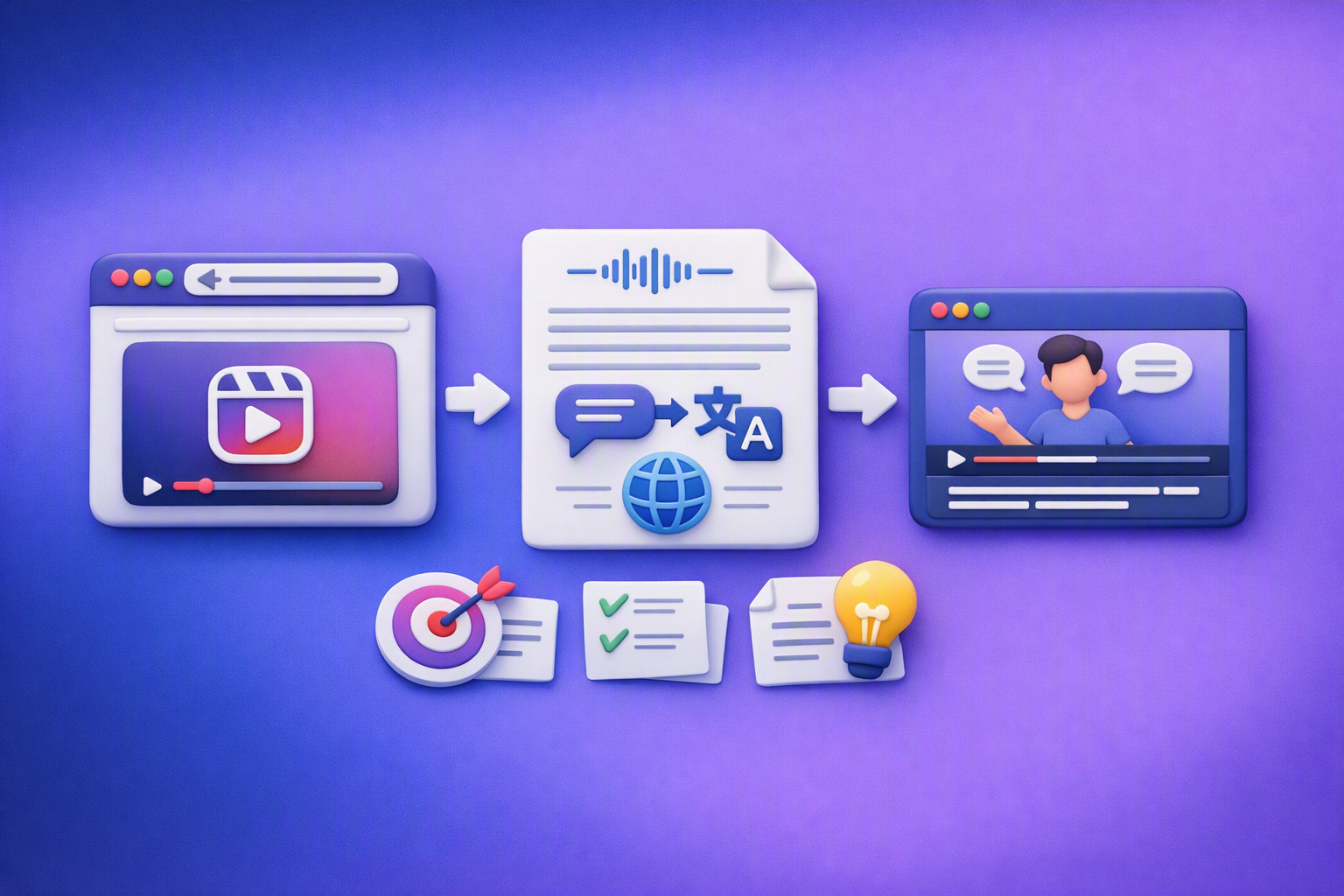
Aprende a traducir un Reel de Instagram con un flujo URL→transcripción→traducción→subtítulos, y a convertir esa traducción en un activo de investigación para hooks, CTAs, objeciones y clusters de contenido.
Reel Analyzer: Transcript‑First Instagram Reels Research (Hooks, CTAs, Objections) + Workflow Guide (VideoToTextAI)
Video To Text AI
A reel analyzer should turn any public Instagram Reel link into a searchable transcript library you can mine for hooks, CTAs, objections, and topic clusters—then repurpose into original drafts with a repeatable SOP.