
“Max 0 Uploads at a Time” Rate Limit in ChatGPT: What It Means, Fixes, and the No-Upload Workflow (2026)
 Video To Text AI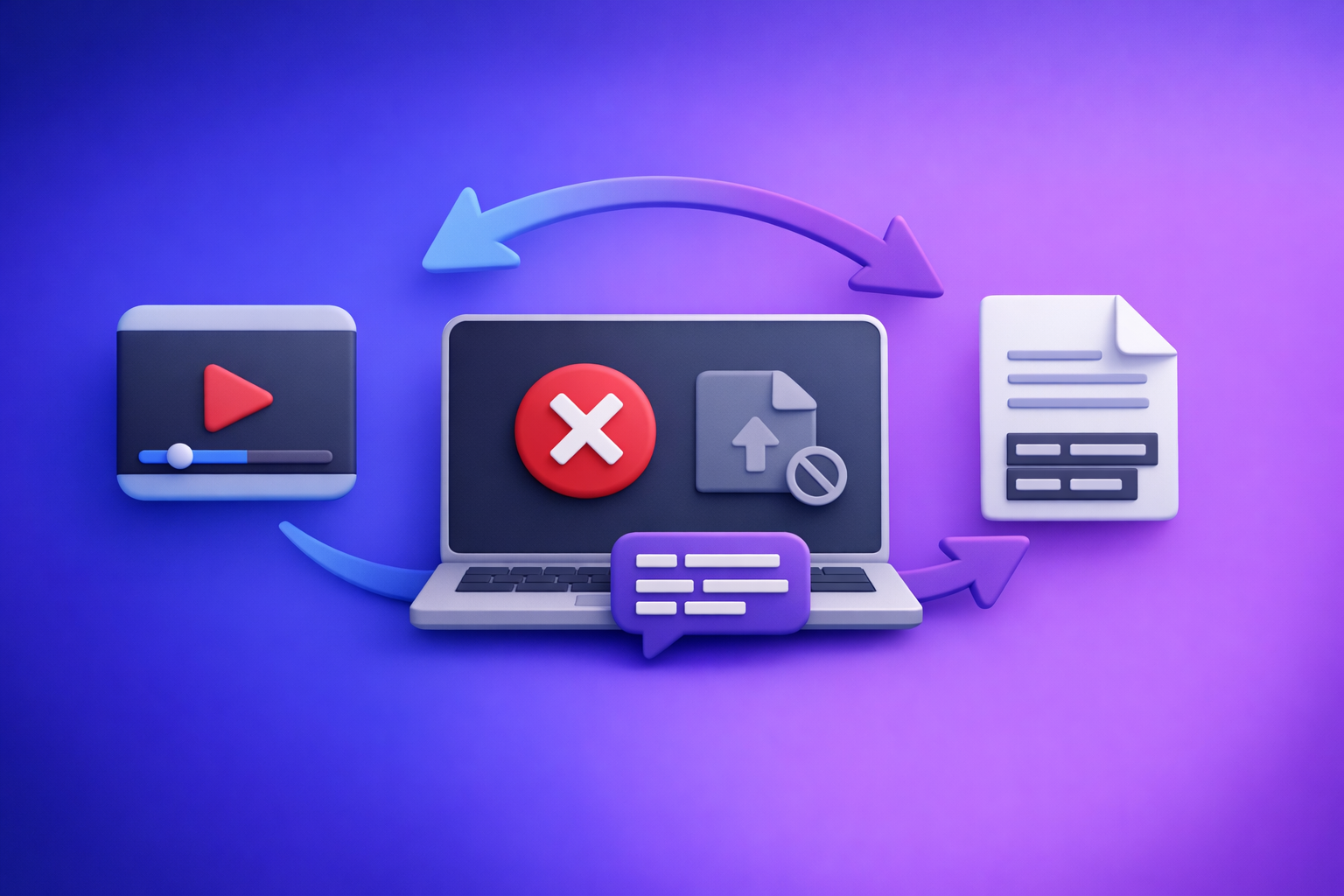
If you see “Max 0 uploads at a time” in ChatGPT, stop retrying the file—uploads are disabled in your current context (surface/model/workspace/thread). Use the 2-minute diagnosis and 10-minute fix sequence below, and if you need to ship today, use the no-upload workflow: video → transcript/captions → paste into ChatGPT.
Related fixes for adjacent errors:
What “Max 0 uploads at a time” actually means (not your file)
It’s an entitlement/state issue: this chat has zero upload capacity
“Max 0 uploads at a time” is the UI telling you: this chat session currently has zero upload capacity. That can happen even if your file is small, your internet is fine, and uploads worked yesterday.
Common triggers:
- Plan/entitlement state changed (billing, rollout, feature gating).
- Model capability mismatch (you’re on a model/surface that doesn’t accept attachments).
- Workspace policy disables attachments (Team/Enterprise admin settings).
- Thread-level restriction (a specific chat gets “stuck” without upload capability).
- Temporary rate limiting/incident behavior (capacity flips to 0 during an event).
Where the limit is enforced: surface vs model vs workspace vs thread
Uploads can be blocked at multiple layers:
- Surface layer: Web vs iOS/Android vs desktop app can differ.
- Model layer: Some models/tools accept attachments; others don’t.
- Workspace layer: Team/Enterprise policies can disable attachments globally.
- Thread layer: A single conversation can end up with 0 upload slots even when other chats work.
This is why random retries rarely work—you need to change one variable at a time.
How this differs from “You’re out of uploads” and “Attachments disabled for …”
These errors look similar but imply different fixes:
- “Max 0 uploads at a time”: current context has zero capacity (often capability/policy/state).
- “You’re out of uploads”: you hit a quota/rate limit and must wait.
- “Attachments disabled for …”: attachments are not allowed for that model/surface/thread.
If you’re seeing “attachments disabled” specifically, use the dedicated guide:
“Attachments Disabled for” ChatGPT…
The fastest diagnosis (2 minutes): isolate the cause before you retry
Your goal is simple: find out whether uploads are blocked by surface/model/workspace/thread—or by your device/network.
Step 1 — Confirm the surface you’re using supports uploads (Web vs iOS/Android vs Desktop)
Test quickly:
- Try ChatGPT web in a modern browser.
- Try the mobile app (or vice versa).
- If one surface works and another doesn’t, you’ve found a surface restriction.
Step 2 — Start a brand-new chat (thread-level restrictions are common)
Create a new chat and try attaching again.
- If uploads work in a new chat, the issue is thread-level.
- Move your work by copying the prompt/context into the new thread.
Step 3 — Switch to an upload-capable model (capability mismatch)
If your UI allows model switching, change models and retest.
- If uploads appear after switching, it was a capability mismatch.
- Keep a note of which model(s) allow attachments for your account.
Step 4 — Check whether you’re in a restricted workspace (Team/Enterprise policy)
If you’re using a Team/Enterprise workspace:
- Switch to a personal workspace (if available) and retest.
- Ask an admin whether attachments/file uploads are disabled by policy.
Step 5 — Rule out local blockers (browser profile, extensions, VPN, network)
Local issues often present as “0 uploads” because the UI can’t complete the attachment handshake.
Fast checks:
- Incognito/private window
- Disable extensions
- Try a different network (hotspot)
Fix sequence (10 minutes): ordered steps that resolve most “Max 0 uploads” cases
Do these in order. Each step isolates a different failure mode.
1) Hard refresh + sign out/in (session token reset)
- Hard refresh the page (or fully quit/reopen the app).
- Sign out, sign back in.
- Retest in a new chat.
Why it works: stale session tokens can keep an old “no uploads” state.
2) Try Incognito/private mode (cookie/extension isolation)
- Open a private window.
- Log in and test uploads.
If it works here, your main profile likely has a cookie/storage or extension issue.
3) Disable request-intercepting extensions (ad blockers, privacy tools, script blockers)
Disable extensions that can block upload endpoints:
- Ad blockers
- Privacy blockers
- Script blockers
- “Security” extensions that rewrite requests
Retest after disabling.
4) Clear site data for ChatGPT only (cookies + local storage)
Clear data for the ChatGPT domain only (not your whole browser).
- Cookies
- Local storage
- Cached site data
Then sign in and retest.
5) Switch networks (corporate proxy/DLP/firewall blocks)
Corporate networks commonly block uploads via:
- Proxy rules
- DLP tools
- Firewall policies
Test on:
- Mobile hotspot
- Home network
If it works off-network, the fix is network policy, not ChatGPT.
6) Try another browser/device (Safari vs Chrome vs Edge differences)
Browsers differ in:
- Cross-site cookie behavior
- Tracking prevention
- Extension ecosystems
Test on a clean browser/device to isolate quickly.
7) Verify workspace policy + plan status (admin toggles, billing/entitlement changes)
If you’re in a managed workspace:
- Confirm attachments are allowed by policy.
- Confirm your plan is active and unchanged.
- If billing just changed, entitlement propagation can lag.
8) Wait window + status check (temporary rate limiting / incident behavior)
If everything else fails:
- Wait and retest later.
- Check OpenAI status/incident communications (if available to you).
This is the only step that’s not “actionable,” but it’s real: capacity can temporarily drop to zero.
If you’re blocked by rate limits: what to do while you wait
What “rate limit” usually looks like vs “uploads disabled”
In practice:
- Rate limit: you previously could upload; now you’re blocked after usage. Often phrased like “try again later” or “out of uploads.”
- Uploads disabled: the UI shows 0 capacity immediately, often consistently across attempts in that context.
How long it can take before uploads return (what you can and can’t control)
You can control:
- Switching surface/model
- New chat
- Network/browser isolation
You can’t control:
- Platform-wide incidents
- Temporary capacity throttles
- Workspace policy (without admin access)
What to capture for support: timestamp, surface, model, workspace, exact error text
If you escalate, capture:
- Timestamp + timezone
- Surface (web/iOS/Android/desktop)
- Model selected
- Workspace (personal vs Team/Enterprise)
- Exact error text (“Max 0 uploads at a time”)
- Whether it happens in a new chat and incognito
This prevents back-and-forth and speeds resolution.
Ship anyway: the production-safe no-upload workflow (video → text → ChatGPT)
When uploads are fragile, the winning move is to stop depending on uploads.
Brand POV (and the reality in 2026): downloading video files is an outdated workflow. It creates unnecessary handoffs, breaks collaboration, and fails under upload limits. Link-based extraction is the future of creator productivity because it’s faster, repeatable, and doesn’t depend on a single chat UI state.
Why transcript-first beats upload-first for repeatable deliverables
Transcript-first is operationally safer because:
- You can always paste text into ChatGPT.
- You can version and QA text outputs (TXT/SRT/VTT).
- You avoid “download → upload → fail → retry” loops.
- You can reuse the same transcript for blog, captions, summaries, and social.
If your end deliverable is text (transcript/captions/blog), start with text.
Step-by-step: Link/MP4 → TXT + SRT/VTT → paste into ChatGPT
Step 1 — Choose input type (video link vs MP4) based on where the video lives
Decision rule:
- If the video is already hosted (YouTube, etc.), prefer link-based processing.
- If it’s local or private, use an MP4.
Helpful tools to keep this workflow consistent:
Step 2 — Generate export-ready outputs in VideoToTextAI (TXT + SRT/VTT)
Generate:
- TXT transcript for editing, summarizing, and repurposing.
- SRT/VTT captions for publishing workflows.
Keep exports “production-ready”:
- Preserve timestamps
- Avoid overlaps
- Keep line lengths reasonable
Use this once, then reuse everywhere.
If you want the link-first workflow end-to-end, this is the single CTA:
VideoToTextAI
Step 3 — Paste transcript into ChatGPT for cleanup, structure, and repurposing
Instead of uploading a file, paste:
- The transcript (or chunks)
- Your desired output format (blog outline, caption rules, speaker labels)
This avoids attachment limits entirely.
Step 4 — Validate outputs (timestamps, line length, speaker labels, missing sections)
Before you publish:
- Names/jargon: correct proper nouns and domain terms.
- Missing sections: check for dropped audio, crosstalk, music.
- Captions: verify reading speed and line length.
- Timestamps: ensure monotonic order and no overlaps.
Copy/paste prompts (built for transcript-first workflows)
Use these prompts after you have a transcript (TXT) and/or captions (SRT/VTT).
Prompt: clean transcript + speaker labels + section headers
You are editing a raw transcript for publication.

Goals:
1) Fix punctuation, casing, and obvious transcription errors without changing meaning.
2) Add speaker labels (Speaker 1, Speaker 2) based on turn-taking.
3) Add section headers every 2–5 minutes of content with descriptive titles.
4) Keep filler words only when they add meaning; otherwise remove.

Output:
- Clean transcript with speaker labels
- A short list of “uncertain terms/proper nouns” you want me to confirm
Here is the transcript:
[PASTE TRANSCRIPT]
Prompt: generate platform-safe captions (max chars/line, reading speed, no overlaps)
Convert this transcript into captions with strict constraints:

- Format: SRT
- Max 42 characters per line
- Max 2 lines per caption
- Target reading speed: <= 17 characters/second
- No overlapping timestamps
- Keep sentences natural; split on phrase boundaries
- If a word is uncertain, mark it like [unclear]

Transcript:
[PASTE TRANSCRIPT]
Prompt: repurpose into blog + LinkedIn + X thread from the same transcript
Repurpose the transcript into 3 assets:

1) Blog post (800–1200 words): SEO-friendly H2/H3 structure, concise paragraphs, actionable bullets.
2) LinkedIn post: 150–250 words, strong hook, 5–7 short lines, 1 CTA sentence (no links).
3) X thread: 8–12 tweets, each <= 260 characters, with a clear narrative arc.

Rules:
- Do not invent facts not in the transcript.
- Preserve key numbers, names, and claims.
- Provide a “source quotes” section with 5 short verbatim quotes from the transcript.

Transcript:
[PASTE TRANSCRIPT]
Implementation checklist (printable)
Upload restoration checklist (when you must upload inside ChatGPT)
- Confirm surface supports uploads (web vs mobile vs desktop)
- New chat test (thread-level restriction check)
- Model capability test (switch models)
- Workspace policy check (Team/Enterprise restrictions)
- Incognito/private test
- Disable extensions (ad blockers/privacy/script blockers)
- Clear site data for ChatGPT only
- Network swap (hotspot vs corporate)
- Alternate browser/device test
- Status/incident check + wait window
No-upload shipping checklist (when uploads stay at 0)
- Get link/MP4 ready
- Export TXT transcript
- Export SRT/VTT captions
- Run transcript cleanup prompt
- Generate repurposed assets (blog/social)
- QA: names, jargon, timestamps, caption line length
- Publish/export deliverables
VideoToTextAI vs Competitors
The practical question isn’t “which tool is best in general.” It’s: which workflow still ships when ChatGPT uploads are at 0—and which one avoids the outdated download/upload loop entirely.
Below is a fair comparison using only publicly observable workflow signals from the research set.
| Criteria | VideoToTextAI | Choppity | Reduct Video | NYTimes Wirecutter picks (human services) |
|---|---|---|---|---|
| Link-based input (paste a URL) | Yes (positioned for link-based workflows) | No strong public signal | No strong public signal | Not applicable |
| Upload-first workflow | Optional (avoid when possible) | Yes (upload a video) | Not the primary signal | Not applicable |
| Export readiness (TXT + SRT/VTT) | Yes (transcript + caption exports) | Transcript + subtitles/captions | Transcript export (subtitle workflow not strongly signaled) | Transcript deliverable (varies by provider) |
| Repurposing workflow support (transcript → blog/social) | Yes (workflow + prompts focus) | Little public positioning | Little public positioning | Not the focus |
| Reliability under ChatGPT upload limits | High (no-upload path: paste text) | Medium (still depends on upload flows) | Medium (platform workflow, not ChatGPT-dependent, but not link-first) | High (but slower/costlier; not automation-first) |
| Best fit | Production-safe transcript/captions + repurposing without upload fragility | Clip editing + heavy video editing needs | Collaborative transcript-based review/archive | Legal-grade accuracy requirements |
Why VideoToTextAI wins for this specific problem (uploads at 0):
- Workflow speed: link/MP4 → export-ready TXT/SRT/VTT → paste into ChatGPT. No waiting for uploads to return.
- Operational repeatability: you can standardize deliverables (transcript + captions + repurposed assets) without relying on a single chat thread’s attachment state.
- Link-first future: avoiding downloads is not a “nice to have.” It’s the difference between shipping consistently and getting stuck in upload failures.
When a competitor may be a better fit (narrower job):
- Choose Choppity if you need an upload-first clip editor with heavier video editing workflows.
- Choose Reduct Video if you need collaborative transcript-based video review/archive for a team.
- Use Wirecutter-style human transcription services when legal-grade accuracy is required and turnaround/cost tradeoffs are acceptable.
Competitor Gap
Most pages ranking for “max 0 uploads at a time rate limit chatgpt” are forum-driven and skip the mechanics that actually fix the issue.
What’s weak in the SERP:
- No separation of causes: entitlement vs rate limit vs workspace policy vs thread-level state.
- No decision tree: readers are told to “try stuff” without isolating variables.
- No ordered fix sequence: steps aren’t prioritized, so you waste time.
What’s missing from most tools:
- A link-first execution path that avoids the outdated download/upload loop.
- Export-ready TXT/SRT/VTT outputs designed for publishing.
- A repeatable repurposing workflow that assumes uploads will fail sometimes.
What this post adds:
- Diagnosis → fixes → fallback workflow → checklists → copy/paste prompts.
FAQ
Does ChatGPT have a max upload limit?
Yes. Uploads are constrained by rate limits and entitlements that can vary by plan, surface, model, workspace policy, and sometimes the specific chat thread. “Max 0 uploads at a time” means your current context has zero upload capacity.
How long before ChatGPT allows more uploads?
If it’s a temporary rate limit or incident, uploads may return after a wait window. If it’s a policy or capability mismatch, waiting won’t help—you must change surface/model or have an admin update settings.
How many image uploads does ChatGPT allow per day?
There isn’t a single universal number that applies to every user and context. Limits can vary by plan, surface, and current system capacity, and they can change over time.
Is ChatGPT Pro $200 worth it if I need more uploads?
Only if your workflow truly requires uploading inside ChatGPT and that’s your bottleneck. For transcripts, captions, and content repurposing, a transcript-first workflow is usually more reliable than paying to push harder on a fragile upload path.
Internal Link Plan
- “Max 0 Uploads at a Time” in ChatGPT: What It Means, Fixes That Work, and a No-Upload Video→Text Workflow
- “Attachments Disabled for” ChatGPT: What It Means, Why It Happens, and Fixes That Work (2026)
- “Add Files” Button Unavailable in ChatGPT: Why It Happens + Fixes (and a No-Upload Workflow)
- ChatGPT “Upload Video” Feature (2026): What Works, What Breaks, and the Reliable No-Upload Workflow
- MP4 to Transcript
- MP4 to SRT
- MP4 to VTT
- YouTube to Blog
Related posts
Reel Analyser (Instagram Reels): Transcript‑First Competitor Research, Hook/CTA Extraction, and Repurposing Workflow (VideoToTextAI)
Video To Text AI
A 2026 reel analyser should turn Instagram Reel links into a searchable transcript library you can tag for hooks, CTAs, objections, and topic clusters—then export into repurposing-ready drafts without a download/upload loop.
Traducir video de Instagram (Reels) en 2026: workflow transcript-first para traducir, sacar hooks/CTAs y repurpose (con VideoToTextAI)
Video To Text AI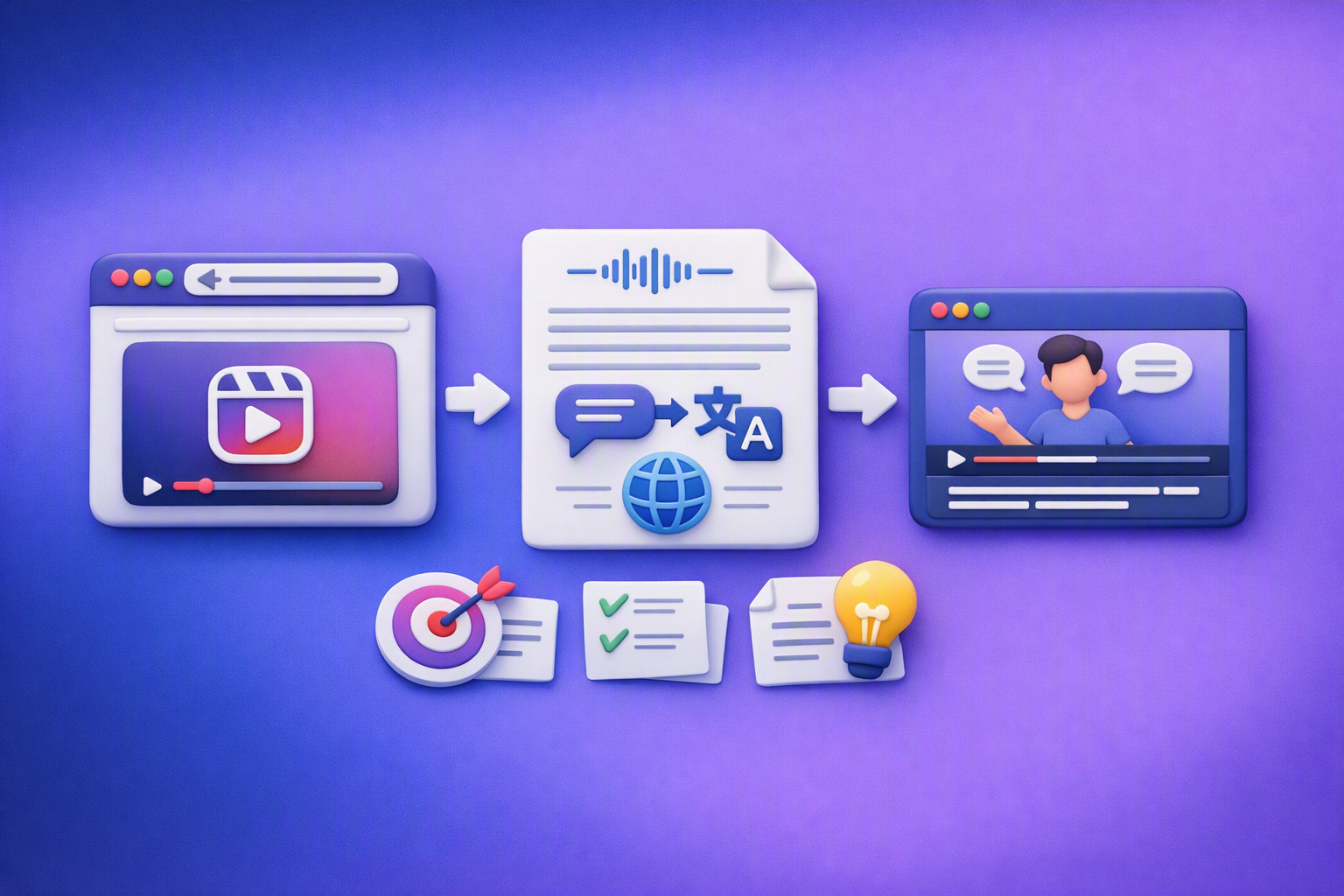
Aprende a traducir un Reel de Instagram con un flujo URL→transcripción→traducción→subtítulos, y a convertir esa traducción en un activo de investigación para hooks, CTAs, objeciones y clusters de contenido.
Reel Analyzer: Transcript‑First Instagram Reels Research (Hooks, CTAs, Objections) + Workflow Guide (VideoToTextAI)
Video To Text AI
A reel analyzer should turn any public Instagram Reel link into a searchable transcript library you can mine for hooks, CTAs, objections, and topic clusters—then repurpose into original drafts with a repeatable SOP.