
“Attachments Disabled for” ChatGPT: What It Means, Why It Happens, and Fixes That Work (2026)
 Video To Text AI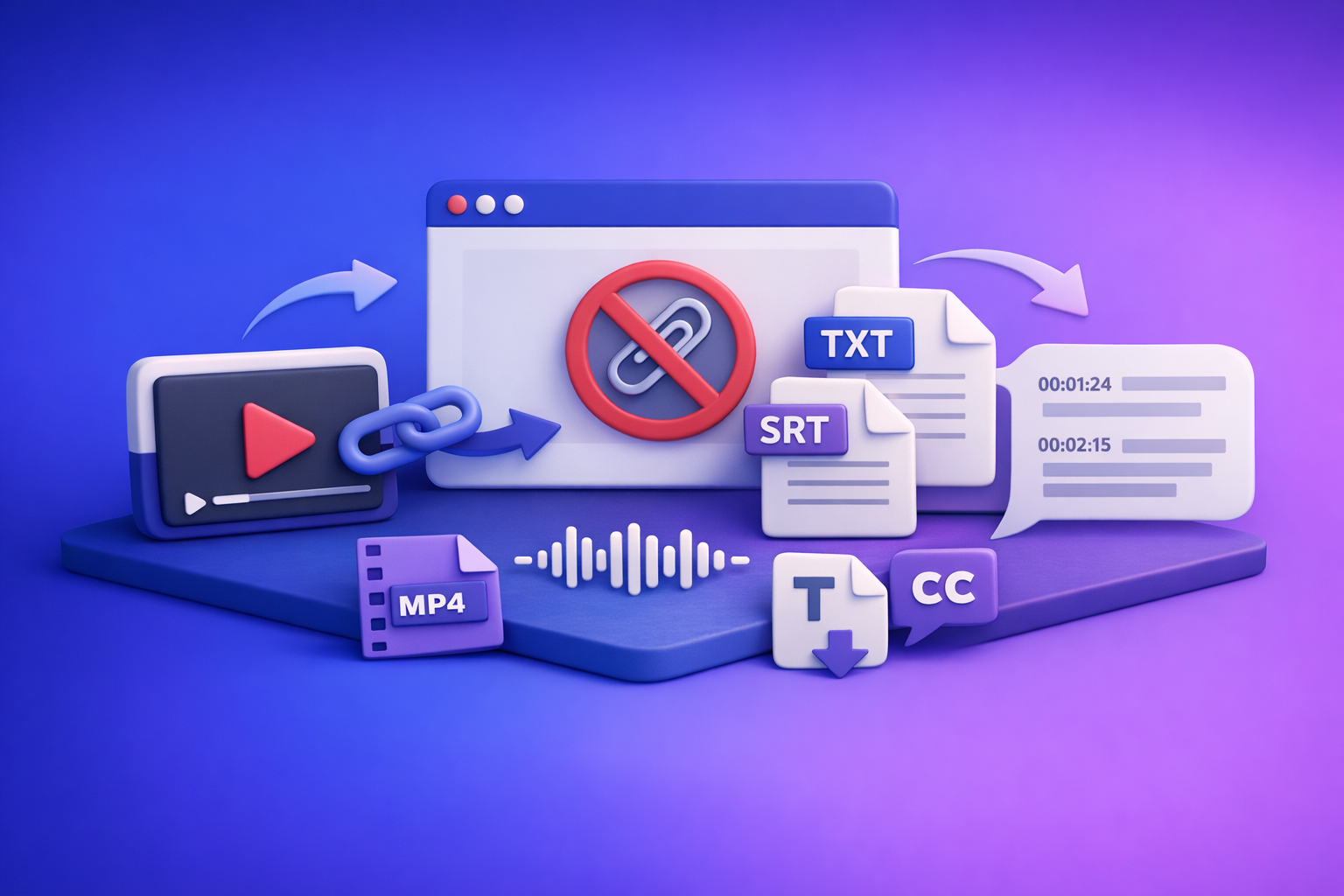
If you see “attachments disabled for …” in ChatGPT, the fastest fix is to start a new chat and switch to an upload-capable model/surface, then run a mobile + incognito isolation test. If uploads still fail after two surfaces and two networks, stop troubleshooting and ship via transcript-first (link/MP4 → TXT + SRT/VTT → ChatGPT-on-text).
Downloading video files just to re-upload them is an outdated workflow; link-based extraction is the future of creator productivity because it removes fragile UI steps and reduces permissions friction.
What “Attachments Disabled for …” Means (and What It Does Not Mean)
“Attachments disabled for …” is a context-level restriction. It means uploads are blocked in this specific place (surface/model/thread/policy), not that ChatGPT is “broken forever.”
The exact UI states you’ll see (banner, tooltip, missing paperclip, greyed-out button)
Common states include:
- A top banner that says “attachments disabled for …”
- A tooltip when hovering the upload control
- The paperclip missing entirely
- An “Add files” button that’s greyed out / not clickable
What’s actually blocked: files vs images vs video vs “all uploads”
Depending on the context, ChatGPT may block:
- All uploads (no files, no images)
- Files only (images may still work in some contexts)
- Specific media types (e.g., video uploads blocked while images are allowed)
Treat it as: “Uploads are disabled here.” Your next job is to find where “here” is.
What it usually isn’t: “bad file,” account ban, or permanent restriction
In most cases, it’s not:
- A “bad file” (wrong format, too large) error
- An account ban/shadowban
- A permanent restriction on your account
Those issues usually show different messaging (or consistent failures across all contexts).
2-Minute Diagnosis (Before You Change Anything)
Time-box this. Don’t start clearing caches or reinstalling apps until you’ve isolated the cause.
Step 1: Identify where you’re using ChatGPT (web vs desktop vs mobile; personal vs workspace)
Write down:
- Surface: web / desktop app / mobile app
- Account type: personal vs workspace (Team/Enterprise)
- Device + OS: Mac/Windows/iOS/Android
This matters because upload capability can differ by surface and policy.
Step 2: Confirm whether the current chat thread supports uploads (thread-level limitation)
Some threads end up in a state where uploads are disabled only in that conversation.
Quick check:
- Open a brand-new chat
- Look for the paperclip / Add files control
Step 3: Check whether the selected model supports attachments in this context
Uploads can be model-dependent in certain contexts.
Quick check:
- In a new chat, switch models
- Watch whether the paperclip appears/disappears
Step 4: Run one isolation test (incognito/private + alternate network) to separate local vs policy issues
Do one fast A/B:
- Incognito/private window (no extensions, clean storage)
- Alternate network (phone hotspot is fastest)
This separates browser/profile issues from network/workspace restrictions.
Root Causes (Ranked by Likelihood) + How to Confirm Each
Model/surface mismatch (uploads not supported in that context)
Uploads may be unavailable on a specific surface/model combination.
How to confirm:
- Start a new chat
- Switch model
- If the paperclip returns, it was a mismatch
Thread-level state issue (uploads missing only in one conversation)
A single thread can lose upload capability.
How to confirm:
- Uploads work in a brand-new chat
- Uploads fail only in the old thread
Plan/entitlement limitations (feature not enabled on your account)
Some accounts/plans may not have uploads enabled in a given context.
How to confirm:
- Test the same steps on another account/plan
- Compare web vs mobile behavior on the same account
Workspace/admin policy (Team/Enterprise restrictions)
Admins can disable uploads or enforce DLP/content controls.
How to confirm:
- Personal account works, workspace account doesn’t
- Issue appears on an admin-managed device or corporate login
Browser profile breakage (extensions, cookies/storage corruption)
Extensions and corrupted site storage commonly break upload UI.
How to confirm:
- Incognito works
- Normal profile fails
Network/security blocks (VPN, proxy, DLP, content filters)
Corporate networks and some VPN/proxy setups block upload endpoints.
How to confirm:
- Phone hotspot works
- Office Wi‑Fi fails
- Turning VPN off restores uploads
Temporary service degradation (status/outage symptoms)
Sometimes it’s just intermittent UI failures.
How to confirm:
- Widespread reports
- Failures across multiple devices/surfaces
- Behavior is intermittent, not deterministic
Step-by-Step Fix Sequence (Ordered, Fastest-to-Verify First)
1) Start a new chat and reselect an upload-capable model
Do this first because it’s the most common fix.
Verification:
- Paperclip returns
- “Add files” becomes clickable
Related: “Add Files” Button Unavailable in ChatGPT: Why It Happens + Fixes (and a No-Upload Workflow)
2) Switch surfaces to rule out a surface-specific limitation
Fastest isolation move:
- Web ↔ official mobile app
- Desktop app ↔ web
If mobile works and web doesn’t, you likely have a browser/network issue.
3) Incognito/private window test (no extensions, clean session)
Open ChatGPT in incognito/private mode and sign in.
If it works: you have an extension/profile issue. Move to steps 4–5.
4) Disable extensions that commonly break uploads
Disable (temporarily) anything that touches scripts, privacy, or downloads:
- Ad blockers
- Privacy/script blockers
- Antivirus “web shield” tools
- Download managers
Verification:
- Reload ChatGPT
- Confirm attachment UI returns
5) Clear site data for ChatGPT and re-authenticate
Clear site-specific data (not a full browser wipe):
- Cookies
- Local storage
- Cache
Then sign in again.
6) Switch networks and remove VPN/proxy
Run a quick A/B:
- Corporate Wi‑Fi vs home Wi‑Fi
- VPN on vs VPN off
- Proxy off (if applicable)
- Phone hotspot test
If the hotspot works, your issue is network/security.
7) Workspace path: what to send your admin (copy/paste request)
If you’re on Team/Enterprise, send this to your admin:
We’re seeing “attachments disabled for …” in ChatGPT. Please confirm whether file uploads are disabled by workspace policy or blocked by DLP/content filtering.
Evidence: timestamp: ___; user: ___; device/OS: ___; browser/app version: ___; network: ___; screenshot attached.
Request: allow required ChatGPT upload functionality and ensure any security tooling isn’t blocking upload endpoints for ChatGPT.
Include:
- Timestamp
- Device + browser
- Network (office/home/VPN)
- Screenshot of the banner
8) Stop troubleshooting after 10 minutes and use the no-upload workflow (ship today)
Decision rule: if uploads fail on two surfaces (web + mobile) and two networks, stop.
At that point, you’re likely dealing with policy or network security—and you can lose hours chasing it.
Edge Cases You’ll See in Real Use (and What to Do)
“You need GPT-4o to continue this chat because there’s an attachment”
This usually means the thread contains an attachment and requires a model/context that supports it.
Fix:
- Switch to the required model or
- Start a new chat and paste text instead of relying on the attachment
Related: ChatGPT “Upload Video” Feature (2026): What Works, What Breaks, and the Reliable No-Upload Workflow
Upload button missing only in one thread (thread-level state corruption)
Fix:
- Start a new chat
- Copy/paste the prompt and continue there
Uploads work on mobile but not desktop (local browser/network culprit)
Fix:
- Incognito test
- Disable extensions
- Clear site data
- Hotspot test
Uploads work on personal account but not workspace (policy culprit)
Fix:
- Escalate to admin with the request above
- Use transcript-first workflow in the meantime
“Max 0 uploads at a time” vs “Attachments disabled for …” (how the fixes differ)
- “Attachments disabled for …” = uploads blocked in this context (surface/model/thread/policy)
- “Max 0 uploads at a time” = quota/limit state (often entitlement or temporary gating)
Ship-Now Workflow (No Attachments Needed): Link/MP4 → TXT + SRT/VTT → ChatGPT-on-Text
When attachments are disabled, the reliable path is transcript-first. You generate clean text assets outside ChatGPT, then use ChatGPT where it’s strongest: reasoning on text.
This is also why downloading video files to re-upload is an outdated workflow. Link-based extraction is the future of creator productivity: fewer moving parts, fewer permissions, less UI fragility.
Why transcript-first works even when attachments are disabled
With a transcript, you can still do:
- Summaries and outlines
- Topic clustering and SEO structure
- Quote extraction
- QA and consistency checks
- Repurposing into posts, emails, and scripts
Implementation: VideoToTextAI link-based workflow (repeatable, export-ready)
Use a deterministic pipeline that produces assets you can paste anywhere.
- Step 1: Paste a video link (YouTube/Instagram/TikTok) or use an MP4
- Step 2: Generate outputs: TXT transcript + SRT/VTT captions
- Step 3: Paste transcript text into ChatGPT for analysis/repurposing (no upload required)
- Step 4: Publish SRT/VTT for accessibility, retention, and SEO
Tools you can use immediately:
If you want the link-first workflow end-to-end, use VideoToTextAI: VideoToTextAI
Common production mistakes (and how to avoid them)
Mistake: pasting raw auto-captions without punctuation/paragraphing
- Fix: add paragraph breaks every 2–4 sentences
- Keep speaker turns on new lines
Mistake: not preserving timestamps when you need clip extraction
- Fix: keep SRT/VTT alongside TXT
- Use timestamps to map quotes to exact moments
Mistake: summarizing before correcting speaker names/terms
- Fix: do a quick pass for:
- Names
- Product terms
- Acronyms
- Numbers and dates
Copy/Paste Prompt Templates (Use With Transcript Text)
Paste your transcript into ChatGPT, then use one of these.
Template: summarize + key takeaways + action items (with constraints)
You are given a transcript. Summarize it in 8 bullets max.
Then provide:
1) Key takeaways (5 bullets)
2) Action items (5 bullets, written as verbs)
Constraints:
- Use plain language
- No filler
- If the transcript is missing info, say “Not specified in transcript”
Transcript:
[PASTE TRANSCRIPT]
Template: convert transcript into an SEO blog post (H2/H3 + meta + internal links)
Turn this transcript into an SEO blog post.
Requirements:
- Provide: title, meta description (155 chars), slug
- Outline with H2/H3
- Include a “Common mistakes” section
- Suggest 5 internal link opportunities (anchor text + where to place)
- Keep claims grounded in the transcript
Transcript:
[PASTE TRANSCRIPT]
Template: generate captions + hooks + repurposed posts (LinkedIn/X/shorts descriptions)
From this transcript, generate:
- 10 short hooks (max 12 words)
- 5 LinkedIn posts (120–180 words)
- 10 X posts (max 240 chars)
- 3 YouTube Shorts descriptions (2 sentences each)
Keep the tone direct and avoid hashtags unless essential.
Transcript:
[PASTE TRANSCRIPT]
Template: QA checklist (find missing steps, contradictions, and unclear sections)
Audit this transcript for clarity and completeness.
Output:
- Missing steps (bullets)
- Contradictions (bullets)
- Ambiguous terms that need definition (bullets)
- A revised outline that fixes the issues
Transcript:
[PASTE TRANSCRIPT]
Checklist: Fix or Fallback (Print This)
Fast fix checklist (10 minutes)
- New chat + switch to an upload-capable model
- Web ↔ mobile app test
- Incognito/private window test
- Disable extensions that touch scripts/downloads/privacy
- Clear ChatGPT site data and re-login
- Hotspot test; disable VPN/proxy
- If workspace: escalate with admin request + evidence
Ship-now checklist (no uploads)
- Generate TXT transcript
- Export SRT + VTT
- Paste transcript into ChatGPT for repurposing
- Publish captions/subtitles from SRT/VTT (don’t rely on ChatGPT uploads)
VideoToTextAI vs Competitors
This comparison focuses on what matters when “attachments disabled for” blocks your workflow:
- Workflow speed: link → usable text assets (no download/upload loop)
- Export readiness: clean TXT + SRT + VTT
- Repeatability: consistent steps for creators/teams (less UI fragility)
- Repurposing: turning transcripts into publishable drafts
| Tool | Link-based input (URL-first) | Export-ready outputs (TXT/SRT/VTT) | Best fit | Where VideoToTextAI wins (per this use case) |
|---|---|---|---|---|
| VideoToTextAI | Yes (designed for link-based workflows) | Yes (transcripts + captions/subtitles) | Creators/marketers who need repeatable video→text assets and repurposing | Faster ship-now path when uploads are blocked; avoids download/upload loops; emphasizes deterministic exports you can paste anywhere |
| Reduct Video | Not a strong public signal for URL-first workflow (more platform-based collaboration) | Transcript export is emphasized; subtitle export not strongly signaled in research | Teams doing collaborative transcript review and synthesis | VideoToTextAI is more link-first and oriented to publishable caption formats (SRT/VTT) for production delivery; Reduct can be better for collaborative analysis inside its platform |
| PCMag (directory/reviews) | N/A (not a tool) | N/A | Market overview and testing context | VideoToTextAI provides an implementation workflow specifically for “attachments disabled” scenarios plus concrete deliverables (TXT/SRT/VTT), not just reviews |
| Morningscore.io (review content) | N/A (not a transcription platform) | N/A | Roundups and free-tool perspective | VideoToTextAI is a purpose-built video→text pipeline with production outputs; review pages don’t solve operational “uploads disabled” constraints |
Fair note: if your primary need is collaborative transcript annotation inside a shared workspace, Reduct Video may be a better fit. If your primary need is shipping text + captions fast without relying on uploads, VideoToTextAI’s link-based workflow is the more operationally reliable path.
Competitor Gap
Most pages that mention “attachments disabled for” stop at generic troubleshooting. The gaps that matter in production:
- No production-safe fallback workflow when uploads are blocked (teams still need deliverables today).
- Upload-heavy guidance ignores the most common failure modes: workspace policy, browser extensions, network security.
- Few guides specify export-ready deliverables and how to use each:
- TXT for analysis/repurposing
- SRT/VTT for publishing and accessibility
- Missing a stop-troubleshooting decision rule (time-boxed diagnosis + ship-now path).
FAQ
Why are my ChatGPT uploads disabled?
Most often it’s one of these:
- Model/surface mismatch
- Thread-level limitation
- Workspace/admin policy
- Browser extensions or corrupted site storage
- Network/VPN/proxy/DLP blocks
Use the 2-minute diagnosis above to isolate which.
Why is ChatGPT not letting me attach files?
Because uploads are disabled in the current context. Start a new chat, switch to an upload-capable model, then test mobile and incognito to determine whether it’s account/policy vs local device.
Where is the upload button in ChatGPT?
If enabled, it appears as a paperclip or Add files near the message box. If it’s missing or greyed out, follow the fix sequence and then use the transcript-first fallback.
Is “attachments disabled for” a workspace/admin policy issue?
Often, yes—especially if:
- Personal account works but workspace doesn’t
- The device is admin-managed
- The issue only happens on corporate networks
Can I still use ChatGPT for video summaries if I can’t upload the video?
Yes. Generate a transcript (TXT) and captions (SRT/VTT), then paste the transcript into ChatGPT. This avoids the outdated download/re-upload loop and aligns with the link-based future of creator productivity.
Internal Link Plan
- “Attachments Disabled for” ChatGPT: What It Means, Why It Happens, and Fixes That Work (2026)
- “Add Files” Button Unavailable in ChatGPT: Why It Happens + Fixes (and a No-Upload Workflow)
- “Max 0 Uploads at a Time” in ChatGPT: What It Means + Fixes That Work (and a No-Upload Video→Text Workflow)
- ChatGPT “Upload Video” Feature (2026): What Works, What Breaks, and the Reliable No-Upload Workflow
- MP4 to transcript
- MP4 to SRT
- MP4 to VTT
- YouTube to blog
Related posts
Reel Analyser (Instagram Reels): Transcript‑First Competitor Research, Hook/CTA Extraction, and Repurposing Workflow (VideoToTextAI)
Video To Text AI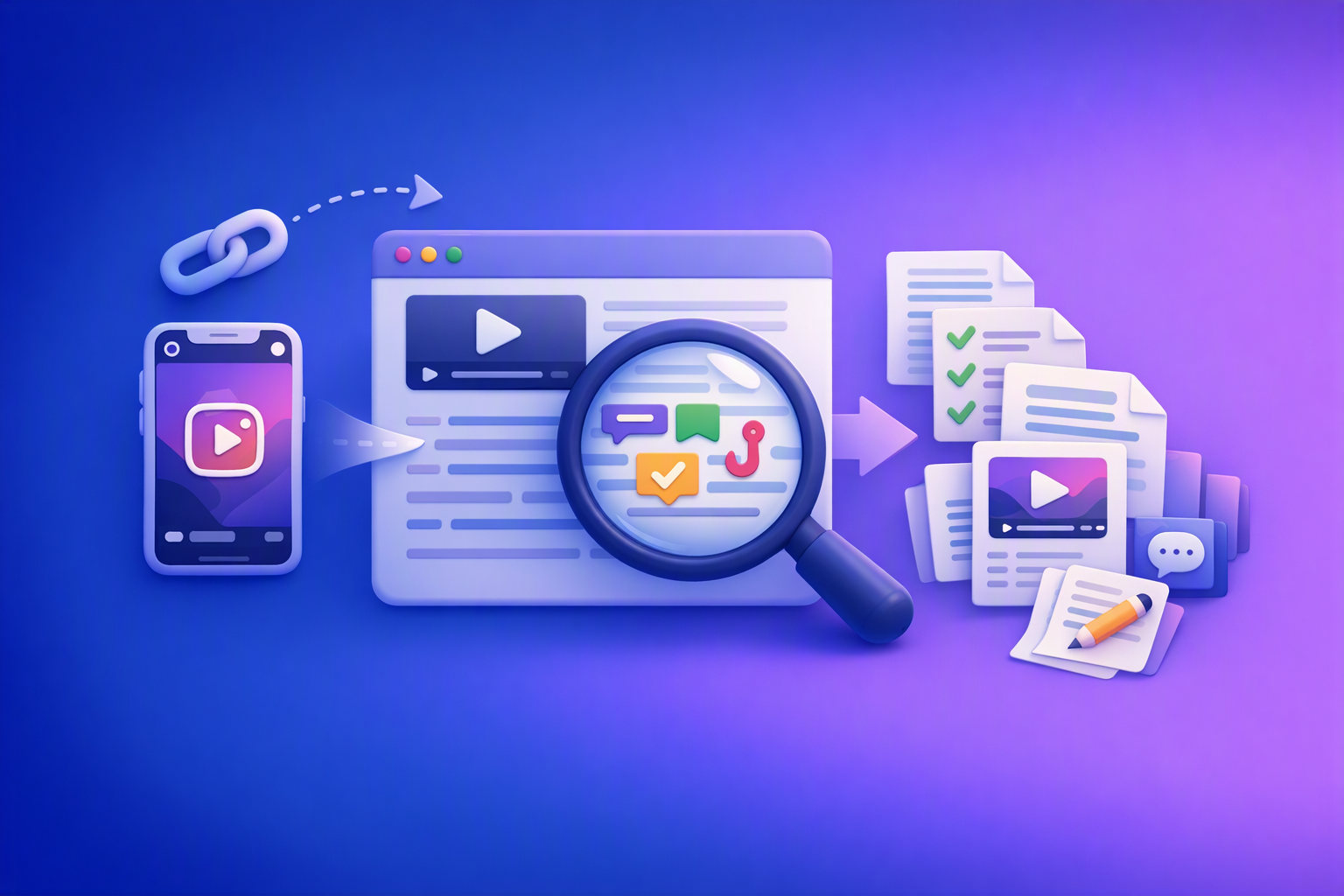
A 2026 reel analyser should turn Instagram Reel links into a searchable transcript library you can tag for hooks, CTAs, objections, and topic clusters—then export into repurposing-ready drafts without a download/upload loop.
Traducir video de Instagram (Reels) en 2026: workflow transcript-first para traducir, sacar hooks/CTAs y repurpose (con VideoToTextAI)
Video To Text AI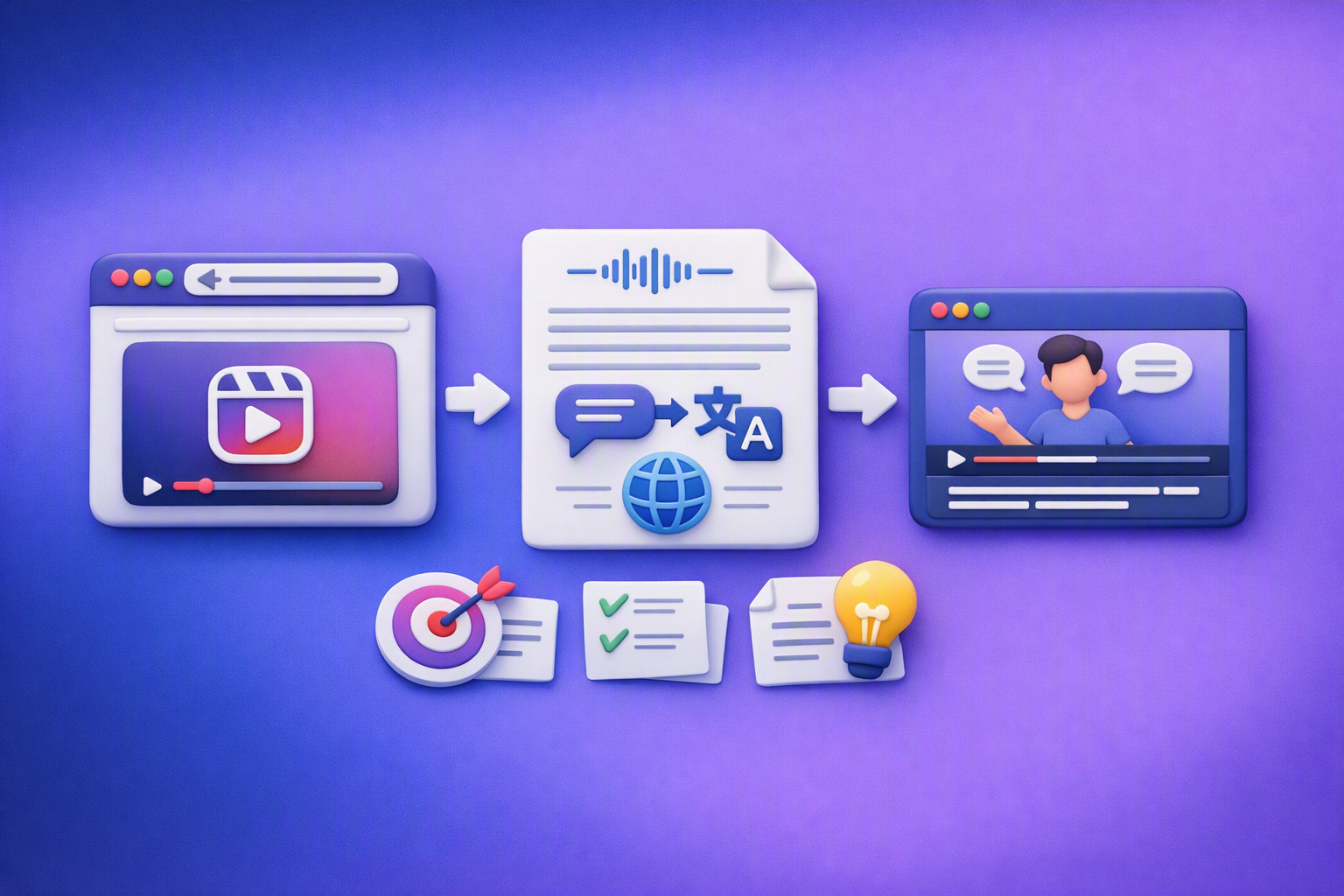
Aprende a traducir un Reel de Instagram con un flujo URL→transcripción→traducción→subtítulos, y a convertir esa traducción en un activo de investigación para hooks, CTAs, objeciones y clusters de contenido.
Reel Analyzer: Transcript‑First Instagram Reels Research (Hooks, CTAs, Objections) + Workflow Guide (VideoToTextAI)
Video To Text AI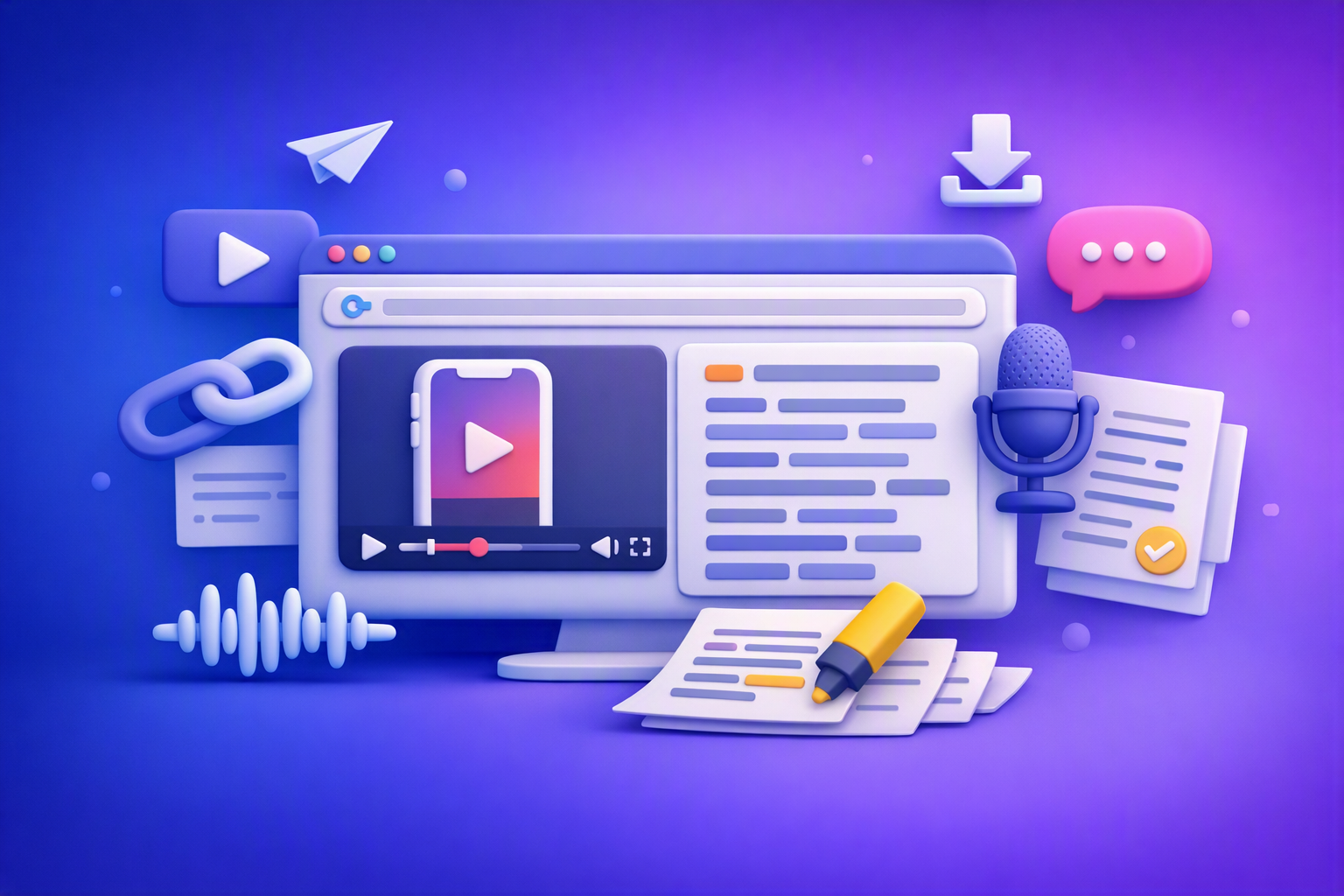
A reel analyzer should turn any public Instagram Reel link into a searchable transcript library you can mine for hooks, CTAs, objections, and topic clusters—then repurpose into original drafts with a repeatable SOP.