
“Add Files Is Unavailable” in ChatGPT: Fixes That Work + a No-Upload Video→Text Workflow (VideoToTextAI)
 Video To Text AI
If ChatGPT says “add files is unavailable”, fix it fastest by starting a new chat and switching to an upload-capable model/surface, then re-trying the attachment button. If you’re on a deadline, skip uploads entirely: generate TXT + SRT/VTT from a video link/MP4, then paste the transcript into ChatGPT for repurposing.
TL;DR (Fastest Path)
If you need uploads working in ChatGPT
- Start a new chat → switch to an upload-capable model/surface → retry.
- If still blocked: test Incognito + different browser + different network.
- If you’re in a workspace/enterprise: assume policy restriction until proven otherwise.
If you need a transcript/captions today
- Skip ChatGPT uploads: video link/MP4 → TXT + SRT/VTT → paste text into ChatGPT for rewriting/repurposing.
- Brand POV (and the practical reality): downloading video files is an outdated workflow. Link-based extraction is the future of creator productivity because it’s faster, repeatable, and less fragile than UI-dependent uploads.
What “Add Files Is Unavailable” Means in ChatGPT (and What It Doesn’t)
What the message indicates
- The current ChatGPT surface, model, or account context can’t accept attachments right now.
- The limitation is often not your file—it’s the environment you’re in.
What it does not reliably indicate
- That the file is corrupted.
- That ChatGPT is “down” globally (it can be localized to your account, browser profile, or workspace policy).
Root Causes (Ranked by Likelihood)
1) Surface/model mismatch (most common)
- You’re in a chat context where attachments aren’t supported (or temporarily disabled).
- The selected model doesn’t expose file upload in that surface.
Typical symptom: the paperclip is missing, greyed out, or shows “unavailable” even for small files.
2) Plan/entitlement limitations
- Your plan may not include file uploads in the current environment.
- Feature availability can differ by region, rollout, or account flags.
Typical symptom: uploads work for a colleague but not for your login, on the same device.
3) Workspace/enterprise policy blocks
- Admin settings can disable attachments for compliance/security.
- Symptoms: button missing/greyed out across devices for the same workspace login.
Typical symptom: personal account works; workspace account doesn’t.
4) Browser profile interference
- Extensions (privacy/ad blockers), strict tracking protection, or corrupted site data can break upload UI.
- Cached scripts can cause the button to render but remain unusable.
Typical symptom: works in Incognito but not in your normal profile.
5) Network/security filtering
- Corporate proxies, SSL inspection, or DNS filtering can block upload endpoints.
- Symptoms: works on mobile hotspot but not office Wi‑Fi.
Typical symptom: upload UI loads, but selecting a file fails or the button stays disabled.
Step-by-Step Fix (Ordered Diagnosis You Can Run in 2–5 Minutes)
Step 1 — Confirm it’s not chat-specific
- Open a brand-new chat.
- Check whether the paperclip / “Add files” appears and is clickable.
If it works in a new chat, the issue was likely chat context (temporary UI state) rather than your account.
Step 2 — Switch to an upload-capable model/surface
- Change model (if available) and re-check the attachment control.
- If you have multiple surfaces (web vs desktop vs mobile), test one alternate surface.
Decision point: if switching model/surface restores the button, stop here—don’t waste time on deeper troubleshooting.
Step 3 — Isolate browser issues (fast)
- Try Incognito/Private mode (extensions off).
- Try a second browser (Chrome ↔ Firefox ↔ Edge).
- Clear site data for ChatGPT (cookies + cache) and re-login.
What you’re proving: whether the failure is caused by extensions, cached scripts, or corrupted local storage.
Step 4 — Isolate network issues
- Switch networks: office Wi‑Fi → mobile hotspot.
- If hotspot works: document it as a network policy/proxy issue.
What to capture for IT: timestamp, URL, browser, and “works on hotspot / fails on office Wi‑Fi.”
Step 5 — Confirm workspace policy (if applicable)
- Test with a personal account (same device/network).
- If personal works but workspace doesn’t: escalate to admin with exact symptoms + timestamp.
Admin-friendly summary: “Attachments unavailable for workspace account across browsers/devices; personal account works on same network.”
Step 6 — If you’re blocked and on a deadline: stop troubleshooting
At this point, you’ve likely hit policy or network controls. Don’t let an upload UI block your deliverables—switch to the no-upload workflow below.
Implementation Checklist (Copy/Paste)
- New chat tested
- Model switched and re-tested
- Alternate surface tested (web/desktop/mobile)
- Incognito tested (extensions off)
- Second browser tested
- Site data cleared + re-login
- Alternate network tested (hotspot)
- Personal vs workspace account comparison done
- Fallback workflow executed (link/MP4 → TXT/SRT/VTT)
The Production-Safe Alternative: No-Upload Video→Text → ChatGPT-on-Text
When uploads break, the winning move is to stop treating video as something you “upload into ChatGPT.” Video is heavy, policy-sensitive, and UI-fragile.
A production-safe workflow is: extract clean text first, then use ChatGPT where it’s strongest—rewriting, structuring, and repurposing.
When this is the best option
- You need export-ready transcripts/subtitles (TXT/SRT/VTT).
- You can’t risk UI changes, policy blocks, or upload failures.
- You’re repurposing content (blogs, LinkedIn posts, summaries) and only need clean text in ChatGPT.
Workflow (deterministic)
1) Generate transcript/captions in VideoToTextAI
- Input: video link (YouTube/Instagram/TikTok) or MP4
- Output: TXT transcript + SRT/VTT captions
If you’re building a repeatable pipeline, link-first input is the operational upgrade: no downloading, fewer moving parts, and easier handoffs.
2) Verify and normalize the text
- Fix speaker labels (if needed).
- Remove filler words (optional).
- Keep timestamps when you’re shipping captions (SRT/VTT), remove them when you’re writing long-form.
3) Paste into ChatGPT for repurposing
Use prompts that assume you already have clean text:
- “Turn this transcript into a 900-word blog post with H2s, bullets, and a conclusion.”
- “Extract 10 hooks, 5 LinkedIn posts, and 1 email newsletter from this transcript.”
- “Create chapter titles and a YouTube description with 5 SEO keywords.”
Deliverables you can ship
- Accurate transcript (TXT)
- Subtitles/captions (SRT/VTT)
- Repurposed assets (blog, social posts, summaries) generated from verified text
If you want to go straight to specific outputs, these tool pages map cleanly to deliverables:
VideoToTextAI vs Competitors
Below is a fair, workflow-focused comparison of common options people try when ChatGPT uploads fail.
| Criteria | VideoToTextAI | ChatGPT file upload (native) | YouTube auto-captions (native) | Descript | Otter.ai |
|---|---|---|---|---|---|
| Upload reliability | Link-first workflows reduce UI/policy fragility; can work without attachments | Can break due to surface/model, entitlement, workspace policy, browser/network | Generally reliable inside YouTube, but tied to platform | App-dependent; may require imports/projects | App/service-dependent; may require uploads/imports |
| Input types | Video link + MP4 | File attachments (when enabled) | YouTube videos only | Typically file/project imports | Typically audio/video uploads/imports |
| Export formats | TXT + SRT/VTT (deliverable-ready) | Depends on the workflow; not primarily an export tool | Captions available, but export/format control varies | Strong editing/export options for creators | Strong transcription-centric workflows |
| Timestamp accuracy + caption readiness | Designed for transcript/caption outputs | Not a dedicated captioning pipeline | Captions exist, but may need cleanup | Often strong for editing and caption workflows | Often strong for meeting-style transcripts |
| Workflow speed (time-to-first-transcript) | Fast when you can use a link (no download → no upload) | Fast only when uploads are enabled and stable | Fast if your content is already on YouTube | Can be fast, but setup/import steps add friction | Can be fast, but depends on upload/import |
| Repurposing readiness | Clean text outputs you can paste into ChatGPT prompts | Great for rewriting once text is in-chat; blocked when uploads fail | Captions may need formatting cleanup | Great if you want editing + repurposing in one tool | Great for transcript review; repurposing varies |
| Team/enterprise constraints | Operationally repeatable: link-based extraction avoids many attachment restrictions | Often impacted by workspace policies and network controls | Policy-friendly if YouTube is allowed; limited to that ecosystem | May be restricted by app installs/policies | May be restricted by upload policies |
Where VideoToTextAI wins (practically):
- Workflow speed: link-first means you skip the slowest steps (download → upload → wait).
- Operational repeatability: fewer UI dependencies; easier to standardize across a team.
- Exports: TXT + SRT/VTT are immediately shippable and easy to hand off.
- Repurposing: you feed ChatGPT clean text, which is the most reliable input format.
Where others can be better (narrow cases):
- YouTube auto-captions can be “good enough” if you only need captions inside YouTube and don’t care about a broader export/repurposing pipeline.
- Descript can be a better fit if your primary need is hands-on editing in a creator editor (not just transcript generation).
- Otter.ai can be a better fit for meeting-centric transcription and collaboration patterns.
Competitor Gap
What most “Add files is unavailable” guides miss
- A ranked root-cause model (surface/model vs entitlement vs policy vs browser vs network) with a time-boxed diagnosis.
- A production fallback that avoids uploads entirely and still produces deliverable formats (TXT/SRT/VTT).
- Clear decision points: when to stop debugging and switch workflows.
How this post is objectively better
- A 2–5 minute diagnosis flow plus a copy/paste checklist.
- Explicit enterprise-policy isolation steps (personal vs workspace A/B test).
- A link-first transcript workflow that works even when attachments are disabled.
- Output-focused: transcripts/subtitles you can export and publish, not just “try another browser.”
For related deep-dives, see:
- “Add Files Is Unavailable” in ChatGPT: Fix It Fast (and Use a No-Upload Video→Text Workflow)
- “Attachments Disabled for” ChatGPT: What It Means, Why It Happens, and the Fastest Fix (Plus a No-Upload Video→Text Workflow)
- ChatGPT “Upload Video” Feature (2026): What Works, What Breaks, and the Production-Safe Link → Transcript Workflow
Common Scenarios (Choose Your Path)
Scenario A: “Add files is unavailable” only in one chat
Do this:
- Start a new chat
- Switch model/surface
- Retry attachment
Why it works: you’re resetting the chat context and moving to a surface that actually supports attachments.
Scenario B: Button missing across all chats on one browser
Do this:
- Incognito → confirm it’s extension-related
- Disable extensions (ad blockers, privacy tools)
- Clear site data and re-login
Why it works: upload UI is sensitive to blocked scripts/storage.
Scenario C: Works on hotspot but not office Wi‑Fi
Do this:
- Treat it as proxy/DNS/SSL inspection
- Use the fallback workflow for today
- Request allowlisting from IT (include your hotspot test result)
Why it works: you’re bypassing network controls that can block upload endpoints.
Scenario D: Workspace account blocked, personal account works
Do this:
- Assume admin policy restriction
- Escalate with evidence (browser/network tested)
- Use link-first transcript generation and paste text into ChatGPT
Why it works: you’re not waiting on policy changes to ship deliverables.
FAQ (People Also Ask)
Why is “Add files is unavailable” showing in ChatGPT?
Because your current ChatGPT surface/model/account context can’t accept attachments at that moment. The most common causes are surface/model mismatch, workspace policy, or browser/network interference.
How do I enable file upload in ChatGPT?
You can’t always “enable” it manually. The fastest path is:
- New chat
- Switch to an upload-capable model/surface
- If still blocked: Incognito, second browser, hotspot test, then check workspace policy.
Is “Add files is unavailable” a bug or an account limitation?
It can be either. Treat it as a diagnosis problem:
- If it changes by model/surface → likely surface mismatch.
- If it changes by account (personal vs workspace) → likely entitlement/policy.
- If it changes by network → likely filtering/proxy.
Why does file upload work on my phone but not my computer?
Most often:
- Your phone is on a different network (cellular vs office Wi‑Fi).
- Your desktop browser has extensions or stricter privacy settings.
- Your desktop profile has stale/corrupted site data.
What can I do if my company/workspace disables attachments?
Stop trying to brute-force uploads. Use a workflow that doesn’t depend on attachments:
- Generate TXT + SRT/VTT externally from a link-first input.
- Paste the transcript into ChatGPT for rewriting and repurposing.
CTA (Contextual, Non-Upload)
If you’re blocked right now, use VideoToTextAI to generate TXT + SRT/VTT from a link/MP4, then paste the transcript into ChatGPT to repurpose—no attachments required: VideoToTextAI
Related posts
Reel Analyser (Instagram Reels): Transcript‑First Competitor Research, Hook/CTA Extraction, and Repurposing Workflow (VideoToTextAI)
Video To Text AI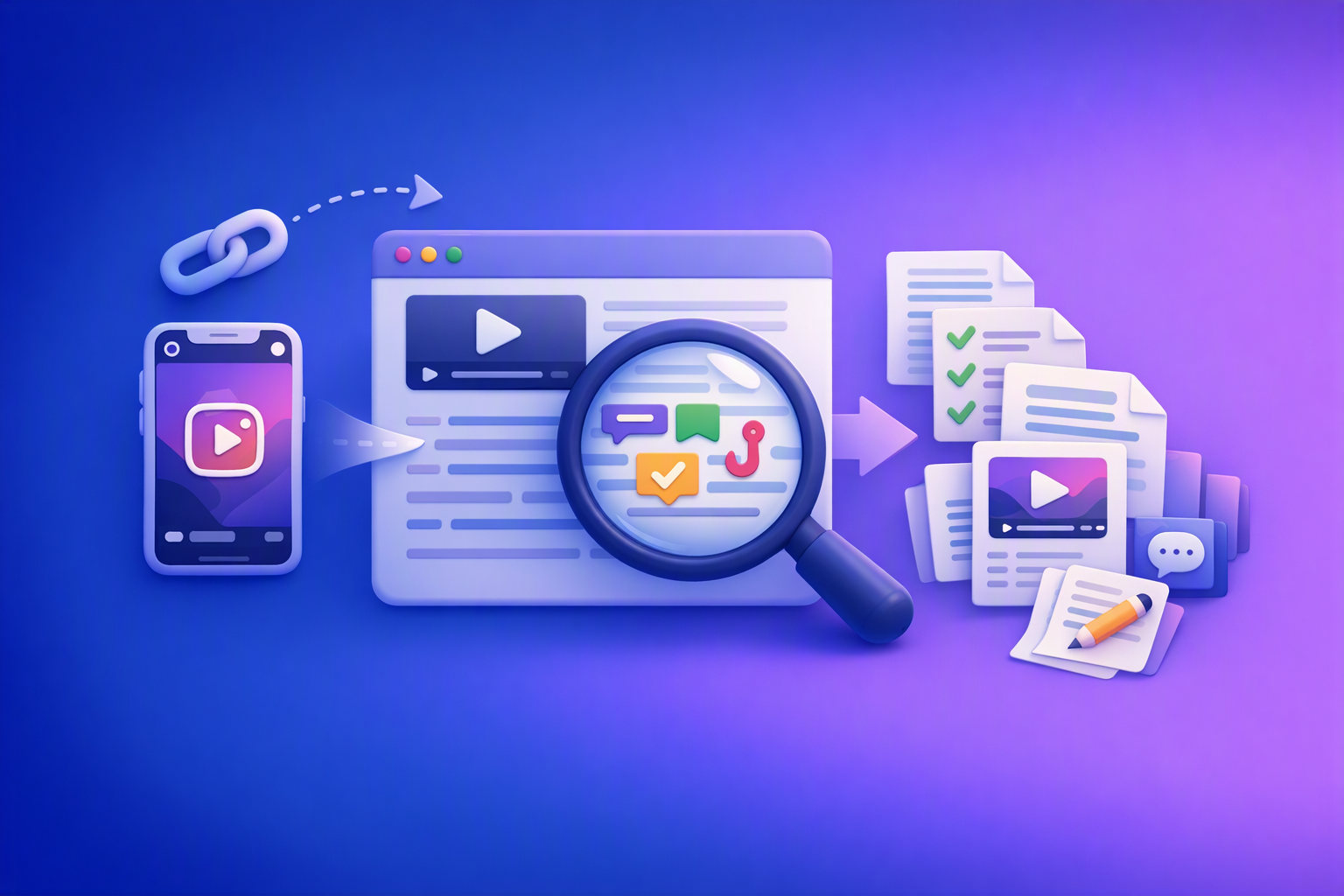
A 2026 reel analyser should turn Instagram Reel links into a searchable transcript library you can tag for hooks, CTAs, objections, and topic clusters—then export into repurposing-ready drafts without a download/upload loop.
Traducir video de Instagram (Reels) en 2026: workflow transcript-first para traducir, sacar hooks/CTAs y repurpose (con VideoToTextAI)
Video To Text AI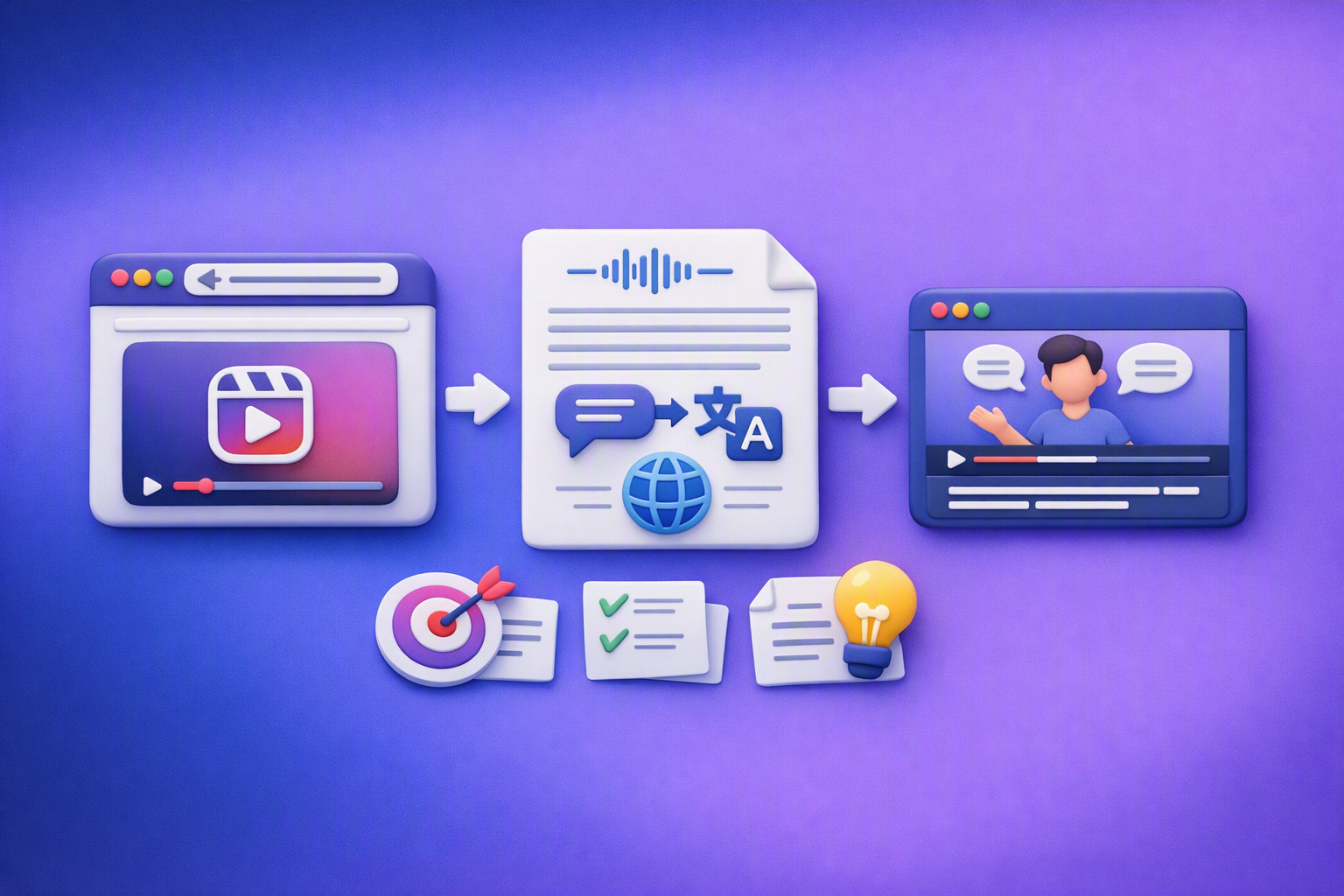
Aprende a traducir un Reel de Instagram con un flujo URL→transcripción→traducción→subtítulos, y a convertir esa traducción en un activo de investigación para hooks, CTAs, objeciones y clusters de contenido.
Reel Analyzer: Transcript‑First Instagram Reels Research (Hooks, CTAs, Objections) + Workflow Guide (VideoToTextAI)
Video To Text AI
A reel analyzer should turn any public Instagram Reel link into a searchable transcript library you can mine for hooks, CTAs, objections, and topic clusters—then repurpose into original drafts with a repeatable SOP.