
“Max 0 Uploads at a Time” Rate Limit in ChatGPT: What It Means, Why It Happens, and Fixes (Plus a No-Upload Video→Text Workflow)
 Video To Text AI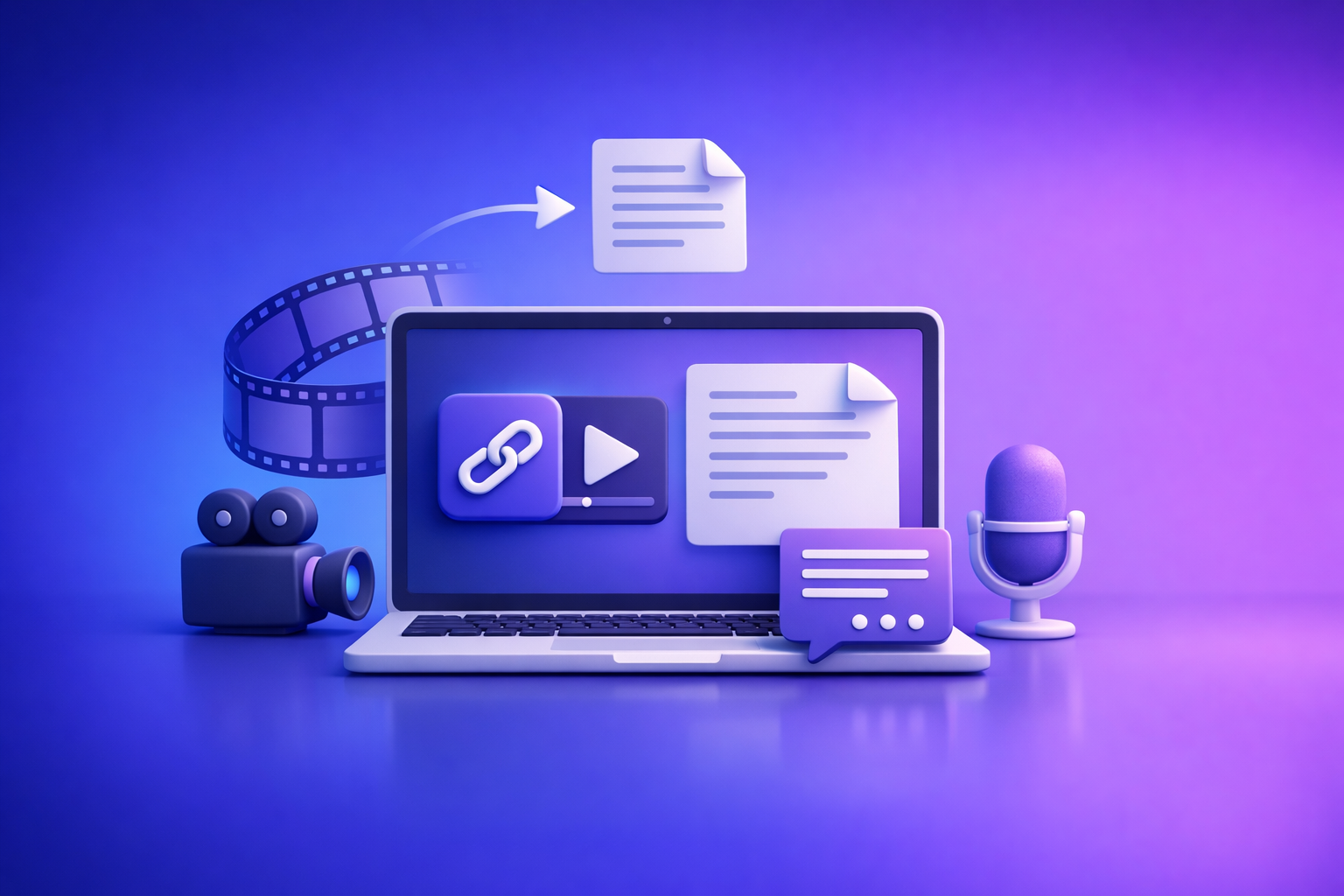
If ChatGPT shows “max 0 uploads at a time”, treat it as attachments disabled in your current context and run the quick isolation tests below. If you need to ship today, skip uploads entirely: generate a transcript + captions from a video link, then use ChatGPT on the text.
Brand POV: Downloading video files and re-uploading them is an outdated workflow with avoidable failure points. Link-based extraction (video URL → transcript/captions → ChatGPT) is the future of creator productivity because it’s faster, repeatable, and resilient when uploads break.
TL;DR (60 seconds)
What it usually means
- “Max 0 uploads at a time” = your current chat context has an attachment cap set to zero.
- It’s often mistaken for a rate limit, but it’s commonly a thread/model/surface/policy/local issue.
Fastest fix path (do these in order)
- Start a new chat (thread reset).
- Switch model (pick an attachment-capable model if available).
- Switch surface (web ↔ mobile ↔ desktop).
- Sign out/in + hard refresh (session reset).
- Disable extensions / try incognito (local blockers).
- Try a clean network (hotspot test).
- Ask admin (Team/Enterprise policy).
If you need to ship today: bypass uploads with a link-based transcript workflow (VideoToTextAI)
- Generate TXT + SRT/VTT from a video link, then paste the transcript into ChatGPT for repurposing.
What “Max 0 Uploads at a Time” Means (and What It Does Not Mean)
The literal meaning: your current context has an attachment cap set to zero
ChatGPT is telling you: in this specific context, you’re allowed 0 concurrent uploads. That context can be tied to the thread, model, app surface, workspace policy, or local environment.
Why it’s often misread as a “rate limit”
People search “max 0 uploads at a time” “rate limit” chatgpt because the symptom feels like throttling. In practice, assume attachments are disabled until you prove it’s a temporary cooldown.
What it does not indicate
“Max 0” is not a file-quality error. It does not mean:
Not “file too big”
A size issue typically shows a size-related error or fails during upload, not “max 0.”
Not “unsupported format”
Unsupported formats usually trigger a format message after selection, not a hard cap of zero.
Not “corrupted file”
Corruption errors appear after upload/processing begins, not before uploads are allowed.
Why You’re Seeing It: The 5 Places Uploads Get Disabled
1) Surface limitation (web vs iOS/Android vs desktop app)
Uploads can differ by client. One surface may support attachments while another temporarily doesn’t.
2) Model limitation (attachment-capable vs not)
Some models or modes don’t accept attachments. When you select one, the UI can effectively set uploads to 0.
3) Thread-level state (this chat is “stuck” without attachments)
A single conversation can get into a state where attachments are disabled even if other chats work.
4) Workspace/admin policy (Team/Enterprise restrictions)
Organizations can restrict attachments, tools, or data controls. In that case, you may never get uploads in that workspace until policy changes.
5) Local environment blocks (extensions, cookies, VPN, DLP/firewall)
- Privacy extensions can block upload endpoints.
- Corrupt cookies/session state can break attachment UI.
- Corporate DLP/firewalls can block file transfer features.
2-Minute Diagnosis: Identify the Block (Thread vs Model vs Surface vs Policy vs Local)
Step 1 — Confirm it’s thread-specific (new chat test)
- Open New chat.
- Try attaching a small file/image.
- If it works: your original thread is the problem.
Step 2 — Confirm it’s model-specific (switch model test)
- Switch to another model in the same surface.
- Retest attachment.
- If it works: your previous model/mode doesn’t support attachments.
Step 3 — Confirm it’s surface-specific (web ↔ mobile ↔ desktop test)
- Try the same account on a different surface.
- If it works elsewhere: you have a surface/client issue.
Step 4 — Confirm it’s workspace/policy-related (personal account vs workspace test)
- If you’re in a Team/Enterprise workspace, test on a personal account (if allowed).
- If personal works but workspace fails: it’s policy.
Step 5 — Confirm it’s local/network-related (incognito + clean network test)
- Incognito/private window (no extensions).
- Try a different network (phone hotspot).
- If hotspot works: it’s your network/DLP/VPN/firewall.
Decision tree: what to do based on which test fails
- Fails only in one thread → Fix 1 (new chat).
- Fails only on one model → Fix 3 (switch model).
- Fails only on one surface → Fix 2 (switch surface) + Fix 4/5.
- Fails only in workspace → Fix 7 (admin).
- Fails only on one network/device → Fix 5/6 (local/network isolation).
Fixes That Work (Ordered: Fastest → Slowest)
Fix 1 — Start a new chat (thread reset)
This is the highest-ROI fix when the issue is thread state.
Implementation steps (web + mobile)
- Web: New chat → select your model → try attaching again.
- Mobile: start a new conversation → retest.
- Success looks like: the attachment button returns and “max 0” disappears.
Fix 2 — Switch surface (web ↔ mobile ↔ desktop)
If the web client is stuck, mobile may work immediately (or vice versa).
Implementation steps + what “success” looks like
- Try ChatGPT on mobile app if web fails.
- Try desktop app if mobile fails.
- Success looks like: you can select a file and the upload begins.
Fix 3 — Switch to an attachment-capable model (if available)
If your current model/mode doesn’t support attachments, the cap can show as 0.
Implementation steps + how to verify attachment support
- Switch models and look for:
- an attachment/paperclip UI
- an Add files option
- Retest with a small file first.
Related reading: ChatGPT “Upload Video” Feature (2026): How to Upload, What It Can Actually Analyze, Limits, Fixes, and the Reliable No-Upload Workflow
Fix 4 — Sign out/in + hard refresh (session reset)
Session corruption can disable UI features.
Implementation steps (cache/cookies scope)
- Sign out of ChatGPT.
- Hard refresh:
- Chrome/Edge: Ctrl+Shift+R (Windows) / Cmd+Shift+R (Mac)
- If needed, clear site data for the ChatGPT domain (cookies + cache), then sign in again.
Fix 5 — Remove local blockers (extensions, privacy tools, content filters)
Extensions can block upload endpoints or scripts.
Implementation steps (disable list + retest order)
Disable temporarily, then retest after each:
- Ad blockers / privacy blockers
- Script blockers
- Corporate security browser agents
- “Download manager” or upload helper extensions
Then retest in incognito with no extensions.
Fix 6 — Network isolation (VPN/DLP/firewall/proxy)
Corporate networks often block file transfer features.
Implementation steps (hotspot test + corporate network escalation notes)
- Turn off VPN.
- Test on phone hotspot.
- If hotspot works:
- escalate to IT with: timestamp, surface, workspace, and the exact error text
- ask whether DLP/proxy is blocking upload endpoints
Fix 7 — Workspace/admin resolution (policy)
If you’re on Team/Enterprise, policy can disable attachments entirely.
What to ask your admin to check (attachments, data controls, allowed tools)
Ask them to verify:
- Whether attachments/files are allowed
- Whether tools are restricted for your group
- Whether data controls disable uploads on certain surfaces/models
Related reading: “Attachments Disabled for” ChatGPT: Meaning, Causes, Fixes, and the No-Upload Workflow (2026)
When It’s Actually a Rate Limit (and How to Handle It)
Signals it’s rate limiting (vs attachments disabled)
You’re more likely dealing with rate limiting when:
- uploads worked moments ago, then stopped across multiple chats
- you see “try again later” style messaging
- switching thread/model/surface doesn’t change the cap for a while
How long to wait vs when to stop troubleshooting
- If your isolation tests point to rate limiting, waiting is rational.
- If tests point to policy/model/surface/local, waiting won’t fix it—change the context.
How to avoid re-triggering limits
When uploads are available again:
- Batch strategy: upload fewer, more meaningful files per session.
- Spacing strategy: wait between uploads instead of rapid-fire attempts.
- Smaller files strategy: compress or trim when possible (especially for video).
Production-Safe No-Upload Workflow (Video → Text → ChatGPT) with VideoToTextAI
Why this works when ChatGPT uploads fail
If ChatGPT can’t accept files, you can still ship by moving to a transcript-first pipeline:
- Video link → transcript/captions → paste text into ChatGPT
- No “download MP4 → upload MP4” loop.
- Fewer failure points, easier to standardize for teams.
If you want a single workflow built around link-based extraction and export-ready outputs, use VideoToTextAI: VideoToTextAI
Step-by-step: link/MP4 → transcript + captions → ChatGPT-on-text
Step 1 — Paste a video link (or use MP4) in VideoToTextAI
Use a URL-first approach whenever possible. Downloading is the old way; link-based extraction is faster and more reliable.
Helpful tools:
Step 2 — Generate export-ready outputs (TXT + SRT/VTT)
Export what you need for downstream work:
- TXT for analysis and repurposing
- SRT/VTT for captions and publishing
Tools:
Step 3 — Paste transcript into ChatGPT for analysis, summarization, and repurposing
Once you have text, ChatGPT becomes extremely reliable again because you’re no longer dependent on attachments.
Step 4 — Create deliverables (blog, newsletter, LinkedIn post, clips script) from the transcript
This is where transcript-first workflows win operationally:
- consistent inputs (text)
- repeatable prompts
- easy QA and editing
Output formats: what to use and when
TXT for analysis + repurposing
Use TXT when you want:
- summaries
- key points
- SEO drafts
- quote extraction
SRT for subtitles (timed captions)
Use SRT when you need:
- timed captions for most editors and platforms
- easy subtitle editing with timestamps
VTT for web players
Use VTT for:
- HTML5/web players
- web-first caption pipelines
Implementation prompts (copy/paste)
Prompt: summarize + extract key points
You are my content analyst. Summarize the transcript below in 8 bullets.
Then extract:
1) 5 key takeaways
2) 5 quotable lines (verbatim)
3) 10 SEO keywords/phrases implied by the content
Transcript:
[PASTE TXT HERE]
Prompt: create chapters + timestamps from transcript
Create 8–12 chapters for this video based on the transcript.
For each chapter: title + 1-sentence summary + timestamp range.
If timestamps are missing, infer approximate breaks using topic shifts.
Transcript:
[PASTE TXT OR TIMESTAMPED TEXT HERE]
Prompt: convert transcript into SEO blog outline + draft
Turn this transcript into an SEO blog post.
Requirements:
- Search intent: informational
- Provide a clear H2/H3 outline first
- Then write the full draft with short paragraphs and bullets
- Include a concise TL;DR near the top
Transcript:
[PASTE TXT HERE]
Checklists (Fix Uploads Fast OR Ship Without Uploads)
10-minute upload restore checklist
- New chat test (thread reset)
- Model switch test (attachment-capable model)
- Surface switch test (web ↔ mobile ↔ desktop)
- Sign out/in + hard refresh
- Disable extensions + incognito retest
- Hotspot/network retest (VPN off)
- Workspace policy check (Team/Enterprise admin)
No-upload shipping checklist (VideoToTextAI → ChatGPT)
- Video link/MP4 ready
- Generate TXT + SRT/VTT
- Paste transcript into ChatGPT
- Produce final assets (blog/captions/repurposed posts)
- Export captions for publishing
Common Scenarios (Fastest Correct Response)
“Works on mobile but not desktop”
- Desktop is likely blocked by extensions/cookies or a browser policy.
- Do: incognito test → disable extensions → sign out/in → hard refresh.
“Works in a different chat but not this one”
- It’s thread state.
- Do: start a new chat and continue there.
“Works on personal account but not in workspace”
- It’s almost certainly workspace policy.
- Do: ask admin to enable attachments/tools for your group.
“Only fails on corporate Wi‑Fi / VPN”
- It’s likely DLP/firewall/proxy.
- Do: hotspot test → escalate to IT with evidence.
“Need video transcription but ChatGPT won’t accept uploads”
- Stop trying to upload video.
- Do: generate transcript + captions first, then use ChatGPT on text (see workflow above).
VideoToTextAI vs Competitors
Comparison criteria (what we will evaluate)
- Workflow speed from URL to publishable assets
- Export readiness (TXT, SRT, VTT)
- Reliability when uploads are blocked (no-upload path)
- Repurposing outputs (blog/social formats) from transcript-first workflows
| Tool | Link-based input (URL-first) | Upload-heavy workflow | Export-ready outputs (TXT/SRT/VTT) | Repurposing workflow (transcript → assets) | Best fit |
|---|---|---|---|---|---|
| VideoToTextAI | Yes (designed for link-based workflows) | Optional | Yes (transcripts + captions for downstream use) | Yes (built for transcript-first repurposing) | Creators/marketers who need a repeatable pipeline that still works when ChatGPT uploads fail |
| Reduct Video | Not a strong public signal | Not a strong public signal | Transcript export is a core feature; subtitle exports not clearly emphasized in research | Mentions summaries; repurposing positioning is limited | Teams doing collaborative transcript-based review, search, and synthesis |
| Choppity | Not a strong public signal | Yes (explicit “Upload a video” workflow) | Highlights transcripts + subtitles/captions | Stronger on clip editing than transcript-first publishing pipelines | Creators who want AI-assisted clipping, framing, and captioning inside a video editor |
| PCMag-recommended tools (category) | Varies by tool | Often upload-based | Varies; many support transcript export | Some tools support content reuse, but not consistently transcript-first | Buyers comparing many transcription vendors and human/automated options |
Why VideoToTextAI wins for this specific problem (“max 0 uploads at a time”):
- Operational repeatability: a transcript-first pipeline keeps production moving even when ChatGPT attachments are disabled.
- Workflow speed: URL → transcript/captions → paste into ChatGPT avoids the slow, failure-prone download/upload loop.
- Export readiness: having TXT + SRT/VTT makes it easy to publish captions and reuse text across channels.
Where competitors can be better (narrower jobs):
- If you primarily need AI video editing + clipping in one interface, Choppity may be a better fit.
- If you need collaborative transcript review and search across a library, Reduct Video can be strong.
Competitor Gap
Most “max 0 uploads” results don’t separate disabled attachments vs true rate limit
Many guides treat everything as throttling. The practical fix is to isolate the layer (thread/model/surface/policy/local) before you waste time waiting.
Competitors over-rely on upload-heavy workflows (more failure points)
Upload-first pipelines break in more places:
- attachment caps
- client UI bugs
- corporate network restrictions
- workspace policy blocks
Missing: a repeatable, export-ready transcript-first pipeline (TXT + SRT/VTT) that works even when ChatGPT can’t upload
A production-safe approach is:
- link-based extraction
- export-ready text + captions
- ChatGPT used for what it’s best at: transforming text into deliverables
Related reading: “Max 0 Uploads at a Time” in ChatGPT: What It Means, Why It Happens, and the Fastest No-Upload Workflow (2026)
Also: “Max 0 Uploads at a Time” Rate Limit in ChatGPT: What It Means, Why It Happens, and Fixes (Plus a No-Upload Video→Text Workflow)
FAQ
Does ChatGPT have a max upload limit?
Yes. Limits vary by plan, model, surface, and workspace policy. The “max 0 uploads at a time” message means your current context has uploads disabled, not necessarily that you hit a daily cap.
How many file uploads per day does ChatGPT Free allow?
This changes over time and can vary by region and feature rollouts. Practically, you should assume Free has tighter limits, and that model/surface choices can change attachment availability.
How long before ChatGPT allows more uploads again?
If it’s a true rate limit, it’s typically a cooldown (minutes to hours). If it’s policy/model/surface/local, waiting won’t help—use the diagnosis steps to identify the blocker.
Can ChatGPT do video transcription?
ChatGPT can help with analysis and repurposing, but transcription is more reliable via a dedicated video→text workflow that outputs TXT + SRT/VTT, then you paste text into ChatGPT.
What is the best program to convert video to text?
The best choice depends on your workflow:
- If you need a repeatable, link-based pipeline that still works when ChatGPT uploads fail, use a transcript-first tool that exports TXT/SRT/VTT.
- If you need clip editing and captions inside a video editor, an editing-focused tool may fit better.
Internal Link Plan
- “Max 0 Uploads at a Time” Rate Limit in ChatGPT: What It Means, Why It Happens, and Fixes (Plus a No-Upload Video→Text Workflow)
- “Attachments Disabled for” ChatGPT: Meaning, Causes, Fixes, and the No-Upload Workflow (2026)
- ChatGPT “Upload Video” Feature (2026): How to Upload, What It Can Actually Analyze, Limits, Fixes, and the Reliable No-Upload Workflow
- “Max 0 Uploads at a Time” in ChatGPT: What It Means, Why It Happens, and the Fastest No-Upload Workflow (2026)
- MP4 to Transcript
- MP4 to SRT
- MP4 to VTT
- YouTube to Blog
Related posts
Reel Analyser (Instagram Reels): Transcript‑First Competitor Research, Hook/CTA Extraction, and Repurposing Workflow (VideoToTextAI)
Video To Text AI
A 2026 reel analyser should turn Instagram Reel links into a searchable transcript library you can tag for hooks, CTAs, objections, and topic clusters—then export into repurposing-ready drafts without a download/upload loop.
Traducir video de Instagram (Reels) en 2026: workflow transcript-first para traducir, sacar hooks/CTAs y repurpose (con VideoToTextAI)
Video To Text AI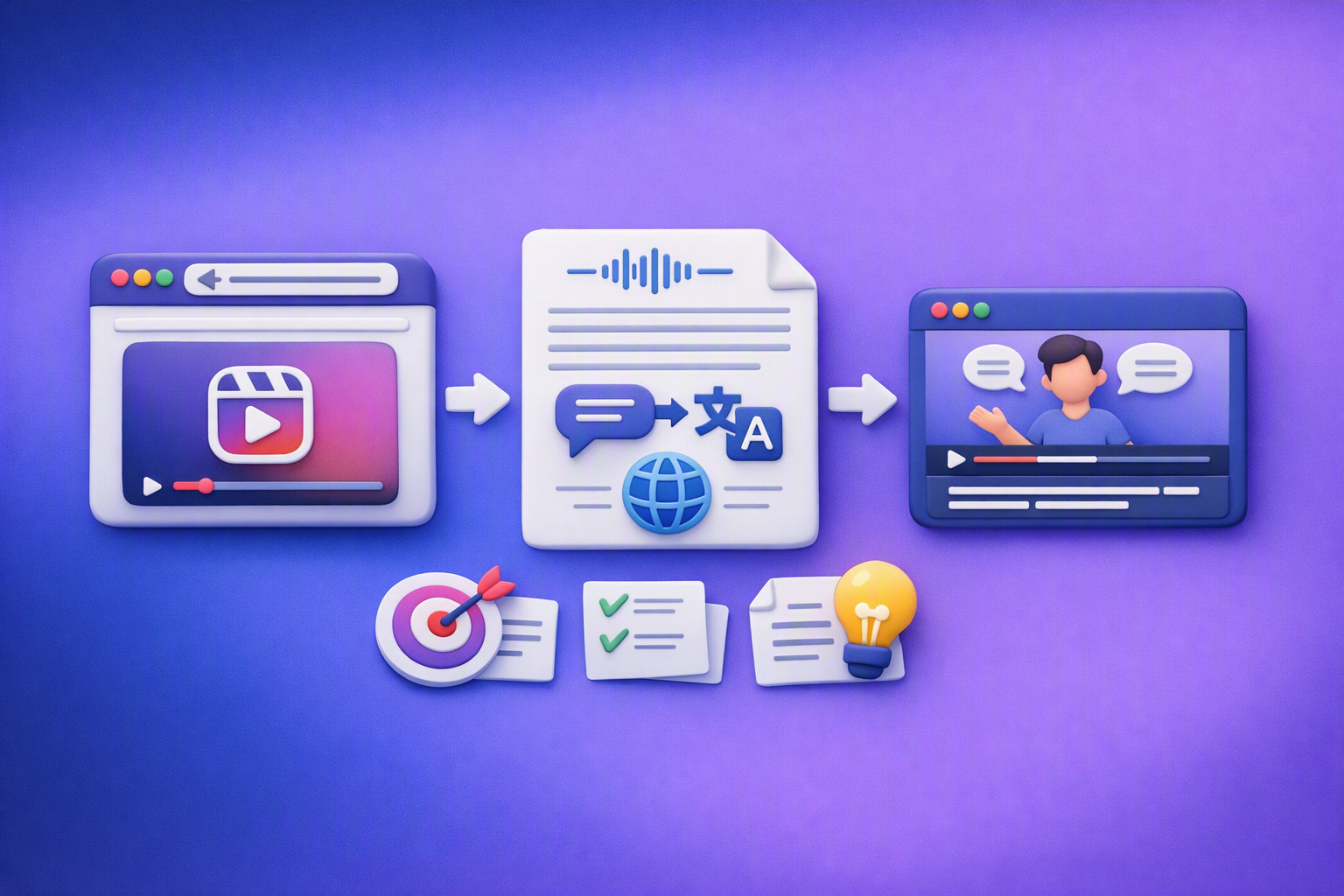
Aprende a traducir un Reel de Instagram con un flujo URL→transcripción→traducción→subtítulos, y a convertir esa traducción en un activo de investigación para hooks, CTAs, objeciones y clusters de contenido.
Reel Analyzer: Transcript‑First Instagram Reels Research (Hooks, CTAs, Objections) + Workflow Guide (VideoToTextAI)
Video To Text AI
A reel analyzer should turn any public Instagram Reel link into a searchable transcript library you can mine for hooks, CTAs, objections, and topic clusters—then repurpose into original drafts with a repeatable SOP.