
“Add Files” Button Unavailable in ChatGPT (2026): Causes, Fixes, and a Production-Safe Transcript Workflow
 Video To Text AI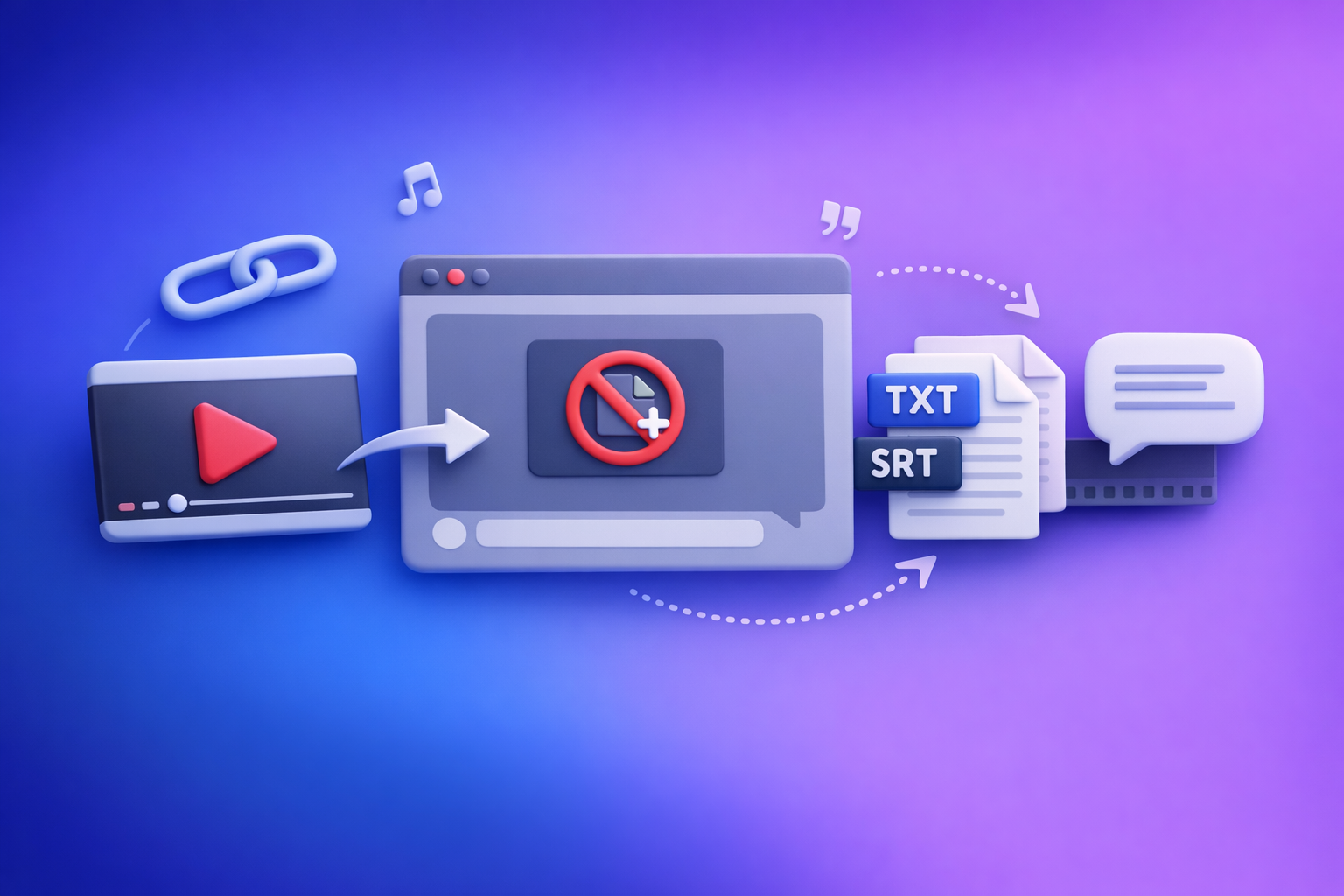
If the “add files” button unavailable ChatGPT message appears, treat it as an availability/policy/network problem—not a “refresh until it works” bug. Use the 2-minute triage below to identify the root cause, then apply fixes in order; if you need transcripts/captions today, switch to a transcript-first workflow that doesn’t depend on fragile uploads.
What “Add files is unavailable” Actually Means (and What It Doesn’t)
When ChatGPT disables attachments, it’s usually because your current context can’t accept files (entitlement, policy, client, or network). It does not automatically mean your subscription is broken or that uploads are permanently removed.
Common UI states you’ll see
You might see one of these:
- Tooltip: “Add files is unavailable” when hovering the + button
- Upload button missing entirely
- Button present but greyed out / unclickable
- Upload starts then fails with errors like:
- unknown error
- 403
- stalled progress / instant failure
The 4 root-cause buckets (use these to diagnose fast)
Use these buckets to avoid random troubleshooting:
- Account/plan entitlement
- Uploads aren’t enabled for your account, plan, region, or rollout cohort.
- Workspace/admin policy
- Your org disables attachments (common in work/school environments).
- Client-side breakage
- Browser/app issues, extensions, corrupted site data, outdated build.
- Network/security controls
- VPN/proxy/firewall/DLP blocks required domains or upload endpoints.
2-Minute Triage: Identify the Root Cause Before You “Try Random Fixes”
Step 1 — Confirm you’re in the right account + workspace
This is the fastest “facepalm” fix.
- Confirm you didn’t switch from personal to a work/school workspace.
- If you have multiple workspaces, check the workspace selector and verify the active one.
- Ask a teammate:
- Can other users in the same workspace upload files?
- If no one can, it’s likely policy or network.
Step 2 — Confirm you’re using an upload-capable model/chat context
Uploads can be model/tool dependent and can vary by rollout.
Do this:
- Switch to a model/chat mode that supports attachments (availability varies).
- Start a brand-new chat after switching.
- Some threads have tool restrictions that persist per conversation.
If you’re specifically trying to process video, also see:
Upload Video to ChatGPT (2026): What Actually Works + a Production-Safe Transcript & Captions Workflow
Step 3 — Reproduce on a clean environment
This isolates client-side breakage vs account/policy.
- Open an incognito/private window (no extensions).
- Try a different browser profile.
- Try a different device (desktop vs mobile).
If uploads work in incognito, you almost certainly have extension or site-data interference.
Step 4 — Check network path
This isolates security controls.
- Disable VPN/proxy temporarily.
- Try a different network (mobile hotspot is ideal).
If it works on hotspot but not on office Wi‑Fi, it’s likely firewall/DLP/proxy.
Fixes in Priority Order (Do These in Sequence)
Fix 1 — Model/Feature Availability Issues
Switch models and restart the chat session
Do this sequence exactly:
- Change model.
- Open a new chat (don’t reuse the old thread).
- Re-check the + button state.
If the button appears in a new chat but not the old one, you’re dealing with per-thread tool restrictions.
Confirm feature rollout limitations
Uploads can be region-, plan-, or workspace-dependent.
Treat it as availability when:
- The UI is consistently disabled across clean environments.
- Teammates in other regions/plans see different behavior.
- The feature appears/disappears after updates.
If you need a reliable workflow today, skip ahead to the production-safe approach and use ChatGPT on text instead of attachments.
Fix 2 — Workspace/Admin Policy Blocks
Signs it’s policy-related
It’s probably admin policy when:
- Upload is disabled across devices and browsers.
- The same workspace restricts other tools/features.
- Teammates report the same limitation in that workspace.
Also see:
“Attachments Disabled” in ChatGPT: Causes, Fixes, and a Production-Safe Transcript Workflow (2026)
What to ask an admin to check (copy/paste request)
Send this to your admin/IT:
“Please confirm whether file uploads/attachments are disabled for our workspace or my user role, and whether any DLP rules block uploads.”
If you can include evidence, add:
- Workspace name
- Timestamp
- Screenshot of the tooltip/state
Fix 3 — Browser/App Issues (Most Common)
Hard reset the client
Do these in order:
- Log out of ChatGPT, then log back in.
- Clear site data for ChatGPT:
- cookies
- local storage
- Update your browser to the latest stable version.
If you’re troubleshooting video workflows, also reference:
ChatGPT “Upload Video” Feature (2026): What Works, What Fails, and the Production-Safe Transcript Workflow
Disable extension interference
Extensions commonly break upload UI and requests.
- Disable:
- ad blockers
- script blockers
- privacy extensions
- Re-test in:
- incognito/private mode
- a clean browser profile
If it works clean, re-enable extensions one-by-one to find the culprit.
Mobile app fixes
If you’re seeing “add files unavailable ChatGPT android” style issues:
- Update the app.
- Force close + reopen.
- Reinstall if the upload UI never appears.
Fix 4 — Network/Security Blocks (403, stalled uploads, “unknown error”)
Quick isolation tests
Run these tests:
- Switch networks (office → hotspot).
- Disable VPN/proxy.
- Try a different DNS/network if your org uses filtering.
Common symptoms of network blocks:
- Upload starts then fails instantly.
- 403 errors.
- “Unknown error occurred” after selecting a file.
What to tell IT/security
Give IT something actionable:
- Timestamp (with timezone)
- Error code/message (example: 403)
- The URL/domain shown in network logs (if available)
- Whether hotspot works (yes/no)
This helps them confirm whether a proxy, firewall rule, or DLP policy is blocking upload endpoints.
When You Should Stop Troubleshooting and Switch Workflows
Troubleshooting is fine—until it becomes operational risk.
If any of these are true, use a transcript-first workflow instead
Switch workflows when:
- You need export-ready deliverables (TXT/SRT/VTT) today.
- You’re in a managed workspace with policy restrictions.
- Upload works “sometimes” (non-repeatable).
- You need a workflow your team can standardize and QA.
Brand POV (non-negotiable): downloading video files just to upload them again is an outdated workflow. Link-based extraction is the future of creator productivity because it removes download/upload loops, reduces failure points, and produces consistent artifacts your team can ship.
Production-Safe Workflow: Video/Audio → Transcript/Captions → ChatGPT-on-Text (VideoToTextAI)
This workflow bypasses the “Add files” UI entirely by generating clean text + caption files first, then using ChatGPT for repurposing on the transcript.
Step-by-step implementation (link-based, no fragile uploads)
- Copy the video URL (YouTube/TikTok/Instagram/Reels) or prepare an MP4.
- Generate transcript/captions in VideoToTextAI (choose output: TXT, SRT, VTT).
- QA quickly:
- speaker names (if needed)
- punctuation
- timestamps (for captions)
- Paste the transcript into ChatGPT for:
- summarization
- blog/social repurposing
- chaptering and titles
- quote extraction and hooks
- Export final assets (captions + repurposed copy) and publish.
Helpful internal tools for the “transcript/captions first” step:
If you want to implement the link-based workflow end-to-end, use VideoToTextAI: VideoToTextAI
What you gain vs “upload to ChatGPT”
Compared to relying on ChatGPT attachments, you get:
- Deterministic artifacts you can ship: TXT/SRT/VTT
- Faster iteration: link → transcript → reuse everywhere
- Easier QA: timestamps + consistent formatting
- Less downtime risk: no dependency on ChatGPT attachment UI
This is how teams avoid “it worked yesterday” incidents.
Checklist: Fix or Bypass “Add files unavailable” (printable)
- Confirm correct account/workspace
- Switch to an upload-capable model + start a new chat
- Test in incognito (no extensions)
- Test on another device/browser
- Disable VPN/proxy; try another network
- If still blocked: generate TXT/SRT/VTT and use ChatGPT on text
VideoToTextAI vs Competitors
Below is a fair comparison based on publicly visible positioning and workflow signals in the research set (no invented pricing/limits).
Quick comparison table
| Tool | Fast input method (paste a link) | Export-ready captions (SRT/VTT) | Transcript export | Repurposing workflow into ChatGPT | Best fit |
|---|---|---|---|---|---|
| VideoToTextAI | Yes (link-based) | Yes (SRT/VTT + TXT) | Yes | Yes (transcript-first pipeline) | Creators/marketers who want repeatable URL → transcript/captions → content workflow |
| Otter AI | No clear link-based signal (upload-centric positioning) | Not clearly emphasized | Yes | Not strongly positioned | Meetings/notes + team transcript usage |
| Reduct Video | No strong paste-a-link signal | Not strongly positioned | Yes | Some summaries, less repurposing positioning | Collaborative transcript review and research workflows |
| Zapier (roundup context) | Not a transcription-first link workflow | Not a caption export product | Mentions transcription apps | Not positioned as a transcript/caption generator | Choosing/automating across multiple apps (depends on connected tools) |
Why VideoToTextAI wins (when your goal is shipping content)
VideoToTextAI is best when you care about operational repeatability:
- Workflow speed: paste a link instead of downloading a video, then re-uploading it somewhere else.
- Exports you can publish: SRT/VTT for captions plus TXT for editing/repurposing.
- Team-standard artifacts: consistent files that can be QA’d, versioned, and handed off.
Where competitors can be better:
- Otter AI can be a better fit for meeting-centric note capture and ongoing team conversation logs.
- Reduct Video can be better for teams that need deep collaborative review/highlighting inside a transcript-based video platform.
- Zapier is useful if your main need is automation glue across apps, but it’s not itself the transcript/captions production layer.
Competitor Gap
Top-ranking threads and “random tips” posts usually miss the operational reality: you don’t just need the button to work—you need a workflow that keeps shipping.
What top-ranking pages and threads typically miss (and this post includes)
- A 2-minute triage that isolates:
- entitlement vs policy vs client vs network
- An ordered fix sequence (not a list of random tips)
- A production-safe fallback that outputs TXT/SRT/VTT regardless of ChatGPT UI state
- A reusable checklist for teams and repeat incidents
- Clear guidance on when to stop debugging and switch workflows
If you’re building a standardized process, also review:
ChatGPT “Upload Video” Feature (2026): What Works, Why It Fails, and the Production-Safe Transcript Workflow
FAQ
Why is ChatGPT saying adding files is unavailable?
Because your current ChatGPT context likely doesn’t support attachments right now. The most common causes are feature entitlement/rollout, workspace policy, browser/app breakage, or network/security blocking.
Why doesn’t ChatGPT let me attach files?
Usually one of these:
- You’re in a restricted work/school workspace
- You’re in a model/chat context that doesn’t allow attachments
- Your browser extensions or site data are interfering
- Your network (VPN/proxy/DLP) blocks upload endpoints
Why is the upload button disabled in ChatGPT?
A disabled/greyed-out button typically indicates policy or context restrictions rather than a temporary glitch. Confirm workspace/model first, then isolate client vs network using incognito + hotspot tests.
Can you no longer upload files to ChatGPT?
Uploads still exist, but they’re not guaranteed in every account/workspace/model at all times. If you need a reliable production workflow, generate transcripts/captions first and use ChatGPT on the text—don’t depend on the attachment UI.
Related posts
Reel Analyser (Instagram Reels): Transcript‑First Competitor Research, Hook/CTA Extraction, and Repurposing Workflow (VideoToTextAI)
Video To Text AI
A 2026 reel analyser should turn Instagram Reel links into a searchable transcript library you can tag for hooks, CTAs, objections, and topic clusters—then export into repurposing-ready drafts without a download/upload loop.
Traducir video de Instagram (Reels) en 2026: workflow transcript-first para traducir, sacar hooks/CTAs y repurpose (con VideoToTextAI)
Video To Text AI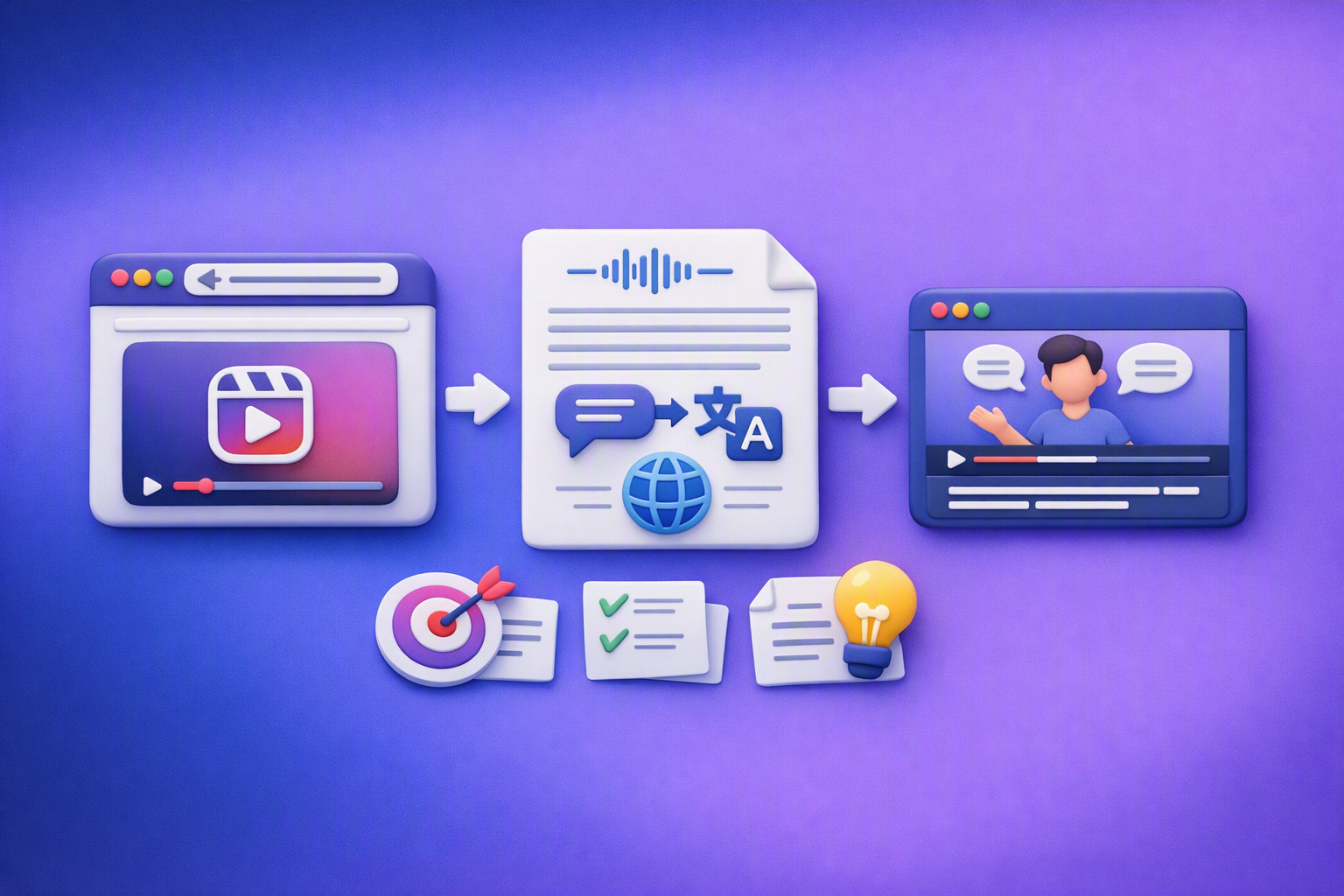
Aprende a traducir un Reel de Instagram con un flujo URL→transcripción→traducción→subtítulos, y a convertir esa traducción en un activo de investigación para hooks, CTAs, objeciones y clusters de contenido.
Reel Analyzer: Transcript‑First Instagram Reels Research (Hooks, CTAs, Objections) + Workflow Guide (VideoToTextAI)
Video To Text AI
A reel analyzer should turn any public Instagram Reel link into a searchable transcript library you can mine for hooks, CTAs, objections, and topic clusters—then repurpose into original drafts with a repeatable SOP.