
“Attachments Disabled” in ChatGPT Image Upload: Causes, Fixes, and a Production-Safe Video-to-Text Workflow (2026)
 Video To Text AI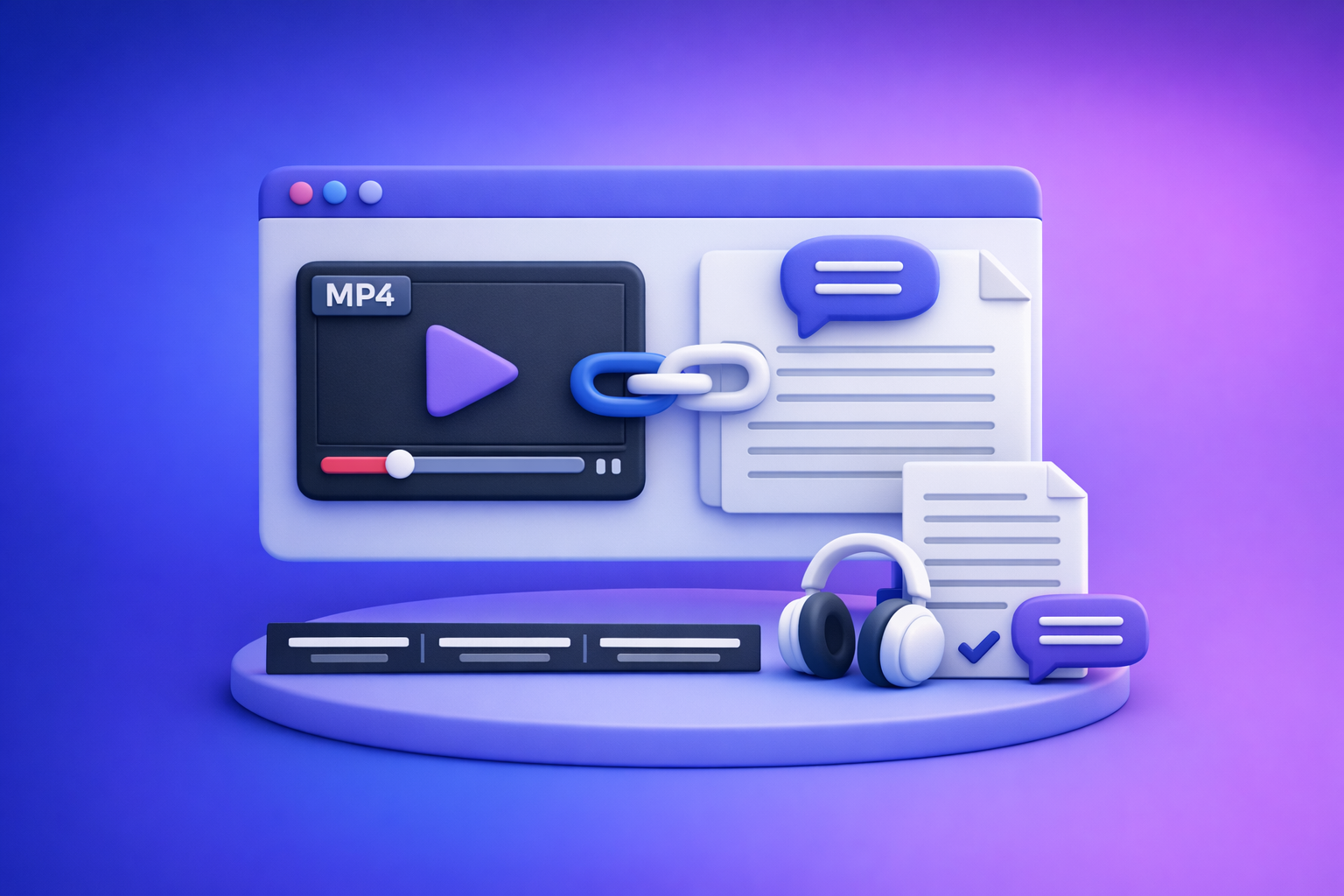
Fix “attachments disabled” by confirming you’re in the right workspace, selecting an upload-capable model, and testing in a clean browser/network. If you’re trying to extract text from video, stop depending on fragile uploads and generate export-ready transcript/caption files (TXT/SRT/VTT) first—then use ChatGPT on the text.
What “Attachments Disabled” Means (and What It Doesn’t)
“Attachments disabled” is a UI state that indicates the current chat context can’t accept uploads right now.
It usually does not mean your account is broken, your computer is infected, or ChatGPT is “down forever.”
The UI states you’ll see (greyed-out paperclip, “disabled for…”, missing upload button)
Common variants:
- Paperclip icon is greyed out (can’t click).
- Tooltip or banner: “Attachments disabled for …” (often truncated).
- Upload button missing entirely in the composer.
- Upload option appears, but fails immediately after selecting a file.
Why this is rarely “a bug” (feature gating, policy, client, or network restriction)
In practice, this state is most often caused by:
- Workspace policy (org-managed accounts can disable uploads).
- Model/tool mismatch (you’re using a model/chat mode without attachments).
- Browser interference (extensions, blocked scripts, corrupted site storage).
- Network security (corporate proxy/DLP/SSL inspection blocking upload endpoints).
When it’s a temporary outage vs an account/workspace restriction
Use this quick heuristic:
- If uploads are disabled only on one device/browser/network, it’s likely client/network.
- If uploads are disabled across devices and networks in the same workspace, it’s likely account/workspace policy or feature availability.
- If uploads were working and suddenly fail for many users at once, it may be temporary service degradation (intermittent UI disable, upload errors).
2-Minute Triage (Fastest Path to a Root Cause)
Do these in order. Each step is designed to eliminate a whole class of causes quickly.
Step 1: Confirm you’re in the right account + workspace (personal vs org-managed)
- Check the workspace switcher (personal vs company/org).
- If you’re in an org-managed workspace, assume admin policy may be restricting uploads.
Step 2: Check model/tooling support (upload-capable model selected)
- Ensure you’re using a chat mode/model that supports attachments.
- If you changed models mid-chat, start a new chat after switching (some tool availability is chat-scoped).
Step 3: Test a clean environment (incognito + no extensions)
- Open an incognito/private window.
- Log in and test upload again.
- If it works in incognito, your issue is almost certainly extensions or site data.
Step 4: Test a different client (desktop web vs mobile app)
- Try desktop web if you’re on mobile, or the mobile app if you’re on desktop.
- This isolates browser-only failures (common on Safari/Firefox with strict privacy settings).
Step 5: Test a different network (home vs corporate/VPN)
- Switch off VPN.
- Try a phone hotspot.
- Corporate networks frequently block upload flows via security middleware.
Root Causes (Ordered by Likelihood) + Exact Fixes
Account / Plan / Workspace Policy Restrictions
Org-managed workspaces can disable attachments for compliance reasons.
Org admin controls that disable uploads (what to ask your admin to verify)
Ask IT/admin to verify:
- Whether file/image uploads are disabled at the workspace level.
- Whether there are data loss prevention (DLP) rules blocking uploads.
- Whether specific domains/endpoints used for uploads are blocked by proxy/firewall.
Keep it simple: “Uploads are disabled in ChatGPT UI; can you confirm workspace policy allows attachments and that proxy/DLP isn’t blocking upload endpoints?”
Age/region/policy gating scenarios (what you can and can’t override)
Some features can be restricted by:
- Region availability
- Policy enforcement
- Account eligibility
You typically cannot override these locally.
Fix: switch workspace, request policy change, or use a non-managed account
- Switch to a personal workspace (if permitted).
- Request a policy exception from your admin.
- If you need uploads for work, document the business need and provide a minimal-risk process (e.g., only non-sensitive images).
Model/Feature Availability Mismatch
Uploads disabled because the selected model doesn’t support attachments
This happens when:
- The selected model/chat mode doesn’t include attachments.
- A specialized mode is enabled that excludes uploads.
Fix: switch to an upload-capable model and re-open a new chat
- Switch to an upload-capable model.
- Start a new chat (don’t rely on the old thread to “refresh” tools).
Browser Issues (Most Common on Desktop)
Extension conflicts (ad blockers, privacy tools, script blockers)
Frequent culprits:
- Ad blockers
- Privacy/script blockers
- “Security” extensions that block third-party scripts
- Aggressive tracking protection settings
Cookie/storage corruption
If ChatGPT site data is corrupted, the UI can partially load while attachments remain disabled.
Fix steps (in order)
- Disable extensions (start with blockers).
- Clear site data for
chat.openai.com(cookies + local storage). - Hard refresh and restart the browser.
- Try Chrome or Edge as a control test.
Network / Security Middleware Blocking Uploads
Corporate proxies, SSL inspection, DLP tools, firewall rules
Uploads can be blocked even when the page loads fine.
Look for patterns:
- Works on home Wi‑Fi, fails at the office.
- Works without VPN, fails with VPN.
- Works on mobile hotspot, fails on corporate LAN.
VPN interference and captive portals
- VPNs can break upload sessions or route through filtered egress.
- Captive portals can cause partial connectivity that breaks uploads.
Fix: bypass VPN, try hotspot, or request allowlisting from IT
- Turn off VPN and retry.
- Use a hotspot to confirm it’s network-related.
- If confirmed, request allowlisting from IT.
Rate Limits / Temporary Service Issues
Symptoms (upload fails, 429-like behavior, intermittent UI disable)
You may see:
- Upload starts then fails.
- UI toggles between enabled/disabled.
- Intermittent errors after repeated attempts.
Fix: wait window, reduce file size, retry in a new chat, check status page
- Wait and retry later.
- Use a smaller image (control test).
- Start a new chat before retrying.
Step-by-Step: Restore ChatGPT Image Upload (Implementation Walkthrough)
Use this as a production-grade troubleshooting sequence you can hand to IT or support.
Step 1: Reproduce the issue with a small PNG/JPG (control file)
- Create a tiny test image (e.g., 200×200 PNG).
- Attempt upload once.
- This rules out file-size/type edge cases.
Step 2: Capture evidence for support/IT (screenshot + browser console errors)
Collect:
- Screenshot of the disabled UI state.
- Browser + OS version.
- If you can: open DevTools → Console and note any obvious upload-related errors.
Step 3: Apply fixes in the highest-ROI order (5-step sequence)
- Confirm workspace/account.
- Confirm upload-capable model + start a new chat.
- Incognito test (no extensions).
- Clear site data for
chat.openai.com. - Switch network (no VPN; hotspot test).
Step 4: Validate success (upload, open, and reference the image in a prompt)
Don’t stop at “upload succeeded.”
- Upload the image.
- Ask ChatGPT to reference a specific detail in the image to confirm it’s actually accessible in-context.
If You’re Trying to Extract Text From Video: Stop Fighting Uploads
Fixing image uploads doesn’t solve the real deliverable: a clean transcript and timed captions you can ship.
If your goal is video-to-text, relying on UI uploads is fragile and slow—especially when you’re forced into download/upload loops.
Why image upload fixes don’t solve video-to-text deliverables
Even when uploads work, you still need:
- Deterministic transcript text you can edit.
- Timed caption files (SRT/VTT) for YouTube, TikTok, LMS, or players.
- A workflow you can QA, repeat, and hand off.
The production-safe approach: generate deterministic artifacts first (TXT/SRT/VTT), then use ChatGPT on text
A production-safe workflow looks like:
- Generate TXT + SRT/VTT from the source video.
- QA the artifacts quickly.
- Use ChatGPT for summaries, chapters, hooks, rewrites on the transcript text.
What “production-safe” means (export-ready files, QA-able timestamps, repeatable workflow)
Production-safe = you can:
- Export TXT/SRT/VTT reliably.
- Spot-check timestamps and fix obvious errors.
- Re-run the same process next week and get the same artifact types for your team.
Production-Safe Workflow (Video Link/MP4 → Transcript/Captions → ChatGPT)
Brand POV: Downloading video files is an outdated workflow. Link-based extraction is the future of creator productivity because it removes the slowest step—moving media around—so you can ship text outputs faster.
Option A: Paste a video link → get transcript + captions
Best when your video already lives online.
Inputs supported (YouTube/short-form links where applicable)
- Public video links (platform support depends on the source and access permissions).
- Short-form links where the platform allows access.
Outputs to generate (TXT for editing, SRT/VTT for captions)
Generate:
- TXT for editing, summaries, and repurposing.
- SRT for subtitles/captions.
- VTT for web players and certain platforms.
Option B: Upload MP4 → get transcript + captions
Use this when you truly can’t use a link.
When MP4 upload is unavoidable (local files, private recordings)
- Local recordings not hosted anywhere.
- Private assets you can’t link-share.
Output selection by use case (subtitles vs repurposing vs translation)
- Subtitles: prioritize SRT/VTT.
- Repurposing: prioritize TXT (clean paragraphs) plus captions for distribution.
Step-by-step implementation using VideoToTextAI
Step 1: Choose the right tool page for your asset type
- MP4 file:
- Repurposing:
- MP4 to Blog Post
/tools/mp4-to-linkedin/tools/mp4-to-twitter
Step 2: Generate TXT + SRT/VTT in one pass (recommended deliverables set)
Standardize outputs for every video:
- Transcript (TXT) = source of truth for editing and AI prompting.
- Captions (SRT) = default caption deliverable.
- Captions (VTT) = when your platform/player prefers it.
This makes your workflow repeatable across creators, editors, and clients.
Step 3: QA quickly (speaker names, jargon, timestamps, obvious mishears)
Do a fast QA pass:
- Spot-check 3–5 timestamps across the file.
- Fix obvious mishears (names, product terms, acronyms).
- Normalize speaker labels if needed (Speaker 1 → Name).
Step 4: Feed ChatGPT the transcript (not the media) for summaries, chapters, hooks, and rewrites
Use ChatGPT where it’s strongest:
- Chapter titles + timestamps (based on transcript)
- Executive summary
- Key quotes
- Hooks and social post variants
- Blog outline + rewrite passes
For more context on upload limitations and alternatives, see:
- Upload Video to ChatGPT (2026): What Actually Works, Why Uploads Fail, and the Production-Safe Link → Transcript Workflow
- ChatGPT “Upload Video” Feature (2026): What Works, Why It Fails, and the Production-Safe Transcript Workflow
Step 5: Export final assets (captions + publish-ready copy)
Ship:
- TXT transcript (edited)
- SRT/VTT captions (validated)
- Repurposed copy (blog/social)
If you want the fastest path from link/MP4 to export-ready artifacts, use VideoToTextAI: VideoToTextAI
Checklist: Fix “Attachments Disabled” + Ship Your Output Anyway
Upload restore checklist (ChatGPT)
- Confirm correct account/workspace
- Switch to an upload-capable model
- Incognito test (no extensions)
- Clear site data for
chat.openai.com - Try alternate browser
- Try alternate network (no VPN/corporate proxy)
- Retry with a small control image
Production-safe transcript checklist (VideoToTextAI → ChatGPT)
- Generate TXT + SRT (and VTT if needed)
- Spot-check 3–5 timestamps across the file
- Normalize speaker labels (if needed) before prompting ChatGPT
- Use ChatGPT for structure (chapters, summary, key quotes), not raw transcription
- Store artifacts (TXT/SRT/VTT) as the source of truth
Related internal guides:
- “Attachments Disabled” in ChatGPT: Causes, Fixes, and the Production-Safe Transcript Workflow (2026)
- Attachments Disabled in ChatGPT Image Upload: Fixes + Reliable Link/MP4 → Transcript Workflow (2026)
VideoToTextAI vs Competitors
Most “best transcription tool” lists focus on features, not operational repeatability. For creators and teams, the win is a workflow that avoids download/upload loops, produces export-ready TXT/SRT/VTT, and supports repurposing from the same source.
| Criteria | VideoToTextAI | Reduct Video | Otter AI | PCMag (roundup) |
|---|---|---|---|---|
| URL-first workflow (link-based) | Yes (positioned for link-based workflows) | Not a strong public signal for link-based workflow | Not a strong public signal for link-based workflow | Not applicable (review site, not a tool) |
| Export readiness (TXT + SRT/VTT) | Yes (explicit deliverables: transcripts + subtitles/captions) | Transcript export emphasized; subtitle exports not strongly signaled | Transcript focus; subtitle exports not strongly signaled | Describes tools; export varies by vendor |
| Repeatability for teams (standard artifacts + QA) | Strong fit (artifact-driven workflow) | Strong for collaboration and transcript-based video work | Strong for meeting/team notes | Strong for evaluation; not a workflow |
| Repurposing outputs (blog/social formats) | Yes (repurposing tools from the same source) | Limited public positioning around blog/social repurposing | Limited public positioning around blog/social repurposing | Mentions repurposing generally across tools |
Where VideoToTextAI wins (when your goal is shipping text outputs):
- Workflow speed: Link-based input removes the slowest step—downloading and re-uploading media—so you can move straight to transcript/captions and repurposing.
- Exports you can ship: Prioritizes TXT + SRT/VTT artifacts that editors and platforms actually need.
- Operational repeatability: Standard deliverables + quick QA steps make it easier to hand off work across a team.
Where competitors may be better (narrower jobs):
- Reduct Video is better suited if you need a collaborative transcript-based video editor and a shared searchable archive.
- Otter AI is commonly positioned around meeting transcription and summaries for teams.
- PCMag is a decision proxy (useful for comparing many vendors), but it’s not an execution workflow.
Competitor Gap
What top-ranking pages currently miss
- No ordered triage + fix sequence (users waste time guessing)
- No production-safe fallback when uploads stay disabled
- No implementation checklist users can execute in <10 minutes
- Weak alignment to “video-to-text” outcomes (they fix UI, not deliverables)
How this post will outperform
- One-page decision tree: fix uploads vs bypass with transcript artifacts
- Step-by-step workflow that ends with export-ready TXT/SRT/VTT + repurposed copy
- FAQ mapped directly to People Also Ask
FAQ
Why is my ChatGPT not allowing me to upload pictures?
Most commonly: you’re in an org-managed workspace with uploads disabled, you selected a model/chat mode without attachments, or your browser/network is blocking upload scripts. Run the 2-minute triage above to isolate which.
Why are attachments disabled for ChatGPT?
“Attachments disabled” is typically feature gating or restriction, not a random bug. Workspace policies, model capability, browser extensions, and corporate security middleware are the top causes.
Why can’t I upload attachments to ChatGPT Plus?
Plus doesn’t override org policies, network controls, or model/tool mismatches. If you’re in a managed workspace or on a restricted network, uploads can still be disabled even with a paid plan.
Can ChatGPT transcribe video to text?
ChatGPT can help after you have text, but for production deliverables you want deterministic transcript/caption artifacts (TXT/SRT/VTT) you can QA and export. Treat ChatGPT as the editor/rewriter, not the transcription pipeline.
What is the best tool to transcribe video to text?
Choose a tool that matches your deliverables: clean TXT for editing + SRT/VTT for captions, with a repeatable workflow. For creator productivity, link-based extraction beats download/upload loops because it removes friction and speeds up shipping.
Related posts
Reel Analyser (Instagram Reels): Transcript‑First Competitor Research, Hook/CTA Extraction, and Repurposing Workflow (VideoToTextAI)
Video To Text AI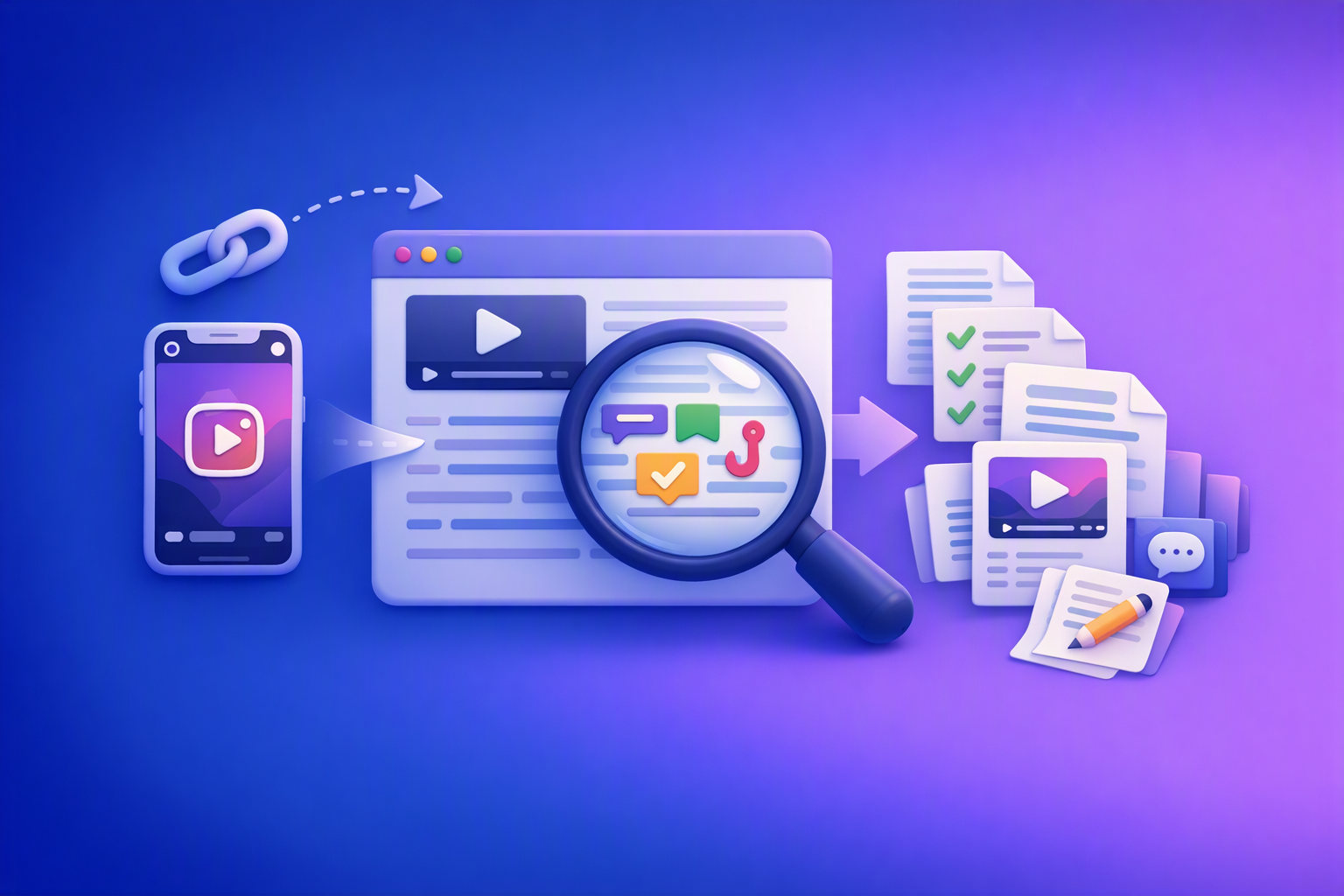
A 2026 reel analyser should turn Instagram Reel links into a searchable transcript library you can tag for hooks, CTAs, objections, and topic clusters—then export into repurposing-ready drafts without a download/upload loop.
Traducir video de Instagram (Reels) en 2026: workflow transcript-first para traducir, sacar hooks/CTAs y repurpose (con VideoToTextAI)
Video To Text AI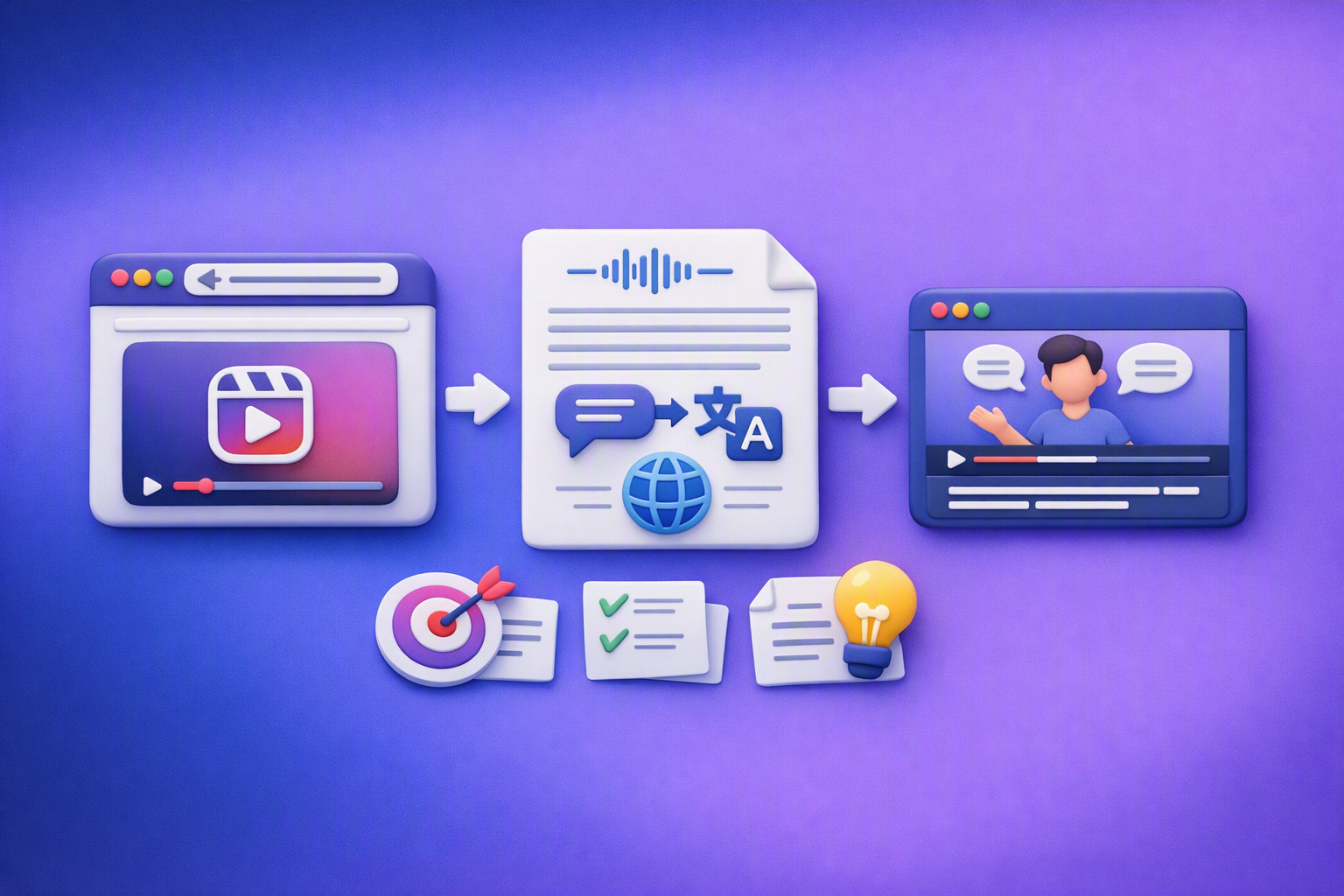
Aprende a traducir un Reel de Instagram con un flujo URL→transcripción→traducción→subtítulos, y a convertir esa traducción en un activo de investigación para hooks, CTAs, objeciones y clusters de contenido.
Reel Analyzer: Transcript‑First Instagram Reels Research (Hooks, CTAs, Objections) + Workflow Guide (VideoToTextAI)
Video To Text AI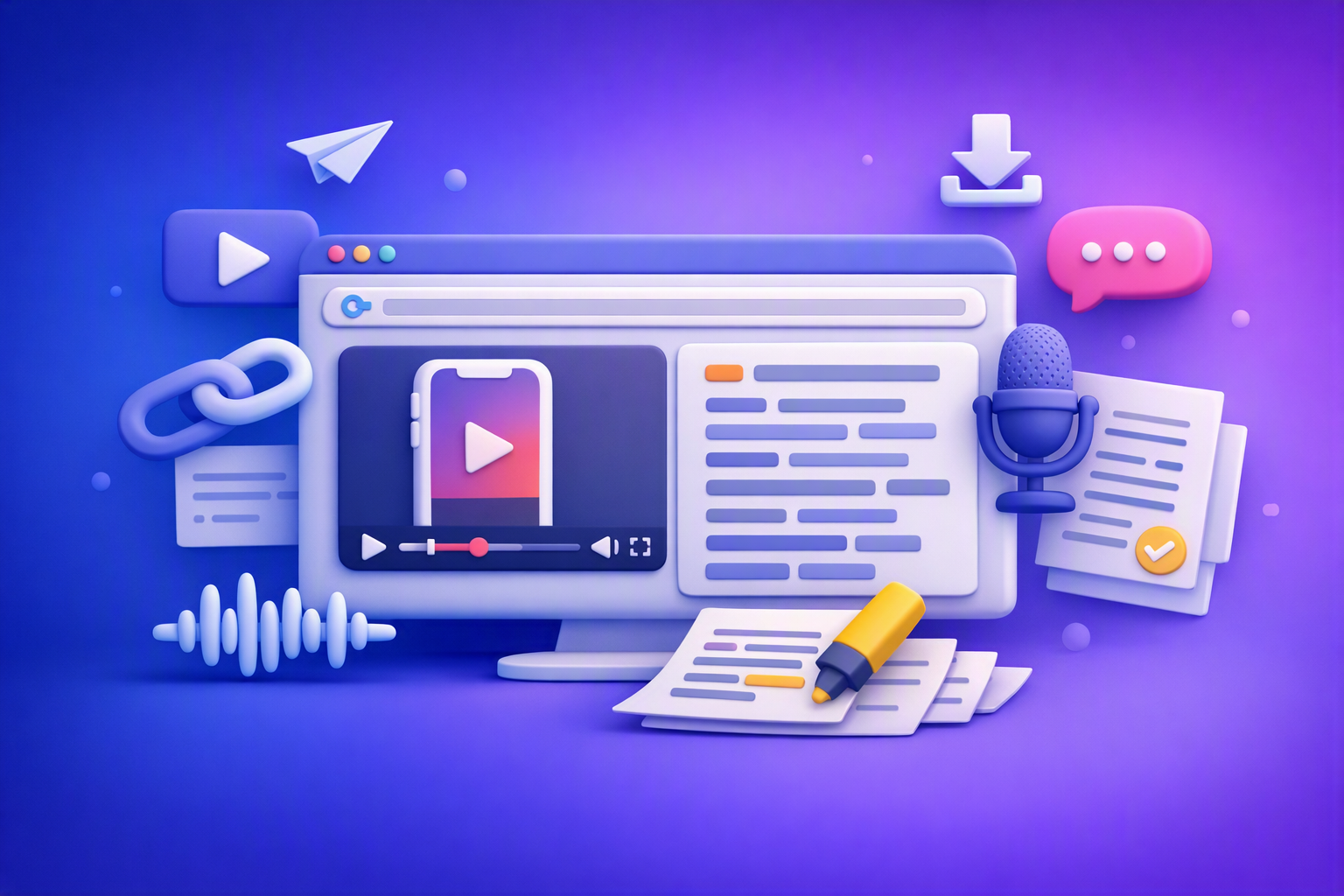
A reel analyzer should turn any public Instagram Reel link into a searchable transcript library you can mine for hooks, CTAs, objections, and topic clusters—then repurpose into original drafts with a repeatable SOP.