
ChatGPT “Upload Video” Feature (2026): What Works, Why Uploads Fail, and the Production-Grade Link → Transcript Workflow
 Video To Text AI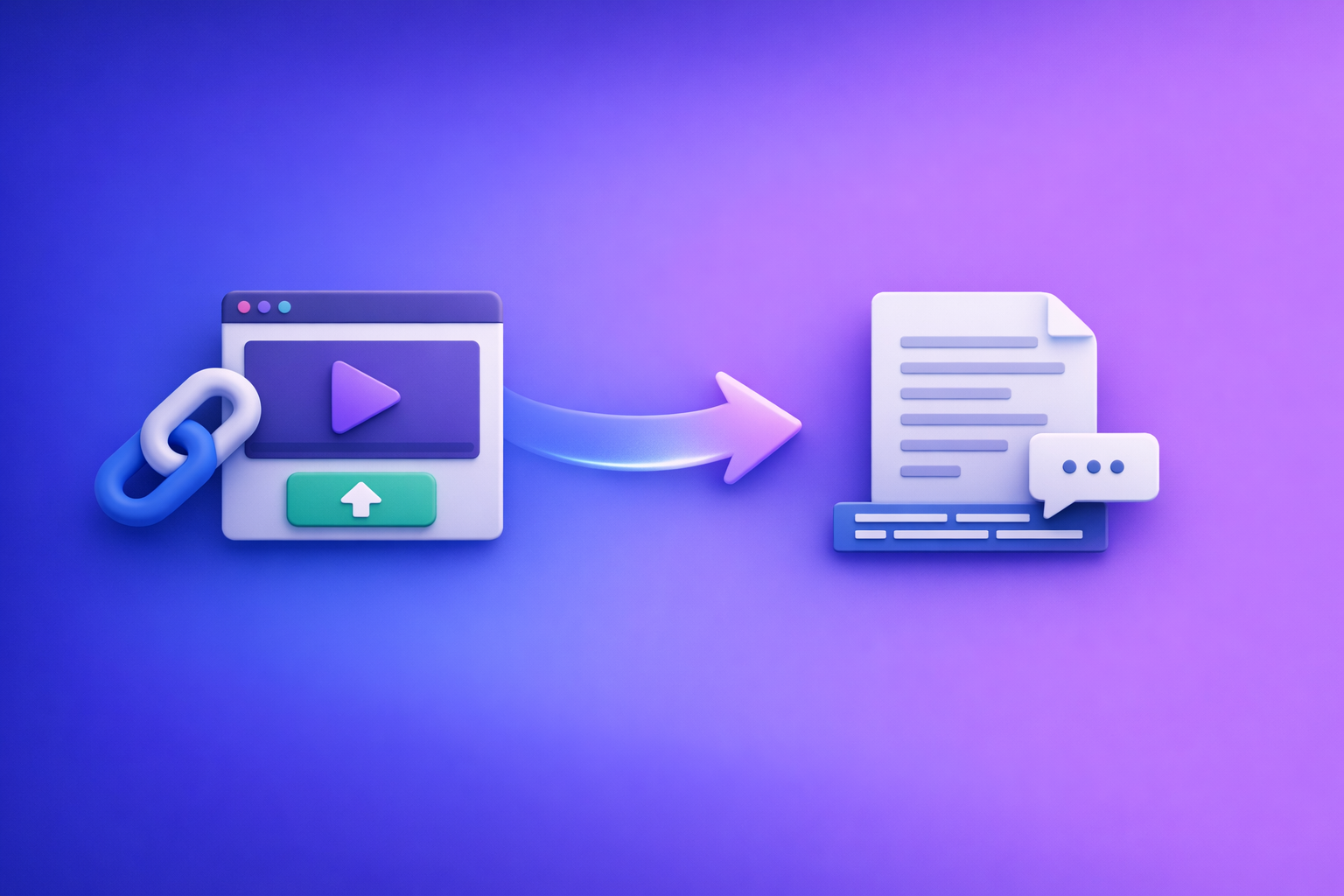
ChatGPT’s “upload video” feature can work for short clips and light analysis, but it’s not dependable for export-ready transcripts, timestamps, or SRT/VTT captions. The production-grade approach is link/MP4 → transcript + subtitles → ChatGPT-on-text, which is deterministic and repeatable.
ChatGPT “Upload Video” Feature (2026): What Works, Why Uploads Fail, and the Production-Grade Link → Transcript Workflow
Quick Answer: Can ChatGPT Upload Videos?
What “upload video” means inside ChatGPT (file upload vs. link)
In practice, “upload video” can mean two different things:
- File upload: attaching an MP4/MOV directly in the chat UI.
- Link sharing: pasting a YouTube/Drive/social link and expecting ChatGPT to “watch” it.
These are not equivalent. File upload is sometimes supported; link “watching” is inconsistent because access, permissions, and platform restrictions vary.
What it can do reliably (analysis/summaries on short clips)
When it works, ChatGPT is best at:
- Summarizing a short clip’s content
- Extracting topics, action items, and key points
- Answering specific questions about what’s in the clip (when the clip is short and clear)
What it’s not reliable for (export-ready transcripts, SRT/VTT, long-form)
ChatGPT is not a production transcription pipeline. Expect failures or incomplete outputs for:
- Long-form videos (timeouts, partial processing)
- Export-ready transcripts (completeness and formatting)
- Captions/subtitles exports (SRT/VTT requirements, timestamp precision)
- Multi-speaker content where you need consistent speaker labels (diarization)
If your deliverable is a transcript/captions file you can publish, treat “upload video” as a convenience feature—not a workflow.
What People Mean by “ChatGPT Upload Video”
Most searches for the "chatgpt" "upload video" feature map to one of these jobs:
“Upload an MP4/MOV from my device”
You want to attach a local file and ask for a summary or transcript.
“Paste a YouTube/Drive link and have ChatGPT watch it”
You want link-based understanding without downloading or converting anything.
“Transcribe the whole video with timestamps”
You want a complete transcript plus timing for editing, captions, and SEO.
“Analyze a clip and pull key moments”
You want highlights, chapters, or a cut list with time ranges.
Only the last one is a good fit for ChatGPT if you already have timestamps from a transcript/caption source.
Does ChatGPT Allow You to Upload Videos? (Reality by Client + Plan)
Web vs. iOS vs. Android: why the button appears/disappears
The upload UI can vary by:
- Client: web app vs. iOS vs. Android
- Account eligibility: staged rollouts and region differences
- Plan/features: some capabilities are gated or throttled
If you’re seeing “it works on my phone but not desktop,” that’s normal for rolling feature flags.
Common constraints that change outcomes
File size and duration ceilings (practical limits)
Even when uploads are enabled, real-world limits show up fast:
- Larger files increase upload time, processing time, and timeout risk
- Longer videos increase the chance of partial analysis or silent failure
For production work, you want a pipeline designed for long-form media, not a chat attachment feature.
Supported containers/codecs (MP4/MOV isn’t always enough)
“MP4” is a container, not a guarantee. Uploads can fail due to:
- Unsupported video codec (e.g., unusual H.265 profiles)
- Unsupported audio codec or sample rate
- Variable frame rate edge cases
Audio track issues (muted, multiple tracks, low bitrate)
Transcription quality and even basic processing can break when:
- The file has no audio track (screen recordings sometimes do this)
- Audio is muted, extremely low, or heavily compressed
- There are multiple audio tracks and the wrong one is selected
Privacy/security considerations when uploading media to AI tools
Before uploading any media:
- Assume the file may be processed by third-party systems
- Avoid uploading sensitive customer data, internal meetings, or regulated content without approval
- Prefer workflows where you can control what text is shared downstream (transcript-first)
Why Doesn’t ChatGPT Let Me Upload a Video? (Root Causes)
Feature rollout and account eligibility
If you don’t see an upload option, the most common cause is simple: your account/client doesn’t have it enabled yet.
Upload errors: network, timeouts, and processing failures
Common failure modes:
- Upload stalls at a percentage (unstable network)
- Processing spins and then errors (server-side timeout)
- “Something went wrong” after a long wait (file too large/complex)
Permissions and access: private links, expiring URLs, restricted content
Link-based attempts fail when the URL is:
- Private (requires login)
- Expiring (temporary signed URLs)
- Geo-restricted or DRM-protected
- Blocked by robots, referrers, or platform policies
“Video upload failed” signals and what they usually mean
Typical meanings:
- Immediate fail: unsupported format/codec or blocked file type
- Fail after upload: processing timeout or audio extraction issue
- Works once, fails later: throttling, load, or feature gating changes
When ChatGPT Video Upload Works (and When It Predictably Fails)
Works best for
Short clips with clear audio
Best-case inputs:
- Under a few minutes
- Single speaker or clear dialogue
- Minimal background noise
Simple tasks: “summarize,” “list topics,” “extract action items”
Use it for:
- Meeting clip recap
- Quick content notes
- “What are the key claims?” style questions
Fails most often for
Long videos (processing timeouts)
Long-form content increases:
- Upload time
- Processing time
- Probability of partial output
Production transcription needs (accuracy + completeness + timestamps)
If you need:
- Full coverage (no missing sections)
- Consistent formatting
- Names/terms preserved
- Repeatable results
…you want a transcription workflow, not a chat upload.
Captions/subtitles exports (SRT/VTT requirements)
Publishing requires:
- Correct timestamp format
- Line length rules
- Segment timing that matches speech
ChatGPT is not a caption exporter.
Multi-speaker content without diarization expectations
If you expect “Speaker 1 / Speaker 2” labeling, you need a tool that supports speaker labeling and consistent segmentation.
Step-by-Step: The Reliable Workflow (Link/MP4 → Transcript/Subtitles → ChatGPT-on-Text)
Why this workflow is deterministic (and “upload video” isn’t)
The deterministic workflow separates concerns:
- Media → text outputs (transcript + captions) using a tool built for it
- Text → intelligence (summaries, chapters, repurposing) using ChatGPT
This is how you avoid “upload failed,” “partial transcript,” and “no timestamps.”
Also: downloading video files is an outdated workflow. Link-based extraction is the future of creator productivity because it removes download/convert/upload loops and keeps teams moving.
Outputs you should generate first (before ChatGPT)
TXT transcript (editing + search)
Use TXT for:
- Editing and cleanup
- Searchability
- Feeding into ChatGPT prompts
SRT/VTT captions (timing + publishing)
Use SRT/VTT for:
- YouTube captions
- TikTok/IG workflows (where supported)
- Editors who need timing
Optional: chapters/outline (navigation + SEO)
Chapters help:
- Viewer retention
- On-page SEO when embedded on a blog
- Faster repurposing into posts and emails
Implementation: VideoToTextAI Link-Based Video → Text Workflow
This is the production workflow we recommend for teams shipping transcripts, subtitles, and repurposed content at scale.
Step 1 — Choose input type (URL or MP4)
Public video links (YouTube, TikTok, Instagram, etc.)
Use a public URL when possible. It’s faster and avoids local file handling.
Local uploads (MP4) when links aren’t available
Use MP4 uploads when:
- The video is private/internal
- The platform doesn’t provide a stable public link
- You’re working from a camera file
For the actual conversion step, use VideoToTextAI (link-based by design): VideoToTextAI
Step 2 — Generate transcript + subtitles in VideoToTextAI
Export formats to select (TXT + SRT/VTT)
Generate both:
- TXT for editing + ChatGPT prompts
- SRT and/or VTT for publishing
This prevents the common mistake of “we have text but no usable captions.”
Language selection and translation needs
Decide upfront:
- Source language
- Whether you need translation
- Whether you need bilingual outputs (e.g., EN transcript + ES subtitles)
Step 3 — Quality pass (fast, repeatable)
Speaker labels (when needed)
If it’s an interview, podcast, or meeting:
- Add speaker labels
- Standardize names (e.g., “Alex” not “Alec”)
Punctuation + paragraphing for readability
Do a quick cleanup pass:
- Fix run-on sentences
- Add paragraphs every 2–4 lines of speech
- Correct product names and acronyms
Timestamp sanity check for caption sync
Spot-check:
- Start: first 30–60 seconds
- Middle: one random segment
- End: last 30–60 seconds
You’re verifying both accuracy and timing.
Step 4 — Use ChatGPT on the transcript (not the raw video)
Now ChatGPT becomes extremely reliable because it’s operating on text.
Summaries and key takeaways
Generate:
- Executive summary
- Bullet takeaways
- Action items
Chapters + titles + descriptions
Create:
- Chapters (with timestamps from transcript/captions)
- YouTube title options
- Description + key links
Repurposing into posts, emails, and blogs
Turn one transcript into:
- Blog post outline
- LinkedIn post set
- Newsletter draft
- FAQ snippets
Related reading you can reference internally:
- Can ChatGPT Transcribe Videos? What Works in 2026 + The Reliable Link → Transcript Workflow (VideoToTextAI)
- Chat GPT Transcribe: What Actually Works in 2026 (Audio, Video Links, and the Reliable Workflow)
Step 5 — Publish and reuse outputs across channels
Captions/subtitles upload workflow (SRT/VTT)
- Upload SRT/VTT to your platform (YouTube, LMS, etc.)
- Verify timing on a quick playback scan
- Keep the captions file as a reusable asset
Content repurposing workflow (blog/social/newsletter)
- Publish transcript-derived content with consistent titles/descriptions
- Store transcript + captions in a shared folder for future reuse
More internal references:
- ChatGPT “Upload Video” Feature: What Works in 2026 (and the Reliable Link → Transcript Workflow)
- ChatGPT “Upload Video” Feature (2026): What Works, What Fails, and the Production-Grade Link → Transcript Workflow
Copy/Paste Prompt Pack (Run on Transcript)
Use these prompts only after you have a transcript (TXT) and, ideally, captions (SRT/VTT).
Prompt: clean up transcript without changing meaning
You are an editor. Clean up this transcript for readability without changing meaning.
Rules: do not paraphrase, do not remove details, keep technical terms, fix punctuation, add paragraphs, and correct obvious mishears.
Output: cleaned transcript only.
Transcript:
[PASTE]
Prompt: generate chapters with timestamps (use transcript timestamps)
Create chapters from this transcript using the existing timestamps.
Rules: 6–12 chapters, each with a short title, start timestamp, and 1-sentence summary.
If timestamps are missing in a section, do not invent them—mark as “timestamp needed.”
Transcript:
[PASTE]
Prompt: create a blog post outline + SEO sections from transcript
Build an SEO blog outline from this transcript.
Include: H1, 6–10 H2s, suggested FAQs, and a short meta description.
Keep claims factual and grounded in the transcript.
Transcript:
[PASTE]
Prompt: extract short clips list (time ranges + hook + caption text)
Create a short-form clip list from this transcript/captions.
Output a table with: Clip #, Start–End time, Hook (max 12 words), On-screen caption (max 90 characters), and why it will perform.
Use only real time ranges from the timestamps provided.
Transcript/captions:
[PASTE]
Troubleshooting: If You Still Need to Use ChatGPT With Video
If your goal is analysis (not transcription)
Do this:
- Provide a short clip (not a full episode)
- Add context: who’s speaking, what the clip is about, what “good” looks like
- Ask one narrow question per run (e.g., “list objections mentioned”)
If your goal is transcription
Don’t iterate inside ChatGPT. Instead:
- Extract transcript + captions first
- Fix names/terms in the transcript
- Then use ChatGPT for structure and repurposing
If your goal is “upload a link”
Validate accessibility:
- Public and playable in an incognito window
- No login required
- No expiry
- Not geo-blocked
If any of those fail, link-based “watching” will fail too.
Implementation Checklist (Ship This Workflow)
Inputs
- Video URL is public and playable (no login, no expiry)
- If MP4: confirm an audio track exists and is audible
- Confirm target language(s) and whether translation is required
VideoToTextAI run
- Generate TXT transcript
- Export SRT and/or VTT
- Spot-check 3 segments: start, middle, end (accuracy + timing)
ChatGPT-on-text run
- Run cleanup prompt (no paraphrasing)
- Generate chapters + summary + repurposed assets
- Final pass: names, numbers, product terms, and links
Publishing
- Upload SRT/VTT to platform
- Publish transcript-derived content with consistent titles/descriptions
- Store transcript + captions for reuse
Additional internal references:
- ChatGPT “Upload Video” Feature (2026): What Works, Why Uploads Fail, and the Reliable Link → Transcript Workflow
- ChatGPT “Upload Video” Feature in 2026: What Works, Why It Fails, and the Reliable Link → Transcript Workflow (VideoToTextAI)
Common Mistakes (and How to Avoid Them)
Expecting ChatGPT to “watch” long videos end-to-end
Fix: extract transcript/captions first, then run ChatGPT on text.
Using private/permissioned links that tools can’t access
Fix: use public links or upload the MP4 to a tool designed for transcription.
Skipping subtitle exports (losing timestamps for editing)
Fix: always export SRT/VTT alongside TXT.
Mixing transcription and rewriting in one step (accuracy drops)
Fix: separate phases:
- Phase 1: transcription (accuracy)
- Phase 2: rewriting/repurposing (style)
Competitor Gap
Most guides stop at “try the paperclip icon” and ignore production outputs. That’s why teams waste hours troubleshooting uploads instead of shipping deliverables.
What’s usually missing:
- Deterministic deliverables: TXT + SRT/VTT (not just “a summary”)
- A repeatable checklist: inputs → exports → QA → publish
- Transcript-first prompt pack: chapters, cut lists, posts, FAQs
- Link-based workflow: avoids download/convert/upload loops (downloading video files is outdated; link-based extraction is the future of creator productivity)
FAQ
Does ChatGPT allow you to upload videos?
Sometimes. It depends on your client (web/iOS/Android), plan, and rollout status, plus practical limits like file size, duration, and codecs.
Why doesn't ChatGPT let me upload a video?
Common causes: feature not enabled, file too large/long, unsupported codec, network timeouts, or restricted/private links.
Can I upload a video to ChatGPT to analyze?
Yes—best for short clips and narrow analysis tasks (summaries, notes, observations). For transcripts/captions, extract text first.
Can you upload videos from photos to ChatGPT?
If your device stores videos in the Photos app, you may be able to select and attach them as files—when uploads are enabled. Results still vary by size/format.
Can you upload videos to ChatGPT for free?
Free access and upload availability vary over time. Even when available, production transcription and caption exports are still better handled via a transcript/subtitle workflow.
Recommended VideoToTextAI Tools (Pick Your Workflow)
MP4 workflows
/tools/mp4-to-transcript/tools/mp4-to-srt/tools/mp4-to-vtt
Repurposing workflows
/tools/youtube-to-blog/tools/mp4-to-blog-post/tools/mp4-to-linkedin
Social link workflows
/tools/tiktok-to-transcript/tools/instagram-to-text
Internal Link Plan
- Can ChatGPT Transcribe Videos? What Works in 2026 + The Reliable Link → Transcript Workflow (VideoToTextAI)
- Chat GPT Transcribe: What Actually Works in 2026 (Audio, Video Links, and the Reliable Workflow)
- ChatGPT “Upload Video” Feature: What Works in 2026 (and the Reliable Link → Transcript Workflow)
- ChatGPT “Upload Video” Feature (2026): What Works, What Fails, and the Production-Grade Link → Transcript Workflow
- ChatGPT “Upload Video” Feature (2026): What Works, Why Uploads Fail, and the Reliable Link → Transcript Workflow
- ChatGPT “Upload Video” Feature in 2026: What Works, Why It Fails, and the Reliable Link → Transcript Workflow (VideoToTextAI)
Related posts
Reel Analyser (Instagram Reels): Transcript‑First Competitor Research, Hook/CTA Extraction, and Repurposing Workflow (VideoToTextAI)
Video To Text AI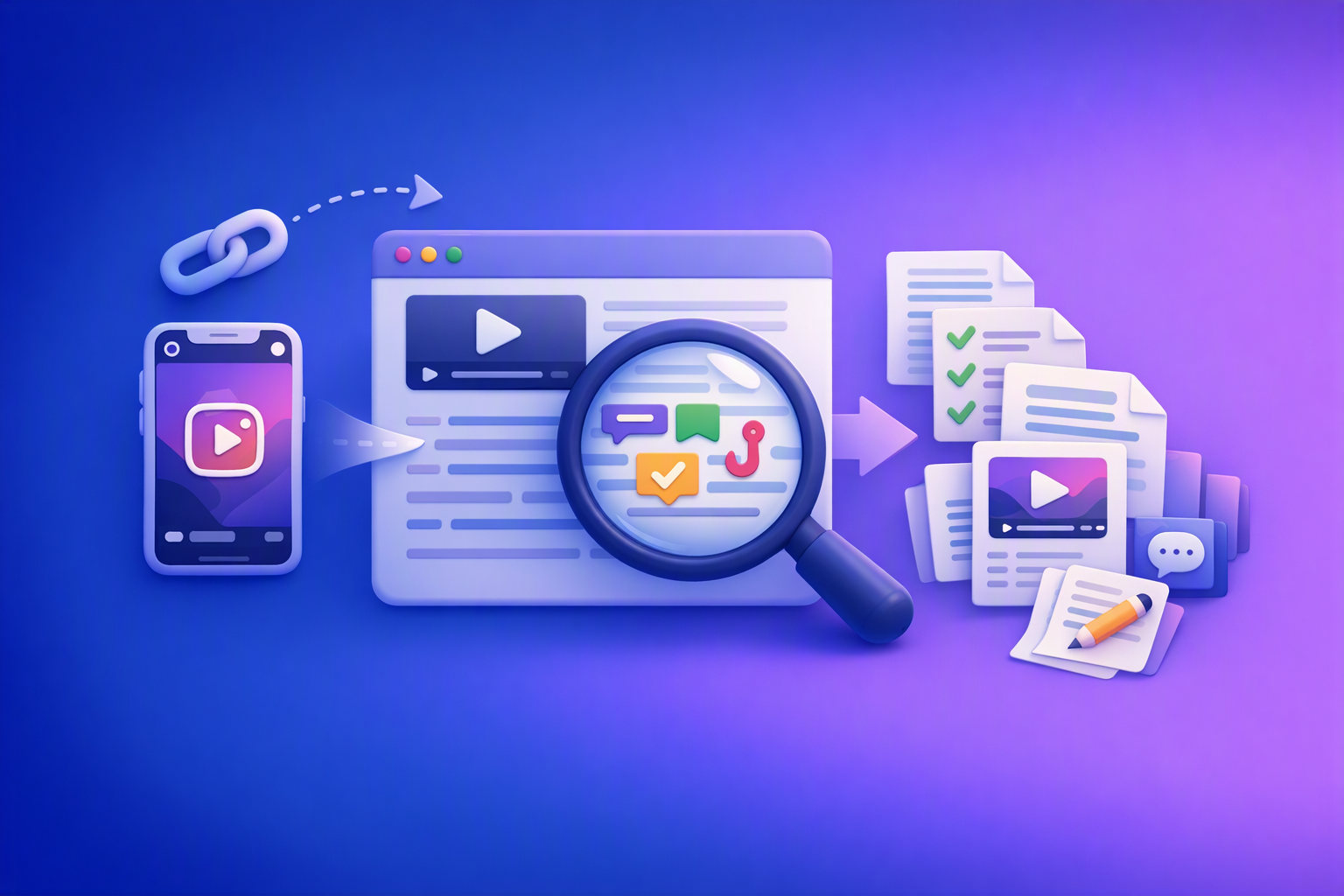
A 2026 reel analyser should turn Instagram Reel links into a searchable transcript library you can tag for hooks, CTAs, objections, and topic clusters—then export into repurposing-ready drafts without a download/upload loop.
Traducir video de Instagram (Reels) en 2026: workflow transcript-first para traducir, sacar hooks/CTAs y repurpose (con VideoToTextAI)
Video To Text AI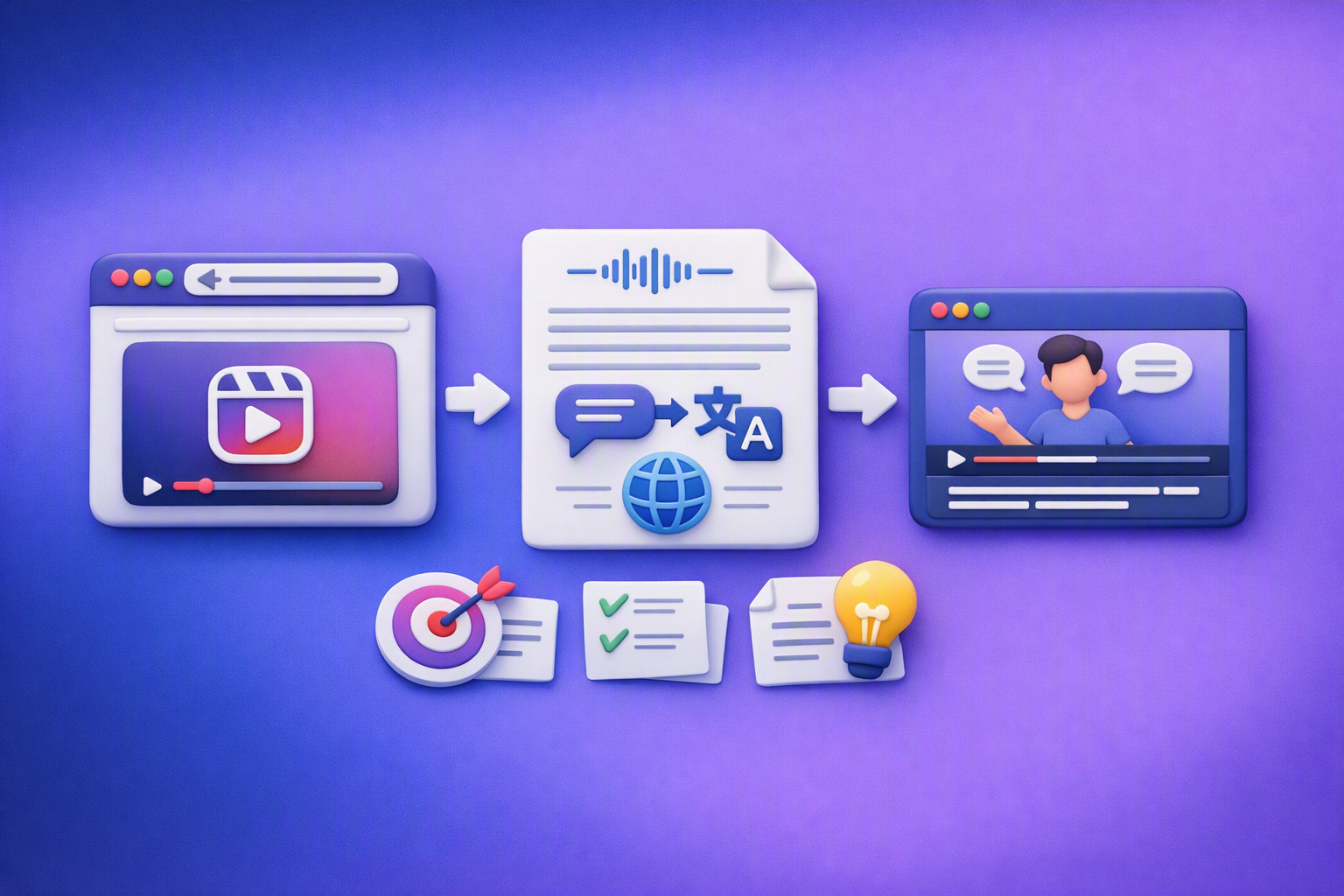
Aprende a traducir un Reel de Instagram con un flujo URL→transcripción→traducción→subtítulos, y a convertir esa traducción en un activo de investigación para hooks, CTAs, objeciones y clusters de contenido.
Reel Analyzer: Transcript‑First Instagram Reels Research (Hooks, CTAs, Objections) + Workflow Guide (VideoToTextAI)
Video To Text AI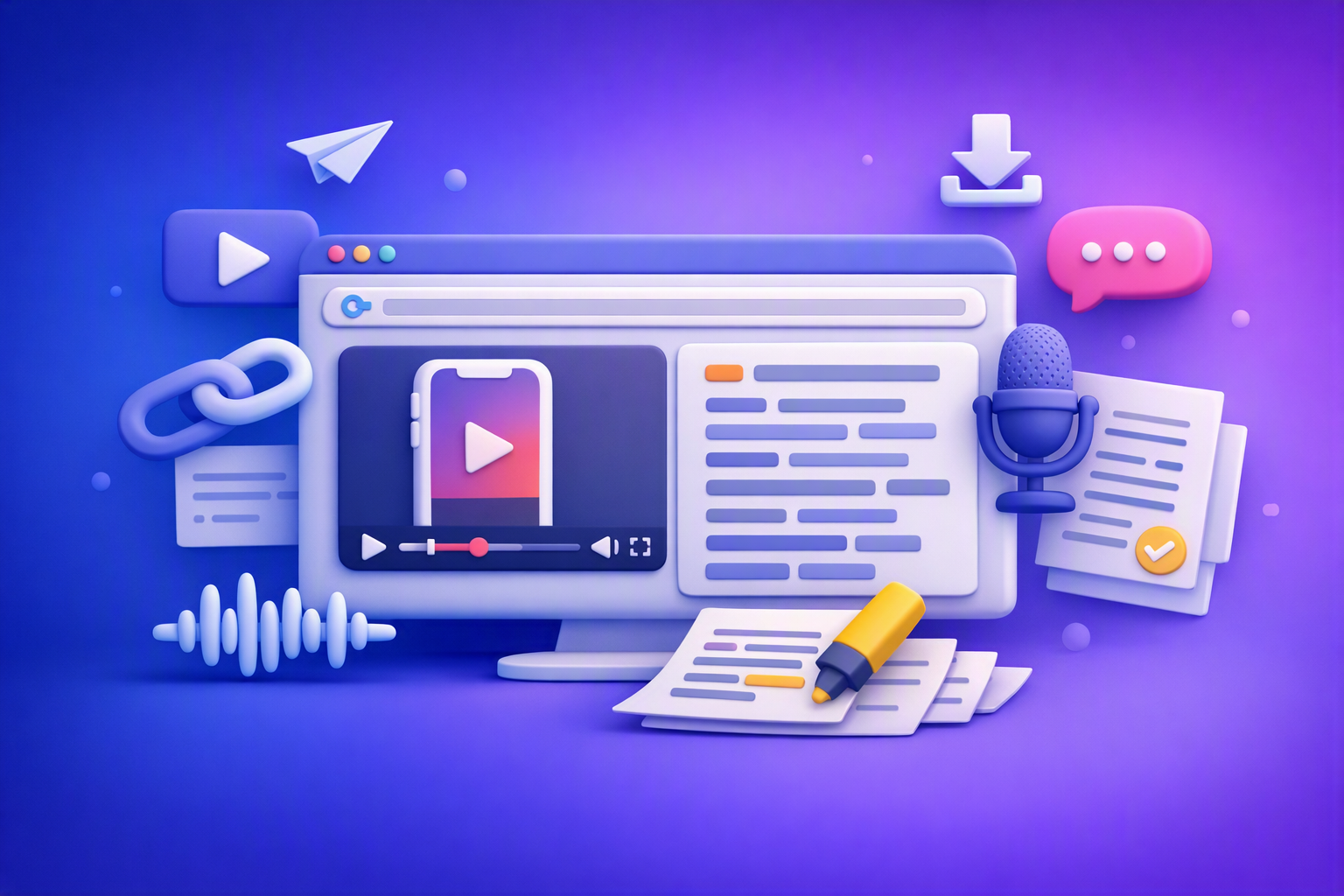
A reel analyzer should turn any public Instagram Reel link into a searchable transcript library you can mine for hooks, CTAs, objections, and topic clusters—then repurpose into original drafts with a repeatable SOP.