
ChatGPT “Upload Video” Feature in 2026: What Works, Why It Fails, and the Reliable Link → Transcript Workflow (VideoToTextAI)
 Video To Text AI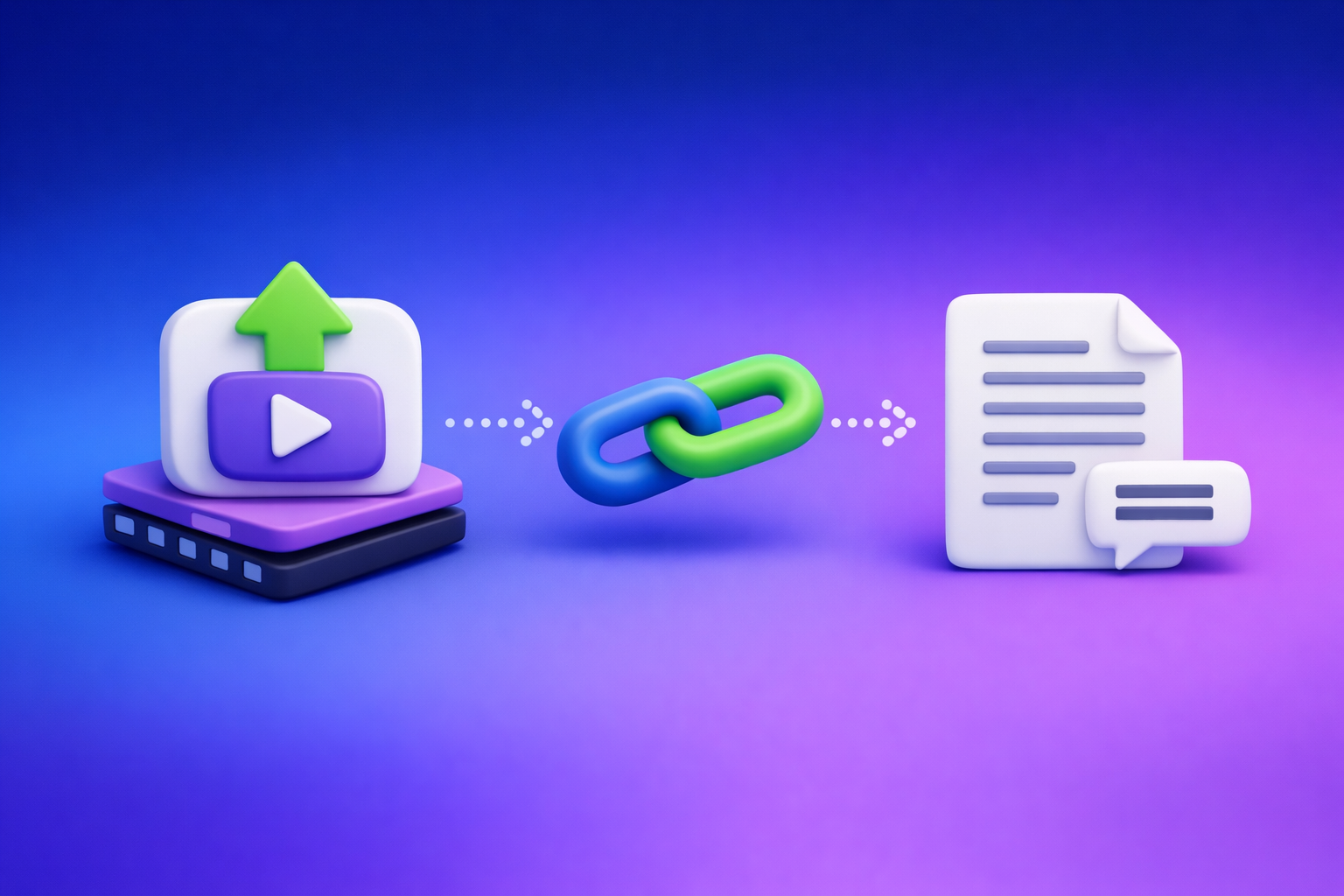
ChatGPT “Upload Video” Feature in 2026: What Works, Why It Fails, and the Reliable Link → Transcript Workflow (VideoToTextAI)
If you need ship-ready transcripts and captions, don’t start by uploading video into ChatGPT—start by generating exportable text outputs (TXT/SRT/VTT) and then use ChatGPT on the transcript. The reliable workflow is link/MP4 → transcript + SRT/VTT → ChatGPT-on-text, because downloading and re-uploading video files is an outdated, failure-prone loop.
TL;DR: When to Use ChatGPT Video Upload vs. When to Use a Transcript-First Workflow
Use ChatGPT “upload video” for
- Quick, one-off analysis of a short clip (e.g., “what’s happening here?”).
- High-level summarization when precision and formatting don’t matter.
- Idea generation from a small sample (hooks, titles, angles).
Don’t use ChatGPT “upload video” for
- Long-form transcription (podcasts, webinars, meetings).
- Caption deliverables you must upload (SRT/VTT) with correct timing.
- Repeatable production workflows with deadlines and QA requirements.
- Anything requiring deterministic output (speaker turns, timestamps, exports).
The production-grade alternative (recommended)
- Generate transcript + captions first (TXT/SRT/VTT).
- Validate accuracy quickly.
- Use ChatGPT to create chapters, summaries, clip lists, and repurposed content from the transcript.
If you want a dedicated transcript pipeline, use link-based extraction (the future of creator productivity) instead of downloading files and fighting upload limits.
What “ChatGPT Upload Video” Actually Means in 2026 (Capabilities + Limits)
Where the feature exists (and where it doesn’t)
“Upload video” is not a single universal capability across every ChatGPT surface.
- Some plans/apps support video file upload in certain contexts.
- Some environments support link previews but not full media processing.
- Behavior can differ between web, desktop, and mobile.
Operationally: treat video upload as best-effort, not a guaranteed media pipeline.
What ChatGPT can reliably do from a video file
When it works, ChatGPT can often:
- Provide a general summary of the content.
- Identify topics, themes, and key moments (roughly).
- Suggest titles, hooks, and outlines based on what it “sees/hears.”
What ChatGPT cannot guarantee (export-ready deliverables)
ChatGPT is not designed as a deterministic captioning/export tool.
Common gaps:
- No guaranteed SRT/VTT export with correct formatting.
- No guaranteed timestamp precision across the full duration.
- No consistent speaker diarization (who said what) at scale.
- No stable behavior for long videos or noisy audio.
Common constraints that break workflows
File size / duration ceilings
- Upload caps vary by plan/app and can change.
- Long videos increase the chance of partial processing or truncation.
Codec/container issues (MP4 variants, audio tracks)
- “MP4” is not one thing; different codecs and audio track layouts can fail.
- Videos with multiple audio tracks (or missing audio) often break transcription.
Network timeouts and processing limits
- Large uploads are vulnerable to:
- flaky connections
- background app suspensions
- server-side timeouts
Permissioned links and blocked sources
- Private videos, expiring URLs, paywalled sources, and blocked CDNs can fail.
- “It plays in my browser” does not mean it’s accessible for processing.
Inconsistent behavior across apps/plans
- The same file can succeed once and fail later due to:
- load
- policy changes
- model routing differences
Why ChatGPT Video Uploads Fail (Root Causes + Fast Fixes)
Failure mode: upload rejected or stuck processing
Root causes:
- File too large/long.
- Unsupported codec/audio track.
- Temporary service limits.
Fast fixes:
- Test a 30–60 second clip from the same source.
- Re-export to a standard H.264 + AAC MP4 if you must retry.
- If it still fails, switch to transcript-first.
Failure mode: partial transcript / missing sections
Root causes:
- Processing truncation.
- Silent segments or low-volume audio.
- Long duration exceeding hidden limits.
Fast fixes:
- Split into smaller segments (but this is still a file-based tax).
- Prefer link-based extraction to avoid repeated uploads.
Failure mode: inaccurate speaker turns and timestamps
Root causes:
- Overlapping speech.
- Background noise.
- Multiple speakers with similar voices.
Fast fixes:
- Use speaker labels only when needed.
- Validate with a quick spot-check before repurposing.
Failure mode: no SRT/VTT export or unusable formatting
Root causes:
- ChatGPT is optimized for conversational output, not strict caption specs.
Fast fixes:
- Generate captions in a tool that exports SRT/VTT deterministically, then use ChatGPT for editorial improvements.
Quick triage checklist (2 minutes)
Confirm source type (file vs link)
- If you’re downloading a video just to upload it again, you’re already in an outdated workflow.
- Prefer link → transcript whenever possible.
Confirm audio track presence and clarity
- Ensure the video actually contains a usable audio track.
- If audio is faint, expect transcription errors.
Reduce variables (short clip test)
- Upload a 30–60 second excerpt.
- If that fails, don’t waste time on full-length retries.
Decide: retry upload vs switch to transcript-first
- If you need captions, timestamps, exports, or repeatability, switch immediately.
The Reliable Workflow: Link/MP4 → Transcript + SRT/VTT → ChatGPT-on-Text (VideoToTextAI)
This is the workflow that holds up under deadlines: generate export-ready text outputs first, then use ChatGPT where it’s strongest—writing and structuring.
Step 1 — Choose input method (public link vs MP4 upload)
Pick the lowest-friction input:
- Public link (recommended): fastest, no local file juggling.
- MP4 upload: use only when you don’t have a stable link.
Related tools:
Step 2 — Generate export-ready outputs in VideoToTextAI
Output formats to generate (TXT, SRT, VTT)
Generate all three so each downstream task is covered:
- TXT: editing, summarization, repurposing.
- SRT: YouTube and many editors.
- VTT: web players and some social platforms.
Timestamp strategy (sentence-level vs phrase-level)
- Sentence-level: best for chapters, clip lists, and readable captions.
- Phrase-level: best when you need tighter sync (but can be harder to read).
Choose one and keep it consistent across your pipeline.
Speaker labeling (when to use it, when to skip)
Use speaker labels when:
- It’s an interview, podcast, or meeting.
- You’ll create quotes, Q&A, or speaker-specific clips.
Skip speaker labels when:
- It’s a solo creator video.
- Speed matters more than diarization.
Step 3 — Quality pass (before you involve ChatGPT)
Spot-check accuracy (names, numbers, jargon)
Check:
- Proper nouns (people, brands, products).
- Numbers (prices, dates, metrics).
- Domain terms (acronyms, technical vocabulary).
Fix obvious diarization/timestamp issues
- Merge or split speaker turns if they’re clearly wrong.
- Ensure timestamps are monotonic and not duplicated.
Normalize formatting for downstream prompts
- Remove filler words if needed (optional).
- Ensure paragraphs break logically.
- Keep timestamps in a consistent format (e.g.,
00:12:34).
Step 4 — Use ChatGPT on the transcript (not the video)
ChatGPT performs best when the input is clean text with clear constraints.
Summaries that map to the actual transcript
- Ask for a summary that quotes or references transcript lines/timestamps.
- Require “no new facts” to prevent hallucinations.
Chapters + titles with timestamp references
- Provide the transcript with timestamps.
- Request a chapter list with start times and descriptive titles.
Clip list / cut list with start–end times
- Ask for 10–20 clips with:
- start time
- end time
- hook line
- why it works
Repurposing outputs (blog, LinkedIn, X, email)
Use the transcript as the “source of truth” so every asset stays aligned.
Helpful internal resources:
Step 5 — Export and publish (captions + content)
Upload SRT/VTT to YouTube/LinkedIn
- Upload the SRT/VTT file directly.
- Avoid copy/pasting captions into platform editors unless required.
Store transcript as the “source of truth” for edits
- Keep one canonical transcript version.
- Regenerate derivatives (blog, clips, emails) from that version.
Step-by-Step: Exact Implementation (Copy/Paste Workflow)
A) Generate transcript + captions in VideoToTextAI
- Start with a video link (preferred) or an MP4 if no link exists.
- Generate TXT + SRT + VTT outputs in one pass.
- Download/store outputs in a project folder:
/transcript.txt,/captions.srt,/captions.vtt. - Do a 3-minute QA pass: names, numbers, obvious timestamp drift.
- Only after QA, move to ChatGPT for writing tasks.
For a link-first workflow that avoids repeated downloads/uploads, use VideoToTextAI once here (single CTA): VideoToTextAI.
B) Prompt ChatGPT using the transcript (templates)
Prompt: clean transcript without changing meaning
You are editing a transcript. Do NOT add new facts.
Task: Clean grammar, remove filler words only when it doesn’t change meaning, and keep timestamps exactly as-is.
Output: Cleaned transcript in the same structure, preserving all timestamps and speaker labels.
Transcript:
[PASTE TRANSCRIPT HERE]
Prompt: create chapters + timestamps
Using ONLY the transcript below, create 8–12 chapters.
Rules:
- Each chapter must include a start timestamp that exists in the transcript.
- Titles must be specific (no generic “Introduction”).
- Add 1 bullet per chapter summarizing what is covered.
Output format:
00:00:00 — Chapter Title
- Summary bullet
Transcript:
[PASTE TRANSCRIPT HERE]
Prompt: generate a blog post from transcript
Write a blog post based ONLY on the transcript below.
Requirements:
- No new claims beyond the transcript.
- Use H2/H3 headings, short paragraphs, and bullets.
- Include a “Key takeaways” section.
- If a detail is unclear, write “Not specified in the transcript.”
Transcript:
[PASTE TRANSCRIPT HERE]
Prompt: create 10 short clips with hooks + time ranges
Create 10 short-form clip recommendations from the transcript.
For each clip provide:
- Clip title (max 8 words)
- Hook (1 sentence)
- Start timestamp and end timestamp (must be present in transcript)
- Why it will perform (1 bullet)
Constraints:
- Clips must not overlap.
- Prefer clips 20–45 seconds unless the transcript suggests otherwise.
Transcript:
[PASTE TRANSCRIPT HERE]
C) Validate outputs (what to verify before shipping)
Captions: timing drift + line length
- Check the first 60 seconds and a mid-point section for drift.
- Ensure caption lines aren’t excessively long (readability on mobile).
Blog: factual alignment to transcript
- Spot-check 5–10 claims against the transcript.
- Remove any invented numbers, names, or “helpful” additions.
Clips: timecodes exist and are non-overlapping
- Confirm every start/end time appears in the transcript timeline.
- Ensure clips don’t overlap and have clear boundaries.
Checklist: Production-Grade Deliverables (What “Done” Looks Like)
Transcript checklist (TXT)
- Complete coverage (no missing middle/end).
- Correct names, brands, and key terms.
- Numbers verified (dates, prices, metrics).
- Consistent timestamps format throughout.
- Speaker labels consistent (if used).
Caption checklist (SRT/VTT)
- Valid file format (SRT blocks or VTT cues).
- No timestamp overlaps or backward timecodes.
- Readable line lengths and sensible breaks.
- No obvious drift after upload test.
- Matches the final edited transcript (or differences documented).
Repurposing checklist (content pack)
- Summary aligned to transcript (no new facts).
- Chapters include timestamps that exist.
- Clip list includes start–end times and non-overlapping ranges.
- Blog/social/email assets reference the same “source of truth” transcript.
Compliance checklist (privacy + permissions)
- You have rights/permission to transcribe and republish.
- Sensitive info removed if needed (PII, internal data).
- Storage/sharing follows your org’s policy.
Use Cases: Best Workflows by Platform
YouTube: link → transcript → chapters → blog post
- Generate transcript + SRT.
- Create chapters with timestamped titles.
- Turn the transcript into a blog post for SEO and distribution.
Related reading:
Podcasts: audio/video → transcript → show notes → clips
- Start with the episode link (or MP4).
- Generate transcript with speaker labels.
- Produce show notes, quotes, and a clip list with time ranges.
TikTok/IG Reels: MP4 → captions → hooks → post copy
- Generate VTT/SRT for accurate captions.
- Use ChatGPT to write 10 hook variations from the transcript.
- Keep captions as the base layer; don’t rely on platform auto-captions alone.
Internal meetings/training: MP4 → transcript → SOP draft
- Generate a transcript with speaker labels if needed.
- Use ChatGPT to draft an SOP, checklist, or training doc from the transcript.
- Store the transcript as the audit trail.
Competitor Gap
Most guides stop at “try uploading the video”
That advice ignores the reality of production: uploads fail, outputs vary, and you still need export formats.
Missing: deterministic export formats (SRT/VTT) and validation steps
Most tutorials don’t explain how to produce uploadable captions or how to QA them.
Missing: failure-mode decision tree (retry vs transcript-first)
Creators waste time retrying uploads instead of switching workflows when the task requires reliability.
Missing: prompt templates that assume transcript-first inputs
Prompts should be built around timestamped transcripts, not raw media.
Missing: ship-ready checklist for captions + repurposed assets
Without a checklist, teams ship:
- drifting captions
- invented facts in blogs
- clip lists with unusable timecodes
FAQ (People Also Ask)
Can ChatGPT upload a video and transcribe it?
Yes, sometimes—but it’s not consistent for long videos or for export-ready captions. For reliable deliverables, generate TXT/SRT/VTT first, then use ChatGPT on the transcript.
Why does ChatGPT fail when I upload a video?
Typical causes are size/duration limits, codec/audio track issues, timeouts, and inconsistent support across apps/plans. If you need repeatability, switch to a transcript-first workflow.
Can I paste a YouTube link into ChatGPT to get a transcript?
Sometimes you’ll get a summary, but link access and extraction are not guaranteed. A dedicated link-based transcription workflow is more reliable for transcripts and captions.
How do I get SRT/VTT captions if ChatGPT won’t export them?
Use a workflow that generates SRT/VTT directly from the link/MP4, then use ChatGPT to refine titles, chapters, and repurposed content from the transcript.
What’s the fastest workflow to turn a video into a blog post?
Link → transcript → ChatGPT blog prompt is fastest because it avoids downloading/re-uploading video files and keeps the blog aligned to the source transcript.
Internal Link Plan
- ChatGPT “Upload Video” Feature: What Works in 2026, Why Uploads Fail, and the Reliable Link → Transcript Workflow (VideoToTextAI)
- Can ChatGPT Transcribe Videos? What Works in 2026 + The Reliable Link → Transcript Workflow (VideoToTextAI)
- MP4 to Transcript
- MP4 to SRT
- MP4 to VTT
- MP4 to Blog Post
- YouTube to Blog
- Podcast Transcription
Related posts
Reel Analyser (Instagram Reels): Transcript‑First Competitor Research, Hook/CTA Extraction, and Repurposing Workflow (VideoToTextAI)
Video To Text AI
A 2026 reel analyser should turn Instagram Reel links into a searchable transcript library you can tag for hooks, CTAs, objections, and topic clusters—then export into repurposing-ready drafts without a download/upload loop.
Traducir video de Instagram (Reels) en 2026: workflow transcript-first para traducir, sacar hooks/CTAs y repurpose (con VideoToTextAI)
Video To Text AI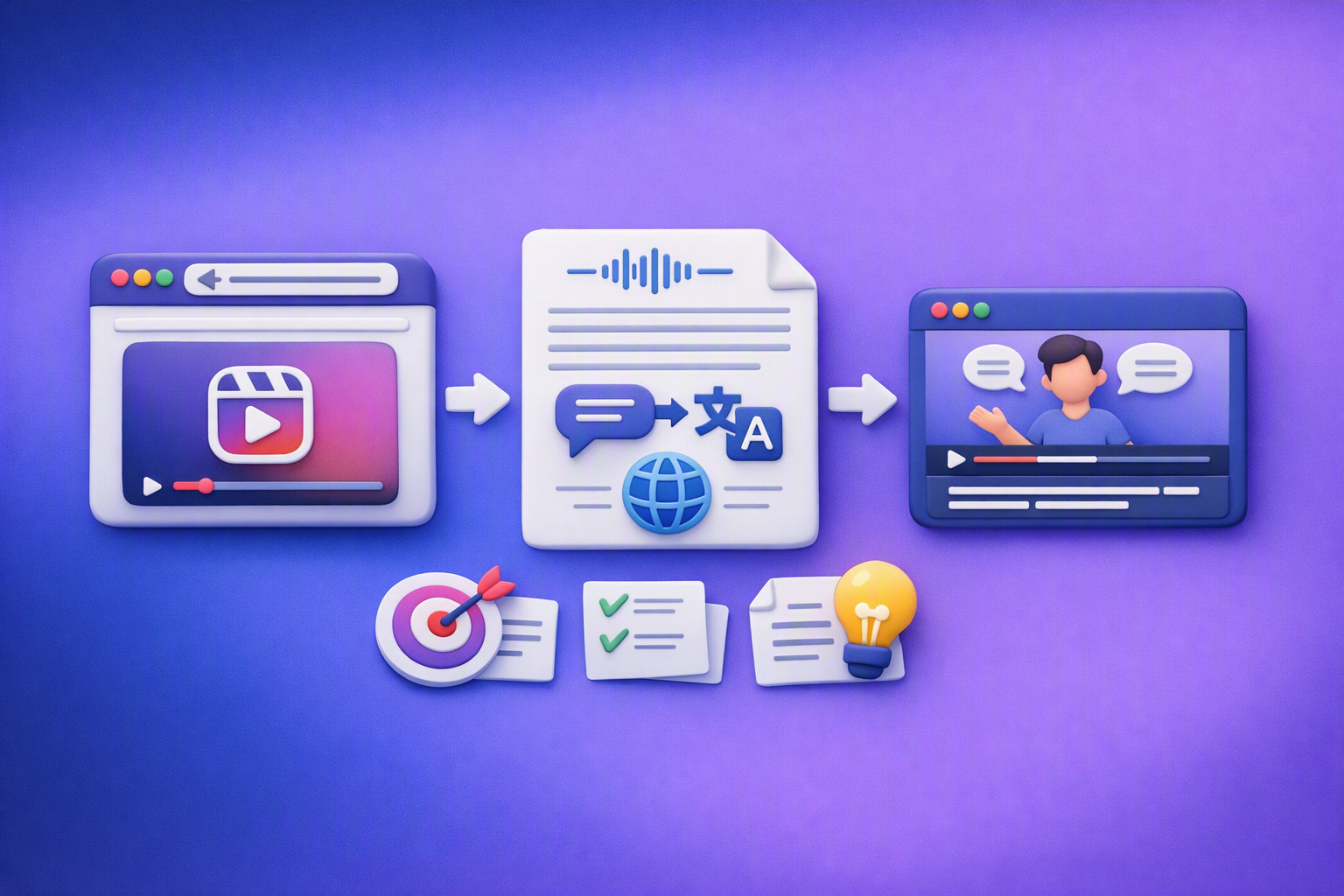
Aprende a traducir un Reel de Instagram con un flujo URL→transcripción→traducción→subtítulos, y a convertir esa traducción en un activo de investigación para hooks, CTAs, objeciones y clusters de contenido.
Reel Analyzer: Transcript‑First Instagram Reels Research (Hooks, CTAs, Objections) + Workflow Guide (VideoToTextAI)
Video To Text AI
A reel analyzer should turn any public Instagram Reel link into a searchable transcript library you can mine for hooks, CTAs, objections, and topic clusters—then repurpose into original drafts with a repeatable SOP.