
Attachments Disabled in ChatGPT Image Upload: What It Means, Fast Fixes (2026), and a No-Upload Video→Text Workflow
 Video To Text AI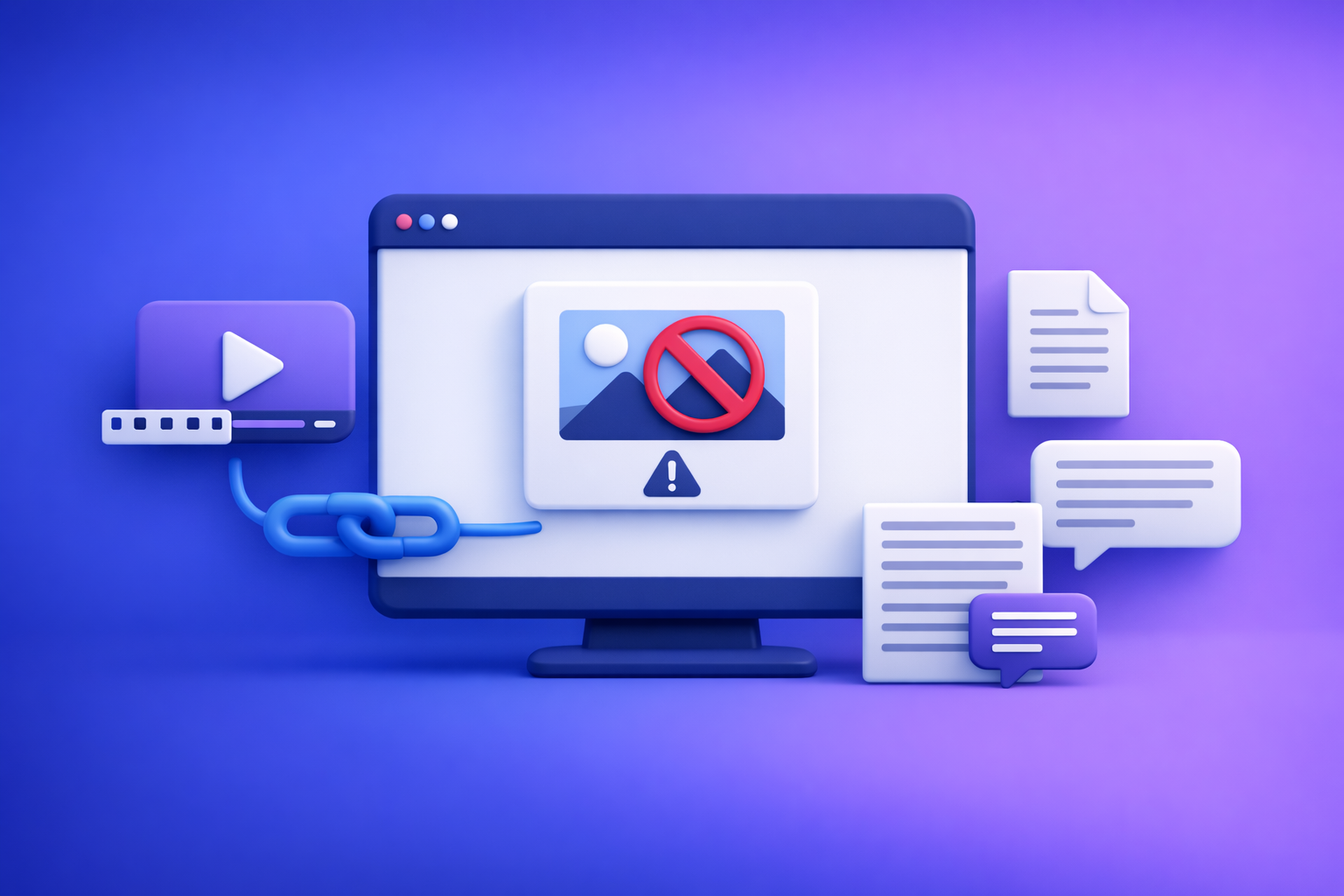
Fix “attachments disabled” by switching to a chat/model/surface that supports uploads, then isolate browser extensions and network/workspace policy blocks. If the upload button still won’t return, skip uploads entirely: generate TXT + SRT/VTT from a video link and paste the text into ChatGPT.
Attachments Disabled in ChatGPT Image Upload: What It Means, Fast Fixes (2026), and a No-Upload Video→Text Workflow
TL;DR (1-minute fix path)
- Confirm you’re in a chat/model/surface that supports attachments.
- Start a new chat + switch model (most common fix).
- Disable extensions/VPN + hard refresh.
- Test another browser/profile + another network (hotspot).
- If you’re blocked by policy or the button won’t return: use a link-based workflow (VideoToTextAI) to generate TXT + SRT/VTT, then paste into ChatGPT.
What “attachments disabled” means (and what it does not mean)
What it usually indicates
“Attachments disabled” almost always means uploads are disabled in the current context, not that something is wrong with your file.
Common interpretations:
- Attachments are disabled in the current thread/model/surface/app state.
- Uploads are blocked by workspace/admin policy (Team/Enterprise, managed devices, DLP).
- Upload UI is suppressed by browser/network tooling (extensions, privacy tools, proxies).
What it does not automatically mean
- You are banned.
- Your account is permanently blocked.
- Your image/video file is “invalid” (context is often the real issue).
Where you’ll see it: common UI patterns
Web app
- Paperclip/upload button is missing.
- “Attachments disabled” banner appears near the input.
- Drag-and-drop does nothing (no hover state, no upload progress).
iOS / Android
- Attachment picker is missing.
- Camera roll option is greyed out.
- Upload starts then fails instantly (often permissions, app version, or network).
Root causes (ranked by frequency)
1) Wrong model or feature set for the current chat
Some models/surfaces don’t expose attachments in certain sessions or plans.
What you’ll notice:
- Upload button appears in some chats but not others.
- Switching models suddenly brings the paperclip back.
2) Thread-level state (the chat itself is “stuck”)
A specific conversation can lose attachment capability after errors, tool calls, or UI desync.
Typical signs:
- Only one thread is broken.
- New chats work normally.
3) Workspace / Team / Enterprise policy blocks uploads
Admins can disable file/image uploads entirely.
Also common:
- Managed devices enforce DLP rules that block attachments.
- Upload endpoints are blocked even if the UI shows a button.
4) Browser issues (extensions, cookies, storage, permissions)
Upload UI can be hidden or broken by:
- Ad blockers, script blockers, privacy extensions.
- Corrupted site data preventing attachment initialization.
- Blocked storage/cookies in strict privacy modes.
5) Network restrictions (VPN, proxy, firewall, DNS filtering)
Corporate networks may block upload endpoints or pre-signed upload URLs.
Common triggers:
- VPN/proxy rewriting requests.
- DNS filtering blocking required domains.
6) Platform/app version issues
- Outdated mobile app builds can ship with broken attachment flows.
- OS-level permissions (Photos/Files) can block selection.
2-minute diagnosis: isolate the cause fast (ordered)
Use this order to avoid wasting time.
Step 1 — Confirm it’s not just the thread
- Open a new chat.
- Check if the attachment button appears there.
If it appears: your old thread is “stuck” (root cause #2).
Step 2 — Switch model (most common fix)
- Change to a model known to support attachments in your plan.
- Re-check the upload button in a new chat.
If switching models fixes it: root cause #1.
Step 3 — Hard refresh + sign out/in
Web:
- Hard refresh: Ctrl/Cmd + Shift + R
- Sign out → sign back in (forces capability refresh)
If it fixes it: likely UI desync or cached capability state.
Step 4 — Incognito/private window test (extension isolation)
- Open a private window.
- Log in and test attachments.
If it works in private mode: extensions or cached site data are the culprit (root cause #4).
Step 5 — Browser profile + alternate browser test
- Try a clean Chrome profile or Safari/Firefox.
- If it works elsewhere: local browser storage/extension issue.
Step 6 — Network test
- Switch Wi‑Fi → mobile hotspot.
- Disable VPN/proxy temporarily.
If it works on hotspot: network policy/filtering is blocking uploads (root cause #5).
Step 7 — Workspace policy check (if on Team/Enterprise)
- Ask admin whether file/image uploads are disabled.
- Test with a personal account on the same device/network (if allowed).
If policy blocks uploads: stop troubleshooting and use the no-upload workflow below.
Fixes that work (mapped to each root cause)
Fix set A — Model/surface mismatch
- Start a new chat → switch model → reload.
- Try web vs mobile app (capabilities can differ by surface).
Fix set B — Thread stuck / UI desync
- Duplicate your prompt into a new chat.
- Web: clear site data for the domain, then re-login.
Fix set C — Workspace/admin policy
- Confirm org policy for uploads.
- If uploads are blocked by policy: skip troubleshooting and use the no-upload workflow below.
Fix set D — Browser extensions/cookies
- Disable extensions (ad blockers, privacy tools, script blockers) one-by-one.
- Allowlist the ChatGPT domain in the blocker.
- Clear cookies/cache for the site only (avoid full browser wipe unless needed).
Fix set E — Network/VPN/proxy
- Turn off VPN/proxy.
- Switch DNS to a standard resolver (if permitted).
- Use a different network for uploads (hotspot) when policy blocks endpoints.
Fix set F — Mobile app issues
- Update the app.
- Reinstall if the attachment picker is missing.
- Check OS permissions: Photos/Files access enabled for the app.
Checklist: “attachments disabled” image upload recovery
- New chat created (not the same thread)
- Model switched and re-tested
- Hard refresh + re-login completed
- Private window test (extensions isolated)
- Alternate browser/profile tested
- VPN/proxy disabled; hotspot test completed
- Workspace/admin policy confirmed (if applicable)
- If still blocked: no-upload workflow implemented
No-upload workaround (production-safe): link → transcript/captions → paste into ChatGPT
When attachments are disabled, downloading video files and re-uploading them is an outdated workflow. Link-based extraction is the future of creator productivity because it’s faster, easier to standardize across teams, and less likely to break under policy restrictions.
When to use this
- Upload button missing.
- “Attachments disabled” persists across browsers/networks.
- You need reliable transcripts/subtitles without fighting UI limits.
Workflow overview
- Use VideoToTextAI to generate TXT transcript + SRT/VTT captions from a link
- Paste the transcript/captions into ChatGPT for summarization, rewriting, repurposing
- Ship outputs (blog, captions, clips plan) without ever uploading files into ChatGPT
Step-by-step implementation
Step 1 — Generate a transcript from a video link
Use one of these canonical tools (choose based on your source):
- Video Transcript Generator: video transcript generator
- Video to Text Converter: video to text converter
- Free YouTube Subtitles: free youtube subtitles
What to validate before you run it:
- The link is accessible (public, or permissioned appropriately).
- Audio quality is acceptable (heavy noise will reduce accuracy).
Step 2 — Export formats that work well with ChatGPT
Export both:
- TXT for clean copy/paste and editing.
- SRT or VTT for timecoded captions, clip extraction, and subtitle workflows.
Operational tip: keep the TXT as your “source of truth” for content writing, and keep SRT/VTT for timestamped tasks (chapters, shorts, caption QA).
Step 3 — Paste into ChatGPT with a structured prompt
Paste:
- Transcript (or selected sections)
- Goal
- Constraints (tone, length, platform, audience)
- Output format requirements (headings, bullets, JSON, etc.)
Example prompts you can reuse:
- Blog draft
- “Turn this transcript into a 900-word blog post with a TL;DR, H2s, and a conclusion. Keep it factual and remove filler.”
- Short-form hooks
- “Extract 10 short-form hooks (≤12 words each) and 5 CTA variants for creators. Keep the tone direct.”
- Caption cleanup
- “Clean this SRT: fix punctuation, remove filler words, standardize speaker labels, and keep timestamps unchanged.”
Step 4 — Repurpose into deliverables
If you want tool-assisted repurposing from the same link-based input, use:
- Blog: youtube to blog
- Summary: youtube to summary
- TikTok transcript: tiktok transcript generator
- Instagram transcript: instagram transcript from link
This is the core advantage of link-based workflows: repeatable outputs without file handling.
No-upload workflow checklist
- Link is accessible (public or permissioned appropriately)
- Transcript exported as TXT
- Captions exported as SRT or VTT
- Transcript pasted into ChatGPT with clear output spec
- Final content validated (names, numbers, timestamps)
For teams that keep hitting upload restrictions, standardize this as your default pipeline and use VideoToTextAI as the link-to-text layer: VideoToTextAI
VideoToTextAI vs Competitors
Below is a fair, workflow-focused comparison for “attachments disabled” scenarios. The key question isn’t “who has the fanciest UI”—it’s who lets you keep shipping when uploads are blocked.
Note: competitor profiles were not provided in the prompt (“competitorProfiles exist” was not included), so this section avoids unverified claims and focuses on decision criteria you can validate quickly.
| Criteria | VideoToTextAI | Other video-to-text tools (general) | Native platform captions (YouTube/TikTok/IG) |
|---|---|---|---|
| Link-based ingestion (no file upload) | Yes (built for link workflows) | Sometimes (often file-first) | Yes (but platform-limited) |
| Export formats | TXT + SRT/VTT (repurposing-ready) | Varies by tool | Often limited; timecodes may be inconsistent or harder to export |
| Reliability when ChatGPT attachments are disabled | High (you paste text, not files) | Depends on whether they require uploads | Medium (depends on access/export options) |
| Speed to publish | Fast: link → transcript/captions → paste into ChatGPT | Can be slower if you must download/upload files | Fast for basic captions, slower for multi-format reuse |
| Repurposing workflows | Tool-specific flows for common sources | Varies | Not designed for cross-channel repurposing |
Why VideoToTextAI wins in “attachments disabled” workflows (based on the product context):
- Workflow speed: link in → TXT + SRT/VTT out, then paste into ChatGPT. No waiting on upload UI, no file wrangling.
- Link-based input: avoids the most common failure mode entirely (attachments blocked by model/surface/policy).
- Operational repeatability: easy to standardize for marketing ops and creator teams (“always start from the link”).
- Repurposing-ready exports: TXT for writing, SRT/VTT for captions and clip planning.
Where a competitor might be better for a narrower job:
- If you only need basic on-platform captions and never need exports, native platform captions can be “good enough” for quick drafts.
Competitor Gap
Most “attachments disabled” fix articles stop at generic advice like “clear cache” and “try another browser.” That’s not enough when you’re blocked by policy or when you need a production workflow that doesn’t depend on uploads.
What this post covers that most miss:
- A ranked isolation flow (thread → model → browser → network → policy) to minimize wasted time.
- A policy-proof fallback that still ships deliverables when uploads are permanently blocked.
- Concrete deliverables: TXT + SRT/VTT plus repurposing steps (not just “try again later”).
- A repeatable checklist for teams (support, marketing ops, creators).
FAQ (People Also Ask-aligned)
Why does ChatGPT say “attachments disabled” when I’m trying to upload an image?
Because uploads are disabled in your current context—most often the model/surface/thread state—or blocked by workspace policy, or suppressed by browser/network tooling. It usually isn’t a file problem.
How do I re-enable image uploads in ChatGPT?
Use the fastest sequence:
- New chat → switch model → hard refresh → re-login
- Private window test (extensions)
- Hotspot test (network)
- Confirm workspace policy (Team/Enterprise)
If it’s policy-blocked, you can’t “fix” it locally.
Is “attachments disabled” caused by my account, my browser, or my workplace policy?
All three are possible, but you can isolate quickly:
- Works in a new chat/model: context issue
- Works in private window: extension/cache issue
- Works on hotspot: network restriction
- Never works on work account anywhere: workspace policy
Why is the upload button missing in ChatGPT on web or mobile?
Common reasons:
- The current model/surface doesn’t expose attachments.
- The thread is stuck after an error.
- The app is outdated or missing permissions (mobile).
- Extensions or network filters suppress the UI.
What can I do if attachments are disabled permanently (e.g., on a work account)?
Stop relying on uploads. Use a link-based extraction workflow to generate TXT + SRT/VTT from the video link, then paste the text into ChatGPT for writing, summarizing, and repurposing.
Related posts (internal links)
- “Attachments Disabled for” ChatGPT: Meaning, Root Causes, Fixes That Work (2026) + a No-Upload Video→Text Workflow
- “Add Files Unavailable” in ChatGPT: What It Means, Fixes That Work, and a No-Upload Video→Text Workflow (2026)
- “Max 0 Uploads at a Time” Rate Limit in ChatGPT: What It Means, Why It Happens, and Fixes (Plus a No-Upload Video→Text Workflow)
- ChatGPT “Upload Video” Feature (2026): How to Use It, Real Limits, Fixes, and a No-Upload Workflow for Transcripts + Captions
- ChatGPT “Upload Video” Feature (2026): How It Works, Real Limits, Fixes, and a Reliable No-Upload Workflow
Related posts
Reel Analyser (Instagram Reels): Transcript‑First Competitor Research, Hook/CTA Extraction, and Repurposing Workflow (VideoToTextAI)
Video To Text AI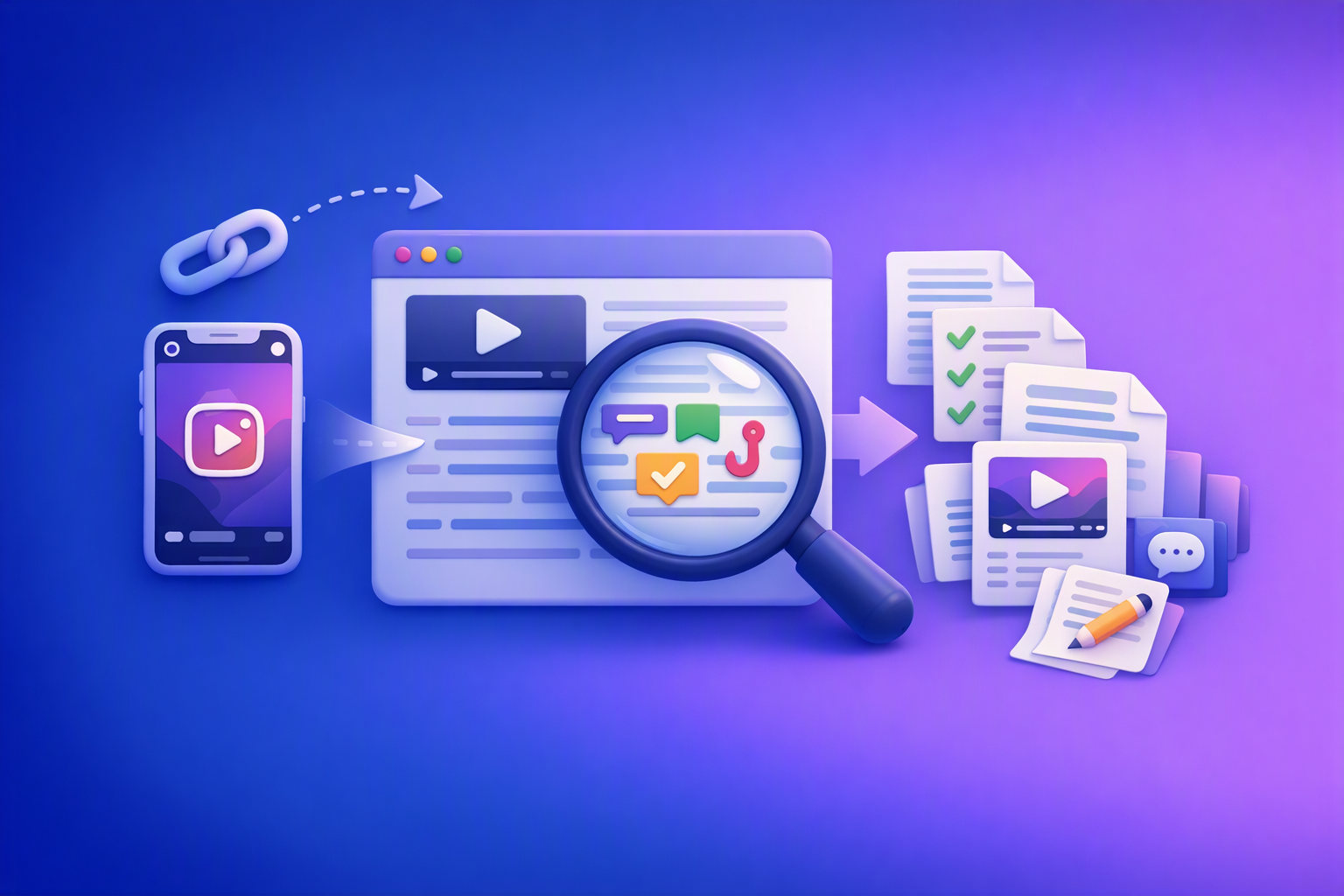
A 2026 reel analyser should turn Instagram Reel links into a searchable transcript library you can tag for hooks, CTAs, objections, and topic clusters—then export into repurposing-ready drafts without a download/upload loop.
Traducir video de Instagram (Reels) en 2026: workflow transcript-first para traducir, sacar hooks/CTAs y repurpose (con VideoToTextAI)
Video To Text AI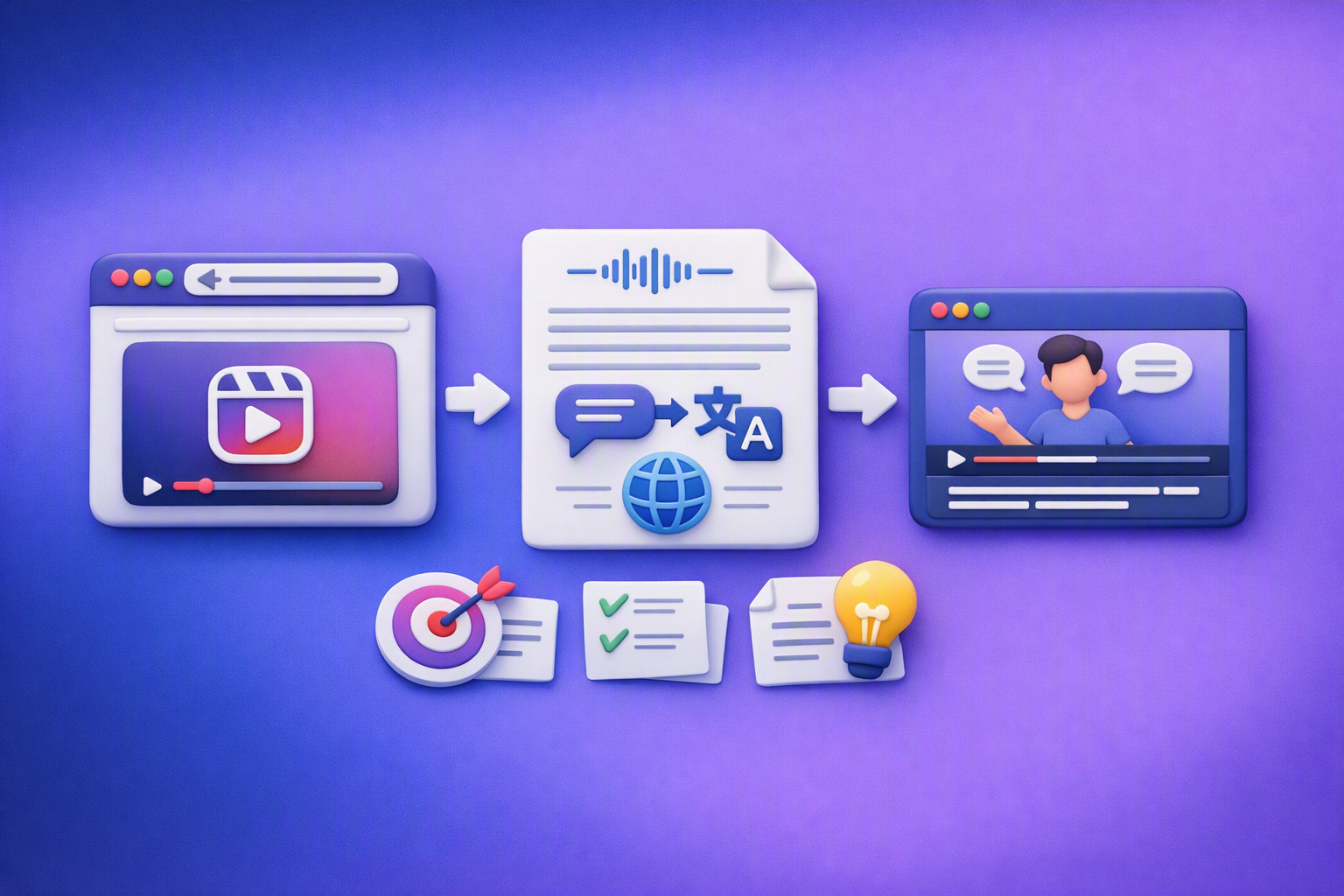
Aprende a traducir un Reel de Instagram con un flujo URL→transcripción→traducción→subtítulos, y a convertir esa traducción en un activo de investigación para hooks, CTAs, objeciones y clusters de contenido.
Reel Analyzer: Transcript‑First Instagram Reels Research (Hooks, CTAs, Objections) + Workflow Guide (VideoToTextAI)
Video To Text AI
A reel analyzer should turn any public Instagram Reel link into a searchable transcript library you can mine for hooks, CTAs, objections, and topic clusters—then repurpose into original drafts with a repeatable SOP.