
ChatGPT “Upload Video” Feature (2026): What Works, What Breaks, and the Production-Safe No-Upload Workflow
 Video To Text AI
ChatGPT “Upload Video” Feature (2026): What Works, What Breaks, and the Production-Safe No-Upload Workflow
If you need export-ready transcripts (TXT) and captions (SRT/VTT), don’t rely on the ChatGPT “upload video” feature—generate those artifacts first, then use ChatGPT on the text. If you only need quick analysis of a short clip, native upload can work (when it’s available), but expect inconsistent behavior.
This is the operational reality in 2026: downloading video files just to re-upload them is an outdated workflow. Link-based extraction is the future of creator productivity because it removes download/upload loops, reduces failure points, and produces reusable assets you can QA and ship.
What People Mean by “Upload Video to ChatGPT” (3 Different Inputs)
Most confusion comes from treating three different inputs as the same capability.
Uploading a video file (MP4/MOV) as an attachment
This is the literal meaning: you attach an MP4/MOV in a ChatGPT chat (paperclip / “Add files”).
What you get: sometimes basic analysis, sometimes partial extraction, sometimes failure.
Pasting a video link (YouTube/Drive/social)
Many users paste a URL and expect ChatGPT to open it, watch it, and transcribe it.
Reality: links often fail due to access restrictions, sign-in walls, geo limits, or ChatGPT not being able to fetch the media.
Asking ChatGPT to “watch” a video (what it can/can’t do)
“Watch this and tell me what happens” implies full video+audio understanding.
In practice: ChatGPT may handle short, simple clips on some surfaces, but it’s not a dependable system for long-form, technical, multi-speaker, or compliance-sensitive transcription/caption deliverables.
Quick Answer: Does ChatGPT Allow Video Uploads?
When video upload is available (and why availability varies)
Video upload availability varies by:
- Plan / entitlements
- Client surface (web vs. mobile vs. desktop)
- Workspace policy (especially in team/enterprise contexts)
- Model/tooling selection inside the chat
- Rollout timing and regional constraints
So “it works for my friend” can be true while it’s unavailable for you.
What ChatGPT can reliably do with uploaded video vs. what it can’t
More reliable (when upload works):
- High-level summary of a short clip
- Q&A about obvious content
- Extracting themes, action items, or structure (if the content is clear)
Not reliable for production deliverables:
- Export-ready transcripts you can publish without edits
- Accurate timestamps across long videos
- Captions/subtitles formats (SRT/VTT) that pass platform QA
- Consistent handling of names, numbers, jargon, and multiple speakers
Best-fit use cases (short analysis) vs. bad-fit use cases (export-ready transcripts/captions)
Best fit: “What are the key points in this 45-second clip?”
Bad fit: “Generate perfect captions for my 58-minute webinar and export SRT + VTT.”
If your goal is shipping assets, use an artifact-first workflow like:
How to Upload a Video to ChatGPT (Step-by-Step)
Use this only when you accept that the output may be incomplete and you’ll need a fallback.
Step 1 — Confirm you’re on an upload-capable surface/model
- Look for the paperclip / Add files control.
- If it’s missing, you’re likely on a surface/model/workspace where attachments are disabled.
If you see errors like “Add files is unavailable,” use: “Add Files Is Unavailable” in ChatGPT: Fixes That Work + a No-Upload Video→Text Workflow (VideoToTextAI)
Step 2 — Prepare the file for the highest success rate (format, duration, size)
To reduce failures:
- Use MP4 when possible (common compatibility baseline).
- Prefer shorter clips (split long videos).
- Avoid exotic codecs, variable frame rates, or huge bitrates.
- Trim dead air; it wastes processing budget and increases timeouts.
Step 3 — Upload + use prompts that reduce failure modes (analysis-first)
Ask for analysis-first, not “perfect transcript.”
Copy/paste prompt:
- “First, tell me what you can confidently extract from this video (topics, speakers, key moments). Then list uncertainties. Only then provide a draft transcript for the first 2 minutes with timestamps every 15 seconds.”
This forces the model to surface uncertainty early.
Step 4 — Validate output fast (spot-check timestamps, names, numbers, jargon)
Do a 2-minute QA pass:
- Check names (people, products, companies)
- Check numbers (prices, dates, metrics)
- Check domain terms (acronyms, jargon)
- Verify timestamps against 2–3 random points
If you need dependable caption files, switch to the artifact-first workflow below.
Why ChatGPT Video Upload Often Fails (Root Causes by Symptom)
Missing paperclip / “Add files is unavailable”
Likely causes:
- Attachments not enabled on that surface/model
- Workspace policy restrictions
- Temporary feature gating/rollout differences
“Attachments disabled for …”
Likely causes:
- Tooling disabled for the current chat
- Workspace/admin policy
- Browser/network constraints
Fix guide: “Attachments Disabled for” ChatGPT: What It Means, Why It Happens, and the Fastest Fix (2026)
“Max 0 uploads at a time”
This usually means uploads are disabled in that context, not that your file is wrong.
Upload stalls, fails, or times out
Common root causes:
- File too large / too long
- Network instability
- Server-side throttling
- Codec/container edge cases
Operational fix: split the video, reduce bitrate, or move to a link-based extraction workflow.
Output is incomplete, inaccurate, or inconsistent (especially for transcription)
This is the biggest issue for production:
- Long context drift
- Missed speaker turns
- Incorrect proper nouns
- Timestamp instability
If you need deliverables, stop asking ChatGPT to be your transcription engine. Use it as your repurposing engine on top of clean text.
The Production-Safe Workflow (Recommended): Video/Link → Transcript + Captions → ChatGPT-on-Text
Why “artifact-first” beats native video upload for deliverables
Artifact-first wins because it’s:
- Repeatable: same steps every time, independent of ChatGPT UI changes
- QA-able: you can spot-check text and timestamps before repurposing
- Exportable: you get TXT + SRT + VTT you can ship to platforms and teams
- Faster operationally: no download/re-upload loops when you start from a link
This is the creator productivity shift: links in, assets out.
What you generate first (TXT transcript + SRT/VTT captions) and why it matters
Generate:
- TXT transcript for editing, search, SEO, and repurposing
- SRT for captions/subtitles on many video platforms and editors
- VTT for web players and accessibility workflows
These formats are the “source of truth” you can reuse across tools and teams.
Step-by-step: Link-based workflow in VideoToTextAI
Step 1 — Paste a video link or use an MP4 input
Use a URL whenever possible to avoid download/upload loops. This is the future-proof workflow for creators and teams.
Step 2 — Generate transcript (TXT) and captions (SRT/VTT)
Export the artifacts you actually need to ship:
- Transcript for content ops
- Captions for publishing
Step 3 — Quick QA pass (speaker names, key terms, timestamps)
Do a fast check:
- Confirm speaker labels (if applicable)
- Verify 5–10 critical terms
- Validate a few timestamps against the video
Step 4 — Paste transcript into ChatGPT for repurposing (summaries, posts, outlines)
Now ChatGPT is operating on stable input (text), which is where it’s most reliable.
If your end goal is a blog post, you can also use: YouTube to Blog
One-time CTA: Use the link-first workflow at VideoToTextAI.
Step-by-step: MP4 workflow (when you have a local file)
Step 1 — Convert MP4 → transcript
Use: MP4 to Transcript
Step 2 — Export MP4 → SRT/VTT for captions/subtitles
Use:
Step 3 — Use ChatGPT on the exported text (not the video)
This avoids the most common failure mode: “video upload succeeded but the transcript is wrong.”
Implementation Prompts (Copy/Paste) for ChatGPT-on-Text
Use these after you have a transcript (TXT) and, ideally, timestamps.
Prompt: clean transcript + fix punctuation without changing meaning
You are an editor. Clean this transcript for readability.
Rules:
- Do NOT change meaning.
- Keep technical terms exactly as written.
- Fix punctuation, casing, and paragraph breaks.
- If a sentence is unclear, mark it with [unclear] instead of guessing.
Transcript:
[PASTE]
Prompt: generate YouTube description + chapters from transcript
Create:
1) A YouTube description (150–250 words) with a clear value prop and 5 bullet takeaways.
2) Chapters with timestamps (mm:ss). Use the transcript timestamps if present; otherwise infer and label as "approx".
Transcript:
[PASTE]
Prompt: create short-form clips plan (hooks + timestamps) from transcript
From this transcript, propose 8 short-form clips.
For each clip include:
- Hook (max 12 words)
- Start timestamp and end timestamp
- Why it will perform (1 sentence)
- On-screen caption text (1–2 lines)
Transcript:
[PASTE]
Prompt: turn transcript into blog outline + draft with SEO sections
Turn this transcript into an SEO blog post.
Requirements:
- Provide an outline first (H2/H3).
- Then write the draft.
- Add a short FAQ section based on the transcript.
- Keep paragraphs under 3 sentences.
Transcript:
[PASTE]
Target keyword: chatgpt upload video feature
Checklist: Fastest Reliable Path to Transcript + Captions + Repurposed Content
Triage checklist (when you insist on native ChatGPT upload)
- Confirm the paperclip/Add files exists in your current chat
- If you see errors, check:
- Trim to a short clip; avoid long uploads
- Ask for analysis-first, not “perfect transcript”
- Spot-check names, numbers, and 2–3 timestamps
Production checklist (recommended artifact-first workflow)
- Start from a video link whenever possible (avoid download/re-upload)
- Generate TXT transcript
- Export SRT + VTT
- Store artifacts in your content system (drive/repo/project)
- Use ChatGPT for repurposing from the transcript text
QA checklist (accuracy, formatting, exports, accessibility)
- Proper nouns: people, brands, products
- Numbers: dates, prices, metrics
- Terminology: acronyms and industry terms
- Captions: line length, reading speed, punctuation
- Timestamps: verify at least 3 random points
- Accessibility: captions present; avoid missing speaker context
VideoToTextAI vs Competitors
Comparison criteria (what we will evaluate)
We’ll evaluate tools on what matters for shipping work:
- Workflow speed (URL → assets without download/upload loops)
- Export readiness (clean TXT + SRT + VTT outputs)
- Repeatability for creators/teams (consistent steps, fewer platform dependencies)
- Repurposing depth (blog/social outputs from transcript, not just transcription)
Feature comparison table
| Tool | Link-based input (paste URL) | Upload-based workflow | Export-ready transcript | Caption/subtitle exports (SRT/VTT) | Repurposing workflow focus | Best suited for |
|---|---|---|---|---|---|---|
| VideoToTextAI | Yes (core workflow) | Yes (optional) | Yes (TXT) | Yes (SRT/VTT) | Yes (transcript → content repurposing) | Production-safe transcript + captions + repurposing |
| Canva (Video to Text) | No strong public signal | Yes | Yes | Not clearly signaled for SRT/VTT exports in research | Not a primary focus | Design-centric teams needing captions inside Canva |
| Choppity | No strong public signal | Yes | Yes | Yes | Not a primary focus | Creators who want AI-assisted editing/clipping + captions |
| Reduct Video | No strong public signal | Not clearly signaled | Yes | Not clearly signaled | Limited public positioning | Teams collaborating around transcript-based review/editing |
Why VideoToTextAI wins (when you care about shipping deliverables)
Based on the research signals above, VideoToTextAI is positioned around:
- Workflow speed: URL-first means fewer steps than download → upload loops.
- Exports: explicit focus on TXT + SRT + VTT artifacts you can ship.
- Operational repeatability: fewer dependencies on ChatGPT’s changing upload surfaces.
- Repurposing depth: a clear path from transcript to blog/social outputs (ChatGPT-on-text).
Fair note:
- If your primary job is designing inside a visual editor, Canva can be a better fit for that narrow workflow.
- If you want AI video editing/clipping as the main product, Choppity may be better aligned.
Competitor Gap
Most pages ranking for the “chatgpt upload video feature” topic fail in predictable ways:
- They conflate upload file vs paste link vs “watch video”, creating wrong expectations.
- They don’t provide symptom-based troubleshooting tied to real ChatGPT messages (e.g., “attachments disabled,” “max 0 uploads”).
- They stop at “summary” and skip export-ready caption formats (SRT/VTT) needed for production.
- They don’t show a repeatable repurposing workflow (transcript → blog/social) with QA steps.
This is why an artifact-first, link-based workflow is the production default.
FAQ
Does ChatGPT allow video uploads?
Sometimes. It depends on your plan, surface, model/tooling, and workspace policy. Even when it works, it’s not the most reliable way to produce transcripts and captions you can ship.
Can ChatGPT watch videos you upload to it?
It can sometimes analyze short clips, but it’s not a dependable “watch everything perfectly” system for long videos or export-ready transcription.
Can I upload a video to ChatGPT to analyze?
Yes, when uploads are enabled. Use it for short analysis and Q&A, then validate outputs quickly.
Why am I not able to upload video on ChatGPT?
Common reasons include missing attachment support on your current surface/model, workspace restrictions, or errors like “attachments disabled” and “max 0 uploads.” Use the fix guides:
Can you upload videos to ChatGPT for free?
Some users may have limited upload capability depending on plan and rollout, but “free” access is not consistent. For production work, plan around a no-upload workflow so you’re not blocked by UI entitlements.
Internal Link Plan
- ChatGPT “Upload Video” Feature (2026): What Works, What Breaks, and the Reliable No-Upload Workflow
- “Max 0 Uploads at a Time” in ChatGPT: What It Means + Fixes That Work (and a No-Upload Video→Text Workflow)
- “Attachments Disabled for” ChatGPT: What It Means, Why It Happens, and the Fastest Fix (2026)
- “Add Files Is Unavailable” in ChatGPT: Fixes That Work + a No-Upload Video→Text Workflow (VideoToTextAI)
- MP4 to Transcript
- MP4 to SRT
- MP4 to VTT
- YouTube to Blog
Related posts
Reel Analyser (Instagram Reels): Transcript‑First Competitor Research, Hook/CTA Extraction, and Repurposing Workflow (VideoToTextAI)
Video To Text AI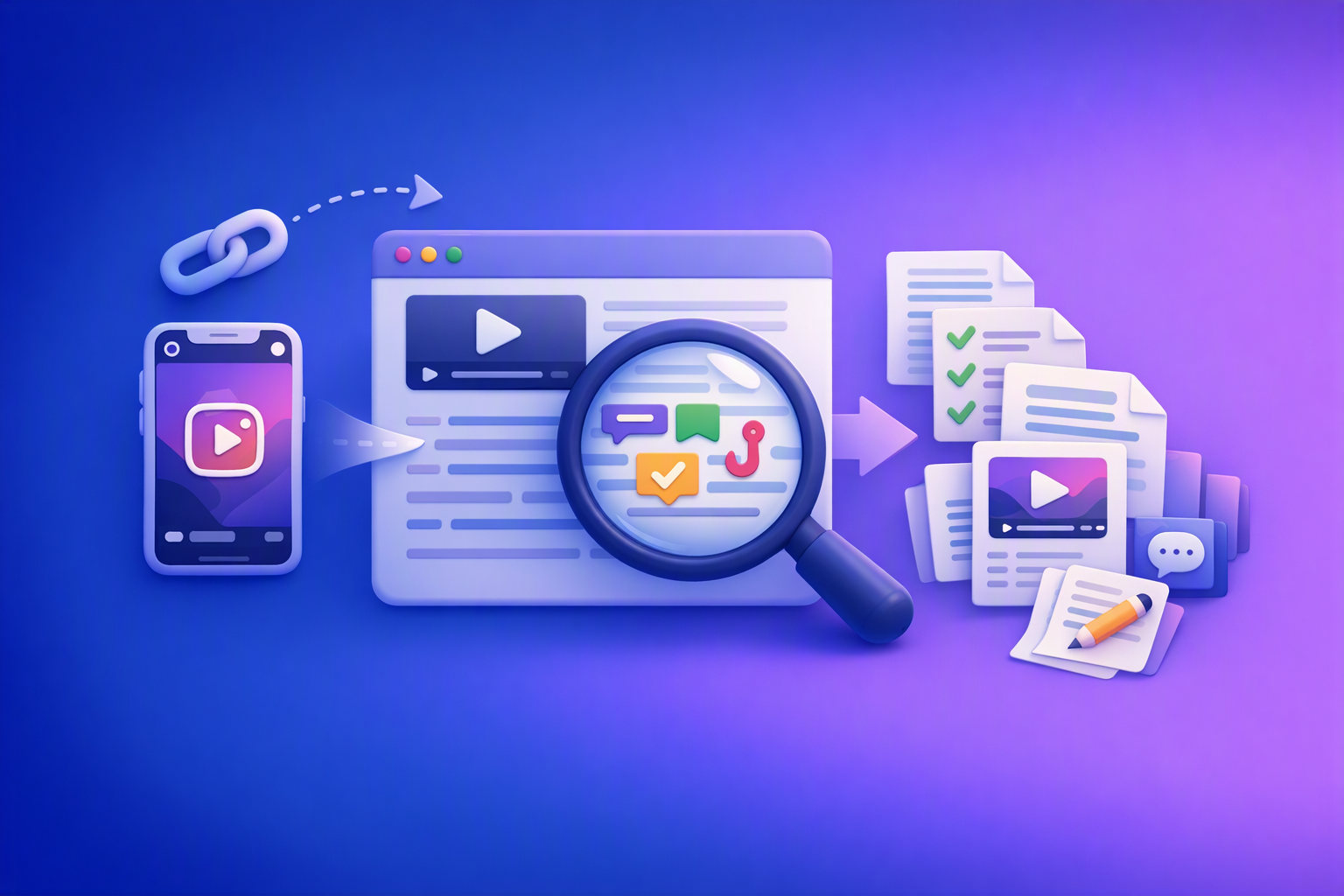
A 2026 reel analyser should turn Instagram Reel links into a searchable transcript library you can tag for hooks, CTAs, objections, and topic clusters—then export into repurposing-ready drafts without a download/upload loop.
Traducir video de Instagram (Reels) en 2026: workflow transcript-first para traducir, sacar hooks/CTAs y repurpose (con VideoToTextAI)
Video To Text AI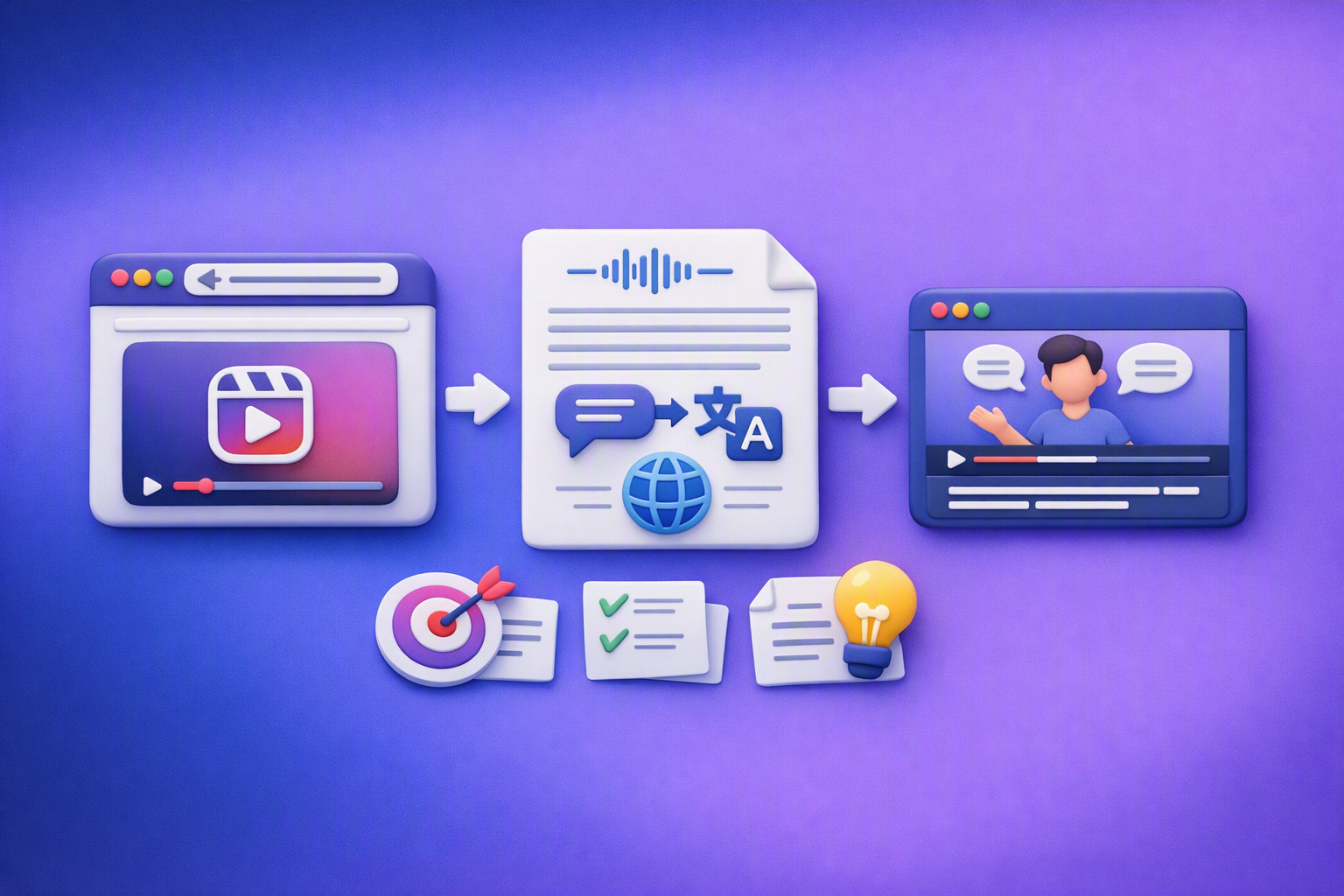
Aprende a traducir un Reel de Instagram con un flujo URL→transcripción→traducción→subtítulos, y a convertir esa traducción en un activo de investigación para hooks, CTAs, objeciones y clusters de contenido.
Reel Analyzer: Transcript‑First Instagram Reels Research (Hooks, CTAs, Objections) + Workflow Guide (VideoToTextAI)
Video To Text AI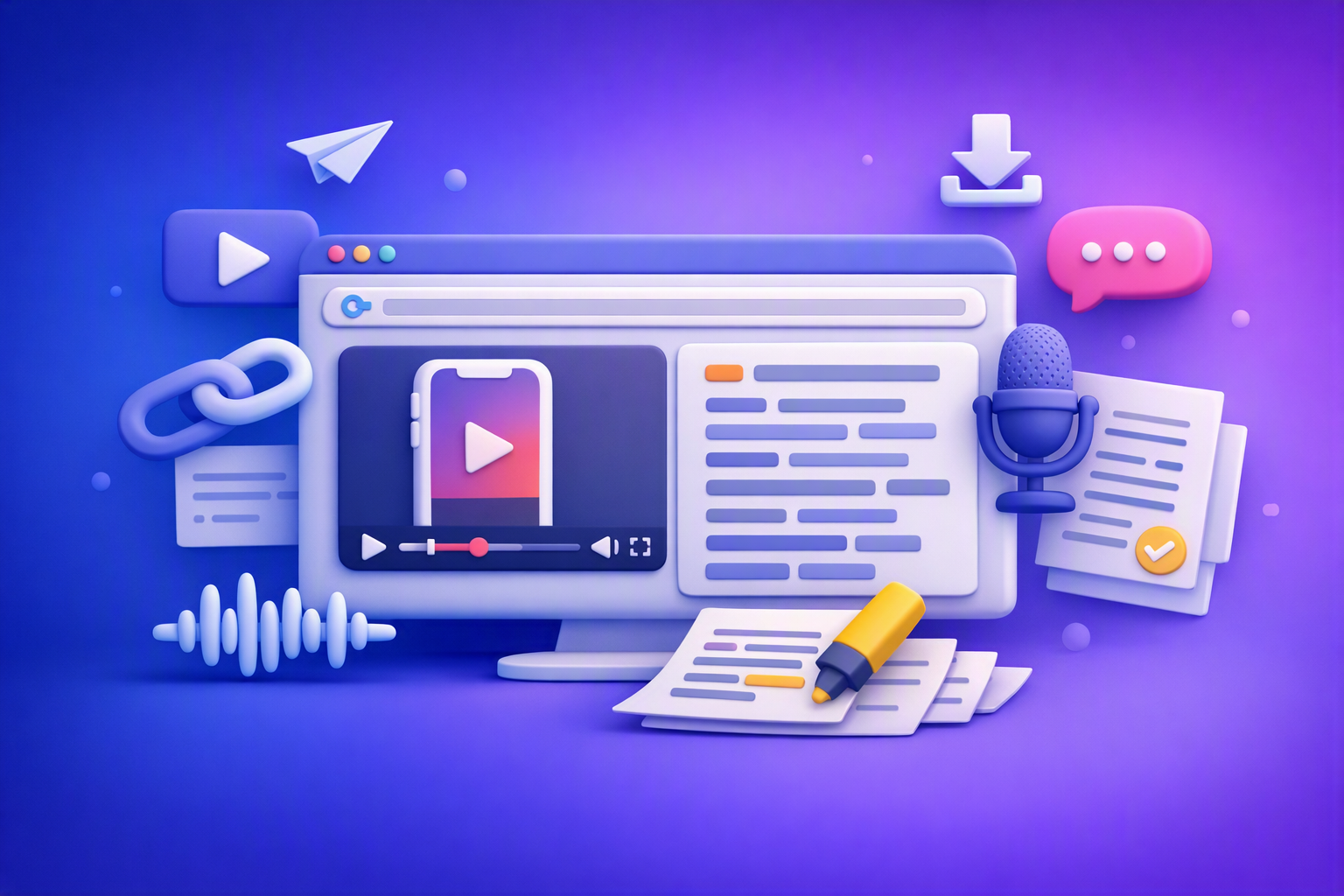
A reel analyzer should turn any public Instagram Reel link into a searchable transcript library you can mine for hooks, CTAs, objections, and topic clusters—then repurpose into original drafts with a repeatable SOP.