
“Add Files” Button Unavailable in ChatGPT: Causes, Fixes, and a Ship-Now Workflow (No Uploads Needed)
 Video To Text AI
“Add Files” Button Unavailable in ChatGPT: Causes, Fixes, and a Ship-Now Workflow (No Uploads Needed)
Fix this fast by switching to an upload-capable ChatGPT surface/model and validating uploads with a small test file. If you’re on a deadline, bypass uploads entirely with a transcript-first workflow: generate TXT + SRT/VTT from a link/MP4, then paste verified text into ChatGPT.
What “Add files is unavailable” actually means (and what it doesn’t)
It’s usually a surface/model/entitlement mismatch—not a ban
In most cases, “add files” button unavailable chatgpt issues come down to capability not being available in the current context:
- The surface you’re using doesn’t support attachments (or is temporarily degraded).
- The selected model doesn’t support uploads for your account.
- Your plan entitlement isn’t active/recognized.
- Your workspace policy disables attachments.
It’s not automatically a suspension, shadowban, or permanent restriction.
Common symptoms you’ll see (greyed out “+”, tooltip text, upload modal missing)
Typical patterns:
- Greyed out “+” (or attachment icon) in the composer.
- Tooltip text like “Add files is unavailable” or “Attachments disabled for …”
- Clicking does nothing because the upload modal never loads.
- Upload starts but fails with validation errors (type/size) or network errors.
Fast decision: fix uploads vs bypass uploads (when time matters)
Use this decision rule:
- If you need ChatGPT to read the original file (tables, images, PDFs), fix uploads.
- If you only need the content (transcript, summary, outline, captions, repurposed posts), bypass uploads and paste text.
Brand POV: Downloading videos just to re-upload them is an outdated loop. Link-based extraction is the future of creator productivity because it’s faster, more repeatable, and less fragile than attachment pipelines.
2-minute diagnosis (do this in order)
Step 1: Confirm you’re on an upload-capable ChatGPT surface
Uploads can vary by surface (web vs mobile vs embedded experiences). Start by testing on the main ChatGPT web app and a fresh new chat.
Quick test: open a new chat and look for the “+” control before changing anything else.
Step 2: Confirm the selected model supports file uploads on your account
Even if uploads exist on the platform, your current model selection may not support them for your account.
- Switch models.
- Start a new chat after switching (some UI states don’t refresh mid-thread).
Step 3: Check plan/entitlement and workspace policy restrictions
Two common blockers:
- Entitlement: your plan isn’t active or isn’t being recognized.
- Workspace policy: your org disables attachments for compliance.
If you’re in a company workspace, assume policy first and verify with a personal account test.
Step 4: Isolate browser causes (profile, extensions, cookies, cache)
Most “it worked yesterday” cases are:
- Extension updates (ad blockers, privacy tools, script blockers)
- Corrupted site data
- Broken cached assets
Step 5: Isolate network causes (VPN, proxy, firewall, DNS filtering)
Uploads can fail when:
- VPN/proxy rewrites traffic
- Corporate firewall blocks storage endpoints
- DNS filtering blocks required domains
Step 6: Check service-side issues (status/outages) and retry logic
If everything else checks out, treat it as a platform incident:
- Retry later
- Avoid peak hours
- Use the fallback workflow below so you can still ship
Root causes + exact fixes (ordered playbook)
Cause 1: Wrong model or chat surface
Fix: switch to an upload-capable model; start a new chat; test with a small file
Do this in order:
- Switch models (don’t assume your current one supports uploads).
- Click New chat.
- Upload a small test file first (TXT or a small PDF).
Verification: “Add files” appears and accepts a <5MB test upload
Success looks like:
- The “+” becomes clickable
- The upload modal opens
- A small file attaches and is readable in the thread
Cause 2: Plan/entitlement not active (or temporarily not recognized)
Fix: re-authenticate, verify billing status, test on another device, wait for entitlement refresh
Implementation steps:
- Log out/in (forces entitlement refresh).
- Confirm your plan is active in billing/account settings.
- Test on another browser/device to rule out local state.
- If you just upgraded/downgraded, wait for propagation and retry.
Verification: uploads work on at least one device/browser
If it works elsewhere, you’re dealing with local browser/network state.
Cause 3: Workspace/organization policy disables attachments
Fix: test in personal account; ask admin to enable file uploads; confirm data controls
What to do:
- Test the same action in a personal account (outside the workspace).
- If personal works, ask your admin about:
- Attachment permissions
- Data controls / retention policies
- Allowed tools/models
Verification: uploads work outside the workspace
This confirms it’s policy, not your device.
Cause 4: Browser extension interference (privacy/ad blockers/script blockers)
Fix: disable extensions (start with ad blockers), try Incognito, use a clean browser profile
Fast isolation:
- Open Incognito/Private (extensions often disabled by default).
- If it works, disable extensions starting with:
- Ad blockers
- Script blockers
- Privacy/security extensions
Verification: button becomes clickable without extensions
Once you find the culprit, allowlist ChatGPT domains or keep a clean profile for work.
Cause 5: Corrupted site data / cookies / local storage
Fix: clear site data for chat.openai.com; log in again; restart browser
Do a targeted reset:
- Clear site data (cookies + local storage) for ChatGPT.
- Restart the browser.
- Log in again.
Verification: upload modal loads consistently
If the modal intermittently fails, you likely still have extension or network interference.
Cause 6: Network blocks (VPN/proxy/firewall) or content filtering
Fix: turn off VPN, switch networks (mobile hotspot), allowlist required domains, try different DNS
Isolation steps:
- Turn off VPN/proxy.
- Switch to a mobile hotspot.
- If you’re on a managed network, request allowlisting from IT.
- Try a different DNS resolver if your DNS is filtering.
Verification: uploads work on alternate network
If hotspot works, your network is the blocker.
Cause 7: File-type/size limits or client-side validation errors
Fix: compress/convert; rename file; try TXT/PDF first; split large files
Practical fixes:
- Rename files to simple names (avoid special characters).
- Convert to a simpler format (TXT/PDF).
- Split large files into smaller parts.
- For videos: don’t upload the video if you only need text—use a transcript-first workflow.
Verification: smaller file uploads succeed
Once small files work, scale up carefully.
Cause 8: Temporary platform degradation
Fix: check status, retry later, avoid peak hours, use fallback workflow below
When it’s not you:
- Check the status page.
- Retry later.
- Use the ship-now workflow so your deliverables don’t depend on attachments.
Verification: uploads resume after status recovery
Treat this as a reliability lesson: build workflows that don’t break when attachments do.
Ship-now workaround: bypass ChatGPT uploads with a transcript-first workflow
When to use this (and why it’s production-safe)
Use this when:
- The “+” is greyed out and you can’t wait.
- You’re working in a workspace where attachments are disabled.
- You’re processing video/audio and ChatGPT doesn’t need the raw file to produce outputs.
It’s production-safe because you’re feeding ChatGPT verified text (the transcript) and keeping captions/subtitles as export-ready files.
Workflow overview: Link/MP4 → transcript + captions → paste verified text into ChatGPT
The modern workflow is:
- Video link or MP4 → generate transcript + captions
- Export TXT + SRT/VTT
- Paste transcript into ChatGPT for:
- summaries
- outlines
- hooks/titles
- repurposed posts
- blog drafts
Brand POV: This avoids the outdated download/upload loop and makes link-based extraction the default for creator productivity.
Step-by-step implementation (VideoToTextAI)
Step 1: Choose your input type (video link vs MP4)
- Use a public URL when possible to avoid download/upload loops.
- Use MP4 when the source is private, local, or not accessible via link.
Step 2: Generate export-ready text assets in VideoToTextAI
Generate the assets you can ship:
- Export TXT for analysis, summarization, and repurposing.
- Export SRT/VTT for captions/subtitles with timecodes.
Use this once, then reuse the same source of truth everywhere.
Step 3: Paste the transcript into ChatGPT (no attachments required)
Operational tips:
- Paste in chunks if needed.
- Keep chunks labeled with timestamps or section headers.
- Ask for outputs that don’t require the original file:
- “Summarize section 00:00–02:30”
- “Create 10 hooks from the transcript”
- “Turn this into a blog outline + H2s”
Step 4: Produce deliverables from the same source of truth
From the same transcript/captions:
- Captions/subtitles: use SRT/VTT directly in editors/platforms.
- Content repurposing: generate blog/social/email drafts from the transcript.
If ChatGPT is down or uploads are blocked, you still ship.
Recommended VideoToTextAI tool paths (pick one)
For local files
- MP4 → Transcript:
/tools/mp4-to-transcript - MP4 → SRT:
/tools/mp4-to-srt - MP4 → VTT:
/tools/mp4-to-vtt - MP4 → Blog Post:
/tools/mp4-to-blog-post
For platform links (creator workflows)
- Instagram → Text:
/tools/instagram-to-text - TikTok → Transcript:
/tools/tiktok-to-transcript - YouTube → Blog:
/tools/youtube-to-blog - Podcast Transcription:
/tools/podcast-transcription
If you want the fastest path from link to export-ready assets, use VideoToTextAI: VideoToTextAI
Implementation checklist (copy/paste)
Upload-fix checklist (ChatGPT)
- Start a new chat on an upload-capable surface
- Switch to an upload-capable model and re-check the “+” button
- Confirm plan/entitlement is active (billing + account)
- Test outside workspace/org (personal account)
- Disable extensions (ad/script blockers first)
- Clear site data for ChatGPT and re-login
- Turn off VPN/proxy; test on mobile hotspot
- Upload a small TXT/PDF test file to validate the pipeline
- Check status page; retry after incident resolution
Ship-now checklist (no uploads)
- Generate TXT transcript from link/MP4 in VideoToTextAI
- Export SRT/VTT for captions/timecodes
- Paste transcript into ChatGPT in labeled chunks
- Generate summary + outline + repurposed assets from verified text
- Publish captions/subtitles using SRT/VTT (no rework)
VideoToTextAI vs Competitors
The point of this comparison is operational: when the “add files” button unavailable chatgpt issue blocks attachments, you need a workflow that doesn’t depend on ChatGPT uploads and doesn’t force download → upload loops.
Competitors compared (researched)
- Reduct Video
- PCMag (transcription services roundup; vendor set)
- Zapier (transcription apps roundup; vendor set)
Comparison criteria we will cover
- Speed: URL-to-assets vs download/upload loops
- Export readiness: TXT + SRT + VTT (timecodes that ship)
- Reliability: workflow that doesn’t depend on ChatGPT attachments
- Repurposing: transcript-first outputs from one source of truth
Comparison table (capabilities signaled in research)
| Tool | Link-based input (paste a URL) | Upload-based workflow | Transcript export | Export-ready captions (SRT/VTT) | Repurposing positioning | Best fit |
|---|---|---|---|---|---|---|
| VideoToTextAI | Yes (core workflow) | Yes (MP4 option) | Yes | Yes (SRT/VTT deliverables) | Yes (blog/social/captions from transcript) | Creators/teams who want URL→assets fast and a fallback when ChatGPT uploads fail |
| Reduct Video | No strong public signal (research whitespace) | Not clearly positioned as link-first | Yes | Weak evidence in researched pages | Some (summaries) | Teams needing collaborative transcript-based review/editing |
| PCMag roundup (vendor set) | Not applicable (it’s a review list) | Yes (many tools) | Yes | Not emphasized in researched page | Mentions repurposing generally | Good starting point to compare many vendors, not a workflow itself |
| Zapier roundup (vendor set) | Not a link-first workflow signal | Not clearly positioned as upload-first in researched page | Yes | Not emphasized in researched page | Not a core focus in researched page | Good for discovering apps and automation ideas |
Where VideoToTextAI fits best
VideoToTextAI is best when you need:
- Link-based + MP4-based video-to-text workflows for transcripts, subtitles, captions, and repurposing.
- A repeatable, production-safe fallback when ChatGPT attachments are blocked, inconsistent, or disabled by policy.
Why VideoToTextAI wins (based on the research angles):
- Workflow speed: link-based input avoids the outdated download/upload loop.
- Export readiness: treating TXT + SRT + VTT as first-class outputs means you can ship captions and timecoded text immediately.
- Reliability: your deliverables don’t depend on whether ChatGPT attachments are available today.
- Operational repeatability: one transcript becomes the source of truth for summaries, posts, and captions.
Fair note: Reduct Video can be a better fit for teams that prioritize collaborative transcript-based video review/editing inside a shared workspace.
Competitor Gap
What top-ranking results miss (and how this post fixes it)
Most results (forums, Reddit threads, generic troubleshooting) don’t give you a layered diagnostic plus a ship-now workflow.
This post closes the gap with:
- An ordered 2-minute diagnosis that isolates model/surface vs policy vs browser vs network.
- A step-by-step “ship-now” workflow that avoids ChatGPT uploads entirely.
- Export-ready caption formats (SRT/VTT) as first-class deliverables, not an afterthought.
- A reusable checklist you can run every time uploads break.
FAQ
Why is “Add files” unavailable in ChatGPT?
Usually because you’re on the wrong surface/model for uploads, your plan entitlement isn’t recognized, or your workspace policy disables attachments. Less commonly, it’s caused by extensions, corrupted site data, network filtering, or a platform incident.
Why can’t I upload files to ChatGPT anymore?
Most “it stopped working” cases trace back to a change in one layer: model selection, workspace policy, entitlement refresh, browser extensions, or network controls. Run the 2-minute diagnosis in order to find the changed layer quickly.
How do I add a file in ChatGPT?
Use an upload-capable surface, select a model that supports uploads for your account, then click the “+” control and attach a small test file first. If the upload modal doesn’t appear, isolate extensions, cookies/site data, and network blocks.
Why can’t I upload images to ChatGPT Plus?
Plus doesn’t guarantee uploads on every surface/model/workspace configuration. Images can be blocked by workspace policy, model selection, browser extensions, or network filtering; test in a personal account and a clean browser profile to confirm.
Internal Link Plan
- “Add Files” Button Unavailable in ChatGPT: Causes, Fixes, and a Ship-Now Workflow (No Uploads Needed)
- “Add Files” Button Unavailable in ChatGPT: Why It Happens + Fixes (and a Ship-Now Workflow)
- “Attachments Disabled for” ChatGPT: What It Means, Why It Happens, and How to Fix It (Plus a Ship-Now Workflow)
- ChatGPT “Upload Video” Feature (2026): What Works, Limits, Fixes, and a Production-Safe Video-to-Text Workflow
- Reel Summary: How to Summarize an Instagram Reel (Accurately) + Turn It Into Captions, Posts, and a Blog
- “Attachments Disabled for” ChatGPT: What It Means + Fixes (and a Production-Safe Video-to-Text Workflow)
Related posts
Reel Analyser (Instagram Reels): Transcript‑First Competitor Research, Hook/CTA Extraction, and Repurposing Workflow (VideoToTextAI)
Video To Text AI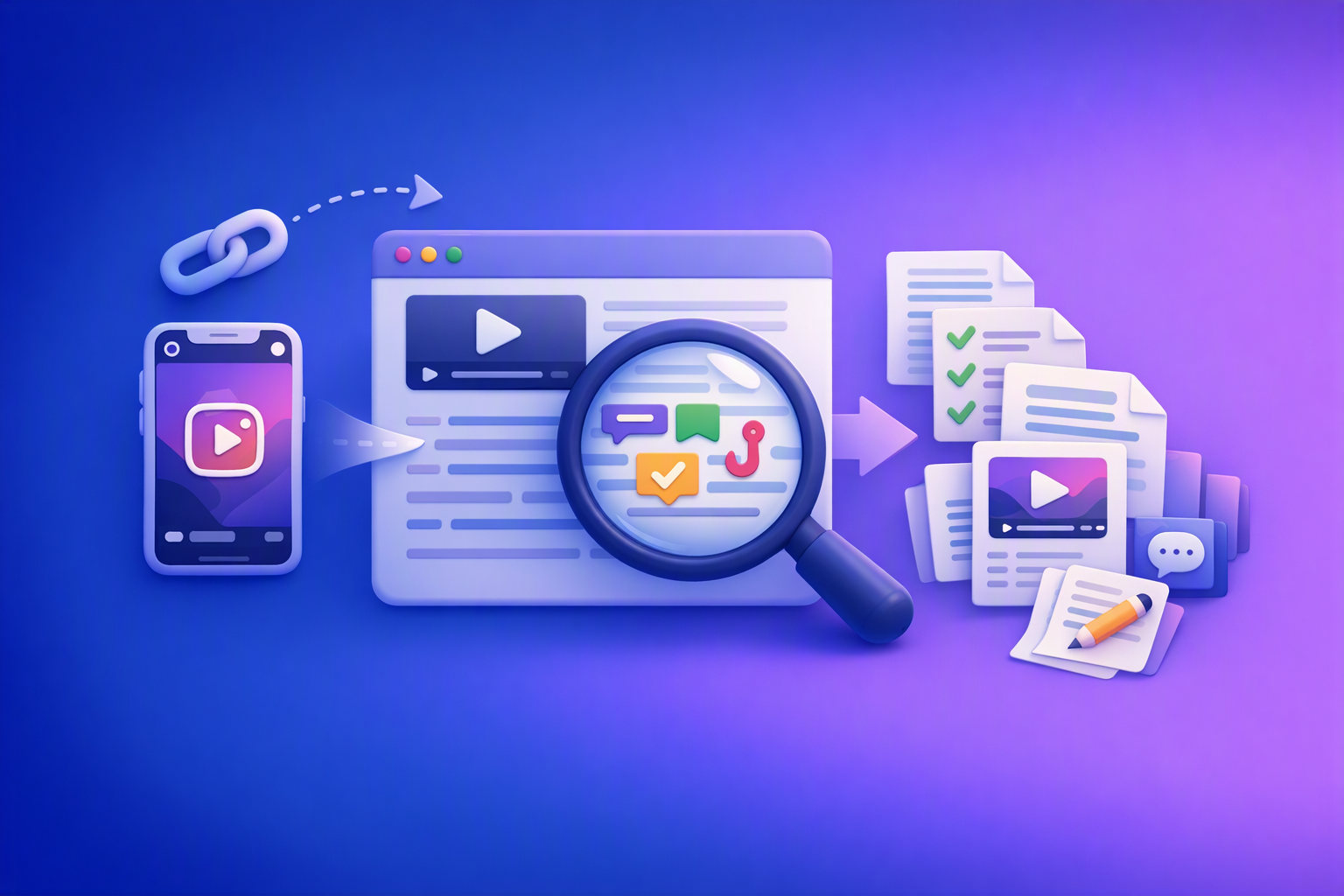
A 2026 reel analyser should turn Instagram Reel links into a searchable transcript library you can tag for hooks, CTAs, objections, and topic clusters—then export into repurposing-ready drafts without a download/upload loop.
Traducir video de Instagram (Reels) en 2026: workflow transcript-first para traducir, sacar hooks/CTAs y repurpose (con VideoToTextAI)
Video To Text AI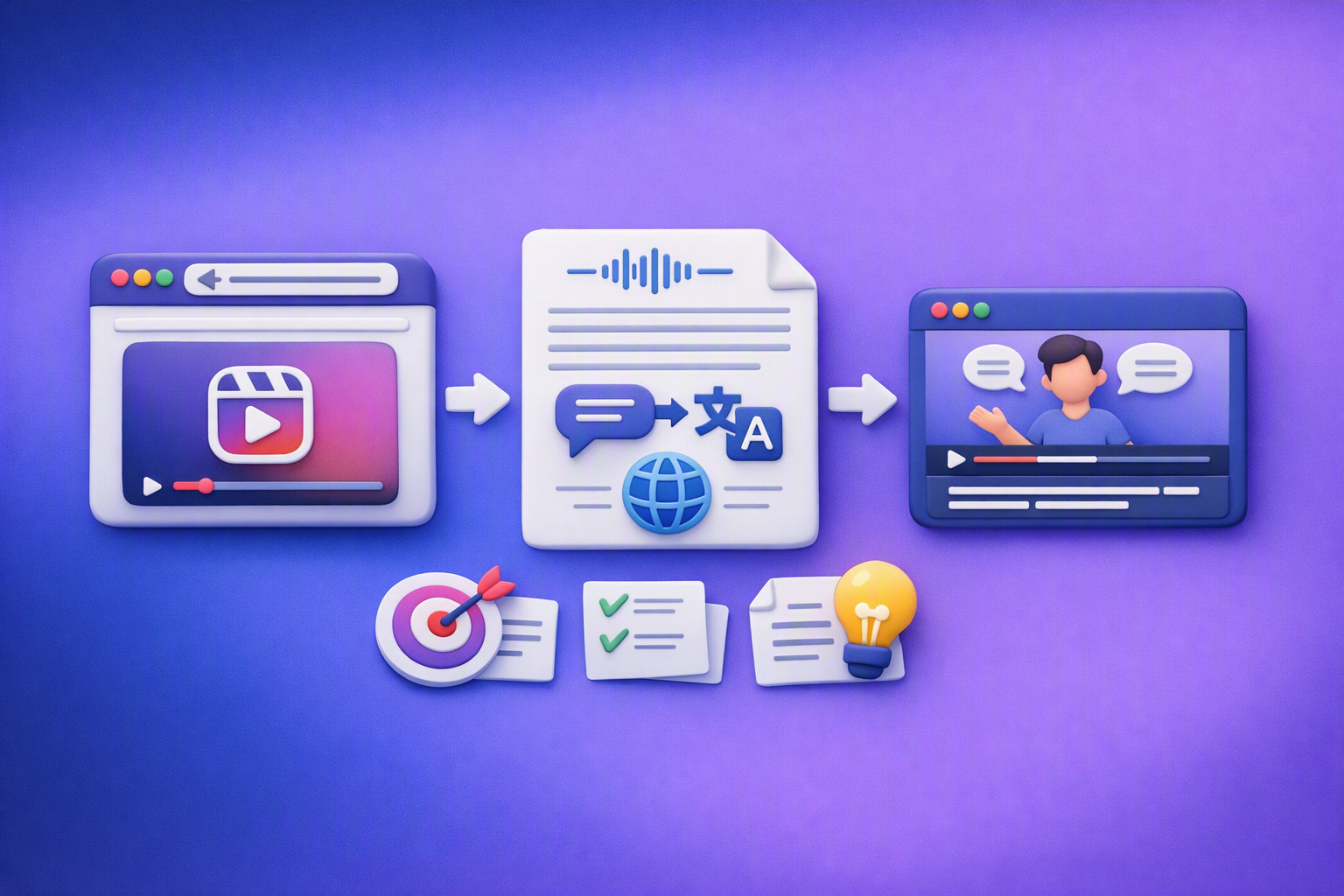
Aprende a traducir un Reel de Instagram con un flujo URL→transcripción→traducción→subtítulos, y a convertir esa traducción en un activo de investigación para hooks, CTAs, objeciones y clusters de contenido.
Reel Analyzer: Transcript‑First Instagram Reels Research (Hooks, CTAs, Objections) + Workflow Guide (VideoToTextAI)
Video To Text AI
A reel analyzer should turn any public Instagram Reel link into a searchable transcript library you can mine for hooks, CTAs, objections, and topic clusters—then repurpose into original drafts with a repeatable SOP.