
Upload Video to ChatGPT (2026): What Actually Works, Why Uploads Fail, and the Production-Safe Link → Transcript Workflow
 Video To Text AI
Downloading video files to “feed” AI is an outdated workflow; link-based extraction is the future of creator productivity. When you need transcripts, captions, and repurposing you can ship, the production-safe path is Link/MP4 → TXT + SRT/VTT → ChatGPT-on-text.
Who this is for (and what you’ll get)
If you searched “upload video” chatgpt, you’re likely trying to get useful outputs from a clip without fighting uploads, codecs, or access errors. This guide shows what actually works in 2026 and what to do when it doesn’t.
Use cases this post covers
- Quick clip understanding: summaries, Q&A, scene notes, key moments
- Transcript + captions you can export: TXT, SRT, VTT
- Repurposing workflows: blog drafts, LinkedIn posts, X/Twitter threads, multilingual versions
What this post does not assume
- You have the upload button
- Your video is short, small, or in a friendly codec
- Your link is publicly accessible
If you want a deeper companion guide, see: ChatGPT “Upload Video” Feature: What Works, Why Uploads Fail, and the Production-Safe Link → Transcript Workflow (VideoToTextAI).
Can you upload a video on ChatGPT? (current reality)
What “upload video” means inside ChatGPT
People use “upload video” to mean three different things:
- Attachment upload: you attach a video file (like MP4/MOV) in chat
- Link sharing: you paste a YouTube/Drive/social link and ask for analysis
- “Watching” a hosted video: the model can access and interpret the content behind the link
Important distinction: “analyze this video” ≠ “generate export-ready transcript/captions.” Even when analysis works, you may not get clean timecodes, consistent speaker labels, or SRT/VTT formatting without extra steps.
Why some users don’t see video upload
If you don’t see an upload option, it’s usually one of these:
- Client differences: web app vs. iOS/Android can differ
- Plan/rollout variability: features roll out unevenly across accounts
- Workspace/admin restrictions: common in team environments (uploads disabled, external links blocked)
How to upload a video to ChatGPT (step-by-step)
Option A — Upload a file (best for short clips)
Use this when you have a short, lightweight clip and you only need quick analysis (not production captions).
Step-by-step
- Open ChatGPT (web or mobile) and start a new chat
- Click the attachment/paperclip icon
- Select your video file (MP4/MOV typically safest)
- Add a task prompt (use templates below)
- Validate output (spot-check timestamps, names, numbers)
Prompt templates (copy/paste)
-
Clip summary + key moments:
“Summarize this video in 8 bullets. Then list 10 key moments with approximate timestamps.” -
Action items:
“Extract decisions, action items, owners, and due dates. Output as a table.” -
Chapters:
“Create YouTube-style chapters with timestamps and titles.”
Tip: If you ultimately need captions, don’t rely on “approximate timestamps.” Use a transcript/caption artifact (SRT/VTT) first, then ask ChatGPT to repurpose.
Option B — Share a link (best when upload fails)
This is the modern direction: work from links, not downloads. Links are faster, easier to collaborate on, and closer to how creators actually publish.
Step-by-step
- Confirm the link is accessible without login (or provide access)
- Paste the link and specify what the model should do with text outputs
- If ChatGPT can’t access the link, switch to the production-safe workflow below
Link-access pitfalls to check
- Private/unlisted permissions (unlisted is not always accessible to bots/tools)
- Expiring signed URLs (common with cloud storage shares)
- Geo restrictions
- Requires cookies/login (most common cause of “can’t open link”)
If your goal is to extract text from a link reliably, see: Give Me the Text: How to Extract Text From Any Video Link (Transcripts, Captions, and Repurposing) with VideoToTextAI.
Why ChatGPT video uploads fail (and how to fix fast)
Uploads fail for predictable reasons. Diagnose by failure mode, apply the fastest fix, and move on.
Failure mode 1: No upload button / feature missing
Symptoms: no paperclip, no “attach,” no video option.
Fix:
- Try the web app (often has features first)
- Update the mobile app
- Switch account/workspace (test a personal account)
- Check team admin policies (uploads may be disabled)
Failure mode 2: “Upload failed” / stuck processing
Symptoms: progress bar stalls, processing loops, or errors after upload.
Fix:
- Shorten the clip (trim to a few minutes)
- Re-encode to H.264 MP4
- Reduce resolution/bitrate (e.g., 1080p → 720p)
- Retry on stable Wi‑Fi (avoid captive portals/VPN issues)
Failure mode 3: Format/codec issues (looks like MP4 but isn’t)
Symptoms: file is “.mp4” but fails or produces broken analysis.
Fix:
- Re-export to MP4 (H.264 video + AAC audio)
- Avoid variable frame rate when possible
- If it’s a screen recording, export with standard settings
Failure mode 4: Long videos time out / partial analysis
Symptoms: incomplete output, missing sections, or timeouts.
Fix:
- Split into segments (e.g., 10–20 minutes each)
- Or skip upload entirely and use link → transcript artifacts (recommended for production)
Failure mode 5: 403 / access denied on links
Symptoms: “can’t access,” “403,” “forbidden,” “login required.”
Fix:
- Use a public link (no auth wall)
- Remove login requirements / share with proper permissions
- Generate transcript from the source platform first, then work from text
The production-safe workflow (recommended): Link/MP4 → TXT + SRT/VTT → ChatGPT-on-text
If you need deliverables you can ship (captions, subtitles, repurposed content), treat video as a source file and text artifacts as the product.
Why this workflow wins for transcripts, captions, and QA
- Deterministic artifacts: exportable TXT/SRT/VTT you can reuse
- Reviewable and correctable: easy to spot errors and version changes
- Resilient: works even when ChatGPT upload/link access fails
- Lower hallucination risk: ChatGPT works from your transcript, not guesswork
This is also why downloading videos to move between tools is outdated. Link-first workflows reduce friction, preserve source-of-truth URLs, and scale across teams.
Step-by-step implementation with VideoToTextAI
Step 1 — Start with the source (link or MP4)
- Input: YouTube/Instagram/TikTok link or upload MP4
- Output targets: TXT transcript + SRT/VTT captions
If you’re starting from a file, these tool pages map cleanly to deliverables:
If you’re starting from a platform link:
Step 2 — Generate transcript + captions (export-ready)
Produce three artifacts:
- Clean transcript (TXT): readable, editable, ideal for repurposing
- Timecoded subtitles (SRT): standard for editors and most platforms
- Web captions (VTT): common for web players and accessibility
Step 3 — QA the artifacts (fast checks that prevent rework)
Do a quick pass before you repurpose:
- Names, numbers, acronyms: fix the high-impact errors first
- Speaker changes: ensure speaker turns are correct (if applicable)
- Timestamp drift: verify start/end alignment on a few random sections
- Profanity/brand terms: normalize brand spellings and product names
Step 4 — Use ChatGPT on the text (not the video)
Paste the transcript (or sections) and request structured outputs:
- Summary + key takeaways
- Chapters + titles
- Blog outline + draft
- Social posts + hooks
- Translation/localization
Transcript-first prompt example:
“Here’s the transcript. Create: (1) a 10-bullet executive summary, (2) YouTube chapters with timestamps from the SRT, (3) a 900-word blog draft, and (4) 5 LinkedIn hooks. Keep terminology consistent with the transcript.”
Step 5 — Repurpose into deliverables
From the same artifacts, you can produce:
- Blog post, newsletter, LinkedIn post, X thread
- Short-form scripts (Reels/TikTok/Shorts)
- Captions/subtitles ready for editors and platforms
If you want the fastest link-first path end-to-end, use VideoToTextAI: VideoToTextAI
Implementation checklist (copy/paste)
Before you try ChatGPT upload
- Confirm you have the upload button (web + mobile)
- Keep a test clip under a few minutes to validate capability
- Use MP4 (H.264 video + AAC audio)
- Ensure stable network and enough device storage
If upload/link fails
- Re-encode to MP4 (H.264/AAC)
- Split long videos into segments
- Verify link is public and not behind login
- Switch to Link/MP4 → TXT + SRT/VTT → ChatGPT-on-text
For production deliverables
- Export TXT + SRT/VTT
- Run QA checks (names, numbers, timestamps)
- Use ChatGPT to structure/repurpose from the transcript
- Store artifacts for reuse (future posts, clips, translations)
Competitor Gap
What competitors miss (and what this post adds)
- A deterministic, artifact-first workflow that produces export-ready TXT + SRT/VTT (not just “analysis”)
- A troubleshooting map tied to specific failure modes (missing button, 403, codec, timeouts)
- Reusable prompt templates designed for transcript-first processing (less hallucination risk)
- A production checklist for QA and repeatability (teams, agencies, creators)
Most “upload video to ChatGPT” guides stop at “try the paperclip.” Production teams need repeatable outputs and versionable artifacts, which is why link-first extraction beats download-and-upload loops.
Tool shortcuts (VideoToTextAI)
Pick the fastest path based on your input
- YouTube link → transcript/repurposing: YouTube to Blog
- Instagram/TikTok/Reels → text + hooks + posts: Instagram to Text and TikTok to Transcript
- MP4 file → transcript + SRT/VTT + summaries: MP4 to Transcript, MP4 to SRT, MP4 to VTT
Recommended tool pages to link from this post
- MP4 transcription and captions: MP4 to Transcript, MP4 to SRT, MP4 to VTT
- Platform-specific link extraction: YouTube to Blog, Instagram to Text, TikTok to Transcript
FAQ
Can I upload a video on ChatGPT?
Sometimes. Video attachments may be available depending on your plan, client (web vs. mobile), rollout status, and workspace policies.
Can ChatGPT watch videos you upload?
In supported experiences, it can analyze an uploaded clip. For export-ready transcripts/captions, use a transcript-first workflow (TXT/SRT/VTT) and then use ChatGPT on the text.
Can you upload a video for ChatGPT to analyze?
Yes—when the attachment feature is available and the file is short enough and encoded in a compatible format (typically MP4/H.264 + AAC). For long videos, expect timeouts or partial results.
Why doesn’t ChatGPT let me upload a video?
Common reasons: missing feature rollout, team admin restrictions, unsupported codecs, file size/length limits, unstable network conditions, or link access errors like 403/login-required. When in doubt, switch to Link/MP4 → TXT + SRT/VTT → ChatGPT-on-text for reliable production outputs.
Related posts
Reel Analyser (Instagram Reels): Transcript‑First Competitor Research, Hook/CTA Extraction, and Repurposing Workflow (VideoToTextAI)
Video To Text AI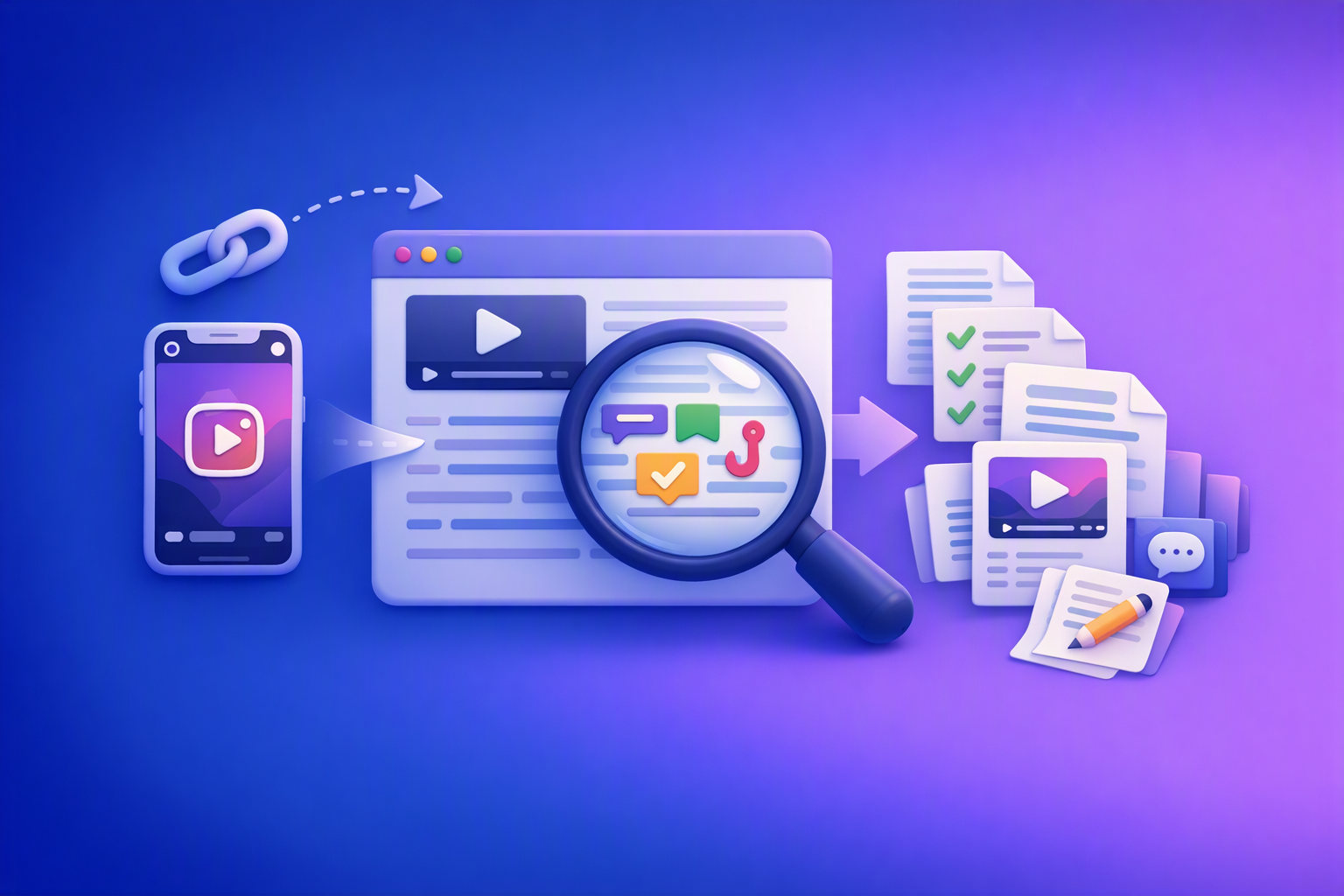
A 2026 reel analyser should turn Instagram Reel links into a searchable transcript library you can tag for hooks, CTAs, objections, and topic clusters—then export into repurposing-ready drafts without a download/upload loop.
Traducir video de Instagram (Reels) en 2026: workflow transcript-first para traducir, sacar hooks/CTAs y repurpose (con VideoToTextAI)
Video To Text AI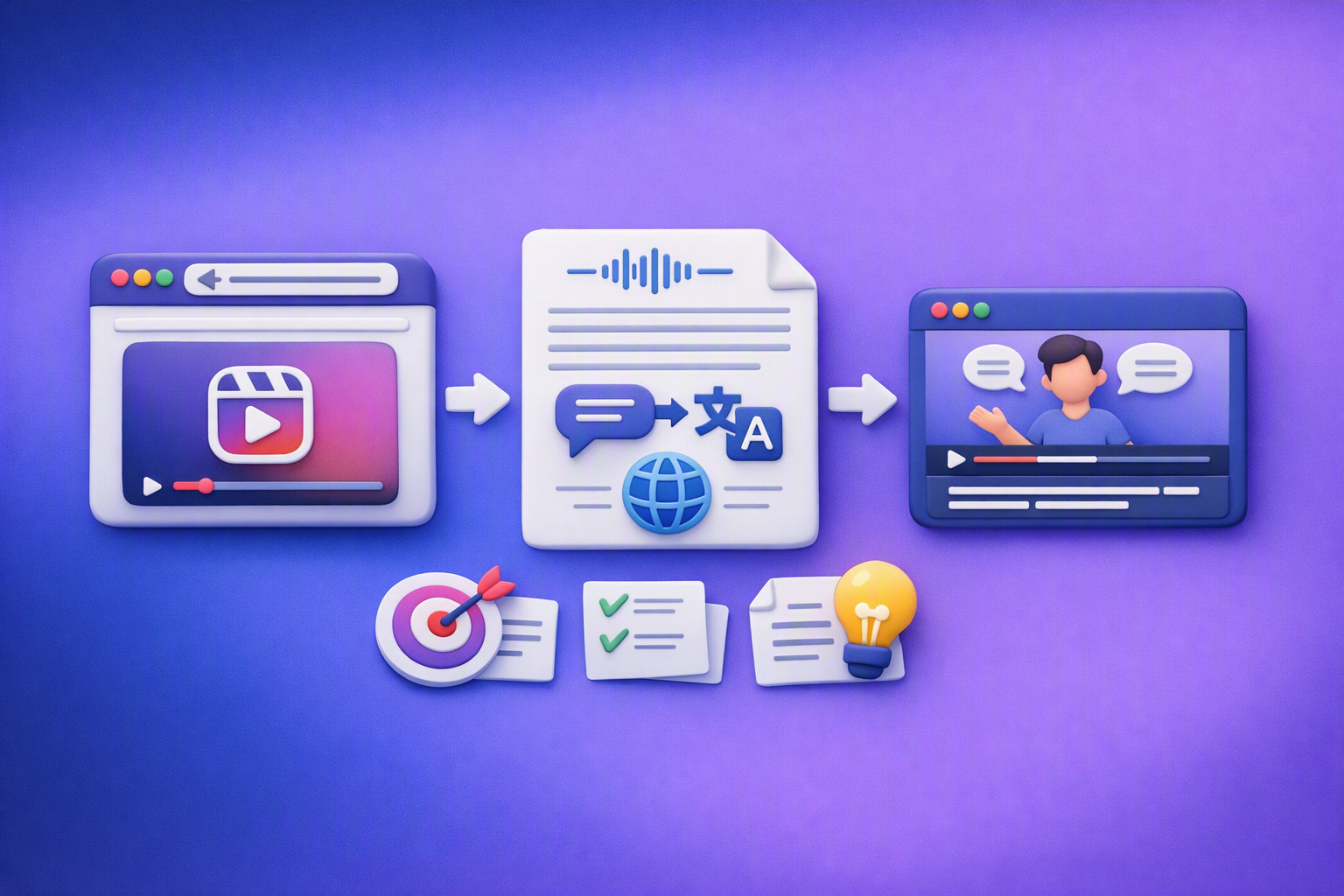
Aprende a traducir un Reel de Instagram con un flujo URL→transcripción→traducción→subtítulos, y a convertir esa traducción en un activo de investigación para hooks, CTAs, objeciones y clusters de contenido.
Reel Analyzer: Transcript‑First Instagram Reels Research (Hooks, CTAs, Objections) + Workflow Guide (VideoToTextAI)
Video To Text AI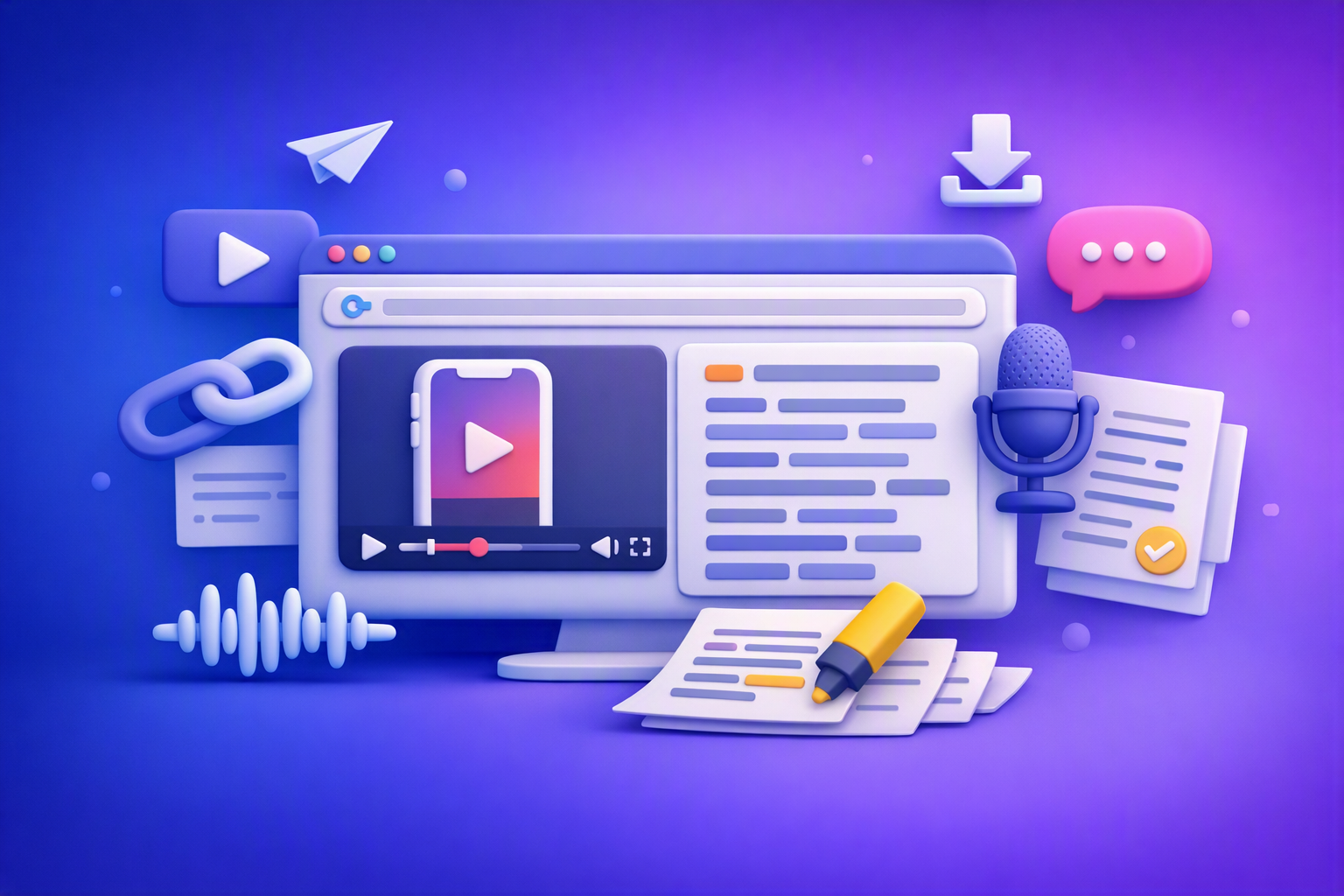
A reel analyzer should turn any public Instagram Reel link into a searchable transcript library you can mine for hooks, CTAs, objections, and topic clusters—then repurpose into original drafts with a repeatable SOP.