
ChatGPT “Upload Video” Feature: What Works, Why Uploads Fail, and the Production-Safe Link → Transcript Workflow (VideoToTextAI)
 Video To Text AI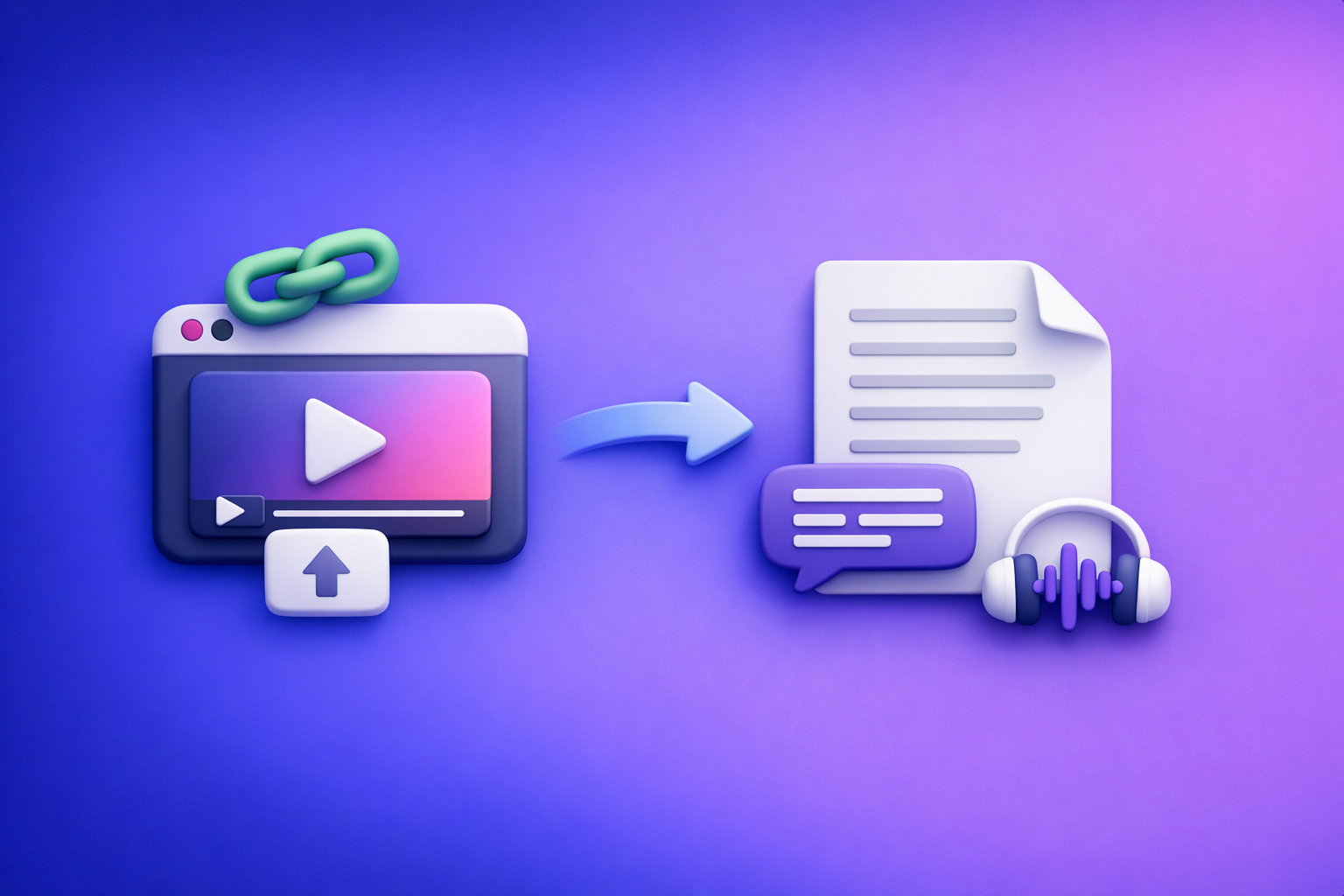
ChatGPT “Upload Video” Feature: What Works, Why Uploads Fail, and the Production-Safe Link → Transcript Workflow (VideoToTextAI)
If you need a transcript, captions, and repurposed content reliably, don’t bet your workflow on ChatGPT video uploads. Use a link → transcript/captions pipeline to generate deterministic artifacts (TXT + SRT/VTT), then use ChatGPT on the text.
What people mean by “ChatGPT upload video” (3 different capabilities)
“Upload video to ChatGPT” is overloaded. People usually mean one of these three things, and each has different failure modes.
1) Uploading a video file (MP4/MOV) into ChatGPT
This is the classic “paperclip/attachment” expectation: attach an MP4/MOV and ask for a transcript, summary, or analysis.
In practice, file upload availability and limits vary, and long videos often time out or fail processing.
2) Pasting a video link (YouTube/Drive/Instagram/TikTok) for analysis
Many users paste a link and expect ChatGPT to “open” it.
This often fails due to permissions, login walls, geo restrictions, expiring share URLs, or platform anti-bot controls.
3) “Watching” video vs. extracting audio/transcript vs. analyzing frames
These are different tasks:
- Transcription: convert speech to text (best handled by a transcript workflow).
- Captioning: timecode text to video (SRT/VTT).
- Visual analysis: interpret frames, on-screen text, scenes (harder, more compute, more failure points).
- Content repurposing: summaries, hooks, chapters, posts (best done from clean transcript text).
For most creator and marketing workflows, you don’t need “watching.” You need accurate text artifacts.
Quick answer: Can ChatGPT upload and analyze video reliably in 2026?
Not reliably enough for production. It can work for short, simple clips, but it’s inconsistent across devices and media types.
When it works (best-fit use cases)
ChatGPT video upload/link analysis tends to work best when:
- The clip is short (minutes, not hours).
- The file is a common MP4 with standard encoding.
- The content is clear audio, minimal background noise.
- You’re doing light analysis (summary, high-level notes), not deliverable-grade captions.
When it fails (most common real-world scenarios)
Expect failures when:
- Videos are long, high bitrate, or large file size.
- You’re on mobile and the app backgrounds mid-upload.
- The link is private, requires login, or is geo-restricted.
- The platform blocks automated fetching (common with social links).
- You need timecoded captions that must stay in sync after edits.
What to use ChatGPT for vs. what to offload to a transcript/caption workflow
Use ChatGPT for:
- Summaries, outlines, chapters, titles, hooks
- Repurposed posts and drafts
- Extracting key quotes and “clip moments”
- Structuring content into tables/checklists
Offload to a transcript/caption workflow for:
- Transcripts you can ship (TXT)
- Captions you can upload (SRT/VTT)
- Repeatable processing from links (not downloads)
Brand POV (and the reality for teams): Downloading video files is an outdated workflow. Link-based extraction is the future of creator productivity because it reduces friction, avoids re-uploads, and scales across sources.
Requirements & limits that cause most failures (before you troubleshoot)
Most “ChatGPT video upload failed” issues aren’t mysterious. They’re predictable constraints.
Account/client availability (plan, region, rollout, web vs. iOS vs. Android)
Common blockers:
- The upload tool isn’t enabled for your account or region.
- The feature exists on web but not your mobile client (or vice versa).
- The model/tool selection doesn’t support the media input you’re trying.
File constraints (size, duration, codec/container, bitrate)
Even “supported” formats can fail due to encoding details.
Typical failure triggers:
- Very large files (size caps vary).
- Long duration videos (processing timeouts).
- Non-standard codecs/containers (e.g., unusual MOV variants).
- High bitrate exports (4K screen recordings can be huge).
Link constraints (permissions, geo-restrictions, login walls, expiring URLs)
If ChatGPT can’t fetch the link, it can’t analyze it.
Watch for:
- “Anyone with the link” not actually enabled
- Google Drive links requiring login
- Instagram/TikTok links that require session cookies
- YouTube videos blocked by region or age gate
- Expiring signed URLs from file-sharing tools
Network + processing constraints (timeouts, stalled uploads, backgrounding on mobile)
Real-world issues:
- Mobile app backgrounding pauses uploads.
- Corporate networks block large uploads.
- Unstable Wi‑Fi causes partial uploads and processing failures.
Step-by-step: Production-safe workflow (Video link/MP4 → TXT + SRT/VTT → ChatGPT-on-text)
This workflow is “artifact-first”: you generate deliverables (transcript + captions) before you ask ChatGPT to do creative/strategic work.
Step 1 — Choose input type (link vs. file) based on where the video lives
Default to links whenever possible. Downloading and re-uploading is friction you don’t need.
Link inputs: YouTube, TikTok, Instagram/Reels, public hosted URLs
Use link inputs when the video already exists online:
- YouTube videos (public/unlisted)
- TikTok links
- Instagram Reels links
- Public MP4 URLs on your site/CDN
Relevant tools and guides:
File inputs: MP4/MOV from camera roll, exports, screen recordings
Use file inputs when the video is local-only:
- Camera roll clips
- Final exports from Premiere/Final Cut/CapCut
- Screen recordings
If you’re starting from a file, keep it simple and standard:
- MP4 container
- H.264 video + AAC audio (widest compatibility)
Helpful tools:
Step 2 — Generate transcript + captions in VideoToTextAI (artifact-first)
Generate two artifacts:
- Clean TXT transcript (for editing, search, repurposing)
- Timecoded SRT/VTT (for platform caption uploads)
This is the key production shift: stop treating transcription as something ChatGPT “might” do and start treating it as a deterministic output you control.
If you want the fastest path from link to deliverables, use VideoToTextAI: VideoToTextAI
Output targets: clean TXT transcript + timecoded SRT/VTT
Aim for:
- A readable transcript with paragraphs and speaker turns (when applicable)
- Captions that match the audio timing and segment lengths
When to generate both SRT and VTT (platform-specific needs)
Generate both when you publish across platforms:
- SRT: widely accepted (YouTube and many editors)
- VTT: common for web players and some platforms/workflows
If you’re unsure, export both. It’s cheap insurance.
Step 3 — QA the artifacts (what to check in 5 minutes)
Do a quick QA pass before you hand anything to ChatGPT or upload captions.
Check:
- Names/terms: product names, acronyms, people, locations
- Speaker turns: are speakers separated logically?
- Punctuation: does it read like written language?
- Timestamp drift: do captions slowly fall out of sync?
- Missing sections: intros/outros, Q&A segments, quiet parts
This QA step prevents shipping broken captions and prevents ChatGPT from amplifying transcript errors.
Step 4 — Use ChatGPT on the text (what it’s best at)
Once you have a transcript, ChatGPT becomes extremely reliable—because you’re giving it the exact input.
Use it for:
- Summaries and key takeaways
- Chapters with timestamps
- Titles, hooks, and descriptions
- Cut lists (best clip moments)
- Repurposed posts (LinkedIn, X threads, newsletters)
- Blog drafts and SEO structure
Prompts for: summary, chapters, titles, hooks, cut list, repurposed posts
Copy-paste prompt templates:
A) Summary + key takeaways
Use only the provided transcript. Write: (1) a 5-bullet executive summary, (2) 10 key takeaways, and (3) 5 “quotable lines.” If you reference a point, cite the closest timestamp.
B) Chapters (YouTube-style)
Use only the provided transcript. Create 8–12 chapters in the format
MM:SS Title. Titles must be specific and action-oriented. Cite timestamps from the transcript.
C) Cut list for short clips
Use only the provided transcript. Identify 10 short-clip moments (15–45 seconds). For each: start timestamp, end timestamp, clip title, and why it will perform.
D) Repurposed LinkedIn post
Use only the provided transcript. Write 1 LinkedIn post (120–220 words) with: strong first line hook, 3–5 bullets, and a practical takeaway. Cite 2 timestamps as sources.
Prompt pattern: “Use only the provided transcript; cite timestamps”
This pattern reduces hallucinations and keeps outputs auditable.
Step 5 — Export + publish (deliverables you can ship)
Now you have outputs that map to real publishing steps.
Captions: SRT/VTT upload to YouTube/LinkedIn/IG
- Upload SRT/VTT directly in platform caption settings.
- Keep the transcript as your “source of truth” for future edits.
Content repurposing: blog draft, LinkedIn post, tweet thread, newsletter
Use the transcript as the canonical input for:
- Blog posts
- Email newsletters
- Social posts
- Sales enablement snippets
- Knowledge base articles
Implementation walkthrough (10–15 minutes): One video → transcript, captions, and repurposed content
This is a realistic “single sitting” workflow for creators and marketing teams.
Goal & inputs
Goal: produce three shippable deliverables from one video.
Inputs (choose one):
- A YouTube link, or
- An MP4 export of your final cut
Deliverable 1: Export-ready transcript (TXT)
Process:
- Generate transcript from the link/MP4.
- Skim the first 2 minutes and a random middle section.
- Fix obvious proper nouns (brand, product, guest names).
- Save as TXT for editing and reuse.
Outcome: a transcript you can paste into docs, CMS, or ChatGPT.
Deliverable 2: Captions (SRT/VTT) that stay in sync
Process:
- Export SRT and VTT.
- Spot-check sync at:
- 00:30
- midpoint
- last 30 seconds
- If you see drift, regenerate from the final cut (don’t “patch” timestamps manually unless you must).
Outcome: captions you can upload without embarrassment.
Deliverable 3: Repurposed assets generated from the transcript in ChatGPT
Use your transcript as the only source.
Blog outline + draft
Prompt:
Use only the provided transcript. Create an SEO blog outline with H2/H3s, then draft the post in a concise, implementation-focused style. Include a short checklist and a “common mistakes” section. Cite timestamps for key claims.
LinkedIn post + hooks
Prompt:
Use only the provided transcript. Write 5 alternative hooks (1 sentence each) and 1 LinkedIn post. Keep it practical and avoid hype. Cite timestamps.
Short clip timestamps + titles
Prompt:
Use only the provided transcript. Provide 10 clip candidates with start/end timestamps and a punchy title for each. Prioritize moments with strong opinions, steps, or surprising facts.
Troubleshooting: “ChatGPT video upload failed” (fixes by symptom)
Use this when you’re tempted to keep retrying uploads.
Symptom: No upload button / can’t attach video
Checks: client (web/iOS/Android), model/tool availability, account state
- Confirm you’re on the correct client (web vs iOS vs Android).
- Confirm the selected model/tool supports attachments.
- Log out/in and check if the feature is rolled out to your account.
Workaround: switch to link/MP4 → transcript workflow (skip native upload)
If the button isn’t there, stop burning time. Generate TXT + SRT/VTT first, then use ChatGPT on the text.
Symptom: Upload stuck / processing failed / timeouts
Fixes: smaller clip, re-encode MP4 (H.264/AAC), stable network, desktop upload
Try:
- Upload a shorter segment to validate the pipeline.
- Re-encode to MP4 (H.264/AAC).
- Use desktop + stable wired/Wi‑Fi.
Production workaround: generate TXT + SRT/VTT first, then use ChatGPT on text
This avoids the “one big upload” failure point entirely.
Symptom: “Failed to fetch” / “403” / ChatGPT can’t access my link
Fixes: make link public, remove login wall, avoid expiring share links
- Make the video truly public/unlisted (no login required).
- Avoid expiring Drive links or signed URLs.
- Check geo/age restrictions.
Workaround: paste transcript instead of relying on link access
If link access is unreliable, text is portable. Paste the transcript.
Symptom: Output is incomplete or inaccurate (missing words, wrong names)
Fixes: regenerate transcript, add domain terms, QA pass on artifacts
- Regenerate with improved settings (language, speaker handling).
- Add a glossary of domain terms (product names, acronyms).
- Do a quick QA pass before repurposing.
Best practice: treat ChatGPT as post-processor, not the transcription source
ChatGPT is excellent at shaping text. It’s not the most reliable place to originate your transcription deliverables.
Symptom: Captions out of sync after editing the video
Fixes: re-export captions from the final cut; avoid editing after captioning
If you change timing, your captions will drift. That’s normal.
Workflow: finalize edit → generate SRT/VTT → upload
Lock picture first. Caption second.
Checklist: Use this instead of trying to “upload video to ChatGPT”
Input readiness checklist (link/file)
- Link is public/unlisted and accessible without login
- No geo/age restrictions blocking playback
- If file: MP4 with H.264/AAC
- Video is the final cut (no more timing edits)
Transcript readiness checklist (TXT)
- Proper nouns corrected (names, brands, acronyms)
- Obvious omissions fixed (intro/outro, Q&A)
- Paragraphs/punctuation readable
- Speaker turns reasonable (if multi-speaker)
Caption readiness checklist (SRT/VTT)
- Sync spot-check at start/middle/end
- No timestamp drift
- Line lengths readable (not giant blocks)
- Exported in the format your platform expects
ChatGPT usage checklist (safe prompting on text)
- Prompt says: “Use only the provided transcript”
- Prompt requires timestamp citations
- Output format specified (bullets, tables, chapters)
- You review for claims not supported by transcript
Ship checklist (platform uploads + repurposed outputs)
- Upload SRT/VTT to the platform
- Store TXT transcript as source of truth
- Publish repurposed assets (blog/social/email)
- Save prompts/templates for repeatability
Competitor Gap
What top-ranking pages miss
Most pages ranking for the “chatgpt upload video feature” query focus on “try uploading again” advice. They often skip the production realities:
- Deterministic deliverables (TXT + SRT/VTT) vs. hoping a video upload succeeds
- Link-permission failure modes (403/login walls/geo) with concrete fixes
- A QA step that prevents shipping broken captions/transcripts
What this post adds
- A production-safe, artifact-first workflow that works even when ChatGPT uploads don’t
- Symptom-based troubleshooting mapped to specific fixes and workarounds
- Copy-paste prompt templates that operate on transcripts (not unreliable video access)
For related guidance, see:
- ChatGPT “Upload Video” Feature (2026): How It Works, Why It Fails, and the Reliable Link → Transcript Workflow
- ChatGPT “Upload Video” Feature: What Works, Why Uploads Fail, and the Reliable Link → Transcript Workflow (VideoToTextAI)
FAQ
Does ChatGPT allow you to upload videos?
Sometimes. It depends on client, plan, region, and rollout, and even then uploads can fail due to file size/duration/codec constraints.
For production work, use a transcript-first workflow so you always get shippable artifacts.
Why can’t I upload videos to ChatGPT anymore?
Common reasons:
- The upload tool isn’t available in your client (web vs iOS vs Android).
- Your account/plan/region doesn’t have the feature enabled.
- The file is too large/long or encoded in a way that fails processing.
When this happens, don’t revert to downloading and retrying uploads. Use link-based extraction and work from text.
Can I upload a video to ChatGPT to analyze?
You can try, but it’s not the most reliable path for transcripts/captions. The dependable approach is:
- Generate TXT + SRT/VTT
- Use ChatGPT to analyze and repurpose the transcript
Can you add videos from your camera roll to ChatGPT?
If your client supports attachments, you may be able to select a video from your camera roll. Mobile backgrounding and large files are common failure points, so desktop or transcript-first workflows are safer.
Can you upload videos to ChatGPT for free?
Free access and media capabilities vary over time. Even when “free” uploads are possible, limits are typically tighter, and reliability is lower than an artifact-first transcript workflow.
Related posts
Reel Analyser (Instagram Reels): Transcript‑First Competitor Research, Hook/CTA Extraction, and Repurposing Workflow (VideoToTextAI)
Video To Text AI
A 2026 reel analyser should turn Instagram Reel links into a searchable transcript library you can tag for hooks, CTAs, objections, and topic clusters—then export into repurposing-ready drafts without a download/upload loop.
Traducir video de Instagram (Reels) en 2026: workflow transcript-first para traducir, sacar hooks/CTAs y repurpose (con VideoToTextAI)
Video To Text AI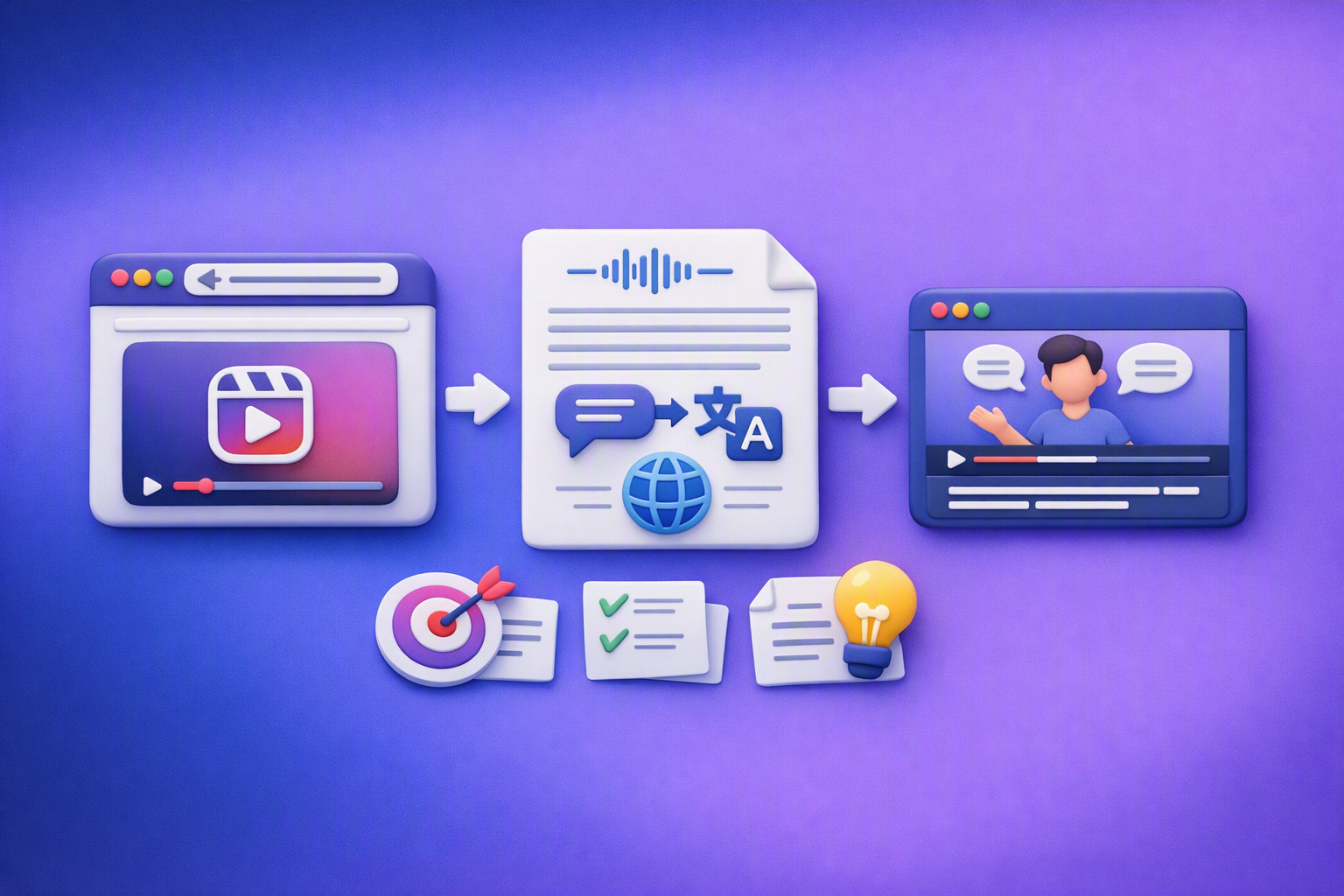
Aprende a traducir un Reel de Instagram con un flujo URL→transcripción→traducción→subtítulos, y a convertir esa traducción en un activo de investigación para hooks, CTAs, objeciones y clusters de contenido.
Reel Analyzer: Transcript‑First Instagram Reels Research (Hooks, CTAs, Objections) + Workflow Guide (VideoToTextAI)
Video To Text AI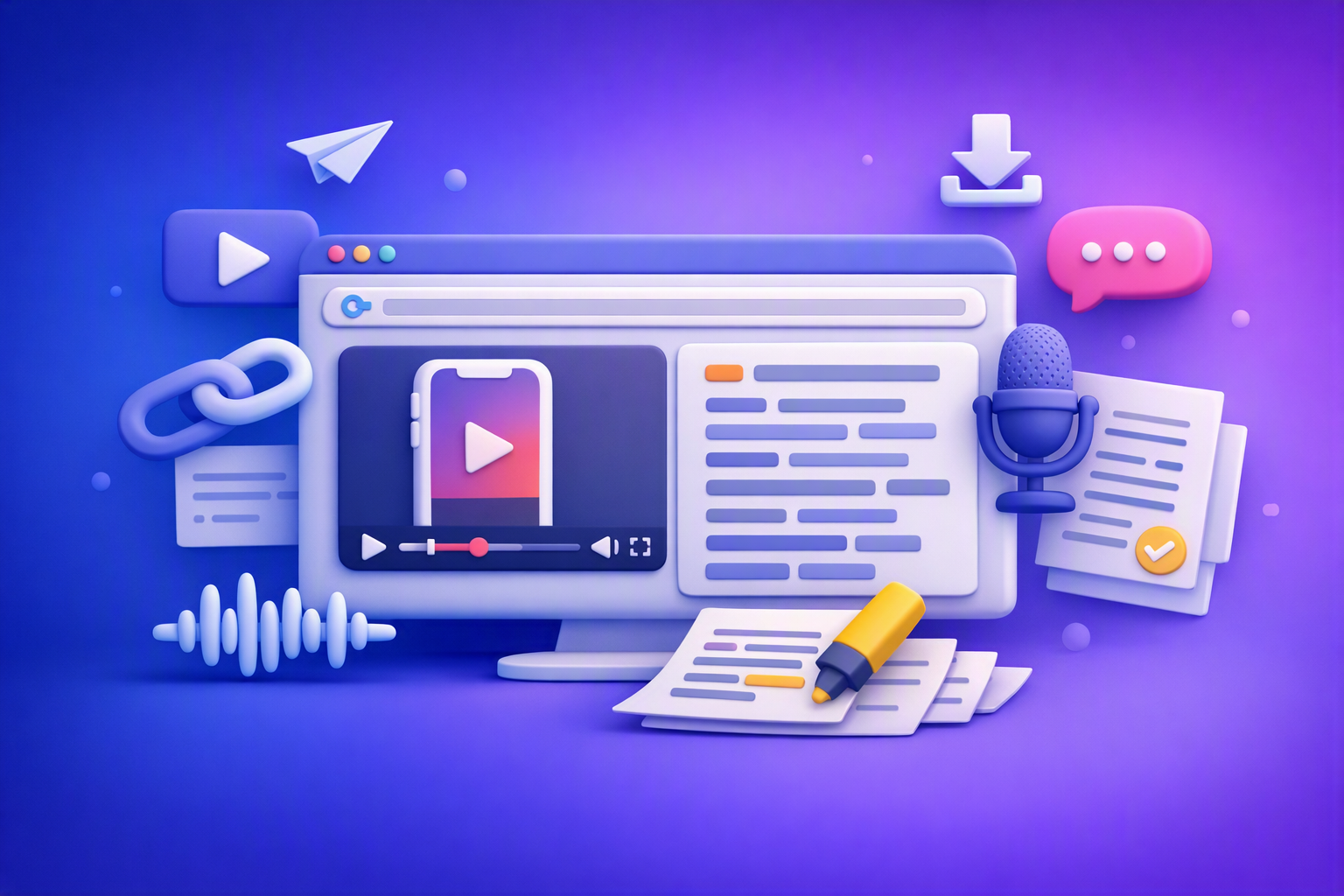
A reel analyzer should turn any public Instagram Reel link into a searchable transcript library you can mine for hooks, CTAs, objections, and topic clusters—then repurpose into original drafts with a repeatable SOP.