
ChatGPT “Upload Video” Feature (2026): What Works, Why Uploads Fail, and the Production-Safe Link → Transcript Workflow
 Video To Text AI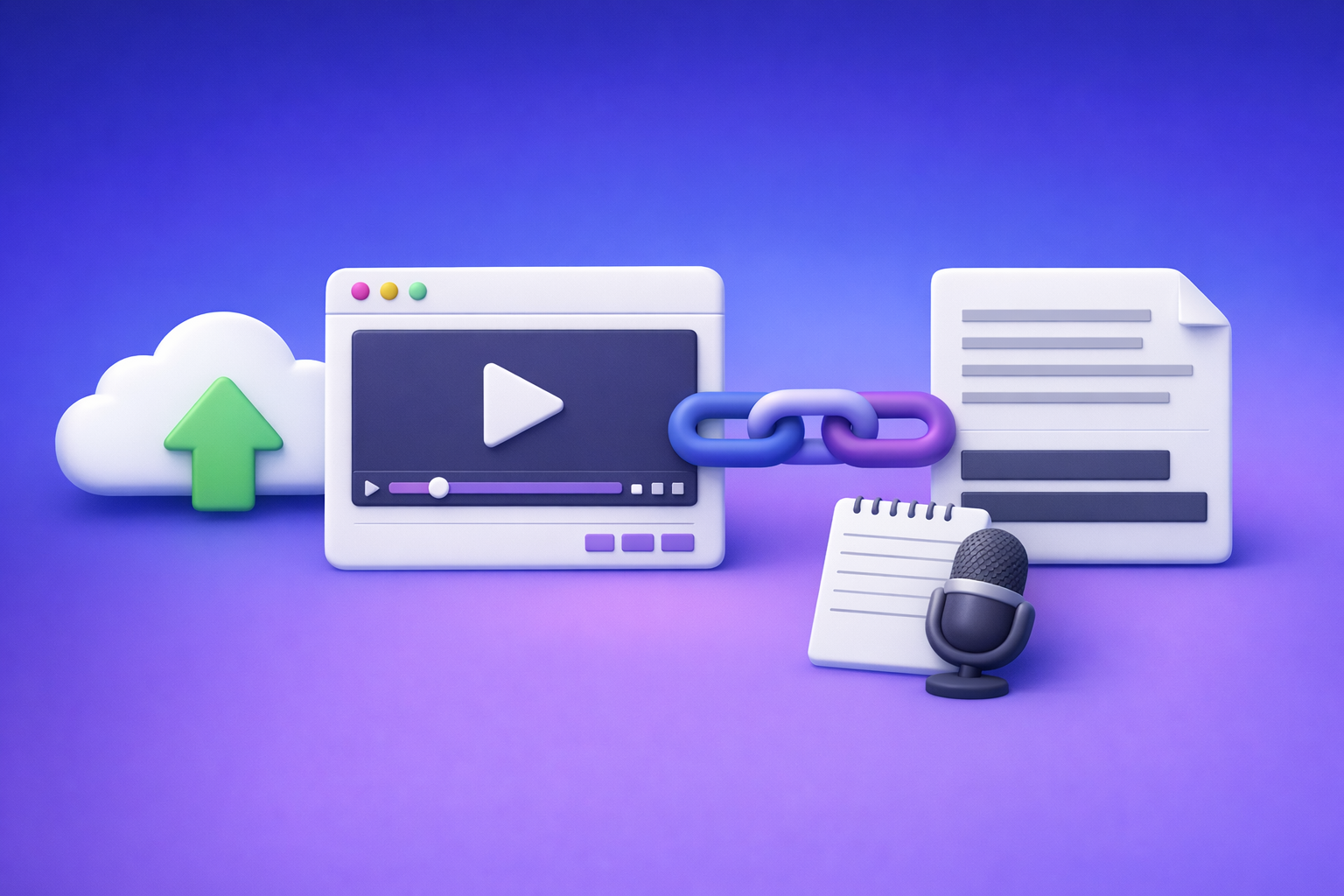
ChatGPT video upload is not a production-safe way to get transcripts, SRT/VTT captions, or repeatable deliverables in 2026. The reliable workflow is video link/MP4 → export-ready transcript/subtitles → ChatGPT-on-text, so you can QA artifacts and ship consistent outputs.
Who this is for (and what you’ll get)
If you’re trying to…
- Upload an MP4/MOV directly into ChatGPT
- Share a YouTube/Drive/Dropbox link for analysis
- Get a transcript, SRT/VTT captions, chapters, summaries, or repurposed content
What this guide delivers
- A clear definition of what “upload video” means in ChatGPT (and what it does not guarantee)
- A failure-mode map + fast triage
- A production-safe workflow: video link/MP4 → export-ready transcript/subtitles → ChatGPT-on-text
- Step-by-step implementation + copy/paste checklists and prompt blocks
Quick answer: Can ChatGPT upload and understand videos?
The reliable truth (not marketing)
- ChatGPT video ingestion is inconsistent across clients, plans, rollouts, codecs, and file sizes.
- Even when upload works, export-ready transcripts/captions are not deterministic (timecodes, speaker labels, and completeness vary).
When ChatGPT video upload is “good enough”
- Short clips
- Low-stakes Q&A about visible content
- Quick “what’s happening here?” checks
When it’s the wrong tool
- Long-form transcription
- Accurate SRT/VTT captions you can publish
- Repeatable team workflows (SOPs, handoffs, QA)
- Compliance-sensitive content where you need auditable artifacts
What people mean by “ChatGPT upload video feature”
1) File upload (MP4/MOV) inside ChatGPT
What users expect:
- “Watch this and transcribe it.”
- “Give me captions and chapters.”
What often happens:
- Timeouts or partial processing
- Unsupported codec/container edge cases
- Inconsistent outputs that can’t be exported cleanly
2) Link sharing (YouTube/Drive/Dropbox)
What users expect:
- “Open this link and summarize.”
What often happens:
- Access blocked (login wall)
- 403/permission errors
- Geo restrictions or expiring tokens
3) “Analyze my video” vs “generate deliverables”
Analysis (often feasible):
- Notes, scene descriptions, high-level summary
Deliverables (where reliability matters):
- TXT transcript
- SRT/VTT captions
- Structured assets (chapters, hooks, cut list) tied to timestamps
What works vs. what fails (real constraints in 2026)
What tends to work
- Short duration clips
- Common containers/codecs (varies by client)
- Public links with no auth wall
What fails most often (and why)
Size/duration limits
- Upload caps vary by client and plan.
- Long videos trigger processing timeouts and context/memory constraints.
- Result: incomplete transcripts, missing sections, or “stops halfway.”
Codec/container mismatch
- “MP4” is a container, not a guarantee of compatible encoding.
- A video can be
.mp4and still fail due to audio codec, variable frame rate, or encoding profile.
Client/rollout inconsistencies
- Feature may exist on iOS but not web (or vice versa).
- Rollouts can be gradual; two teammates can see different UI.
Link access failures
- Private Drive/Dropbox links, expiring tokens, restricted sharing settings
- YouTube age/region restrictions
- Result: “can’t access,” 403, or silent failure
Output limitations
Even when ChatGPT “understands” the clip:
- No guaranteed timecodes
- No guaranteed speaker labels
- No guaranteed export-ready SRT/VTT formatting
How to upload a video to ChatGPT (when you still want to try)
If you’re experimenting or doing low-stakes analysis, here’s how to reduce failure rates.
Web app: upload flow
- Open a chat and look for the attachment/paperclip control near the message box.
- Upload MP4/MOV, then prompt with explicit deliverables.
Prompt pattern (reduce ambiguity):
- Goal + constraints + output format
- Example:
- “Analyze this video. Output: (1) 8-bullet summary, (2) 5 key moments with timestamps if available, (3) any unclear sections flagged as UNKNOWN.”
iPhone/iOS: camera roll and file picker notes
Common iOS failure causes:
- App backgrounding during upload
- Cellular network instability
- Very large files from high-res camera settings
- Unsupported encoding from certain camera apps
Mitigations:
- Keep the app foregrounded until processing completes.
- Prefer Wi‑Fi.
- If it fails twice, stop retrying and switch to transcript-first.
Android: file picker notes
Common Android failure causes:
- Storage permission issues
- Large files on slower networks
- Vendor-specific file picker quirks
Mitigations:
- Confirm storage permissions.
- Use Wi‑Fi.
- If processing stalls, switch to transcript-first.
Link-based attempt (YouTube/Drive/Dropbox)
Minimum requirements for a link ChatGPT can access:
- Public (no login required)
- Stable URL (not expiring)
- No geo/age restrictions
If you see “can’t access” or 403:
- Re-check sharing settings in an incognito window.
- If it still fails, don’t keep “trying different prompts.” Extract text from the link and work from artifacts.
The production-safe workflow: Link/MP4 → transcript/subtitles → ChatGPT-on-text (VideoToTextAI)
Downloading video files to “feed the AI” is an outdated workflow. Link-based extraction is the future of creator productivity because it removes file wrangling, reduces failure points, and creates reusable text assets you can QA and ship.
Why this workflow is deterministic
- You generate artifacts you can QA: transcript TXT + captions SRT/VTT.
- You keep a source-of-truth identifier (original URL or filename).
- ChatGPT is used where it’s strongest: transforming text into structured outputs.
If you want the fastest path from link to export-ready text, use VideoToTextAI once here (single CTA): https://videototextai.com
Outputs you can ship (and reuse)
- Transcript (TXT)
- Subtitles/captions (SRT/VTT)
- Chapters + timestamps (derived from transcript timecodes)
- Blog post, LinkedIn post, X thread, hooks, cut list, email draft
Step-by-step implementation (VideoToTextAI → ChatGPT)
Step 1 — Choose your input type
- Video link (YouTube/Instagram/TikTok/etc.)
- Direct MP4 upload (local file)
Recommended tools (internal):
- Link workflows: YouTube to blog
- MP4 workflows: MP4 to transcript, MP4 to SRT, MP4 to VTT
Step 2 — Generate export-ready text with VideoToTextAI
Generate:
- Transcript as TXT
- Captions as SRT or VTT (when publishing video)
Operational rule:
- Keep the original video URL/filename as the source-of-truth identifier in your project notes and file naming.
Step 3 — QA pass (2–5 minutes) before ChatGPT
This step prevents downstream hallucinations and caption errors.
Do:
- Fix proper nouns (names, brands, locations)
- Normalize product names and acronyms
- Spot-check timestamps if shipping captions
- Confirm speaker turns for interviews/podcasts (even basic “Speaker 1 / Speaker 2” helps)
Step 4 — Run ChatGPT on the transcript (copy/paste prompt blocks)
If the transcript is long, paste in sections and ask ChatGPT to wait for the next part.
Prompt: summary + key takeaways (structured)
You are working only from the transcript below. Do not invent details.
If something is unclear, write UNKNOWN.

Output format:
1) 1-paragraph summary (max 90 words)
2) 7 key takeaways (bullets)
3) 5 notable quotes (verbatim, with any timestamps if present in the transcript)

TRANSCRIPT:
[PASTE]
Prompt: chapters with timestamps
Create YouTube-style chapters from this transcript.
Rules:
- Use timestamps exactly as shown in the transcript (do not guess).
- If timestamps are missing for a section, label it UNKNOWN_TIME.
- Output 8–12 chapters, each: "MM:SS — Title" (or UNKNOWN_TIME — Title).

TRANSCRIPT:
[PASTE]
Prompt: cut list (short clips) + suggested titles
Build a cut list for short-form clips from this transcript.
Output a table with columns:
- Clip idea
- Start time
- End time
- Hook (first 1–2 lines)
- Suggested title (max 60 chars)
Rules:
- Use only timestamps present in the transcript; otherwise write UNKNOWN_TIME.
- Prefer clips 20–45 seconds.

TRANSCRIPT:
[PASTE]
Prompt: repurpose into blog post + SEO sections
Turn this transcript into a blog post draft.
Requirements:
- H2/H3 structure
- Add a short intro, then actionable sections
- Include a "Common mistakes" section
- End with a concise checklist
Do not add facts not supported by the transcript; flag gaps as UNKNOWN.

TRANSCRIPT:
[PASTE]
Prompt: captions cleanup rules (line length, punctuation, readability)
Rewrite these captions for readability without changing meaning.
Rules:
- Max 42 characters per line
- Max 2 lines per caption
- Keep punctuation natural
- Do not censor or paraphrase technical terms
Return in the same format (SRT or VTT) as provided.

CAPTIONS:
[PASTE SRT/VTT]
Step 5 — Publish + distribute
- Upload SRT/VTT to your video platform.
- Add chapters to the description.
- Publish repurposed assets derived from the transcript.
- Store transcript + prompts so the workflow is repeatable across your team.
Copy/paste implementation checklist (no skipped steps)
Inputs checklist (before you start)
- Source URL works in an incognito window (if link-based)
- Video language(s) identified
- Desired outputs selected: TXT, SRT, VTT, summary, repurposed content
VideoToTextAI run checklist
- Generate transcript (TXT)
- Export SRT/VTT (if captions needed)
- Save canonical naming:
{channel}_{date}_{title}_{lang}
QA checklist (fast but effective)
- Proper nouns corrected
- Acronyms normalized
- Caption readability check (line breaks, max characters/line)
ChatGPT-on-text checklist
- Paste transcript (or sections) + specify output format
- Require structured output (headings, bullets, table, JSON if needed)
- Ask for UNKNOWN/UNCLEAR flags instead of guessing
Publishing checklist
- Upload SRT/VTT to platform
- Add chapters to description
- Publish repurposed assets with source attribution and links
Troubleshooting: “ChatGPT video upload failed” (fast triage)
If the upload button isn’t there
Likely causes:
- Client mismatch (web vs mobile)
- Plan/rollout differences
Workaround:
- Skip upload and use the transcript-first workflow.
- Start with MP4 to transcript if you only have a local file.
If the file upload fails immediately
Likely causes:
- File too large
- Unsupported codec/container
- Unstable network
Workaround:
- Generate transcript/captions outside ChatGPT:
- Transcript: MP4 to transcript
- Captions: MP4 to SRT or MP4 to VTT
If the link can’t be accessed (403 / permission)
Likely causes:
- Private link or login wall
- Expiring token
- Restricted sharing settings or geo blocks
Workaround:
- Generate transcript from the source link using a link-based tool (then share only text with ChatGPT).
- For YouTube-to-content workflows, use YouTube to blog.
If ChatGPT output is incomplete or inaccurate
Likely causes:
- Hallucinated details
- Missing sections due to partial ingestion
- No timecodes/speaker labels
Workaround:
- Enforce transcript-only constraints:
- “Use only the transcript. Quote-only for claims. Flag UNKNOWN.”
- Split long transcripts into chunks and request a merged outline at the end.
Security & privacy: should you upload videos to ChatGPT?
What not to upload
- Regulated content (health, finance, legal)
- Confidential client footage
- Videos with identifying personal data you can’t share
- Internal product demos under NDA
Safer alternative
- Extract only the needed text (transcript/subtitles).
- Redact sensitive lines before sharing to ChatGPT.
- Keep the original video link/file internal; share only artifacts externally.
Competitor Gap
Most “ChatGPT upload video” posts stop at “try again” advice. This guide includes what production teams actually need:
- A deterministic artifact-first workflow (TXT + SRT/VTT) instead of repeated uploads
- A 2–5 minute QA step that prevents downstream hallucinations and caption defects
- A fast triage map for:
- Missing upload button
- Codec/container issues
- Link access/403
- Partial processing
- Copy/paste checklists + prompt blocks designed for repeatable team production
- A clear separation between video understanding and deliverable generation (transcripts/captions)
Related reading (internal):
- ChatGPT “Upload Video” Feature: What Works, Why Uploads Fail, and the Production-Safe Link → Transcript Workflow (VideoToTextAI)
- ChatGPT “Upload Video” Feature (2026): How It Works, Why It Fails, and the Reliable Link → Transcript Workflow
Recommended VideoToTextAI tools (pick your workflow)
For link-based videos
- YouTube → transcript → content: YouTube to blog
- Instagram → text:
/tools/instagram-to-text - TikTok → transcript:
/tools/tiktok-to-transcript
For MP4 workflows
- MP4 → transcript: MP4 to transcript
- MP4 → SRT captions: MP4 to SRT
- MP4 → VTT captions: MP4 to VTT
FAQ
Does ChatGPT allow you to upload videos?
Sometimes. It depends on your client (web/iOS/Android), plan, rollout status, and the video’s size/codec. Even when it works, it’s not a guaranteed path to export-ready transcripts or captions.
Why can’t I upload videos to ChatGPT anymore?
The most common reasons are feature rollouts changing, client differences (mobile vs web), plan limitations, or file constraints. If the upload control disappears, treat it as non-deterministic and switch to a transcript-first workflow.
Can I upload a video to ChatGPT to analyze?
Yes for short clips and high-level analysis. For deliverables (TXT transcript, SRT/VTT captions, chapters), use artifact-first extraction and then run ChatGPT on the text.
Can you add videos from your camera roll to ChatGPT?
On some iOS clients, yes—via the file picker/camera roll. Uploads often fail when the app backgrounds, the file is large, or the network is unstable.
Can I upload a video to ChatGPT for free?
Free access varies by rollout and client. Even if you can upload for free, reliability and output determinism (especially SRT/VTT) remain the main blockers for production use.
Why does ChatGPT say “video upload failed” or show a 403 error?
“Upload failed” usually points to size/timeouts/codec/network. A 403 typically means the link is not publicly accessible (private Drive/Dropbox, expiring token, geo restriction). The fastest fix is to extract a transcript from the source and work from text artifacts.
Related posts
Reel Analyser (Instagram Reels): Transcript‑First Competitor Research, Hook/CTA Extraction, and Repurposing Workflow (VideoToTextAI)
Video To Text AI
A 2026 reel analyser should turn Instagram Reel links into a searchable transcript library you can tag for hooks, CTAs, objections, and topic clusters—then export into repurposing-ready drafts without a download/upload loop.
Traducir video de Instagram (Reels) en 2026: workflow transcript-first para traducir, sacar hooks/CTAs y repurpose (con VideoToTextAI)
Video To Text AI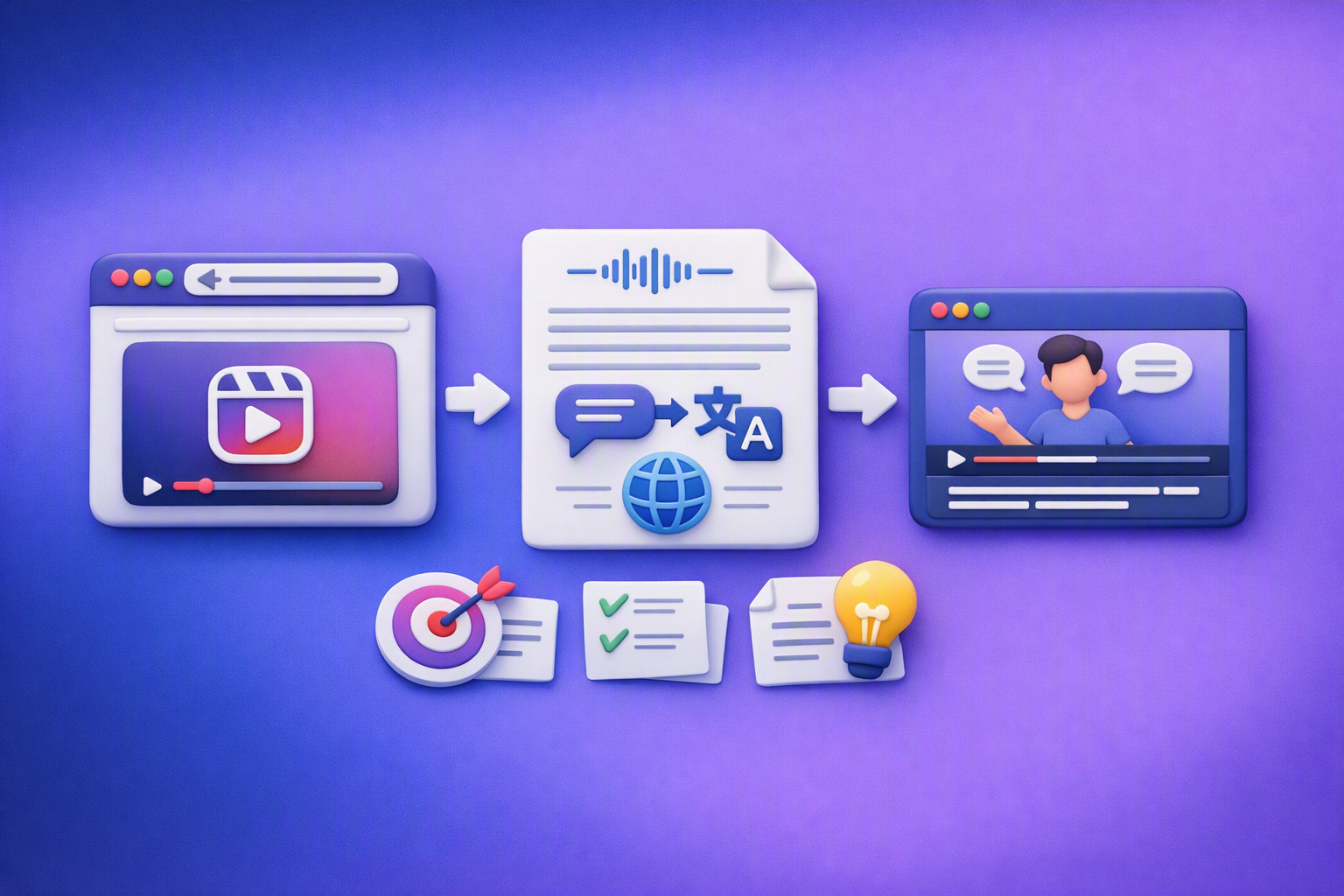
Aprende a traducir un Reel de Instagram con un flujo URL→transcripción→traducción→subtítulos, y a convertir esa traducción en un activo de investigación para hooks, CTAs, objeciones y clusters de contenido.
Reel Analyzer: Transcript‑First Instagram Reels Research (Hooks, CTAs, Objections) + Workflow Guide (VideoToTextAI)
Video To Text AI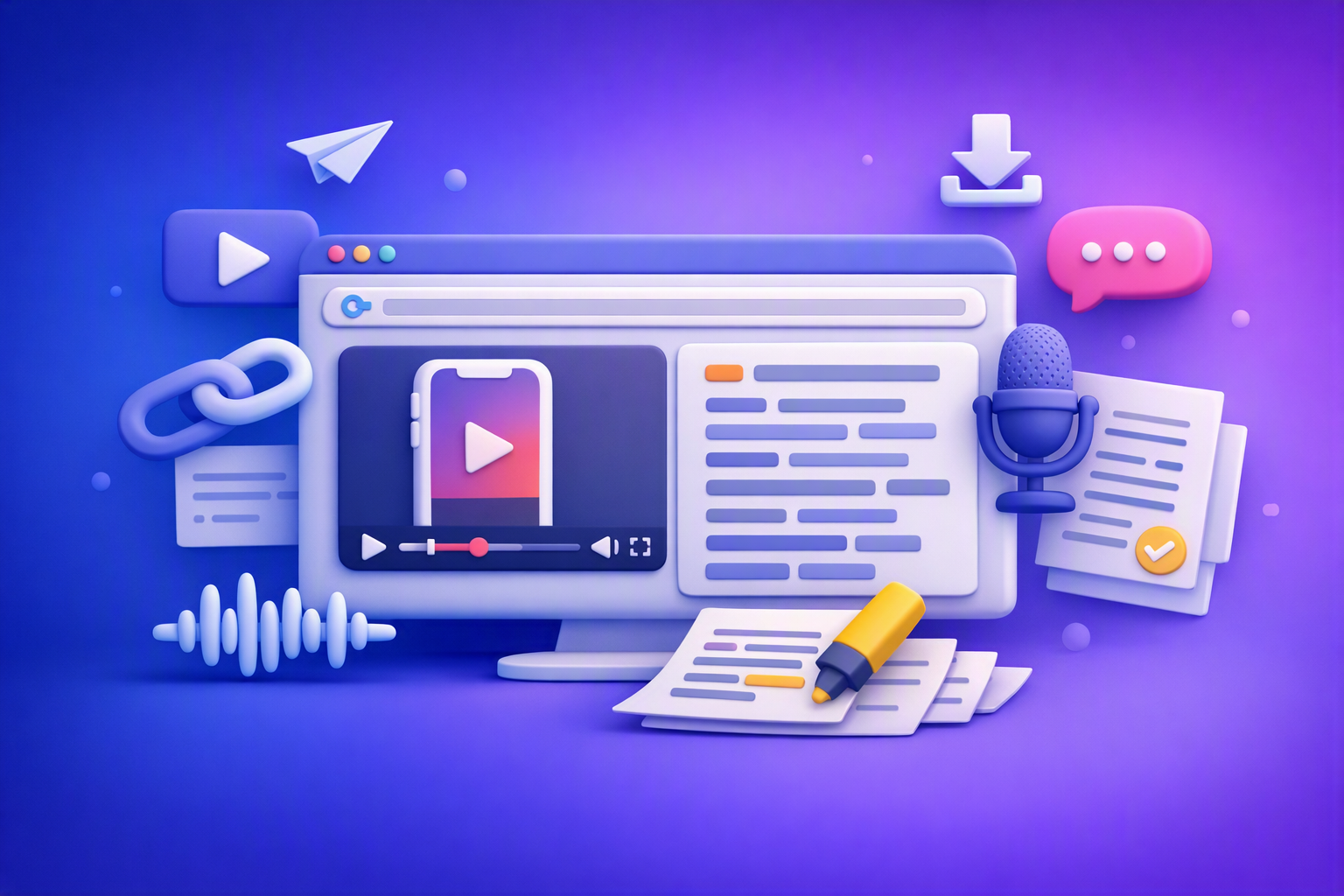
A reel analyzer should turn any public Instagram Reel link into a searchable transcript library you can mine for hooks, CTAs, objections, and topic clusters—then repurpose into original drafts with a repeatable SOP.