
Can ChatGPT Transcribe Videos? What Works in 2026 (and the Reliable Link → Transcript Workflow)
 Video To Text AI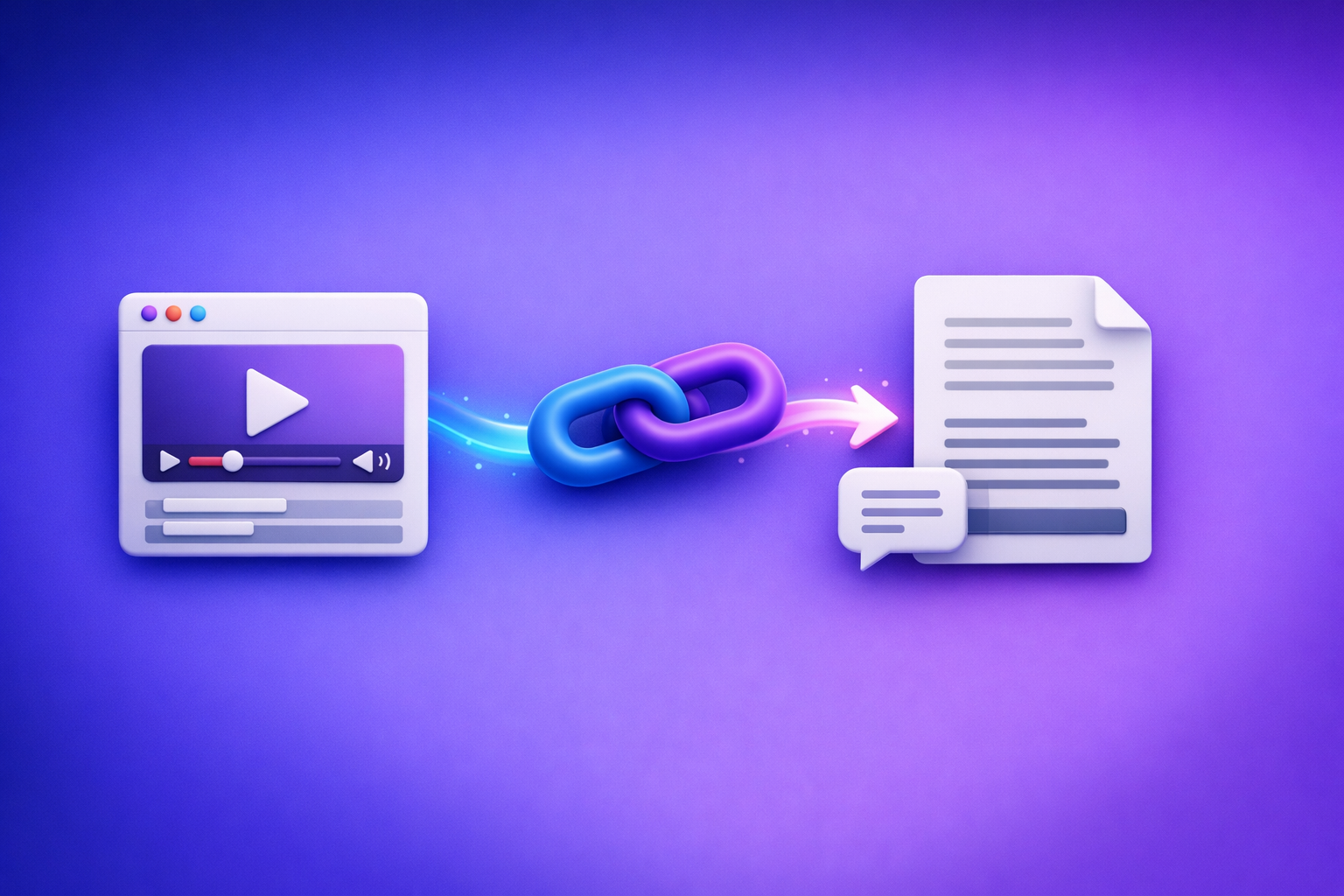
Can ChatGPT Transcribe Videos? What Works in 2026 (and the Reliable Link → Transcript Workflow)
If you need a real transcript or synced subtitles, don’t start by pasting a video link into ChatGPT. Generate an export-ready transcript (TXT) and captions (SRT/VTT) first, then use ChatGPT to clean, structure, and repurpose the text.
Quick Answer: Can ChatGPT Transcribe Videos?
What ChatGPT can do (reliably)
ChatGPT is reliable when it’s working with text that already exists.
Use it for:
- Cleaning transcripts (punctuation, paragraphing, speaker labels)
- Summaries and key takeaways
- Chapters, titles, and descriptions
- Repurposing into blogs, newsletters, and social posts
- Consistency edits (tone, formatting, style guides)
What ChatGPT can’t do (reliably) for video transcription
For production work, ChatGPT is not a dependable “video → transcript” engine because:
- Link access is inconsistent (permissions, geo, login walls)
- Uploads vary by plan/client and can fail silently
- Long videos hit size/duration limits
- Outputs are often non-deterministic (you may not get clean, complete coverage)
- It does not guarantee export-ready subtitle files (SRT/VTT with correct timing)
If you need captions that actually sync, you need a workflow that produces timestamps deterministically.
The production-grade workflow (recommended)
Video link/MP4 → transcript/subtitles (TXT/SRT/VTT) → ChatGPT for cleanup + repurposing
This is the fastest path to:
- Accurate text you can edit
- Captions you can upload
- Content assets you can publish
It also matches where creator productivity is going: link-based extraction. Downloading video files is an outdated workflow that adds friction, duplicates storage, and slows teams down.
How Video Transcription Actually Works (So You Don’t Waste Time)
“Transcription” vs “summarization” vs “captioning”
These are different deliverables, and mixing them up causes most “why didn’t it work?” moments.
- Transcription: word-for-word text of what’s spoken (often exported as TXT).
- Summarization: condensed meaning (bullets, paragraphs, action items).
- Captioning/Subtitles: timed text that syncs to audio (exported as SRT or VTT).
ChatGPT is great at summarization and rewriting. Transcription and caption timing require a tool that’s designed to output structured, timestamped files.
Why “paste a link into ChatGPT” usually fails
Access/permissions
Many video URLs require:
- Login sessions
- Private permissions
- Region access
- Platform-specific tokens
If the model can’t access the media, it can’t transcribe it.
File size/duration limits
Even when upload is available, long-form content (podcasts, webinars, courses) often exceeds practical limits.
Inconsistent upload support across clients/plans
What works in one environment may fail in another:
- Desktop vs mobile differences
- Plan-level feature differences
- Temporary outages or throttling
Non-deterministic outputs (no export-ready SRT/VTT guarantees)
Even if you get “a transcript,” you may not get:
- Complete coverage end-to-end
- Stable formatting
- Proper timestamps
- A valid SRT/VTT structure you can upload
Option A: Use ChatGPT After You Generate a Transcript (Best Practice)
Step-by-step: Link/MP4 → transcript → ChatGPT
-
Get a shareable video link (YouTube, TikTok, Instagram, Drive, etc.) or download MP4 if you must.
If you’re still downloading everything by default, you’re adding unnecessary steps—link-based workflows are the future. -
Generate transcript + timestamps and export TXT + SRT/VTT.
TXT is for editing and repurposing; SRT/VTT is for synced captions. -
Paste transcript into ChatGPT for:
- cleanup (speaker labels, punctuation)
- chapters + titles
- summaries + key takeaways
- repurposed assets (blog, LinkedIn, X, email)
-
QA pass: compare against audio for names, numbers, and jargon.
Spot-checking beats “trusting the model” every time. -
Publish: upload SRT/VTT to your platform and store TXT in your knowledge base.
This creates a reusable content library.
What to ask ChatGPT (copy/paste prompts)
Use these prompts after you have a transcript (TXT) or captions (SRT/VTT).
Prompt: Clean transcript without changing meaning
You are editing a transcript. Clean punctuation, fix obvious mis-hearings, and add paragraph breaks.
Do NOT change meaning or add new information.
Keep technical terms as-is. If a word is uncertain, mark it as [unclear].
Return the cleaned transcript in plain text.
Prompt: Create chapters with timestamps (from SRT/VTT)
Create 6–12 chapters from this SRT/VTT caption file.
Use the existing timestamps to pick a start time for each chapter.
Output as:
- 00:00 Title — 1 sentence summary
Keep titles short and specific.
Prompt: Turn transcript into a blog outline + draft
Turn this transcript into:
1) An SEO blog outline (H2/H3) targeting the keyword: "can chat gpt transcribe videos"
2) A 900–1200 word draft in a direct, practical tone
Include a short FAQ and a checklist.
Do not invent facts not present in the transcript.
Prompt: Extract quotes, hooks, and social posts
From this transcript, extract:
- 10 quotable lines (max 140 characters each)
- 10 scroll-stopping hooks (1 sentence each)
- 3 LinkedIn posts (120–180 words)
- 1 X thread (8–12 tweets)
Keep claims grounded in the transcript.
Option B: Can You Upload a Video to ChatGPT Directly?
When it might work
It might work when:
- The video is short
- The client you’re using supports video upload
- The audio is clean (single speaker, minimal noise)
- You don’t need export-ready SRT/VTT
This is best treated as a convenience feature, not a production workflow.
When it won’t (common failure modes)
Expect issues when:
- The file is large or long
- The upload stalls or errors
- The output is partial or missing sections
- You need synced captions with correct timing
- You must meet compliance requirements (repeatable outputs, consistent formatting)
What to do instead (fast fallback)
Convert video → transcript/subtitles first, then use ChatGPT on text.
If your goal is “captions I can upload,” start with a tool that exports SRT/VTT deterministically.
The Reliable Workflow with VideoToTextAI (Link-Based, Export-Ready)
VideoToTextAI is built for AI link-based video-to-text workflows—the modern alternative to downloading and re-uploading files across tools.
Step-by-step: Transcribe a video link with VideoToTextAI
- Paste the video URL (or upload MP4 if needed).
- Choose output(s): TXT, SRT, VTT (and language if needed).
- Generate transcript + subtitles.
- Download exports and reuse everywhere.
This is the workflow that scales for creators and teams because it’s link-first. Downloading video files as the default is outdated: it wastes time, creates version sprawl, and slows repurposing.
Use it here: https://videototextai.com
Step-by-step: Turn the transcript into content assets
Once you have TXT/SRT/VTT, you can generate:
- Blog post (outline → draft → publish)
- LinkedIn post (insight + story + CTA)
- X thread (hooks + bullets + recap)
- Summary + action items (for teams)
- Multilingual versions (translate after transcription, then QA)
For a direct repurposing path, see: youtube to blog
Recommended outputs by use case
Pick outputs based on where the text will live:
- YouTube captions: SRT or VTT
(If you’re unsure, start with SRT.) - Website transcript: TXT
(Clean, readable, indexable.) - Editing workflows: SRT with timestamps
(Great for finding moments and cutting clips.) - Repurposing: TXT + summary
(TXT is the source of truth; summary is the distribution layer.)
Related tools:
Troubleshooting: Why Your “ChatGPT Transcribe Video” Attempt Isn’t Working
Problem: “I pasted a YouTube link and it didn’t transcribe”
Why it happens: ChatGPT may not have access to fetch and process that media link.
Fix: Generate a transcript from the link, then paste the text into ChatGPT.
If your end goal is captions, generate SRT/VTT first.
Problem: “Upload fails / file too large / takes forever”
Why it happens: Upload constraints and long video processing are common failure points.
Fix options:
- Use link-based transcription instead of uploading files
- If you must use MP4, split the file into smaller segments
- Prefer clean audio (noise reduction, single channel) to speed processing and improve accuracy
Problem: “Transcript is inaccurate”
Why it happens: Poor audio, overlapping speakers, accents, and domain jargon reduce accuracy.
Fixes:
- Improve audio: consistent mic distance, reduce background noise, avoid music beds
- Add domain terms/names during cleanup (create a “terms list” you paste into ChatGPT)
- Run a QA checklist (below) before publishing
Problem: “I need subtitles that actually sync”
Why it happens: Chat responses aren’t guaranteed to follow strict subtitle formatting or timing rules.
Fix: Export SRT/VTT from a transcription workflow designed for captions, then only use ChatGPT for text-level edits (not timing).
Implementation Checklist (Copy/Paste)
Inputs
- Shareable video link OR MP4 file
- Target language(s)
- Desired outputs: TXT / SRT / VTT
Transcription + Export
- Generate transcript from link/MP4
- Download TXT for editing/repurposing
- Download SRT/VTT for captions/subtitles
QA
- Verify names, numbers, acronyms
- Spot-check 5–10 timestamps across the video
- Confirm speaker changes (if applicable)
Repurposing (optional)
- Chapters + title ideas
- Blog draft + meta description
- 5–10 social hooks + posts
Competitor Gap
Most pages ranking for “can chat gpt transcribe videos” miss the practical details that make workflows succeed in production.
Common competitor miss #1: No deterministic “export-ready” deliverables
Many articles imply “a transcript is a transcript,” but don’t specify deliverables.
Add clarity:
- TXT = editable transcript for web/notes/repurposing
- SRT/VTT = timestamped captions for upload and sync
- “Export-ready” means the file is valid and platform-usable, not just readable text
Common competitor miss #2: No troubleshooting map
Most guides skip the real reasons attempts fail.
You need explicit failure modes and fixes:
- Link access/permissions
- Upload limits and timeouts
- Long-form processing constraints
- Subtitle sync requirements (SRT/VTT)
Common competitor miss #3: No execution templates
High-level advice isn’t enough.
What teams need:
- Copy/paste prompts (cleanup, chapters, repurposing)
- A QA checklist
- A repeatable workflow that starts with link-based extraction, not downloads
FAQ
Can ChatGPT extract text from a video?
Not reliably as a standalone workflow. ChatGPT is best used after you’ve generated a transcript (TXT) or captions (SRT/VTT) using a transcription workflow.
Is there an AI that can transcript a video?
Yes. Use an AI transcription tool that accepts a shareable link and exports TXT/SRT/VTT so you can publish and reuse the output across platforms.
Can you put a video into ChatGPT?
Sometimes, depending on the client and plan, but it’s inconsistent for long videos and doesn’t guarantee synced subtitle exports. For production, use video → transcript/subtitles → ChatGPT.
What’s the best way to transcribe a video?
Use a link-first transcription workflow that exports TXT + SRT/VTT, then use ChatGPT to clean and repurpose the text. This avoids outdated download-heavy processes and keeps creator operations fast.
Internal Link Plan
Related posts
Reel Analyser (Instagram Reels): Transcript‑First Competitor Research, Hook/CTA Extraction, and Repurposing Workflow (VideoToTextAI)
Video To Text AI
A 2026 reel analyser should turn Instagram Reel links into a searchable transcript library you can tag for hooks, CTAs, objections, and topic clusters—then export into repurposing-ready drafts without a download/upload loop.
Traducir video de Instagram (Reels) en 2026: workflow transcript-first para traducir, sacar hooks/CTAs y repurpose (con VideoToTextAI)
Video To Text AI
Aprende a traducir un Reel de Instagram con un flujo URL→transcripción→traducción→subtítulos, y a convertir esa traducción en un activo de investigación para hooks, CTAs, objeciones y clusters de contenido.
Reel Analyzer: Transcript‑First Instagram Reels Research (Hooks, CTAs, Objections) + Workflow Guide (VideoToTextAI)
Video To Text AI
A reel analyzer should turn any public Instagram Reel link into a searchable transcript library you can mine for hooks, CTAs, objections, and topic clusters—then repurpose into original drafts with a repeatable SOP.