
Can ChatGPT Upload Video in 2026? What Actually Works (and the Reliable Link → Transcript Workflow)
 Video To Text AI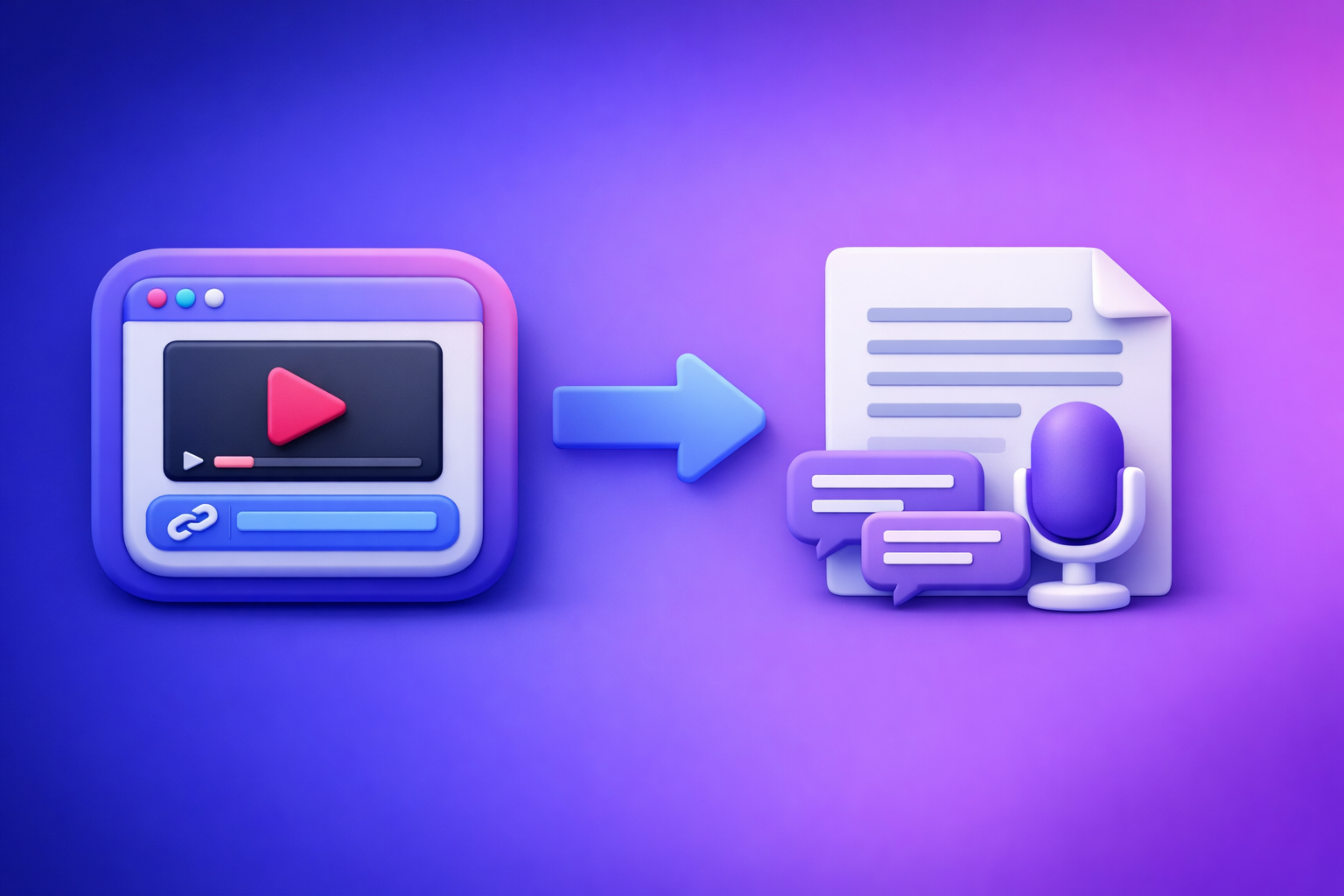
ChatGPT video upload is not a dependable way to transcribe or summarize long videos in 2026. The reliable solution is to convert the video (preferably from a link) into a transcript/subtitles first, then use ChatGPT on the text for chapters, summaries, and repurposed content.
This article explains what “upload video to ChatGPT” really means, why it fails, and the link → transcript → ChatGPT workflow that consistently ships outputs.
Quick Answer (What You Can and Can’t Do)
Can ChatGPT upload video directly?
Sometimes—but not consistently. Depending on your ChatGPT client and plan, you may see options to attach files or media, but video handling is not a stable “upload any MP4 and get a transcript” feature.
If your goal is transcription, treat direct video upload as best-effort, not a production workflow.
When video upload works vs. fails (client, plan, limits)
Video upload (or video-like inputs) tends to be inconsistent because it depends on:
- Client differences: web vs. iOS vs. Android can behave differently.
- Feature rollouts: capabilities can appear/disappear or vary by region/account.
- Limits: file size, duration, and processing timeouts.
- Permissions: private links, restricted content, or DRM.
What ChatGPT can reliably do with video content (once you have text)
Once you have a transcript, ChatGPT is excellent at:
- Summaries (bullets, takeaways, action items)
- Chapters and table of contents
- SEO rewrites (blog posts, landing pages, FAQs)
- Social repurposing (LinkedIn posts, X threads, email drafts)
- Quote extraction and hook generation
The key is simple: models are most reliable on text.
What People Mean by “Upload Video to ChatGPT”
Uploading a local file (MP4/MOV) vs. sharing a link (YouTube/Drive)
Most people mean one of two things:
- Local upload: “Here’s my MP4/MOV—transcribe it.”
- Link share: “Here’s a YouTube/Drive link—analyze/transcribe it.”
In practice, link-based extraction is the future of creator productivity because it avoids the slow, fragile “download → upload → wait” loop and works better across teams and devices.
“Analyze my video” vs. “Transcribe my video” vs. “Summarize my video”
These are different tasks:
- Analyze: interpret visuals, scenes, on-screen text, pacing, structure.
- Transcribe: convert speech to text with timestamps and speaker labels.
- Summarize: compress meaning into bullets, chapters, and takeaways.
ChatGPT can help with all three, but transcription should be deterministic (specialized tool first), then ChatGPT handles the language work.
The practical constraint: models work best on text, not raw video
Raw video is heavy: large files, multiple streams, codecs, and long durations. Text is lightweight, searchable, and easy to transform—so the most reliable workflow is video → text → ChatGPT.
Why ChatGPT Video Uploads Fail (Real-World Causes)
File size, duration, and processing timeouts
Common failure modes:
- Large MP4s exceed upload limits.
- Long videos trigger timeouts or partial processing.
- Slow networks cause stalled uploads.
If you’re working with podcasts, webinars, or interviews, assume direct upload will be unreliable.
Unsupported formats/containers and audio track issues
Even if “MP4” is supported, real-world files vary:
- Unusual codecs or variable frame rate
- Multiple audio tracks
- Corrupted metadata
- Silent or low-volume audio
These issues often look like “upload succeeded” but results are incomplete or wrong.
Policy/permissions problems (private links, DRM, restricted content)
Links fail when:
- The video is private or requires login
- The platform blocks automated access
- The content is DRM-protected or region-restricted
If the tool can’t access it, it can’t process it.
Client differences (web vs. mobile) and feature rollouts
You might see upload options on one device and not another. You can also see different behavior across accounts due to staged releases.
“Video upload failed” troubleshooting signals to look for
Watch for:
- “Upload failed” immediately (format/limit)
- Upload completes but no output (timeout/processing)
- Output stops mid-way (duration cap)
- “Can’t access link” (permissions/login)
When you see these, stop fighting the upload and switch to the deterministic workflow below.
The Reliable Workflow: Video Link/MP4 → Transcript/Subtitles → ChatGPT
Overview: deterministic transcription first, ChatGPT second
Step 1: Generate accurate text outputs (transcript + captions).
Step 2: Use ChatGPT to transform that text into publishable assets.
This separation matters:
- Transcription = accuracy problem
- ChatGPT = language/structure/style problem
What you get at the end (TXT + SRT/VTT + repurposed content)
A production-ready workflow should output:
- Transcript (TXT) for editing, SEO, and reuse
- Captions (SRT/VTT) for publishing and clip editing
- Repurposed content (chapters, summaries, posts, blog drafts)
If you want a deeper companion read, see: Can ChatGPT Transcribe Videos? What Works in 2026 (and the Reliable Link → Transcript Workflow).
Step-by-Step: Turn Any Video Into Text with VideoToTextAI (Then Use ChatGPT)
Downloading video files is an outdated workflow; link-based extraction is faster, cleaner, and more scalable for creators and teams. VideoToTextAI is built around AI link-based video-to-text workflows so you can go from URL → transcript/subtitles → repurposed content without the file-handling overhead.
Use this workflow when your real goal is: transcript, subtitles, captions, summaries, and content repurposing.
Step 1 — Choose your input type (video URL or MP4)
Pick the most direct input:
- Video URL (preferred): fastest, fewer moving parts, easier collaboration
- MP4 upload: use when you truly can’t access a public/accessible link
Supported sources: YouTube, TikTok, Instagram/Reels, podcasts, direct MP4
Common creator workflows map cleanly to tools like:
Step 2 — Generate export-ready outputs in VideoToTextAI
Your baseline deliverables should be export-ready, not “close enough.”
Transcript (TXT) for editing and SEO
Use TXT when you need:
- Blog posts and newsletters
- Searchable archives
- Editing scripts and show notes
- On-page SEO (embedded transcript)
Subtitles/captions (SRT/VTT) for publishing
Export captions when you need:
- Platform uploads (YouTube, LinkedIn, etc.)
- Clip editing with timestamps
- Accessibility compliance
Related tools:
Step 3 — Quality pass: speaker labels, punctuation, and timestamps
Do a fast QA pass before you involve ChatGPT.
- Confirm speaker labels (Speaker 1/2 or names)
- Fix obvious proper nouns (brands, people, locations)
- Ensure punctuation is readable (especially for summaries)
When to keep timestamps vs. remove them
- Keep timestamps when you will:
- Create clips
- Build chapters
- Reference exact moments
- Remove timestamps when you will:
- Draft a blog post
- Create a clean narrative article
How to handle multiple speakers and noisy audio
- If speakers overlap, prioritize speaker separation over perfect punctuation.
- For noisy audio, spot-check accuracy around:
- intros/outros
- Q&A segments
- technical terms
Step 4 — Use ChatGPT for the parts it’s best at (on the transcript)
Once you have clean text, ChatGPT becomes predictable and fast.
Create chapters and a table of contents
Give ChatGPT the transcript (or chunks) and ask for:
- Chapter titles
- Start timestamps (if you kept them)
- 1–2 sentence chapter summaries
Summarize into bullets + key takeaways
Ask for:
- 10-bullet summary
- 5 key takeaways
- Action items (if it’s educational content)
Extract quotes, hooks, and short-form clips (from timestamps)
If you kept timestamps, you can request:
- 5 hooks for short-form intros
- 10 quote pulls with timestamps
- 8–12 clip candidates (15–45 seconds) with start/end times
Rewrite into blog post, LinkedIn post, and X thread
Use the transcript as source-of-truth, then request:
- Blog draft with H2/H3 structure
- LinkedIn post (strong hook + scannable bullets)
- X thread (8–12 tweets, each self-contained)
For a related overview, see: Can ChatGPT Upload Video in 2026? What Works, What Fails, and the Reliable Link → Transcript Workflow.
Step 5 — Publish and reuse outputs across channels
Add captions to the video platform
- Upload SRT/VTT to improve watch time and accessibility.
- Captions also improve comprehension on mute-first feeds.
Embed transcript for accessibility + SEO
- Add the transcript below the video embed.
- Use headings and jump links (chapters) for UX and crawlability.
Repurpose into 3–5 derivative assets
From one video, ship:
- 1 blog post
- 1 email
- 1 LinkedIn post
- 1 X thread
- 3–5 short clips (with caption overlays)
If you want the fastest path from link to outputs, use VideoToTextAI here: https://videototextai.com
Implementation Checklist (Copy/Paste)
Inputs
- Video URL (public/accessible) or MP4 file ready
- Target output(s): transcript, SRT, VTT, summary, blog, social posts
- Language(s) and speaker count (if known)
VideoToTextAI run
- Generate transcript (TXT)
- Export captions (SRT/VTT)
- Verify speaker names (if needed)
- Spot-check 3 segments: start / middle / end for accuracy
- Fix proper nouns (names, brands, product terms)
ChatGPT prompts (run on transcript)
- Chapters + timestamps (if available)
- 10-bullet summary + action items
- 5 hooks + 10 quote pulls
- Blog outline + draft from transcript
Publishing
- Upload SRT/VTT to platform
- Add transcript to page/post
- Create 3 repurposed posts (LinkedIn/X/email)
Common Mistakes (and How to Avoid Them)
Trying to “upload a video link” and expecting a transcript inside ChatGPT
A link is not the same as accessible media. If ChatGPT can’t fetch and process it end-to-end, you’ll get partial or no results.
Fix: Use a link-based transcription workflow first, then bring the text to ChatGPT.
Using private/permissioned links that the tool can’t access
Drive links, unlisted videos with restrictions, and paywalled content often fail.
Fix: Ensure the URL is accessible (or use MP4), and confirm permissions before processing.
Skipping subtitle exports (and losing timestamps for editing)
If you only export a plain transcript, you lose the time alignment needed for clips.
Fix: Always export SRT/VTT alongside TXT.
Not separating transcription from rewriting (accuracy vs. style)
ChatGPT can rewrite beautifully, but it can also introduce errors if it’s forced to “guess” from incomplete media.
Fix: Lock accuracy with a transcript first; then let ChatGPT handle structure and tone.
Troubleshooting: If You Still Need to Use ChatGPT With Video
If your goal is “analysis,” extract frames or a short clip + provide context
For visual feedback (thumbnails, on-screen text, scene critique):
- Provide key frames (screenshots) or a short clip
- Add context: goal, audience, platform, constraints
If your goal is “transcription,” always start with a transcript tool
For anything longer than a short snippet, transcription should be deterministic:
- Generate TXT + SRT/VTT
- Then summarize, chapterize, and rewrite in ChatGPT
If your goal is “editing,” provide the transcript + desired cut list
ChatGPT can help plan edits if you provide:
- Transcript with timestamps
- Your cut rules (remove filler, remove tangents, keep examples)
- Target length and pacing
Competitor Gap
Most pages ranking for “can chat gpt upload video” stop at “it depends” and leave you stuck. A better answer is a deterministic workflow: link/MP4 → transcript/subtitles → ChatGPT.
What competitors typically miss (and what you should implement):
- A step-by-step path with concrete outputs (TXT/SRT/VTT) and what to do with each
- Failure-mode troubleshooting (size, duration, permissions, timeouts, client differences)
- Reusable assets (checklist + prompt set) so the workflow is repeatable
- A modern POV: downloading video files is outdated; link-based extraction is the scalable default for creator productivity
FAQ
Can I upload a recording to ChatGPT?
Sometimes, but it varies by client/plan and can fail on long recordings. For consistent results, generate a transcript and captions first, then use ChatGPT on the text.
Can ChatGPT view video files?
In some product experiences it can interpret limited video-related inputs, but full-length video processing is inconsistent. ChatGPT is most reliable when you provide a transcript.
How do I upload my video?
If your ChatGPT interface supports attachments, you can try uploading an MP4/MOV. If it fails (limits/timeouts), switch to a transcript-first workflow and paste the transcript into ChatGPT.
Can I use ChatGPT for videos?
Yes—best for chapters, summaries, titles, descriptions, hooks, and repurposing once you have text. Use a transcription tool for accurate text extraction first.
Can I upload a video to ChatGPT and get a transcript?
Not reliably in 2026. The dependable approach is: video link/MP4 → transcript + SRT/VTT → ChatGPT for rewriting and repurposing.
Recommended VideoToTextAI Tools (Pick Your Workflow)
MP4-based workflows
MP4 → Transcript
- Use: mp4 to transcript
MP4 → SRT / MP4 → VTT
- Use: mp4 to srt and mp4 to vtt
MP4 → Summary / MP4 → Blog Post
- Practical approach: generate transcript first, then summarize/rewrite from the text (more reliable than “upload and hope”).
Social/video link workflows
TikTok → Transcript
- Use: tiktok to transcript
Instagram → Text / Reel → Post Converter
- Use: instagram to text
YouTube → Blog
- Use: youtube to blog
Internal Link Plan
Related posts
Reel Analyser (Instagram Reels): Transcript‑First Competitor Research, Hook/CTA Extraction, and Repurposing Workflow (VideoToTextAI)
Video To Text AI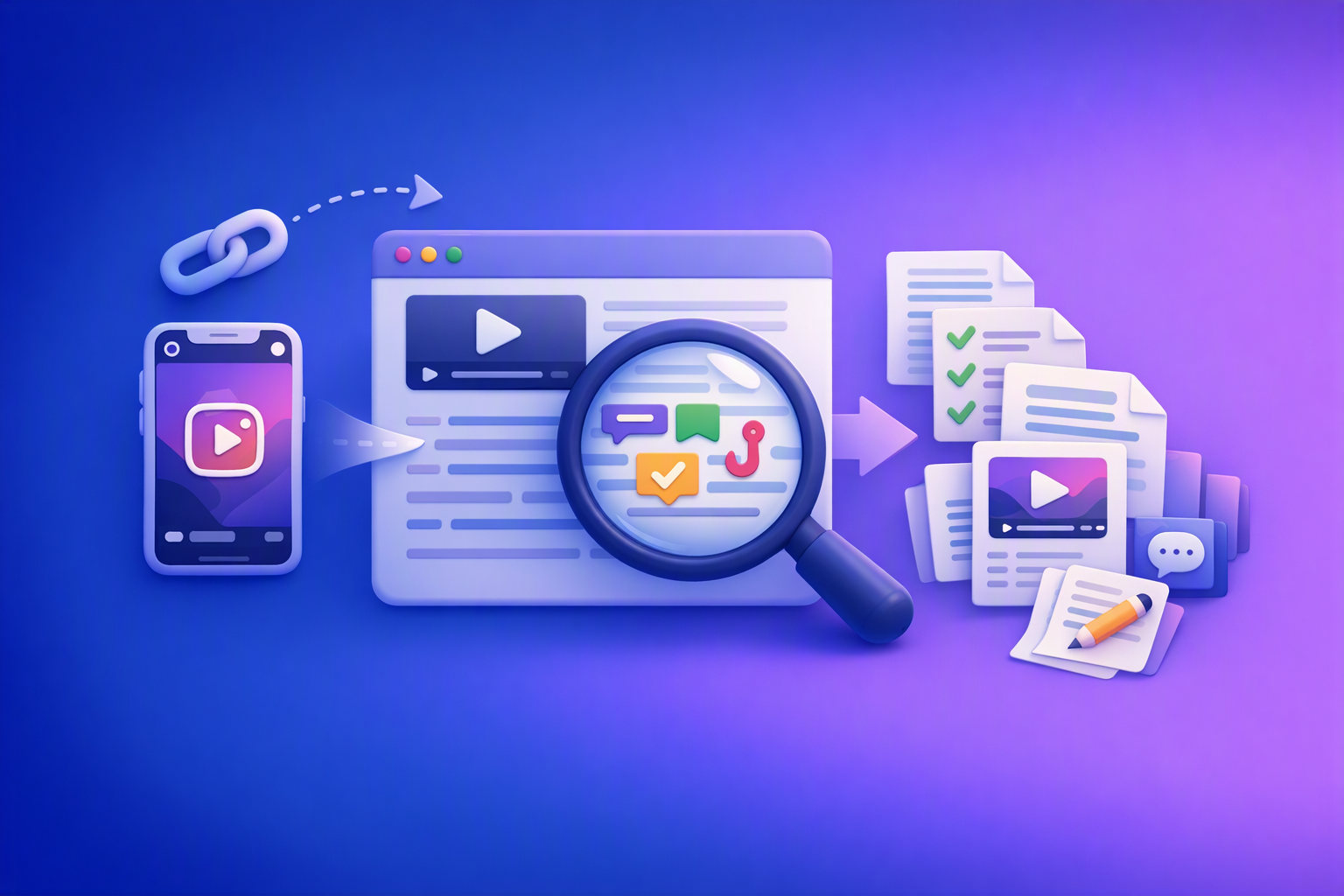
A 2026 reel analyser should turn Instagram Reel links into a searchable transcript library you can tag for hooks, CTAs, objections, and topic clusters—then export into repurposing-ready drafts without a download/upload loop.
Traducir video de Instagram (Reels) en 2026: workflow transcript-first para traducir, sacar hooks/CTAs y repurpose (con VideoToTextAI)
Video To Text AI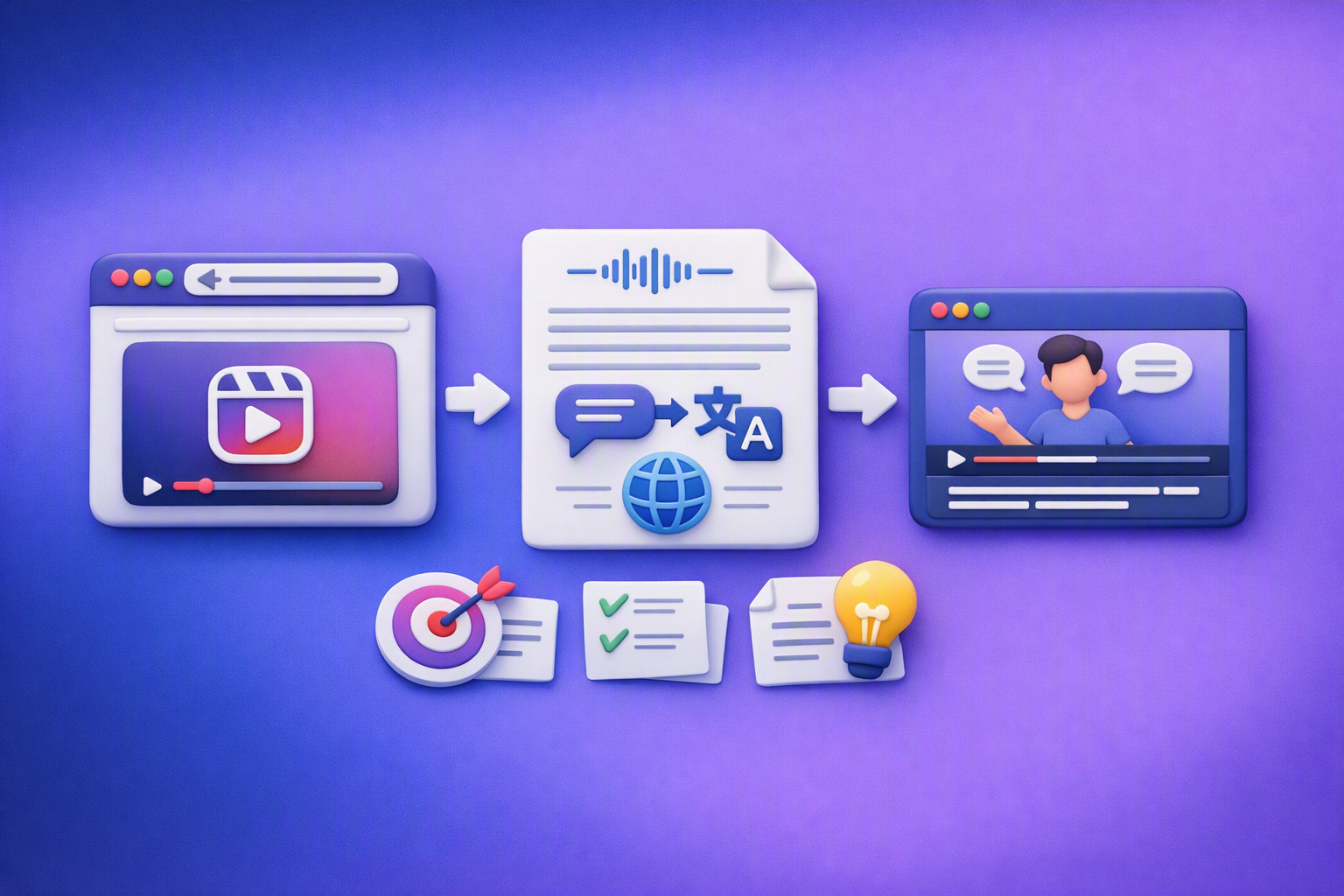
Aprende a traducir un Reel de Instagram con un flujo URL→transcripción→traducción→subtítulos, y a convertir esa traducción en un activo de investigación para hooks, CTAs, objeciones y clusters de contenido.
Reel Analyzer: Transcript‑First Instagram Reels Research (Hooks, CTAs, Objections) + Workflow Guide (VideoToTextAI)
Video To Text AI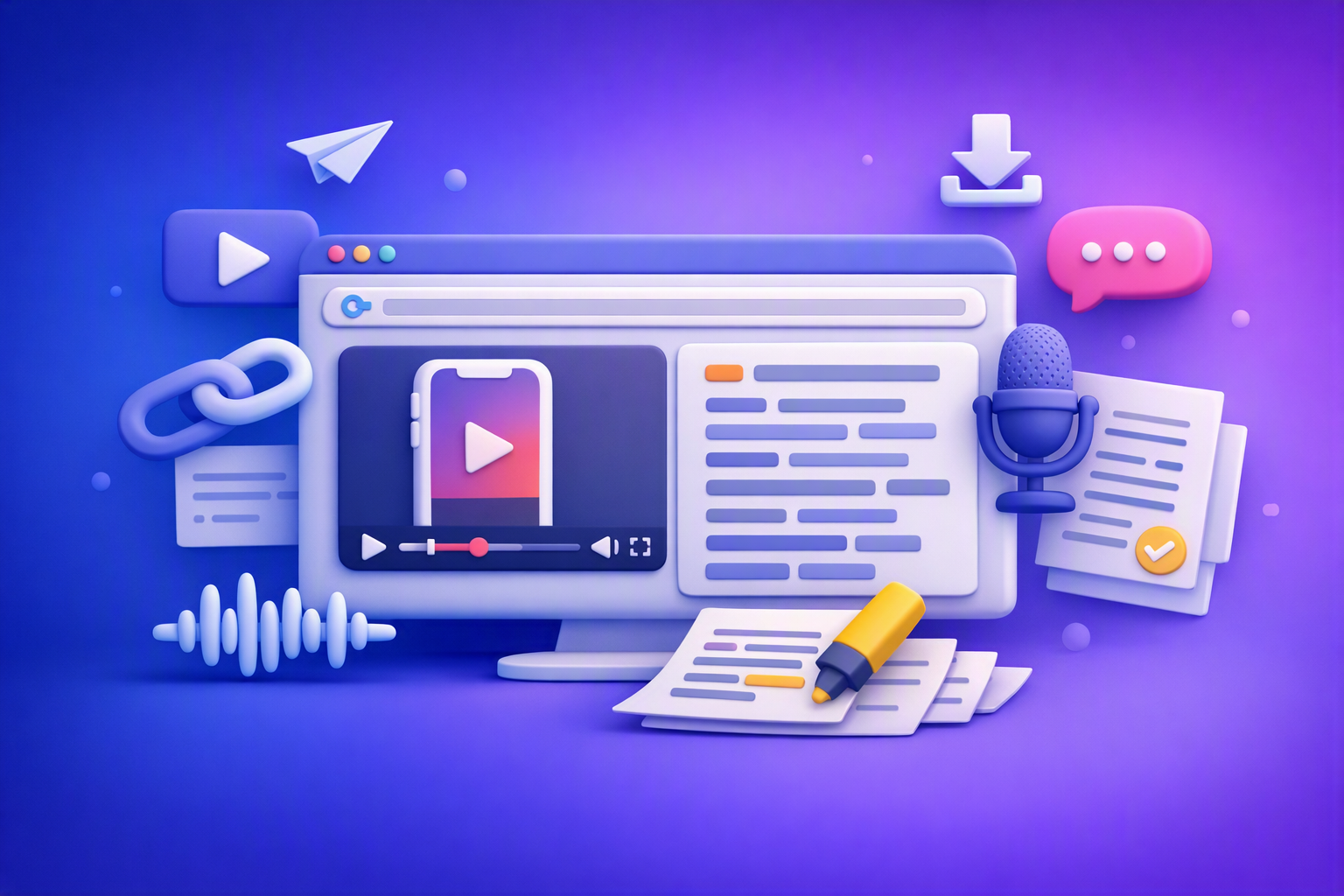
A reel analyzer should turn any public Instagram Reel link into a searchable transcript library you can mine for hooks, CTAs, objections, and topic clusters—then repurpose into original drafts with a repeatable SOP.