
Can ChatGPT Upload Video? What Works in 2026 (Plus a Reliable Link → Transcript Workflow)
 Video To Text AI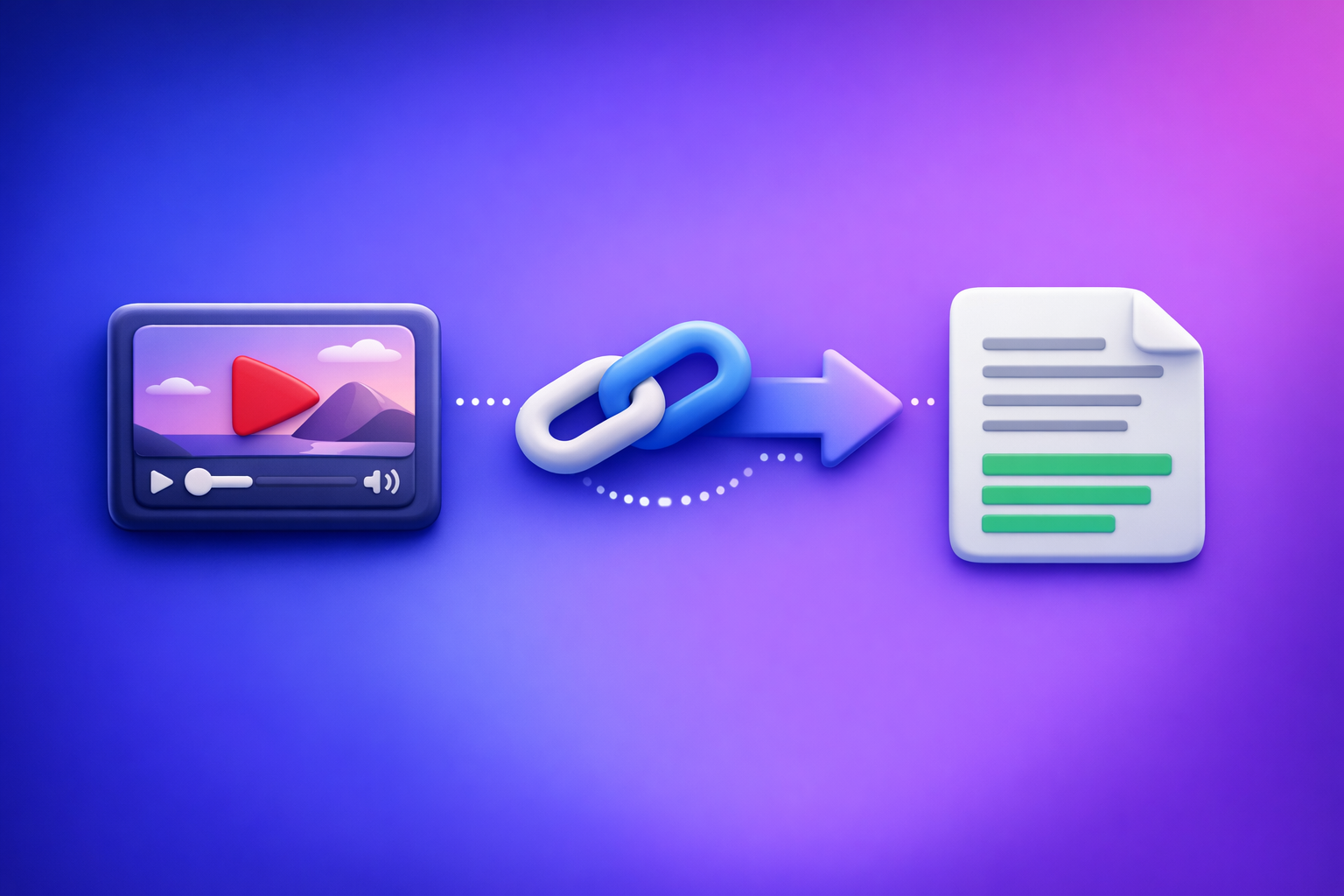
Can ChatGPT Upload Video? What Works in 2026 (Plus a Reliable Link → Transcript Workflow)
If you need a transcript, subtitles, or repurposed content, don’t bet your workflow on “uploading a video to ChatGPT.” Use a link → transcript/subtitles step first, then use ChatGPT for editing, summarizing, and repurposing.
Quick Answer: Can ChatGPT Upload Video?
What “upload” means in practice (file upload vs link vs screen share)
In 2026, “uploading video to ChatGPT” usually means one of these:
- File upload: attaching an MP4/MOV file directly in the chat UI.
- Link sharing: pasting a YouTube/TikTok/Instagram URL and expecting ChatGPT to “watch it.”
- Screen share: showing the video while ChatGPT listens/observes in a live session.
These are not equivalent. A link is not an upload, and screen share is not the same as giving the model direct access to the source media.
The reality in 2026: availability varies by plan, device, and UI
Whether video upload works depends on:
- Your plan (features can be gated).
- Your device (desktop vs mobile).
- The UI surface you’re using (web app vs native app vs embedded experience).
- Current limits (size, duration, rate limits, temporary outages).
That variability is why “it worked yesterday” is common—and why production workflows should not rely on it.
What ChatGPT can reliably do with video today (and what it can’t)
ChatGPT is most reliable when you provide text (or clean, accessible inputs) and ask it to:
- Clean up transcripts (punctuation, filler words, speaker labels).
- Create summaries, chapters, and key takeaways.
- Repurpose into blogs, posts, hooks, and captions.
What’s not reliable:
- “Watch this YouTube link and transcribe it” (often blocked or incomplete).
- Long video uploads without timeouts.
- Handling every codec/container combination without errors.
Why Video Upload to ChatGPT Often Fails
Common blockers
File size/length limits and timeouts
Video files are heavy. Even when uploads are supported, you can hit:
- Max file size limits.
- Max duration limits.
- Session timeouts during upload or processing.
- Slow networks causing partial uploads.
If you’re trying to process a 45–120 minute recording, expect failures unless you split it.
Unsupported formats/codecs (HEVC, variable frame rate, etc.)
A file can be “MP4” and still fail. The usual culprits:
- HEVC/H.265 video (common from iPhones).
- Variable frame rate (VFR) recordings.
- Nonstandard audio tracks or sample rates.
- Odd containers (MOV with unsupported streams).
For deterministic processing, H.264 video + AAC audio is the safest baseline.
Permission and policy restrictions (copyrighted/DRM content)
Even if you can upload, content may be restricted due to:
- DRM-protected streams.
- Copyrighted media you don’t have rights to process.
- Platform rules around re-hosted content.
If you don’t have permission to download or process the media, don’t.
“Upload failed” and HTTP errors (including 403)
Common failure modes include:
- Generic “Upload failed” messages.
- 403 Forbidden when the source is blocked or requires authentication.
- Expired session tokens or signed URLs.
- Corporate networks blocking large uploads.
Why links don’t behave like uploads
YouTube/Instagram/TikTok access constraints
A pasted link is not guaranteed to be fetchable:
- Some platforms require logged-in sessions.
- Bots/scrapers are rate-limited.
- Content can be geo-restricted or age-gated.
- Pages load video via scripts that aren’t accessible like a direct file.
Private/unlisted videos and signed URLs
Private/unlisted content often fails because:
- The model can’t authenticate to your account.
- The link is signed and expires quickly.
- The URL points to a page, not the media file.
If access isn’t public and stable, link-based “analysis” inside ChatGPT is unpredictable.
The Reliable Workflow: Video Link/MP4 → Transcript/Subtitles → ChatGPT
The modern creator workflow is link-first. Downloading and shuffling video files is an outdated, fragile process that slows teams down and breaks at scale.
Step 1: Start with a link-first transcript generator (fastest path)
Use VideoToTextAI to convert a video link into export-ready text
Instead of trying to “upload video to ChatGPT,” generate the transcript/subtitles from the video URL first, then bring the text into ChatGPT for refinement.
Use VideoToTextAI for link-based extraction and export-ready outputs (transcripts, subtitles, captions, repurposing). One CTA only: VideoToTextAI.
Choose output format: TXT vs SRT vs VTT (when each is required)
Pick the format based on where it will ship:
- TXT: best for editing, summarizing, and turning into articles.
- SRT: best for most subtitle upload flows (YouTube, many players).
- VTT: best for web players and some accessibility workflows.
If you’re publishing captions/subtitles, timestamps matter—so start with SRT/VTT, not plain text.
Step 2: If the link fails, use an MP4 fallback
Download/export the MP4 (where permitted) and process it
When link access is blocked (private video, signed URL, platform restrictions), use an MP4 fallback only where permitted.
If you need a tool path for files, see:
When to split long videos before processing
Split when you have:
- Videos longer than 30–60 minutes.
- Multi-speaker meetings with lots of cross-talk.
- Uploads failing mid-way.
A practical split target is 5–15 minute chunks. It reduces timeouts and makes QA faster.
Step 3: Use ChatGPT for what it’s best at (post-processing)
Clean up filler words, punctuation, and speaker labels
Once you have text, ChatGPT is excellent at:
- Removing “um/uh/like” (selectively).
- Fixing punctuation and casing.
- Standardizing speaker labels (Speaker 1 → Name).
Create summaries, chapters, and key takeaways
From a timestamped transcript, you can generate:
- A 5–10 bullet executive summary.
- Chapter titles with time ranges.
- Action items and decisions (for meetings/webinars).
Repurpose into blog posts, LinkedIn posts, and short-form captions
This is where you win on speed:
- Blog draft from transcript sections.
- LinkedIn carousel outline + post copy.
- Short-form hooks and caption variants.
If your source is YouTube, you can also use a dedicated path like youtube to blog. For TikTok, see tiktok to transcript.
Step-by-Step Implementation (10–15 Minutes)
A. Generate transcript/subtitles with VideoToTextAI
1) Paste the video URL (or upload MP4)
- Prefer URL-first (YouTube/Instagram/TikTok/public links).
- Use MP4 only when link access is blocked or you own the file.
2) Select language + output (TXT/SRT/VTT)
- Choose the spoken language (or auto-detect if available).
- Choose:
- SRT/VTT if you need subtitles/captions with timestamps.
- TXT if you only need a transcript for editing and writing.
3) Export and verify timestamps (for captions/subtitles)
Do a quick QA pass:
- Spot-check 3–5 random timestamp ranges.
- Confirm names, acronyms, and product terms.
- Ensure line breaks aren’t absurdly long (especially for mobile captions).
B. Improve the transcript in ChatGPT (copy/paste workflow)
Paste the transcript (or chunks) into ChatGPT and run these prompts.
Prompt: transcript cleanup + speaker formatting
You are an editor. Clean up this transcript without changing meaning.
Rules:
- Keep all technical terms and proper nouns.
- Remove filler words only when they add no meaning.
- Fix punctuation and capitalization.
- Format speakers as: NAME: sentence…
- If speaker names are unknown, use SPEAKER 1, SPEAKER 2 consistently.
Transcript:
[PASTE HERE]
Prompt: chapter markers + titles (time-based)
Use this when you have timestamps (SRT/VTT or timestamped text):
Create chapters from this transcript.
Output format:
- 00:00 Title (1 sentence description)
Rules:
- 6–12 chapters total.
- Titles must be action-oriented and specific.
- Use the earliest timestamp that starts each section.
Transcript:
[PASTE HERE]
Prompt: create captions and hooks from the transcript
Create 15 short-form hooks and captions from this transcript.
Rules:
- Each hook <= 12 words.
- Each caption 1–2 lines, max 90 characters per line.
- Keep the tone: professional, direct.
- Avoid hashtags unless I ask.
Transcript:
[PASTE HERE]
C. Publish-ready outputs
Subtitles: SRT/VTT upload to YouTube/players
- Upload SRT to YouTube for subtitles.
- Use VTT for many web players and accessibility tooling.
- Verify sync on a few sections (fast speech is where drift shows).
Captions: platform-specific line length and pacing
For readability:
- Keep captions short (1–2 lines).
- Avoid long unbroken sentences.
- Prefer natural phrase breaks over strict grammar.
Blog: outline → draft → SEO sections from transcript
A practical flow:
- Extract a blog outline from chapters.
- Expand each chapter into 150–250 words.
- Add an FAQ section based on what viewers ask.
If you want a reference post to interlink, see:
Troubleshooting: Fix the Most Common “ChatGPT Video Upload Failed” Scenarios
If you can’t upload video at all
Confirm device/app supports file uploads
Check:
- Are attachments enabled in your current UI?
- Are you on a managed/work account with restricted uploads?
- Is the file type allowed?
Try desktop browser vs mobile app
If mobile fails:
- Try desktop web.
- Try a different browser profile (extensions can interfere).
- Try a smaller test file to confirm baseline capability.
If uploads fail mid-way
Re-encode to H.264 + AAC, reduce resolution, trim duration
If you must use files, re-encode:
- Video: H.264
- Audio: AAC
- Resolution: 720p is usually enough for transcription workflows
- Trim dead air and long intros/outros
Split into 5–15 minute chunks
Splitting reduces:
- Upload timeouts
- Processing failures
- Rework when one segment fails
If a YouTube link won’t work
Use VideoToTextAI link workflow instead of relying on ChatGPT link access
Treat ChatGPT as a text post-processor, not a link fetcher. Generate transcript/subtitles from the link first, then analyze the text.
Handle private/unlisted videos (permissions checklist)
- Confirm the video is accessible to the account doing the processing.
- Avoid expiring signed URLs.
- Prefer stable share links where possible.
If you see “403” or access denied
Check signed URLs, expired links, and platform restrictions
403 usually means:
- The link requires authentication.
- The URL expired.
- The platform blocks automated fetching.
Use MP4 fallback when link access is blocked
If you have rights to the media, export/download the MP4 and process it via a file-based tool path. Keep this as a fallback, not your default—link-first is the future of creator productivity.
Checklist: Deterministic “Video → Text → Content” Pipeline
Inputs
- Video URL (YouTube/Instagram/TikTok) or MP4 file
- Target outputs:
- Transcript (TXT)
- Subtitles (SRT/VTT)
- Blog draft
- Social captions
- Summary + chapters
Processing
- Generate transcript/subtitles via a link-first workflow
- Spot-check:
- Names, acronyms, jargon
- Timestamp alignment (if SRT/VTT)
- Missing sections (intros/outros)
- Run ChatGPT prompts:
- Cleanup + speaker formatting
- Chapters + titles
- Hooks + captions
Outputs
- Export final TXT/SRT/VTT
- Create repurposed assets:
- Blog + SEO sections
- LinkedIn posts
- Short-form caption sets
- Store:
- Transcript source
- Prompt templates
- Final outputs (for repeatability)
Competitor Gap
What competitors do (and why it’s not enough)
Most answers ranking for “can chat gpt upload video” stop at:
- “You can’t upload video” (or “it depends”) without a workaround
- No deterministic approach for:
- Links that don’t resolve
- Long videos
- Export-ready captions (SRT/VTT)
- Minimal troubleshooting:
- No codec guidance (HEVC/VFR)
- No 403/link-access explanation
- No practical split strategy
What this post adds (implementation-first)
- A link-first + MP4 fallback workflow that reliably ships TXT/SRT/VTT
- A reusable copy/paste prompt set for cleanup, chapters, and repurposing
- A 10–15 minute execution path plus checklist and failure-mode fixes
- A clear POV: downloading video files is outdated; link-based extraction is the scalable path for creator productivity
FAQ
Can you put a video into ChatGPT?
Sometimes you can attach a file or use screen share, but it’s not consistent across plans/devices. For reliable transcription and captions, convert the video to text/subtitles first, then use ChatGPT to refine the text.
Why can’t I upload videos to ChatGPT?
Typical causes include file size limits, timeouts, unsupported codecs (HEVC/VFR), and access restrictions. Links also fail because platforms often block automated access or require authentication.
Can ChatGPT handle video?
ChatGPT can help with video workflows best when it receives transcripts/subtitles. It’s strong at editing, structuring, summarizing, and repurposing content into publish-ready assets.
Can ChatGPT analyze videos from YouTube?
Not reliably from a YouTube link alone. A deterministic approach is: YouTube link → transcript/subtitles → ChatGPT analysis, which avoids link-access failures and produces export-ready outputs.
Internal Link Plan
- Can ChatGPT Upload Video? What Works in 2026 (and the Reliable Link → Transcript Workflow)
- Can ChatGPT Upload Video in 2026? What Works, What Fails, and the Reliable Link → Transcript Workflow (VideoToTextAI)
- Can ChatGPT Transcribe Videos? What Works in 2026 + The Reliable Link → Transcript Workflow (VideoToTextAI)
- mp4 to transcript
- mp4 to srt
- mp4 to vtt
- youtube to blog
- tiktok to transcript
Related posts
Reel Analyser (Instagram Reels): Transcript‑First Competitor Research, Hook/CTA Extraction, and Repurposing Workflow (VideoToTextAI)
Video To Text AI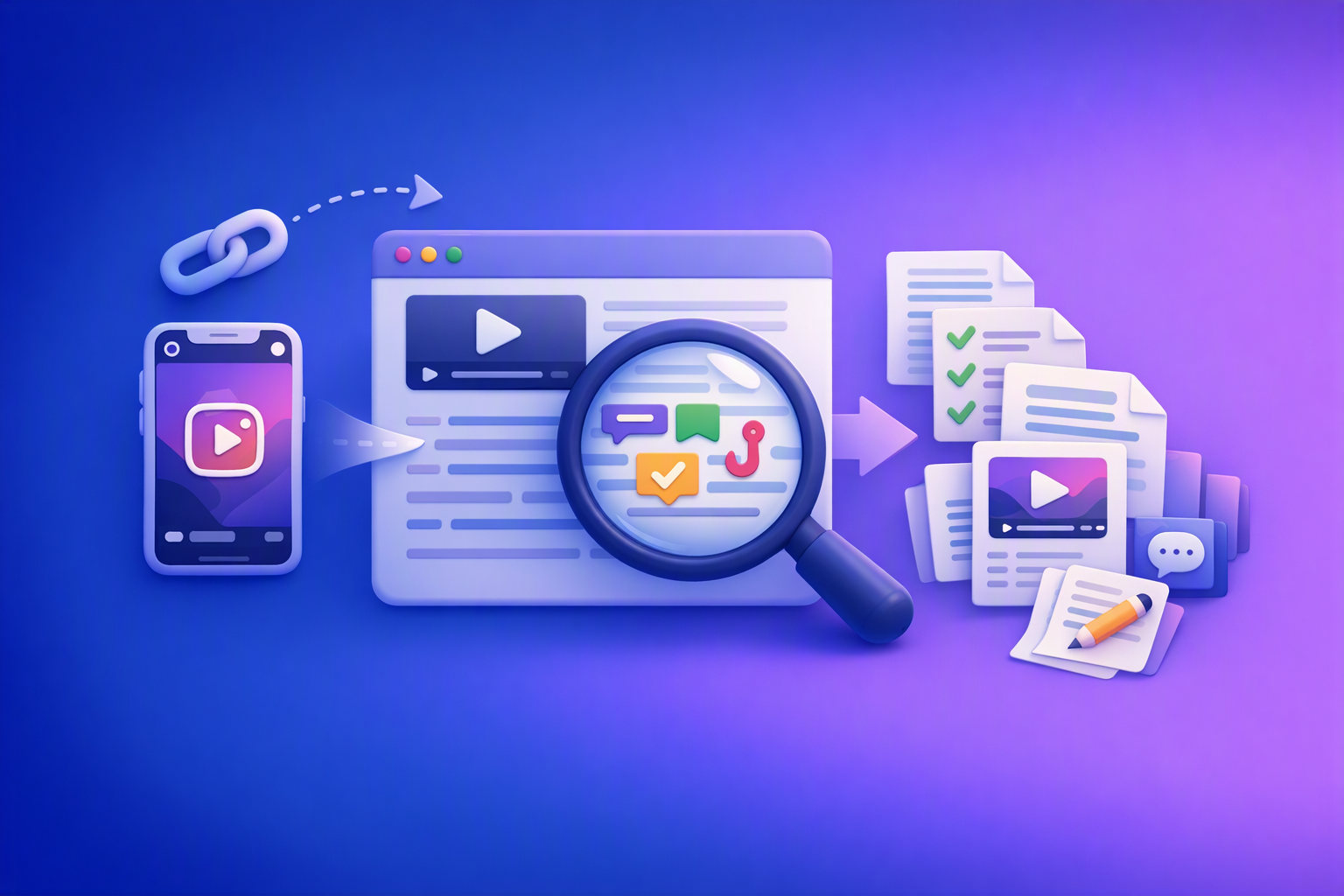
A 2026 reel analyser should turn Instagram Reel links into a searchable transcript library you can tag for hooks, CTAs, objections, and topic clusters—then export into repurposing-ready drafts without a download/upload loop.
Traducir video de Instagram (Reels) en 2026: workflow transcript-first para traducir, sacar hooks/CTAs y repurpose (con VideoToTextAI)
Video To Text AI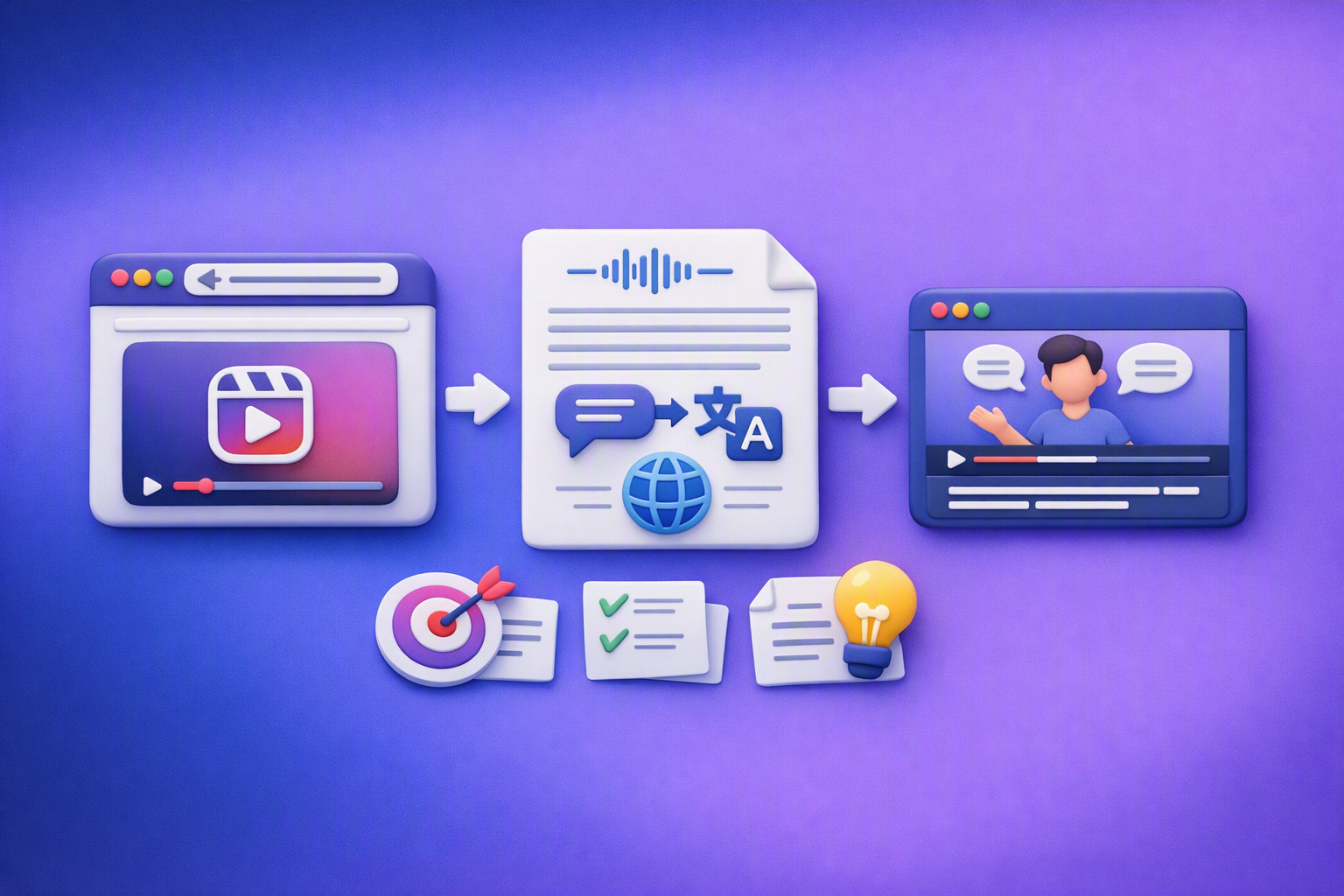
Aprende a traducir un Reel de Instagram con un flujo URL→transcripción→traducción→subtítulos, y a convertir esa traducción en un activo de investigación para hooks, CTAs, objeciones y clusters de contenido.
Reel Analyzer: Transcript‑First Instagram Reels Research (Hooks, CTAs, Objections) + Workflow Guide (VideoToTextAI)
Video To Text AI
A reel analyzer should turn any public Instagram Reel link into a searchable transcript library you can mine for hooks, CTAs, objections, and topic clusters—then repurpose into original drafts with a repeatable SOP.